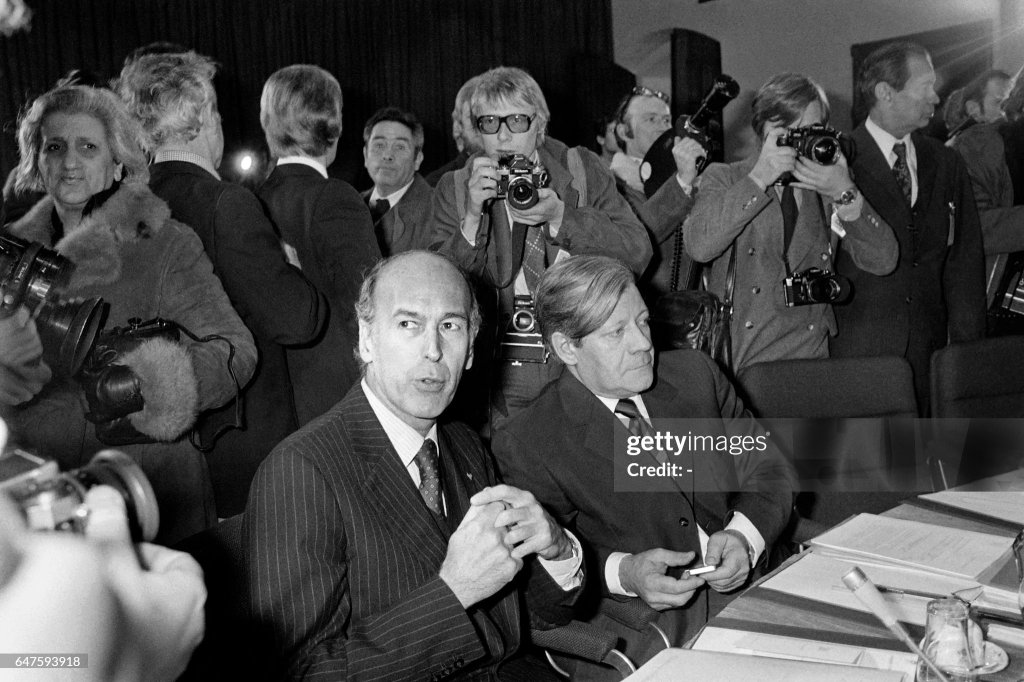
The European Common Market leaders held their year-end conference here today and told one another, in effect, that they could do little except mark time until they learn the intentions of the new United States Administration and of the oil producing countries. As usual, Chancellor Helmut Schmidt of West Germany spoke most bluntly in explaining why Europe could now keep only one eye on Washington and one eye on the oil countries. Briefing the press himself after the opening session this afternoon, Mr. Schmidt said: “There is no U.S policy. We have to wait and we cannot take any decisions yet. It is all the more reason for both the industrial and the developing countries not to upset the difficult situation.” Other heads of government made more or less open appeals to the oil producers not to raise prices in the meantime. But Mr. Schmidt took the firm line that it simply was not a question of whether or not one side made concessions to induce cooperation from the other. The very ability of the industrial countries to transfer resources to the developing lands depends on the price of oil and its impact on their economies, he declared.
Food production has shown a distinct improvement during the past year in most parts of the world except Africa south of the Sahara, according to Edouard Saouma, director general of the U.N. Food and Agricultural Organization in Rome. He said the overall increase was only 2% but that there was “a heartening rise of about 4% in the developing countries.. and as much as 8% in the crucial Far East region.”
Jewish activists presented U.S. officials in Moscow with a petition asking President Ford to instruct the American representative at the United Nations to raise the question of the “violation” of the cultural rights of Soviet Jews. The petition, signed by 92 Jews from nine Soviet cities, protested that nine persons linked with an unofficial symposium planned for next month on Jewish culture in the Soviet Union had had their apartments searched and Jewish materials confiscated.
A worker at the factory near Seveso, Italy, that leaked poisonous dioxin into the atmosphere last July died of liver cancer, hospital officials reported. A spokesman for the factory’s union committee demanded an investigation into the death of Pasquale Mollica, 49, who was hospitalized in August and underwent surgery in September. A statement by the committee indicated that Mollica may have had cancer prior to the poison gas incident.
Police in Rome said they are investigating the possibility that Dr. Enrico Mollica, under arrest on perjury charges in a Mafia murder case, may be the man who severed the right ear of J. Paul Getty III, grandson of the late oil billionaire. Young Getty’s ear was mailed to a Rome newspaper by his kidnappers in 1973 to press the family into paying a $2.9 million ransom, after which he was freed. Mollica, 30, was then a medical student in Rome studying surgery, police said.
Former CIA agent Philip Agee denied he was a threat to British security and asked Home Secretary Merlyn Rees to rescind a deportation order against him. Agee offered, in a letter to Rees, to appear before a special panel set up to consider the deportation orders against Agee and American journalist Mark Hosenball. Agee also presented a 10,000-name petition condemning the orders and asking that they be lifted.
The United Nations Educational, Scientific and Cultural Organization agreed without voting today to put aside for at least two years a resolution on the dissemination of news, averting a floor fight between the document’s Soviet backers and United States opponents.
The Fourier–Deligne transform was first proposed by Belgian mathematician Pierre Deligne as an analog to the 150-year-old Fourier transform created by French mathematician Joseph Fourier.
Leftwing Muslim and right‐wing Christian militiamen traded fire from automatic weapons early today on Lebanon’s last active military front near the Muslim town of Bint Jbail north of the Israeli border. A few miles away, just south of the Christian garrison town of Qlaiaa, the gate in Israel’s electrified border fence was open and the drivers of a dozen cars were waiting for their Lebanese passengers, who had crossed into Israel to get medical treatment at a field clinic there. But just north of the gate Lebanese Christian soldiers blocked the road to Qlaiaa to visitors, explaining that the situation there was “tense.” Except for two sentries out in the cold rain, the soldiers were huddling around a red-hot charcoal brazier in a shelter. In Tyre and Saida, the two port cities of southern Lebanon, the narrow streets of the old markets were crowded as they had not been since last spring. The merchandise ranged from cabbages to worsted wool for suits and gold jewelry, and the war seemed to be far removed from the minds of the bustling shoppers.
Israeli Prime Minister Yitzhak Rabin said today that Israeli troops would stay along the Lebanese border “as long as they are needed,” and his Foreign Minister proposed that Israel and Lebanon reach an agreement to keep the peace on both sides of the frontier. “We are interested in — and therefore propose to reach as soon as possible — a reciprocal agreement with the accredited Government of Lebanon regarding arrangements that will insure calm on both sides of the border,” Foreign Minister Yigal Allon said. “Lebanon, with its own forces, should secure the border region on its side and the ‘Israel army will secure the border region on our side,” he said. Although tension has slackened along the 90-mile border in the past few days, Mr. Rabin made it clear today that there were no plans to pull back infantry and armor rushed there a week ago to deter Syrian troops or Arab guerrillas from entering southern Lebanon in strength.
“I wish my father had stayed here instead of returning to become again a puppet in the hands of the Pathet Lao,” said the son of former Prime Minister Souvanna Phouma of Laos, speaking in Paris. The longtime leader of the pro‐Western Government came to Paris in September and, to the deep regret of his family, former political associates and the large Laotian exile community, returned to Vientiane, the Laotian capital, on October 30, He left, according to his son, Princo Mangkra Souvannaphouma, without telling his three children living here that he was going and without saying goodbye. “My father refuses to recognize that he has been deceived by the Pathet Lao,” Prince Mangkra said in an interview. “He lives completely cut off from the world. My father was a great political leader, but his political life ended in 1974.”
China assured Albania that close links between the countries would continue despite the death of Mao Zedong. Chinese Communist Party Chairman Hua Kuofeng, in a message on Albania’s National Day, said: “In the future struggle, as during the life of Mao Zedong, we shall be closely united with the fraternal Albanian people.”
China’s new leaders appear to be having difficulty in deciding how far and how fast to press their campaign against followers of Chiang Ching and three other disgraced Politburo members. A moderately worded editorial yesterday in the party paper, Jenmin Jih Pao, called for restraint in dealing with those who had sided with the four, saying, “We should allow them to correct their mistake.” We should not strike them down once and for all,” the editorial said, “as the “gang of four’ did with people.” The “gang of four” is the epithet now applied to Miss Chiang, who is Mao Zedong’s widow, and her three colleagues. Cast week the army paper, Chiehfang Chun Pao, published an editorial demanding an “all-out people’s war” to “settle accounts thoroughly” with the four and their followers. “To be benevolent with them would be a crime against the people,” the editorial added. The army paper’s editorial was reprinted at the time in the party paper.
The World Wildlife Fund called on the United States to block an oil supertanker port and refinery on the largely unspoiled Palau Islands in the western Pacific. The islands, located east of the Philippines, are under study as a possible site for a $5 million port, tentatively named Port Pacific, where crude oil brought in supertankers from Iran would be refined for use in Japan.
Latin America’s universities are in political and academic eclipse. One of their problems is that their academic standings have been eroded under the burden of huge student enrollments completely out of proportion to physical facilities, teaching staff and financial resources. State interference — to which the universities had traditionally been immune — is encroaching under authoritarian governments.
Argentine soldiers and policemen raided a Roman Catholic church and neighboring houses in a Buenos Aires residential district, security sources said. The sources reported no arrests at the Church of San Miguel in the Palermo district, but a private news agency said several persons had been taken into custody. The agency, Noticias Argentinas did not say if those reportedly arrested were priests.
Twenty-nine people in Kenya were killed in the wreck of the overnight Mombasa to Nairobi express train when it ran into floodwaters at the town of Kathekani. Because the train carried an estimated 600 people, initial reports worldwide indicated a much larger death toll, later revised to 29 based on the number of bodies recovered.
A million people, one out of six Angolans, are estimated to have been uprooted by the country’s civil war and many are running short of food. “In some areas people are in danger of starving.” said Jaime Baleazar Aranibar of Bolivia, the United Nations chief representative here. Widespread malnutrition has led to the spread of endemic illnesses such as tuberculosis, intestinal infection and tetanus. The country has 500 doctors, one for every 12,000 people.
Mozambique’s new Marxist government is preparing for an expanded war with Rhodesia despite continuing efforts in Geneva to bring about a settlement. At the ports of Maputo and Beira heavy shipments of Soviet arms are being delivered for use by guerrillas operating from bases along the Rhodesian border. Intervention efforts by the United States have been denounced and the criticism of America has been equaled only by general praise of the Soviet Union and its allies. In the ports of Maputo and in Beira, farther north, dockworkers labor under a fierce sun to unload Soviet arms for the guerrillas operating from bases along the Rhodesian border. At the Maputo airport, a Soviet‐built helicopter in camouflage paint is a reminder of the advanced equipment the Russians can still throw into the struggle. Along the glass doors that line the airport concourse, signs call for total mobilization in support of the war. “Solidarity with the fraternal people of Zimbabwe!” they say, using the black nationalists’ name for Rhodesia.
Participants in the conference on Rhodesia’s future, unable to agree on a date for the transfer of political power from the white minority to the black majority, formally shelved the issue today and began discussing the creation of an interim government instead. This development came as two black nationalist leaders ended their long holdout against talking about anything else before Britain, the conference chairman, had committed itself to a firm date for granting formal independence to Rhodesia under black rule. As a result, the British chairman, Ivor Richard, briefed the two nationalist leaders — Joshua Nkomo and Robert Mugabe — on London’s views about the projected biracial interim government that would prepare for independence.
The big 3 steel producers — United States Steel, Bethlehem Steel and Republic Steel — decided to go along with the 6 percent increase on sheet and strip steel announced by six other leading producers. The Aluminum Company of America also announced that it would increase prices by about 10.2 percent on sheet products used for beer, soft drink and other containers. Alcoa’s increase will become effective January 2, while the increase on steel is expected to become effective tomorrow. President-elect Carter was said to be “very concerned” about the inflationary effect of the steel price increases.
President-elect Carter’s press secretary said that Mr. Carter was near a decision on measures that would prevent or discourage appointees in the Carter administration from later joining business concerns that do “substantial business” with the government agencies. Mr. Carter met with advisers to discuss the standards and requirements expected of people asked to serve in his administration.
President Ford, fulfilling an oft-repeated campaign promise, will ask Congress in January to pass a permanent $10 billion tax cut, the White House said today. The President’s tax cut proposal, as outlined today by Ron Nessen, White House press secretary, would be similar to tax legislation proposed by Mr. Ford last year and rejected by Congress, Under the proposal, individual income tax exemptions would rise from $750 to $1,000, yielding an aggregate reduction in personal income taxes of some $7.5 billion. Cuts in corporate taxes would total an additional $2.5 billion under the plan President Ford plans to send to Congress on January 3.
Former President Richard Nixon’s challenge to the 1974 statute that gave the government control over his presidential papers and recordings will be heard by the Supreme Court. Mr. Nixon lost the first round of his challenge last January, when a lower federal court unanimously upheld the statute as constitutional. The Ford administration, through the Justice Department, had asked the Supreme Court Justices to deny Mr. Nixon a hearing and to affirm the lower court’s decision without arguments.
The South Korean Central Intelligence Agency’s chief of operations in Washington and his aides have been recalled in an attempt to stifle a Washington inquiry, according to a Korean source close to the Seoul government. The source said that agency’s American operation has been reorganized under the command of President Park Chung Hee’s son-in-law.
Senator Ted Stevens (R-Alaska) said he rejected a South Korean offer of a large campaign contribution in 1971 or 1972. Stevens said his memory about the incident was hazy and he had no record of it since he had returned the check. “It had something to do with a South Korean fish processing concern,” he said. The check was for either “$2,500 or $5,000.”
Death Row inmate Gary Mark Gilmore called members of the Utah Pardons Board “cowards” in an obscenity-filled letter demanding that he be executed, a board spokesman said in Salt Lake City. Gilmore, scheduled to appear before the board today for a hearing on whether his death sentence should be commuted to life in prison, wrote the board that “I do not seek or desire your clemency. The sentence was set — I accept it. Utah State Supreme Court approved. Let’s do it, you cowards.” Meanwhile, Gilmore, on a hunger strike since November 19, is sufficiently healthy to appear before the board, his lawyer said.
A sniper fired dozens of shots into rush-hour traffic from atop a five story Holiday Inn near the business district in Portland, Oregon, slightly wounding a police officer and shooting out a tire of an ambulance before surrendering after two hours. The accused sniper was identified by police as Daniel Harmon Jones, 20, of Independence, California, who had taken a fifth-floor room on November 18. A policeman wearing a bullet-proof vest was hit a block away from the motel and suffered a bruise near his heart. Police said the sniper fired about 30 shots and they in turn fired a “few” shots at the sniper before his surrender.
A military college student charged with murdering his parents and two brothers during a Thanksgiving holiday trip to his home in Montvale, New Jersey, was held for psychiatric evaluation. Judge Fred C. Galda said he would set bail after the report was in and ordered Harry De La Roche Jr., 18, held until then. The youth, a student at the Citadel in Charleston, South Carolina, told police he discovered the bodies when he returned late to his home after visiting a friend. Dead by small caliber gunfire were the youth’s mother, Mary Jane, 50, his father, 46, a Ford Motor Co. administrator, and his brothers, Ronald Ernest, 15, and Eric John, 12.
The prosecutor in the trial of Wendy Yoshimura, once Patricia Hearst’s companion as a fugitive, said today that he would show the jury “a frightening arsenal” of weapons found in a Berkeley garage in 1972. Jeff Horner, in his opening statement, said that the manager of the garage had found “a repository, arsenal and hideout of terrorists” when he broke open the room to check out a suspicious smell of gasoline. Miss Yoshimura, 33 years old, who is charged with possession of explosives and a machine gun, is accused of renting the garage in 1971 as a weapons storage facility for radicals. Miss Yoshimura dropped out of sight within hours after the Berkeley garage was raided by the police. She was captured with Miss Hearst in 1975 and is now free on $25,000 bail.
The government probably will subpoena certain employee medical records from General Motors Corp. if the company does not voluntarily help fill a “critical gap” in information about lead poisoning, said Dr. John F. Fink lea, director of the National Institute for Occupational Safety and Health. He said lead exposure posed a “major health problem” for a million workers. GM was asked for the information last August 13 and refused in a letter dated September 20, Finklea said. He added that the matter had been turned over to the general counsel of the Department of Health, Education and Welfare.
Barry Commoner, an environmentalist and energy economist, said urban America is the chief victim of a national energy policy that is tempting economic catastrophe. Commoner, director of the Center for the Biology of Natural Systems, told the National League of Cities, meeting in Denver, that cities should create energy banks to subsidize movement toward a new policy featuring use of solar power. These banks would extend low-cost loans to finance solar energy and home insulation. Commoner said. cities were particularly vulnerable to the rising price of energy because their residents would be forced to pay ever-increasing costs just to survive to travel to and from work, to go shopping and visit the doctor.
Production will be increased in Detroit despite sluggish sales since the 1977 automobile models were introduced in the fall. Sharp increases in production are planned in December and the first quarter of next year.
The Philadelphia Stock Exchange’s proposed new regulation that would permit specialists to trade in listed options on securities in which they trade has been approved by the Securities and Exchange Commission. The approval is significant because it recognizes that the potential for abuse is outweighed by pro-competitive factors. Three other exchanges have made the proposal and have applied for approval.
Representative Bella Abzug, Democrat of New York City, is being considered for a top post in the Carter administration, a Carter aide told Mayor Beame. It was also learned that Mr. Beame and Governor Carey had held patronage discussions with Mr. Carter’s aides in an effort to place New Yorkers in key posts in the Carter administration. “The mayor is backing Bella,” one of Mr. Beame’s advisers said.
Matthew Feldman, president of the New Jersey state Senate, pleaded guilty to charges that he paid $6,400 in bribes in an attempt to make his liquor distribution company the exclusive supplier of a New Jersey restaurant chain. Mr. Feldman, 57, is a Democrat from Teaneck. He faces fines, but not a prison sentence.
Texas is sending 300 white-tailed deer to Mexico in exchange for 10 bighorn ewes to build up the state’s bighorn sheep herd, the Texas Parks and Wildlife Commission said in Austin. The ewes will be kept in a 450acre brood pen in the Black Gap wildlife management area in west Texas. Bighorn sheep were almost eliminated in Texas by disease and hunters by the turn of the century. A restocking program was begun in 1954. Hunting of the bighorns has been banned since 1903.
The U.S. Department of Transportation issued a 42-page decision ordering repair of 31 welding defects in the Trans-Alaska Pipeline — but said environmental considerations relieved builders from fixing three more welds on a river-crossing section. John Barnum, deputy secretary of transportation, said there would be more environmental damage from repairing the three river-crossing welds than would be warranted by safety considerations, and “defects in these welds which have been identified do not endanger the integrity of the pipeline.”
What to do with 612,000 gallons of radioactive nuclear waste is puzzling federal officials, who are storing the nuclear material 8 feet underground in upstate New York until the Nuclear Regulatory Commission decides what to do with it. Officials are unsure whether the state and a private oil company subsidiary, Nuclear Fuel Services Inc., should pay for part or all of the disposal, and how they should get rid of it. A research report compounded the problem by suggesting 14 different ways for disposing of the material, which is so old that it is exempted from a 1970 federal policy requiring nuclear waste to be solidified and federally stored for disposal. Estimated costs for disposal range from $10 to $540 million.
The largest windmills in the world — 12 stories tall with 200-foot propellers — will be built next year by General Electric Co. to see if wind can make inexpensive electricity, a G.E. spokesman said in Valley Forge, Pennsylvania. The company’s Space Division received a $10 million contract to assemble two 1,500-kilowatt wind turbine systems. Each is expected to produce enough energy to supply more than 500 homes. The test program is sponsored by the Energy Research and Development Administration and the National Aeronautics and Space Administration.
NFL Monday Night Football:
The San Francisco 49ers upset the Minnesota Vikings, 20–16. Wilbur Jackson rushed for 156 yards and a touchdown, Delvin Williams crossed the 1,000-yard mark with 153 yards rushing, and the two accounted for all but 21 yards of San Francisco’s total offense as the 49ers took a win from the Vikings for the first time since 1972. Scott Bull, starting for injured Jim Plunkett, completed just 3 of 8 passes on the night for only 32 yards, but he drove San Francisco 51 yards on the 49ers first series for a TD, the drive capped by Jackson’s two-yard run. Fran Tarkenton threw second quarter touchdown passes of 18 yards to Sammy White and eight yards to Ahmad Rashad for a brief 13–10 lead. Bull scored on a one-yard run with 1:41 left in the first half to put San Francisco on top for the rest of the game.
Minnesota Vikings 16, San Francisco 49ers 20
Major League Baseball:
The New York Yankees signed free agent Reggie Jackson, formerly of the Oakland A’s and the Baltimore Orioles, to a five-year $2,960,000 contract. His salary increase, from $140,000 to $600,000 a year, set the precedent for lucrative multi-year contracts for Major League Baseball players in years to come.
Stock prices declined in heavier trading following the announcement of price increases by the major steel producers. The Dow Jones industrial average closed down 6.57 points at 950.05, its low for the day. Some short-term interest rates continued to decline and Treasury bills were auctioned at their lowest rates in more than four years.
Dow Jones Industrial Average: 950.05 (-6.57, -0.69%)
Born:
Chadwick Boseman, American film actor known for “Black Panther” and its sequels, as well as for his portrayals of Jackie Robinson, James Brown and Thurgood Marshall; in Anderson, South Carolina (d. of cancer, 2020)
Anna Faris, American TV actress (“Scary Movie”; “Mom”); in Baltimore, Maryland.
Chris Akins, NFL safety (NFL champions, Super Bowl 38-Patriots; Dallas Cowboys, Green Bay Packers, Cleveland Browns, New England Patriots), in Little Rock, Arkansas.
Died:
Godfrey Cambridge, 43, African-American comedian and film actor, died from a heart attack while filming the made-for-TV movie “Victory at Entebbe”, in which he was cast as Ugandan dictator Idi Amin.
Judith Lowry, 86, American stage and TV actress best known for the role of “Mother Dexter” in the sitcom Phyllis in 1975 and 1976.

