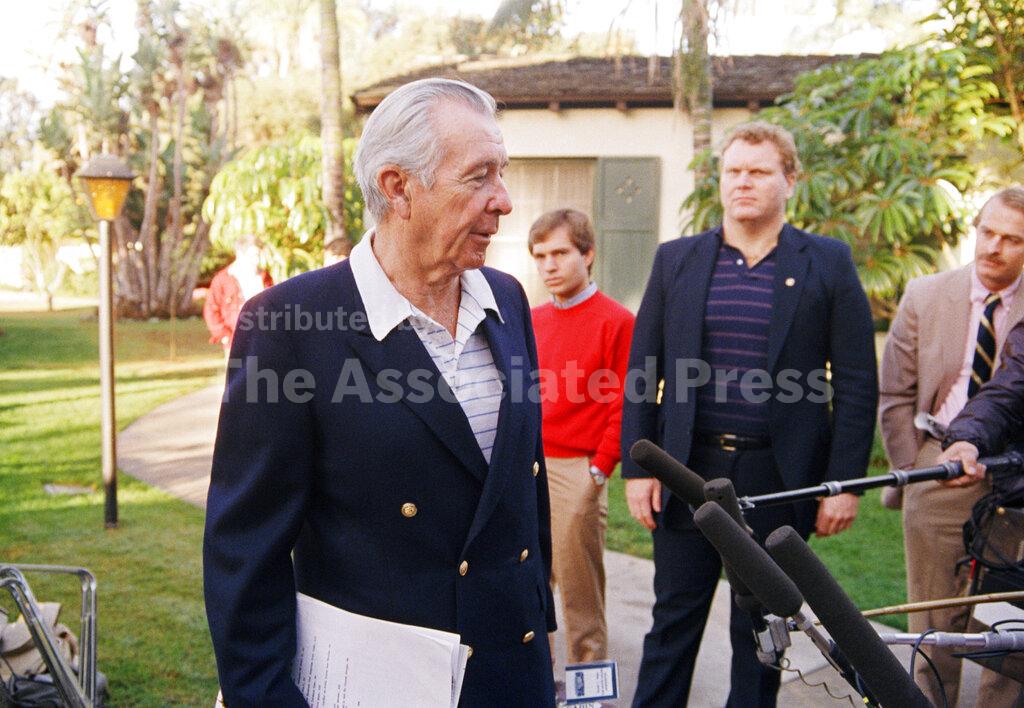
President Reagan tried to draw attention from the Iran arms crisis today by urging Americans not to forget that “there are many other issues that concern us.” The President’s brief appeal in his weekly radio broadcast came amid Congressional warnings that the Reagan Presidency would become ineffective unless the crisis is handled better. Senator Daniel Patrick Moynihan of New York, giving a Democratic response to Mr. Reagan, said: “Your Presidency, sir, is tottering. It can be saved. But only you can save it, and only if you will talk with us, the Congress.”
Emerging evidence shows a significant Saudi Arabian role not only in secret Iranian purchases of arms but also in the supply of military equipment to the rebels in Nicaragua. Associates of Lieutenant Colonel Oliver L. North, an assistant on the National Security Council, were in direct contact with the Saudis, the evidence indicates. One person familiar with the transactions said he was told that Colonel North, who was dismissed this week by President Reagan for his apparent role in the Iranian arms deals, stayed in touch with the operations from his position in the White House. The arrangements were complicated and involved many participants, and for those reasons their precise nature remains clouded. But an array of evidence from interviews, bank records, records of airplane sales, corporate records and other documents permits a partial picture to be drawn.
Vice President Bush, who has been all but invisible to the public since the crisis over arm shipments to Iran erupted, intends to make a public statement on the situation soon, perhaps next week, according to friends and associates. “He is not trying to distance himself from the President,” one friend said today. “It would be a very serious error to avoid comment altogether, but it is only prudent to wait for a bit while the situation resolves itself. Whatever he says will not only attract a lot of attention now, it will be remembered all through 1988.”
Telephone records from Nicaraguan rebel “safe houses” in El Salvador show a series of calls on the same days in September to the former White House offices of Lieutenant Colonel Oliver L. North, as well as to the company run by a retired general involved in dealings with Iran and the Nicaraguan rebels. They also show calls to a telephone in Costa Rica that appears to belong to an American intelligence operative. The telephone calls were from a safe house in El Savador used by American crews secretly flying weapons to the Nicaraguan rebels during a Congressional ban on such aid, and the calls appear to offer the strongest circumstantial evidence so far that there was close coordination between the rebels, Colonel North, American officials in Costa Rica and someone in Stanford Technology Incorporated, of which Gen. Richard V. Secord, retired, is a leading member. Senior Administration officials had previously contended that the rebel supply operation was “strictly private” and therefore did not violate the Congressional ban on delivering arms to the guerrillas. It appears increasingly likely, however, that the program may have been prompted by American officials, financed by secret arms sales to Iran and then monitored by American officials in Central America.
Donald T. Regan, President Reagan’s chief of staff, attended meetings this week in which Attorney General Edwin Meese 3d presented details about his inquiry into the Iran arms deals, according to Administration officials. Mr. Regan has said he was unaware of the diversion of as much as $30 million from the arms sales to the Nicaraguan rebels. Nonetheless several veteran law enforcement officials suggested that Mr. Regan voluntarily withdraw from any further meetings in which the progress of the investigation is discussed. “Don Regan should not be in on any briefings,” said one law enforcement official not presently involved in the Iran case. The official added that if there was found to be any criminal liability, Mr. Regan would be one of the natural suspects.
Senator Larry Pressler, a Republican, called today for the resignation of the White House chief of staff, Donald T. Regan, saying “he epitomizes the arrogance of power” and should have known about the secret transfer of Iranian arms-sale profits to Nicaraguan rebels. “Regan can’t slip out of this one,” Senator Pressler, of South Dakota, said in an interview.
Oliver L. North, the Marine lieutenant colonel at the center of the crisis involving arms sales and aid to the Nicaraguan insurgents, was described by friends this week as being prepared to take the blame like a mixture of martyr and good soldier. One acquaintance said Colonel North had reacted to suggestions that he might be a scapegoat for those higher up by saying he was a soldier and equating his situation to that of a field commander expected to take all the risks necessary to achieve an objective. He was also reported by acquaintances to feel he had done nothing wrong during his five and a half years on the National Security Council staff, including the operation revealed by Attorney General Edwin Meese 3d to divert profits from sales of weapons to Iran to a Swiss bank account for use by anti-Sandinista rebels. Colonel North, talking about his situation on Thanksgiving Day, declined to comment directly on whether he was protecting other people, but he appeared relaxed and confident and insisted he did not feel at all distressed.
One of the defendants on trial in Federal court in New York over the planned sale of arms to Iran said yesterday that he would oppose a dismissal of the charges against him even if the Government asked for it. The defendant, Nico Minardos, a Los Angeles businessman, said he was angry he was indicted as the result of a Government “sting” operation for planning to sell arms to Iran when the Reagan Administration was secretly doing the same thing. It was reported in The New York Times yesterday that the United States Attorney for the Southern District of New York in Manhattan did not know about the sting operation when the prosecutors brought the case, which may now be seriously weakened. It will be difficult, legal sources said, to convict people for doing something the Government was also doing covertly.
The U.S. decision to break the SALT II nuclear arms treaty by deploying its 131st B-52 bomber capable of carrying nuclear-tipped cruise missiles continued to meet with general disapproval by its allies. On Friday, Britain, West Germany, Canada and the Netherlands issued statements deploring the action. They were joined by France, Belgium and Sweden, which all found the decision regrettable. And an editorial in Tokyo’s English-language Asahi Evening News called on President Reagan “to reconsider and refrain from renouncing SALT II.”
Defense Secretary Caspar W. Weinberger will fly to Europe and northern Africa this week for consultations that are sure to be dominated by nuclear arms control issues and recent developments in the Middle East. The defense secretary’s main purpose on the eight-day trip is a regularly scheduled meeting of North Atlantic Treaty Organization defense ministers. But he is also making a special side trip to improve relations with Morocco and will have to allay European concerns about President Reagan’s decision last week to break out from the launcher ceilings imposed by the SALT II nuclear arms accord. Weinberger will leave Washington on Monday for the regular meeting of NATO defense ministers, scheduled December 4-5 in Brussels. The trip will also include stops in Paris and London for consultations with French and English defense officials, in addition to the Moroccan visit.
Two prosecutors in the Ukraine have been fired for ordering the arrest and indictment of a writer for the magazine Soviet Miner who criticized the work of their office, Pravda, the Communist Party daily newspaper reported. The prosecutors, A. F. Daragan and V. P. Shatalov, of the Voroshilovgrad region, ordered a criminal investigation of V. B. Berkhin, leading to a charge of malicious hooliganism-often used against dissidents and protesters. Pravda said Berkhin was released with an official apology.
The Soviet Union today renewed its call for normalized relations with Albania, saying the 25-year-old estrangement of the two Communist nations was not natural. The Communist Party daily Pravda, in an article marking Albania’s national holiday, said the new Albanian leader, Ramiz Alia, had failed to change his country’s position on links with Moscow at a party congress in Tirana earlier this month. But the article said Kremlin policy had changed since Albania severed relations with the Soviet Union in 1961.
Some handicappers appraise the prospects of Britain’s next election, which is generally expected within a year, with this rough calculation: Margaret Thatcher’s chances of leading the Conservatives to a third straight victory look best when the prospects of the politically centrist third force known as the Alliance look worst. A sometimes uneasy betrothal of the Liberal Party, with its antecedents back in the age of Gladstone, and the Social Democrats, who broke away from the Labor Party only five years ago, the Alliance in recent months has been going through what is known here as a rough patch. Its standing in the polls has drooped since the start of the year, when it seemed to be within a couple of percentage points of an equal share of the electorate in a three-way split with Labor and the Tories. As a result, Prime Minister Thatcher’s prospects have recovered some of the bloom that seemed to have faded then, even though polls consistently indicate that a firm majority of voters are weary of her leadership.
A bomb believed set by Basque separatists exploded today at a car showroom in San Sebastián, Spain, a day before voters elect a regional parliament. The blast caused considerable damage at a showroom of Talbot and Peugeot automobiles but no injuries, the police said.
In Beirut, Shiite Muslim forces closed in on the Palestinian district of Shatila today behind a barrage of tank fire. Guerrillas burst from burning shacks and hurled grenades in last-ditch attempts to stem the onslaught. Fighting between Palestinian guerrillas and militiamen of the dominant Shiite movement Amal also raged around the sprawling Burj al Brajneh quarter, south of Shatila. The police said 27 people were killed and 51 were wounded in fighting today around both Palestinian districts in southern Beirut. Casualties since Friday stood at 37 dead and 148 wounded. Shatila shelters about 14,000 Palestinians; Burj al Brajneh’s population is estimated at 50,000, including thousands of Lebanese Muslims. Smoke billowed from Shatila as Amal militiamen blocked all roads to the area today. Journalists watched from a distance as the fighting raged despite efforts by Syria, Libya and Iran to halt Amal’s 18-month-old war against the Palestine Liberation Organization. Amal has said P.L.O. attempts to expand beyond Burj al Brajneh and Shatila prompted the fighting.
One of five Iraqis charged with plotting to kill the Emir of Kuwait was sentenced to death today by a security court. The condemned man, Alaa Mohammed Reda al-Atrash, 33 years old, was the only defendant present at the trial. The court sentenced one of the absent defendants, Wadi Abdul-Hussein Mohammed al-Atrash, 34, to life in prison. Three others were acquitted. Responsibility for the attack in May 1985 was taken in Beirut on behalf of the pro-Iranian group Islamic Holy War. It has demanded the release of 17 prisoners in Kuwait in return for freedom for American and French hostages it says it is holding. The Emir of Kuwait, Sheik Jaber al-Ahmed al-Sabah, escaped with scratches when a car packed with explosives rammed his motorcade. The blast killed five people.
Ahmed Mestiri, the leading political opponent of the Government of President Habib Bourguiba, was serene as he talked of how his political future appeared to be dead. Mr. Mestiri, the 61-year-old president of the centrist Movement of Socialist Democrats, the largest opposition party, was released in October from imprisonment and house arrest for leading a demonstration against the American bombing of Libya in April. Under Tunisian law, anyone sentenced to more than three months’ punishment is barred from ever running for public office. The Government sought and won a four-month sentence for Mr. Mestiri.
The Gorbachev visit to India offered the Soviet leader some challenges he may not have faced before, from long-winded Indian journalists to the art of cupping one’s hands in traditional Indian greeting. For nearly an hour, a group of unsmiling Soviet security men guarded the gates of a shopping emporium here while Raisa M. Gorbachev, wife of the Soviet leader, was inside buying a green and pink silk sari for her daughter. Before long, the agents succumbed to the scene, as most tourists eventually do. They pulled out their instant cameras and snapped pictures of each other posing in front of two caparisoned elephants waiting nearby. Few such spontaneous moments arose in the four-day passage to India by Mikhail S. Gorbachev and his wife, which ended Friday.
India and the Union Carbide Corporation arrived at an agreement today that will clear the way for court action on a suit against the company arising from the 1984 Bhopal gas disaster. Under the agreement, Union Carbide will maintain assets in the United States worth $3 billion to satisfy potential judgments in favor of Bhopal victims. The company did not admit any liability under the agreement, however.
Singapore wants to kick the habit. From the country that pioneered campaigns to banish spitting and tardiness comes a new drive: to eliminate smoking. A three-month campaign to blaze the way “toward a nation of non-smokers” is to begin Monday with a thoroughness typical of Singapore. Fifty-thousand posters will be circulated throughout the city-state; employers and restaurants are being asked to prohibit or discourage smoking, and volunteers will be stationed on the streets to hand fliers to smokers. The campaign says much about how government works in Singapore — and in much of East Asia as well. The authorities rely not so much on laws, such as new taxes or requirements that restaurants provide no-smoking areas, as on exhortations that people drop smoking for the common weal. Appeals to public-spiritedness, which might provoke snickers in the West, are the foundation of the campaign.
The South Korean Government used the largest police mobilization this capital has ever seen today to block a scheduled opposition rally, and by so doing demonstrated both its ability and its determination to stifle dissent. Opposition leaders warned, however, that the Government’s tough line could impel them toward more militant action and make compromise unlikely on a key issue of constitutional revision. Central Seoul was in a virtual state of siege as tens of thousands of riot policemen filled the streets, pushing back would-be protesters and firing frequent rounds of tear gas wherever more than a few people gathered. According to the Seoul Metropolitan Police Bureau, about 40,000 officers were mobilized, with perhaps 8,000 of them assigned to embattled areas. Independent observers, however, said the numbers seemed much larger.
Ever since North Korea shocked its southern neighbor 36 years ago with a surprise attack, this nation has assiduously catalogued every conceiveable threat that could come from the North. Now they see a new weapon in their enemy’s arsenal: water. The threat, as the Seoul Government sees it, comes from a huge North Korean dam and hydroelectric power project that it says could disrupt South Korea’s water supply and power generation, upset the ecological balance of the area and unleash disastrous floods in Seoul and its environs. South Korean military and Government officials have repeatedly warned North Korea to halt work on the project. Lee Ki Baek, South Korea’s Defense Minister, said Seoul would not sit back and allow North Korea to build a dam that could threaten South Korea’s security. Now, the South Koreans have decided to build what they call a “peace dam” able to catch any flow of water released by the North Korean dam.
Pope John Paul II crisscrossed a continent and its cultures today. In the desolate Australian outback, he defended the civil rights of aboriginal tribesmen, and then many miles later he opened the Christmas season by lighting an Advent candle in a stately town square. Even for the Pope, a well-traveled person, it was a remarkable day of contrasts, distances, surprises and controversy. Deep into what is called the “dead heart” of Australia, the barren countryside near the town of Alice Springs, the Pope was introduced to the “dreaming,” the ancient creation legends that are the basis of aborigine culture and religion.
Suriname army leader Dési Bouterse massacres Moiwana village. The massacre occurred during the Surinamese Interior War between the national army led by Dési Bouterse and the Jungle Commando led by Ronnie Brunswijk. On 29 November 1986, a military unit of 70 men was sent by the government to Moiwana as it was thought to be one of Brunswijk’s strongholds. The soldiers systemically massacred the residents of the village. The soldiers blocked off both ends of the village and shot every villager they encountered for over four hours. Many houses in the village were burned down. Maroons fleeing genocide left Suriname for neighboring French Guiana where they lived in several refugee camps set up by French authorities to handle the massive influx of refugees. The Maroons were not granted the status of refugee so that they would not be eligible to work or receive welfare benefits. They lived in these camps until the early 1990s when France and Suriname signed peace accords to repatriate the stranded Maroons back to Suriname.
Three American Roman Catholic clergymen, ending a weeklong visit to Chile, said they sensed a climate of fear and repression in the country. Cardinal Joseph Bernardin, of Chicago, also expressed concern over the expulsion of foreign missionaries and raids on the homes of parish priests. Bernardin and Bishops Joseph Fiorenza of Galveston, Texas, and Ricardo Ramirez of Las Cruces, New Mexico, said they heard numerous accounts of torture and intimidation. They made the remarks in a statement.
Liberian police have arrested an assistant minister in the stabbing deaths of an American missionary and her 10-year-old daughter, authorities announced. Benjamin M. Morris, 32, was arrested while attempting to cross the border into Ivory Coast. The bodies of Libby Tarlton Senter, 46, and her daughter, Rachel, were found in their home in the mining town of Yekepa. The Rev. George Senter, a Southern Baptist missionary, had left his home to go to Monrovia to pick up the couple’s son, Philip, 15, for Thanksgiving.
Two white men riding in the black South African township of Soweto were stoned by black militants, dragged from their vehicle and beaten, the government’s Bureau for Information said. Separately, anti-apartheid church leaders said they fear for the life of the Rev. Tshenuwani Simon Farisani, an Evangelical Lutheran minister who was arrested a week ago in the black tribal homeland of Venda after testifying in the United States and Europe to being tortured during a previous detention.
The leader of South Africa’s Zulus said the ban on many South African imports in a sanctions bill passed by Congress last month was reducing income to black farmers and agricultural workers. He also said the ban seemed certain to increase poverty and unemployment among blacks across South Africa. “There was great anxiety when the sanctions were announced,” said the Zulu leader, Chief Mangosuthu Gatsha Buthelezi, said this week. “Now black people are losing more and more jobs. The sanctions have been devastating.” Chief Buthelezi, 58 years old, is chief minister of the so-called homeland of KwaZulu, representing nearly seven million Zulus, and is the head of the Zulu-based movement Inkatha, which claims a membership of one million.
The policies and processes of local government face substantial change because of Federal action on taxes and the budget deficit as well as court and Congressional challenges to local authority, according to officials at every level of government around the country. Hundreds of counties, small cities and towns as well as some old large cities are increasing taxes and reducing services to cope with the loss of money from the $4 billion-a-year program of general revenue sharing that Congress ended to help reduce the Federal deficit. Many no longer receive any direct aid from Washington for the first time since enactment of President Johnson’s Great Society programs of two decades ago. Around the nation, a reassessment of taxing systems has begun among state and local governments because of Federal tax revision, which reduced tax rates and removed many tax advantages for particular interests. As a result, states that base their tax systems on the old Federal system expect more revenue unless they revise their tax codes. Officials are also under pressure from taxpayers to ease the burden of local and state sales taxes, which are no longer deductible from Federal tax liability.
President Reagan makes a radio address to the Nation on the federal deficit. “Since our first day in office, we’ve been going after this structural deficit by first asking for major spending cuts and second, asking for reforms like the line-item veto and balanced budget amendment that would, well, unstructure the structured deficit,” the President said. “So, while we’ve been occupied with the Iranian issue over the past two weeks, let’s not forget that there are many other issues that concern us,” he continued. “And this deficit problem remains a major priority.”
President Reagan places a call to former President Richard M. Nixon.
In the war against air pollution the new target is neither the smokestack nor the tailpipe but the chimney. Early next year the Federal Environmental Protection Agency is to propose emission limits for wood-burning stoves like those for automobiles or factories. Many stoves will be equipped with catalytic converters to cut down their smoke, as automobiles were a decade ago to cut down exhaust gases. The rules will add hundreds of dollars to the cost of new stoves, but environmentalists and government officials say the regulations will also reduce the cancer-causing chemicals and excessive particle matter that some wood stoves emit.
A small but growing underworld organization with bases in Taiwan and Hong Kong is beginning to move into areas of crime in the United States that were once controlled by the Mafia, Federal law-enforcement officials say. To combat an increase in Chinese organized crime involving narcotics, prostitution, gambling, extortion and murder, the agencies are trying to hire more Chinese-speaking agents. “With all the pressure on La Cosa Nostra, we’re looking down the road several years and wondering if the Asians may replace them,” William F. Weld, the new head of the criminal division of the Justice Department, said in a recent interview. Among agencies recruiting Asian-American agents, Mr. Weld said, are the Federal Bureau of Investigation, the Drug Enforcement Administration, the Immigration and Naturalization Service and the Customs Service. Law-enforcement officials readily acknowledge that the vast majority of Chinese in the United States are law-abiding. But they say the gangs have taken advantage of the large influx of Chinese immigrants from Taiwan, Hong Kong and the Chinese mainland since a change in the immigration law in 1965 ended a virtual ban on Asians.
A religious group’s plans have upset Gardiner, Montana. The Church Universal Triumphant wants to move in, but residents fear another Antelope, Oregon, which was taken over by Bhagwan Shree Rajneesh.
The Union of Orthodox Jewish Congregations of America has called for all its members to divest themselves of their interests in all companies that do business in South Africa and do not comply with voluntary principles for involvement there. In a unanimous action as its convention ended on Friday, the union passed a resolution asking “all Jewish institutions, our member congregations and their congregants to divest.” The union president, Sidney Kwestel, said, “This is not just a statement but a call to action to the more than 1,500 orthodox synagogues and their 1.2 million congregants.”
One of President Reagan’s appointees is stepping down from the United States Commission on Civil Rights, saying the agency has “lost its credibility” and “moral strength.” The appointee, John H. Bunzel, said he had told Mr. Reagan he did not want to be reappointed when his three-year term runs out next month. Mr. Bunzel has sided with a majority of the eight-member commission in opposing the use of quotas for hiring women and blacks and in resisting the use of busing to desegregate schools. But in a letter to the President this week, Mr. Bunzel said: “The best days of the commission are over. Gone are the moral strength and purpose it once enjoyed when times were simpler and its vision clearer.”
Chrysler Corp. Chairman Lee A. Iacocca demonstrates his broad popular appeal as a potential 1988 Democratic presidential candidate by leading Vice President George Bush, the Republican front-runner, 47% to 41%, a new Gallup Poll test election found. Iacocca now runs a better race against Bush than does either Sen. Gary Hart of Colorado or Governor Mario M. Cuomo of New York. Bush and Hart are in a virtual tie, while Bush holds a 51% to 37% lead over Cuomo. Although Iacocca has denied interest in the Democratic nomination, his supporters are urging him to make a run for it.
The island of Hawaii grew as a seven-mile river of molten rock streamed down to the Pacific, turning the water to steam and cooling into nearly an acre of new land, which will belong to the state. The flow of lava from Kilauea Volcano continued with no sign it would be ending any time soon, said Tom Wright, a geologist at the Hawaiian Volcano Observatory. Civil Defense officials opened roadblocks to allow sightseers to approach the cooling waist-high flow and about 2,000 people walked through heavy rain and strong wind to witness the geological process. “It’s amazing, it’s fantastic, it must be what creation is like,” said Rita Finchum of Tucson.
One of the nation’s most widely publicized child molestation cases has been thrown into disarray because of information given to defense lawyers by a movie maker who wants to produce a film about the case. The information was based on the movie maker’s interviews with a former prosecutor in the McMartin Preschool case, who now believes that the seven school officials originally charged are innocent. Just before the trial was to start this month, the movie maker, Abby Mann, turned over the information, much of it beneficial to the defendants, to the defense and to the State Attorney General’s office. The Los Angeles District Attorney’s Office, which is prosecuting the McMartin case, is in turmoil because of the disclosures, and the trial has been delayed. Families with children involved in the case, who have lived with it for three years, say they feel betrayed. The defense is moving for dismissal of the case.
About 2,500 companies in the United States offered day-care information, programs or financial help last year, up steadily from 110 in 1978, 600 in 1982 and 1,850 in 1984, the Council on Economic Priorities reported in a study. But, the public interest research group noted, the level of aid remains low, considering that there are 44,000 companies in the United States with more than 100 employees. Moreover, while corporate involvement has risen, council researcher Steven D. Lydenberg wrote in the six-page report, 29 state governments are spending less to assist child-care programs this year than they spent in 1981, when adjusted for inflation.
The American Federation of Railroad Police announced a $10 million lawsuit against Amtrak because its members are forced to throw the homeless out of New York City’s Pennsylvania Station each night in an “inhumane” policy damaging to police morale. If the police do not comply, they “are subject to criminal and civil liability,” Erick Larsen, union attorney, said at a Penn Station news conference to announce that the suit was filed 10 days ago in U.S. District Court in Manhattan. The lawsuit asks the court to enjoin Amtrak from enforcing the policy and asks for $10 million in damages.
A second teen-ager died from drinking wood alcohol passed off as moonshine at a party in Del City, Oklahoma, authorities said. Kevin Elder, 17, died at a Plano, Texas, hospital, police said. John Lowery, 19, of Oklahoma City remained in custody on a second-degree murder complaint in the Friday death of a party-goer. Two more people were still hospitalized. Consumption of methanol can shut down the liver and kidneys. It can also cause blindness and sometimes death. The latest victim was not at the party but obtained the methanol in Texas from another youth who got it from Lowery, police said.
A man charged with six counts of murder in a series of killings of homosexuals has confessed, the police say. The suspect, Michael Terry, 26 years old, was a loner known as Mr. T., the police said. They said he stabbed the six victims in the neck or shot them in the back of the head from December 1985 to October 1986. Detective Marcellus Head said that on Friday Mr. Terry confessed the slayings, which happened in abandoned houses and empty lots after Mr. Terry had sexual relations with the men. Bill Gripp of the Atlanta Gay Center said Mr. Terry’s arrest sent a message to homosexuals and heterosexuals. “I hope they couple it with a statement that these kind of crimes will not be permitted,” he said.
An appeals court has cut in half a $6.3 million judgment against the Federal Government in a malpractice case involving the birth of a disabled child at an Army hospital in Tacoma, Washington. A three-judge panel of the United States Court of Appeals for the Ninth Circuit said Friday that a lower court had overvalued the emotional losses suffered by the child and her parents and had improperly awarded more than $1.7 million for lifelong care.
Engineers from the University of Michigan are helping NASA design a spacecraft to probe the interior of a comet, knowledge the school says could help solve mysteries of the universe. The engineers are working to equip the craft with cameras and 12 other instruments to be launched in 1992 to rendezvous with a comet. The mission will be “NASA’s first attempt to penetrate the nucleus of a comet in search of clues about the birth of the solar system and the origin of life on Earth,” the university said. A new planetary-class spacecraft designed for missions beyond Mars’ orbit will be used.
A move to protect freshwater clams began this year. For the first time in 50 years there is big demand for upper Mississippi River clams, and environmental officials say they are threatened.
An environmental policy research center recommended today that steps be taken to reduce significantly the world’s emissions of chlorofluorocarbons, which damage the atmosphere’s ozone layer. The study, conducted by the World Resource Institute, said that the reduction in chlorofluorocarbons, or CFC’s, which are used primarily as aerosol propellants or refrigerants, could be achieved by redesigning and operating equipment to cut back on leaks of the gas, capturing and recycling it, using similar forms with shorter atmospheric life spans and substituting non-CFC materials. The institute said that the gas could be reduced by one-third within the next five years. The ozone layer blocks much of the sun’s ultraviolet radiation, which can cause skin cancer and eye disorders. The Environment Protection Agency warned this month that 800,000 cancer deaths could occur in the next 88 years as a result of depletion of ozone.
Cary Grant, the dashing leading man who was one of Hollywood’s biggest stars, died tonight in a Davenport, Iowa hospital emergency room, his longtime attorney told a radio reporter early today. He was 82 years old. “Mr. Grant did not survive the night,” the attorney, Stanley Fox, told a United Stations reporter. “I can’t help relate he was one of the finest men I have ever known in my life.”
51st Iron Bowl: Auburn beats Alabama 21-17 in Birmingham.
Born:
Barbara Hetmańska, known as Candy Girl, Polish dance pop singer, in Katowice, Poland.
Died:
Cary Grant, 82, British-born American actor (“Arsenic & Old Lace”, “North by Northwest”), from a cerebral hemorrhage.

