Kidō Butai Heads East
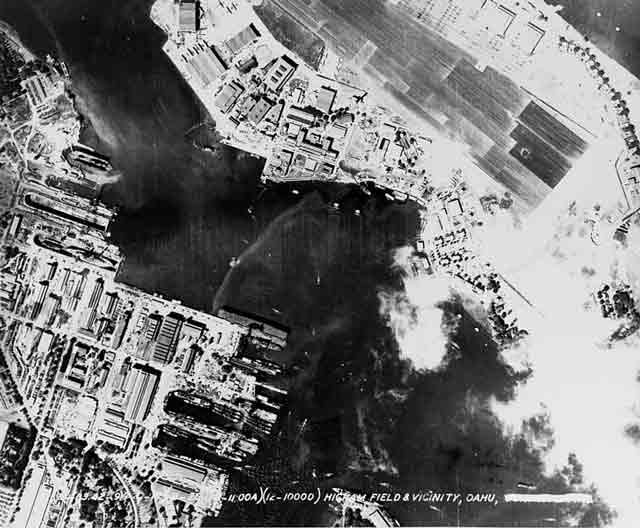
As this photo is taken, six aircraft carriers of the Nihon Kaigun (Imperial Japanese Navy) are departing Japanese waters, on their mission to raid Pearl Harbor.
The Japanese Carrier Striking Force or 1st Air Fleet, aka Kidō Butai, departs on 26 November 1941 from its assembly point at Tankan Bay, Iturup Island, South Kuril Islands for its first mission of the coming war. Its destination is a point to the north of Pearl Harbor, the site of the main United States Pacific Fleet. This force includes five aircraft carriers:
HIJMS Kaga
HIJMS Sōryū
HIJMS Hiryū
HIJMS Shōkaku
HIJMS Zuikaku
Accompanying the six fleet aircraft carriers are two battlecruisers (HIJMS Hiei and HIJMS Kirishima), three cruisers, nine destroyers, and three submarines. There also are eight tankers and supply ships. Separately, Vice Admiral Chuichi Nagumo aboard aircraft carrier HIJMS Akagi departs from Hitokappu Bay in the Kurile Islands. The groups plan to rendezvous at sea and together carry out the “Hawaii Operation” (“Z”) at or about dawn at 7 December 1941 Hawaiian time and date.
British Operation CRUSADER, the attempt to relieve Tobruk, has degenerated into a wild melee with both sides attacking in different directions. The Afrika Korps panzers have advanced to the southeast of Tobruk, threatening the rear of the most advanced British positions, but their dramatic advance to the southeast has left them overextended. General Rommel today orders 21st Panzer Division at Bardia to turn northwest toward Tobruk while the 15th Panzer Division cleans out the border area between Fort Capuzzo and Sidi Omar. The panzers have outrun their supply lines, so General Walter Neumann-Silkow, commanding 15th Panzer Division, decides to take Sidi Aziz where he believes he can find a British supply dump. The Germans now have the initiative, but which side can best satisfy its logistical needs in this fluid battle is bound to be the ultimate victor. Meanwhile, outside Tobruk, members of the Tobruk garrison take the important Italian strong point at El Duda.
Meanwhile, Erwin Rommel’s staff recalled the troops at Sidi Rezegh, Libya, allowing British 7th Armoured Division to capture the town. After two days of German attacks around Capuzzo and Sisi Aziz, Rommel recognizes the gathering of British Armour at Sidi Rezegh and the continued movement of the New Zealand Division toward Tobruk. He begins moving his forces back there.
British Lieutenant General Alan Cunningham, General Officer Commanding Eighth Army, is relieved of command. Lieutenant General Neil Ritchie DSO, MC (1897-1983) was appointed Commander-in-Chief of the British Eighth Army in North Africa.
In Libya, Lieutenant Colonel H. C. J. Yeo took the British 44th Royal Tank Regiment on a spectacular night attack which broke through the besiegers’ lines and effected a link up with the Tobruk garrison. Many had suggested that the attack was impossible, but Colonel Yeo and his men had proven them wrong, and reinforced the matter with a similar operation against Barcia on 1 January 1942.
A fierce battle for Istra, near the Volokolamsk/ Moscow highway, finally ends when the 10th Panzer Division pushes Manchurian troops from Khabarovsk out of the town. However, the Soviet troops pushed out of the town launch furious counterattacks in the -4 Degrees Fahrenheit weather which give the Germans no rest. The 2nd SS Division “Das Reich” advances to support this advanced position and blasts through the 78th Siberian Rifle Division to capture a fortress on the western outskirts of Istra, with two SS infantry regiments, “Deutschland” and “Der Fuehrer,” advancing into the town from the south. While capturing this major strong point is a success, every advance by the Wehrmacht now requires a major effort from multiple directions that includes vicious street fighting. Elsewhere on the Moscow front, the Germans make few if any advances as the Wehrmacht regroups for one more major effort to take the Soviet capital.
Soviet troops re-opened the Tula-Moscow rail line in Russia.
Finland is not at war with anyone but the Soviet Union and it wants to keep it that way. However, both the United States and Great Britain have been threatening a “crisis” in diplomatic relations if Finnish land or troops are used to interdict Lend-Lease supplies to Russia along the Murmansk railway. This has caused Finland to discontinue all offensives which otherwise might be bearing fruit. Today, the British government issues a formal ultimatum to Finland to cease all offensive operations by 3 December 1941 or it will declare war.
In a sixty-five-minute luncheon speech to the delegates of the Anti-Comintern Conference, Foreign Minister Joachim von Ribbentrop delivered today a scathing denunciation of “warmonger number one,” President Roosevelt, and of British Prime Minister Winston Churchill.
Lebanon was proclaimed independent by Georges Catroux, the Chief of Free French forces in the Levant. Allied countries would recognize this independence, although in practice Lebanon was still governed under French authority. Free French General Georges Catroux announced that France would place Syria and Lebanon on a course for full independence.
The German auxiliary cruiser HK Komet (Ship 45 also known to the British as Raider B) returns to Hamburg. It has been at sea for 516 days and sank eight ships for 41,293 tons.
A Japanese aircraft carrier task force, under command of Vice Admiral Nagumo Chuichi sailed from remote Hittokappu Bay in the Kurile Islands, its departure shrouded in secrecy. The task force consisted of six aircraft carriers, two battleships, and several destroyers and cruisers.
RAF Bomber Command, Night of 26/27 November 1941
Emden
80 Wellingtons and 20 Hampdens; only 55 aircraft bombed in cloudy conditions. 2 Wellingtons and 1 Hampden lost. No report is available from Emden.
Ostend
16 Wellingtons and 2 Stirlings; only 7 aircraft bombed. No losses.
Armed merchant cruiser HMS Cape Sable departed Oban for Scapa Flow, arriving on the 27th to conduct working up practices.
Submarine HMS P 36 made an unsuccessful attack on a submarine in 47-16N, 3-20W.
German steamer Egeran (1143grt) was sunk on a mine off Memel.
British transport ships carrying tanks departed Port Said for Alexandria escorted by sloop HMS Flamingo, corvettes HMS Salvia, HMS Hyacinth, and HMS Erica, and Greek destroyers RHS Kondouriotis and RHS Aspis from Alexandria. Anti-aircraft ship HMS Carlisle departed Alexandria and joined the convoy off Port Said. The convoy arrived at Alexandria on the 27th.
Today in Washington, President Roosevelt received Fay Allen Des Portes, United States Minister to Guatemala, and Delfino Sanchez Latour, Guatemalan Chief of Protocol, who presented a private message from the President of Guatemala; Sidney Hillman,, Associate Director General of OPM; Governor Edison of New Jersey; Claude Wickard, Secretary of Agriculture; William Green, president of the American Federation of Labor and Senator George Morris.
The Senate was in recess. The Defense Investigating Committee resumed hearings on Tennessee Projects; the Foreign Relations Committee approved the treaty with Canada for additional diversion of Niagara River water and authorized a subcommittee to study Axis activities in organizing aliens here; a Judiciary subcommittee heard support for the Sumners bill for trial of Federal judges.
The House considered price control legislation and adjourned at 5:30 PM until 11 AM Friday. The Labor Committee considered legislation to curb defense strikes.
Following years of confusion during which the different states of the United States celebrated Thanksgiving on different days, President Roosevelt tries to end the controversy by signing a joint resolution which establishes a fixed date every year for the federal holiday. This bill provides that Thanksgiving will be celebrated every year on the last Thursday in November. That makes tomorrow, 27 November 1941, the legal holiday of Thanksgiving for the entire country. This does not quite end the controversy completely, however, as future congressional action will change the date from the last Thursday of November to the fourth Thursday of November (some Novembers have five Thursdays).
In 1789, President George Washington became the first president to proclaim a Thanksgiving holiday, when, at the request of Congress, he proclaimed November 26, a Tuesday, as a day of national thanksgiving for the U.S. Constitution. However, it was not until 1863, when President Abraham Lincoln declared Thanksgiving to fall on the last Thursday of November, that the modern holiday was celebrated nationally. With a few deviations, Lincoln’s precedent was followed annually by every subsequent president—until 1939. In 1939, Roosevelt departed from tradition by declaring 23 November, the next to last Thursday that year, as Thanksgiving Day. Considerable controversy surrounded this deviation, and some Americans refused to honor Roosevelt’s declaration.
A.F.L. and C.I.O. leaders tonight carried their fight against threatened strike bans to President Roosevelt and legislative halls as the house labor committee prepared to act within 48 hours on the most drastic labor curbs ever considered by congress. William Green, A.F.L. president, and Vice-President Matthew Woll told Mr. Roosevelt they were “resolutely and uncompromisingly opposed” to all pending anti-strike legislation. Green also pointed out to reporters that the federation already has adopted a “no strike” policy toward defense operations and he contended that “local, spasmodic and illegal” strikes by some A.F.L. unions did not justify restrictive legislation.
A spokesman for the United Welders, Cutters & Helpers of America announced tonight that day and night shifts at local shipyards had voted unanimously “to support a strike if it becomes necessary.” He said such a motion was carried at a meeting of approximately 750 members of the night shift after a meeting of day shift workers attended by about the same number had approved a similar motion earlier in the day. A showdown would come, the spokesman said, “if the boilermakers start locking the men out.”
The House rejected today by a teller vote of 218 to 63, with party lines obliterated, the Gore plan for “over-all” control of rents, price and wages during the emergency.
An immediate reduction of $2,000,000,000 in Federal non-defense spending is recommended in a report of the National Association of Manufacturers’ government finance committee made public yesterday. The report will serve as the base for a major plank in the 1942 platform of the Congress of American Industry that meets here next week, according to Charles E. Wilson, chairman of the association’s resolutions committee.
Official circles considered it a foregone conclusion today that a substitute would be advanced for the Treasury’s proposal of a 15 percent income tax, withheld at the source. Higher taxation of individual incomes will be sugar coated, they said, by a plan or taking some of the individual income revenue in the form of compulsory savings, and that this will be supplemented by higher corporation taxation.
Sgt. Delmer Park of Phoenix, Arizona, a United States army observer with the British tank forces in the Libyan desert campaign, was caught in a surprise thrust of German tanks yesterday and killed. He was the first American casualty of the present desert war. Before going to the front, he had been one of a group of U. S. technical sergeants who helped get tanks in shape for combat. Park, 21, who reenlisted recently, camped with a group of British tankmen in the desert some miles from Sidi Omar Monday night. At dawn they arose to continue on to a certain formation of American-made tanks when they were confronted by the surprise onslaught.
Naval enlistments have dropped 15 percent since the sinking of the destroyer Reuben James and the torpedoing of the Kearny, Secretary Knox revealed today. He added that as a consequence selective service men might be used by the Navy. The practice has been to depend upon volunteers for the Navy.
Secretary of the Navy Frank Knox today verified reports originating in New York that two of the Reuben James own depth bombs exploded as the destroyer sank after being torpedoed by a German submarine, and while members of her crew were floundering in the water.
A suggestion that plans are afoot to have Air Corps pilots deliver combat airplanes across the oceans to combatant areas was given today in a review of the work of the Air Corps Ferrying Command.
Brigadier General Brehon B. Somervell has been appointed assistant chief of staff in charge of the general staff’s supply division. He has been on duty as assistant quartermaster general in charge of construction.
Amateur American tennis stars Bobby Riggs and Frank Kovacs turn professional after being suspended by the US Lawn Tennis Association for undisclosed financial gain.
The Phillies name Hans Lobert as their new manager, replacing Doc Prothro. At age 60 years and a month, Lobert is the oldest rookie manager ever. The Phillies finished last under Doc and will finish last under Hans.
Reliable sources said tonight President Higinio Morinigo of Paraguay has defeated a bloodless coup d’etat of pro-axis color after a three-day crisis beginning November 19. During the period heavy army reserves were called into Asuncion and mounted troops patrolled the streets at night. The dispute, it was reported, started when President Morinigo refused a request of Police Chief Luis Santiviago for special honors for the body of former President Eduardo Schaerer, who died November 11 in Buenos Aires. Schaerer was the founder of the pro-axis political entity called the “Schaereristas.”
Japanese carrier forces for the Pearl Harbor attack departed Tankan Bay. The force was composed of aircraft carriers HIJMS Akagi and HIJMS Kaga of the 1st Carrier Division, HIJMS Sōryū and HIJMS Hiryū of the 2nd Carrier Division, and HIJMS Shōkaku and HIJMS Zuikaku of the 5th Carrier Division, light cruiser HIJMS Abukuma of the 1st Destroyer Flotilla with destroyers HIJMS Tanikaze, HIJMS Urakaze, HIJMS Isokaze, HIJMS Hamakaze of the 17th Destroyer Division, HIJMS Kasumi, HIJMS Arare, HIJMS Kagero, HIJMS Shiranuhi of the 18th Destroyer Division, and HIJMS Akigumo of the 10th Destroyer Division, battle cruisers HIJMS Hiei and HIJMS Kirishima of the 1st Battleship Division, and heavy cruisers HIJMS Tone and HIJMS Chikuma of the 8th Cruiser Squadron. Submarines HIJMS I-19, HIJMS I-21, and HIJMS I-23 were deployed to support the force. The supply train consisted of eight tankers and supply ships. Destroyers HIJMS Sazanami and HIJMS Ushio of 7th Destroyer Division sailed to shell Midway Island.
Chūichi Nagumo’s aircraft carrier strike force headed for Pearl Harbor with the understanding that should “negotiations with the United States reach a successful conclusion, the task force will immediately put about and return to the homeland…” Its mission, should talks between United States and Japan fail to resolve the diplomatic impasse over Far Eastern and Pacific questions, is to attack the U.S. Pacific Fleet wherever it is found in Hawaiian waters.
Cordell Hull offered a counter-proposal to the Japanese demands, requiring Japan to recognize Chiang Kai-shek, withdraw from both China and French Indochina and to agree to a multinational non-aggression pact. The Japanese asked for two weeks to study the proposals.
The United States and Japan have failed to find a formula for a peaceful settlement of their differences after seven months of diplomatic negotiations, it was learned authoritatively tonight, and war or peace in the Far East may hinge on Japan’s next move. Secretary of State Hull handed to the Japanese envoys Ambassador Kichisaburō Nomura and Special Minister Saburō Kurusu after a conference late today a document setting forth the basic principles which this government feels must be observed by all nations, including Japan, if peace is to be achieved and maintained in the Pacific.
Ambassador Nomura sends a message to Tokyo with the following entry: “Judging from the progress of present Japanese-American relations, with which you are well acquainted through successive telegrams, the American proposal on the 26th showed a great disparity between the demands of both parties. Unfortunately, there are no hopes of acceptance of our demands within the time limit you set.” Special Envoy Kurusu calls Yamamoto Kumaicho, Head of American Division of Japanese Foreign Office in Tokyo, and says, “I have made all efforts, but they will not yield. I sent a cable expressing my opinions to the Foreign Minister this morning. The situation is just like that. Otherwise there is no means of accomplishing it. I shall cable you now. Already, you have a general understanding I imagine. Accordingly, I do not know how things will turn out regarding my meeting with the President. Hull is not making much progress it seems.”
U.S. intelligence detected Japanese troop movements in Indochina. In response, U.S. Secretary of State Cordell Hull submitted the final proposal to Japanese diplomats for readjustment of U.S.-Japanese relations, demanding the Japanese to withdraw all troops from China and Indochina, and with full expectation that the Japanese were not going to entertain this demand in any way. Hull submitted a counter-proposal to Japan’s Proposal “B.” The American counter-proposal insisted that Japan must withdraw first from Indochina and China. The tone of the note was uncompromising on these points, but promised to negotiate new trade and raw material agreements.
At Pearl Harbor, Joseph Rochefort sent a report for his superiors that his cryptanalytic team had detected Japanese fleet movements and that the Japanese warships were seemingly staging for actions in the South Pacific.
Secretary of State Hull warns U.S. Army and Navy officials of an imminent Japanese surprise attack stating, “There was practically no possibility of an agreement being achieved with Japan.”
U.S. Army G-2 (Intelligence) sends a memorandum to General George S. Marshall, Chief of Staff, U.S. Army, stating: “The following information was received from the Commandant 14th Naval District (in Hawaii) through the Office of Naval Intelligence at 12: 45 a. m., this date:
•1. The Japanese have been organizing a naval task force for the past month comprising:
•a. Second Fleet: Under the command of Commander-in-Chief, Second Fleet. (The Second Fleet corresponds roughly to our Scouting Force, consisting mainly of strong Cruiser Divisions).
•b. Third Fleet which formerly was the China Coast Command Force including its first and second base forces, constituted by miscellaneous small vessels.
•c. Combined Air Force consisting of all large carrier forces.
•d. Also destroyer squadron 3, air squadron 7, submarine squadron 5, and possibly 1 battleship division from First Fleet consisting of 3 battleships.
•Summary of Above: 14 Heavy Cruisers, 4 Light Cruisers, 10 Carriers, 3 Light Cruisers. 2 Destroyer Squadrons (24 destroyers), 2 Submarine Squadrons (18 submarines), and possibly 3 battleships.
•2. The combined air force has assembled in Takao, Formosa, with some units believed in Hainan Island. The Third Fleet is believed moving in direction of Takao and Bako, Pescadores off West Coast of Formosa, from home waters in Japan. Units from the Second Fleet are at present possibly en route to South China as advance scouts. Strong concentration of submarines and air groups in the Marshalls. Present location other units of this task force are not known.
•3. The evaluation put upon the above information by the Commandant, 14th Naval District is that a strong force may be preparing to operate in Southeastern Asia, while component parts thereof may be expected to operate from Palau and the Marshall Islands.
The Chief of Naval Operations, Admiral Harold R. Stark, sends the following message to the Commander-in-Chief Pacific Fleet, Admiral Husband E. Kimmel: “In order to keep the planes of the Second Marine Aircraft Wing available for expeditionary use OPNAV has requested and Army has agreed to station twenty five Army pursuit planes at Midway and a similar number at Wake provided you consider this feasible and desirable. It will be necessary for you to transport these planes and ground crews from Oahu to these stations on an aircraft carrier. Planes will be flown off at destination and ground personnel landed in boats essential spare parts tools and ammunition will be taken in the carrier or on later trips of Regular Navy supply vessels. Army understands these forces must be quartered in tents. Navy must be responsible for supplying water and subsistence and transporting other Army supplies. Stationing these planes must not be allowed to interfere with planned movements of Army bombers to Philippines. Additional parking areas should be laid promptly if necessary. Can Navy bombs now at outlying positions be carried by Army bombers which may fly to those positions for supporting Navy operations? Confer with commanding general and advise as soon as practicable.” A second message is sent stating that the “Army has offered to make available some units of Infantry for reinforcing defense battalions now on station if you consider this desirable. Army also proposes to prepare in Hawaiian garrison troops for advance bases which you may occupy but is unable, at this time to provide any antiaircraft units. Take this into consideration in your plans and advise when practicable number of troops desired and recommend armament.
Japanese military leaders confer on Formosa to complete plans for the invasion of the Philippines.
The Foreign Office sends a message to the Japanese Embassy in Washington, D.C. containing the following statement: “When you reach a settlement in accordance with our new proposal, it is essential that you secure guarantees for the acquisition of goods in connection with clauses 2 and 3 of that proposal. Of these goods, the acquisition of petroleum is one of the most pressing and urgent requirements of the Empire. Therefore, in accordance with the course of negotiations, prior to the signing of an understanding, and at as early a date as possible, I would like to have you make our wishes known insofar as petroleum imports are concerned along the following lines: 4 million tons per year from the United States. (This figure is the average amount of imports during the years 1938, ’39, and ’40 from the United States. The breakdown according to type, aviation gasoline included, corresponds to the actual figures covering imports before the freezing legislation went into effect.) That is to say, roughly 333,000 tons per month. In addition, on the basis of past negotiations and roughly in the agreed amounts, we hope to import from the Netherlands Indies 1 million tons per year.
HIJMS Naka became the flagship of Rear Admiral Shoji Nishimura of Japanese 4th Destroyer Squadron; she departed the Terashima Strait near Sasebo, Japan.
Destroyer HIJMS Yukikaze departed Kyushu, Japan.
Marshall stated at a conference that war could be expected by March.
Navy Department advises Hart that war is impending.
Tug USS Sonoma (AT-12) sails from Wake Island with Pan American Airways barges PAB No. 2 and PAB No. 4 in tow, bound for Honolulu.
The 34th Pursuit Squadron moves from Nichols to Del Carmen on Luzon.
Brereton returns to Clark Army Air Field from his tour of Australian sites.
Dow Jones Industrial Average: 115.93 (-1.03)
Born:
Jeff Torborg, MLB catcher (World Series Champions-Dodgers, 1965; Los Angeles Dodgers, California Angels) and manager (AL Manager of the Year, 1990, Chicago White Sox), in Plainfield, New Jersey (d. 2025).
Amos Garrett, American-Canadian session and touring blues, rock, and roots guitarist (Maria Muldaur; Anne Murray; Doug Sahm), in Detroit, Michigan.
Susanne Marsee, American mezzo-soprano, in San Diego, California.
G. Alan Marlatt, psychologist, in Vancouver, British Columbia, Canada (d. 2011).
Died:
Ernest Lapointe, 65, French Canadian politician, Attorney General of Canada (1935-41).
Naval Construction:
The Royal Navy Assurance-class rescue tug HMS Dexterous (W 111) is laid down by Cochrane & Sons Shipbuilders Ltd. (Selby, U.K.).
The U.S. Navy YMS-1-class auxiliary motor minesweeper USS YMS-63 is laid down by the Gibbs Gas Engine Co. (Jacksonville, Florida, U.S.A.).
The Kriegsmarine (German Navy) Type IXC/40 U-boat U-529 is laid down by Deutsche Werft AG, Hamburg (werk 344).
The U.S. Navy Gato-class submarine USS Pompon (SS-267) is laid down by the Manitowoc Shipbuilding Co. (Manitowoc, Wisconsin, U.S.A.).
The U.S. Navy Fletcher-class destroyers USS Howorth (DD-592) and USS Killen (DD-593) are laid down by the Puget Sound Navy Yard (Bremerton, Washington, U.S.A.).
The U.S. Navy aircraft transport and ferry USS Kitty Hawk (APV-1; later AKV-1) [ex-SS Seatrain New York] is commissioned. Her first commanding officer is Commander Elbert Charles Rogers, USN.
The Royal Canadian Navy Bangor-class (VTE Reciprocating-engined) minesweeper HMCS Miramichi (J 169) is commissioned. Her first commanding officer is T/Lieutenant Walter George Johnstone, RCNR.
The Kriegsmarine (German Navy) Type IXC U-boat U-174 is commissioned. Her first commanding officer is Fregattenkapitän Ulrich Thilo.
The Royal Canadian Navy Flower-class corvette HMCS Weyburn (K 173) is commissioned. Her first commanding officer is T/A/Lieutenant Commander Thomas Maitland Wake Golby, RCNR.
The Royal Canadian Navy Flower-class corvette HMCS Halifax (K 237) is commissioned. Her first commanding officer is T/A/Lieutenant Commander Charles Copelin, RCNR.
11…

