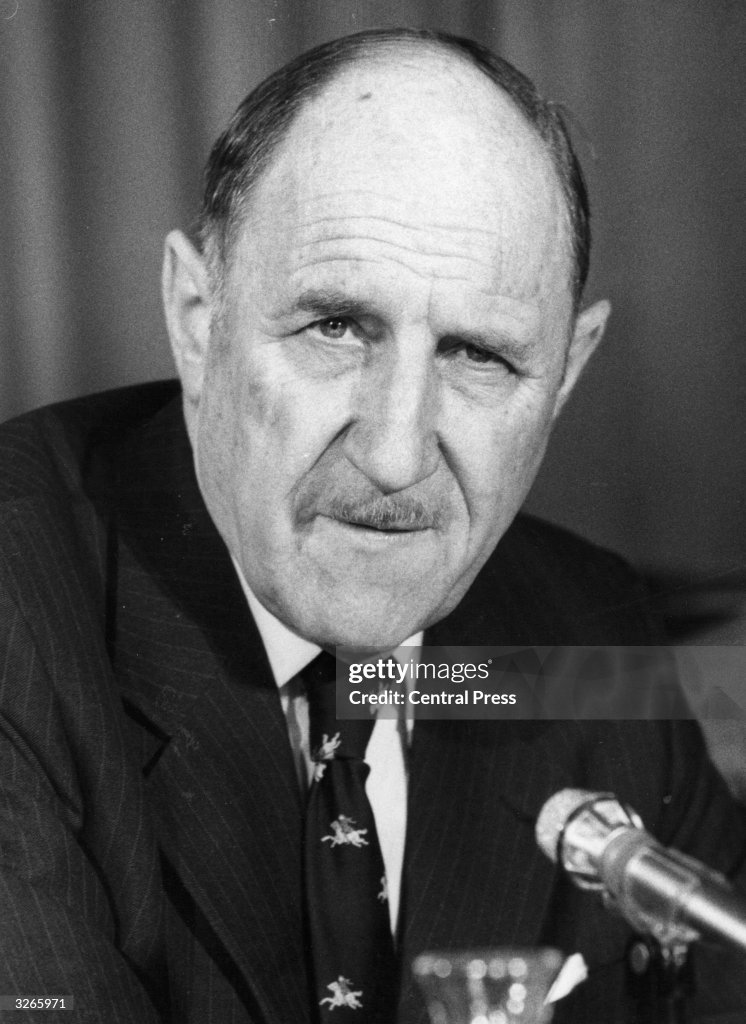
Initial use of nuclear arms by either side in a conflict would be barred under a proposal made to Western nations by the Soviet-led Warsaw Treaty Organization. The proposal was made as the leaders of the seven member nations completed two days of political discussion in this capital city. A statement following the meeting said that a draft of the proposed treaty would be sent to all the other nations that signed the agreement on European security at Helsinki 16 months ago. This would include the members of the North Atlantic Treaty Organization. Leaders of the seven Eastern European countries, meeting in Bucharest, also approved the first major structural change in the alliance since 1969. According to Rumanian sources, the change would dilute the military character of the alliance by developing its political functions. The Warsaw Treaty Organization joint secretariat was established. The new committee of foreign ministers would consult periodically on foreign policy but not make binding decisions for the member nations. Nicolae Ceausescu, the head of the Rumanian Communist Party, who was the host for this conference, had reportedly proposed such a foreign ministers’ committee at the last consultative session, in Warsaw in 1974, but without success. Its adoption this time was considered a coup for Mr. Ceausescu, though one Rumanian insider preferred to term it a “common sense” move.
President Tito and his aides reaffirmed today that Yugoslavia would never join any “political, military or state community.” Government sources said the pledge was especially significant in light of the visit last week by the Soviet Communist Party leader, Leonid I. Brezhnev, whose talks with Marshal Tito have left the impression that relations between Belgrade and Moscow are warmer than in many years. The statements today were viewed as an effort to counter any inference that Yugoslavia might be moving back into the Soviet camp. Marshal Tito and other leaders spoke after the Warsaw Pact meeting in Bucharest yesterday. He warned of “constant pressures being exerted on our country from various quarters.” While he did not specify what he meant, he used much the same phrasing last summer in criticizing the United States.
Turkish and foreign efforts to aid victims of the earthquake in eastern Turkey continued to grow today, and informed Turkish sources predicted that the final death toll would be about 4,000. Turkish Government trucks laden with flour and other provisions rumbled out of the snow-covered provincial capital of Erzurum last night and today, bound for a quake-stricken area to the east, Commanear Diyadin. “Turkey is a land or many earthquakes, and Turks are sympathetic when disaster comes,” said Erzurum’s grim-faced Governor, Sadri Turan, to a traveler here today. Winter cold, snow and damage to some roads continued to hamper aid efforts. However, some well-informed Turks said privately here that the Ankara Government seemed to have reacted more promptly after this week’s quake than after the one near Diyarbakir, southwest of here, last year. There was some criticism of the Government’s response at that time.
British industrial leaders unexpectedly opposed stringent deflationary measures that London is expected to take soon to qualify for a $3.9 billion loan from the International Monetary Fund. The industrialists urged the government to channel resources from the public to the private sector.
The global economic crisis was attributed to bad management by governments, not ideology, by West German Chancellor Helmut Schmidt, Addressing leaders of 62 Socialist parties from the non-Communist world, Mr. Schmidt said in Geneva that the crisis affected all countries, no matter what type of governments they had, and that a solution lay in each government’s will to combat inflation at home.
Robert Havemann, a physicist who is a persistent critic of the East German Communist Party, was arrested today, friends of the dissident reported. They said the 67‐year‐old professor was arrested at his home in an East Berlin suburb. They added that the police had told the physicist he would be taken to a district court about 12 miles away. The friends said no reason had been given for his detention nor was he told how long he would be held. Professor Havemann was among a group of East German intellectuals and cultural figures who criticized the Government for the exiling two weeeks ago of Wolf Biermann, a protest singer and poet, while he was on a tour of West Germany. The official East German press agency denied that Professor Havemann had been detained.
Major changes in the concordat that has governed Italy’s church-state relations since 1929 are embodied in proposals agreed on by the Rome government and the Vatican. The proposals include ending recognition of Roman Catholicism as the state religion and concessions by the Vatican on marriage laws and religious education. Parliament must approve the plan. The 1929 treaty, which resulted from secret negotiations between Mussolini and Pope Pius XI, has long been regarded as outdated in language and substance. After an equally divided commission of six had carried on negotiations for several months, Prime Minister Giulio Andreotti sent the proposals last night to Parliament, where they will be debated and perhaps changed before the revised treaty becomes final.
With apparent Soviet encouragement, a move is under way to establish a formal link between the official Soviet Jewish community and international Jewish bodies. Nahum Goldmann, president of the World Jewish Congress, last week sent a letter to the leaders of the Moscow Jewish community inviting them to come to Paris to discuss the desire they express for participation in world Jewish affairs. “I hope you will be able to accept this invitation,” Mr. Goldmann wrote in recognition of the limited freedom of official Soviet Jewish leaders. No reply has been received, and Mr. Goldmann has sent a telegram repeating his invitation.
The United Nations Educational, Scientific and Cultural Organization voted today by a large majority to affirm its condemnation of Israel’s excavations and building projects in Jerusalem on the ground they were altering the historic character of the city. The UNESCO conference under way here also decided to continue to withhold cultural aid to Israel, amounting to $25,000 every two years, because of its refusal to alter policies in Jerusalem. It was the second time In four days that the conference had criticized Israel for its internal policies. On Monday, the meeting voted to condemn Israeli policies in occupied Arab territories as amounting to “cultural assimilation.”
Edouard Ghorra, the delegate of Lebanon, is eagerly preparing for a long telephone call to the Foreign Ministry in Beirut. What would seem a routine diplomatic activity will actually be an event of striking import for the Lebanese mission to the United Nations. It will mark the reestablishment, after more than a year, of normal working communications between the mission and the Beirut Government. Through many of the months of anguish and civil war in Lebanon, the country’s diplomatic missions abroad found themselves largely cut off from their besieged capital. Lacking detailed instructions or policy guidelines, they played their official roles as best they could, by hunch and hope.
Syria and Iraq, bitter enemies for years, have made a significant step to reduce tensions by withdrawing most military forces from their border. The immediate effect is that Syria, which has more than 20,000 of its best troops tied down in Lebanon, has been freed of a military threat to its rear and will be able to move sizable forces back to its front with Israel. Western diplomats in Damascus estimated that nearly half the Syrian Army’s combat troops had been pulled out of positions against Israel to be deployed in various parts of Lebanon and along the border with Iraq. This, the diplomats said, was regarded by President Hafez al‐Assad as a military weakness in Syria’s otherwise strong political and strategic position.
Southern Yemen said today that it had captured the pilot of an Iranian “spy plane” reportedly shot down by ground defense forces. The Aden radio said that an American-made F-4 Phantom, flown by Major Darius Jalali, was brought down Wednesday when it flew over one of Southern Yemen’s eastern provinces. The broadcast quoted the major as having said that his plane was one of 10 Phantoms that took off from an Iranian base in neighboring Oman for a reconnaisance mission over Southern Yemen. The plane’s second crewman was killed and the major was injured slightly in the downing of the plane, the radio said. A brigade of Iranian troops, supported by jet fighters, is stationed in Oman’s southern Dhofar Province, which borders Southern Yemen. The Iranian troops arrived in Dhofar more than three years ago to help suppress a leftwing rebellion.
The General Assembly voted over the lone opposition of the United States tonight for favorable reconsideration of Vietnam’s request for admission to the United Nations. However, the United States served notice it would again veto Hanoi’s admission when it comes before the Security Council because Vietnam so far has not given an accounting of the 800 American servicemen missing ‘in action in the Vietnam War. The United States blocked Hanoi’s entry on these grounds on November 15 and William W. Scranton, the chief American delegate, told the Assembly that “the United States still has no information leading it to change its view.”
There are indications that Chiao Kuanhua, China’s urbane Foreign Minister, may be the latest victim of the spreading campaign against Chiang Ching, Mao Zedong’s widow, and three other disgraced members of the Politburo. Analysts here caution that the evidence about Mr. Chiao is still conflicting and inconclusive. But they believe that he and his wife, Chang Han‐chih, a deputy director of the Asian Affairs Department of the Foreign Ministry, are under investigation for their relations with Miss Chiang and the three others. “Chiao could still be cleared,” one analyst said. “But he is not likely to get promoted to the Politburo, as he seemed set to before.” Mr. Chiao is a member of the Communist Party’s Central Committee who seemed a strong candidate for elevation to the Politburo. That Mr. Chiao should even be suspected to be involved in the case of Miss Chiang comes as a surprise, since he was long considered one of the closest associates of the late Prime Minister Chou Enlai and seemed to model his suave, sophisticated style on that of Mr. Chou.
A chemical company owned by the Canadian government was accused in 1973 of paying nearly $2 million in kickbacks to foreign customers. A report of the allegations was given to Parliament by Prime Minister Pierre Trudeau, who acknowledged under questioning he had not pursued the matter in the 3 ½ years since he first learned of it.
At least 10 people were killed, and 76 injured, in the explosion of a ruptured natural gas line in Barrientos, a suburb in northern Mexico City. The blast occurred when a mechanical digger struck the pipeline while excavating.
The deadlock that has prevailed at the monthlong conference on Rhodesia’s future was overcome tonight when two black nationalist holdouts accepted a British formula fixing March 1, 1978, as the date for independence under black control. Ivor Richard, the Briton who is the conference chairman, announced after a meeting with Joshua Nkomo and David Mugabe, two of the four black leaders at the talks, that the “date issue will no longer hold up the continuation of the conference.” Mr. Nkomo and Mr. Mugabe, who are linked for the talks in a loose alliance they call the Patriotic Front, had refused to discuss the other issues before the conference until a firm date had been set. The other black delegations, led by Bishop Abel Muzorewa and the Rev. Ndabaningi Sithole, had agreed with. the chairman to shelve the date issue to enable the conference to begin examining a crucial question: the biracial government that is to act during the transitional period leading to black government in the former British colony. The conferees can now discuss the structure of a projected biracial interim government to supervise transition of power from the 270,000 whites to the six million blacks.
Bert Lance, the first person assured of a cabinet-level post in the Carter administration, will soon go to Washington to work on “transitional budgetary matters,” a spokesman for the President-elect said. The announcement was seen as a new signal that the Georgia banker might become director of the Office of Management and Budget, but the spokesman said there had been no final decision.
They might be called the class of 1968, for they are the social engineers who toiled over the blueprints of Lyndon B. Johnson’s Great Society, which promised nothing less than the elimination of poverty from an affluent society. When Richard M. Nixon came to the White House in 1969, they scattered across the land, mostly to university campuses. By then they knew that their record had been, at best, mixed. The Nixon Administration judged it more harshly and, as they watched in mute frustration from their places of exile, they came to feel that not only their programs but also their goals had been abandoned. Now, with the advent of Jimmy Carter, they sense that their concerns are coming back into vogue and that they have a chance to he heard again and maybe — some of them, at least — to return to positions of influence to Washington. It won’t be a class reunion or the Great Society revisited, they know, but nearly all of them have submitted memorandums and policy recommendations to the Carter transition teams.
Corporations, unions and Government contractors can legally contribute to the committee that will foot the bill for President-elect Jimmy Carter’s inaugural festivities. the Federal Election Commission. said today. But a spokesman for the inaugural committee said that such contributions would not be accepted. The commission’s opinion means there are no legal limits on how much an individual may contribute to the committee. But the spokesman said that the committee, nonetheless, would observe the $1,000 limit the law places on individual campaign contributions. A commission staff opinion concluded that campaign spending laws did not apply to the committee. Therefore, it could accept money from organizations that could not legally contribute to Presidential campaign committees. Sue Vogelsinger, the inaugural committee spokesman, said that the estimated $3 million cost of the festivities would be paid for by small contributions, revenue from sales of tickets to various events and money from sales of official inaugural souvenirs. The commission decision also means there is no legal requirement for the inaugural committee to release the names of those who help pay the cost of balls and other January events, but the committee said that it probably would make the names of contributors available if they were requested.
A House committee was asked today to investigate the 1969 killing of Fred Hampton, a Chicago Black Panther Party leader, on the ground that he had been set up by the Federal Bureau of Investigation through an informer and “murdered” in a raid carried out by a special force of the Chicago police. Morton H. Halperin, a former staff member of the National Security Council, now director of projects in conjunction with the American Civil Liberties Union, requested action in a letter to Richard Sprague, chief counsel and staff director of the House Select Committee on Assassinations.
Trustees of the Teamster union’s major pension fund have agreed to begin talks with the federal government about the management of the fund’s $1.4 billion in assets, the Internal Revenue Service announced. The assent was the price the service got for granting a third suspension of the revocation of the fund’s tax-exempt status. The suspension was to have expired next Tuesday. As a result of its latest extension, the third that the fund has received, the fund will retain its tax exemption until February 28, 1977. No one could say yesterday when the new negotiations would start, but Government officials were delighted that the trustees of the Central States, Southeast and Southwest Areas Pension Fund had agreed to them.
Import duties on some European brandies were raised by President Ford in a partial restoration of tariffs reduced in 1974. An administration trade official said that the increases had been ordered because, despite intensive bargaining, the Common Market had refused to cut its import duties on American poultry, particularly turkeys.
More than 25 million Americans have received swine influenza inoculations, Federal health officials said today, with the number in creasing week by week even before the report of a swine flu case in Missouri. The program continues to lag in urban areas when compared with rural states, they said, and Wyoming has become the. first stale to have more than 70 percent. of its population 18 years and older inoculated. Don Berreth, information officer for the National Center for Disease Control, said the report last week from Missouri health officials that they had diagnosed the first case of swine flu this season “may have increased the number of persons receiving the vaccine” this week. He added, however, that no national figures were available yet, to document such a rise.
Higher prices for sheet steel are planned by four more of the nation’s top 10 steelmakers. Armco, Inland, Youngstown Sheet and Tube and Wheeling-Pittsburgh said they would raise the price by 6 percent on December 1. Their actions followed the lead of National Steel and Jones & Laughlin. There was no word on the plans of the industry’s three leading manufacturers — United States Steel, Bethlehem Steel and Republic Steel.
A new inquiry into the 1973 murder of Barbara Gibbons was ordered by Governor Ella Grasso of Connecticut, who also asked an inquiry into the prosecution of murder charges against Peter Reilly, the slain woman’s son. Charges against the 21-year-old youth were dropped Wednesday after a county prosecutor said he had found evidence exonerating the youth in the files of his predecessor. “In view of the action of the court in the Peter Reilly case, I have directed Commissioner Edward P. Leonard to have the state police reopen the investigation of the Barbara Gibbons murder case,” Mrs. Grasso said in a statement that was read at the Capitol in Hartford while the Governor was away at her weekend home. “In addition, I have referred to Chief State’s Attorney Joseph T. Gormley Jr. questions raised concerning the use of evidence in this case,” Mrs. Grasso said in the statement, which ended her yearlong refusal to become involved in the case. Mr. Reilly’s attorney and some of his chief supporters were less sanguine than he was that the Governor’s statement would, in fact, lead to the discovery of the killer and an explanation of how Mr. Reilly came to be prosecuted despite the existence for three years of evidence placing him miles from the scene of the crime at the time it was committed.
The Justice Department sued the City of Boston today on charges that employment, ‘policies of its Public Works Department discriminated against blacks and Spanish-surnamed persons. The civil suit was filed in the Federal District Court in Boston against Mayor Kevin H. White, Joseph F. Casazza, public works commissioner: Wallace C. Kountze, personnel administrator, and members of the Massachusetts Civil Service Commission. It asks the court to enjoin future discriminatory employment, order the city to start recruiting black and Spanish‐.surnamed employees and to compensate victims of past discrimination. The suit charged the officials had Used tests and job standards that disqualified a disproportionate number of minority applicants and used a “perpetual eligibility list for laborer positions.” The list has the effect of “perpetuating the effects of present and past discriminatory practices” in the department, the suit added.
The Federal Bureau of Investigation confirmed today that bureau agents had wounded at least two and perhaps three fellow agents with shotgun fire in a stakeout that thwarted an attempted bank robbery in New Jersey. But a spokesman said that some of the wounds might have been caused by ricochets.
In a complex case that has been compared to the Watergate scandal, Federal and Commonwealth authorities are investigating charges that the Government-owned Puerto Rico Telephone Company violated the rights of hundreds of citizens and engaged in political espionage, through extensive and illegal wiretapping of private telephone conversations.
The trademark for Microsoft was officially registered with the Office of the Secretary of the State of New Mexico. On the application, the registrants noted that the name (based on “microcomputer” and “software”) had been in continuous use since November 12, 1975.
The first punk rock song, “Anarchy in the U.K.”, was released by EMI Records after being recorded by the Sex Pistols on October 17.
Energy-related issues helped send stock prices higher yesterday as the market advanced on a broad front in reduced semi-holiday trading. There was special interest in lesser-known issues. The Dow Jones industrial average advanced steadily, gaining 5.66 points to close at 956.62.
Dow Jones Industrial Average: 956.62 (+5.66, +0.60%)
Born:
Brian Schneider, MLB catcher (Washington Nationals, New York Mets, Philadelphia Phillies), in Jacksonville, Florida.
Mathieu Darche, Canadian NHL left wing (Columbus Blue Jackets, Nashville Predators, San Jose Sharks, Tampa Bay Lightning, Montreal Canadiens), in St. Laurent, Quebec, Canada.
Maia Campbell, American TV actress (“In the House”), in Takoma Park, Maryland.
Died:
Marcel Delgado, 75, Mexican-born U.S. film effects specialist known for his development of stop motion animation for film with models, notably for King Kong.

