Amid the crisis over secret dealings with Iran and the Nicaraguan rebels, President Reagan appointed a three-member panel today to investigate the role of his National Security Council staff. The panel members are John G. Tower, Edmund Muskie and Brent Scowcroft. Nonetheless on Capitol Hill, several Democratic committee chairmen made it clear that they intended to press their own inquiries on the affair. Some Democrats called for the resignation of Donald T. Regan, the White House chief of staff. The President’s action, announced shortly before he left for Thanksgiving at his ranch in California, came as the Justice Department broadened its investigation into the secret arms shipments to Iran and the diversion of millions of dollars from the arms sales to Nicaraguan rebels. The department announced that its inquiry into the affair had become a major criminal investigation that would include agents of the Federal Bureau of Investigation.
The Defense Department, National Security Council and Central Intelligence Agency received messages intercepted over the last year suggesting that money from arms deals with Iran was being diverted to Nicaraguan rebels, according to knowledgeable officials. These officials said it was not clear whether anyone in Government understood the significance of the fragmentary intercepts. But one official familiar with the messages said they should have raised questions in the minds of responsible Government officials. The Reagan Administration has said that only two Government officials and one former official knew that proceeds from the arms sales had been funneled to the rebels.
Leading Democrats are worried that their party may waste the advantage it has clearly gained from the disarray in the White House by behaving, in the words of a Democratic leader in Congress, “like so many apprentice Torquemadas.” Flushed with victory in the November 4 elections, which gave them control of the Senate, the Democrats see obvious benefits and not-so-obvious pitfalls in the unfolding crisis of secret arms shipments to Iran and possibly illegal diversion of funds to the rebels in Nicaragua. One main pitfall, in the view of many senior members of the party, is seeming too prosecutorial, too much like the notorious leader of the Spanish Inquisition. “It’s important that we don’t exaggerate,” said Representative Barney Frank, a Massachusetts Democrat who formerly served as chairman of Americans for Democratic Action. “We shouldn’t talk about Watergate or impeachment or jail terms. In a way, it’s a good thing Congress is not in session, because that would tempt some of our more hotheaded members to decide the time has come to abuse Ronald Reagan.”
Donald T. Regan, the White House chief of staff, said today that he was responding to the storm over the arms-deal disclosures “with equanimity.” Mr. Regan spoke as President Reagan, accompanied by a few senior aides, arrived at the Point Mugu Naval Base near here for a five-day Thanksgiving vacation. The President made no comments. Mr. Regan, when asked how the President was holding up, said, “Fine.”
Swiss Government officials said today that financial transactions by which payments from Iran for Western arms were passed through Swiss bank accounts to the Nicaraguan rebels were probably legal under Swiss banking law. The officials said that such payments would not have to be registered with the Swiss financial or banking authorities, and that they therefore had no immediate way of tracking the funds. Government officials said they had not yet been contacted by the United States for legal aid in tracking the flow of money. Officers of major Swiss banks said they were not aware of such transactions and had not been asked by Government or banking industry overseers to try to trace the money.
Administration officials said today that the Justice Department was investigating people outside the Government who may have served as “a board of directors of sorts,” as a senior official put it, handling Iranian payments diverted to the Nicaraguan rebels. Government officials and others said these people apparently served as go-betweens, laundering the $10 million to $30 million in Iranian funds deposited in Swiss bank accounts and using the money to help buy supplies for the rebels. Officials said the theory had gained credence when a rebel leader, Adolfo Calero, had denied any knowledge of Swiss bank accounts. “We do not control a Swiss bank account, and we have not gotten any money from any Iranian connection,” Mr. Calero said today. If the rebels themselves did not withdraw money from the accounts, the consultants or “board of directors,” probably did, Government officials said.
Iran’s leaders are treating the growing foreign policy uproar here as a major diplomatic and propaganda victory, according to American officials, Arab diplomats, and experts on Iran. One of the Arab diplomats, Ambassador Nizar Hamdoon of Iraq, said: “On the American side, there was a misunderstanding of signals sent from Iran, while Khomeini and others consider this the biggest victory in the history of their Islamic revolution.” Instead of dividing the revolutionary regime of Ayatollah Ruhollah Khomeini, the furor over secret American arms sales to Iran — and diversions of cash to the Nicaraguan rebels — has provided the Iranian leaders with a new issue to unite their nation against the United States. Iranian officials have been mocking the United States as a country willing to apologize for past sins and desperate to re-establish contacts. The only public questioning in Iran of the wisdom of dealing with the United States, popularly portrayed as the world’s greatest Satan, has come from eight members of Parliament, prompted by a group calling itself the Students Following the Line of the Imam, which seized the American Embassy in 1979. Imam is a title given to Ayatollah Khomeini.
Adnan M. Khashoggi, the Saudi billionaire who is said to have been a key intermediary in American and Israeli arms sales to Iran, offered late last year to have Israel sell arms to Iraq, according to Western officials and sources familiar with the weapon sales. The sources said Israeli officials had rejected Mr. Khashoggi’s offer to serve as a middle man in such sales. Mr. Khashoggi’s proposal is the latest indication that the Saudi businessman has played a major role in commercial and diplomatically sanctioned sales of weapons to Iran, and possibly also to the other side in the six-year-old Iran-Iraq war.
Foreign Minister Shimon Peres went before Parliament today to defend Israel’s participation in the Iran arms affair. He said that everything Israel did was at the behest of the United States and that Israel did not know that some of the money paid by Iran was going to Nicaraguan rebels, known as contras. “It was not an Israeli operation,” Mr. Peres said. “It was an American affair. Israel was asked to help and did so . . . We have no part in the contra issue and we have not received any financial or other gains. Our intention was in all seriousness and innocence to help a state.”
Members of Congress said today that the prospects for continued financing of the Nicaraguan rebels, already in doubt after the Democratic victory in the Senate, have dimmed further in the aftermath of disclosures about the diversion of secret Iranian arms money to the insurgents. “I cannot see further aid,” said Representative Dave McCurdy of Oklahoma, the leader of a group of Democrats whose support was crucial in June when the House of Representatives reversed itself and voted for $100 million to the rebels known as contras. “The contras are on their own,” Mr. McCurdy said in an interview. “The power of the President, the personality of the President, is not going to carry the day for them again.”
Nicaraguan rebel leaders said today that it was possible that some of the money secretly diverted from Iran arms sales may have been spent on supplies dropped to their forces by air. But they said they did not know who would have arranged for such flights. The leaders, members of the umbrella group known as the United Nicaraguan Opposition, continued to insist that they had not directly received any of the funds that the White House said had been secretly diverted. But at a news conference here this afternoon, the three top leaders of the umbrella rebel group suggested that some of the money could have been spent to help their men “in the field.”
The Reagan Administration told members of Congress today that the United States would exceed the limits of the 1979 strategic arms treaty on Friday. The limits will be surpassed when the 131st bomber equipped to carry cruise missiles is dispatched to Carswell Air Force Base in Texas. After reports about the exceeding of limits spread through Congress, the Pentagon and the White House confirmed the decision. It was taken Tuesday when senior officials met with President Reagan to review an earlier decision to exceed the limits of the unratified 1979 treaty this year.
A West German court convicted two Arabs today in the bombing of an Arab social club here and upheld as “credible” their testimony implicating Syria and its East Berlin embassy in the outrage. The chief judge in the case, Hans Joachim Heinze, imposed a 14-year prison sentence on Ahmed Hazi, a 35-year-old Jordanian, and a 13-year sentence on Farouk Salameh, a 40-year-old Palestinian, for their roles in the bombing of the German-Arab Friendship Society on March 29. Nine Arabs were severely wounded in the blast. The commanding officers of the three allied powers responsible for West Berlin — the United States, Britain and France — met tonight to study the possibility of banning Syrian diplomats in East Berlin from crossing into the western side of the divided city, according to diplomatic sources.
Two more chemical spills into the Rhine were reported in West Germany, the fifth and sixth contamination incidents in Western Europe’s main river this month. Authorities said 1,760 pounds of methanol, or wood alcohol, accidentally flowed into the river from the Bayer chemical company’s Leverkusen plant while another Bayer plant, in Krefeld, spilled 110 to 220 pounds of a disinfectant. West German Environment Minister Walter Wallmann reacted by calling for new laws to regulate chemical companies, but he predicted that the industry would resist new regulations.
Students have shut down at least 50 of France’s 78 public universities. The strikes, which began November 17, mushroomed this week as high school students joined the protest against the conservative government’s plan to allow the universities greater autonomy in selecting students and in academic orientation. Provincial students will join Parisians in a march today through the Left Bank to the National Assembly as legislators begin debating the controversial higher education bill, and other demonstrations were planned around the country. Students say the bill would create an elitist system and deny them the right to choose a university and curriculum.
Pope John Paul II stood up for women’s rights in the workplace today, calling on society to respect their dual role as workers and mothers. “Work should be so structured that women do not have to bargain for their advancement at the expense of their own dignity or at the expense of their vital role inside the family,” the Pope said at a speech in a training center for the unemployed. Women, he said, “should be able to exercise their gifts and abilities in various forms of employment, but at the same time due respect must be given to their obligations and aspirations.”
The United States is considering sending Vice President Bush or Secretary of State George P. Shultz to the Middle East in an attempt to bolster American standing there, State Department officials said today. They said this was one of the ideas being discussed as the Government grappled with the aftermath of the secret arms sales to Iran and the diversion of Iranian payments to Nicaraguan rebels. Cablegrams went out overnight instructing ambassadors to inform host governments that the United States would not hide the facts of the affair. The envoys were told to assure their hosts that the United States would oppose arms sales to Iran, try to end to the Iran-Iraq war and strengthen its policy against terrorism.
The trial begins in Israel for John Demjanjuk, accused of being Nazi prison guard “Ivan the Terrible” at Treblinka concentration camp. Demjanjuk trembled in court here today as he denied being the sadistic guard who prodded Jews into the Nazi death chambers of Treblinka with a sword and turned on the gas that killed them. “I am not the ‘Ivan the Terrible’ you want to hang,” said Demjanjuk, a former auto worker in Cleveland, Ohio, who is now 66. He rocked back and forth as he spoke, using the table for support. About 850,000 Jews died in the gas chanbers of Treblinka in Nazi-occupied Poland. Mr. Demjanjuk grimaced repeatedly during the 40-minute session that began his trial at Jerusalem’s District Court. The court then adjourned until Jan. 19.
Pitched battles raged today between Palestinian guerrillas and Shiite militiamen here and in southern Lebanon as fears grew of a full-scale Lebanese-Palestinian civil war. The Shiite Amal militia of Justice Minister Nabih Berri said it had tightened its siege around three Palestinian districts in south Beirut to stop guerrillas from moving out of their strongholds there to occupy positions in Moslem West Beirut. The city resounded to the din of explosions as Amal militiamen pounded the districts — Sabra, Shatila and Burj al Brajneh — with artillery and tank fire and as defenders of the districts shelled surrounding areas with Katyusha rockets.
Druze militia leader Walid Jumblatt warned that his forces will back the Shia Muslim Amal militia if Palestinians continue their expansion drive in Lebanon. The warning came as Amal fought hand-to-hand battles with Palestinian guerrillas on the third day of fighting for control of the strategic hilltop village of Maghdousheh, southeast of Sidon. Shells hit the Zahrani oil refinery on the main coastal route south of Sidon and started a huge fire in one tanker. Police said that 131 people have been killed and at least 350 wounded in the Maghdousheh fighting. Syrian-led negotiations to end the violence have been deadlocked.
An Iranian missile devastated an entire block of a Baghdad residential district before dawn today, killing 48 people and wounding 52, the official Iraqi radio reported. Iraqi warplanes bombed seven Iranian targets in retaliation, an Iraqi military communique said. The reported casualties were the highest toll in six Iranian missile attacks on the Iraqi capital this year. Three of the attacks have occurred in the last two weeks. The Iraqis did not specify the type of missile used, but it was believed to be a Soviet-made SS-1 Scud-B with a warhead containing 900 pounds of high explosives. Witnesses said survivors, many of them spattered with blood, had dug through the rubble in the darkness, searching for relatives and neighbors.
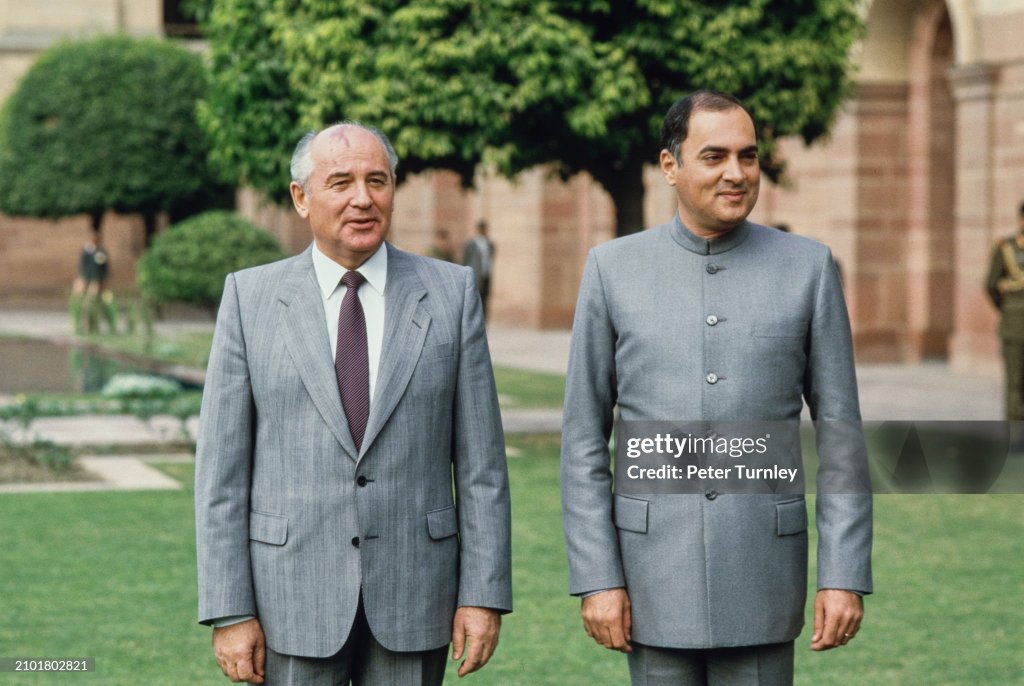
Prime Minister Rajiv Gandhi and Mikhail S. Gorbachev conferred here Wednesday for four hours and today signed a $1 billion economic aid package and accords on scientific and cultural cooperation. On Wednesday, the second day of a four-day visit, the Soviet leader also took part in ceremonies honoring India’s founders, laying a wreath at the site of cremation of Mohandas K. Gandhi, the independence leader. Two small anti-Soviet demonstrations were broken up by the police during the day.
South Korea said it will build a “Peace Dam” against a possible “water offensive” that Communist North Korea might launch to flood Seoul and wash out the 1988 Olympic Games. Seoul has said it fears that a hydroelectric dam the north is building on headwaters of the Han River could be accidentally or deliberately breached, flooding Seoul downstream and isolating its military forces in the area.
Communist rebels and the Government of President Corazon C. Aquino agreed today to a 60-day cease-fire. The cease-fire, to begin December 10, is the first formal cessation of hostilities in nearly 18 years of guerrilla war. The pact, which could open the way to comprehensive peace talks, has the backing of the Philippine armed forces, according to a statement from the Deputy Chief of Staff. Military leaders were briefed on the draft agreement today by two Government negotiators, Agriculture Minister Ramon V. Mitra and Teofisto Guingona, head of the Commission on Audits.
Relaxed from hours spent fishing, the President of the tiny chain of Western Pacific islands of Palau, Haruo I. Remeliik, was dressed in a T-shirt and shorts as he drove home on the night of his assassination. It was just after midnight, June 30, 1985. He pulled up the driveway, parking near a hill dense with tapioca and taro plants. Seconds after he climbed from the driver’s seat, a shot rang out from what was described as a .30-caliber assault rifle. President Remeliik tumbled down the slope as four rounds were pumped into his head, neck and left thigh. Word spreads quickly in a place so small that neighbors are often cousins, and within hours the 14,000 people of Palau, an American-administered trust territory southeast of the Philippines, learned that their first elected President had been assassinated.
The United States, France, New Zealand, Palau, Western Samoa, the Cook Islands and the Marshall Islands have pledged not to dump nuclear waste in the South Pacific, U.N. officials announced. The unprecedented accord bans dumping of radioactive wastes in the 200-mile zones around the Pacific islands. Australia and eight other governments in the region have approved but have not yet signed the treaty. The signatories agreed to “prevent, reduce and control pollution in the treaty area from any source.” The treaty, which must be submitted to the Senate before U.S. participation becomes official, will go into force after 10 governments have signed it.
The Thatcher Government has restated its commitment to the Falklanders in the face of another defeat over the issue at the United Nations. The General Assembly voted 116 to 4 with 34 abstentions Tuesday to support Argentina’s insistence that negotiations over the islands’ sovereignty be part of any reconciliation with Britain. The two nations went to war over the issue in 1982 and the cease-fire was followed by a diplomatic impasse. The latest episode was touched off by the two nations’ differences over fishing rights near the Falklands. Argentina signed a fishing agreement with the Soviet Union and Bulgaria, and Britain, expressing concern about overfishing, responded by announcing a 150-mile conservation zone around the islands starting next February.
The trial of Jean-Bedel Bokassa, the former Emperor Bokassa I, was postponed until next month after the prosecutor said during a stormy four-hour opening session today that he needed more time to prepare the case. Mr. Bokassa, considered one of Africa’s most brutal tyrants during his 14-year rule, has been indicted on charges ranging from multiple murder and cannibalism to embezzling hundreds of millions of dollars in state funds. He was ousted in a coup in 1979 and sentenced to death in absentia in 1980. He returned to the Central African Republic last month from exile in France.
Angolan troops may pursue United States-backed rebels into Zaire if large numbers start using that country as a sanctuary, Angola’s President said Tuesday. “Zairian territory is used by the Unita bandits,” President Jose Eduardo dos Santos of Angola said in an interview, referring to guerrillas of the Union for the Total Independence of Angola, known by its initials in Portuguese as Unita. “Hot pursuit will depend on the extent of use of Zairian territory to attack Angola.” Led by Jonas Savimbi, the group has long been active in Angola’s south, near Namibia, the territory administered by Unita’s major supplier, South Africa. But last year, the United States started sending the first of an estimated $15 million worth of supplies.
South Africa lifted a ban on the International Red Cross and said it can continue operating in South Africa despite Pretoria’s ouster from a Red Cross conference in Geneva last month. The 159–25 expulsion vote came after Third World and East Bloc delegates urged excluding South Africa because of its apartheid system of racial separation. South Africa said its retaliatory ban on the Red Cross was canceled after Red Cross President Alexandre Hay wrote Pretoria dissociating himself from the ouster move. The Red Cross in South Africa helps with political prisoners and refugees.
In what many analysts called the first solid evidence of a turnaround in the trade deficit, the Commerce Department reported today that a surge in exports narrowed the deficit last month to its lowest level since August 1985. The trade gap — the amount by which imports exceed exports — fell $500 million, to $12.06 billion. Administration officials and private analysts said they were particularly encouraged by a 10.3 percent rise in exports, the biggest in 19 months, which more than offset a 4.4 percent rise in imports. “What we’re seeing is the first really serious sign of improvement in exports,” said Keith N. Johnson, senior economist at Townsend-Greenspan Inc., a New York consulting concern. He said he was considerably “encouraged” by today’s report, which was markedly better than most forecasters had expected despite a widening of the trade deficit with Japan.
President Reagan participates in a ceremony to receive a Thanksgiving turkey from the National Turkey Foundation.
President Reagan places a call to Mrs. Peggy A. Say, sister of American hostage Terry Anderson.
Idled steelworkers trying to stop steel shipments blockaded USX Corp. plants in Ohio and Utah, and nearly 90 were arrested, authorities said. In Orem, Utah, 73 protesters were arrested as they tried to stop trucks at the gates of the Geneva Steel Works. In Lorain, Ohio, 14 people were arrested as workers blocked railroad tracks leading from the Lorain Works. There were five people reported injured among police and protesters. The protests were part of a work stoppage that began August 1, idling 22,000 United Steelworkers union members and stopping work at 16 USX plants. The dispute, the longest ever against a U.S. steelmaker, is being called a strike by the firm and a lockout by the union.
Conservative newspaper publisher John McGoff pleaded not guilty to charges that he failed to register as an agent for South Africa. McGoff, 61, president of Global Communications Corp., made the plea at his arraignment before U.S. District Judge Charles R. Richey in Washington. McGoff’s attorney, Raymond G. Larroca, said he will seek a dismissal of the charges on the grounds that the statute of limitations had expired. McGoff, who owns one Michigan daily, recently sold his interest in suburban Detroit weeklies.
In a dramatic Thanksgiving Eve move to thwart his successor, Governor Toney Anaya of New Mexico today commuted the death sentences of all five men awaiting execution in the state, saying the penalty was “inhumane, immoral and anti-God.” Lawyers said it was believed to be the first mass reprieve since Governor Winthrop Rockefeller of Arkansas commuted the death sentences of all 15 inmates awaiting execution in 1970. Todays action came just five weeks before the Democratic Governor is to complete his four years in office, during which he stayed all pending executions. “My personal beliefs do not allow me to permit the execution of an individual in the name of the state,” he said minutes after signing executive orders reducing the sentences to life imprisonment.
The last two of eight people convicted in a plot to smuggle 100 rifles and thousands of rounds of ammunition to the Irish Republican Army were sentenced to prison terms. U.S. District Judge A. David Mazzone in Boston sentenced Noel Murphy, 26, of County Cork, Ireland, to nine years, and Cairan Hughes, 24, of Belfast, Northern Ireland, to eight years. They were arrested with six others at an airfield near Boston, where they were loading weapons aboard a jet.
A survivalist who was a bank robbery suspect, after eluding the police for three months, was killed today in a rugged stretch of North Carolina mountains in a gun battle that left two police officers wounded. The suspect, Michael John Shornock, opened fire on about a dozen officers who were checking a barn on an apple farm, said Capt. George Erwin of the Henderson County sheriff’s office.
Daniel A. Manion, whose qualifications as a judge were attacked by law school deans shortly after President Reagan appointed him to the U.S. 7th Circuit Court of Appeals, was sworn in as a judge. “This is a great honor for me,” Manion said after Appeals Court Chief Judge William J. Bauer administered the oath of office in South Bend, Ind. Manion’s opponents had attacked the quality of his legal writing and said he was unfit for the post.
A conservative Coast Republican was nominated by Governor George Deukmejian to succeed Rose Elizabeth Bird as Chief Justice of the California Supreme Court. Governor Deukmejian today nominated Associate Justice Malcolm Lucas, his former law partner, to succeed Bird as Chief Justice. The nomination of Justice Lucas, a conservative Republican who has a reputation for taking a hard line against criminal defendants, is widely expected to start a fundamental shift in direction at one of the country’s most influential state courts. Since the late-1970’s it has been dominated by appointees of Edmund G. Brown Jr., a liberal Democrat. Justice Lucas’s nomination is subject to review by the State Bar and a three-member legal commission. State legal experts say they expect no significant opposition to his appointment.
Black sect members are accused of child beating and other parental abuse in Florida and New York. A Florida official said members of the Yahweh religious sect were becoming increasingly violent.
Members of the International Typographical Union, its numbers decimated by computerization of the newspaper and printing industries, voted overwhelmingly to become a part of the Communications Workers of America, which is dominated by telephone employees. ITU members voted by more than a 4–1 margin to merge with the CWA, ending a decade-long effort by the typographers to align themselves with a larger union.
The 29th known recipient of an artificial heart is an unidentified 40-year-old Arizona woman. The surgery lasted more than eight hours.
A petition to hold an election on ousting Omaha, Nebraska Mayor Michael Boyle from office has gathered enough signatures, according to an election official. Steve Wiitala, the Douglas County Election Commissioner, said his staff was trying to finish certifying the signatures but that he would wait until December 2 to notify Mr. Boyle officially.
A thin river of lava from the Kilauea volcano consumed two houses in its path today and officials feared that three more homes would also be destroyed. No injuries were reported.
Oil spills have dropped sharply since 1983 because of improved operating standards for oil transportation organizations and reduced demand for oil, according to a research group.
Many types of cancer can apparently be detected in what may be early stages by a new type of blood test, a medical journal reports. Researchers said it could be a step toward developing a simple means of screening people for cancer before it can be detected by X-rays or other conventional diagnostic means. The new blood test might also be used to monitor the effectiveness of cancer therapies, the researchers said in an article in the issue of The New England Journal of Medicine being published today. An editorial in the same issue calls the findings “provocative.” But it adds that the researchers, at the Beth Israel Hospital and Harvard Medical School in Boston, still have “much work” to do with much larger numbers of patients” to determine what value the test has in routine physical examinations and in screening for early cancers among apparently healthy people.
Two and possibly three interplanetary spacecraft will be launched from the cargo bays of space shuttles using less powerful but safer boosters than originally planned, the National Aeronautics and Space Administration said today. The agency also said it had selected a rocket manufactured by the Orbital Sciences Corporation to carry another spacecraft, the Mars Observer, to the planet in the early 1990’s. The three spacecraft that may be launched from the shuttles are the Galileo, designed to explore Jupiter; the Ulysses, which will orbit and study the Sun, and the Magellan, which is to orbit and map Venus. They were originally to have been lofted using hydrogen-fueled Centaur rockets built by the General Dynamics Corporation.
Two astronomers reported discovering what may be the first evidence that an object — possibly part of a star — was sucked into a black hole. Bradley Peterson and Gary J. Ferland, associate professors of astronomy at Ohio State University, reported in the British science journal Nature that an object about the size of the Earth’s sun was torn apart by a huge black hole, which sucked in a small fraction of the object. A black hole is a star that has collapsed into a tremendously dense mass with gravity so strong that not even light can escape it.
Continued high waters from the Chehalis River kept about 250 people away from their homes in flood-weary western Washington, while other rivers in the state gorged by heavy rain and melting snow receded. The threat of flooding moved to the Midwest and East, where a storm that brought heavy rainfall to the South was centered in the Ohio Valley. Some roads in southern Indiana were reported under nearly a foot of water and flash-flood watches were posted for Ohio, western Pennsylvania and western New York.
Barnes & Noble, the nation’s leading book discounter and its third-biggest bookseller, has purchased B. Dalton, the nation’s second-largest chain of bookstores, which has been faltering lately because of competition from discounters. Neither the Dayton Hudson Corporation, the parent of B. Dalton, nor Leonard Riggio, owner of Barnes & Noble, would disclose the sale price for the 779-store chain. Analysts, however, estimated the price at between $275 million and $300 million. Mr. Riggio, whose 35 Barnes & Noble stores are situated mostly in the New York City area, said that he would continue to operate the two chains independently, under their current names.
The Great Atlantic and Pacific Tea Company, continuing its two-year comeback as one of the nation’s largest supermarket chains, agreed yesterday to purchase a controlling interest in Waldbaum Inc., the nation’s 12th-largest supermarket operation, with 140 stores in New York, Connecticut and Massachusetts. The $287 million deal involves a complex agreement under which APW Partnership Corporation, a new entity created by a partnership of A.&P. and members of the family of Ira Waldbaum, will make a tender offer at $50 a share for the 5.7 million shares outstanding.
Companies are wooing older people. Americans over 50 control more than three quarters of the nation’s wealth and are a growing market. Corporate research indicates that many are more active consumers than had been previously thought.
Before investors departed yesterday for the Thanksgiving break, they bought enough blue-chip stocks to push the Dow Jones industrial average to within a few points of its record. But more issues declined in the session than rose. The Dow, which has a history of performing well the day before and after Thanksgiving, rose 4.64 points, to 1,916.76, thanks largely to a spurt of buying in the final 30 minutes. Discussing yesterday’s mixed performance, L. Crandall Hays, an analyst with Robert W. Baird & Company, Milwaukee, said the stock market was due for a pause. “It’s gone up so far the last week that it couldn’t push through,” he said, referring to Dow’s failure to top the record 1,919.71 set on September 4.
Dow Jones Industrial Average: 1916.76 (+4.64)
Born:
Lazar Hayward, NBA small forward (Minnesota Timberwolves, Oklahoma City Thunder), in Buffalo, New York.
Edwin Ubiles, NBA small forward (Washington Wizards), in Brooklyn, New York, New York.
Trevor Morgan, American actor (“Genius”), in Chicago, Illinois.
Diego Urbano, Chilean jazz vibraphonist, composer, and bandleader (“Begs the Question’’), in Santiago, Chile.

