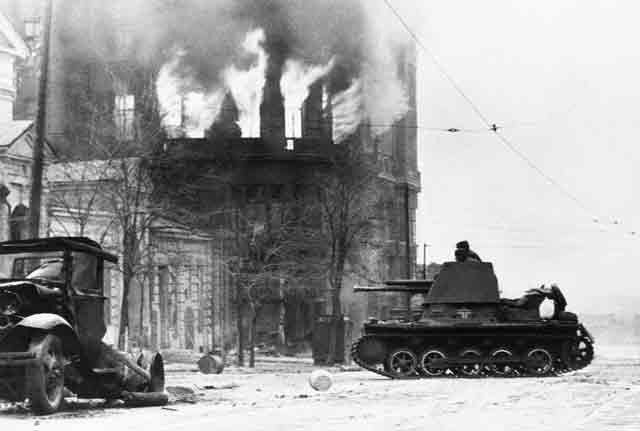
The German 3.Panzerkorps captured Rostov-on-Don in southern Russia.
The Germans now are in possession of Rostov-on-Don, one of the key objectives set forth for Operation Barbarossa in 1941. This should be cause for celebration at the Führer Headquarters in East Prussia on 22 November 1941. However, behind the scenes, Adolf Hitler is growing increasingly agitated at the army’s handling of operations. The success of the entire 1941 campaign depends upon holding Rostov and other key objectives, and there are growing signs that these accomplishments may be in serious jeopardy.
Superficially, the situation on the ground in Russia does appear successful for the Germans. As General Franz Halder, chief of the Oberkommando des Heeres staff (OKH, Army High Command), writes in his war diary:
“Rostov is in our hands. All bridges are reported destroyed except one that leads across the island south of the eastern part of the city. The Russians withdrew across the frozen river. On the southern bank [are] new Russian forces (two Cavalry Divisions).”
However, the Wehrmacht had to exert a massive effort to reach this gateway to the Caucasus and, as Halder notes, the Red Army is bringing in reinforcements. As Halder further notes:
“North of Rostov, First Panzer Army was forced into the defense by the Russian attack with superior forces and will have a hard time seeing it through. The measures instituted are well taken and promise to be successful. However, after First Panzer Army has disposed of the attacker, it probably would be too much to expect it to clear the enemy out of the Donets bend with what is left of its forces.”
The bottom line is that, glorious as the capture of Rostov is, the situation is extremely tenuous.
In fact, serious doubts are creeping into the rosy picture at the highest levels of the Wehrmacht. Halder indicates some dissatisfaction with the generals at the front cooperating towards the greater good:
“Despite all efforts of the Army Group to get Sixth Army moving there are no signs of an attack or initiation of the transfer of the divisions destined for First Panzer Army [which is trying to hold Rostov]. The consequence is that the enemy is withdrawing forces fronting this passive Army to commit them against the First Panzer Army.”
Adolf Hitler is taking an increasingly close eye on developments at the front, and Field Marshal Keitel reports that the Führer is “in a state again.” As Halder records in his diary, one of the issues is General von Kleist, whose 1st Panzer Army forces hold Rostov.
“OKW is worried about Kleist. Führer discusses lateral shifting of forces within the Seventeenth Army in order to help IV Corps get ahead so as to relieve Kleist. Sector boundaries between Kleist, Hoth, and Reichenau must not be allowed to interfere.”
The seriousness of the situation is highlighted by the fact that Halder returns to it several times in his diary. Obviously, Kleist’s situation is a topic of major discussion throughout the day. OKW Headquarters definitely recognizes the problem, Halder emphasizes:
“Kleist’s Army is in serious trouble and no one does anything to help him. The Army Group has been ordered to report what steps have been taken (shifting of forces of Seventeenth Army on the baseline to IV Corps, getting on the move Sixth Army and anything else that is available, especially Assault Guns.”
Such repeated hand-wringing by Halder is unusual and likely a sign that everyone knows this is the Führer’s main concern today. The bottom line is that, glorious as the capture of Rostov is, the vulnerabilities of the Wehrmacht’s position and even the possible loss of the strategic initiative are beginning to take center stage.
As the ice on Lake Ladoga reached 20 centimeters in thickness, 60 trucks made the crossing, aiming to bring back food into Leningrad, Russia on their return trip on the next day. The road across the lake was called “The Road of Life”. It was the main artery connecting the encircled city with friendly territory.
Soviet Premier Joseph Stalin presents a plan to the British to pull Finland out of the war. The British give Finland two weeks’ time to cease their offensive operations or it will declare war on Finland.
The personnel of German Luftwaffe III./KG 4 departed Pskov (German: Pleskau), Russia by rail for a period of rest in Fassberg, Germany. The group’s aircraft were reassigned to I./KG 4 for continued use against Soviet positions in the Leningrad area.
Robert von Greim was mentioned in the Wehrmachtbericht radio report.
Paul von Kleist was mentioned in the Wehrmachtbericht daily radio report.
Operation CRUSADER, a bold new assault on Rommel, is now in its fifth day with the heaviest fighting in the Desert War so far at Sidi Rezegh. Extensively re-equipped and reinforced for the new campaign, the Allied forces now have more than 700 tanks against Rommel’s 320 and nearly 700 aircraft against 320 Axis planes. To Churchill’s annoyance the new Commander-in-Chief, General Claude Auchinleck, refused to begin the offensive until all the new supplies had arrived.
The British offensive in North Africa, Operation Crusader, continues with mixed success. Today is the “Battle of the Omars” due to much of the fighting taking place near Sidi Omar. A British breakout from Tobruk has been stopped by Italian defenders who are showing their mettle. The Italians hold strong points “Tugun” and “Dalby Square” by using a superior position on nearby heights to devastate attacking British tanks and reduce one British company to 33 men of all ranks. The Italian Army shows on 22 November 1941 that, properly armed and positioned, they can be a tremendous asset to the Axis despite all the negative publicity they receive. Coming up from the south, General Scobie’s Eighth Army, led by the 2nd York and Lancaster Regiment, does make some progress and takes strong point “Tiger.” However, these British forces also continue to be unable to make a clean breakthrough against the Italian and German forces who have the advantage of prepared defensive positions. The two sides are grappling fiercely, “in the clinch,” and it remains unclear who will win.
The aim of CRUSADER is to pin down Axis troops on the frontier, outflank them in the desert, and smash through Rommel’s forces to link up with the Tobruk garrison 70 miles north of the frontier. At the start of the campaign the Allies had surprise on their side, and caught Rommel unawares planning his own attack on Tobruk. But yesterday British and South African forces setting out from Sidi Rezegh for Tobruk were savagely hit from the south and east by two panzer divisions. At midday today the 21st Panzer Division struck at the western flank of the British position, over-running the airfield and leaving devastation and confusion by nightfall. At the end of this battle, British units withdraw away from Tobruk. Separately the British 4th Armoured Brigade is mauled by the German 15th Panzer Division. The initiative passes to the Germans. Italian cruiser Cardona arrived at Benghazi, Libya with fuel badly needed by Axis vehicles on the front line; the journey was made without any escorts due to the pressing need. On land, New Zealand and Italian troops engaged in fighting near Sollum, Egypt while the Indian 7th Brigade captured Sidi Omar, Libya. The battle at Sidi Rezegh continued. British tank losses forced the British XXX Corp to order an end to their advance on Tobruk. The garrison at Tobruk was also ordered back to their defensive positions.
The 2nd New Zealand Division captured Fort Capuzzo.
Oberst (Colonel) Werner Mölders, Inspector of Fighters and, quite possibly, the greatest ace of all time, perishes in an air crash at Breslau while his plane tries to land during a thunderstorm. Mölders is just a passenger in the Heinkel He 11 of Kampfgeschwader 27 “Boelcke” as he flies to attend the funeral of General Ernst Udet in Berlin. The event is a visceral shock that reverberates throughout the Luftwaffe, as Mölders is honestly liked and respected by the rank and file both for his attitude and for having over 100 victories. A state funeral is planned for 28 November 1941. Within hours, Mölders’ old unit, Jagdgeschwader 51, is renamed “Mölders” in his honor. Werner Mölders, respected for his pure skill and expertise regardless of politics, will be honored in numerous ways during the post-war years. Some of those honors remain in the 21st Century despite efforts to reverse them, including the naming of the street “Möldersstraße” in Geilenkirchen and Ingolstadt. Colonel Mölders’ grave at The Invalidenfriedhof has been restored after being destroyed by the East German government for political reasons.
Paris: A hand grenade is thrown into a Wehrmacht canteen.
British Commandos carried out Operation Sunstar, an overnight raid on Houlgate, France.
Maxim M. Litvinov, newly appointed Soviet Ambassador to the United States, abandoned plans to visit London en route to Washington, it was learned tonight, following a “muddle” that barred him from a British transport plane at Tehran.
A Swordfish torpedo bomber of British No. 830 Squadron damaged Italian cruiser Abruzzi at 0038 hours off Sicily, Italy; the aircraft was shot down in the process, with 1 killed and 1 captured.
The British Royal Navy dispatched cruisers HMS Devonshire, HMS Dorsetshire, and HMS Dunedin to the South Atlantic to search for the German armed merchant cruiser Atlantis. HMS Devonshire successfully found Atlantis, fueling submarine U-126. While U-126 was able to escape, Atlantis’ crew had no choice but to scuttle her.
British destroyer HMS Sardonyx collided with anti-submarine trawler HMT St. Apollo near the Isle of Lewis, Outer Hebrides, Scotland, United Kingdom. Sardonyx received damage while St. Apollo would sink.
Allied convoy PQ.3 crossed the Arctic Circle west of Norway. Later in the same day, German Stuka dive bombers attacked the convoy without success; two dive bombers were lost during the mission.
Battleship HMS Nelson, escorted by destroyers HMS Faulknor and HMS Icarus, departed Scapa Flow for Rosyth at 1830. Destroyer HMS Eclipse was ordered to leave monitor HMS Erebus off Duncansby Head and join the escort, but the destroyer was unable to proceed due to bad weather and returned to Scapa Flow at 2230. Battleship Nelson arrived at Rosyth at 1100/23rd. The destroyers returned to Scapa Flow, arriving at 1640 that day.
French submarine Minerve departed Dundee for patrol off the Norwegian coast. On the 23rd, the submarine experienced mechanical problems and was diverted to Scapa Flow for repairs, arriving on the 24th. Submarine Minerve was able to departed Scapa Flow on the 25th for patrol.
Anti-submarine trawler HMS St. Apollo (580grt, T/Lt R. H. Marchington RNVR) was sunk in a collision with destroyer HMS Sardonyx off the Hebrides in 59-13N, 7-41W. Destroyer HMS Punjabi, en route from Hvalfjord to Scapa Flow, was ordered to proceed to assist. On arrival, the trawler had already sunk. Destroyer Punjabi escorted destroyer Sardonyx to Loch Ewe. At the Minches, destroyer Sardonyx proceeded unescorted to Loch Ewe and destroyer Punjabi proceeded to Scapa Flow, arriving at 1700/23rd.
Submarine HMS Seawolf unsuccessfully attacked a steamer three and a half miles from Syltefjord.
Norwegian steamer Bestum (2215grt) was damaged by German bombing off Platters near Harwich.
Swedish tanker Uno (408grt) was sunk on a mine three miles off the entrance to Memel. One crewman was lost on the tanker.
German fishing vessel Gertrud Kampf (471grt) was sunk on a mine near Libau.
British schooner Maria Di Giovanni (255grt, T/Lt A.B. Palmer RNR) was lost when she grounded west of Tobruk. Palmer, T/Lt J. Lucas RNR, and the crewmen were taken prisoner.
Dutch submarine HNLMS O.21 sank Italian sailing ship San Salvatore (92grt) off Sardinia in 41-25N, 10-42E.
Destroyers HMS Laforey, HMS Lightning, HMS Legion, and HMS Gurkha of the 19th Destroyer Flotilla departed Gibraltar for exercises and to carry out an anti-submarine sweep.
Corvette HMS Spiraea departed Gibraltar escorting Norwegian tanker Thorshavet and then to meet arriving tanker Velma. On the 23rd, anti-submarine trawlers HMS Lady Hogarth and HMS Stella Carina were ordered to join the outward escort. Corvette HMS Geranium departed Gibraltar on the 29th to provide additional escort. On 1 December, the tanker and corvette Spiraea arrived at Gibraltar.
Convoy ST.9 departed Freetown, escorted by corvettes HMS Armeria, HMS Burdock, and HMS Wallflower. The convoy arrived at Takoradi on the 27th.
Heavy cruiser HMS Devonshire sank German raider Atlantis in the South Atlantic off Ascension Island. U-124 took the lifeboats the cruiser in tow. On the 24th, supply ship Python was met and the survivors were taken aboard. The German ship in her cruise had sunk twenty two allied ships for 145,697 tons in the Atlantic, Pacific, and Indian Oceans.
New Zealand light cruiser HMNZS Achilles met Australian light cruiser HMAS Adelaide in Cook Strait and took over convoy VK.21. Light cruiser HMNZS Achilles departed the convoy on the 24th two hundred and fifty miles east of Chatham Island and proceeded to Navulu Passage.
Convoy SC.56 departed Sydney, CB escorted by corvettes HMCS Drumheller, and HMCS Summerside, and minesweepers HMCS Georgian and HMCS Thunder. These corvettes were detached on the 24th when the convoy was joined by destroyer HMCS Restigouche and corvettes HMCS Agassiz, Alysse, HMS Amhurst, HMCS Bittersweet, HMCS Chicoutimi, HMCS Morden, and HMCS Orillia. Corvette Alysse was detached on 4 December, destroyer HMCS Restigouche and corvettes HMCS Agassiz, HMCS Amherst, HMS Chicoutimmi, HMCS Morden, and HMCS Orillia on 5 December. Sloop Commandant Detroyat joined on 5 December and destroyers HMS Beagle and HMS Montgomery, corvettes HMS Heather, HMS Lobelia, and HMS Narcissus, and anti-submarine trawler HMS Lady Madeleine joined on 6 December. Destroyer Montgomery was detached on 8 December and the rest of the escorts on 9 December before the convoy arrived at Liverpool on 10 December.
The captive coal mine strike was ended today in an agreement that its issue be submitted to arbitration with both sides bound in advance to accept the results. At the continued entreaty of President Roosevelt, the policy committee of the United Mine Workers of America voted unanimously to send its men back into the pits on these terms at once. John L. Lewis, the union’s president, said the decision was made “in the public interest.” Lewis personally rejected the plan earlier in the week. Mr. Roosevelt’s statements on the dispute had so prejudiced the public mind, Lewis said then, that it would be extremely difficult to find an impartial arbiter. But the chief executive, who had said that the mining of coal must be resumed because it was essential to the national defense program, persisted. He addressed another of his several letters to Lewis and the C.I.O. union before today’s policy committee meeting, and named the arbiter in advance of the union’s concurrence.
Thirty thousand tons of steel, enough steel to build thirty destroyers, were “irrevocably lost” to the national defense effort as a result of curtailment of production caused by the captive-mine strike in the mills of the Carnegie-Illinois Steel Corporation, principal subsidiary of the United States Steel Corporation, officials said tonight.
Passage of some measure to curb strikes will be pushed, Representative Norton of New Jersey said today after a conference with President Roosevelt. She said the President desired the House Labor Committee to continue its work of framing restrictive legislation despite the fact that the coal stoppage was ended.Mrs. Norton, who is chairman of the committee, said that the President had nothing specific to offer in the way of legislation, but had expressed confidence that the committee could obtain a satisfactory measure from those it was considering. Voicing regret that “labor has forced this thing upon us,” Mrs. Norton said that, nevertheless, “we’ve got to do something about it.” She explained that she hoped her committee would report a bill “that will not destroy labor gains made during the past eight years, but that will compel labor to understand that we are in an emergency and that they have got to conform to the situation.” She added that it was unfortunate that labor had “put us [the committee] in that position because we have certainly gone far out to do everything we could to improve labor’s position.”
Cautioning the world’s democracies to be on guard, the White House said today Germany was preparing a winter peace offensive embracing proposals ostensibly restoring economic and political independence to continental Europe, but actually leaving Hitler master of a string of “puppet states.”
Defense agencies received authority to requisition property required for the defense of the country in an Executive Order signed by President Roosevelt on Wednesday and made public today. Under the order the Office of Production Management, on its own initiative or acting at the request of related government agencies, can order the seizure and disposition of materials or property when it considers such a course essential to defense.
A two-day strike of Steel Workers Organizing committee (C.I.O.) against Columbia Steel Co., of Pittsburg, California, which holds $5,000,000 In defense contracts, was ended today and the plant resumed operations, Federal Conciliator Omar Hoskins announced. Hoskins said the 3,200 striking unionists voted to return to work while the management and the strike committee continued negotiations on the union’s demands for upward wage revisions in one department of the plant.
In a ninety-minute conference today with representatives of both sides in the railroad wage dispute, President Roosevelt arranged for a resumption of direct negotiations between unions and carriers. Later, spokesmen for 1,150,000 railroad workers expressed the hope that the dispute would be settled in advance of the December 7 strike deadline.
The Congress of Industrial Organizations ended its annual convention at noon in Detroit, Michigan today with the adoption of resolutions savagely assailing the National Labor Relations Board and the Federal Bureau of Investigation.
Refusal of the Navy to make public news of Axis submarine sinkings was criticized today by three of the Senate’s non-interventionist bloc, who declared all publicity regarding naval activities should be made known unless American lives were endangered.
Direct negotiations between the Bell Aircraft Corporation, producing planes for the United States and Britain, and the C.I.O. United Automobile Workers in an effort to prevent a threatened strike are likely to be resumed within a week or two, a company spokesman said tonight.
The United States was brought two steps nearer its two-ocean Navy today when the twin destroyers Aaron Ward and Buchanan, sister ships of the torpedoed U.S.S. Kearny, were launched within twenty-two minutes of each other at the Navy-operated yards of the Federal Shipbuilding and Dry Dock Company in Kearny, New Jersey.
Naval Air Station, New York SNJ-2 delivers needed infantile paralysis serum to Norfolk. It ultimately arrives in Bermuda on time.
Harvard scored a two-touchdown victory over a courageous Yale eleven, 14–0, and won the football championship of the old Big Three on the last big Saturday of the campaign. The game, sixtieth in the series, attracted 55,000. In another Ivy League classic Penn downed Cornell, 16–0, before 73,000. New York’s top game resulted in a one-sided victory for Fordham, 35–7, over St. Mary’s. Meanwhile Colgate defeated Columbia in a high-scoring contest, 30–21, Navy subdued Princeton, 23–0, and Army rallied to top West Virginia by 1 point, 7–6. Notre Dame, Minnesota and Duke, candidates for the mythical national title, all won as they closed their seasons. Ohio State and Michigan played a thrilling 20–20 tie as 85,753 looked on.
Japanese proposals for settlement of Pacific problems were studied for nearly three hours today by Secretary of State Hull and British, Chinese, Dutch and Australian representatives, but no hint was given as to their reaction. Likewise, none of the participants in the meeting the first general gathering of representatives of the ABCD powers whose policies, clashing with Japanese policies, have brought a threat of war to the Far East would give any clue as to the nature of the Japanese proposals.
U.S. Secretary of State Cordell Hull hinted that there might be relaxation of economic pressures on Japan saying that, “… there was a general feeling that the matter could all be settled if the Japanese could give us some satisfactory evidences that their intentions were peaceful.” Hull “said that he had called in the representatives of certain other governments concerned in the Pacific area and that there had been a discussion of the question of whether things (meaning Japanese peaceful pledges, et cetera) could be developed in such a way… these representatives were interested in the suggestion and there was a general feeling that the matter could all be settled if the Japanese could give us some satisfactory evidences that their intentions were peaceful.”
Premier John Curtin, in commenting on the Returned Soldiers’ League’s advocacy of conscription, said that the whole history of such advocacy in Australia had been marked by increasing national disunity, which was most undesirable at any time and would be adverse in the conduct of the war.
The Japanese embassy in Washington DC, United States was instructed that the proposal submitted by Japanese diplomats two days prior would be the final proposal. The deadline for a successful conclusion was pushed back to 29 Nov 1941, upon which date, should the proposal be rejected, the war plans would be executed. The message contains the following statement: “There are reasons beyond your ability to guess why we wanted to settle Japanese-American relations by the 25th, but if within the next three or four days you can finish your conversations with the Americans.”
U.S. Navy issued Task Force Ultrasecret Operation Order 1: warships were to proceed to Hawaiian waters in secrecy, with mission to conduct pre-emptive strikes on any potential threats against Hawaii.
The Japanese First Air Fleet arrives in Hitokappu Bay, Etorofu Island, Kurile Islands. This fleet consists of six aircraft carriers (HIJMS Akagi, Hiryu, Kaga, Shokaku, Soryu and Zuikaku), two battleships (HIJMS Hiei and Kirishima), two heavy cruisers (HIJMS Chikuma and Tone), a light cruiser (HIJMS Abukuma) and ten destroyers. This is the force that will attack Pearl Harbor, Territory of Hawaii.
Dow Jones Industrial Average: 117.04 (-0.01)
Born:
Jacques Laperrière, Canadian NHL defenseman (Hall of Fame, inducted 1987; Stanley Cup-Canadiens, 1965, 1966, 1968, 1969, 1971, 1973; NHL All-Star, 1964, 1965, 1967, 1968, 1970; Montreal Canadiens) and coach, in Béarn, Quebec, Canada.
Jerry Greenspan, NBA shooting guard (Philadelphia 76ers), in Newark, New Jersey (d. 2019).
Jesse Colin Young [Perry Miller], American folk-rock singer-songwriter (Youngbloods — “Get Together”, “Sunlight”), in Queens, New York, New York (d. 2025).
Ron McClure, American jazz-rock bassist (Blood, Sweat & Tears), in New Haven, Connecticut.
Tom Conti, Scottish actor (Reuben, Reuben, American Dreamer), in Paisley, Scotland, United Kingdom.
Died:
Werner Mölders, 28, German fighter ace (plane crash).
Kurt Koffka, 55, German psychologist.
Naval Construction:
The U.S. Navy LCT (Mk 5)-class landing craft, tank USS LCT-389 is laid down by the Mount Vernon Bridge Co. (Mount Vernon, Ohio, U.S.A.).
The U.S. Navy PC-461-class (173-foot steel hull) submarine chaser USS PC-477 is laid down by the Defoe Shipbuilding Co. (Bay City, Michigan, U.S.A.).
The U.S. Navy PC-461-class (173-foot steel hull) submarine chaser USS PC-588 is laid down by the Leatham D. Smith Shipbuilding Co. (Sturgeon Bay, Wisconsin, U.S.A.).
The U.S. Navy YMS-1-class auxiliary motor minesweeper USS YMS-55 is launched by the Gibbs Gas Engine Co. (Jacksonville, Florida, U.S.A.).
The U.S. Navy YMS-1-class auxiliary motor minesweeper USS YMS-89 is launched by the Hubbards South Coast Co. (Newport Beach, California, U.S.A.).
The Royal Navy MMS I-class motor minesweeper HMS MMS 69 (J 569) is launched by the Richards Ironworks Ltd. (Lowestoft, England, U.K.).
The Royal Navy MMS I-class motor minesweeper HMS MMS 84 (J 584) is launched by the Wivenhoe Shipyard Ltd. (Wivenhoe, England, U.K.).
The Royal Navy Isles-class minesweeping trawler HMS Jura (T 169) is launched by the Ardrossan Dockyard (Ardrossan, Scotland); completed by Plenty.
The U.S. Navy PC-461-class (173-foot steel hull) submarine chaser USS PC-496 is launched by the Leatham D. Smith Shipbuilding Co. (Sturgeon Bay, Wisconsin, U.S.A.).
The U.S. Navy Gato-class submarine USS Growler (SS-215) is launched by the Electric Boat Co. (Groton, Connecticut, U.S.A.).
The Royal Navy Flower-class corvette HMS Borage (K 120) is launched by George Brown & Co. (Greenock, Scotland); completed by Kincaid.
The Royal Navy Hunt-class (Type III) escort destroyer HMS Catterick (L 81) is launched by Vickers Armstrong (Barrow-in-Furness, U.K.).
The U.S. Navy Gleaves-class destroyers USS Aaron Ward (DD-483) and USS Buchanan (DD-484) are launched by the Federal Shipbuilding & Drydock Co. (Newark, New Jersey, U.S.A.).
The Royal Navy MMS I-class motor minesweeper HMS MMS 22 (J 522) is commissioned. Her first commanding officer is T/Lieutenant J M C Easton, RNVR.
The Royal Navy Thornycroft 55-foot motor torpedo boat HMS MTB 328 is commissioned.
The Royal Navy Thornycroft 55-foot motor torpedo boat HMS MTB 345 is commissioned.
The Kriegsmarine (German Navy) Type 37 torpedo boat T18 is completed.
The Royal Australian Navy Bathurst-class corvette-minesweeper HMAS Deloraine (J 232) is commissioned. Her first commanding officer is Lieutenant Commander Desmond Aubrey Menlove, RANR(S).
The Kriegsmarine (German Navy) Type VIID U-boat U-215 is commissioned. Her first commanding officer is Kapitänleutnant Fritz Hoeckner.
The Kriegsmarine (German Navy) Type VIIC U-boat U-438 is commissioned. Her first commanding officer is Kapitänleutnant Rudolf Franzius.
15…

