A Pentagon report says that recent Soviet research on microwaves has “great potential for development into a system for disorienting or disrupting the behavior patterns of military or diplomatic personnel. It could be used equally as well as an interrogation tool.” The report made no mention of the current microwave bombardment of the U.S. Embassy in Moscow, which the State Department has declared an unhealthful post.
Five members of a U.S. congressional commission set up to monitor Soviet and Eastern European compliance with the human rights agreement of last year’s European Security Conference reported they have found little progress but remained optimistic. In a statement after a visit to 18 Western European nations, the group said the 35-country Helsinki agreement was “showing both potential and real significance as an instrument for opening long-closed doors to the two-way flow of people, commerce and information.”
Leonid I. Brezhnev, the Soviet leader, arrived in Bucharest, Rumania today on a visit aimed at smoothing over the sometimes troubled relations between the two Communist neighbors. The visit, which was his first in a decade, suggested that both countries were interested in exploring common ground for cooperation in light of the policy of political and ideological independence followed by Nicolae Ceaușescu, the Rumanian leader. A conciliatory tone was evident in the toasts that the two leaders raised to each other at a dinner tonight. Mr. Ceaușescu declared that “some differences of opinion on nonessential questions should not affect the collaboration of our parties and states.” Mr. Brezhnev concentrated on the economic advantages of the relationship and called for a greater coordination of foreign policy. Mr. Brezhnev was greeted by Mr. Ceaușescu on arriving at the airport. Organized crowds, chanting and waving small Soviet and Rumanian flags, lined the road to the city. The turnout, estimated at 150,000 by Rumanian sources, was smaller than the one that greeted President Ford last year.
A Soviet religious activist, Edward Fedotov, has been released from a mental hospital, according to dissident sources in Moscow. Three other dissidents have been freed this month in what Soviet activists are interpreting as a gesture of good faith to President-elect Jimmy Carter, who has spoken out for human rights in the Soviet Union. However, dissident physicist Andrei D. Sakharov said at the same time that police had seized what they described as “slanderous, anti-Soviet material” at the Moscow apartment of a dissident woman lawyer, Zina Kamenskaya.
A meeting between an East German and an American representative has opened the way for a onetime payment from East Germany to “needy” U.S. Jewish citizens who were persecuted by the Nazi regime, the official news agency ADN reported. Otto Funke, a leader of the East German “committee of anti-Fascist resistance fighters,” told Benjamin B. Ferencz, a representative of one U.S.-based organization of Jews who were Nazi victims, of the plan, ADN said. No details of the payments were given.
Increased economic growth to avert a possible worldwide recession should be pressed by the United States, West Germany and Japan, according to Lawrence Klein, a top economic adviser to President-elect Carter. Professor Klein, in an interview in Paris, said that Washington should pump at least $10 billion into the economy, with a tax cut or more federal spending.
Washington’s plan to grant Portugal a $300 million emergency loan could save the country from the prospect of imminent bankruptcy and would give the young democracy a chance to get on its feet. The prospective loan was disclosed by The New York Times in a Washington dispatch last week. A formal announcement, which is expected soon, has been delayed pending consultation by Administration officials with members of Congress and foreign governments. The projected loan is viewed here as‐decisive support for the four‐month‐old minority Government of Prime Minister Mario Soares and its program for economic recovery. The mere promise of aid could come as an important boost to Mr. Soares and his Socialist Party as they face reinforced opposition from the Communists and parties on the right in next month’s crucial municipal elections.
The British House of Lords, the upper house of Parliament whose approval of measures passed in Commons was usually taken for granted, overwhelmingly voted to reject the government-sponsored measure to nationalize Britain’s aircraft and shipbuilding industries, with only 90 in favor and 197 against. The Lords refused to accept the bill as written and insisted on exemptions from takeover for ship-repairing companies that had made a profit.
The United Kingdom’s Energy Act 1976 received royal assent, empowering the British Secretary of State to control the production, supply, acquisition and use of fuels and electricity, and included measures for the conservation of fuels.
Israel was restored to full membership in the United Nations Educational, Scientific and Cultural Organization as a two-year policy barring it from the agency’s European unit was reversed. But the agency voted 61 to 5, with 28 abstentions, to condemn Israel’s educational and cultural policies in occupied Arab lands, calling them “cultural assimilation.” The adoption of this resolution was reported part of the price demanded by Arab countries and Soviet‐bloc nations for agreeing to Israel’s return to the system of regional groups, in which much of the United Nations agency’s work is done. Israel was excluded from the European group in November 1974 by a vote of the general conference, then sitting in Paris. The conference then also voted to withhold cultural aid from Israel on the ground that it persisted “in altering the historical features” of Jerusalem during excavations.
Using the United States as an intermediary, Israel has reiterated its warning to Syria against moving its troops in Lebanon too close to Israel’s northern border. A Foreign Ministry official today confirmed reports that the warning had been transmitted to Damascus by way of the United States. “We are reminding the Syrians of our position,” the official said. “It is in our interest to keep tranquility on our northern border,” another official said, adding that no response to the warning had yet been relayed by the Syrians to Israel. Word of the Israeli move coincided with the renewal yesterday of shelling from across the Lebanese border. Rockets that struck the Israeli town of Nahariya, six miles south of the border, were presumed here to have been launched by Palestinian guerrillas. However, Israeli officials declined to speculate whether the attacks had been sanctioned by the Syrians, who make up most of the Arab peacekeeping force that has secured major portions of Lebanon.
With Syrian troops occupying virtually all of Lebanon, President Elias Sarkis is faced with the task of rebuilding the economic, political and social fabric of a country devastated by 19 months of civil war. The problems are awesome tens of thousands of Lebanese and Palestinians are displaced, the damage to the nation’s industrial sector alone is estimated at $1 billion and bitter sectarian hostilities still simmer beneath the surface of the recent Syrian‐imposed peace. Lebanon, in the words of the 52‐year‐old President Sarkis, “is in a state of general paralysis” that will take months if not years to resolve. Mr. Sarkis, a cautious man who enjoys Syria’s support but has no broad political base of his own, outlined some of his priorities and ideas for economic reconstruction in an address yesterday marking the 33rd anniversary of Lebanon’s independence from France.
American companies in Iran are taking steps to set up a joint defense against terrorism in a project promoted by the U.S. Embassy following the death in August of three U.S. employees of Rockwell International. Large companies would bring in “Pinkerton-type” security officers to serve on a coordinating committee and implement security measures at the companies.
India has warned that a Pentagon proposal to sell 110 A-7 attack aircraft to Pakistan would touch off a new arms race and imperil peace between the two nations. Secretary of State Henry A. Kissinger responded that the Ford Administration intended to leave the final decision to President-elect Jimmy Carter. Diplomatic sources said Kissinger also told India’s foreign secretary, Jagat Mehta, that U.S. policy as it stands now is to make weapons supplies to Pakistan conditional on Pakistan not going through with its attempt to buy a nuclear fuel reprocessing plant from France.
The Sri Lankan Government forbade all demonstrations on public highways today and threatened to arrest students found outside schools and universities during working hours. The actions were interpreted as a move anticipating an island-wide strike called for Friday to protest the killing of a university student and the wounding of over 50 others by the police 10 days ago. All entrances to Colombo will be guarded and armed mobile units and riot squads will be placed at all police stations. The Government apparently fears student involvement in the strike in view of the walkout by high‐school students last week, during which demonstrators scrawled antigovernment slogans on walls and plastered buses with posters, some denouncing Prime Minister Sirimavo Bandaranaike. Another factor may be that, if the strike proves effective, it will have an adverse effect on the governing coalition, which is due to face the voters next year.
Thailand will increase conscription and equip troops with more modern weapons, according to Prime Minister Thanin Kraivichien. He told the nation on television last night that the conscription rate would be increased to 100 percent from 80. It was not immediately clear whether he meant that some young men who were eligible for national service but were currently not being called up would now be called or whether, as a military source was quoted as saying, the armed forces would be expanded to full strength.
Speculation against the peso led the Mexican government to suspend foreign-exchange dealings indefinitely. The speculation and outflow of capital followed unfounded rumors that a military coup would take place over the weekend. The weekend passed uneventfully and President Luis Echeverria Alvarez, soon to end his six-year term, termed the rumors “absurd.”
Security sources reported today that 15 more people died in Argentine political violence, bringing the death toll this year to 1,296. During the weekend, they said, six suspected leftist guerrillas were shot and killed in clashes with security forces in Buenos Aires, nearby La Plata and in the northern province of San Juan in addition, a man and a woman were killed when they were caught in crossfire, the sources said. Six other suspected guerrillas were gunned down today in clashes with security forces in La Plata, the sources said. The capital of Buenos Aires Province, situated 35 miles south of here, it has been the scene of frequent clashes. A bullet‐riddled body found in a Buenos Aires river was presumed to have been killed by a right‐wing death squad. General Jorge Videla, army chief and head of the military junta told visiting Canadian journalists that the extreme left was almost wiped out. “Most of the guerrilla leaders and a large number of guerrilla fighters have been killed or arrested,’ he said.
The Security Council recommended Angola’s entry to United Nations membership tonight by a vote of 13 to 0. The United States abstained and China did not participate. The Council decision clears the way for Angola to be admitted by the General Assembly as the 146th member. The United States, which had blocked Angola’s entry in June by exercising its veto, did not oppose admission this time, saying it was heeding the wishes of African countries to see Angola’s application for membership approved. However, William W. Scranton, the chief United States representative, in a brief but tough‐worded statement, said Washington continued to have serious doubts about the genuine independence of Angola, asserting that thousands of Cuban troops remained on its soil.
Britain must give a firm commitment on the date for Rhodesia’s independence under black majority rule. Joshua Nkomo, a black leader, said today. Mr. Nkomo, who heads one of the four black delegations to the conference with the white‐dominated Government, called in newsmen to affirm that Britain had not given “any undertaking whatsoever” on a date. Speaking for the “patriotic front” he has formed with David Mugabe, who represents the black guerrillas, Mr. Nkomo stressed that the date of March 1, 1978, advanced by Britain was not a firm undertaking. Ivor Richard, the Briton who is conference chairman, said on his return tonight from consultations in London that the conflicting views should be reconcilable, but he indicated that Britain could not commit itself to a firm date at this stage.
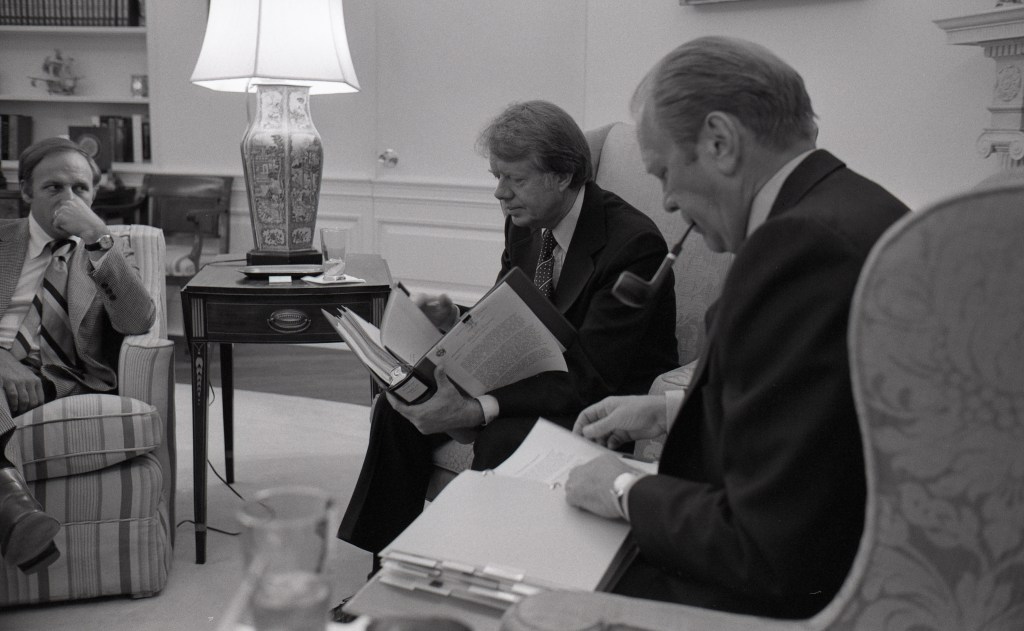
President-elect Carter visited President Ford at the White House and immediately raised the idea of another top-level economic conference with foreign leaders. Mr. Ford replied “It might be a good idea”, and also appeared to suggest a meeting of NATO foreign ministers and perhaps one of government chiefs of NATO countries. Mrs. Ford and Mrs. Carter had tea at the White House and discussed housekeeping problems. Earlier, the future First Lady visited a public school six blocks away that her daughter, Amy, may attend.
A Republican struggle for nominal control of the party between moderates and conservatives was set by the resignation of Mary Louise Smith two years before the end of her term as Republican national chairman. President Ford’s defeat prompted conservatives to urge Mrs. Smith’s replacement by someone reflecting the views of Ronald Reagan, on the theory that he would have defeated Jimmy Carter. Republican moderates now seek a new chairman with no ideological links.
Continuing threats to the life of Secretary of State Henry Kissinger have led the Ford administration to consider asking Congress for emergency authority to allow the Secret Service to protect him after he leaves office. Present law does not permit continued protection of the Secretary when he becomes a private citizen on January 20, inauguration day. The issue is sensitive, in part because of expenses. The whole subject has been treated with extreme sensitivity within the outgoing Ford Administration because of the normal reluctance to talk about security problems publicly and because State Department officials are aware that extension of Secret Service protection to Mr. Kissinger would provoke skepticism about the need for the expensive operation. “I don’t want to sound melodramatic,” a State Department aide said, but the Secretary’s life would be in danger within two weeks of losing his protection.”
The Utah Board of Pardons moved up its special hearing on Gary Mark Gilmore, the condemned killer who wants to be executed, by one week to November 30 to avoid legal disputes over timing of the death penalty. Chairman George Latimer rescheduled the hearing after Utah County Atty. Noall Wootton said he feared the slayer would escape punishment for the murder of a motel clerk unless he was executed by December 7. Gilmore, 35, was continuing the hunger strike he began Friday but authorities reported he was “still healthy.” Gilmore has said he won’t eat until he is allowed to call his fiancee, Nicole Barrett, 20, who attempted to kill herself in a suicide pact with Gilmore last week.
A congressional investigation disclosed that more than 3,400 Indians, mostly women, were sterilized by the Indian Health Service over a three-year period. The inquiry was conducted by the General Accounting Office at the request of Senator James Abourezk (D-South Dakota), who said he had received numerous complaints that the women were being sterilized as a birth-control procedure without their consent or knowledge. The GAO said 142 of those sterilized between 1973 and 1976 were men.
Mel Patrick Lynch, a New York City fireman accused of kidnaping whisky heir Samuel Bronfman II, testified in White Plains, N.Y., that he had homosexual relations with Bronfman and that Bronfman plotted his own kidnaping last year and forced him to join the plot with a threat of exposure. Bronfman, 23, denied the charges. Bronfman’s father, Edgar, 47, is chief executive of the Seagram distillery empire. Lynch, 38, and Dominic Byrne, 54, both of Brooklyn, are charged with abducting the son on August 8, 1975. He was rescued nine days later after a $2.3 million ransom was paid.
A jury of seven women and five men was sworn in today in the Oakland, California weapons and explosives trial of Wendy Yoshimura, onetime underground companion of Patricia Hearst. Judge Martin Putich of Alameda County Superior Court said that testimony would begin next Monday. Jury selection began October 18, and 75 prospective jurors were questioned. The charges against Miss Yoshimura stem from weapons and explosives found in 1972 in a Berkeley garage, more than two years before she met Miss Hearst, when both were fugitives. The state contends the defendant rented the garage as a weapons storage facility for radicals.
The Civil Aeronautics Board gave consumers and other interested parties another two months, until January 23, to say what they think of banning cigars and pipes-and perhaps all smoking — aboard commercial flights. The agency said Action on Smoking and Health, the group which requested the cigar and pipe ban, had asked for the extension. The Tobacco Institute already has told the CAB it does not believe a ban is warranted.
Hope faded that a nine-week Teamsters strike against United Parcel Service in 15 Eastern states could be settled in time to handle the Christmas rush. Formal contract talks were recessed during the weekend with a stalemate on several issues. No further meetings were scheduled. Both sides kept public silence, but an UPS official at company headquarters in Greenwich, Connecticut, said top negotiators were keeping in informal touch. Although the two sides reportedly have reached a basic understanding, an unexplained conflict has come up to delay final settlement.
American Motors Corporation will pay the largest air pollution fine ever collected by the State of California, officials said today. State Air Resources Board spokesmen said that the automobile manufacturer had agreed to pay the state a record $1.1 million to settle a suit filed against the company for selling cars that failed to meet auto emissions standards and for submitting false test reports. “A.M.C.’s agreement to the fine payment should serve as a signal to other manufacturers that compliance with California’s smog laws is a high priority.” Tom Quinn, the Air Resources Board chairman, said.
A second witness testified today that he had seen two key bits of evidence in the triple murders at the Lafayette Grill in 1966 a live bullet and a shotgun shell allegedly taken from the car in which Rubin (Hurricane) Carter and John Artis were riding when they were arrested.
A death penalty bill was passed overwhelmingly by the New Jersey state Assembly after a long, emotional debate and denunciations of the measure by black legislators. The vote was 58 to 16, with a number of legislators abstaining. The bill went to the Senate, where approval is also expected.
The Y.M.C.A.’s shift from a “gym and swim” image to advocacy of social causes was illustrated at its first youth conference on world peace, held on the Texas coast. Delegates from 80 countries debated problems of world justice, including the impact of multinational corporations and allegations of political repression.
Women who plan to have their breasts examined by mammography were advised today to ask first what radiation dose they will be receiving from the X‐ray examination. If the amount of radiation that the machine delivers is much above two and a half roentgens, which would give each breast a dose of about one rad, Dr. Diane J. Fink recommended that the woman have her mammogram somewhere else where the radiation dose is lower. Dr. Fink, director of cancer control at the National Cancer Institute, spoke at a two‐day breast cancer conference sponsored by the White House, the Cancer Institute and the American Cancer Society, where doctors continue to debate the relative benefits and risks of mammography.
The Consumer Product Safety Commission granted today an environmentalist group’s petition to begin regulatory action against fluorocarbon propellants in spray cans on the ground that these gases endanger the planetary ozone layer.
Missouri and Federal scientists have confirmed a case of swine influenza in Concordia, Missouri, that state’s epidemiologist said last night. The case, which involved a 32-year-old telephone lineman who has recovered, is believed to be the first since the virus was discovered last February at Fort Dix, New Jersey.
Kay Summersby wrote before she died in January, 1975, that the World War II romance that she and General Dwight D. Eisenhower shared never became a sexual relationship. She was first his driver and then his aide while he was supreme allied commander. “I feel free to tell the story now,” Mrs. Summersby wrote in “Past Forgetting,” a book to be published in January. “The general is dead. I am dying… I do not believe that anyone today will construe our relationship as shameful.”
The popular newspaper comic strip “Cathy,” written by advertising agency vice president Cathy Guisewite, made its debut and began a run of almost 34 years, concluding on October 3, 2010. Described as “by a woman and about a woman” and distributed by Universal Press Syndicate, Cathy was in 1,400 newspapers at its peak and was reprinted in more than 20 books and inspired three animated TV specials.
NFL Monday Night Football:
The Baltimore Colts edged the Miami Dolphins, 17–16. Mike Barnes blocked Garo Yepremian’s extra point attempt after the Dolphins, trailing 17-10 with 1:52 remaining, stormed back on a 69-yard drive to come within one point of the Colts on Benny Malone’s three-yard touchdown with 12 seconds left in the game. Bert Jones put Baltimore ahead 14–3 with 1:22 left in the half on a 25-yard touchdown pass to Raymond Chester but Bob Griese cut the margin to four points 40 seconds later on a 20-yard TD pass to Jim Mandich. Lydell Mitchell rushed for 80 yards in the game to go over the 1,000-yard mark for the second straight year.
Baltimore Colts 17, Miami Dolphins 16
Stock prices posted a broad gain, with advances outnumbering declines by more than 2 to 1. The Dow Jones industrial average rose 7.07 points to 955.87. Credit markets continued to head toward higher prices and lower interest rates, Some gains were substantial.
Dow Jones Industrial Average: 955.87 (+7.07, +0.75%)
Born:
Regina Halmich, German boxer (WIBF World Super Flyweight title 1994–99; WIBF World Flyweight title 1995– 2007; WIBF World Light Flyweight title 1999–2003), in Karlsruhe, West Germany.
Son Little [Aaron Livingston], American blues and soul singer-songwriter, in Philadelphia, Pennsylvania.
Sultan Munadi, Afghanistan journalist (killed by friendly fire, 2009)
Died:
Jesse F. McClendon, 95, American physiologist and inventor of the McClendon pH-probe to measure the acidity of a patient’s stomach contents.
Rupert Davies, 59, British actor (“Zeppelin”, “Oblong Box”).

