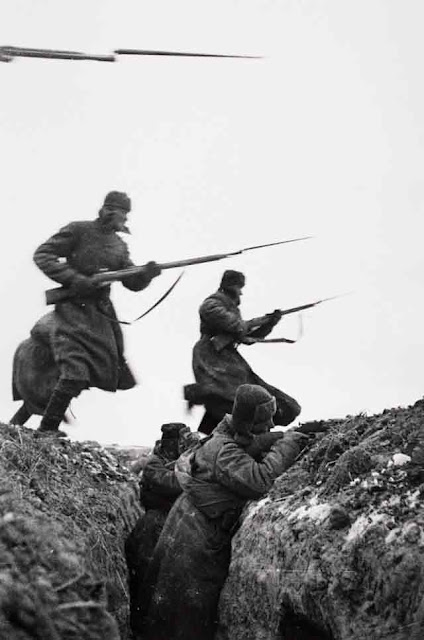
Two days after General Franz Halder at the Orsha Conference directed the Eastern Front generals to continue attacking toward Moscow despite the deteriorating weather conditions, the Wehrmacht resumes Operation Typhoon on 15 November 1941. This offensive is not one that the generals at the front particularly wanted to mount, but they had no say in the matter. The weather is affecting both sides, but the Soviet troops are more accustomed to the climate than the invading Germans, who have never encountered conditions like the fall Rasputitsa and whose equipment is not designed for frigid weather. In addition, the German soldiers do not have adequate winter clothing and many are succumbing to frostbite. The push toward Moscow is taking on a desperate air as the city promises warm accommodations and a defensible perimeter compared to camping out in the surrounding forests and fields. However, at least the ground has frozen which enables the panzers to move again. For better or worse, the hour of decision is at hand.
The Germans continue their attack on Moscow today from three directions: west, northwest, and south. The plan is that General Guderian’s Panzer Army 2 will finally conquer and/or bypass Tula and pose a real threat from the south while Field Marshal von Bock’s forces continue along the Smolensk and Leningrad highways. The Red Army, for its part, has had time to reinforce all three avenues of attack and is throwing in some spoiling attacks of its own in order to disrupt the Germans’ plans.
The offensive resumes with some successes but also some disappointments. One of the many problems for the Germans is that they have sustained heavy battle losses just getting into a position to attack Moscow. South of the city, Kampf Gruppe (battlegroup) Eberbach has never really had a break in the fighting and it is now down to 50 “runners” (usable panzers). Because Guderian has concentrated virtually all of his army’s panzers into Colonel Eberbach’s unit, he has no reserve to reinforce the attack. Eberbach’s panzers are close to encircling Tula and controlling the Elets-Moscow highway, but the Red Army has enough forces at hand to prevent this. Today’s action brings the Germans no closer to a breakout.
On the northwest axis, Ninth Army puts its troops in motion south of Kalinin and, according to General Halder in his war diary, “experiences something new in this war.” An infantry corps that is not tasked with a key role advances and finds the Soviet Thirtieth Army not offering any resistance at all. It retreats without firing more than a perfunctory shot or two. Everyone on the German side is elated and, not for the first time nor the last time, thinks that the final collapse of the Red Army may be at hand. Field Marshal von Bock quickly plans to add Panzer Army 3 and Panzer Army 4 to the general offensive on the 16th.
Much further south in the Crimea, General von Manstein’s 11th Army is encountering fanatical resistance in its attempt to capture Sevastopol along the southern coast road. On 15 November, the Soviet 514th Regiment loses 400 men, with other units taking heavy casualties as well. General Petrov, in charge of the defense, comments on the 15th:
“The situation at Balaklava has become critical. The enemy has seized Height 212.1, the last before Balaklava. We must recapture the heights, for they are key positions on this axis. Should we succeed, then the entire enemy grouping in the area of Balaklava will fall into a trap. At the same time, we [must] reinforce the defense of the whole southern sector. In addition, we must attack the enemy’s flank.”
Petrov plans his counterattacks, but they are going to take several days to prepare, and it is unclear if his troops can prevent a breakthrough into the port itself in the south. If they can, though, there is the possibility that operations on both sides will die down during the worst winter months and leave the Soviets in possession of Sevastopol until the spring.
Across the Eastern Front, the temperature fell to -20 degrees Celsius, freezing both men and machines; the German offensive was generally slowed to a yard-by-yard advance from this date on. The Soviets have built up reserves and brought forces from Siberia. They will allow the Germans to advance while building up forces on the outer flanks.
On the night of 6-7 November the frost which heralds the arrival of the Russian winter gripped the steppes of western Russia. The temperatures plummeted, but overnight the mud which had bogged down the German thrust on Moscow for the past month vanished. Today, with light snow on the ground but under clear skies, the Germans were able to resume their offensive. Winter has restored the mobility of the German armies, but it has also brought a host of problems which are bound to grow worse.
The cold, far more intense than in Western Europe — with temperatures as low as -28 degrees Fahrenheit (-40C) — affects everything. Tank and truck engines can only be started if fires are kept in lit under the vehicles. Guns and vehicles become frozen in and can only be freed by chipping away at the ice with pickaxes. Weapons seize up because the oil in them freezes. Worse, only a small proportion of the German troops have been issued with winter clothing — a sign of the dangerous over optimism with which Hitler and his generals were imbued at the start of the campaign. The result is that frostbite is rapidly increasing the sick list.
Soviet troops, on the other hand, especially the Siberian divisions passing through the Moscow to the front, are used to these conditions. “General Winter” is an ally of the USSR, not Germany, and may yet deny Hitler Moscow.
In summary, 15 November 1941 is a mixed day for both sides on the Eastern Front. The German attacks gain some ground in some places but not in others. However, the Wehrmacht is not just fighting the Red Army, it also is fighting the weather, and that battle is going poorly and getting worse all the time. There also are portents of sinister things to come in 1942 and beyond.
German Luftwaffe III./KG 4 arrived at Pskov (German: Pleskau), Russia.
Himmler and Rosenberg hold a four-hour meeting to discuss Jewish policy and several other areas of their disagreement.
Reich Commissioner for Ostland Hinrich Lohse writes to Alfred Rosenberg, Reich Minister for Eastern Territories, about his recent activities.
“I stopped the wild shootings of Jews in Libau because it was done in an irresponsible manner. I must ask if your inquiry from October 31 is to be interpreted to mean that all Jews in the East should be liquidated? Should this occur without regard to age, gender, and economic considerations?…
“The elimination of Jews from the East is of course an urgent mission, but their liquidation must surely be reconciled with the necessities of the war economy.”
Rosenberg does indeed “mean that all Jews in the East should be liquidated,” as shall become clear soon enough.
Erich Mußfeldt was transferred from Auschwitz Concentration Camp to Majdanek Concentration Camp as the chief of the crematorium.
Despite mass executions, mounting in official Yugoslav announcements to 350,000, a spokesman for the exiled government said today that 80,000 guerrillas to relentless mountain warfare, had wrested most of Serbia from the Axis.
German submarine U-583 collided with U-153 and sank 90 miles northeast of Danzig at 2148 hours, killing all 45 aboard.
Egmont Prinz zur Lippe-Weißenfeld was named the commanding officer of the 5th Squadron of the Nachtjagdgeschwader 2 wing.
Italian SM.79 torpedo bombers sank British freighter Empire Defender of the Operation ASTROLOGER convoy near the Galite Islands off the Tunisian coast, killing 4.
A “Special Air Service Brigade” which was formed in the summer has lost 32 out of 55 men in an attempted para-drop in a sandstorm. The targets — Rommel’s airfields — are untouched. The leader — Captain David Stirling, who proposed the idea of the SAS Brigade in July, was retrieved by another special force, the Long Range Desert Group. The LRDG, formed 14 months ago, comprises pre-war desert explorers practicing deep reconnaissance with special vehicles. Stirling wants a partnership with it after this debacle.
RAF Bomber Command, Night of 15/16 November 1941
Emden
49 aircraft; bombing results were not observed because of cloud. 4 Wellingtons lost.
Kiel
47 aircraft; 4 Wellingtons lost. Only 8 aircraft reported bombing the target area. Kiel reports a cloudy night and no bombs.
Minor Operations: 9 Wellingtons to Boulogne, 5 Hampdens minelaying in the Frisians. No losses.
Free French Air Force pilots formed the Paris and Versailles squadrons. They operated out of Britain, flying Blenheim and Hurricane aircraft.
The de Havilland Mosquito B. Mk. IV light bomber entered service with No. 105 Squadron at RAF Swanton Morley, Norfolk. It wasn’t until May 31, 1942 that the Mosquito took part in its first operational raid — a raid on Cologne, France.
U-583, commanded by Kapitänleutnant Heinrich Ratsch, was sunk in a collision during night training with U-153 off Danzig. All of the ship’s complement of 45 died. During its career the U-583 sank or damaged no ships.
U-752, commanded by Karl-Ernst Schroeter, sank Soviet minesweeping trawler T-889 six miles southeast of Cape Ostrye Ludki, in the Barents Sea near Murmansk. At 1700 hours on 15 Nov 1941, U-752 fired a spread of two torpedoes at the Soviet auxiliary minelayer ZM-93 Jushar (2020 grt, loaded with mines) six miles southeast of Cape Ostrye Ludki and observed a hit after 2 minutes 5 seconds underneath the bridge, but the torpedo probably detonated prematurely because the ship was not damaged in the attack. T-889 (No 34) (SrLt G.V. Lotov) was the only escort of the vessel and forced the U-boat to dive with gunfire, but was then hit by a torpedo that had been fired at 1849 hours aimed at her charge. The ship sank in a short time under a great column of smoke. The minelayer initially attacked the U-boat with depth-charges, returned to search for survivors and then proceeded after nobody was found.
Destroyer HMS Faulknor departed Portsmouth at 0900 for the Clyde to carry out direction finding calibration before proceeding to Scapa Flow. The destroyer arrived in the Clyde at 1100/16th. Destroyer Faulknor departed the Clyde at 1400/20th for Londonderry.
Destroyers HMS Ashanti, HMS Matabele, and HMS Punjabi departed Hvalfjord for an anti-submarine search for a submarine attacked by a U.S. destroyer in 62-50N, 24-30W at 1215/14th.
Submarine HMS Trident departed Polyarnoe and arrived at Blyth on the 30th. The submarine went on to the Tyne for repairs and docking.
British steamer Corhampton (2495grt) was badly damaged by German bombing twenty six miles northeast of Spurn Point. The steamer sank on the 16th in tow two miles 142° from 62D Buoy in the Humber area. The entire crew was rescued.
British drifter Harmony (24grt) was sunk in a collision off Invergordon.
Destroyers HMS Encounter and HMS Jupiter departed Alexandria for the Far East, via Bombay. The destroyers departed Aden on the 20th. They arrived at Colombo on the 26th. On the 30th, at Colombo, the destroyers departed with battleship HMS Prince of Wales and destroyers HMS Electra and HMS Express to proceed to Singapore. Battlecruiser HMS Repulse departed Trincomalee the same day for Singapore.
Light cruisers HMS Naiad and HMS Euryalus were at sea from Alexandria for a practice bombardment.
Dutch submarine HNLMS O.21 unsuccessfully attacked Italian steamer Ninettog. (5335grt) in a convoy in the Tyrrhenian Sea.
British steamer Empire Defender (5649grt), en route to Malta, was sunk by Italian bombing eighteen miles south of Galita Island. Four crewmen were lost on the steamer. The rest of the crewmen were made prisoners of war.
Convoy ON.37 departed Liverpool escorted by anti-submarine trawlers HMS Hugh Walpole and HMS Northern Spray. The convoy was joined on the 16th by destroyers HMS Beverley and HMS Sardonyx. On the 18th, destroyers HMS Scimitar and HMS Watchman and corvettes HMS Dahlia and HMS Monkshood, and anti-submarine trawler HMS Northern Pride. Destroyer Beverley was detached on the 20th and trawler Northern Pride on the 21st. The remainder of the escorts were detached when relieved on the 22nd by American destroyers USS Buck, USS Greer, USS Ludlow, USS McCormick, and USS Swanson. The destroyers were detached on the 30th when the convoy was dispersed.
Convoy HX.160 departed Halifax, escorted by destroyers HMCS Annapolis and HMCS Hamilton. The destroyers were detached on the 17th when relieved by American destroyers USS Babbitt, USS Leary, USS Mayo, USS Nicholson, and USS Schenck. In heavy seas, the American destroyers all sustain storm damage. The American group was relieved on the 25th by destroyers HMS Sardonyx, HMS Scimitar, and HMS Watchman and corvettes HMS Dahlia and HMS Monkshood. Corvette HNoMS Montbretia joined on the 26th. Anti-submarine trawlers HMS Hugh Walpole, HMS Northern Pride, and HMS Northern Spray escorted the convoy in Home Waters. Corvette Montbretia was detached on the 28th and the destroyers and corvettes Dahlia and Monkshood on the 29th. Anti-submarine trawler HMS Kirkella escorted the convoy into Liverpool on the 30th.
A spreading work stoppage throughout the soft coal industry to reinforce the United Mine Workers’ demand for a union shop in the captive pits appeared imminent today as a midnight strike deadline passed with the operators and the union still deadlocked. With the dispute still unbroken, President Roosevelt conferred with Secretary of War Stimson and army officers, apparently mapping a course of governmental action. The president has voiced determination that the captive mines, supplying fuel for vital defense forces, must operate. A few hours in advance of the midnight deadline which John L. Lewis set and stuck to for expiration of the truce in the captive mine strike, a lieutenant served notice on the Illinois operators that “it may become necessary momentarily’ to call out all the miners in that state.
Presidential intervention is expected next week to avert a national railroad strike scheduled to begin at 6 AM December 7, leaders of both sides said today in discussing the wage dispute involving 1,250,000 workers on 180 of the country’s roads. The threat of a railroad tie-up persisted today as union men studied instructions governing their conduct in ‘the strike. The rules were rushed to 500 general chairmen and 10,000 local chairmen of the “big five” operating brotherhoods, which have a membership of 350,000 engine men, firemen, conductors, switchmen and trainmen. These instructions were in the form of a printed eight-page booklet and contained drafts of orders to be issued by the general chairmen, a resolution authorizing the strike and a statement referring to the recommendations of the President’s fact-finding board. There were also three lists of railroads. One group of fifty-one will be struck December 7, forty-three more December 8 and sixty-two others the day after. Instructions will go out later to workers on the roads not listed.
A group of House members, it was learned today, is drafting broad, new anti-strike legislation preliminary to an attempt to force congressional action on restricting defense production stoppages. Members of the group asked their names be withheld but disclosed the proposed legislation would: Compel a 30-day cooling off period, during which the labor department’s conciliation service would function, between a strike call and the effective date. Forbid a strike unless approved by the majority vote of affected workers by secret ballot under government supervision. Forbid sympathy, jurisdictional and boycott strikes. Freeze existing open and closed shop arrangements between employer and workers. Forbid mass picketing. Provide for protection of workers against violence. The attitude of the administration toward anti-strike legislation remained obscure, but was expected to be clarified after outcome of the current captive coal mines controversy. Many urging legislation agreed none was likely unless President Roosevelt gave it support.
The International Ladies Garment Workers Union, New York City’s largest union, is considering withdrawing from the American Labor party because it does not wish to provide a “cloak of respectability” for Communist elements in the party, it was learned last night.
American agriculture, after a victory over Germany, will face the task of feeding “hundreds of millions throughout the continents of Europe and Asia” lest the world is allowed to relapse into an “endless barbarism,” Secretary Morgenthau told the National Grange today.
Girls with a knack for trigonometry, algebra, calculus and other higher mathematics have an increasing opportunity for employment as engineering calculators in the nation’s defense industries, says a General Electric Company executive. “The idea of using girls for engineering calculations work is growing by leaps and bounds,” Miss Emily T. Hannan, head of the company’s turbine calculations department, said today in a talk prepared for a WGY program. Miss Hannan, speaking on “Women at Work for Defense,” said that girls were “well adapted” for calculations work, adding: “Their carefulness, accuracy, patience and high output have formed a niche for them.”
Eight passengers and the driver of a Cincinnati to Indianapolis Greyhound bus were injured fatally to night as the vehicle plunged over a 25-foot embankment and caught fire after a collision with an automobile four miles east of Rushville on Indiana road 44.
Franklin Roosevelt had lunch with Princess Märtha of Sweden (Crown Princess of Norway) at the White House in Washington DC, United States, followed by a private showing of the film “Dumbo.”
In a realistic simulation of actual wartime conditions, helped along by heavy Saturday afternoon traffic, magnesium flares and sulphur pots, more than 70,000 volunteer air raid wardens and fire department auxiliaries mobilized at seven posts in the five boroughs of the city yesterday afternoon to receive identification cards and do their stuff for New York Mayor La Guardia and admiring crowds of friends and neighbors.
The Cow Palace opens in San Francisco.
The U.S. Army dispatched troops to Dutch Guiana to protect bauxite mines; this was agreed upon by the Dutch government-in-exile.
Army GHQ maneuvers begin in North and South Carolina. Two U.S. Navy (VB-8 and VS-8) and two Marine Corps (VMF-111 and VMF-121) squadrons take part in the large-scale war games.
TU 4.1.1 (Captain Marion Y. Cohen) assumes escort duty for convoy ON.35 at the MOMP. There will be no U-boat attacks on the convoy, but nearly continuous heavy weather between 16 and 25 November result in 16 of the 26 ships straggling.
U.S. 22nd and 23rd Fighter Squadrons, both operating P-40 Warhawk fighters, was assigned to Losey Field in Puerto Rico.
In College Football, Michigan, showing tremendous power, gained a four-touchdown victory over Columbia, 28–0, at Baker Field. This was New York’s big game of the day. In the Yale Bowl the Princeton eleven, paced by Captain Bob Peters, who scored three times, beat the Elis, 20–6, in the sixty-fifth game between the teams. Unbeaten Notre Dame registered a 1-point 7–6 decision over Northwestern at Evanston, Illinois. Penn won from Army, 14–7, before 70,000, Harvard downed Brown, 23–7, and Cornell conquered Dartmouth, 33–19, in three of the East’s big games. Manhattan rallied to tie Holy Cross at 13–all and Syracuse gained a last-minute 19–19 deadlock with Colgate. Tulane routed New York University, 45–0. Texas Christian sprang a surprise by downing Texas, 14–7. Pitt, following up last week’s upset of Fordham, subdued Nebraska, 14–7.
On November 15th 1941, at 1:30 PM (U.S. time) Special Ambassador Saburō Kurusu arrived in Washington. Kurusu, Japan’s special envoy, arrived at Washington National Airport early this afternoon with the word that as long as the American people remained sympathetic he believed he had a “fighting chance” of succeeding in his mission.
Emperor Hirohito formally opened today the extraordinary session of the Japanese Diet, which was convoked yesterday to cope with the critical international situation. His brief message from the throne exhorted the members to do their utmost to cooperate with the Tojo Government in its grave task.
The converted passenger liner Awatea arrived at Hong Kong this evening, carrying 2,000 Canadian troops under Brigadier J. Lawson. The Canadians will boost the garrison in Hong Kong, but, as Churchill himself has pointed out, two semi-trained battalions are unlikely to deter Japan from war, but will merely increase the numbers of prisoners the Japanese can take. The Canadians seem only too aware of this. “Oh God, another Dunkirk,” Signalman William Allister said when he heard where he was going. “No fella,” another voice added, “at Dunkirk they had somewhere to go.”
The 212 vehicles assigned to the force are aboard the freighter SS Don Jose but these vehicles will never reach Hong Kong. The Don Jose had only just reached Manila, Philippine Islands when the war with Japan begins, and the U.S. forces are given approval to use the Canadian equipment in the defense of the Philippines.
General Marshall holds a press conference at which he stated that V Bomber Command constituted the “greatest concentration of heavy bomber strength anywhere in the world”; when queried over the inability of the B-17’s in the Philippines to bomb Japan and to return to Clark AAF, Marshall stated that the USSR would allow the airplanes to refuel at Vladivostok.
Dow Jones Industrial Average: 116.72 (-0.09)
Born:
Daniel Manus Pinkwater, American sci-fi author (“Magic Moscow”), in Memphis, Tennessee.
Heathcote Williams [John Henly Heathcote Williams], British poet, actor and political activist, in Helsby, Cheshire, England, United Kingdom (d. 2017).
Jim Dickinson, American record producer (Mud Boy), in Little Rock, Arkansas (d. 2009).
Naval Construction:
The U.S. Navy Auk-class minesweepers USS Portent (AM-106) and USS Prevail (AM-107) are laid down by the Pennsylvania Shipyards Inc. (Beaumont, Texas, U.S.A.).
The Royal Navy Abdiel-class (2nd Group) minelayer HMS Ariadne (M 65) is laid down by A. Stephen & Sons Ltd. (Glasgow, Scotland).
The Kriegsmarine (German Navy) Type VIIC U-boat U-472 is laid down by Deutsche Werke AG, Kiel (werk 303).
The U.S. Navy Barnegat-class small seaplane tenders USS Casco (AVP-12) and USS Mackinac (AVP-13) are launched by the Puget Sound Navy Yard (Bremerton, Washington, U.S.A.).
The Kriegsmarine (German Navy) Type VIID U-boat U-217 is launched by F. Krupp Germaniawerft AG, Kiel (werk 649).
The Kriegsmarine (German Navy) Type VIIC U-boat U-411 is launched by Danziger Werft AG, Danzig (werk 112).
The Royal Canadian Navy Tribal-class destroyer HMCS Athabaskan (G 07) is launched by Vickers Armstrong (Newcastle-on-Tyne, U.K.); completed by Parsons.
The Kriegsmarine (German Navy) Type IXC U-boat U-173 is commissioned. Her first commanding officer is Korvettenkapitän Heinz-Ehler Beucke.
The Kriegsmarine (German Navy) Type XIV U-boat U-459 is commissioned. Her first commanding officer is Kapitänleutnant Georg von Wilamowitz-Möllendorf.

