West European nations must modernize their navies if the North Atlantic Treaty Organization is to counter an improved Soviet nuclear submarine force, U.S. Navy Admiral Isaac C. Kidd told the North Atlantic Assembly today. Admiral Kidd, the commander of NATO forces in the Atlantic, told the military committee at the 22d annual meeting of the assembly that the Russians “have developed a nuclear‐powered strategic missile submarine force capable of threatening the alliance from any of the world’s oceans.” They have “expanded their shipbuilding capacity beyond any reasonable expectations,” he declared. The admiral criticized European membersbers of NATO for not modernizing their navies to meet the Soviet threat. “There are political forces in our nations who may believe that a strong U.S. Navy is adequate to deter the Soviet naval forces in the Atlantic,” he asserted. “This feeling is probably at the roots of inaction and delay by some of the NATO partners toward modernization of ships and replacement of obsolete maritime aircraft.” The North Atlantic Assembly is the interparliamentary assembly of member countries of NATO. It provides a forum for West European and North American politicians to discuss major political issues.
Chiding those who would compare Soviet-Yugoslav relations with those of “the wolf and Little Red Riding-hood,” Leonid I. Brezhnev arrived here today for three days of talks with President Tito. Mr. Brezhnev’s fairy‐tale reference was part of a toast he delivered at a dinner given by the Yugoslav leader, Alluding to statements made during the recent American election campaign, Mr. Brezhnev said it had become fashionable in the West to cast shadows on Soviet-Yugoslav relations. “Authors of such fairy tales try to present Yugoslavia as a helpless Little Red Riding-hood, whom the terrible and bloodthirsty wolf — the aggressive Soviet Union — is preparing to dismember and devour,” Mr. Brezhnev said.
The European Common Market rejected a proposal for full-scale trade links with the East European economic bloc, Comecon. The nine-nation market’s foreign ministers, in a regular meeting in Brussels, called instead for a continuation of trade links between the community and individual Communist countries. The decision was in reply to a Comecon proposal of February 16 suggesting that both sides offer most-favored nation treatment and establish business contacts.
A Paris court denied extradition of four Americans accused of hijacking a Delta Air Lines plane to Algiers in 1972, but ordered them tried in France on the hijacking charge. The court accepted the pleas of the four, former residents of the Detroit area, that they had acted for political reasons. The United States claimed that the two men were fleeing prosecution for common crimes and the two women had merely followed them. The four— George Brown, 28; Joyce Tillerson, 25; Melvin McNair, 30, and Jean McNair, 30— were arrested in Paris in May and have been held on charges of using false passports. George Wright, listed as a member of the hijacking party, is still at large.
Britain’s parliament passed an act amending the Motorcycle Crash Helmet Act of 1972 to permit Sikh wearers of turbans to be exempt from the requirement of wearing a helmet. The legislation followed a four year campaign by Manchester resident Gyani Sundar Singh Sagar, popularly known as Gyan Ji, who had been repeatedly arrested by defying the law in the name of his religious faith.
Israel attacked an Afro-Arab condemnation of its policies in occupied territories and warned the Arab world that such actions would not help prepare the way for peace talks suggested by Egypt. The condemnation, which was being considered at the UNESCO General Conference in Nairobi, Kenya, was tabled. Egyptian President Anwar Sadat said over the weekend that he was prepared to sign a peace treaty with Israel.
Israeli Government officials are reluctantly conceding the effectiveness of a recent series of Arab diplomatic and political moves in the complex search for peace in the Middle East. At the same time, these officials are labeling the Arab moves as skillful propaganda maneuvers rather than as sincere and purposeful efforts to end the state of belligerency between Israel and its Arab neighbors. At the risk of once again being labeled intransigent by the international community, Israel is sticking to its posture of making no major concessions regarding occupation of Arab territories for anything but solid guarantees of an end of the protracted state of war.
The United States attacked today as “conviction without trial” a proposal that a United Nations conference in Kenya condemn Israeli educational and cultural policies in occupied Arab areas. The American statements came four days after the United States supported a, declaration by the Security Council branding as illegal and “an obstacle to peace” Israeli settlements in the territories taken in the 1967 war and any action that “tends to change the status” of Jerusalem. Sources in the American delegation to the meeting here of the United Nations Educational, Scientific and Cultural Organization cautioned that it would be a “disservice” to interpret the American stand as designed to counterbalance American support of the Security Council declaration.
The Syrian Army took total control of Beirut today, forcing peace on the battle‐ravaged downtown area of the capital and in effect halting a civil war in which at least 35,000 people have been killed in 19 months. Officially the Syrians were only part of an Arab League peacekeeping force but actually they constitute its overwhelmingly dominant part. They were the only ones who participated significantly in today’s occupation operation. The Syrians met almost no armed resistance as they began advancing toward the center of the city shortly after dawn. Their American‐made bulldozers broke through thick earth and cement barricades, and their Soviet‐made tanks and truckloads of heavily armed infantrymen followed. The Lebanese leftists and Muslims who with their Palestinian allies had been exchanging shellfire with Lebanese rightwing Christians through the night either disappeared or peacefully gave up control of key points on the urban front lines to the advancing Syrians. A few fusillades of machine‐gun fire and several mortar shells were aimed at the advancing troops, who returned the fire. But no casualties were reported among either the Syrians or the retreating militia forces as a result of the exchanges of fire.
Subramaniam Swamy, a rightwing opposition leader in India who has fled the country, was expelled from the Indian Parliament for alleged misconduct and subversive activity. The first such action in India’s 29 years of independence was based on a committee investigation that found him guilty of evading the law, spreading anti-India propaganda and traveling on a passport that had been ordered impounded. Swamy’s whereabouts are uncertain.
The United States today vetoed the admission of Vietnam to the United Nations on the ground that Hanoi had failed so far to give an accounting of the 800 American servicemen who are still officially listed as missing in action in the Vietnam war. The vote in the Security Council was 14 to 1, with the United States using the veto for the 18th time. William W. Scranton, the chief United States delegate, denounced the Vietnamese for failing to hand over information he said they possessed, saying: “We cannot help but conclude from the Vietnamese refusal to provide a fuller accounting that the Socialist Republic of Vietnam persists in its attempts to play upon the deep anguish and the uncertainty of the families of these men in order to obtain economic and political advantage.”
A suburban Detroit newspaper has quoted letters from an American engineer working in Indonesia saying that he knows of 250 to 300 Americans listed as missing in action who are working in Vietnam. However, J. Angus MacDonald, staff director of the House Select Committee on missing persons in Southeast Asia, said in Washington that the panel placed “no credence” in the report. The copyrighted story in the Macomb Daily was based on letters from the unidentified engineer to Nelson Amsdill, a former Veterans of Foreign Wars commander.
China tonight flatly rejected any return to friendly relations with the Soviet Union following the death of Mao Zedong. The rejection came in a tough speech by Deputy Prime Minister Li Hsien‐nien that had earlier provoked a walkout by the Soviet Ambassador, Vasily S. Tolstikov, and diplomats from seven other pro-Moscow countries. Mr. Li was speaking at a banquet at Peking’s Great Hail of the People. In a clear reference to recent Soviet statements on China, Mr. Li said that the Russians “kept creating false impressions of relaxation of relations.” He dismissed this as wishful thinking and daydreaming. Mr. Li, who was speaking at a banquet for President Jean‐Bedel Bokassa of the Central African Republic, said that China would carry out unswervingly the foreign policies laid down by Chairman Mao, who died in September.
Japan began the return of the Soviet Union’s stolen MiG-25 jet fighter to the Soviets. Thirty crates, each filled with parts from the advanced jet fighter (which had been disassembled for study after Russian pilot Viktor Belenko defected to Japan) had been loaded onto the Russian freighter Taigonos on November 12 at the port of Hitachi and would arrive on November 18.
Japanese Prime Minister Takeo Miki, whose ruling Liberal‐Democratic Party is divided by a power struggle, today launched his campaign for the first elections since the Lockheed payoff scandal emerged in Japan. Mr. Mild, who became Prime Minister two years ago when Kakuei Tanaka resigned over financial dealings, has been under heavy attack from inside the party over the past six months. Demands have been made for his resignation over charges that he was a weak leader and lie has been criticized for his handling of the Lockheed affair. Mr. Miki has said he will remain in office if the party wins a stable majority in the December 5 elections. As campaigning officially got under way today, former Deputy Prime Minister Takeo Fukuda, Mr. Miki’s rival in the party, began his campaign in Osaka.
The separatist Quebec Party, which seeks independence of the French-speaking province from Canada, was swept into power. In its third attempt since 1970, the party won a solid majority of seats in the National Assembly on a wave of votes protesting against the governing Liberal Party. The Parti Québécois won 71 of the 110 seats in elections for the provincial legislature, overwhelmingly defeating the Quebec Liberal Party, which lost all but 26 of the 102 seats it had held before the vote. Rene Levesque became the new Premier of Quebec, replacing the QLP’s Robert Bourassa.
Multiparty elections were allowed in Brazil for the first time in over a decade as part of a gradual reform promised by the right-wing military government of General Ernesto Geisel, with voting for aldermen and mayors in the South American nations 3,789 municipalities. Although the government’s Alliance for National Renewal was unopposed in 1,789 locations, the opposition Brazilian Democratic Movement had candidates in the other 2,000. An accident killed 38 people who were being transported to the polling location, when the driver of a bus failed to stop at a ferry crossing and fell into the Urubu River.
Twelve leftist guerrilla suspects were reported killed in four clashes with Argentine Army troops today and security sources said that terrorists killed an Argentine businessman. The latest deaths among guerrilla suspects raised to 63 the number reported killed in 10 days, most of them in the La Plata area 35 miles south of Buenos Aires. The overall death toll from political violence this year is now put at 1,243. ‘The businessman, Virginio Garcia, aged 56, personnel manager of the Argentine-owned Textil Oeste Company, was shot and killed as he walked in the Buenos Aires suburb of San Justo, the sources said.
Nine black Africans were killed and 55 injured in tribal clashes at the Impala platinum mine 60 miles northwest of Johannesburg, a police spokesman said. The spokesman said the fights started at a bar and spread to the workers’ living quarters. An explosion and fire at another mine, the Bracken gold mine 70 miles east of Johannesburg, killed nine workers. Nearly 800 were treated after breathing fumes from the blast and fire.
South African Minister of Justice James Kruger has given black students who have fled the country one week to return. The minister’s ultimatum follows reports that more than 600 students from the black township of Soweto have fled abroad since rioting began there in June. Kruger’s ultimatum, as reported over South African television, did not say what would happen if the students did not return. A Botswana government spokesman said that more than 500 students had crossed the border in his country and a U.N. report said another 130 had sought refuge in Swaziland.
The comparatively low turnout in the presidential election was apparently due to demographic factors such as the sharp increase of young people in the electorate rather than disillusionment, according to a New York Times and CBS News survey. The poll found that, among both voters and non-voters, 55 percent believed that public officials had no concern for them. However, non-voters tended to feel more powerless toward government.
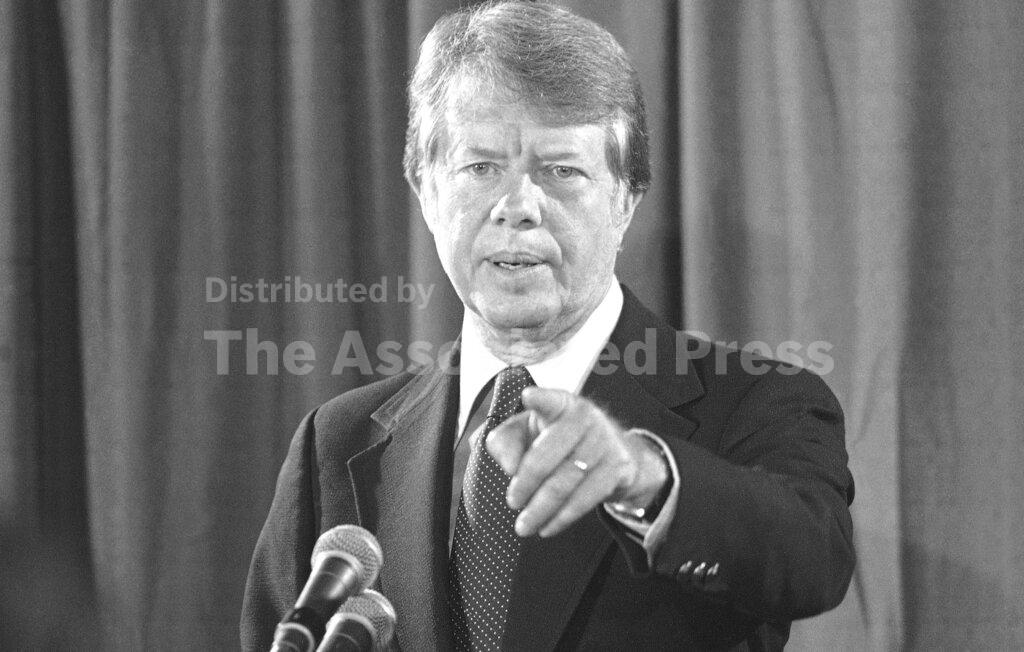
An apparently conciliatory tone was taken by President-elect Carter toward Arthur Burns, chairman of the Federal Reserve Board. At a news conference in Plains, Ga., Mr. Carter said he had received a pledge of cooperation from Dr. Burns and felt the two would find “substantial compatibility.” The remarks followed a flurry over previous remarks by Dr. Burns that had been interpreted to mean that the two might clash over a possible tax cut to stimulate the economy.
In foreign policy, Mr. Carter urged oil-exporting countries not to raise prices at their meeting next month and said he would feel tree to renegotiate any accords already made with the Russians on strategic arms.
The Supreme Court announced today it would review the scope of a Federal court’s power to impose programs and orders designed to end illegal segregation in public schools. The review will also embrace the effects of past illegal segregation. Specifically, the Court agreed, at the request of the State of Michigan, to review a Federal appeals court decision that required expansion of various educational programs such as reading and career guidance in Detroit’s school system and required the state to pay a large part of the cost. The state contends that the court‐ordered desegregation plan should have been limited solely to reassignment of children to different schools. The state also contends that the order that the state help finance the plan is “a sight draft on the treasury of the state.”
The Supreme Court refused today to review the circumstances of the Government’s decision allowing commercial flights of the British‐French supersonic jet Concorde to the United States. The Justices let stand a decision by the United States Court of Appeals for the District of Columbia that Secretary of Transportation William T. Coleman Jr. had acted within his authority in permitting the Concorde to operate on a trial basis at two airports in this country.
Turning down a petition by the American Civil Liberties Union, the Supreme Court refused to review lower Federal court rulings sustaining a night‐time curfew imposed on juveniles by a rural Pennsylvania community. (Bykofsky v. Borough of Middletown, No. 76‐318). Justice Thurgood Marshall, joined by Justice Brennan, issued a dissent, contending that the Court should have reviewed the case because it was of importance to “thousands of towns with similar ordinances.” Justice Byron R. White, in a separate statement, also dissented.
Over the objection of Solicitor General Robert H. Bork, the Court agreed to decide whether the United States is liable under the Federal Tort Claims Act for third‐party claims that seek indemnity for damages that were paid to servicemen injured or killed in activity that was incidental to military service. The case arose out of injuries to an Air Force Reserve pilot when he was forced to eject from a fighter plane.
A Postal Service surplus for the first time since the agency was set up in 1971 was reported for the months of July, August and September. The $15 million margin contrasted with annual deficits of up to $1 billion. It was attributed to a slight increase in volume and a cutback in employees.
Industrial production fell in October for the second successive month, the Federal Reserve Board reported. The decline was five-tenths of 1 percent from September, which was revised downward. Less than one-third of the October drop was attributed to strikes and the rest of it to reduced demand.
The nation’s air controllers’ union reached agreement with the Civil Service Commission on proposed new pay scales. A spokesman for the Professional Air Traffic Controllers Organization said the commission had clarified some aspects of its proposals to upgrade the pay of most controllers while lowering the rate in a few areas. The union now finds the proposal acceptable and will drop its plan to protest by ordering “by the book” operations. The spokesman said 63 or fewer controllers would be downgraded under the agreement but all of them would have the chance to transfer to another facility at the same pay level before they could be downgraded.
U.S. District Judge June L. Green directed the government to show why it would harm national security to have a suit against the government’s monitoring of cable traffic tried in court. She asked for an affidavit for her eyes only by Monday so she could determine whether trial would bring out information which should not be disclosed. The suit is a class action by a number of groups that opposed U.S. involvement in the Vietnam war. They say their rights were violated when the National Security Agency monitored their cables. It was disclosed a year ago that the NSA had for years been reviewing messages sent overseas by American citizens.
The Air Force is trying to work out an arrangement so President-elect Jimmy Carter won’t have to make a final decision on producing the controversial B-1 bomber within a few weeks of taking office, a spokesman said. Carter has indicated he wants to take his own look at the costly program and might delay production. If the current contract with Rockwell International is allowed to expire at the end of the month, a later move to restart it would cost much more money and so, the spokesman said, the Air Force is seeking “some sort of solution that would not make a great (expensive) gap in the contractor’s work” in case Carter decides to go ahead with the program.
A Virginia state trooper abducted at gunpoint in his unmarked patrol car died with more than 21 bullet wounds in his body. Authorities said they did not know whether he was killed by his captor or died by police gunfire at a roadblock. The body of Garland West Fisher Jr., 33, was pulled from his car after North Carolina highway patrolmen used a tractor trailer rig as a roadblock to force a showdown near Durham. Charged with murder was Fisher’s alleged abductor— Reuben Conley, 33, of Atlanta. He was wounded in the chest, hand and knee and was hospitalized in fair condition. Fisher was shot and forced to drive toward Atlanta after he stopped a car going the wrong way on the highway near Petersburg, Virginia.
In the latest setback for President Ford’s swine flu immunization program, the U.S. Public Health Service said only one in every 10 children would get the shots because of a vaccine shortage. There will be enough, however, to immunize chronically ill children between 3 and 18, the PHS said. It also announced that it now recommends a second swine flu shot four weeks after the first shot for young adults aged 18-24. Only 8 million doses of the split-virus vaccine suitable for children will be available before February. Since two shots four weeks apart would be necessary for each youngster, only 4 million of the nation’s 40 million children aged 3-18 could be immunized.
The House Committee on Assassinations, meeting formally for the first time, announced today that a study group of 170 persons would conduct what it hoped will be the definitive investigations of the murders of President Kennedy and Dr. Martin Luther King Jr.
The Nuclear Regulatory Commission has announced that it will not begin a broad program of financial assistance for private groups that wished to express their views about the Government’s nuclear policies at commission hearings. A program to help support the expression of opposition views recently has been initiated by the Federal Trade Commission, and the Environmental Protection Agency is scheduled to start a similar program in the near future. Both the F.T.C. and E.P.A. efforts were specifically authorized and funded by Congress. While rejecting the proposal for a general assistance program, the Commission announced that it would ask Congress for funds to assist those who wished to participate in the hearings on the narrow but important question of whether the Government should license the widespread use of plutonium.
American new car sales for November 1-10 slipped 1.5 percent from a year earlier due in part to what analysts said was the impact of the Ford Motor Company strike. However, auto executives still expect the domestic share of the 1976 market to show a 25 percent gain over last year, to 8.8 million cars.
The first megamouth shark (Megachasma pelagios) was discovered off the island of Oahu at Hawaii, when it became entangled in the anchor cable of a United States Navy ship, AFB-14, at a depth of about 540 feet (160 m).
NFL Monday Night Football:
The Dallas Cowboys downed the Buffalo Bills, 17–10. Roger Staubach and Drew Pearson combined for nine passes and 135 yards, including a 21-yard touchdown pass 13 seconds before the end of the first half, in leading the Cowboys to their best 10-game record (9–1) in their 17-year history. Gary Marangi hit Rueben Gant with a 27-yard scoring pass with 4:51 left in the first half to tie the game 7–7, prior to the Staubach-Pearson connection for a 14–7 Dallas advantage. The Cowboys recovered Buffalo’s attempted onside kick after both teams traded fourth quarter field goals, and Mel Renfro intercepted Marangi on the Bills’ final possession enabling Dallas to hang on for the win.
Buffalo Bills 10, Dallas Cowboys 17
Stock prices gained moderately in continued slow trading. The Dow Jones industrial average rose 7.73 points to close at 935.42, its high for the session. In credit markets, fixed-income security prices made a moderate advance and short-term interest rates eased a little.
Dow Jones Industrial Average: 935.42 (+7.73, +0.83%)
Born:
Greg Jones, MLB pitcher (Anaheim-Los Angeles Angels), in Clearwater, Florida.
Brandon DiCamillo, American comedian (“CKY”, “Jackass”), in West Chester, Pennsylvania.
Virginie Ledoyen, French actress (“8 Women”, “The Beach”), in Aubervilliers, France.
Claudia Llosa, Peruvian film director; in Lima, Peru.
Died:
Jean Gabin [stage name for Jean-Alexis Moncorgé], 72, French film actor (“Moulin Rouge”), of leukemia.

