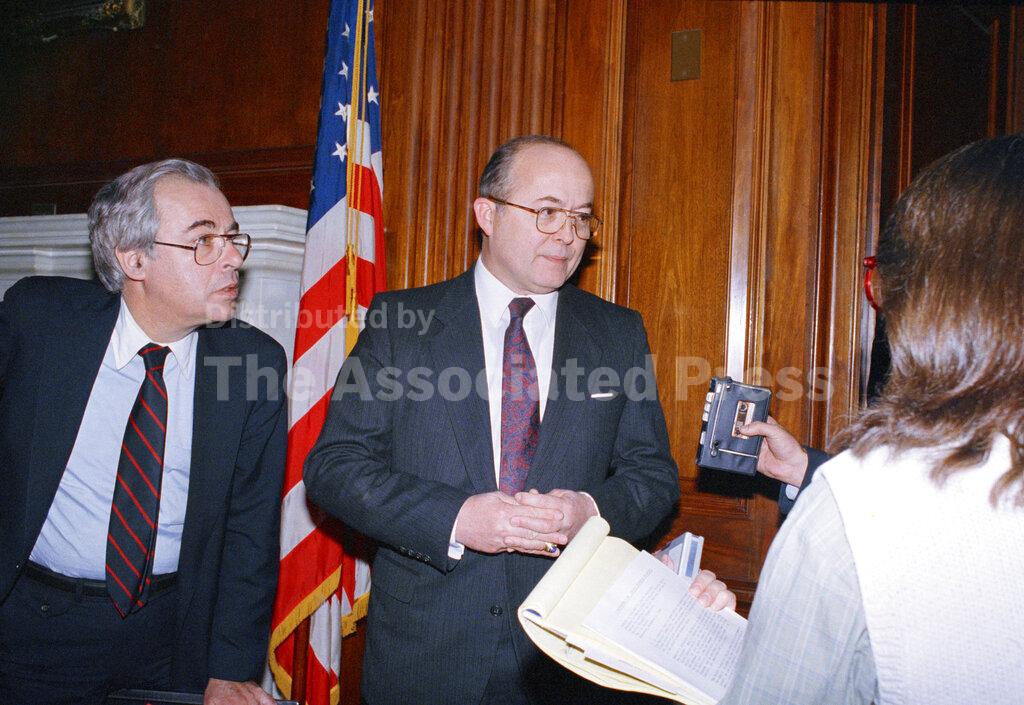
The United States and the Soviet Union ended a sixth round of arms talks here today, with the chief American negotiator portraying them as “useful and productive.” The assessment, by Max M. Kampelman, contrasted with negative Soviet appraisals. Mr. Kampelman said in a concluding statement that the two sides were in agreement on elements of three areas of the negotiations — medium-range weapons, long-range weapons, and adherence to the 1979 antiballistic missile treaty for 10 more years. He said “important areas of difference” remained to be resolved when the talks resume Jan. 15. The negotiations began in March 1985. “This has been a useful and productive round, our most productive to date,” Mr. Kampelman said. “I do not, however, wish to minimize the number and significance of the differences that still divide us.” He confirmed reports that the two sides would hold interim talks in December to try and overcome differences.
His comments ran counter to statements by Soviet officials and appeared to reflect attempts by the United States to portray the talks in the best light possible. The chief Soviet negotiator, Viktor P. Karpov, said in a statement issued earlier through the Tass press agency that the United States “has done all it could to cross out” agreements reached during the Iceland summit meeting in October. He said the negotiations “are at a standstill.” Mr. Karpov said that if the United States was serious about continuing the arms talks it must “display readiness to take practical measures to work out an agreement on eliminating all strategic nuclear weapons within 10 years.” In the Iceland meeting, Mikhail S. Gorbachev argued for eliminating all offensive long-range arms by 1996, while the formal American proposal was for the elimination of all ballistic missiles, of all ranges, within the next 10 years, leaving long-range bombers and cruise missiles.
In the interim, Mr. Kampelman said, the two sides were in agreement on the first phase of the potential arms-control accord — cutting back all long-range arms by roughly 50 percent over five years, to 1991, which would leave each side with no more than 6,000 warheads and 1,600 missiles and bombers. The Soviet Union now has about 10,000 warheads, and the United States 11,700. He also said that there was agreement on eliminating Soviet and American medium-range missiles from Europe, and reducing the number of warheads on such missiles elsewhere to 100 each. This would remove 810 Soviet medium-range warheads from Europe, and 80 percent of a Soviet medium-range force of 513 warheads in Asia. The United States has deployed 108 Pershing 2 missiles and 128 ground-launched cruise missile in Europe, but has none in Asia.
In a meeting with Congressional leaders, President Reagan today for the first time personally acknowledged sending military supplies to Iran, according to Administration officials. He also defended the action as necessary for establishing ties to moderate elements there, they added. The officials said the meeting occurred after Mr. Reagan unexpectedly summoned key Congressional leaders to the White House to respond to increasing demands by legislators for an explanation of the Administration’s reversal of its policy ruling out any deals for the release of American hostages. The officials said Mr. Reagan told the group of four senators and House members that he saw some hope that the current secret negotiations with Iran would lead to the release of two more hostages. In acknowledging the Administration’s involvement in supplying arms to Iran, Mr. Reagan argued that the United States had undertaken clandestine contacts with the Tehran Government because some factions in Iran were viewed, in the words of one participant at the meeting as “traditionalists or nonradicals who have a greater interest in U.S. ties.”
The secret movement of American military equipment to Iran over the last 18 months was accomplished through an international network of ships, planes, middlemen and companies, according to American and Israeli officials, participants and Iranian dissidents. The operation, linked to the release of American hostages in Lebanon, involved the use of phony passports, travel under assumed names and flights from Israel and Europe by American and Israeli pilots, according to the sources. A role has also been played by a Danish ship and Danish seamen, and by mysterious fronts, such as a now defunct Nigerian company based in Brussels. Three shipments of military equipment to Iran have become known: plane deliveries in September 1985, and last July, and a shipload a few weeks ago. The three deliveries, believed to contain millions of dollars worth of military materiel, coincided with the release of American hostages.
The highest ranking Iranian official in the United States strongly denied today that his Government was involved in trading American hostages for military equipment. But he made it clear that Iran would welcome better relations with the United States. At a news conference, Said Rajaie-Khorassani, Iran’s chief delegate to the United Nations, also confirmed that Iran was receiving American military materiel and offered new details of the recent visit of Robert C. McFarlane, President Reagan’s former national security adviser, to Teheran. “We don’t have any arms deal or any other kind of deal with regard to the release of the hostages with the United States or with anybody else,” Mr. Rajaie-Khorassani said when asked about reports that the United States has been arranging for the shipment of American-made military equipment to Iran in return for its help in obtaining the release of American hostages held by Iranian-backed guerrillas in Lebanon.
Some Arab leaders are seething over reports that the United States sent military spare parts to Iran in a clandestine deal for the freedom of American hostages in Lebanon, according to Arab and Western diplomats and other sources. There have been no official public statements on the matter from leaders in Egypt, Jordan, Saudi Arabia or the Persian Gulf emirates that have been supporting Iraq in its six-year war with Iran. Their support for Iraq has grown out of fear of the spread of Ayatollah Ruhollah Khomeini’s fundamentalist revolution.
Evidence is growing that the underground groups that have taken hostages in Lebanon are more concerned with serving Iranian interests than any other goals, Arab diplomats say. The other goals, the diplomats say, include a demand, made by some of the groups, for the release of 17 militants imprisoned in Kuwait for the bombings of the American and French Embassies there in 1983. The diplomats say the two factions most involved in hostage-taking are made up of Lebanese Shiite Moslem activists totally loyal to the Islamic Government of Ayatollah Ruhollah Khomeini in Iran. They are Islamic Holy War and the Revolutionary Justice Organization. Beginning early this month, Islamic Holy War freed one American captive, David P. Jacobsen, and the Revolutionary Justice Organization released two Frenchmen, Camille Sontag and Marcel Coudari.
The United Nations issued a report on human rights in Iran on Tuesday, and Western diplomats, Iranian opposition groups and human-rights advocates immediately criticized it, saying it failed to document widespread torture and executions carried out by the Government of Ayatollah Ruhollah Khomeini. The 10-page report, prepared by Reynaldo Galindo Pohl, a lawyer and former diplomat from El Salvador, deals exclusively with his efforts to persuade the Iranian Government to allow him access to the country to investigate accusations of abuses. It contains no details of human rights violations.
Switzerland formally accepted responsibility today for a major chemical accident that poisoned the Rhine River, saying it was ready to pay compensation to other affected countries. Switzerland also agreed to study ways of tightening existing antipollution safeguards, including bringing its own rules closer into line with stricter standards adopted by neighboring countries, Swiss and other officials reported. The Swiss reaction to what is widely seen as one of the gravest European ecological disasters in decades, was spelled out today by the President Alphons Egli of Switzerland, who is also Interior Minister, at an emergency meeting of ministers responsible for the environment from countries bordering the Rhine. Besides Switzerland, France, Germany and the Netherlands, the meeting was also attended by representatives of Luxembourg and the European Common Market Commission in Brussels.
Scientists said today that roughly 185 miles of the Rhine River, from Basel, Switzerland, to Mainz, West Germany, had suffered serious ecological damage as a result of the accidental release of poisonous chemicals. But they said the impact on other areas further down the Rhine, as the river winds its way to the North Sea, would be negligible, with little lasting effect on the life forms that abound in the waterway. The most bitter complaints came from experts who said the chemical spill had virtually wiped out decades of work to restore wildlife in the river. The Rhine had been declared all but devoid of oxygen by experts who studied the river in the late 1960’s, and now the new spill has poured millions of gallons of water laced with highly toxic herbicides, pesticides and mercury compounds into the river after a fire November 1 at a chemical warehouse in Basel.
In a move reflecting new tensions between church and state in Poland, Government censors have blocked publication of an article in an independent Roman Catholic journal. In the article, the chief spokesman of the Roman Catholic hierarchy urged lay Catholics to organize associations dealing with social and economic issues. The article, by the Rev. Alojzy Orszulik, director of the church’s press office, speaks to the most sensitive question of Polish political life — in precisely what areas can people form associations independent of Communist Party and state control.
Queen Elizabeth opened Parliament today and outlined a light legislative program for the coming year, fueling speculation that the Conservative Government would call an early election next summer. Amid centuries-old pageantry, the Queen read in the House of Lords a speech written by the Government.
The Government formally proposed a new law today that, if adopted by the Parliament, would change the definition of who is a French citizen. The Government’s move appeared to be a response to a powerful wave of anti-foreign sentiment in this country. The anti-foreign feelings have been fueled in part by the rise of an extreme right-wing political party, the National Front, which has become a major force in the country by exploiting the resentment against foreigners. For the last 59 years, any person born in France to foreign parents became a French citizen after five years of residency.
Michael Shirman, 32, is too sick with leukemia to receive a bone marrow transplant from his sister, who battled for nine months to leave the Soviet Union to try to save his life, according to doctors at Israel’s Kaplan Medical Center, south of Tel Aviv. “He is in a critical condition,” said a doctor, who declined to be identified. The statement came the same day that doctors discovered that the bone marrow of Shirman’s sister, Inessa Fleurova, 37, is compatible with his. The doctor said that “everyone here is hoping that his condition will improve enough for an operation to be viable.”
Freed Soviet dissident Anatoly Shcharansky publicly apologized for meeting with two Arab supporters of the Palestine Liberation Organization after right-wing Israelis criticized him for it. In a television address, he said that he did not know at the time that the two Arabs were “identified with the PLO,” which he condemned as an “organization of murderers… beneath any moral standard.” Shcharansky had talked with the Arabs after they appealed for his help in fighting an Israeli expulsion order against Akram Haniyeh, editor of the East Jerusalem daily Al Shaab. The editor has been accused of having subversive connections with the PLO.
After reaching a pinnacle last summer, Rabbi Meir Kahane’s popularity has fallen drastically in recent Israeli public opinion polls. But although his personal appeal has diminished, he is still influencing Israeli politics. Among his ideas is one calling for the expulsion of all Arabs from Israel and the occupied territories. “Kahane as an individual has lost popularity,” the poll-taker Hanoch Smith said. “But Kahanism as an ideology is gaining.”
President Reagan is expected to announce a list of political and economic measures against Syria this week, Administration officials said today. They said the move was intended to demonstrate American anger over Syria’s reported support of terrorism. The officials said that the decision had been strongly recommended by Secretary of State George P. Shultz and that it would be used to counter criticism that the Administration’s secret dealings with Iran had weakened its anti-terrorist stance. Charles E. Redman, the State Department spokesman, said the United States would institute measures against Syria. “Further steps will be taken,” he said on Monday. Today, he said he stood by that statement.
Iraqi warplanes struck deep into Iran for the second consecutive day today and reports in Teheran said as many as 25 people were killed in early morning raids. In Baghdad, a military spokesman said Iraqi jets had hit an oil refinery and a power station in the central Iranian city of Isfahan and as well as an oil field. The Baghdad statement said dozens of planes had attacked military camps near the war fronts.
China’s Communist government observed the 120th anniversary of revolutionary Sun Yat-sen’s birthday by denouncing Taiwan’s independence and appealing to the island’s Nationalist leaders to open talks on reunification. A rally attended by about 10,000 people at the Great Hall of the People in Peking marked the birth of Sun, revered on both the mainland and on Taiwan as the leader of the 1911 revolution that overthrew China’s last emperor. Peng Zhen, chairman of the Standing Committee of the National People’s Congress, told the rally that Sun urged the unification of China, divided after the revolution into small fiefdoms.
Police in Seoul, South Korea, said they have arrested 16 people, mostly former student activists, on charges of trying to set up an underground, anti-state ring aimed at “socialist revolution.” The announcement said 36 people in all have been involved in what it identified as the Anti-Imperialists’ League, with 16 rounded up and 20 being sought. The government has alleged Communist influence among dissidents, but activists contend that the accusation is an excuse to prolong the government’s hold on power.
President Corazon C. Aquino of the Philippines delivered a church sermon today and used it to warn that she would wage “the good, the honorable, the moral fight” against Communist insurgents should reconciliation attempts fail. Armed force would be a last resort, Mrs. Aquino said, speaking at a Roman Catholic mass. But she added, “If we must confront and scatter the perpetrators of an ideology that denies the primacy of God and what He teaches and commands, then we pray that the signal to march forward might be clear and unequivocal.” Mrs. Aquino offered no new proposals in the continuing discussions over a possible cease-fire. Her purpose seemed to be to convince Japanese leaders of her readiness to be tough if the situation warranted it. Mrs. Aquino, who arrived in Tokyo Monday, will return to Manila on Thursday.
Up to 200 Haitians are missing and believed dead in the sinking of a jammed coastal ferry 45 miles north of Port-au-Prince. Nearly all the passengers were poor people who had paid $1 each for the trip.
Government prosecutors asked a Nicaraguan court to sentence captured American flier Eugene Hasenfus to the maximum 30 years in prison if he is found guilty of helping to supply arms to U.S.-backed contras fighting the leftist Sandinista government. In a written closing statement, prosecutor Ivan Villavicencio said Hasenfus’ confession and an abundance of evidence “fully demonstrated” his guilt. Villavicencio asked the court to find Hasenfus, 45, guilty of terrorism, criminal association and violation of public security laws.
Brutality, executions, political detentions and abuse of the press are hallmarks of the government of Liberian President Samuel K. Doe, a human rights group charged. The private, New York-based Lawyers Committee for Human Rights based its conclusions mainly on the findings of a journalist, Bill Berkeley, who spent a month in the African nation last spring interviewing the alleged victims, their families and others. The report said that “summary killings have been a recurring feature” of Doe’s regime and that several hundred people were executed after an attempted coup in November, 1985.
Thousands of people, many suffering bullet wounds, have fled to Malawi after fighting in neighboring Mozambique between troops of the Marxist Government and pro-Western rebels, the Malawi press agency said today. The press agency said rebels of the Mozambique National Resistance were occupying Ulongwe, administrative capital of an agricultural district in northwest Tete Province, after driving out Government soldiers. Many residents Ulongwe, close to the Malawi border town of Ntcheu, were killed in the fighting, the agency said. Mozambique says the guerrillas are backed by South Africa and operate from bases in Malawi. Malawi denies any links with the guerrillas.
South Africa will allow the Soviet Union to decode a flight recorder, or “black box,” from the plane in which President Samora M. Machel of Mozambique was killed last month, Foreign Minister Roelof F. Botha said today. Mr. Botha, speaking by telephone from Paris, told reporters that South African, Soviet and Mozambican investigators had agreed on the first steps for analyzing black boxes from the plane.
A case about a man and a woman who both wanted the same promotion came before the Supreme Court today as the Justices heard oral argument for the first time on the legality of affirmative action preferences favoring women over men. The case is a lawsuit by Paul E. Johnson against Santa Clara, Calif., for promoting a woman instead of him to be a road crew dispatcher, under a plan voluntarily adopted by the county to increase the percentage of women and minority group members in its work force. He had scored higher than her on an oral test. Mr. Johnson’s appeal was heard with another affirmative action case in which Solicitor General Charles Fried urged the Court to strike down as “strictly arbitrary” a court-ordered quota requiring Alabama to promote black and white state troopers on a one-for-one basis to make up for past discrimination against blacks.
President Reagan participates in a photo opportunity with Edward J. Perkins, Ambassador-designate of the U.S. to the Republic of South Africa.
President Reagan addresses members of the New York Mets baseball team, winners of the 83rd World Series Championship.
National Security Adviser John M. Poindexter signed a memorandum last week that gives federal departments broad new powers to limit release of government data and creates a new “sensitive” classification to restrict access to national security related information. The memorandum is part of the Reagan Administration’s continuing efforts to create mechanisms, such as stringent export controls, to deny certain kinds of technical and economic information to the Soviet Bloc. The new “sensitive” classification is a move to keep such information out of computerized databases.
The Supreme Court ruled today that convicted criminals may not avoid making court-ordered restitution payments to victims of their crimes by declaring bankruptcy under Chapter 7 of the Federal Bankrupcy Code. Associate Justice Lewis F. Powell Jr.’s opinion for the Court reinstated a Connecticut woman’s legal obligation to pay back, as a condition of her probation, $9,932 she obtained illegally in state welfare benefits. The 7-to-2 ruling would also apply to corporations that were found guilty of criminal charges.
A federal judge threw out the U.S. Customs Service’s employee drug testing program in a decision that a lawyer said may indicate whether President Reagan’s program will hold up in court. U.S. District Judge Robert F. Collins ruled in New Orleans that the customs program was unconstitutional because it constituted illegal and unwarranted search and seizure. Lois Williams, a lawyer for the National Treasury Employees Union, said the ruling would have far-reaching effects on the President’s order for mandatory testing of federal employees. “We believe … there is no way the executive order can go on,” she said.
Martin Marietta Corp. unveiled a full-scale, functional model of a crew module for the U.S. space station that includes private quarters for each astronaut and a computerized helper named “George” that tells astronauts of any problems aboard the station. The computer system is a key part of the simulator displayed at the Marshall Space Flight Center in Huntsville, Alabama, by the aerospace firm, one of a team of companies competing for the development contract for the crew module.
The fourth woman to receive an artificial heart was alert and talking with family members a day after the implant surgery. Nicole Christoffersen, 28, of Minot, North Dakota, the mother of two young sons, received a miniature Jarvik-7 mechanical pump in a 52-hour operation at Abbott Northwestern Hospital in Minneapolis in a stopgap measure until a human heart donor can be found.
Union locals representing about 3,500 longshoremen in Baltimore and Delaware rejected proposed local and national contracts, setting the stage for a strike next week. Meanwhile, International Longshoremen Association members in Boston, New York, New Jersey, and Hampton Roads, Virginia, voted to accept a new national contract that provides no wage increase in the first two years.
People whose bodies contain high levels of vitamin E and another nutrient found in vegetables are half as likely as those with low amounts of the substances to get lung cancer, a study concluded. The study, conducted at Johns Hopkins School of Hygiene and Public Health and published in today’s New England Journal of Medicine, found that people with low levels of vitamin E in their blood were 2 ½ times more likely than those with high levels to get all types of lung cancer. It also found that people with low levels of beta-carotene, found in carrots and green vegetables, were four times as likely to get squamous-cell carcinoma, a form of lung cancer.
Two Boeing 727 jetliners nearly collided in the air north of Atlanta yesterday after a stuck cockpit microphone prevented an air traffic controller from talking to either plane, according to spokesmen for the Federal Government. The planes, one belonging to Braniff Airways and the other to United Airlines, were flying at 35,000 feet when they passed each other perpendicularly. Industry sources said the planes might have been as close as 500 feet. Shortly before the close call, the “conflict alert” system in the Federal Aviation Administration center from which the planes were being controlled gave visual and aural warnings of a potential collision.
Federal agents today arrested the master of a South Korean fishing boat after a United States magistrate signed a warrant accusing the man of assaulting an American fisheries observer in international waters. The master, Lee Jung Sik, was arrested in Kodiak and brought to Anchorage.
The Tampa Bay area has emerged as one of the nation’s most energetic metropolitan centers. The area’s television market serves about 1.2 million households and is ranked the 14th largest in the country.
Pepsico Inc. accused Coca-Cola of improperly inducing Wendy’s hamburger chain to switch from serving Pepsi products to Coke. Pepsi executives expect the suit to be filed in a Federal Court today.
Bishops expressed sympathy with a censured colleague, Raymond G. Hunthausen, but said they backed the Vatican’s curbing of his powers as Archbishop of Seattle. He had asked their support.
Archbishop Hunthausen won backing from several groups at the Roman Catholic bishops’ conference, including one from New Jersey that wore large, red “H” patches as a symbol of martyrdom.
An experimental drug for Alzheimer’s disease significantly improved the memories of a small group of people treated in a preliminary study and temporarily reduced the symptoms of this devastating illness of old age, sometimes dramatically, according to the study. The drug, tetrahydroaminoacridine, or THA, is not available except to physicians using it experimentally in medical centers whose ethics committees have approved its use. The researchers who did the study and others who reviewed their data strongly cautioned that much more research needed to be done to determine which patients might be helped by the drug, whether it was safe and how long its effects might last.. It is likely that THA “will cease to have effects as Alzheimer’s disease progresses,” said Dr. William Koopmans Summers, who conducted the study with a team of researchers working with patients at Huntington Memorial Hospital and Las Encinas Hospital in Pasadena, Calif. The study is reported in the new issue of The New England Journal of Medicine.
Researchers at Oregon State University said today that they had conducted field trials on a gene-altered viral vaccine in New Zealand, bypassing United States regulations on such tests. The field tests earlier this year were financed by the Department of Agriculture and were approved by two New Zealand government agencies. The prototype vaccine, a genetically engineered combination of two animal viruses, was injected into dozens of farm animals last spring at a research center near Wellington, the capital of New Zealand. The announcement by the Oregon scientists came two days after a prominent biomedical institution in Philadelphia, the Wistar Institute, confirmed that it had tested another gene-altered vaccine in Argentina without the knowledge of the Argentine government. In that case, researchers said they, too, were bypassing United States regulations.
The fiber optics industry has woes five years after being considered a promising high-tech field. The tiny hair-thin strands of glass are used to transmit information on beams of laser light.
Freeze warnings were posted in the South yesterday as record-breaking cold air raced southward and eastward, forcing homeless people into packed shelters and snarling traffic on icy roads. The weather has been blamed for at least 18 deaths since the season’s first big snowstorm hit the northern Plains last week. Crews in North Dakota were searching for a 13-year-old boy who had been missing from the Fort Totten Indian Reservation since the snowstorm dropped more than two feet of snow and reduced visibility to zero.
More than 80 years after it disappeared from the Eastern seaboard, the red wolf came home today to coastal North Carolina, the first step in an effort to put back into the wild an animal that now exists only in zoos. Next spring, if all goes according to a plan by Federal biologists, three breeding pairs of the animals will be released from holding pens near here and allowed to roam the Alligator River National Wildlife Refuge, an isolated, 120,000 acre expanse of shrubby bogs, blackgum and white cedar swamp in Dare County. “Good luck to them, and I hope they make it,” said Carl Bornfriend, a teacher at a nearby high school who brought his class to the Dare County airport to watch as the wolves, cowering inside plastic shipping cases with metal grates, were unloaded from a Coast Guard helicopter and transported to the refuge. Four pairs of the animals were flown here today from Federal research facilities in Washington and Missouri, where they had been bred and raised for the project.
Major League Baseball:
Roger Clemens wins the American League Cy Young Award unanimously, joining Denny McLain (1968) as the only pitchers to do so.
Stock prices dipped slightly yesterday on Wall Street, but trading activity was up considerably largely because of another round of rumors about possible takeovers and restructurings. At least half of the 10 most active stocks yesterday have been mentioned as candidates for restructurings by Wall Street’s arbitrage community. At the head of the list was Archer-Daniels Midland, which rose 1 1/4, to 23 1/8, on volume of 4.5 million shares because of speculation about a restructuring. The Dow Jones industrial average, which managed a small gain in Tuesday’s session, retreated 2.25 points yesterday, to 1,893.70.
Dow Jones Industrial Average: 1893.70 (-2.25)
Born:
Kerry Meier, NFL wide receiver (Atlanta Falcons), in Pittsburgh, Kansas.
Cord Parks, NFL cornerback (St. Louis Rams), in Decatur, Georgia.
Evan Yo [Tsai Min-you], Taiwanese Mando-pop singer, in Taipei, Taiwan, Republic of China.

