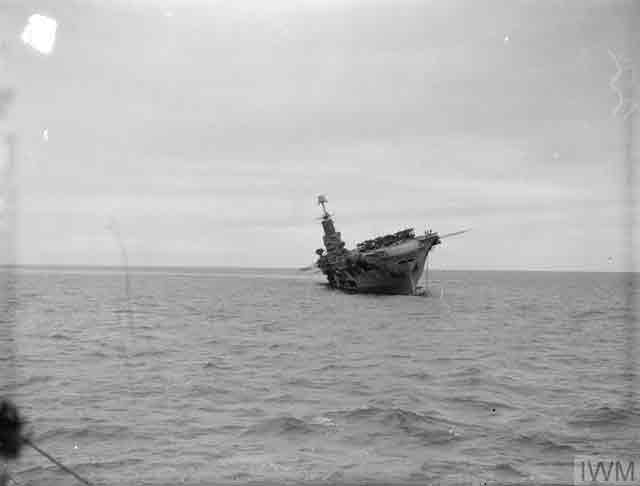
The Loss of HMS Ark Royal
It is decision time on the Eastern Front on 13 November 1941. Winter is setting in, and the Wehrmacht is still over 100 kilometers from Moscow, its current Operation TYPHOON objective. During the summer there did not seem to be any time pressure, but now there is because winter is closing in. The Germany Army retains the initiative, but it is unprepared for winter combat. There is no antifreeze for the vehicles, meaning they must be run virtually continually, putting a strain on men and machines and also letting the Red Army know the Germans’ exact positions. The men are getting frostbite in the -22° C weather dark summer uniforms make everyone a target against the snowy backdrop. The time has come to halt operations and dig in to await the spring — or has it? Army Chief of Staff General Franz Halder calls the chiefs of staff of the three army groups to Orsha to tell them what the high command has decided.
The meeting is held at 10:00 in Halder’s command train, which is parked at a siding in the town of Orsha, which is located midway between Minks and Smolensk. In attendance are Lieutenants-General Kurt Brennecke (chief of staff of Army Group North), Greiffenberg (Center) and General of the Infantry Georg von Sodenstern (South). Also present but more as observers than participants are the chiefs-of-staff from seven of the ten armies operating in the east (from north to south, the Eighteenth, Sixteenth, Ninth, Fourth, Second Panzer, Sixth and Seventeenth).
Halder begins the meeting with what is intended to be an inspirational speech that portrays the current situation in the most favorable light. He concedes that a “decision” is no longer “100% attainable” in the limited campaigning time left in 1941. However, since the war to date has reduced the Red Army’s strength “by at least 50%,” the Wehrmacht had to remain on the offensive for the time being “to maximize damage to the enemy.” It is not the most logical presentation, but it does make some sense — if you believe that the Red Army is on the verge of collapse. That is not the case, however, and the men listening in the railway car know this.
Colonel Eberhard Kinzel, the head of Foreign Armies East, then gives the OKH’s estimates of Red Army strength. After admitting that pre-war estimates that the Red Army had 140 divisions were faulty, Kinzel further admits the Soviets have been able to raise new forces during the conflict faster than expected. Kinzel estimates that now the Red Army has 160 divisions remaining in the European Theater of Operations — a large number, for sure, but any finite number is reassuring given the seemingly endless ability for the Soviets to find additional troops whenever needed. Given the rushed recruitment of new soldiers, Kinzel further assures that the real strength of these 160 remaining Soviet divisions is actually 75 regular divisions. Due to Lend-Lease assistance and further recruitment, though, Kinzel concludes that the Soviets could double those 75 divisions by spring — making their destruction now before that can happen all the more important.
Following Kinzel are two supply officers, chief of the OKH Organization Branch Major-General Walter Buhle and Quartermaster-General Eduard Wagner. Buhle concedes that due to war losses, the army will have to disband fifteen entire divisions “to create reserves.” In addition, the size of panzer divisions is to be reduced and no more trucks can be expected to ease supply problems. Wagner adds that ammunition production was lowered during the year in anticipation of a quick victory, and thus shortages will occur during the first half of 1942. After everyone breaks for lunch, Halder asks the army group chiefs of staff what they think should happen. Brennecke and von Sodenstern suggest going immediately into winter quarters, while Greiffenberg — whose army group is the one that would gain the glory of capturing Moscow — is at best lukewarm. Sodenstern makes the memorable and very sour observation that the war was not being fought in France and it was not the month of May — suggesting that the drastically different circumstances could lead to a drastically different outcome. The opinions of the attendees are irrelevant, however, and Halder concludes the meeting by handing out pre-printed copies of the plans for the final stage of Operation TYPHOON — which is to begin virtually immediately.
The Orsha Conference commits the Wehrmacht to an effort to win the war in 1941 by capturing Moscow. The decision to continue attacking is based on assumptions based on information sources that already have been proven to be faulty. Most importantly, it completely disregards the degraded state of the German military, which is very well known by everyone involved. Attacking into the winter is a dangerous gamble because it exposes the troops to the elements and to counterattack in unfavorable circumstances. The decision is based on the hope that the Red Army is on the verge of collapse, but if that is not the case, continuing Operation TYPHOON could have devastating consequences for the German Army.
The Germans today resumed their attack on Moscow. Taking advantage of the frost-hardened ground, they have launched one of their customary pincer movements in a final attempt to capture the city before the winter strikes the exposed German army with all its severity.
The plan is for Guderian’s 2nd Panzer Group to take Tula, to the south of the Russian capital, and then sweep up behind Moscow to Kolemna. Hoth’s 3rd Panzer Group is to form the northern arm of the pincer with the task of driving eastwards to the Volga Canal and then wheeling towards Moscow while Hopner’s 4th Panzer Group attacks in the center.
This may well be the Germans’ last chance to take Moscow before “General Winter” takes an icy hand in this war. The Germans are happy that the frost has made the ground hard enough for their tanks and horses and men to operate, but if they cannot reach the shelter of Moscow within the next few weeks they will be forced to go onto the defensive. The initial reports of the fighting show that it is going to be much harder for them to take Moscow than seemed possible last month when panic gripped the city.
Tula has been turned into a strongpoint, and unless the Germans take this communications center and its airfield they cannot complete their pincer movement. Stalin has put heart into the people of Moscow, and Zhukov has created an effective defense. With both sides desperately weary and apparently short of men and machines, Moscow’s fate now hangs in the balance.
The temperatures in Moscow dips to -8° F (-22° C) overnight.
General Kirill Meretskov attacked German troops at Tikhvin, Russia with Soviet 4th, 52nd, and 54th Armies.
Soviet cruiser Chervona Ukraina, damaged by German aircraft on the previous day, sank at Sevastopol, Russia. Her guns would be salvaged to be used on shore.
After sundown, Soviet destroyers Gordy and Surovy departed Gogland, Russia for Hanko, Finland, escorted by minelayer Ural, four T-class minesweepers, and four MO-class submarine chasers. En route, Surovy, T-206, and MO-301 struck Finnish naval mines and sunk.
Nazi Propaganda Minister Joseph Goebbels charged today that the Jews had brought on the war in hope of destroying Germany and declared that “they are suffering no injustice by the treatment we bestow on them — they more than earned it.”
Transnistria: (i.e. east of the Dniester, or Nistru River as it is known in Romanian) In the department of Golta, under the control of Colonel Modest Isopescu [while unable to confirm this, I suspect he was a Jandarmi officer rather than regular Army], Bogdanovca was a small village chosen by Isopescu, upon his appointment as prefect in early October 1941, as one of those “controlled localities” as a depository for the Jews in the department. Shortly after collection of the local Jewish populace commenced, nine thousand Jews arrived on foot, having been deported from Odessa. Overcrowding quickly produced lethally unhealthy conditions, with a dispatch from Colonel Isopescu to Governor Alexianu today reporting no fewer than eight thousand Jews having died with another eleven thousand crammed into the village’s pigsties.
The British aircraft carrier HMS Ark Royal was torpedoed and severely damaged off Gibraltar by the German submarine U-81 in the Mediterranean Sea 150 miles east of Gibraltar at 0437 hours; 1 was killed, 1,487 survived. The Ark Royal sank the next day at 06:19 while under tow. Destroyer escorts counterattacked with 130 depth charges, but U-81 would escape. HMS Ark Royal was taken in tow.
Adolf Hitler ordered the German Navy to refrain from attacking American ships, but should German warships be fired upon by the Americans, they were to fire back in defense.
German military-intelligence service Abwehr meets with Yugoslav Chetnik guerilla leader Draza Mihailovic.
The British Air Ministry instructed Sir Richard Pierse, the Commander-in-Chief Bomber Command, to curtail drastically the scale of sorties against Germany, especially in bad weather. The War Cabinet stated the instruction “having stressed the necessity to conserve our resources in order to build a strong force to be available by the spring of next year”. With the exception of a few minor raids in the following months this is exactly what happens and, by early January, Pierse had been reassigned as Air Officer Commander-in-Chief, Air Forces in India.
Assertions that the “inexperience” of American labor leaders may lead to a general strike further damaging already “painfully crippled” American aid to the allies today accompanied renewed laborite demands in the British House of Commons for the opening of a “second front.” Laborites seized advantage of commons debate on the king’s speech which opened the new session yesterday to urge increased aid for Russia, an immediate offensive in Libya and removal of members of the government hostile to Russia. Pro-Communist Leftists who prior to June had opposed the ‘Imperialist war’ now agitate continually for a Second Front in Europe which the British Army is in no realistic position to mount, solely to save Stalin from his former ally.
United States Ambassador John G. Winant received loud cheers tonight when he announced at a London dinner at the naval reserve auxiliary patrol club that the U.S. House of Representatives had passed the Neutrality Act revision bill. Sir Dudley Pound, first sea lord, had just finished a speech praising the cooperation of the United States Navy in the battle of the Atlantic. Recalling that 50 United States destroyers and 10 coast guard cutters had been given to Britain, Sir Dudley said, “if I had to go back tonight and take out of service every one of these ships, In plain language, I don’t know where in the hell we would be.” A few minutes later Winant, a guest, received a note and, he arose and made his announcement.
There were no RAF Bomber Command operations from 10 to 15 November 1941.
U-126, commanded by Kapitänleutnant Ernst Bauer, sank British steamer Peru (6961grt) at 1-30N, 13-20W. At 0042 hours on 13 Nov 1941 the unescorted Peru (Master C.V. Frederiksen) was hit amidships by one torpedo from U-126 southwest of Cape Palmas and sank at 0145 hours after being hit in the engine room by a coup de grâce. The Germans questioned the survivors before leaving the area. The master, 42 crew members and seven gunners were picked up by the British whaling ship Uniwaleco and landed at Freetown on 16 November. The 6,961 ton Peru was carrying pig iron, groundnuts, and general cargo and was bound for the United Kingdom.
Aircraft carrier HMS Ark Royal was torpedoed by U-81, commanded by Kapitänleutnant Friedrich Guggenberger, in 36-03N, 4-45W. At 1637 hours on 13 Nov 1941, U-81 fired a spread of four torpedoes at HMS Malaya (01) in the Force H and heard two detonations after 6 minutes 6 seconds and 7 minutes 43 seconds. In fact one torpedo hit HMS Ark Royal (91) (Capt L.E.H. Maund, CBE, RN) amidships, which sank under tow by the tugs HMS Thames and HMS St. Day (W 55) with almost all of her aircraft about 30 miles east of Gibraltar at 0813 hours on 14 November. One rating was lost. The crew had been evacuated 13 hours after the torpedo hit by HMS Legion (G 74) (Cdr R.F. Jessel, RN) and taken to Gibraltar. The carrier was returning from Operation Perpetual. On 10 November, she had left Gibraltar together with HMS Argus (D 49) (Capt G.T. Philip, DSC, RN) to ferry 37 Hurricane fighters to Malta under escort by the Force H, formed by HMS Malaya (01) (Capt C. Coppinger, DSC, RN), HMS Hermione (74) (Capt G.N. Oliver, RN) and seven destroyers. Two days later they had launched the fighters and turned back to Gibraltar.
Light cruiser HMS Sheffield departed Hvalfjord for Faroes — Iceland patrol.
Destroyer HMS Echo departed Scapa Flow at 0830 for Hvalfjord to join the Commander in Chief, Home Fleet. The destroyer carried mail for the fleet. The destroyer arrived at 0940/15th.
Destroyer HMS Brighton departed Loch Alsh at 1900 to carry out docking and repairs at Scapa Flow. The destroyer arrived at 0830/14th.
Dutch steamer Joma (372grt) was sunk by a mine in Falmouth Harbour. Three gunners were lost on the steamer.
Soviet destroyer Surovy was lost in a mining off Hango.
Operation APPROACH, carrying stores to Tobruk, began when destroyers HMS Kipling, HMS Jackal, and HMS Encounter departed Alexandria on the first serial. Polish General Sikorski took passage in destroyer Kipling to inspect Polish troops at Tobruk. The ships returned to Alexandria on the 14th.
Destroyer HMS Eridge and sloop HMS Flamingo passed through the Suez Canal northbound. Sloop Flamingo departed Port Said for Alexandria, arriving on the 14th. Destroyer Eridge was held at Port Said to take part in an anti-submarine sweep the next day.
Greek auxiliary ship RHS Aghios Nicolaos was sunk on a mine between Dikili and Mitylene. The Master and crew of three were all lost.
Anti-submarine trawlers HMS St. Nectan and HMS Lady Shirley departed Gibraltar escorting tanker Cowrie westwards and then joined tanker Winamac for Gibraltar, arriving on the 21st.
Submarine HMS Regent arrived at Malta from Alexandria with passengers, stores, and kerosene. On the 12th, her starboard engine broke down completely and she arrived at Malta with only her port engine operating.
The German commerce raider Atlantis rendezvoused with the submarine U-68 southwest of the island of St. Helena in the South Atlantic in order for the Atlantis to transfer fuel oil to the submarine as the Atlantic was now scheduled to return to Germany.
Convoy ON.36 departed Liverpool escorted by destroyers HMS Broke, HMS Chelsea, and HMS Wolverine, corvettes HMS Begonia, HNoMS Eglantine, and HMS Larkspur. Destroyer Chelsea was detached on the 16th when destroyer HMS Broadway joined. Destroyer Broadway was detached later that day. On the 18th, the escorts were relieved by destroyer HMS Rockingham and corvettes HMCS Arrowhead, HMCS Buctouche, HMCS Cobalt, HMCS Moose Jaw, HMS Nasturtium, HMCS Pictou, and HMCS Windflower. Destroyer Rockingham was detached on the 20th. The remainder of the escorts was detached on the 25th when the convoy was dispersed.
Convoy SC.54 departed St Johns escorted by destroyer HMS Burnham and corvettes HMCS Algoma, HMCS Chambly, HMCS Matapedia, and HMS Napanee.
Canadian troop convoy TC 15 departed Halifax with liners Andes (25,689grt), Christiaan Huygens (16,287grt), Duchess of ATHOLL (20,119grt), Durban Castle (17,388grt), Orcades (23,456grt), Oronsay (20,043grt), Reina Del Pacifico (17,702grt), Sobieski (11,030grt), and Warwick Castle (20,107grt). The convoy was escorted by U.S. battleship USS New Mexico, light cruisers USS Philadelphia and USS Savannah, and destroyers USS Morris, USS Sims, USS Hughes, USS Mustin, USS Russell, USS Walke, and USS O’Brien on the 13th. On the 18th, destroyers HMS Highlander (S. O. ), HMS Harvester, HMS Havelock, HMS Hesperus, HMS Westcott, and HMS Blankney, which had been escorting convoy CT.6, joined the convoy and escorted it to arrival on the 21st.
Today in Washington, President Roosevelt, in a letter to Speaker Rayburn and Majority Leader McCormack, urged that the House approve the Senate amendments revising the Neutrality Act. His callers included Senator Kilgore and the West Virginia Congressional delegation and Senator Murray. The president remained in the White House a second day with a head cold, but was said to be improving.
The Senate passed the District of Columbia rent control bill, confirmed the nomination of Anthony J. Brexel Biddle as Ambassador to the refugee Greek Government, confirmed the nomination of Charles Fahy as Solicitor General, received the O’Mahoney resolution requesting information on OPM priority policies, received the Herring resolution to establish new procedure in handling defense strikes and forbidding closed shops in defense industries and adjourned at 1:12 PM until noon Monday. The Foreign Relations Committee considered a treaty exempting defense materials for Britain from taxation; the Privileges and Elections Committee continued hearings on the fitness of Senator Langer.
The House completed Congressional action on Neutrality Act revision, 212 to 194; heard demands for anti-strike legislation and adjourned at 4:44 PM until noon tomorrow. The Judiciary Committee considered the subpoena sent to Representative Fish; the Labor Committee discussed the defense labor situation.
Responding to a dramatic last-minute appeal from President Roosevelt, the U.S. House of Representatives voted 212 to 194 today to let armed American merchant ships carry cargoes through zones of battle directly into the harbors of belligerent nations. By that 18 vote margin, it sent to the White House legislation repealing the remaining major provisions of the neutrality law, and saved the administration from a disastrous and prestige-shattering defeat. But slender though the majority was, it was more than large enough to surprise and delight the administration leadership in the house. For two days, it had fought to avert what looked at times like certain defeat. The roll was called in tense silence. As soon as it was over, the Speaker, Sam Rayburn of Texas, who immediately before the vote went on to the floor and read a letter from the president urging passage, happily signed it. The president will sign it on Monday.
The bill’s history was a notable demonstration not only of the declining, though still formidable, power of the isolationists but also of President Roosevelt’s political skill. Realizing that he did not at first have the votes for revising the Neutrality Act so drastically as to allow American ships to enter war zones, he first sent a bill allowing U.S. merchantmen to be armed to the House. Polls suggested that most Americans were in favor, and the bill was passed by the House by almost two votes to one on 17 October. Then, after making a speech in which he claimed that the Nazis were planning to subjugate Central and South America, he sent the more ambitious bill allowing ships to go into war zones to the Senate, where it passed by 50 to 37. That was close.
Senator Hiram Johnson, a leading isolationist, told his son that it was a good result, given that “the bundles to Britain crew and all the Anglophiles were pulling and hauling and doing everything they could”. But only then did the president send the stronger bill to the House of Representatives.
Declaring yesterday that the adoption of the amendments to the Neutrality Act by the House was “gratifying,” Wendell L. Willkie attributed the close vote in part to “the Administration’s negligence and muddling in the solution of our industrial labor relations problem” and “its utter disregard of the needs and rights of large elements of our population in the handling of our domestic and defense program.”
The U.S. Navy is prepared tonight to start putting guns and gun crews aboard U. S. merchant ships as soon as President Roosevelt signs the neutrality revision resolution on Monday. Secretary of the Navy Knox told a recent press conference the merchantmen will be armed with 3-inch, 4-lnch and 5-inch guns, depending on the structure of individual ships. The new 5-inch dual-purpose guns probably will be placed only aboard newer ships built especially to absorb the recoil of heavy weapons. They now comprise the main armament of new navy destroyers. They can be used against either surface or air targets, and have an effective range of eight miles, several miles more than that of 4-inch guns.
President Roosevelt, on the eve of a conference with John L. Lewis on the captive coal mine dispute, told congress yesterday a shutdown of these mines supplying steel mills with fuel could not be permitted. Mr. Roosevelt’s assertion was made in a letter to house leaders. It came amid widespread reports in Washington that administration-sponsored legislation to restrict strikes was imminent, and toward the end of a day which saw these other labor developments: The Federation of Long Lines Telephone Workers (independent) called off a strike set for midnight Friday and arranged for its national council to meet with federal conciliators in New York November 21. The union is asking a 4 percent wage increase for 15,000 members whose current scale ranges from $13 to $66 a week. Fourteen non-operating railroad unions, representing 900,000 workers, rejected a recommendation from a White House-appointed special board that they be satisfied with raises of 13 percent. The unions said wages now ranged from 33 to 85 cents, and they had asked 30-34 cent increases. A strike the second week In December has been called by the operating brotherhoods, who also were dissatisfied with the board’s recommendations. C.I.O. officials said workers at Bell Aircraft’s two plants In Buffalo, N. Y., were “getting hot” and predicted a strike unless the management “begins to bargain,” The United Automobile Workers (C.I.O.) is demanding a general 20-cents an hour raise and a minimum of 75 cents an hour instead of 50. Bell’s 11,000 employees are working on $150,000,000 of aircraft orders for Britain and the United States.
The nation’s coal-supply situation was characterized today as “generally comfortable” by Secretary Ickes, who said that stocks on hand at steel mills are sufficient to last about thirty-one days.
Two prominent members of the House Rules Committee said tonight that they would block future Administration legislation unless the leaders permitted anti-strike legislation to be brought to the floor. This aim was stated by Representatives Cox of Georgia and Smith of Virginia, the first and second ranking members of the committee, after an outburst in the House which followed announcement of the result of the vote on the neutrality resolution.
Associate Director Sidney Hillman of the Office of Production Management capped a day-long tour of automobile industry defense plants tonight with a plea that labor settle its disagreements with management and its “family quarrels” without work stoppages. “Shall it be said of labor that when our country needed arms we gave it jurisdictional feuds and bickering among ourselves?” said Hillman. “Let us sink our petty differences in the common cause, the cause of freedom.”
Destroyer USS Edison (DD-439), screening convoy ON.34 southwest of Iceland, depth charges sound contact.
Destroyer USS Decatur (DD-341), screening convoy HX.159, depth charges sound contact; although it is regarded as a good contact, the ensuing search yields no evidence of a submarine.
Joe DiMaggio is named American League MVP. His 56-game hitting streak edges out Ted Williams and his .406 batting average for the award (291 votes for DiMaggio and 254 for Williams). The National League winner is Dolph Camilli with Dodger teammates Pete Reiser and Whit Wyatt finishing 2nd and 3rd. The next time the vote will have teammates 2nd and 3rd will be in the American League, in 1959. Both Camilli and DiMaggio also win The Sporting News MVP Awards.
The speeches to be delivered by Premier Hideki Tojo, Foreign Minister Shigenori Togo and Finance Minister Okinori Kaya at the extraordinary session of the Diet opening tomorrow, were approved at a special Cabinet session yesterday and the three Ministers will now proceed to the imperial villa at Hayama to obtain Emperor Hirohito’s sanction for them.
A Chinese Army spokesman said today that intelligence service reports told of large-scale Japanese troop movements at sea and indicated that great numbers of warships and troop transports were being massed off the coast of Northern Indo-China.
Japanese Admiral Yamamoto gathered his commanders at Iwakuni air base at Yamaguchi, Japan to discuss Pearl Harbor tactics.
A message from the Foreign Ministry in Tokyo to the Japanese Ambassador in Washington, D.C., includes the following: “Judging from the tone of these talks, the United States is apparently still assuming that they are of a preliminary nature. We pleaded with the U. S. Ambassador (to Japan) again on the 12th to try and see the seriousness of the situation. Will you, too, do everything in your power to make them realize this in accordance with the lines contained in my various instructions on this subject?”
Australian troop convoy US.13 departed Fremantle with liners Queen Elizabeth (83,673grt) and Queen Mary (81,235grt). The convoy was dispersed on the 20th. The liners then travelled independently.
Dow Jones Industrial Average: 115.67 (+0.23)
Born:
Mel Stottlemyre, MLB pitcher (All-Star, 1965, 1966, 1968–1970; New York Yankees) and coach, in Hazleton, Missouri (d. 2019).
Jerry Richardson, NFL cornerback and safety (Los Angeles Rams, Atlanta Falcons), in Los Angeles, California.
Sammy Odom, AFL linebacker (Houston Oilers), in Shreveport, Louisiana (d. 2001),
Dack Rambo, American actor (“Guns of Will Sonnett”, “Dallas”), in Earlimart, California (d. 1994, of complications from AIDS)
Naval Construction:
The U.S. Navy SC-497-class (110-foot wooden hull) submarine chaser USS PC-675 (later SC-675) is laid down by the Hiltebrant Dry Dock Co. (Kingston, New York, U.S.A.).
The Royal Navy “T”-class (Third Group) submarine HMS Tactician (P 314) is laid down by Vickers Armstrong (Barrow-in-Furness, U.K.).
The U.S. Navy 77-foot Elco patrol motor torpedo boat USS PT-68 is launched by the Electric Launch Company Ltd. (Elco), (Bayonne, New Jersey, U.S.A.).
The U.S. Navy Monadnock-class coastal minelayer USS Miantonomah (CMc-5; later CM-10) [ex-SS Quaker] is commissioned. Her first commanding officer is Lieutenant Cdr. Raymond Dorsey Edwards, USN.
The Kriegsmarine (German Navy) Type VIIC U-boat U-596 is commissioned. Her first commanding officer is Kapitänleutnant Gunter Jahn.

