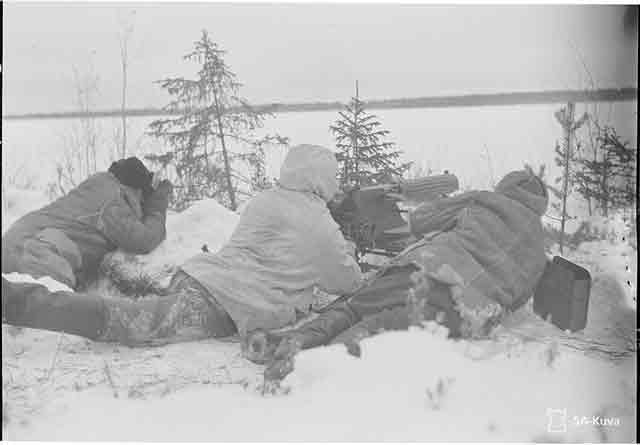
Finland gives an official answer to the U.S. offers to mediate peace between Finland and the Soviet Union. Finland states that her war is defensive in nature, and the Finnish military efforts doesn’t threaten the U.S. interests. Finland can’t fulfill the U.S. demand to retreat behind the pre-1939 border, because such an act would undermine Finnish security.
Finland occupies an awkward position throughout World War II. While coordinating its military activities closely with the Reich, it does not consider itself to be an ally. Rather, Finland takes pains to characterize itself as a “co-belligerent.” While at first glance the difference may seem merely semantic, to the Finns it is of immense importance. Finland is the only Axis power which maintains somewhat normal relations with the United States throughout the conflict, and it is only because the Finns cling to their co-belligerent status.
As of 11 November 1941, that has not interfered with military operations. The Finnish Army has excelled in the forests and marshes recently occupied by the Soviet Union during and following the Winter War. There is no question that its soldiers perform better in that environment than do attached Wehrmacht units. The Germans are somewhat mystified by why the Finns perform so well but are highly appreciative of the military assistance. However, today the Finns’ double game of fighting alongside the Germans while also trying to maintain proper relations with the Allied powers creates an impact on operations in the field that is of lasting significance.
The commander of Finnish III Corps within Army of Norway, Major General Hjalmar Siilasvuo, is commanding the portion of Operation SILVER FOX which aims to cut the Soviet Murmansk railway at Loukhi. While technically the Germans command Siilasvuo through the Army of Norway headquarters, in reality, Siilasvuo is in complete operational control because the German troops are of minimal effectiveness. In addition, all supplies to all of the troops at the front are controlled by the Finns. A complete withdrawal of Finnish cooperation and assistance would leave the German troops stranded and end all operations on the extreme end of the Eastern Front. Everybody knows this, and this gives the Finns complete control, especially on the fronts where Finnish troops predominate. These fronts include the area directly north of Leningrad, where the Germans want the Finns to attack but the Finns completely refuse. They also include the front east of Kestenga, where a joint Finnish-German battle group is attempting to cut the critical Murmansk railway which brings Western Ally supplies into the Soviet Union.
Marshal Mannerheim, the commander of the Finnish Army, is extremely attuned to the political machinations going on behind the scenes between Finland, Germany, and the Western Allies. Finland is not at war with either Great Britain or the United States and the Finnish government aims to keep it that way if it can. The Americans have demanded that Finland cease operations against the Murmansk railway because American supplies flow through it. The clear implication in the United States’ position is that interference with those supplies will lead to a United States declaration of war against Finland — even while the United States is not at war with Germany. This places Finland in a very uncomfortable position which has been percolating for some time.
On 11 November 1941, the Finns make their choice. They deliver a long diplomatic letter to Washington which explains at great length their situation. The Finns explain that their military is acting independently of the Reich’s (which heretofore really has not been the case in most instances) and that they do not take orders from Hitler. The Finns also decide to make an object lesson of this “independence” in the field. Marshal Mannerheim issues a secret order to Siilasvuo to halt the attack on the Murmansk railway at Loukhi. The Finns realize that cutting the railway could not help but be noticed in Washington. By discontinuing the attack, the Finns hope to maintain their neutral status vis-a-vis the Americans and the British. After giving this official answer, the Finnish FM Witting pays an unofficial visit to the U.S. ambassador Schoenfeld. Witting states that Finland won’t cut the Murmansk railway or advance to Archangel. All Finnish military operations from now on will be modest in nature.
The Finns do not tell the Germans about any of this. Instead, the Finns just stop attacking, with Siilasvuo making excuses about declining Finnish manpower, the heavy losses being incurred, and the difficulties of winter warfare. Finnish losses indeed are high relative to its population — they lose 79 men on the 11th — but sustainable if one is fighting a war for important national goals. The Finns continue resisting Soviet attacks, one of which they beat off today which attempts to rescue an encircled Soviet regiment west of Loukhi. However, they go over to the defensive here and elsewhere on the Eastern Front. From this point on, the Finns do just enough to satisfy German demands but absolutely no more than that. There is no question that the Finns could do more — if they were so inclined. Mannerheim from now pays more lip service to joint operations than giving actual commitments. It is a subtle but very real turning point in the war.
After dark, Soviet destroyers Stoiki and Leningrad, minelayer Ural, troop transport Andrei Zhdanov, and three minesweepers departed the island of Gogland (known in Finnish as Suursaari) in the Gulf of Finland for the Hanko Peninsula in southern Finland. After Andrei Zhdanov was sunk by a mine (7 were killed, 66 survived) and Leningrad damaged by a mine, the convoy abandoned its mission to evacuate Soviet troops from Hanko and sailed back to Gogland.
A German government report published on this date noted there were 700,000 Soviet prisoners of war employed as forced laborers.
The first execution using a small-caliber silent gun at the execution wall between Blocks 10 and 11 took place at the Auschwitz I camp, where 76 Polish prisoners were killed.
Britain did not pause for a moment today in the grim task of pushing ahead with her war effort, yet thousands of men and women managed to remember that it was the twenty-third anniversary of Armistice Day. By nightfall the foot of the Cenotaph in Whitehall was buried in wreaths and sprays of flowers laid there on behalf of all ranks of the people, from commoner to King. The King’s large wreath of poppies, among the first to be placed on the monument, was followed by others from Prime Minister Winston Churchill, David Lloyd George, the three fighting services, the British Dominions and numerours veterans’ organizations. Long after the officials had departed, individuals, many of them women with children, stood in line with their small offerings of fresh cut flowers.
German submarine U-580 collided with target ship Angelburg and sank 33 miles west of Klaipeda, Lithuania by accident; 12 were killed, 32 survived.
British Hudson aircraft of No. 53 Squadron RAF damaged German submarine U-203 with four depth charges in the Bay of Biscay at 1415 hours.
Britain and America are dumping war material at Basra, Iraq, on Russia’s Caspian doorstep as fast as the Soviets can pick it up and throw it at the Germans, British officials said today. Bustling activity at this port where lend-lease freighters disgorge cargoes to be hustled across the deserts and mountains made it easy to take the assertion at face value. With supplies already moving across Iran by several routes, Brig.-General Sir Godfrey Jones Rhodes said, plans are being carried out rapidly for extension and improvement of the transport.
Allied forces, with local guerrillas assisting, attack Chilga and Kulkaber around the main Italian Gondar position in Ethiopia. The attacks make little headway today.
There were no RAF Bomber Command operations from 10 to 15 November 1941.
U-561, commanded by Oberleutnant zur See Robert Bartels, sank Panamanian steamer Meridian (5592grt), straggling behind convoy SC.53, in the North Atlantic. At 2335 hours on 11 Nov 1941, U-561 fired a spread of four torpedoes at the Meridian, observed one hit in the bow and heard another detonation at 2341 hours. The ship was a straggler from convoy SC.53 and was reported missing after being seen for the last time by HMCS Chambly (K 116) (A/Cdr J.D. Prentice, RCN) at 1730 hours on 11 November. The 5,592 ton Meridian was carrying government stores and general cargo and was bound for Archangel, Soviet Union.
U-580, commanded by Oberleutnant zur See Hans-Günther Kuhlmann, was sunk in a collision with German target vessel Angelburg (3053grt) during night excercises off Memel in the Baltic Sea. Twelve crewmen were lost in the submarine. Thirty two crewmen were rescued. During its career the U-580 sank or damaged no ships.
Battleship HMS Rodney and destroyers HMS Onslow, HMS Impulsive, and HMS Antelope on patrol off the Faroes — Iceland passage were ordered to Hvalfjord at 0144. The ships arrived at Hvalfjord on the 12th.
Heavy cruiser HMS Kent departed Hvalfjord for exercises and then patrol in the Faroes — Iceland passage.
Minesweeper HMS Sharpshooter departed Cardiff for Scapa Flow at 0012. The minesweeper arrived at 0730/13th.
Minesweeper HMS Blyth was damaged by German bombing off Dartmouth. The damage required sixteen days to repair.
T/Sub Lt (A)G. Black, RNZVR, was died of injuries after his Swordfish flew into high ground at Durham.
A/Leading Airman S. H. Tyson of 1 SFTS Netheravon was killed when his Battle crashed at Shrewton LG.
Battleship HMS Valiant, light cruiser HMAS Hobart, and four destroyers were at sea from Alexandria on exercises. The 7th Destroyer Flotilla was also at sea exercising.
Convoy ST.8 departed Freetown, escorted by sloop HMS Bridgewater, corvettes HMS Clover, HMS Hollyhock, and HMS Wallflower, and anti-submarine trawlers HMS Kelt and HMS Sarabande. The convoy arrived at Takoradi on the 16th.
Armistice (Veteran’s) Day in the United States. As the United States celebrated today the signing of the World War armistice, President Roosevelt declared in his address that this country may be forced by Germany into another war. Other speakers emphasized the same theme of the Nazi peril.
President Roosevelt gave an Armistice Day address at Arlington National Cemetery. “Our observance of this Anniversary has a particular significance in the year 1941,” the president said. “For we are able today as we were not always able in the past to measure our indebtedness to those who died … Whatever we knew or thought we knew a few years or months ago, we know now that the danger of brutality and tyranny and slavery to freedom-loving peoples can be real and terrible. We know why these men fought to keep our freedom — and why the wars that save a people’s liberties are wars worth fighting and worth winning — and at any price.” President Roosevelt told an Armistice day audience at Arlington National Cemetery today that the people of America believed liberty was worth fighting for and if need be would “fight eternally for it.” “This duty we owe,” he said, “not ourselves alone, but to the many dead who died to gain our freedom for us to make the world a place where freedom can live and grow into the ages.”
General George C. Marshall summoned the nation tonight to be on guard against a “sudden and widespread attempt” by the axis powers to sabotage the United States munitions, utility and transportation industries. Already, he declared, the axis has unleashed a propaganda attack designed to disrupt army morale and the “clever methods” used, he added, have succeeded in upsetting the families of soldiers and have “misled” members of congress. “We should realize,” the army chief of staff said in a broadcast on Civilian Defense week, “that the more we, as a nation, influence the course of this war, the more important it becomes for us to protect every phase of our national life against the efforts of the axis powers to deter or weaken us.”
Navy Secretary Knox declared in an Armistice Day speech in Providence, Rhode Island today that America has striven by every means to maintain peace in the Pacific, but further forbearance would be misunderstood and the time had come when this country could no longer ignore its rights.
The likelihood of any direct conferences in Washington between President Roosevelt and Japan’s special envoy, Saburō Kurusu, receded tonight as the Chief Executive maintained tentative plans to leave Washington for Warm Springs, Georgia, before Sunday and the envoy was held up for a second day at Midway Island, in the Pacific.
America is in real danger today, because it is smug and self-satisfied and susceptible to overconfidence, Sergeant Alvin C. York, World War hero, said here today in an Armistice Day address. He blamed the activities of Charles A. Lindbergh and other leaders of the America First Committee for this condition.
Unless President Roosevelt’s “attempts to draw the United States” into “actual war” are checked, the American people who are opposed to war may be forced to form a movement of “Free Americans” similar to the Free French Government of General Charles de Gaulle, John F. Finerty, national chairman of the Keep America Out of War Congress, declared last night.
The American Lend-Lease program is expanded to include Free France based in Britain. President Franklin D. Roosevelt agrees to the extension of Lend Lease Act to the Free French because, “the defense of territories allied to Free France is vital to the defense of the United States.”
A pledge to supply the defense industries with all the steel required was given by steel representatives today in the first industry-wide conference ever held with the government on defense needs. For its part, the government, through high officials of the defense organization, promised to define more precisely the types and quantities of steel which were needed and the dates upon which it should be delivered.
Angrily protesting the Defense Mediation Board’s ruling against a union shop in captive coal mines, C.I.O. President Philip Murray and an aide resigned from the board today, and reports were current that the army was preparing to cope with any new “emergency” in the pits. From Pittsburgh came word an army intelligence center had been established in that area. This prompted speculation that the army might take over the mines if John L. Lewis, United Mine Workers head, ordered renewal of the strike which was halted pending the board’s decision. However, no confirmation was forthcoming from the War Department.
The strike of A.F.L. building craftsmen, which has tied up $23,000,000 of Navy and marine construction in San Diego’s defense program, will end at noon tomorrow, union leaders announced tonight following a long meeting.
The Commerce Department said today that price rises are beginning to outrun increased national income so that many workers are no better off than before they made more money. Observing that the national income reached in September a rate equivalent to $92,000,000,000 a year, the highest rate in history and $10,000,000,000 more than the actual 1940 figure, the department added, nevertheless, that “the gains in income payments for August and September were approximately offset by rising prices and the real volume of non-agricultural income showed a marked decline. September income payments, the estimated total of all money paid for wages, dividends, net rents, interest, relief and individual business profits, totaled $8,099,000,000, compared with $7,270,000,000 in August and $6,574,000,000 in September of last year. Income payments in the first nine months of the year aggregated $64,332,000,000, or 17 percent more than in the similar period last year. In these periods, wage payments were up 21 percent, individual business and farm profits increased 14 percent, and dividends gained 10 percent.
President Roosevelt appealed for support of the Red Cross as “an essential part of our preparedness program” in a message tonight on a radio program which opened the annual Red Cross membership roll-call. Both Mr. Roosevelt and Norman H. Davis, Red Cross chairman, who read the president’s message, emphasized the increasing tasks now being placed upon the organization. Secretary of War Stimson, Secretary of the Navy Knox, Secretary of Labor Perkins and Clark Gable, motion picture actor, also appealed for the public’s support.
Destroyer USS Edison (DD-439), en route to rendezvous with convoy ON.34, depth charges sound contact.
Destroyer USS Decatur (DD-341), screening convoy HX.159, depth charges sound contact off the Grand Banks; it is later evaluated as a “doubtful” submarine.
Robert Johnson completed aviation cadet training and began his service with the U.S. Army at Oklahoma City, Oklahoma, United States.
Joe DiMaggio of the New York Yankees was named the American League’s Most Valuable Player. DiMaggio’s 56-game hitting streak beat out Ted Williams’ .406 batting average, 291 points to 254.
The acting chairman of Argentina’s “Dies Committee,” declared tonight that he had evidence substantiating President Roosevelt’s charges of German designs on South America.
The Foreign Ministry in Tokyo sends the following message to the Japanese embassy in Washington, D.C.: “Judging from the progress of the conversations [with U.S. authorities], there seem to be indications that the United States is still not fully aware of the exceedingly criticalness of the situation here. The fact remains that the date set forth in my message #736 [25 November] is absolutely immovable under present conditions. It is a definite dead-line and therefore it is essential that a settlement be reached by about that time. The session of Parliament opens on the 15th [work will start on (the following day ?)] according to the schedule. The government must have a clear picture of things to come, in presenting its case at the session. You can see, therefore, that the situation is nearing a climax, and that time is indeed becoming short.”
Although Japanese Spokesman Koh Ishii declared yesterday that Prime Minister Winston Churchill’s speech lining up Britain with the United States in case of a conflict in the Pacific was no surprise to Japan, which would “wait and see,” the Japanese press denounced it as “an outrageous but crafty British plot to involve the United States in a war in the Pacific for the protection of British interests.”
Imperial Japanese Navy aircraft carrier HIJMS Kaga entered the drydocks at Sasebo Naval Shipyard, Japan.
Ten Imperial Japanese Navy submarines departed from Yokosuka Naval Base in Japan for Kwajalein of the Marshall Islands, where they would proceed for U.S. Territory of Hawaii.
The Nihon Kaigun (Imperial Japanese Navy) submarine HIJMS I-68 joined the Advance Expeditionary Force for the Pearl Harbor attack; she departed Saeki, Japan for Kwajalein, Marshall Islands.
A general election was held in the Philippines. Incumbent President Manuel L. Quezon won an unprecedented second term. Returns in the elections indicated early today that President Manuel Quezon was leading his nearest opponent by about 7 to 1, assuring him of re-election to the Presidency for another four years. He had previously announced, however, his intention to serve only two years and then relinquish the Presidency to Sergio Osmena, who is apparently winning re-election as Vice President by an even bigger margin than Quezon.
Major General Lewis H. Brereton, Commanding General Far East Air Force, is ordered by Lieutenant General Douglas MacArthur, Commanding General U.S. Army Forces Far East (USAFFE), to undertake a three-week, 11,500-mile (18 507 kilometer) survey to Rabaul, New Britain Island, Bismarck Archipelago; Port Moresby, Papua New Guinea; and Townsville Queensland, and Melbourne, Victoria, Australia, to comply with U.S. Army Chief of Staff General George C. Marshall’s directive of 30 September 1941. The purpose of the trip is to establish working relations with Australian officials and to survey the trans-Pacific air ferry route from Australia to the Philippines and Java including its extension to Singapore and China. Brereton departs for Australia on 16 November.
The Australian War Memorial was opened in Canberra.
Australian light cruiser HMAS Sydney departed Fremantle to escort British troopship Zealandia (6683grt), which had departed Sydney escorted by light cruiser HMAS Adelaide for Singapore. Light cruiser HMS Durban relieved light cruiser HMAS Sydney on the 17th. The Australian light cruiser was to return to Fremantle, arriving on the 20th.
Born:
Helga Niessen Masthoff, West German tennis player, in Essen, Germany.
Died:
Charles Huntziger, 61, French army general (plane crash).
Naval Construction:
The Nihon Kaigun (Imperial Japanese Navy) Kaidai-type submarine (KD7 sub-class) (I-176-class) HIJMS I-181 is laid down by the Kure Naval Arsenal (Kure, Hiroshima Prefecture, Japan).
The Nihon Kaigun (Imperial Japanese Navy) Agano-class cruiser HIJMS Yahagi (矢矧) is laid down by the Sasebo Naval Arsenal (Sasebo, Nagasaki, Japan).
The Kriegsmarine (German Navy) Type VIIC U-boat U-353 is launched by Flensburger Schiffsbau-Ges, Flensburg (werk 472).
The Royal Canadian Navy Fairmile B-class motor launch HMCS ML 061 is commissioned.
The Royal Canadian Navy Bangor-class (VTE Reciprocating-engined) minesweeper HMCS Swift Current (J 254) is commissioned. Her first commanding officer is Lieutenant Commander Albert George King, RCNR.

