A Soviet newspaper, in a rare public acknowledgment, said the Kremlin had ideological differences with a Communist neighbor in eastern Europe. Commenting on party General Secretary Leonid I. Brezhnev’s coming visit to Yugoslavia, the government daily Izvestia said, “It is known that the Soviet Union and Yugoslavia take a different approach to some problems in the construction of a new society.” Moscow traditionally has taken the position that it is the center of world communism and parties everywhere are obliged to follow its line.
America’s best face was put on display in Moscow today with the opening of a United States‐sponsored exhibition to celebrate the Bicentennial. With special stress on history and political freedoms, the exhibition relegates gadgetry — normally the centerpiece of such displays overseas — to a lesser role, Film, music, slides, videotape, an evoca tive collection of photographs and tasteful selection of cultural artifacts — both antique and modern — convey the texture of life so vividly that an American in Moscow is likely to suffer an acute attack of nostalgia.
British Prime Minister James Callaghan began summit talks with President Valery Giscard d’Estaing in Rambouillet, France. Callaghan was expected to tell the French leader that Britain would solve its economic crisis without direct financial help from the European Common Market. However, Britain has sought a $3.9 million loan from the International Monetary Fund and would welcome Common Market backing on the request.
A group of paramilitary Protestant organizations proposed a 10-year phaseout of British rule, to end with an independent Northern Ireland. The proposal was an about-face for the militant Protestants, who in the past have strongly supported British control. The Protestant groups included the Ulster Volunteer Force and the Red Hand Commandos, both blamed by police for anti-Catholic bombings and assassinations. Protestant politicians Ian Paisley and Harry West criticized the plan, saying it would lead to a united Ireland rather than an independent Ulster.
Italy’s trade unions offered limited wage restraint next year following stern warnings by Premier Giulio Andreotti on spiraling labor costs. Leaders of the three major trade union confederations, in a statement after a meeting in Rome, said unions would not seek local wage increases next year on top of national contracts signed earlier this year. But they remained opposed to any changes in the automatic link between wage rises and the cost of living.
The Spanish Government of Prime Minister Adolfo Suárez has moved cautiously against some bastions of the hard right. But its seeming inability to check neo‐fascist “commandos” has become something of an embarrassment and a test of its democratizing intentions. Bookstores have become a litmus test. The Rafael Alberti on Calle Tutor was hit over the weekend — another name in a lengthening list of bookstores burned or bombed by right‐wingers in the year since Francisco Franco died. The Adolf Hitler Sixth Commando of the New Order sends a lot of death threats to liberal and leftist figures in Spain these days. Most of the time the threats prove empty. “You are a Marxist bookseller and cuckold,” read the note sent to Enrique Lagunero Munoz, the 50‐year‐old proprietor of the Rafael Alberti. “And, moreover, we are going to steal your bookstore, and also kill you, if you don’t get out of Spain in a week.” Already the target of three unsuccessful assaults, the richly stocked store, favored by students from the nearby Complutense University, succumbed the other night when thugs bashed in its front door and ignited a mixture of oil and gasoline. Its facade was spray‐painted with antileft and anti‐Semitic slogans.
Portugal’s Communist Party opened a four‐day congress in Lisbon today with a demand for entry into the Government and with a restatement of its strongly pro‐Soviet position. Alvaro Cunhal, the party’s secretary general, declared that the three‐month-old Socialist Government of Prime Minister Mario Soares was a failure and that only a cabinet that included the Communists could solve Portugal’s urgent social and economic problems. The Communist leader accused Mr. Soares and his Government of carrying out a policy opposed to workers and for the “return of capitalism,” and he warned that the Communist‐led workers would oppose this. He referred to recent Government moves to restore discipline in factories, curb excessive wage increases and return some illegally expropriated lands to their original owners.
Prison sentences for four Czechoslovak pop musicians were confirmed by a Prague court of appeals amid new protests against their convictions on “hooliganism” charges. The prison terms, ranging from eight to 18 months, were being viewed as a crackdown on unorthodox art forms. Ten legal experts who had been purged after the Russian invasion of Czechoslovakia in 1968 denounced the convictions as “lacking factual grounds and violating the principles of socialist legality.”
Forty-five poor Third World countries will get $200 million in loans from an Organization of Petroleum Exporting Countries’ special fund, the fund’s director general announced in Vienna. Allocations were set at a two-day meeting of the $800 million fund’s governing committee, Ibrahim Shihata said. The countries receiving the long-term, interest-free loans will be those described by the United Nations as the “least developed countries” or “food priority countries,” he said.
Arab countries at the UNESCO general conference sought condemnation of Israel today for its activities in territories occupied after the 1967 Middle East war. Some 30 Arab and African countries circulated a draft resolution in the United Nations Educational, Scientific and Cultural Organization accusing Israel of “systematic Judaization of education and cultural life” in the occupied territories. The resolution also condemned as “contrary to human rights” what it said were violations of the right of people in the area to national and cultural life.
A prominent Christian politician who is the most outspoken Lebanese opponent of Syria’s dominating military presence survived a machine‐gun attack upon him today from a passing car in Muslim‐dominated west Beirut. The politician, Raymond Edde, was defeated last May in a bid for the Presidency by Elias Sarkis, the Syrian‐supported candidate who is now President. Mr. Edde, virtually the only prominent Lebanese Christian politician who has sometimes sympathized with the Lebanese leftist‐Moslem cause in the 19-month civil war, suggested in an interview in his west Beirut home tonight, as he fingered bullet holes in his sweater, that Syria might have been responsible for the attack, in which his chauffeur was seriously wounded. The shooting occurred as Syrian troops and tanks were preparing to penetrate deeper into the capital to separate the combatants facing each other across the line that divides the city.
Egypt’s President Anwar Sadat announced that political parties, outlawed since the 1952 revolution, would be allowed with limitations. Although Sadat’s Arab Socialist Organization remained the chief political party, the Liberal Socialist Party and the National Progressive Unionist Party, whose organizations had put forth candidates in the October 28 elections, were allowed to operate as well. Limited democracy in Egypt is being gradually restored by President Anwar Sadat. Addressing the People’s Assembly, he said that three political groups that competed in a parliamentary election last month could now function as “free” parties with three limitations. These are, he said, that they must respect “national unity,” not act as religious parties and not try to destroy welfare gains won by Egyptians since the 1952 revolution.
A group of 12 U.S. senators arrived in Cairo for talks with Egyptian officials including President Anwar Sadat on safeguards necessary to go along with the sale of nuclear reactors to Egypt. Under terms of an agreement signed in Washington in August, the United States will build three nuclear power plants, each with a capacity of 600 megawatts, in Egypt. The agreement still must be approved by Congress and the senators are seeking guarantees of “safeguards to prevent the diversion of nuclear fuels from power plants into illicit weapons,” according to government sources.
Following virtual ultimatums to Pakistan by the United States and Canada and what are interpreted as changes in France’s attitude, it seems more and more unlikely that the French will provide Pakistan with a controversial nuclear reprocessing plant. The contract for the plant, signed last spring, has grown into a symbol of the spread of nuclear weapons potential because the plutonium for bombs can be derived through reprocessing of spent nuclear fuel. A meeting here earlier this week between Foreign Minister Aziz Ahmed of Pakistan and the French Foreign Minister, Louis de Guiringaud, and the reported dispatching of a presidential envoy to Pakistan last weekend have heightened speculation that the deal may be called off.
The Forty-second Amendment of the Constitution of India, authorizing dictatorial powers to the national government led by Prime Minister Indira Gandhi, was passed by the Indian Parliament’s upper house (the Rajya Sabha), 191 to 0. The measure had passed the 521-member Lok Sabha, 366 to 4 (with the opposition boycotting the vote) on November 2. It would be ratified by at least half of India’s 22 state legislatures and then signed into law by President Fakhruddin Ali Ahmed on December 18, and go into effect on January 3, 1977.
The editor of the Soviet Communist Party newspaper Pravda said today that he detected signs of an improvement in Soviet‐Chinese relations. The editor, Viktor G. Afanasyev, said at a news conference here that his newspaper encountered the same difficulties as Western news organizations in gathering news from China. Speaking through an interpreter, he said: “Information is meager and contradictory. But we wage no anti‐Chinese propaganda. We are trying to reconcile our differences and it is for China to respond.
Japan began returning a dismantled supersonic MIG-25 jet fighter flown there by a defecting Soviet pilot Friday morning, handing over 13 stainless steel crates to Soviet officials at the port of Hitachi.
President Agostinho Neto of Angola said today that his country faced a threat from imperialist bases for aggression in South‐West Africa. President Neto was speaking in Luanda on the first anniversary of Angola’s independence from Portugal. His speech was broadcast by Luanda radio and monitored in London. He said imperialism was always looking for new tactics to disrupt “our revolution.”
Black Rhodesian nationalists in Geneva said today that they had failed to make progress on a date for independence under black majority rule at a meeting of two hours and 40 minutes with Ivor Richard, chairman of the conference on the future of the white‐controlled territory. Mr. Richard, a Briton, gave no hint of progress when he emerged from the exceptionally long private session with Joshua Nkomo and Robert Mugabe, who have separate delegations but present what they call a “patriotic front” at the conference. Mr. Richard, London’s representative at the United Nations, said only that the discussion with the two black leaders was “detailed, intensive and prolonged.” The chairman said he expected to see Mr. Nkomo and Mr. Mugabe again tomorrow. He also planned to see the two other black leaders at the talks — Bishop Abel Muzorewa and the Rev. Ndabaningi Sithole — and Pieter van der Byl, Foreign Minister in the white minority Government of Prime Minister Ian D. Smith.
White Rhodesians celebrated the 11th anniversary of Rhodesia’s self-proclaimed independence from Britain with a formal ball and the tolling of a bell patterned after America’s Liberty Bell. Before ringing the bell, Prime Minister Ian Smith told his all-white audience he would speak in “a low key” to avoid “any provocative statements” during the Geneva conference on Rhodesia’s transition to black majority rule.
Defense Minister Pieter. W. Botha denied today that South African forces were supporting pro‐West guerrillas in their continuing resistance to the new Angolan Government. He said in an interview with the South African Press Association that such allegations were made by the SouthWest African People’s Organization to divert attention from crimes he said the black nationalist group was committing.
Veteran’s Day in the United States.
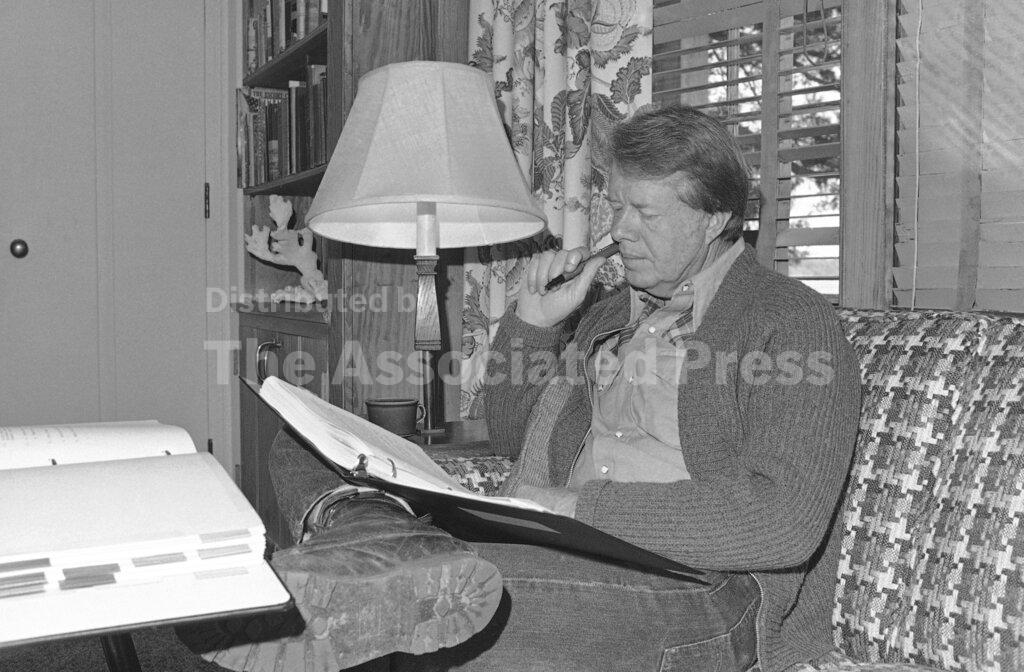
President‐elect Jimmy Carter flew back home today after a five‐day vacation at a plantation on St. Simons Island off the Georgia coast. Arriving in Plains shortly before noon, Mr. Carter almost immediately resumed work on matters relating to his move to the White House in January. He had spent much of his vacation studying a thick stack of memorandums on staffing requirements and governmental operations. “He’s maybe half to two‐thirds through the pile,” Jody Powell, his press secretary, said. Meanwhile, Patrick Caddell, the Carter campaign pollster, reported that his pre-election surveys had consistently indicated that the race with President Ford would be fairly close, with Mr. Carter winning by no more than six or so points. The actual spread was three points.
Three former aides of Henry A. Kissinger and a former Pentagon official in the Johnson Administration will lead Jimmy Carter’s transition teams into the foreign policy bureaucracy. Jack Watson, one of Mr. Carter’s transition leaders, gave the four names to White House aides yesterday, The team leaders, all of whom are considered moderates, are:
•Anthony Lake, a 36‐year‐old former Foreign Service officer, for the State Department. He has been heading the international relations section of transition planning for Mr. Carter. Before that, he was executive director of International Voluntary Services, a private organization similar to the Peace Corps.
•Richard C. Steadman, 44, a former Deputy Assistant Secretary of Defense, for the Pentagon, He is a partner in J. H. Whitney & Co., a private venture capital investment company in New York.
•David Aaron, 38, a former Foreign Service officer, to the National Security Council staff. He has been an aide of Senator Walter F. Mondale,. now the Vice President‐elect.
•Fred Bergsten, 35, a former State Department official in the Johnson Administration, to handle international economics as it cuts across the Treasury Department, the State Department and related agencies.
An execution stay for Gary Gilmore, a convicted murderer, until after the Utah State Board of Pardons meets next Wednesday, was granted by Governor Calvin Rampton. Mr. Gilmore, a convicted murderer, had asked to be shot by a firing squad on schedule Monday morning. The death penalty has not been carried out in the United States for more than nine years. Governor Rampton’s announcement came the morning after the Utah Supreme Court granted Mr. Gilmore’s wish by voiding an earlier appeal for a stay. The 35‐year‐old convict, clean shaven and in leg irons, handcuffs and white prison denims, made his appeal before the five justices yesterday. A great deal of confusion surrounds this case. Mr. Gilmore dismissed his two court‐appointed attorneys because they would not heed his pleas for an early execution. His new attorneys, his former attorneys, the American Civil Liberties Union and the State Attorney General have all become involved. Tonight, in a statement issued through his attorney, the condemned man accused the Governor of bowing to the demands of “egotistical” pressure groups. “To prolong this execution against my will puts me through the stress of cruel, unusual and inhuman treatment,” he said. “This delay also prolongs the agony of waiting for my family and friends.” Governor Rampton said in a letter to the Board of Pardons that he was stepping in because it was his duty to do so under the State Constitution. The Governor, who is retiring in January, made it clear that he was expressing no opinion on the death sentence itself or the possibility of commuting it.
More than 14 million persons — about 10% of the target total — have been inoculated against the swine flu, officials said. The program. funded by a $135 million congressional appropriation, started in early October after being delayed two months by vaccine makers’ problems and arguments over side effect liability. “The next several weeks are the critical ones because it’s probably easier to get the inoculations now than it has been or than it will be as the program is winding down in December,” said a spokesman for the National Center for Disease Control. The shots usually do not become effective until two or three weeks after they are received, he said.
Rep. Ken Hechler (D-West Virginia) conceded defeat in his reelection bid, giving House Democrats the same number of seats they had in the last Congress — 290 — with three elections still undecided. Democrats were winning one of those and losing two. In a fourth race, a Democratic victory was so close it could be changed in a recount. Democrat Nick J. Rahall became the clear winner in West Virginia when incumbent Hechler conceded that his effort to keep his seat by a write-in vote had failed. Hechler gave up the seat to run for governor but when he lost the primary he began the write-in campaign.
The main welfare fund of the Teamsters’ union plans to name Richard Kleindienst as a defendant in a $14 million damage suit it filed last summer alleging fraud by five life insurance companies. The decision, disclosed by a fund spokesman, followed unsuccessful efforts by its lawyers to obtain return of a $250,000 fee shared by the former Attorney General and another lawyer for helping direct millions of dollars in premiums to the companies.
Warning against increased inflation, Dr. Arthur Burns, chairman of the Federal Reserve Board, said he opposed stimulating the economy through tax cuts, more government spending or a looser monetary policy. He seemed to be cautioning President-elect Carter that the board might try to block any such administration policies. In congressional testimony, Dr. Burns termed the stimulative steps unnecessary and dangerous.
The campaign-financing law, enacted after the Watergate scandals, had a deep impact on last week’s election. Political leaders in both major parties generally agree that the new law, in imposing the first spending ceilings in a presidential election, almost certainly produced a victory for Jimmy Carter in light of the very close results.
An attorney for Patricia Hearst said today that tomorrow he would ask for her release on bail on the ground that the only place she was safe in prison was in solitary confinement, and that such confinement would constitute “inhumane” treatment. Attorneys for Miss Hearst, sentenced to seven years for robbing a bank with the self‐styled Symbionese Liberation Army, which had kidnapped her, will appear before Federal District Judge William Orrick to argue for a new trial and her release on bail pending appeal of her conviction. United States Attorney James L. Browning Jr., who prosecuted Miss Hearst, has said that he will oppose bail because he considers her a flight risk. Miss Hearst, 22 years old, who has become a Government informer, was transferred secretly Tuesday at her own request from the campus‐style Federal Correctional Institution in Pleasanton, California, near San Francisco, to the higher‐security San Diego Metropolitan Correctional Center.
Rubin (Hurricane) Carter went on trial for the second time on murder charges, a 1966 crime for which the former middleweight boxer spent nine years in jail despite claims of innocence. Carter and John Artis, both blacks charged with the murder of three whites during a period of racial unrest in Paterson, New Jersey, said they were unhappy the trial was being held in Paterson, even though the jurors were chosen in Jersey City. The two men won new trials last March from their life sentences when the New Jersey Supreme Court ruled the prosecution in the first trial had withheld evidence from defense attorneys.
Mary Louise Smith has discounted reports she may step down soon as chairman of the Republican National Committee. Mrs. Smith said at her home in Des Moines there had been no decision on the chairmanship and emphasized that she had not been asked to resign. She said she talked with President Ford before he left on his California vacation and that the subject did not arise. Iowa GOP sources said, however, she would resign in the near future although her decision would be made “reluctantly.” Mrs. Smith has been a national committeeman since 1964 and chairman for more than two years.
Oil companies would have to disclose to the government major details of their agreements with foreign governments, under a proposal by the Federal Energy Administrator, Frank Zarb. He also said that “significant negotiations in progress” would also have to be reported under the plan.
Los Angeles and other major airports across the nation would be required to develop ways to reduce airport noise levels under a recommendation made by the Environmental Protection Agency to the Federal Aviation Administration, which oversees the country’s air transportation system. The FAA will rule on the EPA proposal after considering what impact its implementation would have on airport safety and the air transportation system.
The Justice Department expects the Allied Chemical Corporation voluntarily to pay for cleaning up Kepone contamination from the James River, the United States attorney for northern Virginia said today. William E. Cummings said that Allied, which produced the toxic pesticide ingredient in Hopewell, Va., until 1974, wrote the department in mid‐October asking what was expected of it in the way of a voluntary cleanup. “Justice responded by telling Allied we expect payment of the cleanup costs for the James River plus reimbursement of the approximately $2 million spent on Kepone problems by the Environmental Protection Agency,” Mr. Cummings said. Experts estimate a clean up operation based on dredging the river could cost $100 million to $500 million.
Representatives of the Clean Air Coalition met in Washington, D.C., with officials of the Environmental Protection Agency to protest a newly announced policy they claim would undercut the Clean Air Act. The policy would permit new industrial development in areas where the air has not yet been improved to the level the law requires — provided there is an accompanying reduction of other pollution in the same region. Coalition representatives complained that the policy is “just totally contrary to our purposes in protecting the air.”
A dissident group known as Prod filed suit in Washington charging the Teamsters Union with depriving 18,000 striking employees of United Parcel Service of an estimated $1.3 million in strike benefits. The class action suit was filed in Superior Court on behalf of three of the UPS workers who have been on strike on the East Coast since last September 16. Union officials declined to comment. Prod charged the union has illegally subtracted $10 a week from each worker’s strike benefits. The increase was voted at a convention last June but no effective date was mentioned.
A grand jury returned a 16-count indictment in Winchester, Tennessee, against an Episcopal priest accused of establishing a home for wayward boys and using it for homosexual orgies. Authorities said the Rev. Claudius I. (Bud) Vermilye was indicted on 11 felony and five misdemeanor counts and remains in jail. The priest was arrested Wednesday and accused of engaging in homosexual activities with the boys and selling pornographic pictures of them to raise money for his Boys Farm, Inc.
Traditional teachings of the Roman Catholic Church on sexual ethics were strongly upheld in a pastoral letter approved by the Catholic bishops of the United States, The letter, reiterating the stands taken in the Vatican’s “Declaration of Sexual Ethics” earlier this year, was adopted by a vote of 172 to 25 despite rising opposition within the church.
Stock prices rebounded in very light trading of 13.23 million shares. The Dow Jones industrial average gained 7.39 points to close at 931.43. Corporate and tax-exempt bond prices were steady, also in very light trading. The government securities market was closed in observance of Veterans Day.
Floor members of the New York Stock Exchange, at a tumultuous meeting, sharply denounced a proposal to increase the number of available seats. They said the plan would further reduce the value of exchange seats.
Dow Jones Industrial Average: 931.43 (+7.39, +0.80%)
Born:
Rob Furlong, Canadian Army sniper who held the record (2002 to 2009) for furthest distance for a confirmed kill by a sniper, of 2.43 km (more than 1.5 miles); in Fogo Island, Newfoundland.
Jason Grilli, MLB pitcher (All-Star, 2013; Florida Marlins, Chicago White Sox, Detroit Tigers, Colorado Rockies, Texas Rangers, Pittsburgh Pirates, Los Angeles Angels, Atlanta Braves, Toronto Blue Jays), in Royal Oak, Michigan.
Juan Melo, Dominican MLB second baseman and pinch hitter (San Francisco Giants), in Bani, Dominican Republic.
Brad Hoover, NFL fullback (Carolina Panthers), in High Point, North Carolina.
Corey Atkins, NFL linebacker (Atlanta Falcons), in Greenville, South Carolina.
Jesse Keeler, Canadian musician (Death From Above; MSTRKRFT), in Toronto, Ontario, Canada.
Lisa Gleave, American actress and model (“The Price is Right”), in Queensland, Australia.
Died:
Alexander Calder, 78, American sculptor and mechanical engineer known for creating the mobile after graduating from the Stevens Institute of Technology. Calder’s first publicly-displayed mobile, Le Cirque Calder, was created in Paris in 1956 with images of circus acrobats and animals suspended from wire.
Narasingha Malla Deb, 69, the last ruler of the Indian princely state of Jhargram from 1916 until 1954 when the area was made part of the state of West Bengal.

