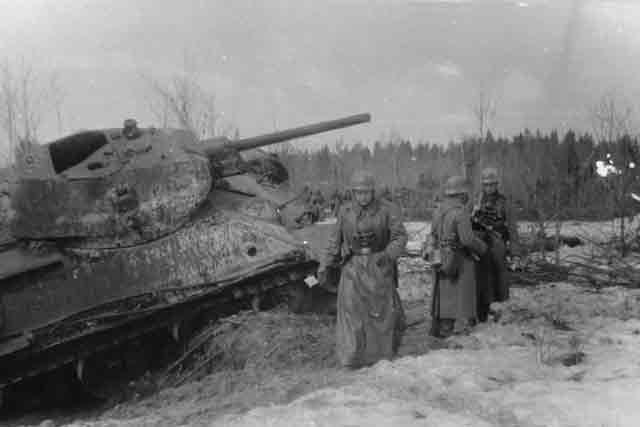
Troops of the German Armeegruppe Nord captured Tikhvin near Leningrad, Russia. As dawn breaks on 8 November 1941, the German 12th Panzer Division (General Josef Harpe), supported by a reinforced regiment of the 18th Motorized Division and a combat group from the 8th Panzer Division (General Brandenburger), stands seven kilometers from Tikhvin. The town is defended by elements of four rifle divisions commanded personally by General Vzevolod Fedorovich Iakovlev, commander of the 4th Independent Army. A fierce snowstorm beats down, but Harpe sends his panzers forward.
The snow aids the German attack by obscuring the vision of the defending Soviet troops. The anti-tank gunners on the outskirts of Tikhvin do not see the panzers until the last moment, and then they open fire and destroy several vehicles. However, the German infantry quickly catches up and eliminates the guns, enabling the attack to continue. The panzers break into Tikhvin, where the Red Army defenders defend each house. The going is slow because the panzers are of less value in the city streets, but at midday, the combat group from the 8th Panzer division makes good progress. General Iakovlev and his staff barely escape with their lives — for Iakovlev it becomes a bittersweet escape because he is immediately replaced as commander of the 4th Independent Army by General Kiril Afanasevich Meretskov.
By the early sunset, the Germans hold Tikhvin. Both sides have taken heavy casualties, with the Soviets losing 20,000 men as prisoners and an untold number of other casualties. In the 12th Panzer Division, each rifle company is down from its normal complement of about 100 men. While Hitler had selected Tikhvin as the objective (rather than the nearer Volkhov preferred by his generals), he is not satisfied by its capture. He quickly sends a message to General Rudolf Schmidt, commander of 39thArmy Corps (motorized), setting Volgada as the next objective. This would entail an advance of another 400 km and take the unit further east than any other. Schmidt quickly replies that a further advance in the winter snow is impossible.
The capture of Tikhvin is an astonishing achievement. It opens up many strategic possibilities for the Wehrmacht, including joining the Finns to the north at the Svir River or, as Hitler suggests, making a deep encirclement of Moscow. Most importantly, having Tikhvin cuts the last supply roads and railway lines to Leningrad (via Lake Ladoga). If the Germans can hold Tikhvin, Leningrad cannot hold out for very long at all. Hitler, safe in his warm command headquarters, sees the possibilities and wants to make the most of them.
There are several problems with Hitler’s plans, however. For one, the weather north of Moscow is getting worse every day. Temperatures are at 20 degrees below zero Fahrenheit and soon fall to -40. The Wehrmacht soldiers are not properly equipped for such conditions, and even if they were, their equipment is not. The panzers have to be run almost constantly to keep them from freezing, and the supply route from the Volkhov River is tenuous at best. Most significantly, the Red Army has been pushed back, but hardly has been beaten. General Meretskov immediately begins planned a riposte against Schmidt’s depleted and freezing forces in the town.
As he does each year on the anniversary of the 1923 Putsch, Adolf Hitler gives a speech in the Löwenbräukeller Munich to his party faithful. He does not mention the day’s big success at Tikhvin for some reason, perhaps because he is not sure if the victory is complete at the time of the speech. However, Hitler has a lot to say about England, describing Winston Churchill as a “whiskey-happy gentleman” who had been counting on the Soviet Union to save Great Britain. Leningrad, he claims, is about to “fall into our hands” as a “heap of ruins.” He further claims that Germany has taken 3.6 million Soviet prisoners so far and inflicted “an absolute loss of at least eight to ten million” men on the Soviet Red Army. In this, Hitler seems to be competing with Stalin, who on the evening of the 6th claimed to have inflicted over 4 million casualties on the Wehrmacht, figures which Hitler sneeringly recites and then refutes. The Soviet Union he describes as a “Mongolian state of a second Genghis Khan.”
Perhaps Hitler’s most interesting comments concern the United States, about which he has not spoken overly much in previous speeches. Hitler blames President Roosevelt for “Poland’s entry into the war” — apparently forgetting that it was Germany that invaded Poland. Hitler continues:
“I have ordered German ships, if they sight American ones, not to fire, but to defend themselves if they are attacked. A German officer who does not defend himself will be court-martialed by me. If, on the President’s order, an American ship fires, then it does this at its own risk. The German ship will defend itself, and our torpedoes will not miss.”
There is little question that both sides, Germany and the United States, are edging toward war. The looming question that remains, however, is what will turn this simmering conflict at sea into an all-out shooting war.
Soviet submarine M-59 struck a mine and sank off Constanza, Romania in the Black Sea; all men aboard were killed.
In conjunction with the creation of the Lwów Ghetto, 5,000 of the city’s Jews were executed.
Reliable sources said today that the Gestapo has arrested Bernhard Lichtenberg, the dean of St Hedwig’s Roman Catholic Cathedral here. Renowned for his opposition to the Nazis, he used to close all his services with a prayer for the Jews and prisoners in the concentration camps. This summer the police questioned him after he preached a series of sermons criticizing Nazi policies and the behavior of the Gestapo in particular. He was released, but confined to challenge Hitler inside and outside church; together with his colleague the Roman Catholic bishop of Münster, he carried on preaching against the Nazi regime. Most recently, he wrote to the Reich chief physician, Leonardo Conti, to protest against the authorities “euthanasia” campaign of killing mentally defective and incurably ill patients. “As a human being, a Christian, a priest and a German,” he wrote, “I demand … that you answer for the crimes that have been perpetrated with your consent, which will bring the vengeance of the Lord on the heads of the German people.”
To a group of workers in a northern production town today Lord Beaverbrook, Supply Minister, hammered out what is probably the most vigorous speech yet been made on the necessity for increased production and Russian cooperation.
British cruisers HMS Aurora and HMS Penelope and destroyers HMS Lance and HMS Lively were dispatched from Malta to intercept an Axis convoy (intelligence gained through Ultra; a Maryland aircraft was dispatched to create the illusion that the convoy was spotted) that had just departed from Italy consisted of German freighters Duisburg and San Marco; Italian freighters Maria, Sagitta, and Rina Corrado; and Italian tankers Conte di Misurata and Minatitlan. This convoy carried 223 troops, 389 vehicles, 34,473 tons of supplies, and 17,281 tons of fuel. The convoy was escorted by 2 Italian cruisers and 7 Italian destroyers.
Last night RAF bombers attacked Cologne, Berlin and Mannheim in the heaviest bombing so far in a single night.
The RAF is radically reviewing its bombing strategy after German air defenses took a heavy toll of RAF bombers and aircrew. A total of 380 aircraft attacked Berlin, Cologne, Mannheim and the Ruhr; 34 — nearly a tenth — were lost.
Germany’s Kammhüber Line, as it is known to the RAF, is responsible. This is a series of ground-controlled interception “boxes” along the most frequently-used routes; in each “box” a night-fighter waits to pounce, so far with great effect.
Word has reached New York that after he was arraigned publicly by Marshal Henri Philippe Petain as one of those responsible for the defeat of French arms and ordered to be interned in a “fortified precinct,” Paul Reynaud, the wartime Premier, sent several letters to the Chief of State, one of which was particularly bitter.
Police inquiries continued in Paris today and in Vichy the government revised its judicial system for the prosecution of de Gaullist agitators and violators of the food restrictions.
The Communist Party of Albania (renamed the Party of Labour of Albania in 1948) was founded.
RAF Bomber Command, Day of 8 November 1841
11 Blenheims on escorted raids to Lille and Gosnay. Only the power-station at Gosnay was bombed. No Blenheims lost.
RAF Bomber Command, Night of 8/9 November 1941
Essen
54 aircraft; 35 bombed, claiming large fires. 6 aircraft – 3 Wellingtons, 2 Whitleys, 1 Hampden – lost. 8 further Hampdens made searchlight-suppression flights; 1 of these was lost.
Minor Operations: 18 aircraft to Dunkirk and 8 to Ostend. 1 Wellington was lost from the Dunkirk raid.
The German commerce raider Atlantis was given orders to rendezvous first with the submarines U-68 and later with the U-126. These orders would prove to be the undoing of the Atlantis as the British Intelligence services had begun to reap the benefits of the equipment and code-books from the captured U-110, plus the fact that with their detailed knowledge of the characteristics of the South Atlantic, they had a fairly good idea where supply-ships were most likely to rendezvous with the U-boats.
Destroyer HMS Hurworth departed Scapa Flow at 0230 for Loch Ewe carrying sixty bags of mail for battleship HMS Rodney and the destroyers on her screen. The destroyer arrived at 0850 and sailed again at 1050 for Scapa Flow, carry out gunnery firing practices off the Orkneys on the return passage.
Rear Admiral Minelaying departed Loch Alsh at 0800 to carry out minelaying operation SN.83B.
German steamer Flottbek (1930grt) was sunk on a mine laid by Russian submarine K.1 on 27 October in Mageroy Sund.
Norwegian steamer Victo (3655grt) was sunk by German bombing 1.8 miles 330° from 18B Buoy, Scarborough in 54-20N, 0-17W. Two crewmen were killed on the steamer.
British fishing trawler Cradock (204grt) was sunk by German bombing fourteen miles north, northeast of St Abb’s Head. The entire crew was rescued.
British drifter Monarda (109grt) foundered in the Thames Estuary.
British steamer Gaslight (1696grt) was damaged by German bombing two cables southeast of S.1 Buoy off Sutherland. The steamer was towed to Sutherland arriving on the 9th.
Italian submarine Dandolo sank Spanish steamer Castillo Oropesa (6600grt) near Melilla. The entire crew was rescued.
Lt Cdr J. M. Wintour Rtd of 802 Squadron in aircraft carrier HMS Audacity was lost when his plane was shot down engaged German aircraft attacking convoy OG.76. Destroyer HMS Wanderer of the escort recovered Wintour’s body. The Kondor that shot down Wintour’s Martlett was shot down by Sub Lt D. A. Hutchison.
Corvette HMS Spiraea departed Gibraltar to meet and escort Norwegian tanker Thorshavet to Gibraltar. On the 15th, corvette HMS Azalea departed to join the arriving ships. All three arrived on the 17th.
Submarine HMS Upholder unsuccessfully attacked a submarine in 36-19N, 16-22E.
Convoy HX.159 departed Halifax, escorted by destroyer HMCS Annapolis and corvettes HMCS Kamloops and HMCS Saskatoon. The escort was relieved on the 10th by American destroyers USS Badger, USS Cole, USS Decatur, USS Livermore, and USS Plunkett. On the 18th, destroyer HMS Sabre, corvettes HMS Alisma and HMS Sunflower, and American Coast Guard cutter USCGS Campbell joined the convoy. The American destroyers were detached on the 19th and destroyer HMS Rockingham and corvette HMS Kingcup joined. The Coast Guard cutter and corvette Sunflower were detached on the 22nd. Anti-submarine trawlers HMS Lady Elsa, HMS Le Tigre, and HMS Wellard escorted the convoy in Home Waters. The convoy arrived at Liverpool on the 23rd.
Administration leaders decided today to press for a direct final House vote on the Senate’s amendments to the Neutrality Bill not later than Thursday. Speaker Rayburn said after a conference with the majority leader, Representative McCormack of Massachusetts, that this procedure would get the legislation to President Roosevelt “muth quicker” than would turning the House and Senate bills over to a joint committee for compromise. When Senate and House pass related but differing legislation there are two methods for adjusting the differences:
- One chamber must accept the other’s version, or
- A committee of Senators and House members works out a compromise which must be submitted to both chambers for final approval.
In the present case the House rolled up a 259 to 138 vote on October 17 for repeal of the Neutrality Act’s prohibition against arming of merchant ships. This measure then went to the Senate which last night passed by a vote of 50 to 37 an amended bill which also would permit United States merchant ships to enter combat zones and belligerent ports. Announcing the decision to ask the House to accept the Senate bill instead of seeking to compromise, Mr. Rayburn said: “We think we have the votes to pass it.”
Designation of Iceland as a full-fledged naval operating base stirred conjecture tonight that extension of American naval patrols and convoy escorts all the way to Britain was imminent. Secretary Knox assigned Rear-Admiral James L. Kauffman, 54-year-old veteran of World war convoy battles against submarines, to command the Iceland base. The announcement followed by a day the senate’s vote to permit American flag vessels to go into belligerent, meaning especially British, ports.
For the second time within 10 days, President Roosevelt engaged in a sharp exchange with a labor leader yesterday over compliance with a White House request that a strike be ended. This time his correspondent was Daniel J. Tobin, president of the A.F.L. teamsters union. The sequence was this: On Friday, the president asked that Tobin order about 60 A.F.L. truck drivers, on strike in Detroit against the Railway Express agency, to return to work within 48 hours. At the same time, Mr. Roosevelt appointed an emergency three-man board to attempt settlement of the dispute. Tobin said that he would have to submit the request to the executive board of the union by telegraphic poll and this could not be done before Monday. To which Mr. Roosevelt replied on Saturday: “I have fully considered your answer and reiterate my request.”
New York representatives at the national convention of the Congress of Industrial Organizations, to open in Detroit on November 17, will fight against any effort by supporters of John L. Lewis to have the convention go on record as opposed to American participation in the European war, leaders of the C.I.O. said yesterday.
The O.P.M. labor division said today that about 2,349,600 man-days of work were lost in “123 strikes of significance to defense” from June 1, 1940, to October 1, 1941. According to labor department records, a total of 24,284,981 man-days of work was lost in strikes in all American industry in this period of the defense emergency. Thus, the O.P.M. said, “the man-days lost to defense amount to about one-tenth of total man-days lost in all U. S. industry.”
Opinion was prevalent among railroad labor leaders tonight that President Roosevelt could and probably would avert the threatened nationwide rail strike.
High defense officials were reported tonight to have given tacit backing to a proposal defense strikes be forbidden unless approved in a secret ballot election by a majority of workers in a plant. Senator Bridges of New Hampshire a Republican who has supported the administration’s foreign policies disclosed he had drafted for introduction in the senate Monday a bill including this idea.
Plans for more effective participation in the national defense effort were discussed today by 200 representatives of sixty-seven national organizations of women at a conference on women’s activities. Mrs. Franklin D. Roosevelt, Assistant Director of National Defense, presided, and among the speakers were Paul V. McNutt, Federal Security Administrator, and Dr. Thomas Parran, Surgeon General, who urged intensive, cooperative effort to maintain and expand essential health and welfare services, emphasizing problems in areas adjacent to Army camps and industrial defense centers.
The controversial price control bill, which has for its avowed purpose the curbing of inflation during the emergency, was formally presented to the House today by the Banking and Currency Committee, but under circumstances which indicated that a battle royal would greet it when it comes up for consideration probably during the week of November 16.
USAAF 12th Bombardment Squadron began anti-submarine operations from St. Croix Airfield in the U.S. Virgin Islands.
Destroyer USS Niblack (DD-424) damages Norwegian freighter Astra in collision, Reykjavik, Iceland.
Naval Operating Base, Iceland, is established; Rear Admiral James L. Kauffman is the first commandant.
USAAF 3rd Pursuit Squadron on Luzon receives 25 P-40E’s.
The keel of the Liberty ship SS Robert E. Peary is laid at the Permanente Metals Corporation (Kaiser) No.2 Yard in Richmond, California, at 0001 hours. The 250,000 parts weighing about 7,000 tons (6 350 metric tonnes) are assembled in 4 days, 15 hours and 29 minutes and she is launched on 12 November. The ship survives the war and is scrapped in June 1963.
The United States warplane PB2M Mars, a sixty-seven-ton Martin patrol bomber, was launched today in the Middle River, the first airplane the Navy ever formally launched. Ranking Army, Navy, Congressional, State and local officials were present to see Mrs. Artemus L. Gates smash a bottle of champagne across the silver bow of the flying warship.
Benefit at the Scottish Rite Hall in San Francisco for Russian soldiers and sailors.
Navy, Army and Fordham were ousted from the ranks of the unbeaten teams and mighty Texas, leader in the national rankings, was held to a tie in a day of thrills on the gridirons. Notre Dame, led by its passing ace, Angelo Bertelli, downed Navy, 20–13, before a crowd of 64,795 in Baltimore. Harvard, bagging two second-half touchdowns, subdued Army, 20–6, before 53,000 at Cambridge. Pittsburgh, paced by Edgar Jones, crushed Fordham, 13–0.
Admittedly without much hope of reaching a settlement with the United States, Japan’s special envoy, Saburo Kurusu, flew eastward tonight while the Far East debated President Roosevelt’s contemplated withdrawal of United States Marines from China. A reliable source said that Mr. Kurusu told friends during his overnight stop-over here that there was “not much hope” that his dramatic flying trip to Washington would be successful. It was said hr apparently felt he would be unable to offer the United States sufficient concessions. This idea was supported by competent Americans who recently arrived in Manila from Japan. They said Mr. Kurusu undoubtedly was armed with “some talking point” but that it was probably insufficient because Japanese Nationalism was so strong that Tokyo would be unable to recede in any substantial degree from her present position on the continent of Asia.
Japan appeared to be continuing solidification of her position in French Indo-China. Domei, the Japanese News Agency, said Kenkichi Yoshizawa, special Ambassador to Indo-China, had arrived in Hanoi. The agency made no mention of his staff, but previous reports from various Far Eastern centers said he was accompanied by 300 assistants. This great number led to speculation that his arrival would mark extension of efforts to place Indo-China virtually under a Japanese
regime despite Tokyo assurances to Vichy that the colony’s sovereignty would be respected.
The Foreign Office in Tokyo announced today that it had lodged a strong protest with the Government of Panama against allegedly discriminatory and “in- human” acts designed to drive Japanese residents from areas close to the Panama Canal by depriving them of their livelihood.
Shanghai acted today to prevent trouble coincident with the possible withdrawal of United States Marines from China and a renewed exodus of American nationals and took steps to avert rice riots.
Shanghai is buzzing with conjectures on Washington’s announcement that United States Marines may be withdrawn from Shanghai, Tientsin and Peiping. Some believe America is backing down, others declare the proposed step is another move to convince Japan that America is ready to follow her announced policy regarding Japanese policies in the Far East.
Per the Great Army Instruction No. 992, the Japanese Army and Navy were ordered to coordinate their plans for the opening phases of the Pacific War.
Dow Jones Industrial Average: 118.26 (-0.07)
Born:
Nerys Hughes, Welsh actress (“The Liver Birds”; “The District Nurse”), in Rhyl, Flintshire, Wales, United Kingdom.
Naval Construction:
The U.S. Navy Navajo-class fleet ocean tugs USS Apache (AT-67) and USS Arapaho (AT-68) are laid down by the Charleston Shipbuilding and Dry Dock Co. (Charleston, South Carolina, U.S.A.).
The U.S. Navy YMS-1-class auxiliary motor minesweeper USS YMS-76 is launched by the Stadium Yacht Basin (Cleveland, Ohio, U.S.A.).
The U.S. Navy Accentor-class coastal minesweeper USS Valor (AMc-108) is launched by the Snow Shipyards Inc. (Rockland, Maine, U.S.A.).
The Royal Navy Bangor-class (Turbine-engined) minesweeper HMS Llandudno (J 67) is launched by William Hamilton & Co. (Port Glasgow, Scotland); completed by Whites M.E..
The U.S. Navy 77-foot Elco patrol motor torpedo boat USS PT-67 is launched by the Electric Launch Company Ltd. (Elco), (Bayonne, New Jersey, U.S.A.).
The Kriegsmarine (German Navy) Type VIIC U-boat U-440 is launched by F Schichau GmbH, Danzig (werk 1491).
The Kriegsmarine (German Navy) Type XIV U-boat U-461 is launched by Deutsche Werke AG, Kiel (werk 292).
The Royal Navy Bangor-class (Turbine-engined) minesweeper HMS Poole (J 147) is commissioned. Her first commanding officer is Lieutenant Wilfred Louis Gerard Dutton, RNR.
The Royal Canadian Navy Bangor-class (VTE Reciprocating-engined) minesweeper HMCS Nipigon (J 154) is commissioned. Her first commanding officer is Lieutenant Commander Arthur Truman Morrell, RCNR.
The Royal Canadian Navy Bangor-class (VTE Reciprocating-engined) minesweeper HMCS Gananoque (J 259) is commissioned. Her first commanding officer is T/Lieutenant Edward Middlemas More, RCNR.
The Вое́нно-морско́й флот СССР (ВМФ) (Soviet Navy) “M” (Malyutka)-class (3rd group, Type XII) submarine M-117 is commissioned.
The Вое́нно-морско́й флот СССР (ВМФ) (Soviet Navy) “M” (Malyutka)-class (3rd group, Type XII) submarine M-118 is commissioned.
The Вое́нно-морско́й флот СССР (ВМФ) (Soviet Navy) “M” (Malyutka)-class (3rd group, Type XII) submarine M-120 is commissioned.
The Kriegsmarine (German Navy) Type VIIC U-boat U-254 is commissioned. Her first commanding officer is Kapitänleutnant Hans Gilardone.

