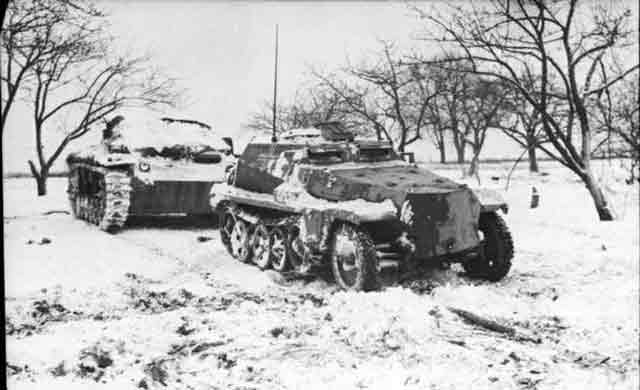
In Russia, German Panzer Army 2 attacked Tula while other German units captured Kursk 180 miles to the southwest to protect the southern flank of the assault toward Moscow. It is getting very cold in Russia, as General Heinz Guderian pointedly notes in his diary. Despite this, the ground in most places is still too muddy to enable regular truck even panzer traffic. At the juncture of Army Group’s Center and South, German forces occupy Kursk — an event which would be much more celebrated in July 1943 than now, when it is little noticed. Guderian’s own forces at Tula south of Moscow mount another effort to take the city by attacking a stadium and cemetery on the city’s southern outskirts. The Soviet defenders, including a rare deployment of NKVD detachments sent by Lavrentiy Beria, repel the attack. This continues a lengthening stalemate south of Moscow as both sides bring forward reinforcements.
German attacks continue in the Leningrad sector. Their goal is Tikhvin, 100 miles east of Leningrad. The Soviet counterattacks will be aimed at some of the strongest German positions. The port city of Feodosia is captured by the German 46th and 170th Infantry Divisions. Kursk fell to units of Panzergruppe 2 (Guderian) of Heeresgruppe Mitte (von Bock) at the junction of Army Group Center and Army Group South.
Finnish forces occupy the Baltic naval base of Hango, a base Finland was forced to lease to the Soviets as part of the peace accords ending the Winter War in 1940.
Soviet submarine ShCh-214 sank Turkish schooner Kaynakdere with gunfire in the Black Sea.
Hans-Joachim Marseille was awarded the silver Honor Cup (Ehrenpokal) in Germany.
Allied convoy QP.2 departed Arkhangelsk, Russia.
Six Norwegians were executed in Norway today for “assisting enemies” and the entire Norwegian fishing fleet of 70,000 vessels was placed under State control, presumably to prevent further escapes to Britain, press dispatches said tonight.
The ruthless campaign of Acting Protector Reinhard Heydrich to liquidate Czecho-Slovak resistance to German authority can now after five weeks be looked on as successfully completed, according to a German announcement today, but coupled with it is the conditional information that “investigations still tin progress may occupy the authorities with one or two more special cases.”
HMS Indomitable (92) is accidentally damaged when she runs aground off Kingston while training. This carrier was scheduled to join HMS Prince of Wales (53) and HMS Repulse (34) as the British Far East Fleet but she must be repaired and misses the movement with these two ships.
The British merchant ship Flynderborg was sunk off Newfoundland by German submarine U-202.
RAF Bomber Command, Night of 3/4 November 1941
Minor Operations
8 Wellingtons to Brest, 7 aircraft to Boulogne, 6 Hampdens on shipping patrol attacked a convoy in the Frisians, 10 Hampdens minelaying in the North Sea. No losses.
British planes stage a series of attacks on Sicily.
Battleship HMS King George V, aircraft carrier HMS Victorious, heavy cruisers HMS Kent, HMS Berwick, and HMS Suffolk, and destroyers HMS Somali, HMS Ashanti, HMS Matabele, HMS Punjabi, HMS Offa, and HMS Oribi departed Scapa Flow at 1730 for Iceland. Battleship King George V, heavy cruisers Berwick, Kent, and Suffolk, and destroyers Somali, Matabele, and Punjabi arrived at Hvalfjord at 0730/5th. Aircraft carrier Victorious and destroyers Ashanti, Offa, and Oribi arrived independently at Hvalfjord after exercises. At 1730/4th, destroyers HMS Tartar and HMS Eskimo departed Scapa Flow for Hvalfjord to join the Commander in Chief. The destroyers arrived at 1000/6th.
Destroyer HMS Escapade departed Scapa Flow at 1700 to boiler clean at Rosyth.
Convoy ON.33 departed Liverpool. The convoy was joined on the 4th by destroyers HMS Beagle and HMS Roxborough, sloop Commandant Detroyat, corvettes HMS Heather, HMS Lobelia, and HMS Narcissus, and anti-submarine trawlers HMS Arab, HMS Lady Madeleine, HMS Norwich City, and HMS Stella Carina. Destroyer Roxborough was detached on the 8th and destroyer Beagle and the trawlers, less Lady Madeleine, on the 9th. Destroyer HMS St. Laurent and corvettes HMCS Snowberry and HMCS Trail joined on the 10th. On the 11th, the sloop, the corvettes, and trawler Lady Madeleine were detached when corvettes HMCS Chiliwack, HMCS Collingwood, and HMS Primrose joined. Destroyer St. Laurent was detached on the 13th. Corvette HMS Polyanthus joined on the 16th and was detached the next day. Corvette Collingwood was detached on the 17th, Trail on the 18th, Chilliwack on the 19th, and Snowberry on the 21st. Corvette Primrose was detached on the 22nd when the convoy was dispersed.
British patrol vessel Ouzel (76grt, T/LtG. W. Wilkinson RNR) was sunk on a mine one half mile east of Mablethorpe. Wilkinson and the entire crew of the vessel were lost.
Submarine HMS Trident sank German auxiliary patrol vessel UJ.1213 (whaler Rau IV, 354grt) in Honningsvaag in 70-58N, 26-58E. German steamer Altkirch (4713grt) was missed in the same attack.
Convoy QP.2 departed Archangel with steamers Atlantic (5414grt), Panamanian Capira (5565grt), Gemstone (4986grt), Soviet Ijora (2815grt), Panamanian North King (4934grt), Blairlevis (4155grt), Soviet Cheynyshevski (3588grt), Harmonic (4558grt), Lorca (4875grt), River Afton (4579grt), and Ville D’ Anvers (7462grt). Heavy cruiser HMS Norfolk, which departed Archangel at 2214 on the 2nd, escorted the convoy from 3 to 11 November. The cruiser proceeded to Scapa Flow. Destroyers HMS Eclipse and HMS Icarus, which departed Archangel at 2214 on the 2nd, escorted the convoy from 3 to 16 November, when they were detached to Kirkwall, arriving at 0800/17th and Scapa Flow at 1130 that day. Minesweepers HMS Bramble, HMS Leda, and HMS Seagull were local escorts from Archangel and escorted the convoy from 3 to 5 November. Trawlers HMS Celia and HMS Windermere departed Hvalfjord at 2315/9th and joined the convoy on the 11th to relieve destroyers HMS Eclipse and HMS Icarus. The trawlers escorted the convoy to 13 November. The destroyers proceeded to Seidisfjord to refuel and rejoined on the 13th. The convoy arrived on the 17th. The destroyers arrived at Scapa Flow on the 17th.
U-202, commanded by Kapitänleutnant Hans-Heinz Linder, sank British steamers Flynderborg (2022grt) and Gretavale (4586grt) in 51-21N, 51-45W from convoy SC.52. The submarine claimed sinking two other steamers. At 0454, 0458 and 0505 hours on 3 Nov 1941, U-202 attacked the convoy SC.52 northeast of Notre Dame Bay, Newfoundland and observed hits on two ships and heard a third. At 0844 hours, a capsized wreck was sunk by coup de grâce, possibly that of one of the vessels struck during the first attack. However, the Flynderborg and Gretavale were sunk by these attacks.
The master, 18 crew members and two gunners from the Flynderborg (Master P. Petersen) were picked up by HMCS Windflower (K 155) (T/Lt J. Price, RCNR) and landed at St. John’s. Three crew members were lost. The 2,022 ton Flynderborg was carrying lumber and was bound for London, England.
The master, 31 crew members and six gunners from the Gretavale (Master Frank S. Passmore) were lost. Six crew members were picked up by the HMCS Windflower (K 155) (Lt John Price) and landed at St.Johns. The 4,586 ton Gretavale was carrying steel and 17 trucks and was bound for Loch Ewe, Scotland.
U-203, commanded by Kapitänleutnant Rolf Mützelburg, sank British steamer Empire Gemsbuck (5626grt) in 52-18N, 53-05W and British steamer Everoja (4830grt) 80 miles 77° from Belle Isle from convoy SC.52. At 1828 hours on 3 Nov 1941, U-203 attacked the convoy SC.52 northeast of Cape Charles, Labrador and sank the Everoja and Empire Gemsbuck, which broke in two.
The master, 36 crew members and six gunners from the Empire Gemsbuck (Master William Stewart Anderson) were picked up by HMCS Buctouche (K 179) (Lt W.W. Hackney, RCNR) and landed at St. Johns, Newfoundland on 6 November. The 5,626 ton Empire Gemsbuck was carrying general cargo, including machinery and was bound for Londonderry, England.
The Everoja (Master Alfred Kirschfeloths) in station #93 was struck by a torpedo on the starboard side in #2 hold, blowing off its hatches and beams and destroying the starboard side of the bridge and boat deck. No distress signals could be sent as the wireless set was disabled by the explosion. The master, 35 crew members and five gunners (the ship was armed with one 4in and six machine guns) abandoned ship in two lifeboats within five minutes when she developed a list of 15° to starboard. After about 20 minutes, HMS Nasturtium (K 107) (LtCdr R.C. Freaker, DSO, RNR) arrived and took the survivors aboard. At 2000 hours, a boarding party led by the chief officer went back aboard, but found the vessel beyond salvage as the boiler and engine rooms were flooded. They recovered the confidential papers, all machine guns, the chronometer and the Aldis lamp and returned to the corvette, which stood by the ship waiting for a salvage tug until the Everoja foundered at 1530 hours on 4 November. The survivors were landed the next day at St. John’s, Newfoundland. The 4,830 ton Everoja was carrying wheat and was bound for Dublin, Ireland.
In an attack on a German convoy in the Channel, MGB’s claimed torpedoing and badly damaging a Moewe class torpedo boat (note says Moewe or Greif) and sinking a 5000 ton ship.
German minelayer Kaiser laid mines in the Baltic.
German steamer Anneliese (726grt) was lost on a mine off Dievenow.
Submarine HMS Proteus damaged Italian tanker Tampico (4958grt) in the Gulf of Athens three miles south of Mandili Island in 37-53N, 24-30E. The submarine was counterattacked by Italian torpedo boats Monzambano and Castelfidardo.
Submarine HMS Urge unsuccessfully attacked a steamer north of Kuriat.
Submarine HMS Utmost arrived at Malta after a special operation in the Gulf of Hammammet and patrol off Kuriat.
Polish submarine ORP Sokol arrived at Malta after patrol off Naples.
Aircraft carrier HMS Indomitable was damaged in grounding off Kingston, Jamaica. Corvette HMS Clarkia, escorting the aircraft carrier, also ran aground. The carrier arrived at Norfolk on the 12th. Aircraft carrier Indomitable departed on 12 December.
Convoy HX.158 departed Halifax escorted by destroyer HMCS Annapolis and corvettes HMCS Algoma, HMCS Chambly, HMCS Orillia, and HMCS Pictou. The escorts were detached when relieved on the 5th by American destroyers USS Buck, USS Cole, USS Ludlow, USS McCormick, and USS Swanson. Destroyer Cole was detached the next day. The American group was relieved on the 13th by destroyers HMS Beagle and HMS Roxborough, sloop Commandant Detroyat, corvettes HMS Heather, HMS Lobelia, and HMS Narcissus, and anti-submarine trawlers HMS Arab, HMS Kirkella, HMS Lady Madeleine, HMS Norwich City, and HMS Stella Carina. The trawlers, less Kirkella, were detached later that day. The escorts, less Kirkella, were detached on the 17th. The convoy arrived at Liverpool on the 18th.
Today in Washington, Senate considered Neutrality Act revision, received the Bilbo bill to authorize additional military and naval academies, and recessed at 4:28 PM until 11 AM tomorrow. The Privileges and Elections Committee opened hearings on the fitness of Senator Langer; the Education and Labor Committee heard support for a bill to provide a long-range public works planning program.
The House passed a bill to freeze rents in the District of Columbia, heard Representatives Hoffman and Cox urge enactment of defense labor legislation, and adjourned at 2:58 PM until noon tomorrow.
Ninety-seven lives apparently were lost in the torpedoing of the American destroyer USS Reuben James, it was disclosed tonight as the navy gravely announced that it had “little hope” for those listed as missing. Only two firemen were definitely listed as dead, but the missing numbered 88 men and seven officers, all the officers aboard the warship, which went down west of Iceland last Thursday while on convoy duty. Forty-five of the crew of 142 were saved, eight of them suffering injuries and the rest without hurt.
Secretary of State Hull releases to the press the correspondence of June and September detailing the German refusal to pay reparations for sinking U.S. freighter Robin Moor on 21 May. The United States has demanded $2,967,002 from Germany for damages in connection with sinking of the freighter Robin Moor one of the first American ships sunk in the battle of the Atlantic but thus far has received no reply, the state department disclosed today. The Robin Moor was torpedoed In the south Atlantic last May 21. All on board were rescued after being adrift for periods ranging from several days to three weeks.
Administration leaders in the Senate indicated tonight that they would have enough votes to pass the measure to arm merchant vessels and permit them to go to belligerent ports despite the announcement today by two Senators that they would vote against it. The two Senators were Maloney of Connecticut and Bilbo of Mississippi. Senate leaders hope to obtain passage on Wednesday or Thursday. Mr. Maloney declared in an impassioned impromptu address in the Senate debate today that he was opposing the sending of merchant vessels into belligerent ports because he thought the measure “was going too far, too fast,” and would inevitably lead to war. Senator Bilbo said he thought we were not prepared for the military ordeal which in his opinion the nation faced. “If I have any judgment of the signs of the times,” he said, “it will not be long before we shall be engaged in an all-out war with the German Empire and her allies. Personally, it is my judgment that we are not ready.”
The United States and little Finland, heretofore bound together by an almost idyllic friendship, came close to the parting of the ways tonight as the State Department called on the Helsinki government to stop making offensive war on Soviet Russia. Sad-eyed and obviously thinking of other days, Secretary of State Hull disclosed that Finland was being told that unless she halted such operations and withdrew her troops, she would forfeit American friendship. The Finnish Government today received a strong hint from the United States Government that it would like to see affirmative action on an offer by the Soviet Union to make peace. That offer was transmitted to Helsinki from Washington last August 18.
President Roosevelt declared that the United States would never accept the “new order” of dictatorship in a speech today citing the effective manner in which democracy works in the long run.
Before a group of leaders of the steel industry John L. Lewis, president of the United Mine Workers, today argued his case in favor of the closed shop in the captive coal mines owned by this country’s major steel corporations.
Striking welders of the Seattle area rejected today by unanimous vote a “back to work” appeal from Sidney Hillman, associate director of the Office of Production Management.
Navy announced plans today for construction of fifty convoy-escort vessels for Great Britain. The ships will be smaller than destroyers, but will be capable of long ocean cruises. Total cost will be about $300,000,000 and will be financed out of lease-lend funds. The cost per ship will thus be about $6,000,000, compared to a cost of about $8,000,000 for a destroyer. It is expected that the new ships will be able to perform the duties now undertaken by destroyers, but they can be produced faster. All of the vessels will be built at Navy Yards, twenty-four at Mare Island, California; twelve at Boston, eight at Puget Sound and six at Philadelphia. The vessels will be equipped with submarine listening devices, various defensive weapons and apparatus for using depth charges against hostile submarines.
[Ed: While the U.S. Navy called them destroyer escorts (DE), the Royal Navy and Commonwealth forces classified them as frigates. In total, 78 of these American-built destroyer escorts served the Royal Navy as the Captain-class.]
American PBY Catalina aircraft continue to provide air cover for Atlantic convoy ON.31.
Eleven officers and men of the Navy and an Army officer were killed in the crash of a Navy Martin PBM Mariner bomber in the “Atlantic Ocean area,” the Navy Department announced tonight. PBM plane #1248, at an altitude of about 800-ft, crashed and burned on a barren, rocky, and uninhabited mountain side in Iceland during a period of reduced visibility. The plane crashed as a result of insufficient and unreliable aids to aerial navigation, under instrument conditions. The pilot maintained his course in the assumption that it was a safe course based upon the radio-direction-finder bearing he obtained on Reykjanes Point which bearing were inaccurate. There was no damage to private property. The classified publications and materials carried on the plane and not recovered were burned and destroyed beyond recognition as a result of the crash.
All personnel killed:
Pilot ENS C. M. Thornquist, AV-N USNR
ENS Carl Balek, AV-N USNR
2 LT. William P. Robinson, US Army
AMM1 Walter V. Garrison, USN
ARM1 Oran C. Knehr, USN
AMM1 Vern H. Anderson, USN
S2 M. Ground, USN
S2 E. L. Cooper, USN
AMM1 Coy M. Weems (NAP)
ARM2 Joseph S. Wanek, USN
AMM3 Andrew R. Brazille, USN
AOM3 W. Gordon Payne, USN.
Destroyer USS Upshur (DD-144), escorting convoy HX.157, depth charges sound contact (later determined to be most likely a whale or blackfish) at 56°56’N, 49°21’W.
Joseph Rochefort’s cryptanalytic team of the U.S. Navy in Pearl Harbor, Territory of Hawaii was realizing that the Japanese were inflating the amount of radio traffic.
A Joint Board meeting is held in Washington. Marshall states that there would only be sufficient B-17’s in the Philippines to “have a deterrent effect on Japanese operations.” The Joint Board concurred in opposing the State Department’s hard line towards Japan and advocated the U.S. making minor concessions to buy time.
The evacuation of women and children from the U.S. Pacific islands of Guam, Midway and Wake begins.
Chinese military intelligence reports recently have told of large Japanese troop movements in French Indo-China toward the borders of China’s Yunnan Province, British Burma and Thailand, a Chinese Army spokesman declared tonight.
General Sir Archibald P. Wavell, British commander of the Indian Army, who arrived in Singapore yesterday on a visit to Malaya, was busy today with a series of conferences and visits to military establishments.
Chief of the Japanese Naval General Staff Admiral Osami Nagano approved the draft plan for the attack on Pearl Harbor, U.S. Territory of Hawaii, and presents the plan of attack to Emperor Hirohito.
The leaders of the Japanese government, including Emperor Hirohito and top military commanders, attend a conference to discuss relations with the United States on 3 November 1941. With negotiations having broken down, the discussion is oriented toward how and where to attack, not whether to attack. The outcome of the conference is Top Secret Order No. 1, which directs that in 34 days time, the military forces of Imperial Japan are to attack the United States Fleet in Hawaii, the Philippines, Malaya, and the Dutch East Indies.
The Japanese plan calls for the Japanese Combined Fleet to occupy Rabaul, Bismarck Islands, which is an Australian naval base per League of Nations mandate, and use it as a Japanese forward base. Admiral Yamamoto, Commander-in-Chief of the Combined Fleet, formally presents his operational plan for the attack on the United States fleet base at Pearl Harbor, Hawaii, and Chief of the Japanese Naval General Staff Admiral Osami Nagano approves the plan.
After the conference with the Emperor, Admiral Chūichi Nagumo, commander-in-chief of the First Air Fleet which comprises the Imperial Japanese Navy’s main aircraft carrier force, goes to aircraft carrier Akagi and holds his own conference. He summons his main commanders and informs them of the decision to attack the United States and Great Britain bases, including US protectorate the Philippines, and other targets. This is the first that many commanders learn of the attack plan. Many of Nagumo’s subordinates privately grumble that Nagumo, who is frail and elderly, is not the right man to lead the leading Japanese naval forces during such a crucial period.
Japan has one good reason for expansion in the Far East: oil. The country has been starved of oil since the USA decided in July, following the Japanese occupation of French Indochina, to extend the licensing of exports to Japan. It was not intended to ban oil exports to Japan, but U.S. officials refused all applications to export oil and gas. Roosevelt felt that to reverse the refusals would be a sign of weakness; since then the USA has operated a de facto embargo. With virtually no oil supplies of its own, Japan’s eyes are now firmly set on the oil-rich Dutch East Indies.
The U.S. Ambassador to Japan, Joseph C. Grew, who of course is unaware of the secret Japanese conference, sends a lengthy secret telegram today to Secretary of State Cordell Hull. He warns that “the view that war probably would be averted… is an uncertain and dangerous hypothesis upon which to base considered United States policy and measures.” He notes that “In Japan political thought ranges from the medieval to liberal ideas and public opinion is thus a variable quantity.” He concludes:
“[I]t would be shortsighted for American policy to be based upon the belief that Japanese preparations are no more than saber rattling, merely intended to give moral support to the high-pressure diplomacy of Japan. Japan may resort with dangerous and dramatic suddenness to measures which might make inevitable war with the United States.”
Grew does not know it, but before he even sends this telegram, Japan already has committed to such a dangerous and dramatic path, which Grew further notes would be a “suicidal struggle with the United States.”
Dow Jones Industrial Average: 118.87 (+0.76)
Born:
Martin Williams, British diplomat (High Commissioner to New Zealand and concurrently the Governor of the Pitcairn Islands, 1998 to 2001).
Died:
Samuel Murray, 72, American sculptor and educator.
Naval Construction:
The Kriegsmarine (German Navy) Type IXD2 U-boat U-200 is laid down by AG Weser, Bremen (werk 1046).
The Kriegsmarine (German Navy) Type VIIC U-boat U-229 is laid down by F. Krupp Germaniawerft AG, Kiel (werk 659).
The Kriegsmarine (German Navy) Type VIIC U-boat U-669 is laid down by Howaldtswerke Hamburg AG, Hamburg (werk 818).
The U.S. Navy Gleaves-class destroyers USS Mervine (DD-489) and USS Quick (DD-490) are laid down by the Federal Shipbuilding & Drydock Co. (Kearny, New Jersey, U.S.A.).
The Royal Navy Attacker-class escort carrier HMS Tracker (BACV-6, then D 24) is laid down by the Seattle-Tacoma Shipbuilding Corp. (Seattle, Washington, U.S.A.).
The Royal Navy tug HMS Busy is launched by the Gulfport Shipbuilding Co. (Port Arthur, Texas, U.S.A.).
The Royal Navy LCT (Mk 2)-class landing craft, tank HMS LCT 135 is launched by Stockton Construction (Thornaby, U.K.).
The Royal Navy LCT (Mk 2)-class landing craft, tank HMS LCT 166 is launched by Tees-Side Bridge (Middlesbrough, U.K.).
The Royal Navy “M”-class destroyer HMS Meteor (G 73) is launched by A. Stephen & Sons Ltd. (Glasgow, Scotland).
The Royal Canadian Navy Bangor-class (VTE Reciprocating-engined) minesweeper HMCS Quatsino (J 152) is commissioned. Her first commanding officer is T/Lieutenant Laurence Fricke, RCNVR.
The Royal Navy Thornycroft 55-foot motor torpedo boat HMS MTB 327 is commissioned.
The Royal Navy Thornycroft 55-foot motor torpedo boat HMS MTB 329 is commissioned.
The Royal Navy Thornycroft 55-foot motor torpedo boat HMS MTB 330 is commissioned.
The Royal Navy Thornycroft 55-foot motor torpedo boat HMS MTB 331 is commissioned.
The U.S. Navy PC-461-class (173-foot steel hull) submarine chaser USS PC-471 is commissioned. Her first commanding officer is Lieutenant William B McClaran, Jr., USNR.
The Kriegsmarine (German Navy) Type VIIC U-boat U-755 is commissioned. Her first commanding officer is Oberleutnant zur See Walter Göing.
The Royal Navy Hunt-class (Type II) escort destroyer HMS Beaufort (L 14) is commissioned. Her first commanding officer is Lieutenant Standish O Grady Roche, RN.
The Royal Navy Hunt-class (Type II) escort destroyer HMS Wheatland (L 122) is commissioned. Her first commanding officer is Lieutenant Ronald de Leighton Brooke, RN.

