The United States and the Soviet Union signed two modest arms control agreements in Geneva in recent weeks but no announcement was made because the Ford Administration wanted to avoid a possible controversy on the eve of the election. The two accords, according to officials, were concerned with putting into effect two earlier agreements. An outline was made known to The New York Times by State Department officials upon inquiry, but details will be kept secret in accordance with an arrangement with Moscow, although Congressional committees will be briefed confidentially. According to the officials, one agreement says how both sides should go about modernizing or replacing the one antiballistic missile system allowed under previous accords. The second agreement, signed on Sept. 30, provides a code to be’ used for rapid communication over the hot line between Moscow and Washington in case of an accident that may increase the risk of a nuclear war. Under an agreement signed in 1971, each side is supposed to inform the other promptly of any accidents, such as a misfired missile or a suspicious nuclear explosion, that might lead the other to order its forces into action. The latest accord provides a way of using as few words as possible to communicate the facts about such an accident.
Boris Ponomaryov, secretary of the Soviet Communist Party’s Central Committee, left for home after a weeklong visit to Britain that was plagued by Jewish demonstrators in London and Scotland because of his alleged part in Soviet subversion abroad. When asked at a press conference whether he was aware that many British people were glad to see him leave, Ponomaryov said, “It is rather impolite. When people are invited here as guests, hospitality should be shown.”
Two Moscow Jews, who were arrested during a series of protest demonstrations two weeks ago, have been charged with malicious hooliganism, a criminal offense that carries a possible prison term of one to five years, Jewish sources said. The sources said Boris Chernobylski, a radio engineer, and Joseph As, a surgeon, were being held in prison pending their trial. Twenty-two of the 30 Jews who participated in the demonstrations were sentenced to 15 days in jail for disturbing public order. They had demonstrated to demand answers for the requests to emigrate.
A court in Karlsruhe, West Germany, allowed a right-wing organization to go ahead with a memorial rally for “German war heroes,” but barred it from honoring a convicted Nazi criminal. The court reversed a ban issued by Manneheim city authorities, which said the meeting would violate the West German law against Nazi propaganda.
The United States Navy announced today that it had chartered a West German salvage ship to raise the F-14 Tomcat jet fighter-bomber that sank in 1,800 feet of water off the North Sea coast of Scotland during NATO maneuvers last month.
New East German Premier Willi Stoph named a 42-man Council of Ministers, adding three new faces and dropping one member of the previous 40-man cabinet. In the major change. Werner Krolikovski was named to replace fellow party Politburo member Guenter Mittag as one of the two first deputy premiers. It is believed likely that Krolikovski is being groomed for eventual promotion to premier. Stoph, 62 and suffering from ill health, was replaced as head of state last week by party leader Erich Honecker.
Portuguese Agriculture Minister Antonio Lopes Cardoso, who is on the radical left wing of the ruling Socialist Party, resigned from the Cabinet today, opening what appeared to be a serious political crisis and throwing in doubt the future of Portugal’s controversial land-reform program. The departure of Mr. Lopes Cardoso was viewed as a victory for the right wing of the Socialist Party as well as the Farmers Confederation, which had been pressing for his dismissal. Conservative political forces openly welcomed his resignation as a confirmation of the rightward shift of the Socialist Government, which has moved recently to restore discipline in the factories and schools and to curb wage increases.
Ten Iranians were detained in Paris for questioning as French police pressed their search for gunmen who wounded an Iranian diplomat. Cultural Attache Homayoun Keykavoussi, the sixth diplomat to be attacked in France in two years, was recovering after being shot four times in the chest and stomach as he was on his way home. An organization named after Iranian Marxist guerrilla Reza Rezai, killed by Teheran police three years ago, claimed responsibility and said the attache worked for Sevak, the Iranian secret police.
Patrick Hillery, Irish member of the Common Market Executive, announced that he would be a candidate for president of Ireland on the opposition slate of Fianna Fail. Prime Minister Liam Cosgrave has given no indication of who will be the candidate from his ruling coalition of Fine Gael and Labor parties to succeed Cearbhall O Dalaigh.
The worst railroad accident in Poland in more than ten years killed 25 people and injured 60 others after an express train crashed into the back of a passenger train that had been making a scheduled stop at the station at Julianka. The express between Lublin and Wrocław, traveling in a dense fog, came in behind the other train.
Jacques Mayol of France became the first person to dive to a depth of 100 metres (330 ft) without the use of scuba gear. Mayol, age 49, held his breath and went down into the Mediterranean Sea off of the island of Elba.
The Soviet Union failed today in an attempt to block a proposal that should enable Israel to join UNESCO’s European regional group, a membership that was denied two years ago. The Soviet defeat occurred at a meeting of the Political Commission of the United Nations Educational, Scientific and Cultural Organization, one of three commissions set up for the organization’s biennial conference. At the general conference in 1974 the application of Israel, a member of the organization to join the European group was refused, prompting the United States to cut off contributions. It still owes its 1975-76 contribution, $38 million.
Prices shot up in Israel as the government added 20 percent on food and 11 percent on fuel, with 20 percent more for public transportation and 11 percent for electricity and water to start within two weeks. The action reflected the precarious state of the economy in a losing fight against inflation.
The Bank of America, the world’s largest bank, said today that it would stop giving any assistance to the Arab boycott of Israel. The bank said that it had instructed all its branches to stop immediately the processing of letters of credit and other documents containing boycott provisions. A spokesman at the bank’s headquarters in San Francisco said that the instructions applied both to its United States offices and to 114 branches in 44 other countries. The bank becomes the first concern to spell out its compliance with a new California antiboycott law, interpreting it as applying not only within state borders but wherever the bank does business. The California legislation becomes effective in January.
While rightists and leftists clashed with mortars and machine guns in Beirut, last-minute snags delayed the arrival and deployment of the Arab League peacekeeping force, league sources said. The first contingents of the Arab force had been expected to join Syrian troops in the peacekeeping force assigned by the Arab League to police Lebanon’s shaky two-week-old truce. But Arab League and militia sources said the troops now would not be arriving perhaps until the weekend. Preparations were reported under way today to place Arab peacekeeping troops into positions in the next few days to begin reopening highways long closed by fighting during a year and a half of civil war.
The Government of India introduced legislation today to postpone for a year the national elections that had been scheduled next March. With the sweeping revisions of the Constitution that were voted yesterday, the action was regarded by the political opposition as a major step in the dismantling of democratic institutions.
In a statement over the Burundi radio, Lieutenant Colonel Jean-Baptiste Bagaza declared that he had taken over in place of President Michel Micombero, who was deposed Monday in a military coup. Colonel Bagaza announced the suspension of the country’s Constitution and said that power would be assumed by a 30-member Supreme Revolutionary Council. In a 20-minute broadcast last night, Colonel Bagaza said the army had seized control because President Micombero had concentrated power in his own hands while the country had come to a halt economically. He said the new ruling council would undertake a complete revision of the country’s institutions and the re-education of “elements morally incapable for running public affairs efficiently.”
New fighting between Government forces and guerrillas in southern Angola has forced hundreds of refugees io flee across the border into South-West Africa, a senior official said today. Jannie de Wet, commissioner general for the indigenous peoples of South-West Africa, said Cuban-backed forces of the ruling Movement for the Liberation of Anycla had concentrated their attacks on the Oukwanyama tribe, known to support the pro-West National Union for the Total Independence of Angola. “All boys older than 10 years of age belonging to this tribe are singled out and shot by the rival forces and the women abducted.” Mr. de Wet said. He said the Popular Movement forces, focusing their attacks near towns and main roads, were supported by forces of the South-West African People’s Organization.
Negotiations on Rhodesia were set back when Prime Minister Ian Smith flew home after a two-hour meeting with four nationalist leaders and the British chairman of the Geneva conference produced no agreement on a date for black majority rule. Mr. Smith left his hardline Foreign Minister, P K. van der Byl, to head the delegation. “I can’t go on sitting here twiddling my thumbs,” Mr. Smith said angrily after a two-hour meeting with four Rhodesian nationalist leaders and Ivor Richard, Britain’s representative at the United Nations and chairman of the Geneva conference on the future of Rhodesia. Although Mr. Smith is leaving a delegation in Geneva, the departure of the 57-year-old Prime Minister was a setback for British efforts to work out a settlement at the conference, designed to arrange the transition to black majority rule.
Rhodesia said today that its security forces had succeeded in blocking an offensive by up to 1,700 black nationalist guerrillas by staging a pre-emptive strike into guerilla base areas in neighboring Mozambique Sunday. In a briefing for reporters at military headquarters at Mount Darwin in northeastern Rhodesia, a senior police official said the Rhodesian forces destroyed several guerrilla bases and 50 tons of war materials during the operation, which lasted two days.
Jimmy Carter saw “a beautiful new spirit” in the country as he returned home to Plains, Georgia, after winning the presidency — the first son of the Deep South to do so since the Civil War. Although his mandate was limited by a narrow victory — his electoral vote was no more than 303 and perhaps as little as 272 — the Georgia Democrat was only the eighth man in the nation’s 200 years to defeat an incumbent president.
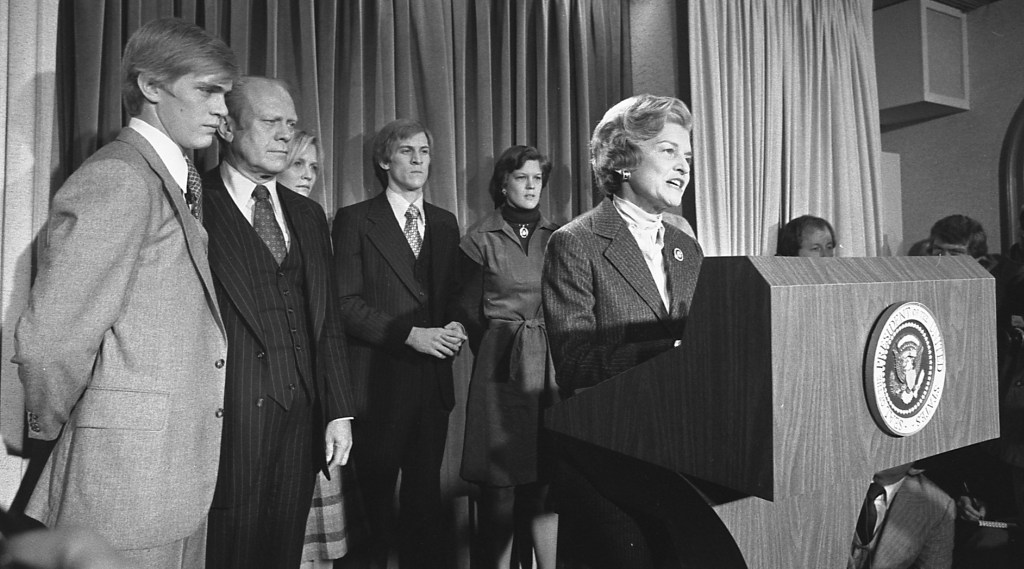
When President Ford heard the result, on waking, he telephoned Mr. Carter with congratulations and a call to unite the country in the common pursuit of peace and prosperity. Because of his hoarse throat, an aide read the message for him. President Ford, accepting his first political defeat, conceded victory to Jimmy Carter without reservation today and offered “my complete and wholehearted support” in the transition to a new national leadership.
Planning has begun in Plains, Georgia, for the transition from the Ford to the Carter administration. The successful candidate disclosed this as he told reporters of Mr. Ford’s “gracious expression” of congratulation and cooperation in a personal telephone call before the White House announcement. Mr. Carter appeared refreshed although he had little sleep.
Staff studies for Mr. Carter include ambitious preparations to take swift charge of the federal government and change the size and functioning of the White House staff, an approach to major cabinet appointments, and an analysis of where a Carter imprint could alter the 1977 and 1978 budgets. A reorganization of the government is promised. There are more than 50 option papers on major policy initiatives in many areas.
The traditional Democratic coalition of union members, blacks, the poor, Roman Catholics, Jews and liberals rallied to Mr. Carter in the election even though he had won in the primaries as an attacker of the party’s establishment. Interviews by CBS News after the voting showed the impact of organized labor’s massive effort and found Mr. Carter had a 5–1 advantage among black voters.
Both houses of Congress kept their strong Democratic majorities, giving Mr. Carter a partisan base for his legislative program. Democrats were particularly pleased that only 2 of their 79 freshmen representatives in the 1974 landslide were beaten, showing that the Republicans had failed to rebound from that defeat.
President-elect Carter may bolster the American economy when he takes office if he follows the economic advice he has been getting from his own campaign adviser and several former economic advisers to past presidents. As evidence builds up of a slower worldwide recovery in 1977 than had been forecast, Professor Lawrence Klein, his campaign adviser, has spoken for reducing taxes and increasing federal spending by $5 billion to $10 billion as a stimulus.
The Carter and Moynihan victories have put the New York state Democratic Party in its strongest position since the New Deal after years of statewide losses and bitter feuding. Holding its recent gains in Congress and the state Assembly magnified the effect and contrasted with Democratic disappointments in the neighboring states of Connecticut and New Jersey.
The cost of the controversial B-1 strategic bomber program has risen by another $1.27 billion to a total of $22.89 billion, according to new Air Force estimates made available to Congress. The Air Force, which regards the B-1 as its most important project, said the increase resulted from revised estimates of price escalation rather than additions to the system. The increase is expected to intensify opposition to the costly Rockwell International Corp. plane and increase the chances that Jimmy Carter as President will either kill the program or scale it back considerably. Early in his campaign Carter opposed the construction of the B-1 but later said he would favor continued research and development “if it should become necessary in the future.”
General Motors reported good sales of its new line of scaled-down “big cars” at a rate 35 percent higher than their bulkier predecessors achieved on first appearance last year.
Hearings on nuclear waste disposal issues involving the Vermont Yankee nuclear power plant in Brattleboro, Vermont, were scheduled by the Atomic Safety and Licensing Board for December 7 at Brattleboro. The action was taken despite pending appeal by Vermont Yankee to the U.S. Supreme Court on a lower court decision that reopened licensing hearings to take into account the environmental impact of nuclear waste and reprocessing. Richard Ayers, a lawyer for the Natural Resources Defense Council, said the ASLB agreed that it could reconsider an issue such as waste regardless of action pending in the courts.
Isolated instances of questionable or improper payments abroad were listed in a report filed with the Securities and Exchange Commission, said Monsanto Co., a leading chemical and plastics manufacturer. But the payments, uncovered through an investigation that began in June, were labeled contrary to company policy by John W. Hanley, chairman and president. Hanley said a total of about $461,300 in payments to foreign countries had been made since January 1, 1971. He said internal measures will prevent their recurrence. St. Louis-based Monsanto said its SEC report listed questionable or improper payments of about $278,500 to employees of foreign commercial customers. About $170,000 went to employees of foreign governments.
About 1,000 registered nurses struck two major Chicago hospitals, protesting proposed cuts in sick-leave benefits. The strikers posted pickets at Cook County and Oak Forest hospitals, where officials have been curtailing emergency services and reducing patient loads since the nurses voted last week to authorize a strike. The nurses, who have been working without a contract for the last four months, were protesting a proposal by the Cook County Health and Hospitals Governing Commission to eliminate pay for the first two days of all sick leave. The commission has charged the nurses with abusing their yearly 12 days of paid sick leave by taking off before and after holidays and weekends.
Three men were charged in Philadelphia with a bizarre scheme to dump 1,000 gallons of home heating oil in the city’s water system unless they were paid $1 million. The three, David R. Nugent, 37, Louis Scott, 25, and Kevin Grosso, 23, all pipefitters at the Philadelphia Naval Shipyard, were jailed in lieu of $50,000 bond each. City officials learned of the scheme after the discovery of a tape recorder with a cassette message in a City Hall office Monday morning. An attempt to deliver the money failed, but no oil was dumped in the water supply. Authorities said the oil at worst would have caused nausea. A Navy spokesman said confidential information led to the arrests.
NBC Radio’s national News and Information Service will be discontinued by mid-1977, Jack G. Thayer, president of the NBC Radio Division, announced. The NIS, providing around-the-clock live news, sports and features to radio stations around the country, was launched in June, 1975. It has been costing NBC $10 million a year to operate. NBC’s conventional radio network, one of the oldest in the nation, is not involved. The reason for the phase-out, Thayer said, was that the number of subscribing stations (70) was too small.
A fire of unknown origin raced through a rooming house on the south side of Providence, Rhode Island, killing three men and a woman, authorities said. Investigators said three of the victims apparently died of smoke inhalation. The fourth victim was burned beyond recognition. Police said six other persons were taken to a hospital for treatment or shelter. Battalion Chief Anthony Sauro said the blaze, which broke out at 2:30 AM, raged out of control for several hours before it was extinguished.
Brian DePalma’s horror film “Carrie,” based on the novel of the same name by Stephen King, premiered in select cities before going into general release nationwide on November 16.
Reacting to Jimmy Carter’s victory in the Presidential election, stock prices plunged yesterday, with declines on the New York Stock Exchange topping advances by a ratio of about 4 to 1. The Dow Jones industrial average sank 9.56 points to close at 956.53. Earlier in the day, the decline had been 15.38 points below Tuesday’s closing level. Wall Street executives had previously expressed concern over Mr. Carter’s economic program. Bond prices generally dropped but New York City bonds climbed sharply and Municipal Assistance Corporation bonds sold more rapidly.
Dow Jones Industrial Average: 956.53 (-9.56, -0.99%)
Born:
Anthony Henry, NFL cornerback (Cleveland Browns, Dallas Cowboys, Detroit Lions), in Fort Myers, Florida.
Kelly Herndon, NFL cornerback (Denver Broncos, Seattle Sehawks, Tennessee Titans), in Bedford, Ohio.
Dennis McKinley, NFL fullback (Arizona Cardinals), in Kosciusko, Mississippi.
Jake Shimabukuro, Japanese-American ukulele virtuoso (“While My Guitar Gently Weeps”), and composer (Saidoweizu/Sideways), in Honolulu, Hawaii.
Emiliano Reali, Italian novelist, in Rome.
Died:
Henk Korthals, 65, Dutch politician and former Deputy Prime Minister of the Netherlands, 1959 to 1963

