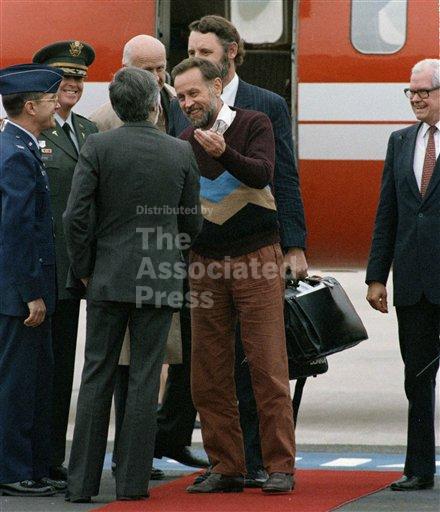
David Jacobsen arrived in Wiesbaden, West Germany, after more than 17 months of captivity, praising Terry Waite, who helped arrange his release, and recalling the tune “The Best Things in Life Are Free.” Mr. Jacobsen landed at a United States Army airfield after flying in a red two-engine Learjet from Larnaca, Cyprus, accompanied by Terry Waite, the Archbishop of Canterbury’s special envoy, whom Mr. Jacobsen described as “a man of hope in our darkest hour.” “I can’t tell you how very, very happy I am here today,” Mr. Jacobsen told reporters at the airfield. But he said the continued captivity of Americans in Lebanon meant he harbored “really mixed feelings.” Mr. Jacobsen, 55 years old, of Huntington Beach, Calif., was then taken to the United States Air Force Regional Medical Center in Wiesbaden, where he began physical and psychological testing. He is to be reunited with members of his family on Tuesday. Mr. Jacobsen was met at the airport by Michael Newlin, Deputy Assistant Secretary of State for Consular Affairs, and Alexander Rattray, the American Consul General in Frankfurt.
Senior Administration officials said today that they were uncertain why Islamic Holy War had decided to release one of its American hostages in Lebanon. But they said there was considerable speculation that Syria and Iran, for different reasons, might have chosen to use their influence singly or jointly with the kidnappers, who are believed to be pro-Iranian Shiite Muslims. Both Syria and Iran have been looking for ways recently to send signals of moderation to the West. Another possibility, officials said, is that the Islamic group was persuaded by an American statement on October 3 that suggested Washington had become more flexible in holding discussions on the hostages, even if it would not meet the captors’ demands.
The Lebanese magazine Ash Shirra first reveals secret U.S. arms sales to Iran. This was the first public report of the weapons-for-hostages deal. The operation was discovered only after an airlift of guns (Corporate Air Services HPF821) was downed over Nicaragua. Eugene Hasenfus, who was captured by Nicaraguan authorities after surviving the plane crash, initially alleged in a press conference on Nicaraguan soil that two of his coworkers, Max Gomez and Ramon Medina, worked for the CIA. He later said he did not know whether they did or not. The Iranian government confirmed the Ash-Shiraa story, and, 10 days after the story was first published, President Reagan appeared on national television from the Oval Office on 13 November, stating:
“My purpose was […] to send a signal that the United States was prepared to replace the animosity between [the US and Iran] with a new relationship […]. At the same time we undertook this initiative, we made clear that Iran must oppose all forms of international terrorism as a condition of progress in our relationship. The most significant step which Iran could take, we indicated, would be to use its influence in Lebanon to secure the release of all hostages held there.”
The scandal was compounded when Oliver North destroyed or hid pertinent documents between 21 November and 25 November 1986. During North’s trial in 1989, his secretary, Fawn Hall, testified extensively about helping North alter and shred official US National Security Council (NSC) documents from the White House. According to The New York Times, enough documents were put into a government shredder to jam it. Hall also testified that she smuggled classified documents out of the Old Executive Office Building by concealing them in her boots and dress. North’s explanation for destroying some documents was to protect the lives of individuals involved in Iran and Contra operations. It was not until 1993, years after the trial, that North’s notebooks were made public, and only after the National Security Archive and Public Citizen sued the Office of the Independent Counsel under the Freedom of Information Act.
During the 1989 trial, North testified that on 21, 22 or 24 of November 1986, he witnessed Poindexter destroy what may have been the only signed copy of a presidential covert-action finding that sought to authorize CIA participation in the November 1985 Hawk missile shipment to Iran. U.S. Attorney General Edwin Meese admitted on 25 November that profits from weapons sales to Iran were made available to assist the Contra rebels in Nicaragua. On the same day, John Poindexter resigned, and President Reagan fired Oliver North. Poindexter was replaced by Frank Carlucci on 2 December 1986.
On the eve of an East-West conference there, Vienna has become a capital of dissident causes of the Soviet Union and Eastern Europe. Some of the causes and protagonists are well known, for example, the issue of an undetermined number of Jews still trying to emigrate from the Soviet Union. Other causes are more obscure, like Soviet cancer patients denied treatment abroad or spouses divided from their husbands and wives. And some are seemingly forlorn, like the champions of independence for the three Baltic countries — Estonia, Latvia and Lithuania — absorbed into the Soviet Union in 1940.
Soviet dissident Andrei D. Sakharov and his wife, Yelena Bonner, said they are facing new restrictions that further isolate them in exile in the Soviet city of Gorky, relatives in Newton, Massachusetts, reported after a telephone call marked by interference on the line. Tatiana and Efrem Yankelevich, Bonner’s daughter and son-in-law, said Bonner told them that a change in Soviet postal procedures makes it impossible for the couple to know whether they are receiving all the mail and packages being sent to them. Sakharov also has not been visited by scientific colleagues as in the past, Yankelevich said.
With the barriers to their emigration behind them, Inessa Flerov and her family left the Soviet Union today hoping that she can donate bone marrow to a brother in Israel who has leukemia. “We hope I shall help my brother,” Mrs. Flerov said at Sheremetyevo Airport. “It is our main task.” The Flerovs were heading for Vienna. Mrs. Flerov’s husband, Viktor, said they did not know what connections they would make to fly on to Tel Aviv. Mrs. Flerov asked permission in March for a temporary visit to Israel so that her marrow could be tested for compatibility with her brother’s. When the request was rejected, the family applied to emigrate. After several months of mixed signals from visa authorities, a hunger strike and Western pressure, Mrs. Flerov and her two daughters were granted permission to leave in August. But Mr. Flerov was denied permission because he lacked his father’s signature on a financial release document. Mrs. Flerov refused to leave without her husband. The father’s approval was finally waived.
Pepsico is negotiating with Moscow to open up to 100 Pizza Hut restaurants in the Soviet Union, the company said. Pepsico introduced American soft drinks to the Soviet menu on a wide scale in 1973.
As part of a cost-cutting reorganization, Secretary General Javier Perez de Cuellar has told 11 high-level staff members that he will not renew their contracts at the end of the year, diplomats and United Nations officials said today. The 11 — five Under Secretaries General and six Assistant Secretaries General — received letters Friday informing them of the decision, and other cuts are expected shortly, according to officials. The cutbacks came so suddenly that diplomats have dubbed it “the Halloween Massacre.”
Masked men burned down a synagogue in a provincial Romanian town in what is believed to be the first such attack in the country since the anti-Semitic terror under German occupation in World War II, members of the Bucharest Jewish community said. They said at least two assailants stabbed and seriously injured the janitor of the 18th-Century temple in Buhusi, about 160 miles north of Bucharest. The attackers then set fire to the building by pouring gasoline on the walls. About 60 Jews live in Buhusi out of Romania’s remaining community of about 23,000.
Prime Minister Garret FitzGerald of Ireland pledged to have no dealings with Sinn Fein, the political wing of the outlawed Irish Republican Army, which decided to enter Irish parliamentary politics. FitzGerald, in a Dublin radio interview, urged all other Irish parties to shun Sinn Fein at the next election “when a challenge is put down to the democratic system by people with an Armalite [rifle] in one hand and a ballot paper in the other.” Sinn Fein decided at its convention Sunday to drop its policy of refusing to take seats won by its members in parliamentary elections.
The largest chemical company in the world would result from a planned acquisition of the Celanese Corporation by West Germany’s Hoechst A.G. for $2.84 billion.
An employee of the (U.S.) Arms Control and Disarmament Agency is under investigation for “allegations of improper handling of highly classified material” and has been on paid leave for more than a year, a Government official said early today. The investigation is based on charges that the employee made documents available to the South Korean Government about Pakistani efforts to produce a nuclear weapon, officials said. They said the employee apparently hoped that the documents would dissuade South Korea from providing technical assistance to Pakistan.
A leading Palestinian newspaper editor in East Jerusalem has been ordered expelled on the grounds that his support for the Palestine Liberation Organization constitutes a danger to Israel’s security. Akram Haniya, editor of the Arabic-language daily newspaper Al Shaab (The People), was arrested at his home in the occupied West Bank town of Ramallah. Israeli military sources were quoted as describing him as a leading PLO activist and said his journalistic work was subsidized by the guerrilla organization. Haniya, 35, is chairman of the Palestinian Journalists’ Assn. in the West Bank and a short-story writer. He said he will appeal the expulsion order.
More than 20 British nurses who were deported from Saudi Arabia after attending an illegal drinking party flew to London and warned. others not to travel to the strict Muslim kingdom because of tightening curbs on foreigners’ behavior. “The restrictions are getting stricter and stricter,” one said. A British Foreign Office spokesman said Saudi religious police burst into an August 20 birthday party where expatriate workers were drinking homemade wine and took names. Later, 21 British nurses, an Australian and an Irish nurse were ordered out of the country. Three other British women are being held on liquor-related charges and are also expected to be deported, the spokesman said.
A power struggle in Iran is believed to be an element that aided the release of an American hostage in Lebanon, David P. Jacobsen, and improved chances for freeing others, Arab diplomats said.
A malfunctioning altimeter caused an Iranian military transport plane to crash into a mountain in eastern Iran, killing all 103 people aboard, the Iranian press agency said today. The American-built C-130 plane was taking soldiers from the western war front on Sunday to Zahidan, near the borders with Afghanistan and Pakistan, the Iranian military authorities were quoted as saying.
Pakistani soldiers fired on rioters in Karachi today and rival gangs battled with guns and homemade bombs, leaving eight people dead in a fourth day of street battles, officials and witnesses said. At least 44 people have been killed and 300 wounded in violence that began Friday with a gun battle between the Pathan and Muhajir ethnic groups. Hundreds of soldiers were sent to Karachi today to reinforce army units dispatched over the weekend. Thousands of riot police officers clashed again with roving gangs of rioters who defied a curfew. One man was killed by army gunfire, hospital officials said. The seven others were killed in ethnic clashes.
China demanded that Moscow set a timetable for the complete withdrawal of Soviet troops from Afghanistan and criticized a recent partial pullout as “void of practical significance,” a Foreign Ministry spokesman said. The Communist Party newspaper People’s Daily said the Kremlin used the pullback of six regiments — 6,000 to 8,000 troops — as a “feint” to deceive public opinion.
President Corazon C. Aquino today called a Communist cease-fire proposal “a step forward” and said negotiators for both sides would meet this week to discuss details. One of the Government negotiators, Ramon Mitra, said he was optimistic that a cease-fire would be achieved in the 17-year-old insurgency. After a two-and-a-half-hour meeting today in her office with the National Security Council, Mrs. Aquino issued a statement saying a group of civilian negotiators and military advisers had been formed to refine the Government’s position for presentation to the Communists on Wednesday. On Saturday, in what appeared to be a softening of their position, the Communists proposed a 100-day cease-fire, to begin in December. They put forward five “talking points,” which they said were not conditions, regarding aspects of the cease-fire.
Yanks returned to Guadalcanal 44 years after the major battle there. Solomon Islanders, who recall that battle gratefully, hailed five Seabees sent to help them rebuild after a cyclone.
The Federated States of Micronesia signs the Compact of Free Association with the United States.
The Northern Mariana Islands became a Commonwealth associated with the United States. About 18,000 residents of the Northern Mariana islands became U.S. citizens as the islands in the central Pacific officially became a U.S. commonwealth. Admiral James Lyons Jr., Pacific Fleet commander, presented Governor Pedro Toniaro with the first U.S. passport in a Saipan ceremony marking the adoption of commonwealth status under a 1978 agreement. The U.S. Trust Territory of the Pacific is being dismantled as islands assume greater self-government while retaining economic ties to the United States, which will provide defense and economic aid.
Despite renewed American backing, the Nicaraguan rebels face a decidedly uphill military and political struggle, according to American and rebel officials. The next 12 months will be decisive for the guerrillas, the officials say. They say the rebels must not only engage a better-prepared Sandinista army, but must also offer a long overdue political program that can attract wider support. In addition, a new Congress will almost certainly be asked to support the war against Nicaragua with further aid. Senior rebel officials are holding constant meetings at their offices in Miami to set strategy and also to open a new radio station, a human-rights commission, a diplomatic campaign and a political program for Nicaraguan exiles. “The next year will be one of major changes,” said the rebels’ longest-serving political leader, Adolfo Calero. “We have to show the Nicaraguan people that there is a possibility of winning so they will turn their passive rejection of the Sandinistas into active rejection.”
Mozambique’s chief, Joaquim Chissano, who succeeds Samora M. Machel, has been Foreign Minister for 11 years and is popular for his grassroots efforts and a reputation for keeping pledges. Chissano, who has been Foreign Minister since Mozambique won independence from Portugal in 1975. immediately vowed to continue the policies of Samora M. Machel, who died in a plane crash in South Africa two weeks ago. Mr. Chissano was elected at a special session of the Central Committee of the Mozambique Liberation Front, an avowedly Marxist group that is the country’s only legal political movement. The new leader, 47 years old, is considered to be more a political pragmatist than ideologue. Western diplomats and Mozambican political experts said that of several likely contenders for the presidency he was the one favored by the United States.
The Rev. Jesse Jackson says there are several indications that South Africa might have caused the plane crash that killed President Samora M. Machel of Mozambique two weeks ago. Mr. Jackson, the rights activist, also says there are indications that South Africa delayed providing rescue workers and medical aid to survivors. Mr. Jackson, speaking in a telephone interview from London after having attended the Mr. Machel’s funeral, said he based his statements on information given to him by Mozambican officials who went to the site of the crash and talked with survivors and witnesses. He said the death of Mr. Machel, an opponent of apartheid, along with what he called stepped-up efforts by South Africa to “economically and militarily destabilize” black-ruled countries in the region, had convinced him that the situation “is very grave.”
Edward J. Perkins was sworn in as U.S. ambassador to South Africa, saying he felt “good will” toward. all the people of that country, but he vowed to carry with him America’s “intolerance of racial apartness.” “All Americans share the same goals,” the black diplomat told a standing-room-only crowd at his swearing-in ceremony at the State Department. Perkins, 58, replaces Herman J. Nickel.
Speaking in Los Angeles, President Reagan ended months of campaigning today by looking beyond Tuesday’s election to what he hopes will be his legacy to the country. Addressing an audience in the state where his political career began, Mr. Reagan asked to be recalled as a defender of freedom. He said that his hope for the future was a nation in which all Americans are equal. The speech, at times emotional and highly personal, came as Mr. Reagan appeared here for Representative Ed Zschau, the Republican Senate candidate in California, after campaigning earlier in the day in Nevada.
The President and First Lady attend an outdoor political rally of 15,000 for Congressman Zschau in Anaheim, California.
President Reagan participates in an airport rally for Jim Santinit in Las Vegas, Nevada.
With Democrats hoping to take control of the United States Senate after six years in opposition, Americans vote today in national elections that will measure how deeply President Reagan has affected the nation’s political climate. Democrats sounded confident and Republicans wary in assessing the outcome of Senate races in 34 states that will determine who will control the body for the last two years of Mr. Reagan’s Presidency. Several Republican poll takers were privately conceding the likelihood of a narrow Democratic margin in the new Senate. But this was based as much on hunch and the law of averages as on scientific analysis, because 22 of the seats up for election today are held by Republicans and only 12 by Democrats. Final surveys of public opinion suggested that at least a half-dozen races were still so close that they could not be counted as certain for either party. In several states, narrow leads appear to have changed hands almost daily in the campaign’s final days. Kirk O’Donnell, a top Democratic strategist who heads the Center for National Policy, cautioned that the pre-election news had been operating in the Republicans’ favor.
So close is the tussle for control of the Senate in Tuesday’s general election that television viewers who want to make their own analyses or compare theirs with those of the commentators are in for a long and perhaps confusing evening. But there are two ways of looking at the early results that might yield some clues whether the Democrats are likely to reach their goal of regaining control, for which they must make a net gain of four seats. If the Democrats lose Maryland or Florida, where their nominees, Representative Barbara A. Mikulski and Governor Bob Graham, are expected to win handily, they are in serious trouble. Conversely, if the Republicans fail to prevail in North Dakota or Missouri with their candidates, Senator Mark Andrews and former Gov. Christopher S. (Kit) Bond, their hopes are likely to be dashed. Since the campaign began, Peter Hart, the Democratic poll-taker, has been talking up what he calls his “1-2-3 rule.” If one Democratic seat falls to the Republicans this rule says, the Democrats are probably in; if two fall, the contest is a toss-up; if three fall, the Republicans should win. The best Republican chances, in roughly ascending order of probability, are in Louisiana, Colorado, California and Missouri.
The Supreme Court declined today to resolve an apparent conflict among Federal appellate courts on how to deal with efforts by school boards to dismantle court-ordered desegregation plans, which could be the most important desegregation issue of the next decade. To the surprise of some legal experts, the Court declined to review both a ruling that allowed Norfolk, Virginia, to end its court-ordered busing of elementary children and a seemingly conflicting ruling against the school board in Oklahoma City. In another case, the Court decided in a 5-to-3 ruling that states may not deny family planning grants to otherwise eligible private groups merely because they use money from other sources to offer abortions and abortion counseling. In brief orders denying review in the desegregation case, only Associate Justice Byron R. White said he wanted to hear the cases, which the Court has been mulling for several weeks. None of the Court’s members wrote opinions to explain their votes.
The Supreme Court agreed today to decide the constitutionality of a 1984 law in which Congress authorized pretrial detention of defendants considered to be dangerous. The case involves the pretrial jailing of Anthony Salerno, alleged to be head of the Genovese crime group, who is now on trial with seven other men in Federal District Court in Manhattan in a different case on charges of conducting the racketeering activities of a ruling commission of organized crime. The action today sets the stage for the Court to resolve a major debate between advocates of a tougher stand against crime and civil libertarians, who argue that preventive detention of defendants suspected of being dangerous undercuts the presumption that they are not guilty until proved guilty. Congress’s authorization of preventive detention of such defendants, in the Bail Reform Act of 1984, was one of the most important changes in Federal criminal law in decades. Except in cases carrying a potential sentence of death, Federal bail law had previously authorized jailing before conviction only if necessary to insure appearance at trial.
The Supreme Court ruled today that states may not deny family planning grants to private groups merely because they use money from other sources to offer abortions and abortion counseling. The 5-to-3 decision was issued without an opinion and without full briefing or oral arguments. It affirmed a Federal appellate decision striking down a 1980 Arizona provision barring grants of state money that year to any groups that “offer abortions, abortion procedures, counseling for abortion procedures or abortion referrals.” The United States Court of Appeals for the Ninth Circuit ruled that the Constitution bars states from denying state money to a group providing state-approved family planning services merely because that group also provides abortion services and abortion counseling, a form of free speech. This was the ruling the Supreme Court affirmed.
Lyn Nofziger, a former top political aide to President Reagan, intervened at the White House in behalf of a Bronx military contractor four months after leaving his Administration post, according to Government documents. Mr. Nofziger and his partner, Mark A. Bragg, were later paid for their work in behalf of the contractor, the Wedtech Corporation, in Wedtech stock. When the company later went public, the stock would have been worth $720,000, but it is not known how much the men realized when they eventually sold it. Federal ethics laws prohibit former high-ranking Administration officials from lobbying their old agencies for at least a year after leaving office. Mr. Nofziger resigned his White House job as Mr. Reagan’s special assistant for political affairs on Jan. 22, 1982, to set up a consulting business. In late May of that year, Mr. Nofziger sent a letter to the Deputy White House Counselor, James E. Jenkins, and asked for help in getting the Army to approve a $31 million contract with Wedtech to produce 6-horsepower engines for a variety of military uses. It eventually won the contract.
A Senate subcommittee staff report made available today sharply criticizes the Labor Department’s investigation of a contested election of a maritime union. The subcommittee report said senior Labor Department officials had ignored evidence of “widespread and grievous” violations of Federal labor laws when they decided not to challenge the 1983 election of the National Maritime Union of America. Accusing the department of poor management and bureaucratic infighting in its investigation, Senator William V. Roth Jr., Republican of Delaware, chairman of the Senate Permanent Subcommittee on Investigations, said the election had been “beset by significant violations” of the Federal laws. Mr. Roth said department officials had disregarded the evidence, however, and inexplicably decided not to overturn the election. This decision, he said, raises serious questious about whether the department was generally enforcing Federal laws insuring fair union elections in a vigorous manner.
Ex-Secretary of State Henry A. Kissinger failed to stop distribution of the December issue of Penthouse containing an interview with him and filed a $10-million suit against the magazine and the interviewer. A judge ruled that it was too late to grant a restraining order because some copies were already on newsstands. Kissinger said he had understood that the interview would be used only as part of a book on statesmen. He said use in a magazine infringed on his agreement with the Los Angeles Times, for which he is a syndicated columnist, and, he added, “I don’t wish to appear in Penthouse,” a magazine known for depicting nudity.
Consumer advocate Ralph Nader charged that President Reagan and Senate Republicans are delaying action on an $18-billion measure that extends the Clean Water Act. Supporters of the measure fear that Reagan will “pocket veto” the bill, or allow it to die by failing to act by Thursday, when his 10-day time limit expires. Intended to curb pollution of lakes and streams, the bill, which the Administration contends is too costly, was passed by Congress on October 16 but sent to the White House several days later.
Many people have opposed gambling on moral grounds. Voters in eight states, most of them inland, will decide today whether to turn to gambling as a way to offset declining tax revenue.
The Secretary of State of Texas has ordered “additional security” procedures in Tuesday’s election to prevent fraud in the 40 or so counties that use computerized vote counting and reporting. Under the directive issued by the Secretary, Myra A. McDaniel, the computer-generated printed log of the vote tabulation must record all operator commands and “inputs,” and the log may not be turned off at any time. The Attorney General of Texas, Jim Mattox, is investigating charges of vote fraud arising from last year’s mayoral election in Dallas. No findings have yet been issued in the inquiry, for which the state has hired Arthur Andersen & Company, the accounting and consulting concern.
Political experts in Vermont say Governor Madeleine M. Kunin, a Democrat, may win the largest number of votes today, but fall short of the 50 percent majority required by state law. “It really looks like Madeleine will win a plurality but not a majority,” said James Welch, the executive editor of The Burlington Free Press. “So it will go to the Legislature, where anything can happen.”
Fernand J. St Germain has fought his toughest House race in 20 years. The powerful Democratic Representative has spent nearly $600,000 to counter a strong challenge by John A. Holmes Jr, a Republican.
The munitions smuggling case against a White House maid, Anita Sanabria Castelo, was dismissed today as her trial was to begin in Federal District Court. Mrs. Castelo, who is on Nancy Reagan’s staff, was charged with illegally trying to ship .22-caliber ammunition to her native Paraguay from Richmond’s Deepwater Terminal. But the United States Attorney, Henry Hudson, told Judge Robert R. Merhige Jr. that the Government decided there was no illegal intent on Mrs. Castelo’s part.
Quietly and with little ceremony, the cremated remains of the seven astronauts killed when the space shuttle Challenger exploded last January have been buried in a small common grave in Arlington National Cemetery. According to Philip Bigler, an American history teacher at Bethesda-Chevy Chase High School who formerly served as historian of the cemetery, the remains were placed in the grave on an early morning in May before the cemetery gates had been opened for the day to the public. Some members of the astronauts’ families were there for the burial, he said. All that marks the site now is a low concrete base. In time it will support a monument to the astronauts that will contain engraved likenesses of each of them. The grave is in an area passed by most visitors to the Arlington cemetery, near the Amphitheater and the Tomb of the Unknown Solider. Nearby is the grave of three of the Americans killed in 1980 in the unsuccessful attempt to rescue the hostages being held at the United States Embassy in Iran.
16,000 convicted drunken drivers have pilot licenses, Federal officials said. They said about 7,000 of the pilots did not admit convictions on medical reviews required under Federal law.
The Labor Department was remiss in failing to challenge a 1983 maritime union election that involved “widespread and grievous” violations of Federal labor laws, a Senate panel’s staff report said.
A law allowing pretrial detention of defendants considered dangerous that was approved by Congress in 1984 will be reviewed by the Supreme Court. The case involves Anthony Salerno, a reputed mobster.
New York City will offer free, anonymous AIDS screening, beginning Wednesday at a Manhattan clinic. Susan Rosenthal, Health Department AIDS counseling director, said that eventually, the tests will be available throughout the city. She said the program includes analysis of a blood sample, identified only by number, and at least two counseling sessions. The test shows antibodies to the virus that causes acquired immune deficiency syndrome, but cannot diagnose the disease.
A helicopter had the wrong clutch when it plunged into the Hudson on October 22, killing a radio traffic reporter, a mechanic admitted. The technician, who was not identified, came forward with the admission and resigned.
A federal judge in Boston fined a Connecticut firm $500,000 and sentenced a former meat inspector to two years in prison for defrauding federal school lunch programs in 10 states of more than 1 million pounds of beef over three years. District Judge A. David Mazzone fined Idle Wild Farm Inc. of Pomfret Center, and sentenced James Niddrie, 52, of Worcester. Idle Wild also paid the government $2.6 million as part of a civil settlement. Prosecutors said the government sent its meat to a subsidiary of Idle Wild and it was then diverted from school lunch programs, using vegetable fillers as substitutes.
Evidence is growing that the genetic defect in Down’s syndrome is four times more likely to be transmitted to children by their mothers than their fathers, researcher Charles Epstein of UC San Francisco reported. Recent studies are also confirming that Down’s syndrome is caused when a child is born with an extra copy of a small piece of genetic material at the end of human chromosome No. 21. Genetic engineering is helping to explain how the excess genes are transmitted and, eventually, might lead to a treatment, Epstein said.
John Lennon’s “Menlove Avenue” album is released posthumously
NFL Monday Night Football:
Mike Lansford kicked a 50-yard field goal with four seconds remaining tonight to give the Los Angeles Rams a victory over the Chicago Bears, 20–17. The victory boosted the Rams’ record to 7–2 and kept them comfortably in the lead of the National Conference West at a game and a half. The Bears fell to 7–2, with their lead over the Minnesota Vikings in the N.F.C. Central at two games. The winning field goal ended a 33-yard drive that began with 47 seconds remaining. Steve Dils, who suffered through an otherwise trying game in his third start of the season, completed three of his six passes in the drive to bring the Rams to the Chicago 32, before the winning kick. For the game, Dils completed 6 of 25 passes for 137 yards. Eric Dickerson ran 29 times for 111 yards to give him 1,141 for the season. Steve Fuller, starting his third game for the injured Jim McMahon, completed 9 of 19 passes for 102 yards before he was replaced by Mike Tomczak. But he fared little better, completing just 2 of 8 for 28 yards. The Bears played most of the second half without Walter Payton, who suffered a dislocated toe on his right foot. He left with 61 yards on 19 carries.
Los Angeles Rams 20, Chicago Bears 17
The Dow Jones industrial average, a good gainer last week, rose another 16.45 points today, to 1,894.26. Stock prices rose smartly as investors became excited, albeit belatedly, about signs of improvement in the nation’s economy. The market action, however, was tempered by concern about today’s Congressional elections. “It’s a surprisingly decent market considering what might have been a natural wait-and-see attitude on the election outcome,” said Eric Miller, a market analyst with Donaldson, Lufkin & Jenrette Securities Inc.
Dow Jones Industrial Average: 1894.26 (+16.45)
Born:
Alex Wilson, MLB pitcher (Boston Red Sox, Detroit Tigers, Milwaukee Brewers), in Dharan, Saudi Arabia.
Johnny Knox, NFL wide receiver and kick returner (Pro Bowl, 2009; Chicago Bears), in Houston, Texas.
Antonia Thomas, English actress (“Misfits”; “The Good Doctor”), in London, England, United Kingdom.
Heo Young-saeng, South Korean K-pop singer (SS501; Double S 301), in in Gochang County, South Korea.
Died:
E. Cuyler Hammond, 74, American epidemiologist (first to link smoking with lung cancer).
Eddie “Lockjaw” Davis, 64, American jazz saxophonist (Count Basie; Kenny Clarke/Francy Boland Big Band), and bandleader, of Hodgkin’s lymphoma.

