The Sinking of the USS Reuben James
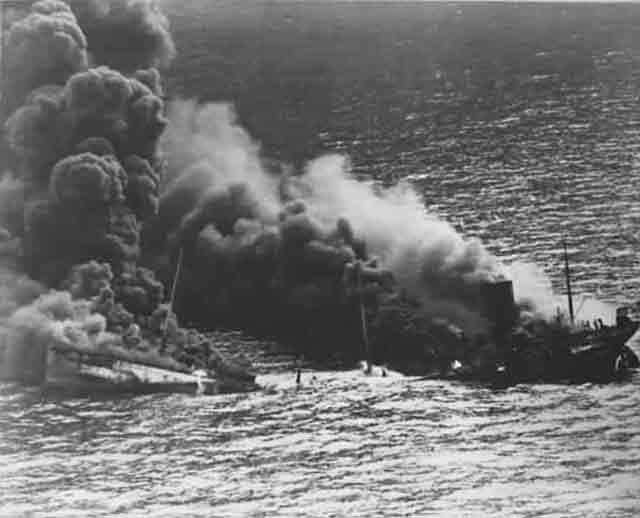
While escorting Allied convoy HX 156 in the North Atlantic, the American destroyer USS Reuben James (DD-245) was sunk by the German submarine U-552 with the loss of 115 of 159 crew. U-552 (Kptlt. Erich Topp), on its sixth patrol out of St. Nazaire, is operating with Wolfpack Stosstrupp on 31 October 1941 and shadowing Convoy HX-156 southwest of Iceland and west of Eire. At 08:34, Kptlt. Topp fires two torpedoes at a warship guarding the convoy. At least one of the torpedoes hits the ship in the forward area and explodes. It is the USS Reuben James (DD-245, LtCdr Heywood Lane Edwards, USN), part of U.S. Escort Group 4.1.3.
The explosion, assisted by a magazine exploding within the Reuben James, breaks the ship’s back. Both sections sink within five minutes, the forward section virtually immediately. As the stern section sinks, depth charges break loose and explode, killing men in the water. Seven officers — all aboard — and 90 enlisted men perish in the sinking (some sources say an even 100 are killed), and one of the 46 survivors (some say 45) succumbs to his wounds on 2 November. This is the first United States Navy ship lost in World War II and the sinking is quickly memorialized by Woody Guthrie in a popular song.
The loss of USS Reuben James proves a temporary detriment to Navy recruiting efforts. Since this ship has essentially the same silhouette as the 50 destroyers loaned to the British, the U-boat commander believes it is a Royal Navy ship. It is only when they heard the attack announced by a U.S. radio station a few days later that he realized their target had been a USN ship.
Another German submarine fired a torpedo at American destroyer USS DuPont; the torpedo missed its target.
The Wehrmacht is within 200 km of the center of Moscow on three main axes of their attack on 31 October 1941 — from the northwest, west, and south — and Joseph Stalin faces a crisis. It is not the first crisis, and it will not be his last crisis, but if there is one thing that Stalin knows how to handle, it is a crisis. One word sums up Stalin’s attitude to a crisis: ruthlessness. He has been ordering executions of top lieutenants, such as the elimination of his “Hero of the Soviet Union” former air force commanders on 28 October, but those were just the tip of the iceberg. A secret report today within the highest reaches of the Soviet government reveals just how ruthless Stalin can be.
Major General Solomon Rafailovich Milshtein, chief of the Investigative Unit of the NKVD (Soviet state security apparatus, akin to the Gestapo and forerunner of the KGB), delivers the report to his superior, Lavrentiy Beria. Milshtein is one of Beria’s closest associates, one who can be entrusted with the most sensitive reports. A Vilnius of humble means and Jewish descent, Milshtein met Beria when both joined the Transcaucasian Cheka during the early days of the Bolshevik Revolution. Beria had Milshtein control the railways and use them for such secret activities as the Katyn Forest massacre and other liquidations. The topic of Milshtein’s report reflects one of Stalin’s favorite paranoias: sedition and treason.
The report states that, from the start of the Russo-German war through 10 Oct 1941, 657,364 troops were arrested for falling back without authorization, 249,969 of whom by agents of the Special Department Directorate in the NKVD (UOO NKVD USSR, a predecessor of SMERSH) and 407,395 by other agents of NKVD. The majority of those arrested were returned to the front, but 10,201 were executed. To set an example, 3,321 of those executed were done so in front of their units.
Beria’s and Milshtein’s influence grows throughout 1941 and 1942. Stalin is convinced during these years that his Red Army soldiers are disloyal, from the very bottom ranks to the very highest. For instance, he questions why so many tanks break down, something he attributes to sabotage rather than inferior Soviet manufacturing processes. While the NKVD is active at all times in the Soviet state, it gains particular supremacy in those areas designated as in a state of emergency. That covers broad swathes of the country in late October 1941, including Leningrad, Moscow, and the entire Crimea. In essence, Beria and Milshtein are running a ruthless police state at Stalin’s orders and do it competently and without any recourse whatsoever for the victims.
Soviet destroyer Bodry and other warships shelled German tank concentrations 25 miles north of Sevastopol, Russia. Meanwhile, German dive bombers attacked Soviet warships in the harbor, causing 50 casualties but failing to cause damage to the ships.
SS Commander Erich von dem Bach-Zalewski reports back to Berlin that there are no Jews left in Estonia.
Nazi Germany announced heavy taxation increases for tobacco, spirits and champagne effective Monday. State Secretary of the Finance Ministry Fritz Reinhardt claimed that the primary aim of the new taxes was to reduce consumption.
To ease labour shortages, Hitler agreed that Soviet prisoners of war could be used in the Reich, as long as they were isolated from the Home population.
German workers are being forced to “volunteer” as much as 25 Reichmark (about £2/1/8d) a week from their wages to pay for Hitler’s war. Those who resist payment are likely to be approached by Nazi Party members in their factories.
An illegal underground newspaper, the Suddeutsche Volkstimme, is claiming that this “iron savings” scheme means that Hitler is “extorting nearly six billion marks from the people to pay for armaments.”
The British 1st Airborne division was formed on under the command of Major General Frederick “Boy” Browning.
A clothing factory fire in Huddersfield, England, kills 49, most of them girl workers, as it burned swiftly through a five-story clothing factory. The victims were trapped on upper floors and many were killed in attempting to jump to safety. Others were buried when the roof and floors caved in.
One of the lessons learned in the last war was that bully beef and mutton stew, no matter how plentiful, neither satisfied the appetites of the troops nor kept up their morale. The Army Catering Corps has now been formed, and chefs for all branches of the armed forces go through a sophisticated training program. Professional caterers have been moved from their hotels and restaurants and put to work analyzing the needs of serving men in climates as different as Libya and Iceland. They have developed no fewer than 89 rationing scales. However, civilians should not feel that they are getting the scraps from the Army’s table; the ministry of food says it takes their needs just as seriously.
After a shaky start the Ministry of Information is showing signs of growing sophistication in the propaganda war with Germany. Posters have gained in artistic impact; slogans are snappier. So far the focus of propaganda has been directed within Britain, cajoling the citizens into public spirited behavior, whether it be avoiding gossip, growing vegetables or mending clothes. As thoughts begin to turn to promoting the Allied cause abroad, the changing line-up of war powers has caused some problems even at home. For the past four months, for instance, the backroom boys of the MOI have been juggling with a tricky question: Now that we have Joe Stalin as an ally, what do we tell the public about communism.
Churchill appointed Brendan Bracken, the journalist and financier to head the ministry soon after Hitler attacked the Soviet Union. Bracken found the civil servants fearful of a communist takeover. Bracken has now solved the problem: Stalin and his armed forces are to be praised to the skies, but with absolutely no mention of communism. Any attempts by British communists to exploit public admiration for Russia will be forestalled by the ministry organizing Tanks-for-Russia campaigns. In its early months, the ministry had been ridiculed for its fondness for exhortation: Your courage, your cheerfulness, your resolution will bring us victory. At a policy meeting after the outbreak of war, contingency plans for the ministry were examined; a proposal that cups of tea should be provided to prevent panic after air-raids was amended to cups of coffee. It only slowly dawned on the officials that what people wanted was not rallying cries but actual information, particularly as, in its absence, rumors flourish.
General Maurice Gustave Gamelin and former Premiers Leon Blum and Edouard Daladier will be called to trial before the Supreme Court at Riom on January 15, 1942. Minister of Justice Joseph Barthelemy announced that date to the Council of Ministers here today for the opening of the trial for responsibility for the French defeat.
262 British civilians have been killed and 361 injured in air raids this month.
The first production Avro Lancaster heavy bomber makes its first flight today. It has four 1,280 hp Merlin XX engines and with its dorsal and ventral gun turrets weighs in at 60,000 lb.
RAF Bomber Command, Day of 31 October 1941
9 Blenheims on sweeps off the Danish coast. 1 ship was claimed hit. No losses.
RAF Bomber Command, Night of 31 October/1 November 1941
Hamburg
123 aircraft of 5 different types. 4 Whitleys lost.
Crews reported that visibility in the target area was bad and only 56 crews claimed to have bombed there. Hamburg reports no major incidents but 14 fires – 7 of them large ones, 1 person killed, 8 injured and 175 bombed out.
Bremen
40 Wellingtons and 8 Stirlings; the weather was bad and only 13 crews claimed to have found the target. The Bremen diary has no entry for this night. 1 Wellington lost.
Minor Operations: 25 aircraft to Dunkirk, 7 to Boulogne, 17 Hampdens and 1 Manchester minelaying in the Frisians, the mouth of the Weser and in Kiel Bay, 2 O.T.U. sorties. 1 Halifax lost from the Dunkirk raid.
Total effort for the night: 223 sorties, 6 aircraft (2.7 percent) lost.
It was announced that RAF aircraft operating out of Malta had destroyed 76,500 tons of enemy shipping in the Mediterranean Sea.
Returning again to the scene of the air battles of Crete that went against the British last Spring, strong forces of British bombers blasted Candia and the Suda Bay area Wednesday night through stormy weather, the Middle East Command reported today.
Convoy HX.156 was being escorted by American destroyers USS Niblack, USS Tarbell (Flag), USS Reuben James, USS Benson, and USS Hilary P. Jones.
Destroyer USS Reuben James (Lt Cdr H. L. Edwards) was sunk by U-552, commanded by Kapitänleutnant Erich Topp, in 51-59N, 27-05W. At 0834 hours on 31 October 1941, U-552 fired a spread of two torpedoes at a destroyer and hit it with both torpedoes. The ship hit was USS Reuben James (DD-245) (LtCdr H.L. Edwards, USN) which was escorting the convoy HX.156 in the U.S. Escort Group 413 together with with USS Benson (DD-421), USS Hilary P. Jones (DD-427), USS Niblack (DD-424) and USS Tarbell (DD-142). The explosions broke the ship in two, the forward section sank immediately with all hands while the stern remained afloat for five minutes. When the stern sank the unsecured depth charges exploded killing some survivors in the water. USS Niblack (DD-424) picked up 36 men (one of them died of wounds on 2 November) and USS Hilary P. Jones (DD-427) picked up ten more, but all officers were lost. USS Reuben James (DD-245) was the first warship of the US Navy lost in the Second World War (two months before Pearl Harbor).
U-374, commanded by Oberleutnant zur See Unno von Fischel, sank British steamer Rose Schiaffino in 47-40N, 51-50W. At 0903 hours on 31 October 1941 the unescorted Rose Schiaffino (Master Thomas Percival Evans) was hit on port side by one of two G7e torpedoes fired by U-374 and sank by the stern within 30 seconds about 90 miles east.northeast of St. John’s, Newfoundland. The master, 36 crew members and four gunners were lost. Rose Schiaffino had originally joined the convoy SC.51 after leaving Wabana and returned to St. John’s when she became a straggler on 27 October. The ship then sailed again independently, presumably to join another convoy at sea, but was sunk shortly after leaving port. The 3,349 ton Rose Schiaffino was carrying iron ore and was bound for Cardiff, Wales.
U-96, commanded by Kapitänleutnant Heinrich Lehmann-Willenbrock, sank Dutch steamer Bennekom (5998grt) from convoy OS.10 in 51-20N, 23-40W. At 2247 hours on 31 Oct 1941, U-96 fired four single torpedoes at the convoy OS.10 from a long range during a full moon night and claimed the sinking of two ships with 13,000 grt. In fact, only the Bennekom (Master Leonardus Hendrik Mager) in station #22 was hit on the port side amidships in the deep tank in #4 hold by one torpedo, which had been spotted too late to be evaded by putting the wheel hard to port. The fuel oil in the tank immediately caught fire and was blown over the ship, setting the saloon and accommodation on fire. The men on the bridge were cut off from the boat deck by the flames and all means of communications were disabled as the explosion had wrecked the fore side of the bridge, including the machine gun nest there. However, the men on watch below stopped the intact engines according to orders previously arranged and the crew of 46 men, seven gunners (the ship was armed with one 4in and eight machine guns) and three passengers (British Army personnel) began to abandon ship in fine weather and calm sea. Unfortunately the deck officers were all on the forward deck after escaping from the bridge by sliding down the signal halyards, so the port aft boat and both starboard boats were launched by inexperienced engineers and stewards. The boats pulled away from the burning ship without attempting to rescue the survivors on the fore deck, as the occupants were frightened of the ship sinking and dragging the boats under. Only the port raft capable of accommodating 18 persons was available for these 25 men, because the port forward lifeboat had been destroyed and the raft on starboard drifted away just after being launched. Six men volunteered to swim, so a hatch cover was thrown overboard and they jumped after it. About 2330 hours, the Bennekom began to sag in the middle until the shelter deck was under water and the raft was then launched with 18 men and the master hung on to the grab lines of it. After drifting for one hour they were picked up by HMS Culver (Y 87) (LtCdr R.T. Gordon.Duff, RN), while the survivors in the lifeboats were rescued by HMS Lulworth (Y 60) (LtCdr C. Gwinner, RN). The Bennekom was seen to sink by the stern about 530 miles west of Cape Clear. Six crew members and three gunners were lost. The 25 survivors aboard HMS Culver were later transferred to HMS Lulworth and all men eventually landed at Bathurst on 20 November. The 5,998 ton Bennekom was carrying general cargo and government stores and was bound for Madras, India.
Minelayers HMS Menetheus, HMS Port Quebec, and HMS Welshman, escorted by destroyers HMS Brighton, HMS Offa, HMS Oribi, and HMS Onslow, laid minefield SN.83A. Light cruiser HMS Sheffield covered the operation until being detached at 2200/31st and arriving at Scapa Flow on 1 November. Destroyer Onslow, Offa, and Oribi arrived back at Scapa Flow at 1800 on 1 November. The minelayers, escorted by destroyer Brighton, arrived at Loch Alsh at 2200 on 1 November.
Destroyer HMS Maori departed London at 0800 for Sheerness to embark ammunition and fuel after long refitting. The destroyer arrived at 1300 that day. Destroyer Maori departed Sheerness at 0845 on 2 November for Scapa Flow where she arrived at 1730 on 3 November to work up.
Destroyer HMS Escapade departed Scapa Flow at 0930 for Scrabster to embark a Russian General for passage to Archangel in light cruiser HMS Kenya. The destroyer arrived back at 1300.
Light cruiser HMS Kenya and destroyers HMS Bedouin and HMS Intrepid departed Scapa Flow at 2300 for Seidisfjord to refuel prior to escorting convoy PQ.3.
Submarine HMS Seawolf arrived at Scapa Flow from Portsmouth. The submarine departed that day for Murmansk.
British A/T/Sub Lt (A) P. Fahrenholtz RNVR, was killed when his Proctor of 780 Squadron collided with a Shark at Worthy Down. A/A/Sub Lt (A) J. E. Hampson RNVR, of the Shark was not injured.
British tanker British Fortune (4696grt) was sunk by German bombing one mile 265° from Aldeburgh Light Buoy. Seven crewmen and a gunner were missing.
Greek steamer Nicolaos Piangos (4499grt) was sunk by German bombing in 51-58-45N, 1-37-30E. Eight crewmen were lost.
Destroyers HMS Eridge and HMS Avonvale departed Alexandria, escorting ocean boarding vessel HMS Chantala to Port Said. There they sailed to join the Suez Escort Force. The destroyers passed through the Suez Canal on 1 November and joined the Suez Escort Force.
Submarine HMS Truant sank Italian tanker Meteor (1685grt) south of Ortona.
Destroyer USS Reuben James (DD-245), while escorting 42-ship convoy HX.156, is torpedoed and sunk by German submarine U-552 off western Iceland, 51°59’N, 27°05’W; 115 men are killed. No merchantmen in HX.156 are attacked. Despite the heavy oil slick in the vicinity and the need to investigate sound contacts, destroyer USS Niblack (DD-424) rescues 36 men (one of whom dies of wounds on 2 November); USS Hilary P. Jones (DD-427) picks up 10. The loss of Reuben James, the first U.S. naval vessel to be lost to enemy action in World War II, proves a temporary detriment to Navy recruiting efforts.
AP Reports: “The navy tersely announced rescue of 44 members of the crew of the American destroyer USS Reuben James tonight, leaving fate of the other enlisted men and seven officers still the subject of anxious waiting and inquiry. But, beyond this and the fact the ship had been torpedoed and sunk west of Iceland the first American naval vessel to be sent to the bottom since the war started the department still was without information.”
Today in Washington, President Roosevelt said at a press conference that the sinking of the United States destroyer Reuben James was not likely to affect this country’s policies. He sent to the Senate the nomination of Colonel Myron C. Cramer to be Judge Advocate General of the Army and other Army promotions. He left for Hyde Park.
The Senate considered Neutrality Act amendments, discussed the sinking of the Reuben James, heard Senator McKellar assail John L. Lewis, received the Johnson bill providing pay increases for men in the armed services and recessed at 4:50 PM until noon tomorrow. The Defense Investigating Committee heard testimony on the government contract with the Aluminum Company of America.
The House was in recess. The Banking and Currency Committee continued to draft price-control legislation.
President Roosevelt indicated today that he did not expect the sinking of the destroyer Reuben James to affect American foreign policy or diplomatic relations with Germany. He appeared to regard the torpedoing as an inevitable incident in the Battle of the Atlantic. In a calm way the President talked of the incident briefly at an 11 AM press conference. In the afternoon he left for Hyde Park, where he will have a weekend meeting with Prime Minister Mackenzie King of Canada and entertain the Princess Juliana of the Netherlands and her children. As a large number of reporters entered the oval office of the Chief Executive he was fingering a press association dispatch on the news of the sinking of the destroyer and the possible loss of its entire crew. He was dressed in a gray suit with a black tie and black armband.
Administration leaders said today that the sinking of the destroyer USS Reuben James had solidified a “safe majority” in a grim determination to remove all restraints from America’s full exercise of the right of freedom of the seas. This was their view, despite an adverse reaction among opponents of neutrality revision, which reached a climax in Senate debate when Senator Aiken charged President Roosevelt with “contempt for existing law,” for his “shoot-on-sight” order and with personal responsibility for whatever lives were lost on the destroyer. Quick in response Senator Barkley, Majority Leader, contended that Mr. Roosevelt had no personal connection whatever for what happened on the North Atlantic and that such orders as he issued were promulgated in his capacity as Chief Executive of the United States, Commander in Chief of the Navy.
Commenting on sinking of the destroyer Reuben James, Wendell L. Willkie called today for immediate repeal of the Neutrality Act and declared Germany should be advised officially the United States meant to protect her rights at any hazard. “The intent of the Nazis,” he said dictating a statement to newsmen, “ought now to be completely apparent even to those who spoke last night at Madison Square Garden in condemnation of their country’s foreign policies.” Charles A. Lindbergh, Senator Burton K. Wheeler, Montana Democrat, and John Cudahy, former ambassador to Belgium, spoke at an America First rally there. “The Neutrality Act,” Willkie declared, “should be promptly repealed. We should speed our preparations to the limit. Foolish and unnecessary labor disputes should be promptly eliminated and production pushed to the utmost, and the Nazis should be officially advised at once and in no uncertain terms that America intends to maintain her rights at all hazards. This is no time to entertain hopes of peace. This is the time to enforce our rights so that freedom may survive in this world.”
The bayonet-encircled plant of Air Associates, Inc., hummed tonight with defense production under stern guard of 2,100 soldiers who poured into the strike-torn area during the early morning. “The machines are turning in the shop and shipments already have been made of critical material,” Colonel Roy M. Jones, army air corps officer in charge of federal operation of the aircraft factory, announced. Almost 600 of the plant’s normal complement of 750 have been rehired, Colonel Jones said tonight.
The Defense Mediation Board today asked John L. Lewis and 16 steel company executives to meet with it Monday for a discussion of the captive coal mine dispute. Chairman William H. Davis indicated the board would, within a few days after that meeting, recommend for or against a union shop in the coal mines owned by major steel companies. But he declared the board would not be hurried into a decision by “pressure.”
The Agriculture Department estimated today farmers would receive this year a total cash income of $11,200,000,000, including government benefit payments, compared with $9,120,000,000 in 1940. The department had previously forecast the 1941 income at “nearly” $11,000,000,000. The new estimate would be about $100,000,000 above the average for the 1924-29 period, but about $100,000,000 less than In 1929. An income of $13,000,000 was forecast for 1942.
Two army pursuit pilots who subsisted for a week on fish and emergency rations while lost in the autumn cold of the High Sierras were brought out of the mountains tonight and put to bed at the Fresno air base hospital. The fliers, Lieutenants Jack C. West of Centerville, Iowa, and Leonard C. Lydon of Des Moines, made the last 70-mile lap of their trip to safety in a highway patrol car which met them near the base of 10,400-foot Barton peak, on which they had been stranded. The hospital said the condition of the two aviators was good, considering their experience since they parachuted from their separate planes into the wilderness last Friday.
Mount Rushmore, near Keystone, South Dakota, is “completed” this day. Actually, the money ran out. Work on the monument, honoring Presidents George Washington, Thomas Jefferson, Abraham Lincoln, and Teddy Roosevelt, had begun 10 August 1927. It was dedicated 3 March 1933 although work continued. Sculptor Gutzon Borglum died in 1941 and his son, Lincoln, continues the project until funds ran out on this day. Since then, no additional carving has been done, nor is any further work (other than maintenance) on the memorial planned. Due to a lack of funding and other issues, the project was terminated with some portions left uncompleted. However, the important parts — the Presidents’ 60-foot tall faces — were what really mattered and they were completed to become an iconic image. The visitor’s center which offers a view of the monument is named after Lincoln, who remained the memorial’s first superintend until 31 May 1944 and who passed away on 27 January 1986. Incidentally, work continues sporadically on Mount Rushmore, with the Hall of Records being completed in 1998.
Mastermind behind the Minneapolis Union Defense Guard, which the government argues was really a private army, was Leon Trotsky, who was slain in Mexico, jurors were told this afternoon in the sedition trial of Socialist Workers party members in Federal District Court.
TU 4.1.6 (Commander George W. Johnson), screening ON.28, carries out vigorous attacks on sound contacts: destroyer USS Babbitt (DD-128) carries out two, while USS Buck (DD-420), USS DuPont (DD-152) (which is attacked by U-boat but missed), USS Leary (DD-158) and USS Sampson (DD-394) one attack apiece.
The Japanese High Command approves the plan submitted by Admiral Yamamoto Isoroku, Commander-in-Chief, Combined Fleet, calling for an aerial attack on the U.S. Navy fleet at Pearl Harbor, Oahu, Territory of Hawaii. Yamamoto has threatened to resign if his plan is not approved. Admiral Yamamoto has been having his subordinates draft a plan for an attack on Pearl Harbor since early September. Today, the Japanese High Command approves the plan. Negotiations with the United States continue, but Prime Minister Tojo is preparing for war with Emperor Hirohito’s lukewarm approval.
Japan is ready to undertake mediation of the Russo-German war if an opportunity can be found, the English language newspaper Japan Times Advertiser, which usually reflects the views of the Foreign Office, said today in an editorial.
Japanese forces have completed their destruction of Chinese bases on the south bank of the Yellow River and hence were being withdrawn from the Chengchow area of North Honan Province, headquarters for the Japanese Army in North China announced today. The statement said the drive on Chengchow, started earlier this month, was designed to disperse two Chinese armies that had established bases in and around the Chengchow railway junction and on the south bank of the Yellow River, which long had formed a sort of boundary between Japanese- and Chinese-controlled zones. Chengchow was occupied without difficulty, the statement said, and the Japanese then continued pursuit of the Chinese as long as organized bands could be found. All Chinese bases were destroyed.
In conformity with a previous announcement, the Cabinet today formally decided to submit to the extraordinary Diet session a war-time program of sweeping increases in indirect consumption and luxury taxes, to be followed by corresponding price increases.
MacArthur requests recall of Commander of the Philippine Department George Grunert and was appointed Department commander in his stead.
Dow Jones Industrial Average: 117.82 (-1.36)
Born:
Sally Kirkland, American actress (“Anna”; “The Sting”), in New York, New York (d. 2025).
Luke Jackson, Team USA and NBA center and forward (Olympic gold medal, 1964; NBA Championship-76ers, 1967; NBA All-Star, 1965; Philadelphia 76ers), in San Marcos, Texas (d. 2022).
Derek Bell, British auto racer (24 Hours of Le Mans, 1975, 1981, 1982, 1986, 1987; World Sportscar Championship 1985, 1986; 24 Hours of Daytona 1987, 1989), in Pinner, England, United Kingdom.
Ed Spiezio, MLB third baseman, pinch hitter, and outfielder (World Series champions-Cardinals, 1967; St. Louis Cardinals, San Diego Padres, Chicago White Sox), in Joliet, Illinois.
Nick Ryder, NFL fullback (Detroit Lions), in Nyack, New York.
Brent Collins, American soap actor (“Another World”, “As the World Turns”), in Plainville, Kansas (d. 1988).
Dan Alderson, American scientist (Jet Propulsion Laboratory; wrote the software used to navigate Voyagers 1 and 2) and sci-fi fandom figure (Larry Niven’s ‘Alderson drive’), in Missouri (d. 1989, from complications of diabetes).
Died:
Herwarth Walden, 62, German artist and art expert, in a Soviet prison.
Naval Construction:
The Royal Navy Fairmile B-class motor launch HMS ML 393 is laid down by Le Blanc Shipbuilding (Weymouth, Canada).
The Royal Navy YMS-1-class auxiliary motor minesweeper HMS BYMS 2005 (J 805) is laid down by the Wheeler Shipbuilding Corp. (Whitestone, Long Island, New York, U.S.A.).
The U.S. Navy YMS-1-class auxiliary motor minesweeper USS YMS-7 is laid down by Henry B. Nevins Inc. (City Island, New York, U.S.A.).
The U.S. Navy SC-497-class (110-foot wooden hull) submarine chaser USS PC-674 (later SC-674) is laid down by the Hiltebrant Dry Dock Co. (Kingston, New York, U.S.A.).
The U.S. Navy PC-461-class (173-foot steel hull) submarine chasers USS PC-557 and USS PC-558 are laid down by the Luders Marine Construction Co. (Stamford, Connecticut, U.S.A.).
The Kriegsmarine (German Navy) Type VIIC U-boat U-639 is laid down by Blohm & Voss, Hamburg (werk 615).
The Royal Navy modified Black Swan-class sloop HMS Whimbrel (U 29) is laid down by Yarrow Shipbuilders Ltd. (Scotstoun, Scotland).
The Royal Navy LCT (Mk 2)-class landing craft, tank HMS LCT 151 is launched by Arrol (Meadowside, U.K.).
The U.S. Navy 77-foot Elco patrol motor torpedo boat USS PT-65 is launched by the Electric Launch Company Ltd. (Elco), (Bayonne, New Jersey, U.S.A.).
The Royal Canadian Navy Fairmile B-class motor launch HMCS ML 052 is commissioned.
The Royal Navy Isles-class minesweeping trawler HMS Kerrera (T 200) is commissioned. Her first commander is Skipper Richard George Utting, RNR.
The Royal Canadian Navy Bangor-class (VTE Reciprocating-engined) minesweeper HMCS Chignecto (J 160) is commissioned. Her first commanding officer is Lieutenant Lachlan Frank McQuarrie.
The Вое́нно-морско́й флот СССР (ВМФ) (Soviet Navy) “L” (Leninec)-class (4th group, Type XIII-modified) submarine L-23 is commissioned.
The Nihon Kaigun (Imperial Japanese Navy) Type A1 (I-9-class) submarine HIJMS I-10 is commissioned. Her first commanding officer is Commander Kayahara Yasuchika.
The Nihon Kaigun (Imperial Japanese Navy) Type C (I-16-class) submarine HIJMS I-24 is commissioned. Her first commanding officer is Commander Hanabusa Hakushi.
The Sjøforsvaret (Royal Norwegian Navy) Flower-class corvette HNoMS Rose (K 102), launched as the Royal Navy HMS Rose (K 102) and transferred upon completion, is commissioned. Her first commanding officer is Lieutenant Commander Thomas Jacobsen, RNoN.
For the month of October, 1941, German U-boats sank 45 ships, for a total of 176,622 tons, and damaged 6 more ships (total 45,773 tons).

