The Soviet Union has denied a visa to an American political scientist who was to have analyzed the Presidential election for Soviet officials and journalists, sources at the United States Embassy said today. Professor Jeane Kirkpatrick of Georgetown University had been scheduled to speak Wednesday at Spaso House, the residence of the American Ambassador, at a luncheon. A number of Soviet institutions also had invited her to address their groups. An embassy official said that no reason had been given for refusing the visa. He said the professor was not a Soviet specialist and had written exclusively about American politics. The official said that the embassy would be expressing its “profound disappointment” to the Russians tomorrow, though not in the form of a formal protest. “We had thought the visit would be beneficial not only to the Americans we had invited but also useful, informative and enjoyable for the many Soviet guests we had hoped would come,” the embassy official said. He said that the invitations to the Russians would now be cancelled, although the planned exhibit of election materials would still be held for American residents in Moscow.
A United States Navy recovery team today retrieved a Phoenix missile that fell off an aircraft carrier six weeks ago and dropped to the bottom of the North Atlantic, the Navy said. The recovery just before dawn ended more than a month’s effort to locate and recover the missile, lost when an F‐14 fighter plane fell from the deck of the carrier John F. Kennedy during a NATO exercise September 14. The air‐to‐air missile carried a conventional warhead, but it would have been of value to intelligence personnel of potential adversary. The Phoenix-equipped F‐14 is one of the Navy’s major weapons for defense of ships against missiles and planes. There had been concern that Soviet ships would attempt to recover the plane.
The Defense Department has decided to give the new F-16 fighter a nuclear capability, partly to reassure the European allies that the United States will have a continuing ability to wage a limited nuclear war in Europe. Officials in both the Defense and State Departments acknowledge that there was considerable concern among the European allies about the future nuclear warfighting capability of the United States as it shifts to a new generation of fighters to replace the F‐4 fighter‐bomber. For nearly 15 years the F‐4 has been the workhorse of the Air Force as both a fighter and a bomber, and in Europe it has been the principal vehicle for delivering tactical nuclear weapons. The F‐4 is now being replaced by more specialized planes that will not have such a clear nuclear capability, such as the F‐15, which is designed as an air superiority fighter to knock down other planes from relatively great distances the F‐16, which started off as a highly maneuverable, relatively low‐cost dogfighter for close‐in combat, and the A‐10, which is designed for close support of ground troops.
Pessimism is spreading among business and financial experts in Europe over prospects for the world economy and its ability to cope with rising problems of managing debts, slow growth and increasing unemployment. Analysts say there is a lack of international leadership to deal with the issues.
Police sources in Belfast said they believed they have identified the gun used to kill Maire Drumm, a 56-year-old grandmother and one of Northern Ireland’s most prominent Roman Catholic figures. Mrs. Drumm, a former vice president of Sinn Fein, the legal political arm of the outlawed Irish Republican Army, was killed as she chatted with fellow patients in her Belfast hospital room. The police sources say the gun may have been used before by members of the Protestant extremist Ulster Volunteer Force. Meanwhile, three more Catholics were shot dead in Belfast’s sectarian violence.
Albania’s Enver Hoxha, one of the most durable Communist rulers in the world in his post of first secretary of the Central Committee of the Albanian Workers’ Party, appeared certain of reelection as party delegates gathered in Tirana. Hoxha, 67, remains Albania’s undisputed leader despite reports of failing health and uncertainty over future relations with China. He has been in power for 35 years. There had been speculation that the hardline Albanian Communists expected the leftist group to take over in China after Chairman Mao’s death instead of the moderates headed by the new chairman, Hua Kuo-feng. Albania has been China’s only ally in Europe.
The Turkish Cypriots have accelerated their efforts to expel the ethnic Greeks from northern Cyprus, and it is widely believed here that by spring this Mediterranean island will be completely divided along ethnic lines. The campaign comes at a time when prospects for a political solution to the Cyprus problem seem bleaker than ever. Neither side wants to risk serious negotiations, and no official meetings have taken place since May. In recent months elections in both parts of the island have strongly endorsed leaders who oppose compromise. Glafkos Clerides, the leading advocate of flexibility and moderation, lost his job as Greek Cypriot negotiator and was soundly defeated at the polls. Now the Greek side is preparing to take its case before the United Nations again, a tactic that infuriates the Turkish side. Meanwhile both sides are closely following the American election. Jimmy Carter has generally backed the Greek viewpoint, and many Greek Cypriots view him — somewhat mistakenly, diplomats believe — as a potential savior. Ethnic Turks have denounced the Democratic candidate as “an organ of Greek propaganda” who is fishing for votes.
The revolutionary fervor that shook Portugal two and a half years ago is gone. Gone are the red carnations, the chants and marches and the general mood of liberated irresponsibility that accompanied the toppling of the right-wing dictatorship. Now the mood of the country appears to be one of frustration and complaint, and most conversations with leftists, rightists or those in between seem to end with the view that the only solution may be another dictatorship. Portugal’s military leaders have kept their promise to turn power over to civilians, but they remain very present in the background. Prominent among them is the tough, conservative commander of the northern military region, Brigadier António Pires Veloso, who is increasingly seen as a kind of parallel power. Government and opposition leaders, key military officers and foreign diplomats have visited the hospital in Oporto where he is recovering from a serious helicopter accident, and most of Portugal’s leading newspapers have devoted long analyses to what they call his “phenomenon.” Some charge that he is plotting kind of right‐wing takeover, others picture him as a leader in reserve should the present constitutional minority Government of Prime Minister Mário Soares fail.
Georg Hagn‐Sternecker, a 72‐year‐old Bavarian farmer, does not feel out of place wearing a pair of embroidered Lederhosen and a green Alpine hat in the elegant streets of Munich. “Why not?” he says. “Munich is Bavaria too, isn’t it?” But, he says, he’d be ridiculed if he turned up dressed like that in any North German city — Hamburg, Bremen, Hanover — and in a Tyrolean hat. “Up north,” he says, “they think we’re hicks who have to knock down three liters of beer and a plate of sauerkraut with every meal.” In this country “southerners” and “northerners” belong to two almost separate worlds. On the national political scene, the cool Protestant northerners dominate, with Helmut Schmidt, the Chancellor, who is from Hamburg, heading the list. In the national elections October 3 the sentimental Roman Catholic southerners seemed to revolt. In Bavaria, 60 percent of the 6.7 million voters, like Mr. Hagn‐Sternecker, supported the opposition to Mr. Schmidt, led here by a typically Bavarian figure, the conservative Franz Josef Strauss; in Hamburg, 63 percent of the voters supported the Government.
Rebel Roman Catholic Archbishop Marcel Lefebvre defied Pope VI again when he ordained 13 deacons in Econe. Switzerland, three months after the Vatican suspended him from all priestly duties for ignoring papal orders. Msgr. Lefebvre, a rightwing French traditionalist who opposes reforms promoted by the 1962–1965 Vatican Council, ordained the student priests, 11 of them from the seminary he established in the Swiss village six years ago. Supporters of the archbishops also maintain seminaries and centers in France, Italy, Britain and the United States.
Scores of Christian Arab citizens of Israel have recently volunteered to serve in the Israeli defense forces, apparently in appreciation of Israel’s military assistance to the Lebanese Christians in their civil war. Shmuel Toledano, minority affairs adviser to Prime Minister Yitzhak Rabin, confirmed in an interview today that Arabs of the Maronite and Greek Catholic religions had recently said they wanted to serve. “It’s a trend,” he said, “but before we respond we’re checking whether it is a spontaneous move reflecting emotions that could change, or whether it is something deeper and broader.” Military service is compulsory for Jews in Israel but the Government has exempted Arabs, because it recognizes that it is not feasible to expect them to fight their fellow Arabs, Israel’s only potential enemies. However, leaders of the Druse and Circassian communities, both offshoots of Islam, have requested that their young men he conscripted, the same as Jews, and the Government has complied. Some Bedouin Arabs, who are Muslims and mainly nomadic, have volunteered and are serving as officers and soldiers throughout the Israeli forces, chiefly as trackers. Other Israeli Arabs have been free to volunteer individually but, until now, no Christians had done so in recent years, according to Mr. Toledano. Some Christians, however, serve as Israeli policemen.
A meeting of military commanders of rival factions in Lebanon failed to materialize today as right‐wing Christian leaders clearly indicated that an Arab peace plan for Lebanon could not he fulfilled before an Arab deterrent force arrived here. Meanwhile, there were sporadic exchanges of gun and mortar fire in Beirut and its southern suburbs today. Rightist radio stations said that the leftists and Palestinians were still receiving additional arms supplies and volunteers from Iraq and Libya. The meeting of rightist, leftist, and Palestinian representatives was proposed by Major General Mohammed Hassan Ghoneim, the Egyptian commander of the small Arab peacekeeping force already here. At first, Christian commanders objected to the site of the conference, hotel in Muslim‐held west Beirut proposed by General Gnoneim. They said later, however, that the Egyptian general was no longer empowered to bring about an end to the 18‐month civil war. The 2,300‐man peace force under General Ghoneim came here four months ago merely to separate the combatants. Two Arab leadership conferences held in October expanded the force and gave it additional powers. Renamed the “deterrent force,” it was also placed under the direct and personal orders of the Lebanese President, Elias Sarkis.
The price of Iran’s oil must be raised by at least 15%, the Shah of Iran said in an interview with the newspaper Welt am Sonntag. He said Iran was forced to increase the price “because our purchasing power has dropped by nearly 40% since we raised oil prices. . . in 1974. But of course we cannot raise the price of oil that much.”
New Delhi municipal authorities who sealed the presses of The Indian Express this month, today auctioned some of the newspaper’s property. A spokesman for the city corporation said that the air‐conditioning system and some booster pumps were sold to recover what he said were unpaid property taxes. Nonpayment of the taxes was the reason given by the corporation for the sealing of the presses almost a month ago. The New Delhi high court later ordered the machinery to be unsealed on the ground that it belonged to a separate company. The proprietors of The Indian Express have charged that they are being harassed by the Government, with whom they have been locked in a legal battle over press censorship.
The new martial law regime is cracking down on the large Vietnamese community in Thailand. It claims the actions are designed to control areas of potential Communist subversion. Police in Nong Khai say they have seized about 3,000 documents they describe as Communist in nature. The town of about 50,000 people with 4,000 to 5,000 Vietnamese residents is stirring with border patrol police, special forces and troops. Searches of Vietnamese homes are everyday occurrences.
The United States has given Thailand five helicopters for use in this country’s campaign against narcotics, a spokesman for the United States Embassy said today. The Bell helicopters, unarmed civilian versions of the “Huey” craft used extensively in the Vietnam War, will probably be used to track down opium caravans and locate crops and heroin factories in the inaccessible area called the Golden Triangle, where the borders of Thailand, Laos and Burma converge. That area considered the source of about two‐thirds of the world’s opium. The embassy spokesman said the helicopters were now being assembled in Thailand for the Thai police. “Although Thailand isn’t the worst opium‐producing country, we are a main trading center for narcotics,” said Prime Minister Tanin Kraicvichien. “We are trying to tackle this problem with full force.”
A severe earthquake that rocked remote areas of central New Guinea on Friday claimed an estimated 50 lives, according to reports reaching Jakarta. Hundreds of persons were reported missing and the death toll could reach 100. The reports came from the Mission Aviation Fellowship, which runs an air service that is practically the only means of communication with isolated Irian Java province.
The United States is convinced that Britain must play a pivotal role in the transition to black majority rule in Rhodesia or face an escalation of the guerrilla war there, according to well‐placed diplomatic sources. Despite Britain’s insistence, at the current Geneva conference on Rhodesia, that she will not accept responsibility for running an interim government in Rhodesia, United States officials expect London to face the option of acceding to African demands and enacting a powerful role in the transfer of power or overseeing the collapse of the meeting and a rapid increase of warfare. The United States position reinforces the view of the four African nationalist delegations that have gathered in Geneva with Prime Minister Ian D. Smith of Rhodesia and Ivor Richard, Britain’s representative at the United Nations, who is presiding at the conference. The meeting follows Mr. Smith’s acceptance of a plan presented by Secretary of State Henry A. Kissinger for the creation of an interim biracial government that would set up, within two years, a black majority government in the nation of 270,000 whites and six million blacks.
Senator Edward M. Kennedy (D-Massachusetts) praised Secretary of State Henry A. Kissinger’s efforts to bring about a settlement in Rhodesia. “I don’t see how anyone who is not interested in a very massive amount of potential killings could have anything but commendation for the efforts,” Kennedy said. His comments came during a Massachusetts television debate with his Republican rival for the U.S. Senate, Michael Robertson.
The latest gains in enough states have given President Ford close to an even chance of defeating Jimmy Carter in Tuesday’s election, according to a comprehensive 50-state electoral vote survey by the New York Times. In some states the number of undecided voters seemed to be rising. The outcome could be decided by the final day of stumping, election eve television appeals and the success of the contenders in getting backers to the polls.
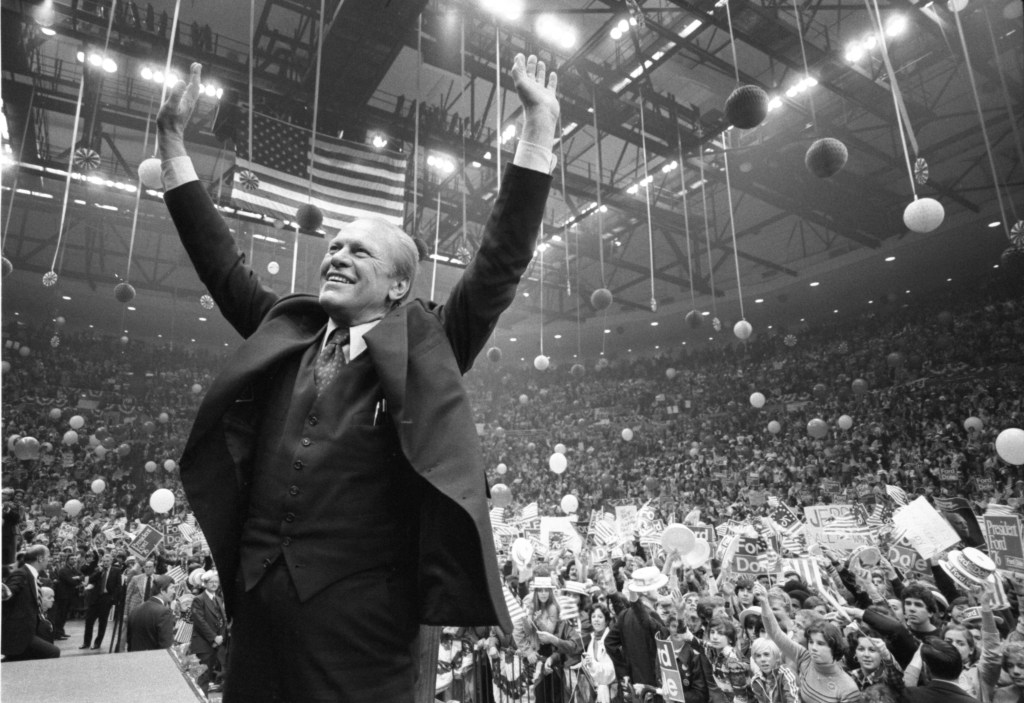
President Ford went to a Roman Catholic mass at St. Stanislaus Church in Buffalo yesterday and began the last Sunday of the Presidential campaign with two happy surprises. The first was a strong anti‐abortion pastoral letter that, although nominally nonpolitical, was sympathetic to the Republican President. The second was a formal welcome to the Polish‐American church, which absolved Mr. Ford of his most famous campaign misstep — his insistence in the second television debate with Jimmy Carter that Poland and the other Communist states of Eastern Europe are free of Soviet domination. Only recently, Mr. Ford would not have been expected to close his final campaign weekend among usually Democratic voters in neighborhoods of East European background. Nor would he have been expected to be in New York City, whose pleas for financial aid Mr. Ford long resisted, or in New York State, whose Republican patriarch, Vice President Rockefeller, he had dropped from the national ticket. Strong crowds — in the rain at Rochester yesterday morning and at the Nassau Coliseum last night — and the President’s high spirits added to the impression in public polls and in White House propaganda that the race was close and suddenly winnable for Mr. Ford, in New York and the nation.
In his final campaign appearance in Texas, Jimmy Carter characterized President Ford today as a man with an undistinguished record in Congress unbroken by his tenure in the White House. “I have nothing against him,” the Democratic nominee said at a breakfast rally in nearby Dallas. “But he was a Congressman for 25 years — and can any of you remember one piece of legislation he sponsored?” His partisan audience of more than 1,000 Texans responded with a lusty, “No!” Pleased with the response, Mr. Carter continued the litany and asked if anyone could remember any programs Mr. Ford had conceived and executed as President. “Higher unemployment!” shouted one member of the audience — and Mr. Carter smiled broadly and vigorously agreed. For the first time since Labor Day, he had his wife and four children at his side as he began the final hours of his campaign. But, as they attended church today at Texas Christian University, there were reverberations from his own church in Plains, Georgia.
The deacons in the Plains Baptist Church voted last week to cancel services there today after a black minister from nearby Albany, Ga., announced his intention of attempting to join the church this morning. Mr. Carter, arriving at the Tarrant County Convention Center here for a fried chicken boxed lunch with about 6,000 Democrats, at first said that he knew nothing about it. Then, after a brief conversation with his administrative assistant, Greg Schneiders, he said he had always supported the right of anyone, ‘regardless of race,” to become a member of his church. Robert S. Strauss, the chairman of the National Democratic Committee, and one of a host of Texas political dignitaries who have traveled with the candidate in the last two days, shook his head in resignation when he heard that reporters were pursuing what Mr. Carter called “the problem in Plains.” Mr. Strauss had worked very hard putting together the details of the Texas foray for Mr. Carter, including four appearances with the candidate by Luci Johnson Nugent, the daughter of the late President Johnson. As he entered the Convention Center, amid the stir caused by the deacons’ decision in Georgia, Mr. Strauss was visibly upset by the possibility that the events in Texas today would be overshadowed by the events in Plains.
Jimmy Carter’s top economics adviser said he was recommending immediate help for the economy, such as a tax cut, because the economy was “seriously deteriorating week by week.” Lawrence R. Klein said that whoever was elected President must act quickly to give tax cuts or tax rebates or to increase federal spending. “We’re losing time. The situation has developed to the point where the government needs to act now,” he said. But Alan Greenspan, chairman of President Ford’s Council of Economic Advisers, said he thought that new stimulus for the economy would be “unwise” because it would make inflation worse in the long run.
Concern over double-digit inflation among top executives has lessened considerably in the last year, a new survey says, but the executives said they were still cautious in their business policies. Fortune magazine in its November issue said 200 executives answering their pool were also more confident that the U.S. economy would rebound and stay prosperous over the next few years. It said 25% of the executives believed double-digit inflation still was a problem, down from 62% a year ago. Inflation has been running at an annual rate of 5% to 6%. The magazine said executives were more cautious this year than last and often were unwilling to expand without assurance the economy would come out of its current lull.
Federal investigators have closely questioned high officials at the Agriculture Department in the last few weeks about alleged attempts by two Congressmen to influence departmental decisions involving rice and other export programs, according to Government sources. The inquiry appears to be related, the sources said, to a broad investigation by the Justice Department into charges of South Korean efforts to bribe and influence United States Congressmen. The questioning by Justice Department investigators has focused on Representatives Otto E. Passman of Louisiana and Robert L. Leggett of California, both Democrats, the sources said, but the investigators indicated that they had an equal interest in at least three other legislators, whom they did not name.
Individual investors are expected to react coolly to new notes and bonds totaling $6 billion that the Treasury will offer this week in contrast to heavy demand for previous offers. If interest rates hold steady, it’s probable that the new three-year notes will yield about 6¼ percent, seven-year notes will yield a bit more than 7 percent and long-term bonds about 7¾ percent.
The newest popular tax shelter, leasing syndications for mining coal, has been opposed by the Internal Revenue Service. Coal leases are the last broad chance for high-bracket taxpayers to gain immediate tax deductions totaling up to four times their cash investment. The I.R.S. has proposed rules to prevent investors from paying coal mining royalties in advance. This would delay tax deductions until the coal is sold.
The first woman broker to spend her entire working day on the floor of the New York Stock Exchange last week acknowledged the work was quite a jolt. No matter how many years “you spend in this business, the floor is a completely different world,” she said, adding, “There’s a different verbiage, a different pace,” The broker is Alice Jarcho, 30, of New York.
Citizens of Detroit have recently started a concerted campaign to break the commercial sex industry here and chase it out of town. Prostitutes have been scared off the streets in some parts of town by groups of neighborhood residents picketing during heavy business hours. Customers of prostitutes, commonly referred to as johns have found that when they are arrested or convicted on a soliciting charge, their names and addresses are listed in the regular prostitute report published in The Detroit News, the city’s big afternoon newspaper. City and county attorneys, with the help of the police here, have padlocked massage parlors and are trying to close more theaters and bookstores through the enforcement of tough zoning laws, upheld by the United States Supreme Court last June.
With barbed pleasantries, Senator James Buckley and Daniel Patrick Moynihan debated issues in their final television confrontation of the New York Senate campaign. Mr. Buckley said his labeling of his challenger as “professor” was “respectful.” Mr. Moynihan said the Senator had vowed to beat him so “liberalism would never again show its ugly head in New York.”
Cigarette smuggling has become a booming business, costing states and cities millions of dollars in lost tax revenue, the Law Enforcement Assistance Administration said. But a new cooperative program-the Interstate Revenue Research Center based in Indianapolis-involving law enforcement officials in seven states “may be making inroads against” the criminal enterprise, the LEAA said in a report. The research center has received $787,500 from LEAA to coordinate investigations of smuggling in Florida, Missouri, Michigan, Ohio, Indiana, Illinois and Minnesota. Five of these states will lose $100 million this year. There were no estimates for losses in Florida and Missouri.
A sniper started shooting from a barricaded apartment toward a restaurant in the Hudson Valley town of Mechanicsville. A 90-minute gun battle between the gunman and dozens of policemen left two killed, 10 injured and the assailant charged with murder. A shipping clerk was charged with two counts of second-degree murder after a police officer and a bar customer were killed and nine other persons wounded by gunfire sprayed from an apartment building in Mechanicville, New York. Police said Kenyon W. Pruyn, 32, was taken into custody as he emerged from the burning building. They said he had fired more than 300 rounds during the two-hour shootout involving 50 officers. Nine rifles and shotguns were in the apartment. Police said Pruyn, a former marine, had been having family problems and had been drinking. His wife and two daughters were not at home at the time.
Reported missing 17 days, a New Jersey mariner was found 500 miles east of Puerto Rico, adrift in his damaged sloop but apparently unhurt. The Coast Guard said that the sailor, 23-year-old Robert Gainer, who had sought to circle the globe alone, seemed in good spirits and in no immediate danger.
The executive committee of the National Council of Churches has called for the suspension of Archbishop Valerian Trifa from its governing council because of alleged wartime ties with the Nazi Party in Romania. Trifa, of Grass Valley, Michigan, is head of the Romanian Orthodox Episcopate of America and is one of the six Orthodox Church of America delegates to the council’s governing board. The committee said it had decided to seek Trifa’s withdrawal because “the atrocities of that (World War II) era are so repugnant to us that we cannot allow any doubts about… them.”
The first VHS (Video Home System) recorder and player, the HR-3300 manufactured by JVC, went on sale to the public at electronic stores in Tokyo’s Akihabara district. The initial cost of the recorder, invented by JVC engineers Yuma Shiraishi and Shizuo Takano, was ¥310,000 Japanese yen (US$1,060, equivalent to $5,100 in 2021). It would go on sale in the United States 10 months later on August 23, 1977, under the name “Vidstar”.
NBA legend Larry Bird (19) divorces high school sweetheart Janet Condra only 11 months after getting married.
NFL Football:
The Kansas City Chiefs downed the winless Tampa Bay Buccaneers, 28–19. Mike Livingston sparked the Chiefs’ offense with two third quarter scoring passes to lead Kansas City to its third win in the last four games. The Chiefs defense held the Buccaneers to 14 yards rushing and had four quarterback sacks. Tampa Bay scored three touchdowns in the last 10 minutes of the game, two coming on Steve Spurrier passes.
The Oakland Raiders beat the Denver Broncos, 19–6. Ken Stabler broke a 6–6 fourth quarter tie with a 31-yard touchdown pass to Fred Biletnikoff, putting the Raiders’ receiver over 8,000 career yards and giving Oakland the win and a three-game lead in the AFC West. The Raiders’ defense sacked Steve Ramsey 10 times for 62 yards and allowed only two field goals. Clarence Davis scored Oakland’s other TD on a seven-yard run.
The Chicago Bears edged the Minnesota Vikings, 14–13. Johnny Musso landed on his own fumble in the end zone for the winning touchdown as the Bears pinned the first loss on the Vikings, the last of the undefeated. Fran Tarkenton, breaking John Unitas’ career passing yardage record with 272 yards passing for a 40,421-yard total, drove 80 yards on the next series and scored on a two-yard run to bring the Vikings within one point with 7:42 left in the game.
The Philadelphia Eagles blanked the New York Giants, 10–0. Mike Boryla capped a 61-yard second quarter drive with a 13-yard touchdown pass to Harold Carmichael as the Eagles won for the sixth time in their last seven games with the Giants. Punt returner Larry Marshall started the scoring drive with a 16-yard return and brought back another Giants punt 15 yards, setting up Horst Muhlmann’s 20-yard field goal with 10 seconds left in the first half.
The St. Louis Cardinals nipped the San Francisco 49ers, 23–20. Jim Bakken’s 21-yard field goal at 6:42 of overtime, set up by six straight carries by Jim Otis following a 49ers’ fumble of a Cardinals punt, kept St. Louis one game behind Dallas in the NFC East and dropped San Francisco into second place in the NFC West. The 49ers held a 20–14 fourth quarter lead on a three touchdown, club record 194-yard rushing performance by Delvin Williams before Jim Hart combined with Mel Gray for a 77-yard touchdown pass with 8:02 left to tie the game 20–20. The extra point was blocked, sending the game into overtime. San Francisco kicker Steve Mike-Mayer missed two field goals and an extra point, any of which would have won the game in regulation.
The Dallas Cowboys defeated the Washington Redskins, 20–7. Roger Staubach ignored a broken bone in his right hand and guided the Cowboys to first and third quarter touchdowns, dropping the Redskins two games behind Dallas in the NFC East race. Doug Dennison scored on a three-yard run in the first quarter after Efren Herrera pinned Washington deep in its own territory on the previous series with a fake field goal punt. Staubach finished a 68-yard third period drive with a one-yard TD plunge and Herrera added field goals following two Redskins turnovers. Washington averted a shutout when Joe Theismann threw a seven-yard touchdown pass to Roy Jefferson with 48 seconds left in the game, following a 59-yard punt return by Eddie Brown.
The Atlanta Falcons beat the New Orleans Saints, 23–20. Scott Hunter came off the bench to throw two touchdown passes that led the Falcons to their first win under Pat Peppler, ending a four game losing streak. Hunter’s scoring passes to Alfred Jenkins and Haskel Stanback tied the game 14–14 before the Saints went ahead on a two-yard TD run by Tony Galbreath. Stanback’s one-yard run with 4:51 left in the game put Atlanta back in the lead, the Falcons final two points coming when Bobby Douglass was forced out of the end zone with 30 seconds remaining.
The Los Angeles Rams crushed the Seattle Seahawks, 45–6. James Harris threw for 208 yards and two touchdowns after a two week injury absence, leading the Rams to their third straight win and into first place in the NFC West. Monte Jackson got Los Angeles’s first touchdown on a 41-yard interception return and Harris put the Rams up 31–3 at the half with a 15-yard TD pass to Ron Jessie. Harold Jackson caught Harris’s second touchdown pass, a 20-yarder, in the third period and Pat Haden, replacing Harris midway through the fourth quarter, passed 23 yards to Tom Geredine for the final score.
The Detroit Lions trounced the Green Bay Packers, 27–6. Greg Landry and Ray Jarvis combined for two first half touchdowns as the Lions evened their record at 4–4. Jarvis, who caught six passes for 163 yards, outran two Packers defenders on a 74-yard first quarter touchdown and got his second score on a 13-yard play in the second period. The Detroit defense recovered three fumbles and James Hunter had two interceptions.
The Pittsburgh Steelers shut out the San Diego Chargers, 23–0. Terry Bradshaw, appearing in the Steelers’ lineup after missing two games with a neck injury, drove Pittsburgh for three touchdowns in the fourth quarter as the Steelers reached the .500 mark. Roy Gerela kicked a 36-yard field goal midway through the second quarter for a 3–0 lead which held until Bradshaw picked up Pittsburgh’s first TD on a one-yard run and then passed to Ernest Pough for a 17–0 advantage. Reggie Harrison rushed for 108 yards, his first 100-yard game in the NFL, and the Steelers’ defense sacked Dan Fouts five times and picked up five Chargers’ turnovers.
The New York Jets defeated the Buffalo Bills, 19–14. Linebacker Larry Keller’s interception and block of a Buffalo punt both set up scores leading to the Jets’ second victory. Richard Todd hit David Knight with a 20-yard scoring pass following Keller’s interception on the next series. Steve Poole returned the blocked punt seven yards for a second touchdown. The Bills came back to score two touchdowns, but a third drive was stopped by a fumble at the Jets’ 5-yard line.
The Cincinnati Bengals topped the Cleveland Browns, 21–6. Boobie Clark’s two one-yard touchdowns and 100 yards (first 100-yard Bengals rusher since his 104 vs. Chiefs in 1973) led Cincinnati to a season sweep of the Browns. Isaac Curtis got his 17th touchdown against Cleveland in the last four years on a 69-yard pass from Ken Anderson for a 14–6 halftime lead. Clark capped a 90-yard drive with his second TD while the Cincinnati defense stopped two second-half scoring threats by the Browns at the Bengals’ 7 and 11-yard lines.
The New England Patriots bowed to the Miami Dolphins, 10–3. Dolphins’ defensive tackle Don Reese sacked Steve Grogan at the Miami 40 for a 16-yard loss in the fourth quarter, snuffing out a possible game tying scoring drive. Bob Griese threw a 16-yard touchdown pass to Jim Mandich in the second quarter which proved to be the margin of victory. Miami evened its record at 4–4 to keep its playoff hopes alive and dropped the Patriots two games behind Baltimore in the AFC East.
Kansas City Chiefs 28, Tampa Bay Buccaneers 19
Denver Broncos 6, Oakland Raiders 19
Minnesota Vikings 13, Chicago Bears 14
Philadelphia Eagles 10, New York Giants 0
San Francisco 49ers 20, St. Louis Cardinals 23
Dallas Cowboys 20, Washington Redskins 7
New Orleans Saints 20, Atlanta Falcons 23
Seattle Seahawks 6, Los Angeles Rams 45
Green Bay Packers 6, Detroit Lions 27
San Diego Chargers 0, Pittsburgh Steelers 23
New York Jets 19, Buffalo Bills 14
Cleveland Browns 6, Cincinnati Bengals 21
New England Patriots 3, Miami Dolphins 10
Born:
Piper Perabo, American actress (“Covert Affairs”), in Dallas, Texas.
Audrey Sauret, French WNBA guard (Washington Mystics), in Charleville-Mezieres, France.
Died:
Clarence Chamberlin, 82, American aviator, died of complications after receiving the “swine flu” vaccination. On June 4, 1927, Chamberlin became the second pilot (after Charles Lindbergh 15 days earlier) to fly an airplane by himself nonstop across the Atlantic Ocean, and the first to take a passenger with him.
Linda Watkins, 68, American actress (“From Hell it Came”, “Harpy”).
Eileen Gray, 98, Irish modern architect.

