Secretary of State George P. Shultz warned the Soviet Union today that what he called its continuing human-rights abuses “can only jeopardize” the chances of achieving arms control and other agreements with the United States. Reaffirming that there was a linkage between human rights and other issues, Mr. Shultz said, “Until there is substantial Soviet progress in the vital area of human rights, advances in other areas of the relationship are bound to be constrained.” In two speeches on Soviet relations, in Los Angeles this afternoon and in San Francisco tonight, Mr. Shultz delivered a detailed and aggressive attack on Soviet human-rights policies. What made the criticism particularly significant was that Mr. Shultz, who is known as one of the Administration’s strongest proponents of arms-control accords, went out of his way to hold progress in the arms field hostage to an easing of Soviet policies toward dissidents and Jews who want to emigrate.
Senior Administration arms-control officials will accompany Secretary of State George P. Shultz to a meeting next week with the Soviet Foreign Minister, Eduard A. Shevardnadze, Reagan Administration officials said today. The officials said they hope to pick up where the United States and the Soviet Union left off at the end of the summit meeting in Iceland. The presence of the senior officials with technical expertise, who would not normally attend a meeting of the Secretary of State and his Sovet counterpart, would make it easier to conduct in-depth discussions on arms-control matters with the Russians. At the Iceland talks, a team of senior American officials negotiated directly with Soviet officials and advised President Reagan in his talks with Mikhail S. Gorbachev, the Soviet leader. According to current plans, the same team is to accompany Mr. Shultz to his meetings in Vienna with Mr. Shevardnadze. Those meetings are to take place on Wednesday and Thursday. The senior officials who are scheduled to go to the Vienna meeting include Paul H. Nitze, the senior arms-control adviser to Mr. Shultz; Max M. Kampelman, the chief American negotiator at the Geneva arms talks, and Richard N. Perle, the Assistant Defense Secretary.
A total of 55 Soviet diplomats left Washington with their families today under an expulsion order intended to reduce the ability of the Soviet Embassy to conduct espionage. The diplomats were told last week to leave the country by November 1. The departure, an Aeroflot charter flight from Dulles International Airport, involved the largest number of Soviet personnel ever expelled by the United States at one time. It came as part of a series of tough measures by both superpowers against each other’s diplomatic missions.
In quiet corners and subdued tones, American diplomats bade farewell today to Soviet workers who had stopped by the United States Embassy to pick up their personal belongings and penultimate paychecks. As the Russians collected their goods in shopping bags, some near tears, many of the Americans said they had got a crash course in Soviet reality since the withdrawal of the Soviet employees a week ago. Without the services of the Russians, who handled many of the embassy’s mundane chores such as clearing food shipments through customs and obtaining train and airplane tickets, the Americans have been forced to grapple with the Communist bureaucracy, long a bane of everyday life for Soviet citizens. The immediate result, according to embassy officials, has been a reduction in the time devoted to tracking and analyzing the nuances of Kremlin foreign and domestic policies and an increase in exposure to the frustrations of Soviet life.
Two bombs exploded early today in Paris, causing damage but no injuries, the Interior Ministry said. A leftist group took responsibility. One bomb exploded outside the offices of the state-owned charter airline Air Minerve in central Paris and the other went off outside the headquarters of the Government’s Immigration Office, a ministry spokesman said. The blasts came almost simultaneously, he added. The left-wing urban guerrilla group Direct Action claimed responsibility for the two attacks in a letter found in Paris after a telephone call to an international news agency.
Britain’s governing party has challenged the integrity of the British Broadcasting Corporation, accusing it of distorted anti-American news coverage of the United States raid on Libya in April. In a bitter and unusual critique Thursday, Norman Tebbit, the Conservative Party chairman and a close adviser to Prime Minister Margaret Thatcher, issued a detailed analysis contending that BBC coverage was loaded with unfair, opinionated criticism of the raid and of Mrs. Thatcher’s decision to allow American bombers to fly from bases in Britain. Complaining to the policy governing board of the network, Mr. Tebbit accused the news organization of “increasingly subjective and confrontational” coverage. He questioned whether the BBC had been guilty of “an uncritical carriage of Libyan propaganda.”
Syria said today that it had received a letter from the Soviet Union expressing firm support for Damascus after Britain’s decision to break diplomatic relations with Syria. The state-run Damascus radio, monitored here, said the message to President Hafez al-Assad from the “Soviet leadership” cited an “aggressive campaign” against Syria led by Britain in coordination with the United States and Israel. The Syrian Ambassador left Britain today, a week after Britain broke diplomatic relations, and the British Ambassador to Syria also flew home.
A special envoy of the Archbishop of Canterbury, Terry Waite, arrived in Beirut unexpectedly today in a fresh effort to secure the release of American hostages held by Moslem extremists. Mr. Waite’s arrival came amid a flurry of rumors that the release of at least some of the Western hostages in Beirut might be imminent. Tonight, two Lebanese Christian radio stations here broadcast an unconfirmed report that two French hostages had been turned over to Syrian officials in the Bekaa region of eastern Lebanon in preparation for their release along with the American hostages. Mr. Waite told reporters that he had come to Beirut in the hope that there would be new developments in the case of the hostages. He did not elaborate.
Hundreds of Egyptian Muslim fundamentalists battled with policemen outside a mosque today in a melee involving guns, knives, clubs and tear gas, witnesses said. The Government-run Middle East News Agency quoted a police official as saying one person had been shot to death and 48 were arrested.
Government officials, speaking hours after more than 7,000 riot policemen ended a siege by hundreds of university students, denounced the anti-Government protesters today as pro-Communist and vowed to continue a nationwide campaign against them. Television news this evening carried scenes of smoke pouring from Konkuk University buildings and students hurling rocks and fire bombs at the police. There were also scenes of destruction inside university buildings — charred walls and stairwells, shattered glass, broken desks, chairs and shelves — and slogans scrawled on building walls. Posters at the university called for the withdrawal of American troops from South Korea, and they blamed the outbreak of the Korean War on the American and South Korean Governments. Western diplomats here said they believed the incident this morning, in which about 1000 students were arrested, could lead to more student protests, fuel public support for the Government’s anti-leftist campaign and hurt the opposition in a time of prolonged stalemate over South Korea’s political future.
Against the backdrop of the American elections on Tuesday, the United States and Japan announced a broad agreement today to coordinate their economic policies and bolster both economies. Japan agreed to accelerate its sluggish economy by cutting interest rates, among other actions, and the United States agreed to abandon its efforts to drive the dollar down against the yen. Treasury Secretary James A. Baker 3d and Finance Minister Kiichi Miyazawa, who began working out the agreement at a meeting in San Francisco in September, termed their actions an important step in the year-old effort of leading industrial countries to coordinate economic policies. As part of the agreement, Japan’s central bank announced that it was cutting its discount rate, which it charges on loans to commercial banks, from 3 1/2 percent to 3 percent, the lowest rate since World War II. Mr. Baker noted today that he had been openly urging Japan and West Germany to reduce their interest rates since August in the belief that doing so would speed up their economies, assure the import of more American goods and thus help reduce the American trade deficit.
All this week, fighter planes creased the skies above the Japanese city of Chitose and infantrymen crawled across muddy fields in the most comprehensive military maneuvers ever held jointly by the United States and Japan. Code-named Keen Edge, the exercise tested the two countries’ combined forces against an unnamed enemy, nonetheless recognized by everyone to be the Soviet Union. Military planners here have long assumed that this northern Japanese island of Hokkaido, because of its location astride the strategic La Perouse Strait, would be a candidate for Soviet invasion in a conventional war. Technically, Keen Edge was nothing more than a bigger version of maneuvers held for years under a security treaty requiring the United States to come to the defense of Japan if Japan is attacked. But it was also one of the more visible demonstrations in recent years of how Japan has increasingly aligned its military policies with overall American strategy in East Asia. The military cooperation has picked up considerable steam in the face of a steady buildup of Soviet naval and air power across Asia.
The armed forces Chief of Staff said today that in the eight months since President Corazon C. Aquino took power, the Communist insurgency in the Philippines had grown larger, was better armed and might be capable of inflicting more serious economic and political damage to the country. The Chief of Staff, General Fidel V. Ramos, speaking at the videotaping of a television interview to be broadcast here Saturday, said nearly a fifth of the towns and villages were in some way affected by guerrilla activity. About eight people are dying every day, he said, in an average of eight or nine “violent incidents” involving the Communist New People’s Army. In the last three months, the Aquino Government has been trying to open substantive negotiations with the guerrilla leaders of the New People’s Army through the Communists’ political organization, the National Democratic Front, in order to end an 18-year-old insurgency. The President has also begun to talk with Muslim rebels waging a separate war.
The Justice Department is investigating real estate transactions involving the Philippine Defense Minister, Juan Ponce Enrile, and his wife, Christina, Federal officials said today. The investigation concerns charges that Mr. Enrile and his wife diverted hundreds of thousands of dollars in American aid for personal use, but Federal officials said they had no firm evidence to support the charges. The officials said they were examining several transactions made by the couple before the Government of Ferdinand E. Marcos was toppled early this year. The transactions to include the purchase by Mrs. Enrile in 1977 and 1979 of condominiums in San Francisco, which she sold in 1982 to a dummy corporation, according to the officials.
Three Armenians charged with killing a security guard during the seizure of the Turkish Embassy in Ottawa, Canada last year were found guilty today of first-degree murder and sentenced to life in prison. An Ontario Supreme Court jury reached the guilty verdict against Ohannef Noubarian, 30 years old, of Montreal; Kevork Marachelian, 35, of La Salle, Quebec, and Rafi Panos Titizian, 27, of Toronto.
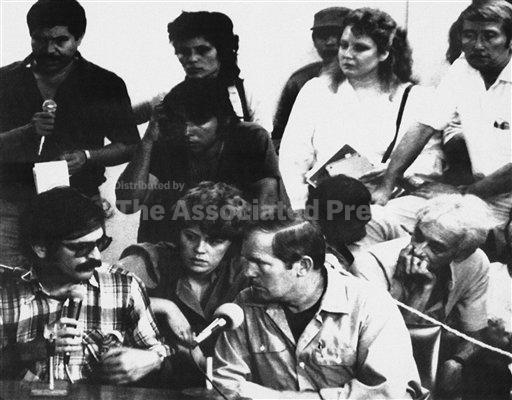
The American air-freight handler whose arms-laden plane was shot down over Nicaragua October 5 refused to testify today before a Nicaraguan court. The American, Eugene Hasenfus, who is being tried by a people’s tribunal for aiding the United States-backed insurgents, appeared confused by the proceedings. The presiding judge, Reynaldo Monterrey, repeatedly warned him against seeking advice from his lawyer during the court session. According to Judge Monterrey, rules of the tribunal prohibit lawyers from advising clients in the courtroom. The judge declared a recess in the trial and told Mr. Hasenfus that he would have to testify at some point. “Anyone who comes before this tribunal and is asked questions by the tribunal is obligated to reply,” the judge said. “You must say yes or no.” “You are here for a judicial proceeding, not for a meeting with your lawyer or your family,” he told the defendant.
A member of Congress from California, citing documents she said were provided by an insider, said today that the Army had illegally used its reservists for construction projects in Honduras and Panama. The lawmaker, Representative Barbara Boxer, Democrat of California, said the practice continued even after the Secretary of the Army was warned about it in a December 1985 audit by the Army Inspector General.
President Reagan spends the day attending/addressing political rallies in the Western United States. President Reagan today sought to ease local concern over a radioactive site in Washington state as he continued his campaign to retain a Republican Senate majority in next Tuesday’s elections. As he campaigned in Spokane before arriving here, Mr. Reagan sought to aid the election of Senator Slade Gorton, a Washington Republican, by assuring voters that his Administration would not “circumvent” the law to allow the selection of a radioactive waste site to go ahead illegally. But he did not indicate that he would overturn the Energy Department’s decision to begin test drilling on such a site at Hanford, Wash., southwest of here, one of three choices for the final location.
Representative Thomas P. O’Neill Jr., the retiring House Speaker, said today that he expected the Democrats to win control of the Senate in the elections Tuesday despite President Reagan’s cross-country campaign trip in behalf of Republicans. “I will be surprised if the Senate does not go Democratic,” he said.
The Government’s main economic forecasting gauge climbed four-tenths of 1 percent in September, reversing the slight decline of August, the Commerce Department reported today. The data added to rapidly accumulating evidence that the economy may have begun to grow somewhat faster than the 2.25 percent annual rate recorded in the first nine months of 1986. In another sign, the Commerce Department said orders received by the nation’s factories posted their best advance in almost two years. [ Page 38. ] Private analysts said they were particularly heartened by the fact that the gain in the index of leading indicators, though modest, was paced by components reflecting the “real” economy, and that the rise in factory orders covered most industries.
Farm experts say the immigration bill Congress passed this month assures that American agriculture will have a continuing long-term supply of inexpensive field hands for the forseeable future. But some say the need for such workers is likely to decline. This is because of increased mechanization and other steps to improve efficiency, a surplus of domestic agricultural workers, and rising competition from foreign growers that is cutting into sales of American growers. According to the Department of Agriculture, the nation’s total number of hired farm workers, excluding members of farming families, has declined almost one-third since 1980, to 1.233 million. Although increasing consumer demand for fresh fruits and vegetables is ameliorating the trend, department economists say the immediate prospect is for the decrease to continue.
The staff director of the United States Civil Rights Commission, J. Al Latham Jr., resigned today, complaining that Congressional action had crippled the agency. Mr. Latham, who was appointed by President Reagan to the $68,700-a-year position last December, said in a letter of resignation to the President that the commission had been “hobbled” by recent Congressional action that reduced its financing. The action contributed to his decision to leave, he said.
Flanked by the heads of nearly every Hollywood studio and major television production company, Nancy Reagan asked them today to create characters “who firmly reject drugs in any form” and not to collaborate “in the illusion that drugs are fun.” “No one is advocating censorship,” the President’s wife said in a speech to 1,300 members of the Academy of Television Arts and Sciences, opening a two-day conference on how members can deal with drugs on television without glamorzing them. Mrs. Reagan asserted, “The average child watches 27 hours of television a week,” which she said allowed the shows to create fads in fashion. “Hollywood can’t say, yes, we have the power to influence what clothes a young person wears, but not the power to influence what that person thinks about drugs,” she said.
Orange plumes rose into the night air from vacant houses and abandoned automobile late Thursday despite Detroit’s efforts to contain a wave of arson that plagues the city each year the night before Halloween, which is called Devil’s Night here. However, about 11,000 firefighters, police officers and civilians who descended on deserted streets and lots managed to stave off arsonists and douse fires, and officials said the number of fires, though still high, was far below the number set in recent years. Since Wednesday, 504 teen-agers have been arrested for violating a city-imposed, dusk-to-dawn curfew, prohibiting people under 18 years old from walking the streets without a parent or guardian. The curfew, the first ever imposed to stem Halloween-related arson, was also in effect from 6 PM tonight until 6 AM Saturday.
The Air Force, deciding a long and bitter battle between the Northrop Corporation and the General Dynamics Corporation, chose today to buy the General Dynamics F-16 fighter plane in a deal that will be worth billions of dollars. The Air Force also selected two teams, one headed by Northrop and the other by the Lockheed Corporation, to design another new fighter plane. In the contest between Northrop and General Dynamics, the F-16, already widely used in the Air Force and in many foreign countries, edged Northrop’s F-20, designed by the company at a cost of $1 billion without ever attracting a buyer. Contest Required Northrop supporters have argued that the F-20 would provide competition and thus lower aircraft costs. They pressed legislation through Congress requiring the Air Force to have a contest between the planes for the job of defending the United States against attacking bombers. The Air Force plans to equip 270 planes for that job, replacing fighters designed in the 1960’s.
Investment analysts had bet heavily on General Dynamics as the winner of the competition. But they said the huge investment by Northrop, which in an unusual move deducted its research and development costs from earnings as the money was spent, could pay off in other fighter programs. As if to underscore that point, the Air Force included Northrop’s design today in its choice of companies to develop and build prototypes of the next generation of combat aircraft, known as the Advanced Tactical Fighter. Northrop has agreed to share its work on that project with a subcontractor, the McDonnell Douglas Corporation. The Lockheed Corporation, too, won a contract to build an advanced fighter prototype. Lockheed will be joined by General Dynamics and the Boeing Company in its design work. Each team will share contracts worth $691 million to build prototypes in the next four years. After flying the prototypes, the Air Force will select one as its premier fighter, entering service in the 1990’s.
A conservative Michigan newspaper publisher was charged today with acting as an unregistered foreign agent for South Africa since 1974. In a criminal information filed in Federal District Court, the publisher, John P. McGoff, was charged in connection with his purchase of an interest in The Sacramento Union in California and an attempt to buy The Washington Star in 1974, as well as other acts. Government prosecutors contend that Mr. McGoff made an unsuccessful effort to purchase The Star with $10 million provided by the South African Government. The Star is now defunct.
The mentally ill woman who killed three people and tried to kill seven others in a shopping mall shooting rampage a year ago was sentenced to three consecutive life terms today by a judge who said “she should not be put back on the street.” The judge, Robert Kelly, rejected a defense plea that the woman, Sylvia Seegrist, be given “a glimmer of hope” for freedom should she ever recover from her disabling mental illness. Last June, Miss Seegrist was found guilty but mentally ill on three first-degree murder counts and seven of attempted murder for the October 30, 1985, shootings at the Springfield Mall in suburban Philadelphia. Witnesses said Miss Seegrist arrived at the Springfield Mall dressed in military fatigues and armed with a rifle.
Governor Mark White has chosen to spend three of his last campaign days here in deepest East Texas, land of loblolly pines, red clay dirt, staggering unemployment and people who, it used to be said, would rather vote for a yellow dog than a Republican. The “yellow dog” Democrats are wavering. And Mr. White is fighting hard to build the margin he needs here to offset new Republican strength in other parts of Texas and beat back a stiff challenge from former Governor Bill Clements, the first Republican to hold the office in Texas since Reconstruction. So Mr. White barnstormed the region today, stopping in towns like Texarkana, Domino, Pittsburg and Sulphur Springs and ending up here talking to steelworkers at the Lone Star Steel plant, a vivid symbol of the state’s economic troubles. At the height of the great oil boom in 1982, the plant had 7,000 workers turning out pipes and drilling equipment; now only 1,000 are left and the plant is trying to diversify into other products.
The campaign to elect Alabama’s first Republican Governor since Reconstruction has received an important lift from the announcement that Attorney General Charles Graddick, who had been running as an independent write-in candidate, was dropping out of the race. That means voters will choose Tuesday between Guy Hunt, a Republican who only five months ago was given no chance of winning, and Lieut. Gov. Bill Baxley, whose bitter battle to defeat Mr. Graddick for the Democratic nomination split his party. With Mr. Graddick, a 41-year-old conservative and former Republican, out of the race, people who closely follow politics here say that Mr. Hunt, 53, a Baptist lay minister and salesman, is now the probable winner in the campaign to succeed Governor George C. Wallace, who is retiring.
Union and management representatives negotiated past a strike deadline today to try to avert a walkout at San Francisco’s two major daily newspapers and The San Jose Mercury News. The parties agreed earlier this week not to disclose details of the bargaining sessions. But Larry Hatfield, president of the Northern California Newspaper Guild, said the critical issue was a management proposal for an 18-month wage freeze. Robert M. McCormick, vice president of sales and marketing for the San Francisco Newspaper Agency, described management’s view of the talks as “guardedly optimistic.” The unions have said their proposal called for a $165 per week pay increase over a three-year term. The employers are said to have offered a $24 weekly increase over the final 18 months of a three-year contract, following an 18-month wage freeze.
A group of Kiowa Indians who have taken over their tribal headquarters greeted Federal police officers today as they were stationed outside the building. The Indians, led by Herschel Sahmaunt, occupied the complex Thursday in an attempt to stop a tribal election Saturday. Mr. Sahmaunt, who was elected chairman of the group in June but was later disqualified, said the new election was illegal.
With another best-selling novel to its credit, the Naval Institute Press is now batting a thousand as a publisher of fiction. Its new book, only the second novel the press has published in its 114-year history, is “Flight of the Intruder” by Stephen Coonts, an account of Naval aviators at war over Vietnam. In The New York Times Book Review tomorrow, “Flight” will be listed as the No. 12 hard-cover book of fiction. It follows by 20 months the appearance on that list of Tom Clancy’s “Hunt For Red October,” which not only vaulted Mr. Clancy to fame but also brought a measure of fame and fortune to the Annapolis, Maryland, publisher.
The State of Colorado and the Union Carbide Corporation agreed today on a $40 million plan to clean up the site that produced uranium for the first atomic bomb. State officials described the agreement, which would settle their lawsuit against the company and its subsidiary, the Umetco Minerals Corporation, as the largest single recovery of money from polluters for reclaiming hazardous waste sites under Federal laws and the largest such effort in terms of geographical area. If approved by Federal District Judge Jim A. Carrigan, the agreement would result in a 15-year program to reclaim the Uravan uranium mill in southwestern Colorado. The mill had produced uranium oxide, or yellowcake, since 1917 and had left 10 million tons of radioactive tailings that have polluted the surrounding land and the San Miguel River that flows past the site and provides water to farmers and Indian reservations before joining the Colorado River.
Intensive analysis of data sent to Earth by two Soviet spacecraft as they flew past Halley’s comet last March has shown the comet’s nucleus to be 10 miles long and considerably larger than recent estimates. Having now determined its size, the Russians believe that for the first time they can estimate its density. While the estimate is only approximate, it indicates that the comet is too lightweight to have the rocky core envisioned by some astronomers. Among these astronomers are those who believe that some asteroids are comets that have shed the frozen gases of which they were primarily formed, leaving a rocky residue.
Stock prices were mixed yesterday on Wall Street, as a cut in interest rates in Japan failed to help the market extend its recent rally. The reduction in Japan’s discount rate, to 3 percent, from 3 ½ percent, was announced before trading began in New York. Anticipation of the rate cut was part of the reason why the Dow Jones industrial average jumped 26 points on Thursday. The Dow, after rising several points early in the session yesterday, closed down by 0.56 point, at 1,877.81. For the week, the blue-chip index was up 45.65 points.
Dow Jones Industrial Average: 1877.81 (-0.56)
Born:
Christie Hayes, Australian actress (Kirsty Sutherland in “Home and Away”), in North Nowra, New South Wales, Australia.
Chris Alajajian, Australian racing driver, in Sydney, New South Wales, Australia
Died:
Robert S. Mulliken, 90, American chemist and physicist (Nobel prize in Chemistry, molecular orbital method of computing the structure of molecules, 1966).

