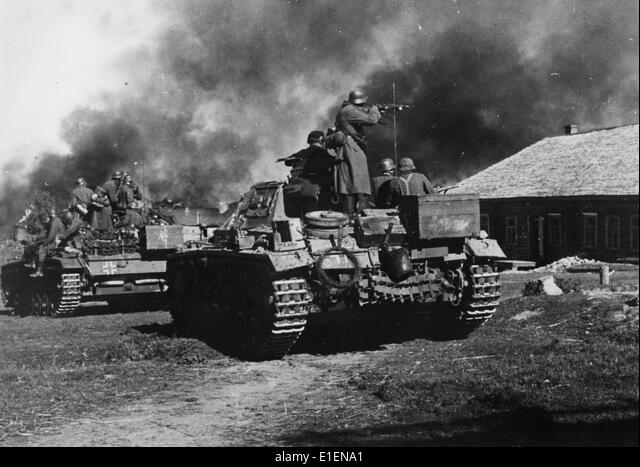
General Winter begins to assist the Soviet defense of Moscow. The German attacks suffer their own weakness, but the soft muddy ground and severe frosts at night damage machinery and weaken the soldiers further. They are not equipped with proper clothing for fighting in these conditions. Guderian’s forces near Tula make the major effort during this time. These movements make little headway. Volokolamsk further north falls to the Germans.
For the first time in this war the weather — hitherto one of Reichsführer Hitler’s most faithful allies — has turned against him with a vengeance and saved Moscow from what is described as certain Nazi conquest, according to reliable information arriving in Berlin from the Eastern Front.
Rain and Red Army strategy have turned the tide of battle west of Moscow, it was announced this morning by an authoritative commentator on the Moscow radio.
On the 128th day of the war in Russia news reached Paris from Berlin that the “desperate resistance of the Reds calls for maximum efforts on the part of the German armies.”
Aleksandr Vasilevsky was promoted to the rank of lieutenant general.
The Soviet Military Collegium evacuated Moscow, Russia for Chkalov (now Orenburg), Russia.
It is no secret that Joseph Stalin is a very hard man. No matter how you phrase that description, it can’t quite capture the reality, so let’s just leave it at that and let some of the facts speak for themselves. On 28 October 1941, Stalin demonstrates once again just how severe his methods can be. As usual, Stalin uses his chief henchman, Lavrentiy Beria, to rid him of underlings who have failed at their tasks. Whether these tasks were ever achievable in the first place is not the issue — men have failed, and they must die. That is how it is in the Soviet Union, and everybody knows it. Or, Stalin may just not like someone. That’s how it rolls.
Six (former) top Soviets leaders perish today at the hands of Beria’s NKVD (actually, Beria also executes about 15 others, but most of them are simply nondescript minions). Their names are Smuschkevich, Shtern, Rychagov, Loktionov, Savchenko, and Proskurov, and the one thing that they have in common is that they are accused of treason. Now, treason in the Soviet Union is sort of a catch-all crime. It is not like in the West, where “treason” is understood to be an attempt to overthrow the legitimate government. In fact, none of the six men appear to have done anything of the sort. What exactly they did varies, but the only common denominator seems to be that it displeased Stalin. That is sufficient for execution in the Soviet Union in 1941.
General Yakov Vladimirovich Smushkevich earned the title Hero of the Soviet Union during the Spanish Civil War. That is the highest award in the USSR, akin to the United States Medal of Honor. Smushkevich followed up his Spanish Civil War heroics with the successful command of aviation for the 1st Army Corps at the Battle of Khalkhin Gol, one of the most significant military victories of the 20th Century (it convinced the Japanese to attack south instead of north into the Soviet Union). For this, Smushkevich earned the award of Hero of the Soviet Union — again. This guy, this Smushkevich, is like Audie Murphy and Sergeant York rolled into one man. Due to his past success, Smushkevich has been promoted to commander of the entire Soviet Air Force from 1939 to 1940, and then Deputy Chief of the General Staff (Stavka) from 1940 to 1941. However, for unknown reasons, Stalin has Beria arrest Smushkevich on 8 June 1941, two weeks before the outbreak of Operation Barbarossa. The reason that Smushkevich’s “crime” is unknown is that there is no trial — not even a show trial, as was common practice in the 1930s. It appears that Smushkevich was found guilty due to a Politburo inquiry in April-May 1941 into a high accident rate in the Red Air Force. In addition, a Luftwaffe Junkers Ju 52 lands in Moscow in May, undetected by the Soviet air defenses (ADF). Beria has his men execute Smushkevich on 28 October 1941 at Kuybyshev. Yakov Smushkevich is only 39.
Pavel Rychagov suffers a similar fate. He is arrested on 24 June 1941. Rychagov is another hero of the Spanish Civil War, a biplane fighter ace, who in 1940 is appointed to Head of the Red Army Air Force Administration and the Red Army Chief Military Council (predecessor to the Stavka). He follows Smushkevich into command of the Soviet Air Forces (VVS) on 28 August 1940, a position he holds until Operation Barbarossa. As with Smushkevich, it is unclear what Rychagov’s crime is aside from the same general problems with the Red Air Force. In any event, Rychagov not only is arrested and held without trial, but he also is tortured — which is not particularly significant, because Stalin sometimes does that to his friends, too, who often are later restored to high ranks. However, Lieutenant General Rychagov does not earn a reprieve, and he is executed alongside Smushkevich. However, Rychagov does not die alone — his wife is executed alongside him. Yes, that Stalin, nice guy.
Amidst the tens of millions of lives lost during World War II, it is easy to dismiss a relative handful of deaths at the hands of a dictator, names of people you will never know and never personally care about. However, some did not forget. Rychagov was exonerated posthumously in 1954, during the general cleansing of some of the sins of the Stalinist era. A fat lot of good that did him, and others have been rehabilitated as well, but it just shows the sheer arbitrariness of life and death in the Soviet Union during the chaotic days of 1941.
34,000 more Jews were massacred in Kiev, Ukraine.
Kaunas (Kovno), Lithuania: By order of the Nazis, the entire population of the ghetto, some 27,000 Jews, assembled in the main square at daybreak this morning. The SS commander, Rauca, stood on a hillock, his dog by his feet. Eating sandwiches and drinking coffee, he pointed the way for each one with his finger. He sent the younger and healthier people to the left. Young children, the old and the sick went to the right. To the left meant life, albeit in slavery; to the right, death. It is thought that some 10,000 Jews were thus condemned to die.
Axis forces rehearsed for the planned assault on the besieged city of Tobruk, Libya.
Mussolini declares that the “coalition of Bolshevism and its European and American Allies” will be destroyed.
RAF Bomber Command, Night of 28/29 October 1941
Minor Operations
17 Wellingtons and 7 Whitleys to Cherbourg but only 13 reached the target. 10 Stirlings to the Škoda works at Pilsen in Czechoslavakia but none reached the target; 8 bombed places in Germany. 2 O.T.U. sorties. No losses in any operation.
U-68, commanded by Korvettenkapitän Karl-Friedrich Merten, sank British steamer Hazelside (5297grt) at 23-10S, 1-36E. At 0343 hours on 28 Oct 1941 the unescorted Hazelside (Master Charles Knight Evans) was torpedoed by U-68 about 600 miles southeast of St. Helena. At 0401 hours, the vessel was sunk by a coup de grâce. Two crew members were lost. The master, 37 crew members and six gunners were picked up by the Malayan Prince and landed at Capetown. The master, Charles Knight Evans, was awarded the Lloyds War Medal for bravery at sea. The 5,297 ton Hazelside was carrying general cargo, including military stores and was bound for Alexandria, Egypt.
U-432, commanded by Oberleutnant zur See Heinz-Otto Schultze, sank British steamer Ulea (1574grt) from convoy HG.75 in 41-17N, 21-40W. At 0508 and 0509 hours on 28 Oct 1941, U-432 fired a spread of two bow and one stern torpedoes at the convoy HG.75 east.northeast of the Azores and observed hits on two ships, one of them sinking by the stern after about 4 minutes. However, the only ship hit in the attack was Ulea (Master Frederick Osborn Ambrose). The master, twelve crew members, three gunners and three passengers were lost. Four crew members and one gunner were picked up by HMS La Malouine (K 46) (T/Lt V.D.H. Bidwell, RNR) and two crew members by HMS Bluebell (K 80) (LtCdr R.E. Sherwood, RNR) and landed at Liverpool. The 1,574 ton Ulea was carrying copper pyrites and was bound for Clyde, United Kingdom.
U-106, commanded by Oberleutnant zur See Hermann Rasch, sank British steamer King Malcolm (5120grt) in 47-40N, 51-50W. At 0719 hours on 28 Oct 1941 the King Malcolm (Master James Wilson) was hit by one of two torpedoes from U-106 and sank within three minutes southeast of St. Johns. The ship had been in convoy SC.50, but straggled and was last seen on 21 October in 47°40N/51°15W. The master, 33 crew members and four gunners were lost. The 5,120 ton King Malcolm was carrying potash and was bound for Garston, England.
Minesweepers HMS Harrier and HMS Britomart departed Scapa Flow at 1200 for Grimsby and Hartlepool, respectively, for refitting. Minesweeper Harrier arrived in the Humber at 1935/29th. Minesweeper Britomart arrived at Hartlepool at 1300/30th, having put into the Tyne to shelter from bad weather en route.
Submarine HMS Sealion departed Scapa Flow for Murmansk.
Submarine HMS P.35 departed Scapa Flow for Dundee.
German auxiliary patrol vessel Vp.309 (trawler Martin Donand (367grt) was lost south of Libau on a mine.
Submarine HMS Rorqual departed Gibraltar for Holy Loch, where she arrived on 4 November.
Polish submarine ORP Sokol unsuccessfully attacked Italian steamer Citta di Palermo (5413grt) in 40-42N, 13-47E.
Submarine HMS Thrasher sank Italian steamer Esperia (384grt) by gunfire northeast off Benghazi.
Destroyer HMS Gurkha and Dutch destroyer HNLMS Isaac Sweers departed Gibraltar to meet arriving convoy OS.9G.
Midshipman P. A. Brown RNVR, and Sub Lt F. A. J. Smith RNVR, were killed when their Albacore of 828 Squadron frialed to return to Hal Far after an attack on Comiso airfield by seven Albacores of 828 Squadron.
Submarine HMS Urge arrived at Malta from patrol off Kuriat.
Submarine HMS Ursula arrived at Malta from patrol off Calabria.
Light cruiser HMS Caradoc was refitting at the New York Navy Yard from 28 October to 26 February 1942.
Convoy ON.31 departed Liverpool, escorted by corvettes HMS Celandine and HMS Heartsease and anti-submarine trawlers HMS Angle and HMS St. Apollo. On the 20th destroyers HMS Amazon and HMS Georgetown, corvettes HMS Renoncule, HMS Roselys, and HMS Sunflower, naval trawler HMS Inchkeith, and anti-submarine trawler HMS Cape Warwick joined. Trawlers Cape Warwick and Inchkeith were detached on 2 November. The remainder of the escort was detached on 4 November when American destroyers USS Bainbridge, USS Overton, USS Roe, USS Sturtevant, and USS Truxton joined. The American destroyers were detached on 15 November when the convoy was dispersed.
Convoy OG.76 departed Liverpool on the 28th, escorted by destroyer HMS Bradford, sloop HMS Deptford, and corvettes HMS Convolvulus, HMS Cowslip, HMS Marigold, HMS Pentstemon, HMS Samphire, and HMS Vetch. The convoy was joined on the 29th by escort aircraft carrier HMS Audacity, which had departed the Clyde. The convoy was joined on the 31st by corvette HMS Rhododendron and on 9 November by destroyers HMS Vidette and HMS Wishart, which departed Gibraltar on 8 November. The convoy arrived at Gibraltar on 11 November. The aircraft carrier was detached on 11 November and arrived at Gibraltar for repairs from 12 November to 13 December.
Ex U.S. cargo ships transferred to the United Kingdom Empire Pintail (7773grt), Empire Egret (7248grt), Empire Fulmar (7775grt), Empire Widgeon (6736grt), Empire Peregrine (7842grt), and Empire Oriole (6551grt) departed Halifax. The convoy was escorted by U.S. battleship USS New Mexico, aircraft carrier USS Yorktown, light cruisers USS Philadelphia and USS Savannah, and destroyers USS Morris, USS Hughes, USS Sims, USS Hammann, USS Anderson, USS Mustin, and USS Russell of the 2nd Destroyer Squadron. On 2 November, the convoy met convoy CT.5 with steamers Duchess of Atholl, Sobieski, Orcades, Warwick Castle, Andes, Durban Castle, Oronsay, and Reina Del Pacifico, escorted by anti-aircraft cruiser HMS Cairo and destroyers HMS Newark, HMS Charleston, HMS Caldwell, HMS Beverley, HMS Badsworth, and HMS Croome. The escorts traded convoys and the U.S. escort took convoy CT.5 towards Halifax. The British escort took the convoy, designated Tango, and proceeded to North Channel. On 3 November, American destroyers USS Wainwright, USS Mayrant, USS Trippe, USS Rhind, USS Rowan, USS McDougal, USS Moffett, and USS Winslow relieved the U.S. destroyer escort for refueling. The convoy arrived at Halifax on 7 November and the troops carried in convoy CT.5 were transferred to U.S. transports for convoy WS.12X.
Convoy HX.157 departed Halifax escorted by destroyer HMCS Annapolis and corvettes HMCS Buctouche and HMCS Galt. American destroyers USS Dallas, USS Eberle, USS Ellis, USS Ericsson, and USS Upshur joined on the 30th. On 3 November, the original escort was detached. Destroyer Amazon joined 6 November. The American escort was detached on 8 November when relieved by destroyers HMS Belmont and HMS Georgetown and corvettes HMS Heartsease, HMS Renoncule, and HMS Roselys, and anti-submarine trawlers HMS Angle and HMS Cape Warwick. Destroyer HMS Douglas joined on 9 November. Destroyers Belmont and Georgetown were detached on 11 November and destroyers Amazon and Douglas on 12 November. The convoy arrived at Liverpool on 13 November.
In Washington this day, President Roosevelt signed the $5,985,000,000 lend-lease bill and in an executive order established the Office of Lease-Lend Administration, naming E. R. Stettinius Jr. as administrator. He designated November 11 as Armistice Day, nominated Brigadier Generals Charles B. Price and Philip H. Torrey to be Marine Corps major generals, entertained the Duke and Duchess of Windsor at luncheon, received Sumner Welles, Under-Secretary of State, and Governor Broughton of North Carolina, and held the usual Tuesday press conference.
The Senate debated Neutrality Act amendments, heard Senator Byrd urge government action against defense strikers, completed Congressional action on a bill permitting the Housing Administration to refund some bonds, confirmed Representative J. Joseph Smith as a Federal judge in Connecticut, received the Bailey amendment to the Neutrality Law to broaden the definition of sabotage to include defense work stoppages and recessed at 4:20 PM until noon tomorrow. The Interstate Commerce Committee approved the nomination of Clifford J. Durr to the FCC and approved a subcommittee’s recommendation for a merger of the telegraph companies. The defense investigating committee continued hearings on labor policies in the defense program. The Education and Labor subcommittee heard opposition to the anti-child labor amendment.
The House was in recess. The Banking and Currency Committee considered price control legislation. The committee investigating migratory labor heard Alex Taub and Donald M. Nelson. The Interstate Commerce Committee opened hearings on amendments to the Securities Acts.
President Franklin D. Roosevelt signs the appropriation bill passed by Congress for an additional US$6 billion (US$77 billion in 2004 dollars) in Lend-Lease aid to U.K. and the U.S.S.R. President Roosevelt signed a new lend-lease fund of $5,985,000,000 today and let It be known he considered it evidence of America’s determination “to pull our own oar in the destruction of Hitlerism,” as he said in a Navy Day address. The bill provided $176,000,000 additional for other defense activities. It brought the total of lend-lease appropriations to $12,985,000,000.
President Roosevelt, whose thrice-voiced plea to John L. Lewis has failed to end a strike of 53,000 C.I.O. coal miners, said today that he was considering new legislation to cope with defense strikes in general. There have been suggestions that persons conducting strikes with “intent” to slow defense production be punished as saboteurs. A reporter asked Mr. Roosevelt whether he was considering a law calling for compulsory arbitration and suspension of the right to strike on defense work. If the query were confined to general terms, and omitted specific methods, the answer would be in the affirmative, the chief executive replied.
On the heels of John L. Lewis’s refusal to heed President Roosevelt’s three requests to keep the “captive” coal mines working on fuel for national defense steel, the storm aroused in Congress beat higher today with suggestions and plans for drastic anti-strike legislation for the defense industries. An anti-sabotage amendment to the Neutrality Act was designed by its author, Senator Bailey, to deal with situations like the “captive” mine strike. A bill modeled after the Railway Labor Act probably will be offered in the Senate tomorrow. This measure would provide for maintenance of status quo cooling-off periods in disputes between employees and employers in defense industries, pending certain procedures, including joint conferences, mediation, voluntary arbitration and fact-finding by an emergency board. The Vinson bill, which also provides a “cooling off” arrangement, but which has more drastic provisions than the companion bill to be offered in the Senate, is likely to be taken off the calendar as soon as the House reconvenes. Whether this bill will be backed by the Administration was not revealed, but it will be offered by a New Deal Senator.
The National Defense Mediation Board made public tonight telegrams from three steel companies involved in the captive mine strike, accepting the board’s suggestions for settling the dispute between the companies and the United Mine Workers (C. I. O.). Chairman William H. Davis of the Mediation Board said that the United States Steel Corporation, the Wheeling Steel Corporation and the Weirton Steel Company had informed the board they would accept its recommendations, which John L. Lewis has rejected. Irving S. Olds, chairman of the board of directors of United States Steel, wired Mr. Davis that his corporation would accept the board’s first plan, which provided for a hearing before the full Mediation Board of eleven members.
In a telegram sent yesterday to President Roosevelt, Richard T. Frankensteen, national director of aviation for the United Automobile Workers, C.I.O., threatened to use his union’s “large-scale economic strength” to force settlement of the labor conflict at Air Associates, Inc., at Bendix, New Jersey. Spokesmen for the union made it clear that this “economic strength” meant a general stoppage by C.I.O. workers of all kinds in New England, New York, New Jersey and Pennsylvania, the C.I.O. “regional area” into which the Bendix plant falls. The exact number is uncertain, but probably no more than sixty to seventy-five workers are involved directly in the Air Associates strike. The C.I.O. claims a membership of 250,000 in the Eastern Region. Many of them are working on airplanes and other indispensable defense items. The union contention is that the officials of Air Associates have persistently refused to carry out the recommendations of the National Defense Mediation Board, which held that the two parties should bargain collectively and that strikers should be reinstated to the jobs they held without delay. The company argues that it is willing to bargain and that it stands ready to reinstate strikers to payroll status immediately, which would mean that they would receive base pay, and to their former jobs as soon as such jobs become available.
President Roosevelt said today that Nazi protestations of “fake” at his statement that he had a German map for the partition of South America were most amusing. It’s a scream, he told his press conference; it’s good. Told that German sources had said a map purporting to show how Latin America would be divided by the axis was a fake, Mr. Roosevelt said the charge was in the same class as that a week or 10 days ago that he was responsible for torpedoing the American destroyer USS Kearny. The map, Mr. Roosevelt said, came from a source which was undoubtedly reliable. There is no question about that, he said. But he declined to make public the map or a document he said described Nazi plans to suppress religions, both of which he mentioned in his Navy day speech last night.
Charges that President Roosevelt in his Navy Day speech admitted publicly that he “tricked” the American people onto the road to war were made in the Senate today by Senator Taft of Ohio as foreign policy critics regained a modicum of hope that they might narrow the measure repealing all substantial provisions of the Neutrality Act of 1939.
Senator Pepper, Florida Democrat, strongly urging revision of the neutrality law, told the senate today that if the present desperate effort to save America’s peace should fail, he knew of “nothing else to which we can resort, other than a naval war.” He spoke after Senator Taft, Ohio Republican, had charged President Roosevelt with tricking the American people and with already having done what he could to “plunge this nation into a shooting war.” This, he said, was implicit in Mr. Roosevelt’s speech of last night. It was the senate’s second day of debate upon administration proposals for revision of the neutrality law. The pending legislation would repeal sections of that act which prohibit arming American merchant ships, and forbid them to enter combat zones or belligerent ports.
An increase in the social security tax rate, in addition to the broadening of its base recently foreshadowed by President Roosevelt, has been recommended by the Treasury for White House approval and is expected to be announced soon as an anti-inflationary measure. To the same end the Treasury is seeking new tax sources, and, on this score, will ask the Supreme Court to pass on the taxability of new stock distributed as dividends. Also, the Treasury is considering, but has not yet decided to adopt, a proposal to tax the stockholders of companies on undivided profits. In addition to these measures by the Treasury, and the pending Price Control Bill, the Federal Reserve Bank is pressing for authority to increase bank-reserve requirements, but has little hope of getting the necessary legislation this year.
The House Banking and Currency Committee was reported tonight to be giving favorable consideration to a flexible wage control plan sponsored by Committee Chairman Henry B. Steagall, Alabama Democrat. His proposal was canvassed during a three-hour secret discussion of the administration’s price control bill but no definite decision was reached. Members reached an informal understanding, however, to report the bill Friday if possible. The fact that Steagall is sponsoring the plan was regarded as an indication that the administration is yielding in its heretofore adamant opposition to any wage-pegging.
The motion picture “How Green Was My Valley” premieres at the Rivoli Theater in New York City. Directed by John Ford, this drama about Welsh coal miners, based on the Richard Llewellyn novel, stars Walter Pidgeon, Maureen O’Hara, Donald Crisp, Roddy McDowall, Barry Fitzgerald, Patrick Knowles and Arthur Shields. The film is nominated for ten Academy Awards and is awarded five: Best Actor in a Supporting Role (Crisp); Best Director (Ford) and Best Picture. Although nominated for Best Actress in a Supporting Role, Allgood loses to Mary Astor in “The Great Lie.”
Zang Shiyi signed a document in Nanjing, China that formally recognized Manchukuo’s recognition of fellow Japanese-sponsored puppet state in the formal Chinese capital.
President Roosevelt’s Navy Day speech was received by headlines in the Japanese press as “the declaration of a shooting war against Germany.” But the press also notes that while the President again pledged continued aid to China and Russia he omitted any mention of American-Japanese relations and gave no hint identifying him with Navy Secretary Frank Knox’s “strong, surprising statement about the inevitability of a clash in the Pacific.”
Dow Jones Industrial Average: 119.6 (+0.17)
Born:
John Hallam, actor, in Lisburn, Northern Ireland (d. 2006).
Hank Marvin, guitarist for The Shadows, in Newcastle upon Tyne, England, United Kingdom.
Curtis Lee, American singer (“Pretty Little Angel Eyes”), in Yuma, Arizona (d. 2015).
Jochen Hasenmayer, speleologist and cave diver, in Pforzheim, Germany.
Naval Construction:
The Royal Navy Fairmile B-class motor launch HMS ML 397 is laid down by Le Blanc Shipbuilding (Weymouth, Canada).
The U.S. Navy SC-497-class (110-foot wooden hull) submarine chaser USS PC-641 (later SC-641) is laid down by the Elizabeth City Shipyard (Elizabeth City, North Carolina, U.S.A.).
The U.S. Navy SC-497-class (110-foot wooden hull) submarine chaser USS PC-642 (later SC-642) is laid down by the Peterson Boat Works (Sturgeon Bay, Wisconsin, U.S.A.).
The Royal Canadian Navy Bangor-class (VTE Reciprocating-engined) minesweeper HMCS Westmount (J 318) is laid down by the Davie Shipbuilding and Repairing Co. Ltd. (Lauzon, Quebec, Canada).
The Royal Navy Bangor-class (Turbine-engined) minesweeper HMS Hartepool (J 155) is laid down by the Blyth Shipbuilding & Drydock Co. Ltd. (Blyth, U.K.); completed by Whites M.E. She is transferred to the Royal Indian Navy before completion as commissions as the HMIS Kathiawar (J 155).
The Kriegsmarine (German Navy) Type VIIC U-boat U-341 is laid down by Nordseewerke, Emden (werk 213).
The Kriegsmarine (German Navy) Type IXC/40 U-boat U-527 is laid down by Deutsche Werft AG, Hamburg (werk 342).
The U.S. Navy 77-foot Elco patrol motor torpedo boat USS PT-64 is launched by the Electric Launch Company Ltd. (Elco), (Bayonne, New Jersey, U.S.A.).
The Kriegsmarine (German Navy) Type VIIC U-boat U-256 is launched by Bremer Vulkan-Vegesacker Werft, Bremen-Vegesack (werk 21).
The Royal Canadian Navy Fairmile B-class motor launch HMCS ML 057 is commissioned.
The U.S. Navy Aloe-class net tender USS Hackberry (YN-20; later AN-25) is commissioned. Her first commanding officer is Lieutenant Clarence Byron Wegner, USN.
The U.S. Navy Aloe-class net tender USS Mimosa (YN-21; later AN-26) is placed in service. Her first commanding officer is Lieutenant William Lester Freeburn, USNR.
.
.
.
40 Days to Pearl.

