The 20th anniversary of the Hungarian rebellion, in which more than 20,000 people died, is passing without a murmur, seemingly all but forgotten. New cars made within the Soviet bloc jam the old squares and streets of Budapest where, two decades ago, young Hungarians armed with gasoline bombs fought an unequal battle against Soviet tanks. With the approach of October 23, last Saturday, the anniversary of the beginning of the Hungarian uprising, there were some reports of official uneasiness. The police were said to have been somewhat more alert than usual for troublemakers. Now, as 20 years ago, the Soviet Army is still in Hungary, and on October 18 Soviet and Hungarian troops began joint maneuvers. The beginning of the exercise on that date might or might not have been related to the anniversary.
A 26-year-old Czech hijacked an Ilyushin-18 of the Czech National Airline and forced it to fly to Munich, where he gave himself up, Bavarian police said. The hijacker, Rudolf Becvar, took over the plane carrying 105 passengers and a crew of eight while it was on a domestic flight and forced it to fly across the border to West Germany. After landing at the Munich airfield, he released the passengers and crew and surrendered his pistol. Police said the hijacker said he wanted to flee to the West.
Falling birthrates and unforeseen deaths from hunger have slowed global population growth to the point where a doubling of the world’s population by the year 2000 is no longer expected, according to the Worldwatch Research Institute. Population growth has decreased in rich and poor countries alike, reversing for the first time in history a trend of gradually accelerating growth, the study says. The Worldwatch Research Institute, which studies environment‐related problems in the world is based in Washington and is financed in part by the United Nations. Dr. Lester Brown, an agricultural economist who heads the institute, said in the report released here today that the decline in population growth reflected more than anything else the widening availability of family‐planning services and a growing desire to use them.
Spanish riot police firing tear gas and using clubs clashed in Madrid with demonstrators demanding amnesty for workers fired during labor disputes. Several hundred protesters, most of them youths, blocked streets with cars and benches before riot police moved in. Several youths were arrested. Earlier police fired rubber bullets and smoke bombs to disperse a group of bus drivers whose strike for more pay stranded about a million commuters and shut down schools.
Socialist and Communist members of the Paris City Council boycotted a reception today for King Juan Carlos of Spain at the city hall. Leaders of the two parties in the National Assembly published an open letter to the King, who is on the second day of a state visit to France, demanding an amnesty for political prisoners in Spain. While French security precautions forestalled any incidents close to the King, a bomb shattered the windows of the headquarters of Interpol, the international police organization, here early today. An anonymous telephone caller told the newspaper France‐Soir that a group of Spanish “deportees” was responsible for the blast. He said that Interpol “must pay” for backing the struggle against opponents of the Spanish Government.
Three youths murdered Maire Drumm, an Irish Republican Army political organizer, in a hospital ward. Belfast police reported. They said the youths, apparently disguised as medical staff, shot Mrs. Drumm as she lay in bed. She was a former vice president of the Sinn Fein, the political arm of the IRA’s Provisional wing.
Palestinian forces began to move southward today from two fronts in central Lebanon where they had been fighting the Syrian Army. The Palestinian movement in the direction of the Israeli border was in accordance with decisions made by Arab leaders in Cairo this week and in Saudi Arabia 30 days earlier. The movement of the guerrillas toward the Israeli border could have a major impact on the Middle East conflict. Israel is on record that it will never permit the guerrillas to return to the border region, which before the Lebanese Civil war served as a base and staging area for raids across the border. Lebanese right‐wing Christian forces, using weapons supplied to them by Israel, have been creating a military security zone along the burden Christian commanders have told reporters that the purpose was to keep the Palestinian guerrillas out of the region. Yesterday and today, large numbers of Palestinian guerrillas were seen arriving in Bint Jbail, three miles from the Israeli border. Bint Jbail is inhabited by members of the Shiite Muslim sect. it is the only major town in that part of the border region that the right‐wing Christians have not been able to take. The Palestinian reinforcements in Bint Jbail included not only men of Al Fatah, the main guerrilla organization but also of the radical group headed by George Habash, who rejects all thought of a negotiated settlement of the Arab‐Israeli conflict. The continuing cooperation of the two groups in the south was considered significant.
Israeli officials are carefully analyzing reports from Lebanon of an improvement in relations between two foes, Syria and the Palestine Liberation Organization, as well as reports of a buildup of Palestinian forces in southern Lebanon close to northern Israel. So far there has been no agreement here, at least in public, as to what the rapidly changing developments in Lebanon mean for Israel, which has a winding 80‐mile fenced border with Lebanon. Foreign Ministry officials said today they did not think that a movement of Palestinian guerrillas to southern Lebanon constituted a “mass movement” at this time but that developments there were under constant scrutiny. “We are not aware of a significant movement of the P.L.O. to be alarmed over at the moment,” one official said.
UNESCO attempted today to defuse a long‐standing dispute among its members over Israeli regional participation. The director general of the 140‐nation organization, Ahmadou‐Mahtar M’Bow, suggested that it should allow each of the body’s regional groupings to decide whether a country should be allowed membership in the group. At the previous conference of the United Nations Educational, Scientific and Cultural Organization, in Paris in 1974, Israel’s application to join the European group was rejected after bitter attacks by Arab, Communist and third world countries. This led the United States to withhold its contributions, and today it owes UNESCO about $38 million. If a decision on Israel’s membership is left to the European group, it is believed that the country’s application might be accepted.
The first democratic elections in Egypt in almost 25 years began with 1,660 candidates competing for the 347 seats in the People’s Assembly, although candidates still had to be approved by the government. Runoff elections were held on November 4 for those races where no candidate received a majority of the vote. There is little doubt among Egyptian political analysts that the Assembly will be dominated by representatives favorable to the policies of President Anwar el‐Sadat. Mr. Sadat has made it clear that today’s voting does not mean a giant step toward Western style democracy. But the President, who won another six‐year term almost unanimously in a one‐candidate plebiscite last month, is letting a little air into the tightly controlled system that supports him.
The Soviet Union announced today that Iran had returned a Soviet pilot who flew a light plane across the border last month in search of political asylum. The announcement, by the Soviet press agency, Tass, said that the pilot, Lieutenant Valentin I. Zasimov, was extradited Monday under an antihijacking agreement signed by the two countries in August 1973. it said the plane would also be returned. The report came a day after the Nobel Peace Prize winner, Andrei D. Sakharov, land four other Soviet dissidents issued a statement appealing to the Shah of Iran not to return the pilot. “He did not use violence, he did not put anybody’s life at risk but his own,” the statement said, “and in our opinion his action could not possibly be classified as air piracy.”
By an overwhelming vote, the lower house of India’s Parliament gave preliminary approval to a wide-ranging bill to change the nation’s constitution. Most major opposition parties boycotted the session to protest the detention of 30 members under emergency laws. After the vote, the house began a point-by-point debate of the bill. About 600 amendments to the government’s bill have been offered, including one to extend the life of Parliament from five to seven years.
Widespread allegations that Korean intelligence agents and other Koreans have been harassing and coercing and violating the civil rights of Korean aliens residing in the United States and of Korean-Americans are being investigated, federal authorities disclosed. Officials said that the investigation is separate from the inquiry into alleged South Korean efforts to bribe members of Congress.
Although China has given no hint since the death of Mao Zedong that it is ready to improve relations with the Soviet Union, the Russians seem still in a waiting, watching mood suspending polemics in the press and probing for positive responses from the Chinese leadership. The latest Soviet probe, rejected today by Peking, was a brief message from Leonid I. Brezhnev, the Soviet party leader, to Hua Kuo‐feng on his appointment as party Chairman, Mr. Brezhnev addressed Mr. Hua as “Comrade.” A Foreign Ministry spokesman in Peking said this message and others from Soviet‐bloc parties had been returned because “we have no party‐to‐party relations with them.” The same reason was given last month for the rejection of party messages of condolence on Mao’s death. The next clue to Chinese attitudes is likely to be found in Peking’s annual message on the anniversary of the Bolshevik Revolution on November 7. if the greeting is either frostier or warmer than normal, it may indicate a slight change of course. Neither Western analysts nor Soviet officials who talk to Westerners expect any quick reduction of hostility.
The sale to China of a computer system with both military and industrial capability has been approved by President Ford. High administration officials said that, in approving the sale, Mr. Ford was waiving established safeguards on the advice of Secretary of State Kissinger as a gesture to China’s new leaders. Some officials had objected to the sale on the ground that the computer can be used to make calculations on nuclear tests.
Japanese police mobilized 12,100 officers for a nationwide sweep against illegal gang activities, arresting 1,573 persons and confiscating 307 illegal pistols and rifles. The arrests involved charges of blackmail, intimidation, gambling and possession of illegal weapons, police said. Officers confiscated 2,530 knives, swords and wooden clubs.
High winds and blowing snow delayed rescuers in snowmobiles trying to reach 12 members of an Eskimo caribou hunting party whose battered boat was stuck between ice floes in Queen Maud Gulf in the Arctic Circle more than 1.200 miles north of Winnipeg, Manitoba. Three members of the group are women and eight are children, two of them less than 2 years old. Food was dropped to them from an airplane earlier. The rescue party is making a 100-mile trek from the Northwest Territories outpost of Gjoa Haven to reach the stranded group.
Ten men identified as leftist guerrillas died and two members of Argentina’s military police security forces were seriously wounded in a shoot-out in La Plata, 40 miles south of Buenos Aires, the army announced. The guerrillas were “presumably responsible” for a terrorist assault earlier in the week on the home of a university rector in which two guards were killed, the announcement said.
Ebola, a hemorrhagic fever that has killed 335 people in Africa, is the most dangerous virus disease discovered in the world in more than 25 years, immunologists in Brussels said. No serum for the virus exists, and the epidemic has not spread more widely only because infected persons simply died before they could communicate it over a wider distance, Dr. Maurice Kivits, a Belgian specialist said.
The Geneva conference on Rhodesia got off to a delayed start today after last‐minute negotiations by the British diplomat Ivor Richard averted a possible boycott by two powerful black nationalist groups that are anxious that Britain play a more assertive role in the talks. The conference finally opened at 5:35 PM, more than two and a half hours late. it was a solemn moment for both Prime Minister Ian D. Smith of Rhodesia and the leaders of the four black nationalist groups, who have acknowledged that the talks may present the last opportunity for agreement on a peaceful transfer of power from Rhodesia’s 270,000 whites to its 6 million blacks. For the Western powers, concerned over growing Soviet influence in southern Africa, the gathering in the ornate council chamber of the Palais des Nations had major diplomatic implications. The conference, the seventh major effort to resolve the governmental dispute since Rhodesia broke away from Britain in 1965 could also represent the final chance to promote a biracial democracy in the former colony.
The white-minority government of South Africa lifted its ban against Ebony magazine, the monthly U.S. periodical for African-Americans.
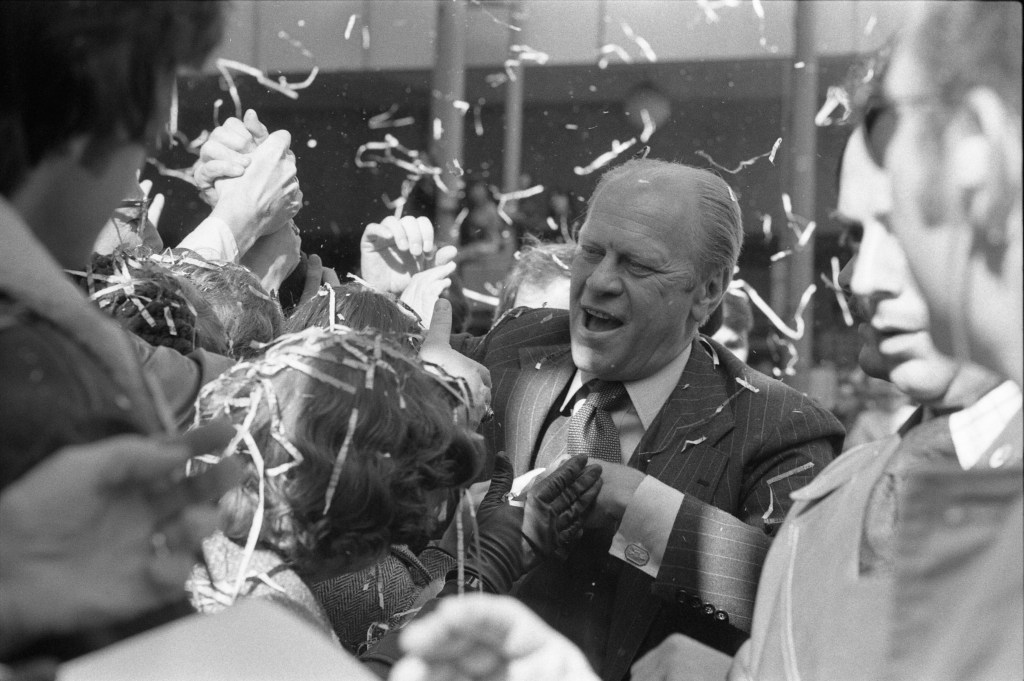
President Ford, campaigning in Indiana and Ohio, pledged to make a new federal income tax cut “the number one priority in the next Ford administration.” Mr. Ford, who met large and friendly crowds, said that the basic issue of the campaign was economic policy. Jimmy Carter’s sharp drop in voter surveys, the President said, was the result of his reliance on a formula of more promises, more programs and more spending.
The possibility of tax cuts was suggested by Jimmy Carter if he is elected, but then he indicated it should not be interpreted as a firm pledge. The Democratic presidential candidate campaigned in Pittsburgh and Erie, Pennsylvania, and in Cleveland and then made his second visit in two days to New York.
Jimmy Carter’s campaign for the Democratic presidential nomination was sometimes called “brilliant,” but his fall campaign against President Ford has been less sure-footed and his standing in the polls has dropped precipitously. Mr. Carter’s slippage has been attributed to many factors, including what some regard as intemperate attacks on Mr. Ford and in distractions that diverted attention from his major themes and that at times were frivolous and made him appear to be losing control of events.
President Ford today formally announced a broad new Government program to prevent nuclear materials intended for peaceful purposes from being used for atomic weapons, and Jimmy Carter, the Democratic nominee for President, charged it was “too little and too late.”
More money on campaign television advertising has been spent by the President Ford Committee than for any previous national candidate and more will be spent. By October 18, the campaign had cost $9.9 million, and a campaign official estimated that the eventual total would be $12 million.
More than five million Americans have received swine flu shots, and the national immunization program “is picking up steam” despite some lingering fears, Federal, health officials said today. Immunization clinics are open to the general public in most states after three weeks of concentrating shots on the elderly and the chronically ill, persons considered to have a high risk of catching swine flu. Reports of about 40 deaths, mostly among the elderly or ill, “probably scared a lot of people off,” Stafford Smith, public information officer for the Federal. Center for Disease Control, said. “We’re still optimistic the program can be completed by the end of the year,” said Mr. Smith. The goal is to vaccinate all Americans over the age of 18, “but. I’m not sure what percent we’d have to reach to call the program a success,” he said.
An elderly woman and her son died, today within 24 hours of getting swine flue shots, health authorities said. As they have said in other such instances, the authorities said there was no connection between the shots and the deaths. State Health and Welfare Commissioner Robert E. Whalen said that Lucien Blouin, 61 years old, and his mother Florentine Blouin, 82, died of congestive heart failure. Both had long histories of heart trouble and Mrs. Blouin also had high blood pressure, Mr. Whalen said.
Minority enrollment in the nation’s colleges and universities rose 11.7% between 1972 and 1974, with major strides in private schools, the U.S. Office for Civil Rights announced. The survey showed that white enrollment in public institutions actually decreased during the two years, from 3,986,450 to 3,964,292. White enrollment in private schools rose modestly from 1,405,862 to 1,448,368. Minority students represented 11.9% of the total higher education enrollment in 1972 and 13.1% in 1974. Black enrollments in private schools increased by 27.9%. Spanish-surnamed by 105.4%, Asian-Americans by 33.7% and American Indians by 6.4%.
Coast Guard investigators said a nearly empty half-pint liquor bottle was recovered from the wheelhouse of a ferry that was rammed and capsized last week, killing 78 persons. The discovery came a day after a coroner’s report showed the captain of the ferry George Prince had been drinking and would have been declared legally drunk in most states when his vessel was rammed broadside by a 664-foot Norwegian tanker. Only 18 persons survived the October 20 collision near Destrehan, Louisiana, 30 miles upriver from New Orleans. Seventy-two bodies have been recovered. The coroner reported that ferry Captain Eugene Auletta’s body contained .09% alcohol, .01% less than needed to be legally drunk in Louisiana.
A House subcommittee chairman said “it is not inconceivable” that “legionnaires’ disease” resulted from deliberate poisoning, but a medical authority cited as support for the theory said his conclusions were misinterpreted. Rep. John M. Murphy (D-New York) said “the true cause may never be known” for the outbreak in Philadelphia in July that left 29 persons dead. He added in a confidential report that Dr. William F. Sunderman Jr. of the University of Connecticut advocated a theory that nickel carbonyl could have been the toxic agent and that it “must have been introduced willfully…” Sunderman, however, said there was no conclusive evidence.
John Ehrlichman, one of the Nixon administration’s most powerful advisers, entered a federal prison camp in Arizona, even though appeals are pending. He will serve at least 30 months and no more than eight years for his roles in the White House “plumbers” operations and the Watergate cover-up. As matters now stand, Mr. Ehrlichman will serve a minimum of 30 months and no more than eight years as a result of convictions in the “plumbers” case, in which he was sentenced to 20 months to five years, and in the Watergate coverup case, in which he was sentenced to 30 months to eight years. Both sentences are to run concurrently.
A federal judge voiced skepticism about FBI claims that it is fast losing its informants because they no longer believe the FBI can keep their names secret. Referring to an affidavit by James B. Adams, deputy associate FBI director, U.S. District Judge Thomas P. Griesa remarked in New York City. “A lot of this could be scuttlebutt.” Adams submitted the affidavit as a key part of the government’s defense against a $37 billion damage suit brought by the Socialist Workers Party against the FBI. The suit has elicited evidence that the SWP was subjected to at least 92 break-ins and other harassment during a 38-year investigation of the radical Trotskyite organization. Griesa ruled that Adams must appear to testify.
A request by Wendy Yoshimura, an underground associate of Patricia Hearst, to present her own opening statement to the jury in her trial on explosives and weapons charges was denied. Alameda County Superior Judge Martin Pulich rejected the motion on grounds that Miss Yoshimura, in presenting the statement, would not be under oath and would not be subject to cross-examination. Miss Yoshimura was arrested with Miss Hearst a little more than a year ago in San Francisco. Miss Yoshimura was charged with having rented a garage in Berkeley in which weapons and explosives were being stored.
Rep. John E. Moss (D-California) chairman of a House subcommittee on oversight and investigations, recommended creation of a single federal agency to protect consumer interests, which he said have fallen victim to overlapping functions and political pressure. “The conclusions reject the notion that the agencies themselves, as presently constituted. can be counted on to represent the broad interest of the general public, particularly consumers,” he said. A section of the panel’s report recommended setting up a “consumer safety and health commission” to take over and coordinate functions of several agencies.
Candace (Candy) Mossler, the socialite who Miami Beach officials say apparently suffocated during a heavily sedated sleep, will be buried today in Arlington National Cemetery beside the wealthy husband she was acquitted of killing. Jacques Mossler was a World War I veteran. Mrs. Mossler, whose sensational murder trial in Miami drew worldwide attention in 1966, died Tuesday. She was believed to have been 62, but had said she was seven years younger.
The nation’s trade balance fell again last month as imports exceeded exports by $778.9 million, the Commerce Department announced. The deficit, widened from $757.7 million in August, brought the total trade imbalance for 1976 to $3.4 billion.
Builders of the Alaska pipeline said safety standards should be waived on 86 defective welds because they do not impair the line. E. L. Patton. head of the Alyeska Pipeline Service Co., said the defects are “only nominally, if at all, outside” the petroleum industry’s standards adopted for the project. His statement, at a Department of Transportation hearing in Washington, D.C., brought objections from environmentalists, who insisted that standards should be met.
The Justice Department has intervened in school busing case before the Supreme Court, contending that a lower court went too far when it ordered the merging of the Wilmington, Delaware, city schools and 10 suburban school districts. In a brief filed yesterday with the Supreme Court, Solicitor General Robert H. Bork argued against a May 19 decision by the Federal District Court in Wilmington that ordered the creation of a nets 80,000‐pupil school district from the current city and suburban jurisdictions. Under the District Court plan, each school in the new district would have a black enrollment of from 10 to 35 percent. Mr. Bork said that the busing involved should instead be limited to correcting specific acts of racial discrimination by local officials.
The New York State senatorial campaign, which began on a low key, has increasingly become a hard-fought contest involving bitter charges. Daniel Patrick Moynihan, the Democratic-Liberal challenger, charged that the record of Senator James Buckley was “so consistently uncaring, so consistently arrogant toward us that if it did not exist it would be impossible to invent it.”
Senator Buckley, campaigning hard in Harlem, won pledges of support amid expressions of coolness of traditionally Democratic black voters to Mr. Moynihan.
The trend of lower interest rates continued as the Continental Illinois National Bank and Trust Company said it would trim its prime lending rate to 6½ percent from 6¾ percent, effective at once. Continental is the nation’s seventh largest bank with assets of more than $22 billion. There were no immediate followers, and officials of several large New York banks said they would resist a new cut in prime rates.
Stock prices eased after two sessions of active advances. The Dow Jones industrial average, reflecting narrow changes throughout the trading day, dipped 3.49 points to close at 952.63. The credit markets, in a lackluster day, moved up and down in narrow ranges several times and closed with small gains. In the two preceding sessions, the Dow rose more than 18 points in a recovery touched off mainly by hopes that oil prices would be increased by only a modest amount in December when Middle East oil‐producing nations make their decision.
Dow Jones Industrial Average: 952.63 (-3.49, -0.37%)
Born:
Karl Tremblay, Canadian folk-rock singer (Les Cowboys Fringants), in Montreal, Quebec, Canada (d. 2023).
Xia Yu, Chinese film actor; in Qingdao, Shandong province.
Died:
Máire Drumm, 57, former vice president for the Northern Ireland branch of Sinn Féin, was shot to death by Ulster Defense Regiment terrorists in Belfast while she was laying in bed in the Mater Infirmorum Hospital. She was recovering in bed in the Roman Catholic hospital in the capital of Northern Ireland, three weeks after having had eye surgery.
Cherukad Govinda Pisharodi, 62, Indian Malayalam language novelist and playwright.
Aarne Juutilainen, 72, Finnish military officer and hero of the Battle of Kollaa during the Talvisota, the war between Finland and the Soviet Union.

