Masha
The weather continues to be terrible all along the central section of the Eastern Front on 26 October 1941. There is still heavy fighting, but the Wehrmacht’s vehicles are struggling in the Rasputitsa mud. In addition, the Red Army defenders are fighting ferociously, so the German infantry has trouble advancing without the support of the armor. The Wehrmacht’s trucks are virtually immobile, and even the panzers have difficulty because their treads are not as wide as the Soviet tanks’ treads. The Germans are hardly on the defensive, but in many areas, they are able to make at most only small advances.
One area where the Germans make good progress is on the southern axis of the Operation Typhoon advance on Moscow. There, General Guderian’s 2nd Panzer Army broke through the Soviet defenses at Mtsensk on the 24th by combing all of the army’s panzers into one brigade and smashing through the defenses. Guderian’s momentum continues today on the good road running north to Moscow. By the end of 26 October 1941, Guderian’s panzers are halfway to Tula. The distance covered is an impressive 70 km advance in only a few days, possible largely because the Soviets have been focused n the western approaches and have not extended the Mozhaysk defensive line this far south. The Stavka now has remedied that oversight with Guderian about 200 km from the center of Moscow, and the panzers are forced to halt due to stiffening Red Army resistance from 50th Army and civilian volunteers. The Kremlin places Tula under a state of siege, which means the NKVD has carte blanche to stiffen the defenders’ resolve using any means necessary — and Lavrentiy Beria has a lot of persuasive means at his disposal and an active imagination. By sheer force of will, inventiveness, and the timely concentration of his panzers, Guderian has created a threat to Moscow from the south. This has forced the Soviets to stretch out their defenses — a victory far more important than just the ground his forces have gained.
The other major offensive on the northern portion of the main front is a Wehrmacht thrust toward Tikhvin. Tikhvin itself is not that significant as a city but is important to capture for several reasons. It sits astride the only remaining rail and road routes from Moscow to Leningrad (via Lake Ladoga), so if Tikhvin falls and the Germans can hold it, Leningrad is doomed. Pushing east above Moscow also offers the possibility of a deep encirclement of Moscow, which would doom it. The Germans also could head north from Tikhvin and link up with the Finns on the Svir River. Finally, Hitler himself has picked Tikhvin as the next Army Group North objective over the plans of his generals (who prefer the closer Volkhov), so its capture is a matter of prestige — always a major factor in the Wehrmacht.
Given its sudden importance, the Red Army is shifting forces to protect Tikhvin and adjusting the commands in the area. General Fedyuninsky is a protege of Stalin’s favorite general, Georgy Zhukov, so he is switched from command of the relatively dormant Leningrad front to command of the 54th Army which is directly defending Tikhvin. The commander of that army, General Mikhail Khozin, replaces Fedyuninsky in Leningrad. While at first glance this appears to be a demotion for Fedyuninsky, he is being moved to a sector in crisis in order to restore the situation. Thus, the transfer is a reflection of the high esteem in which Fedyuninsky is held in the Kremlin. Whether Fedyuninsky has the forces to hold Tikhvin, however, is very much in doubt.
Far to the south, things are proceeding well for the Wehrmacht. General von Manstein has almost cleared the Perekop Isthmus in the Crimea and is ready to break out toward the key port of Sevastopol. The German Sixth Army continues consolidating its hold on Kharkiv, while General Hoth’s Seventeenth Army is eying Rostov-on-Don, the gateway to the Caucasus. The Germans are on the verge of massive success in the Army Group South sector which may finally justify the expansive projections of the spring — but only if the weather and the Red Army cooperate.
Mikhail Khozin took over the defense of Leningrad from Ivan Fedyuninsky, who was transferred to lead the Soviet 54th Army at Tikhvin.
A crowd of 10,000 at a labor-sponsored demonstration demanding “all aid for Russia” shouted down government speakers in London’s historic Trafalgar Square today with cries for a “western front offensive.” While representatives of British and Russian labor unions pledged in Russia a mutual support In the fight against Hitler, workers’ meetings both in London and in Coventry swelled the clamor of the British public for all-out aid to Russia with demands for more work and for positive action. Only yesterday Foreign Secretary Anthony Eden and First Lord of the Admiralty A. V. Alexander pleaded publicly for confidence in the government’s course, Eden asserting the war “is a long term business” which “will not be settled by any sudden, brilliant improvisation.” A mixed crowd of Communists, Socialists, representatives of several London labor councils and soldiers and sailors on leave jammed Trafalgar square and heckled speakers supporting the present policy of the government. “Take her away,” the crowd shouted at Miss Ellen Wilkinson, parliamentary secretary for the Ministry of Home Security, a Laborite and a noted leader in social work. Communists who only months ago decried and often obstructed the home effort to support the “imperialist war” have become the most ardent proponents of fighting and opening a “Second Front” only since Germany invaded the USSR in late June.
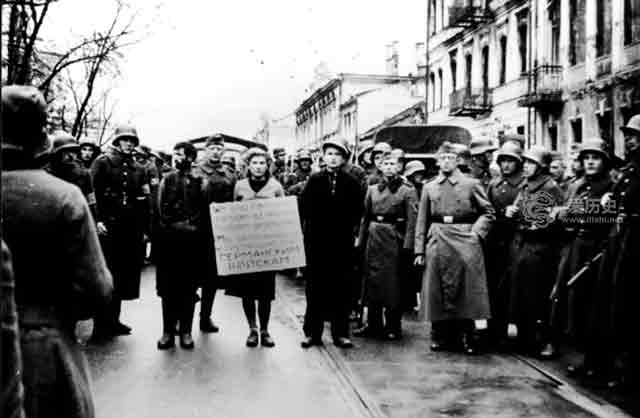
Masha Bruskina, is the first teenage girl to be publicly hanged by the Nazis in Belorussia. She worked as a nurse in a military hospital in Minsk, and was a member of an underground cell which aided Soviet officers hospitalized there, to escape certain death and join the partisans. Despite the constant danger they continued to risk their lives by disobeying orders, sabotaging the daily routine. In 1941 the members of the cell were informed on and quickly rounded up by Nazi officers. Masha and two of her male comrades, Volodya Sherbateivich and Krill Trous, were sentenced to death by the Nazis. They were led through the streets with Masha wearing a large placard proclaiming that they were partisans. Their hands were tied behind their backs with cord and they were hanged one at a time, Masha first, by the German 707 Infanteriedivision who meticulously filmed the proceedings. The young prisoners were neither hooded nor blindfolded, and they were given no drop, so their cruel and slow deaths would act as a stronger deterrent to the local people who witnessed the event. Hanging was the preferred Nazi method for the execution for partisans as it produced more of a public spectacle than shooting and was used to terrorize the local populace as well as entertain the German troops. The execution of Masha and her comrades took place on October 26th 1941 in the city of Minsk and the bodies were left hanging for several days as a grim reminder to others. In her native Belarussia, she had not been recognized. Despite the weight of overwhelming evidence, the testimony of eyewitnesses and the confirmation of respected scholars Masha’s homeland denied her identity. She may be recognized elsewhere, but in Minsk, Belorussia, where she fought and for whom she died, the girl in the photograph was still officially described as unknown until 2009. The reason: Masha was Jewish.
Jews living in Bessarabia and Bukovina are being banished by Rumanian authorities into ghettos established in the neighborhood of the Bug River in the Russian Ukraine, the official news agency Rador announced today.
They seek him here in the ruined capital of Yugoslavia; they seek him out there in the rugged, mountainous countryside so ideal for guerrilla fighting; the Germans seek him everywhere and bring in more and more troops daily to search for this man whose name they do not know and his partisan bands who grow in numbers daily. Josip Broz, a former sergeant in the Austro-Hungarian army, became a dedicated communist while a prisoner of the Russians and spent years in Yugoslav prisons for his beliefs. While he organized his partisan bands from a luxury villa here — with an escape hatch behind the wash-basin — he used more than 20 aliases until he settled on “Tito”. Until today, Tito’s partisans have maintained a guarded alliance against the Germans with the Chetnik fighters who are led by an army colonel, Drazha Mihailovich. The two men met today soon after the Germans started killing 100 Yugoslavs for every German soldier killed. Tito wants a joint command, but Mihailovich is opposed to sharing leadership in this way.
The operation to relieve the Australian garrison at Tobruk with the British 70th Infantry Division; begun on 12 October, ends.
Second meeting of partisans Tito and Draža Mihailović in Yugoslavia.
Karl von Le Suire was awarded the Order of the Cross of Liberty 1st Class with Swords.
RAF Bomber Command, Day of 26 October 1941
8 Blenheims on a sweep off the Dutch coast. Ships were attacked but not hit. 1 Blenheim lost.
RAF Bomber Command, Night of 26/27 October 1941
Hamburg
115 aircraft of 5 different types to shipyards and 2 city aiming points. 3 Wellingtons and 1 Hampden lost.
Crews reported good bombing in moonlight and Hamburg records confirm that more damage and casualties were caused than on average raids for this period. It is believed that 27 people were killed and 129 injured and that there were 10 to 12 fires but the table of figures consulted is not clear.
Minor Operations: 17 aircraft to Cherbourg, 5 Hampdens minelaying in Kiel Bay. No losses.
German U-boat U-83, commanded by Oberleutnant zur See Hans-Werner Kraus, damaged CAM ship HMS Ariguani (F 105) (6746grt, Cdr R. A. Thorburn (ret)) west of Portugal in the eastern Atlantic Ocean in 37-50N, 16-10W from convoy HG.75. At 0354 hours on 26 Oct 1941, U-83 fired three torpedoes at the convoy HG.75 and saw three detonations and columns of fire between running times of 4 minutes 28 seconds and 5 minutes. Kraus claimed three ships sunk with 18000 tons. In fact, only HMS Ariguani (F 105) (Cdr R.A. Thornburn, RNR, (retired)) was damaged by one torpedo. The vessel was abandoned, later reboarded and HMS Vidette (D 48) (LtCdr E.N. Walmsley, RN) tried to take her in tow. The fighter catapult ship was towed to Gibraltar by HMS Thames and HMS Rollicker (W 00), arriving on 2 November, escorted by HMS Jonquil (K 68) (LtCdr R.E.H. Partington, RNR), HMS Heliotrope (K 03) (LtCdr J. Jackson, RNR) and HMS Campion (K 108) (LtCdr A. Johnson, RNVR). Two days before, Commandant Duboc had transferred 18 survivors from the Carsbreck to HMS Ariguani (F 105). The ship had been sunk by U-564 (Suhren) that day. These men were picked up by HMS Campion (K 108) after they abandoned the fighter catapult ship and were later transferred to HMS Vidette (D 48) and landed at Gibraltar. The badly damaged HMS Ariguani (F 105) was decommissioned, transferred to the Ministry of War Transport (MoWT) and laid up at Gibraltar. Only much later temporary repairs were made and the ship towed by HMS Samsonia (W 23) to the Clyde in February 1943, arriving at the Tyne for repairs on 22 March. Reverted to a merchant, she returned to service in January 1944.
Light cruiser HMS Trinidad departed Devonport, escorted by destroyer ORP Kujawiak, for the Clyde where they arrived on the 27th. The light cruiser began her trials.
German steamer Herta Engeline Fritzen (5100grt) was lost in a stranding near Hook of Holland.
Light cruiser HMS Hermione was under repair at Gibraltar from 26 October to 7 November.
Submarine HMS Rorqual arrived at Gibraltar from Malta. On the 28th, the submarine departed for Holy Loch, arriving 4 November.
Convoy ON.30 departed Liverpool, escorted corvettes HMS Arabis, HMS Dahlia and HMS Monkshood and anti-submarine trawlers HMS Northern Gem and HMS Northern Spray. Destroyers HMS Sardonyx and HMS Watchman joined on the 29th. These escorts were detached on 2 November when American destroyers USS Charles F. Hughes, USS Gleaves, USS Lansdale, USS Madison, and USS Simpson joined. The American destroyers were detached on 9 November when the convoy dispersed.
Convoy SL.91 departed Freetown escorted by destroyer HMS Wrestler to 31 October, sloop HMS Sandwich to 12 November and corvettes HMS Anchusa to 12 November, HMS Burdock to 31 October, HMS Calendula to 12 November, HMS Clover to 31 October, HMS Mignonette to 12 November, and HMS Nigella to 31 October. On the 28th, sloops HMS Black Swan, HMS Fleetwood, and HMS Scarborough to 12 November joined the convoy. Sloop HMS Fowey and corvettes HMS Campion, HMS Carnation, and HMS Heliotrope joined on 8 November to 12 November. Convoy SL.91 rendezvoused with convoy SL.91G on 8 November. After reforming, later on 8 November, the joined convoys SL.91 and SL.91G split into SL.91GF and SL.91GS. SL.91GF arrived at Liverpool on 18 November and SL.91 GS on 19 November.
A call to sacrifice their personal, sectional and group interests “in order that we may remain united and unconquerable” was issued by President Roosevelt tonight in a letter ushering in the nation’s celebration of Navy Day tomorrow. Addressed to Secretary Knox, the letter was made public by the Navy Department, which, in cooperation with the unofficial Navy league, had arranged for scores of naval shore establishments to observe Navy day with suitable demonstration of their part in defense. Mr. Roosevelt alluded to the vastly expanded sea operations of the navy by mentioning “our fleets far out in the Atlantic and Pacific,” and the forces that support them “in our far-flung bases.”
Secretary Knox warned American industry today that production of Navy armaments was “still not enough.” Mr. Knox told reporters at a press conference on the eve of Navy Day observances and tours of defense industries that what Detroit was doing in the defense program “is still not enough,” and that “they must do more and more.” “What I say for Detroit, goes for the whole country,” he added. “Everybody has to do more. No one is doing enough.”
Senate debate on its Foreign Relations Committee’s recommendation for repeal of all remaining substantial provisions of the Neutrality Act will occupy the spotlight on Capitol Hill this week to the practical exclusion of everything else. The repeal measure would permit arming of American merchant ships and their passage through combat zones to deliver goods at ports of belligerents. The debate is to start tomorrow. Few hearings of major importance are scheduled this week by committees of either chamber and the House itself will hold only two brief pro forma sessions, being under agreement not to take up any business until a week from tomorrow. However, the Senate debate on what opponents of Neutrality Act repeal have called “the last step before we actually enter the war” is expected to hold most Senators in attendance throughout, with the galleries crowded to capacity. The 13-to-10 majority of the Foreign Relations Committee tonight sounded the first gun in this debate with the submission of a report supporting its recommendations.
President Roosevelt appealed for a second time tonight to John L. Lewis to call off a strike in the vital captive coal mines that supply the sinews for steel but the United Mine Workers chieftain made no move to reply. The White House made public a letter in which the president told Lewis that Myron C. Taylor, former chairman of the board of the United States Steel Corp., would meet Lewis Wednesday “to see if you and he in private and personal conference can work out a peaceful solution of the problem.” Mr. Roosevelt, in asking Lewis Friday to keep the 53,000 miners at work in the steel company-owned captive pits, had suggested the Lewis-Taylor conference. Lewis replied yesterday that he was ready to meet with Taylor but that he did not feel warranted in calling off the strike which started last midnight.In an eleventh hour appeal to John L. Lewis and his associate officers of the United Mine Workers, “as loyal citizens, to come now to the aid of your country,” President Roosevelt tonight called for reconsideration of the decision which ended the truce in the captive coal mines of big steel corporations and resulted in the calling out of 53,000 workers on strike. Following his return from a brief afternoon cruise on the Potomac the President wrote to Mr. Lewis acknowledging his letter of yesterday refusing to continue the captive mines in operation as he had been requested to do by Mr. Roosevelt on Friday. “In this crisis of our national life there must be uninterrupted production of coal for making steel, that basic material of our national defense,” the President said. “That is essential to the preservation of our freedoms, yours and mine; those freedoms upon which the very existence of the United Mine Workers of America depends.”
“I have no comment of any character.” John L. Lewis, since 1919 president of the United Mine Workers, uttered this sentence tonight after he had received a brief, calmly worded appeal from President Roosevelt to keep the nation’s “captive” mines operating in the interest of national defense. The union chief, bitter Roosevelt-hater, then drew a mantle of silence about him. By tomorrow he will have made a decision that may be fateful not only to his personal future as a labor leader, but to his union and all of organized labor as well.
Armament officials told the American automobile industry that effective December 15, scarce materials such as chrome, nickel and aluminum could no longer be used for purely decorative aspects of cars.
A portable steel landing field for airplanes has been used successfully for the first time in the United States. The First Army’s public relations headquarters reported today that a B-18 type Army medium bomber, occupied by four officers, had made three separate landings and take-offs without difficulty from the huge metal runway. The plane was flown there from Pope Field, near Fayetteville. The landing field was set up recently by the Twenty-first Engineers, a mile and a half from Hoffman, North Carolina, headquarters of Lieutenant General Hugh A. Drum, who commands the First Army, now engaged in maneuvers in the Carolinas. The runway, made up of steel planks, weighs 2,250,000 pounds and is 3,000 feet long and 300 feet wide.
A strike of the 6,000 employees of the Robins Drydock and Repair Company, which has shipbuilding yards at the foot of Dwight Street, Brooklyn, and holds defense ship repair contracts as well as contracts for the repair of British merchantmen, was called last night for 7 o’clock this morning.
Future U.S. President John F. Kennedy was commissioned as an ensign in the U.S. Naval Reserve.
The classic children’s book “Curious George” by Margret and H. A. Rey was published.
A destructive F4 tornado struck Hamburg, Arkansas, causing 15 fatalities and injuring 75 people.
Speaking today in Osaka to 200 higher officials the new Premier, General Hideki Tojo reiterated that Japan’s policies were “immutable and irrevocable,” and there would be “no going back.”
The U.S. Navy submarines USS Narwhal (SS-168) and USS Dolphin (SS-169) arrive off Wake Island on simulated war patrols.
Died:
Masha Bruskina, 17, Belarusian-Jewish resistance fighter (hanged).
Arkady Gaidar, 37, Russian writer (killed in action on the Eastern Front).
Victor Schertzinger, 53, American composer and filmmaker.
Naval Construction:
HMS MMS 127 (J 627) is launched by United Engineers (Singapore). Scuttled at Singapore in February 1942.

