The policy-making Central Committee of the Soviet Communist Party wound up a two-day session today with some personnel changes that left the senior leadership ranks intact. Despite a flurry of speculation that shifts were impending, the only significant promotion was that of Yakov P. Ryabov, the party leader of the industrial region of Sverdlovsk in the Urals. Mr. Ryabov, a 48‐year‐old former engineer, was brought into the party’s national secretariat, which with the Politburo constitutes the inner circle of the Soviet leadership. In view of his experience with heavy industry in Sverdlovsk, it was thought that Mr. Ryabov was being prepared to take on the supervision of the military‐industrial complex that Dmitri F. Ustinov handled before he was named Minister of Defense last spring. In a subtle way, the introduction of Mr. Ryabov into the leadership group confirmed the strong patronage position of Leonid I. Brezhnev, the party’s general secretary. Mr. Ryabov worked his way up through the Sverdlovsk party apparatus once headed by Andrei P. Kirilenko, now Mr. Brezhnev’s deputy.
European bankers are concerned at the implications for world financial stability of Britain’s third monetary crisis this year. They feel Prime Minister James Callaghan is trying to raise the stakes in the bargaining for new financial assistance.
Spain suspended an air force general and colonel from active service in connection with alleged bribery of Spanish officials by the Lockheed Aircraft Corp. An Air Ministry communique said alleged payoffs involving General Luis Rey Rodriguez and Colonel Carlos Grandal Segade were uncovered during investigation of Lockheed contracts. The suspensions were the first official action in Spain on the bribery scandal.
Striking before dawn in Paris and in other French cities, policemen today rounded up 10 men on suspicion of being members of the gang that tunneled into a bank vault on the Riviera in July and escaped with $8 million in money and jewelry. Others got a chance to escape, according to the chief of criminal police, Maurice Bouvier, because radio station put out a bulletin on the operation at 7:30 AM, while the raids were continuing. There were reports that 300 policemen had participated in the sweep, looking for more than 30 suspects. But these reports could not be confirmed because the police were angry with all journalists and mostly declined comment. What has become known as the “bank robbery of the century” began on Friday, July 16, when, according to police estimates, six to eight men entered the Nice sewer system and began digging a 30-foot tunnel leading into a branch office of the Société Générale. The thieves apparently spent a comfortable weekend underground. They had brought chairs, food and wine. They transported their heavy tunneling equipment by van, driving along an underground municipal passageway and using inflatable rafts for a 400‐yard trip to the tunneling point. Inside the vault, after attaching pornographic pictures to the walls, they broke into 305 safe‐deposit boxes, methodically sorted out the loot and took only the best. Sometime Sunday night or early Monday, they retraced their movements by raft and van and disappeared.
The pound had a last-minute slump on the London market after gradually strengthening during most of the day’s trading. It closed at $1.59, down from Monday’s $1.595.
The Israeli parliament supported Prime Minister Yitzhak Rabin’s Labor government, defeating an opposition no-confidence motion that accused it of corruption, incompetence and lack of leadership. The 57–38 vote followed party lines. The Likud opposition bloc introduced the motion after the arrest of Asher Yadlin, the government’s nominee to head the Bank of Israel, on charges of bribery and corruption. Yadlin’s nomination has been withdrawn. Presenting their fifth unsuccessful no-confidence motion in two years, Likud speakers urged Mr. Rabin to resign in view of financial scandals and accused him of being in constant dispute with his top Cabinet colleagues. Mr. Rabin accused Likud of passing judgment before trial, and said the opposition bloc was also guilty of mismanaging its finances.
Syria and the Palestine Liberation Organization, whose forces fought a bloody battle in the mountains above Beirut only 10 days ago, were reported today to have resumed some of their previous military cooperation in southern Lebanon. That is an area that Israel wants to keep free of Palestinian guerrillas. According to Lebanese right-wing Christian sources, Syria has agreed to reopen the so‐called Arafat Trail, the customary supply route from Syria to the Palestinian forces in southern Lebanon. The trail is also the northern access road from Syrian‐occupied eastern Lebanon to the Arkub, the slope of Mount Hermon that was the main staging area for guerrilla attacks against Israel before the Lebanese civil war began more than a year and a half ago.
The Cairo meeting of Arab leaders produced no accord on the makeup of an expanded peacekeeping force for Lebanon, but their closing statements seemed to imply that Syria would dominate it. This was in spite of objections by Iraq, Libya and the Palestine Liberation Organization to Syria’s role with 23,000 of its soldiers in the country. A fund to pay for the force was agreed on, with the richer oil‐producing Arab countries pledging to provide most of the money. After two days of sometimes rancorous argument over Syria’s role in Lebanon and the composition of the peacekeeping force, the meeting ended tonight several hours later than scheduled and with an unexplained cancellation of a final open session of the 14 heads of state and senior officials representing the 21 Arab League members at the conference. It was officially announced that there would be no immediate disclosure of how many troops would be provided for the force, which now consists of about 2,300 and which is to be expanded to 30,000. The exact composition, the announcement said, will be worked out by the secretary general of the Arab League, Mahmoud Riad of Egypt.
Mao Zedong’s widow, Chiang Ching, removed several of his documents front the Communist Party’s special archives and reworded them, according to a report in an independent Hong Kong newspaper. According to the paper, Ming Pao, a respected independent daily, when China’s new leader, Hua Kuo‐feng, discovered that Miss Chiang had removed the documents without proper permission, he ordered her to return them immediately and then discovered the alterations. The paper said that this was one of several actions by Miss Chiang that led Mr. Hua to arrest her and three leftist colleagues on October 6. Ming Pao said the story of forgery by Miss Chiang is being circulated among party members in Canton to explain the leftists’ arrest and disgrace. The story was brought to Hong Kong by a Chinese traveler who heard it from a friend who is a middle‐grade official. There was no independent confirmation of the newspaper’s report. But analysts here said that it seemed in line with reports they have heard from other Chinese sources and sounded highly plausible. A Chinese Communist representative in, Hong Kong said today that the story appeared to be “based on facts.”
James R. Schlesinger, former Defense Secretary recently returned from a private visit to China, expressed doubt yesterday that Peking’s new moderate leadership would seek to heal the schism with the Soviet Union or otherwise after China’s strategic relationship to the United States. That relationship, he said. involves a “high degree of American dependence” on China for maintenance of the military political equilibrium that has marked global strategy since the end of the war in Vietnam. Yet on the two principal issues between Washington and Peking — the establishment of formal diplomatic relations and the future status of Taiwan — Mr. Schlesinger found neither side in a position to take an early initiative.
Four North Korean diplomats left Finland just hours before the deadline for their expulsion. They were ousted after what was officially described as an investigation “into matters similar to those elsewhere in Scandinavia.” Denmark and Norway have expelled North Korean diplomats after investigating reports that they sold duty-free goods such as liquor and cigarettes on the lucrative Scandinavian black market.
The South Korean Embassy denied today that there was any connection between the Seoul Government and Park Tong Sun, a wealthy Korean businessman, who is under Federal investigation, accused of seeking to influence members of Congress. Former South Korean agents have, however, identified Mr. Park as an agent of the South Korean Central Intelligence Agency, as have Americans with access to intelligence reports. in addition, several reports have placed Mr. Park in Seoul at meetings with President Park Chung Hee and his senior intelligence officers to plan a strategy for gaining influence in Washington. Meanwhile, Representative John Brademas, Democrat of Indiana, reported today that he had accepted $4,650 in campaign contributions from Mr. Park in 1972 and 1974 but he asserted that they were properly reported and had no influence on his Congressional activities.
Aldo Vera Serafin, a Cuban exile who was once a top police official of the Government of Prime Minister Fidel Castro but later split with him, was shot to death last night as he walked along a street in a San Juan suburb, the police reported today. Mr. Vera, 43 years old, was hit by two shots fired from an automobile and died immediately, the police said. A companion, Jose Rodriquez Gomez, another prominent exile, was reported wounded. The police said they were just beginning to investigate the shooting and could not speculate about political motives. There have been several recent cases of slayings or terrorism involving Cubans in Miami. Exile sources here said that Mr. Vera was involved in an organization called the Fourth Republic. The group was Said to have connections with Orlando Bosch, now detained in Venezuela in an investigation of the crash October 6 of a Cuban airliner off Barbados that killed 73 persons.
Progress toward an agreement on the future of the U.S.-controlled Panama Canal was announced in Panama City as American negotiators left for home. A Panama government spokesman reported advances on the question of how much territory the United States would retain along the canal under a new treaty, particularly for military purposes. The chief U.S. negotiator, Ellsworth Bunker, confirmed that his team had modified its previous position on the territorial issue but gave no details. No joint communique was issued.
The Trinidad and Tobago government deported to Venezuela two suspects in the crash of a Cuban airliner that killed 73 persons October 6, government sources said. Freddy Lugo, 31, and Hernan Ricardo Losano, 25, reportedly were put aboard a flight to Caracas after three weeks of squabbling by five nations over jurisdiction in the case. The two had been held since their arrest October 7 as “undesirable immigrants.”
The U.N. Educational, Scientific and Cultural Organization began its general conference in Nairobi, Kenya, with a dispute over freedom of the press. The United States and West European countries hoped to block adoption of a controversial press proposal backed by the Soviet bloc and some Third World countries. The draft declaration says, “States are responsible for activities in the international sphere of all mass media under their control.” The draft has been interpreted in the West as an attempt to put the stamp of approval on government control of news.
Efforts to unite Rhodesia’s faction‐ridden black nationalists were under way here today as Ivor Richard of Britain continued his quest for flexibility in the opposed positions of the white and black delegations to the conference on a transition to black rule. As African diplomats worked to bridge the differences between the nationalists before the opening of the conference Thursday, Mr. Richard, chairman of the conference, held his first meetings with Bishop Abel Muzorewa and Rev. Ndabaningi Sithole, the nationalist leaders who t have been excluded from the seemingly powerful alliance struck by Joshua Nkomo and Robert Mugabe. The drive for unity among the nationalists was aimed at removing one of the major obstacles to success at the conference, which was called to establish a biracial transitional government for Rhodesia.
Transkei, a poor section on the coast of South Africa created for the relocation of black African members of the white-minority ruled nation’s Xhosa people, was declared an independent nation. Kaiser Matanzima, the new Prime Minister of Transkei, accepted the documents of independence from South Africa’s President Nicolaas Diederichs in a ceremony at the Transkeian capital, Umtata. Botha Sigcau was appointed as the nominal President of Transkei. The legitimacy of Transkei, the first Bantustan or “black homeland” to be set aside for black majority rule, was not recognized by the rest of the world. The United Nations General Assembly voted unanimously (134 to 0) to request member nations not to deal with Transkei, with one vote of abstention by the United States, which had already stated that it would not recognize Transkei. Transkei and the three other Bantustans would cease to exist on April 27, 1994, when South Africa’s new constitution took effect to institute democratic rule with a black majority government.
A General Assembly resolution urging United Nations members to bar contacts with the Transkei, just given independence by South Africa, was adopted, 134 to 0. The vote reflected a feeling that granting independence to a South African black homeland was part of the apartheid policy. The United States was the only country to abstain, explaining it planned no relations but that this was a sanction only the Security Council could invoke.
Prime Minister John Vorster said in an interview published here today that he had forbidden Arnaud de Borchgrave, a senior editor of Newsweek, to visit South Africa. Mr. Vorster termed a recent Newsweek article, in which Mr. de Borchgrave, who frequently reports from abroad, attributed anti‐Government views to senior members of the Bureau for State Security, known as BOSS. “an astounding report.” In the interview, with the weekly magazine To The Point, Mr. Vorster said that he was completely satisfied that such opinions were never expressed to Mr. de Borchgrave by the officials, one of whom was minted as saying that there would be political collapse in South Africa unless the Prime. Minister ignored rightists and made drastic changes.
U.S. journalist Arnaud de Borchgrave. a senior editor of Newsweek magazine, said in Geneva that he had been banned from South Africa by Prime Minister John Vorster because he wrote an article on the South African security service’s alleged antigovernment views. The journalist said that it was an open secret in Pretoria that the views of the South African Bureau of State Security were almost diametrically opposed to Vorster’s. De Borchgrave called himself an “innocent victim of policy differences.”
The Soviet Union launched Ekran, its first geosynchronous satellite, to permit direct satellite television.
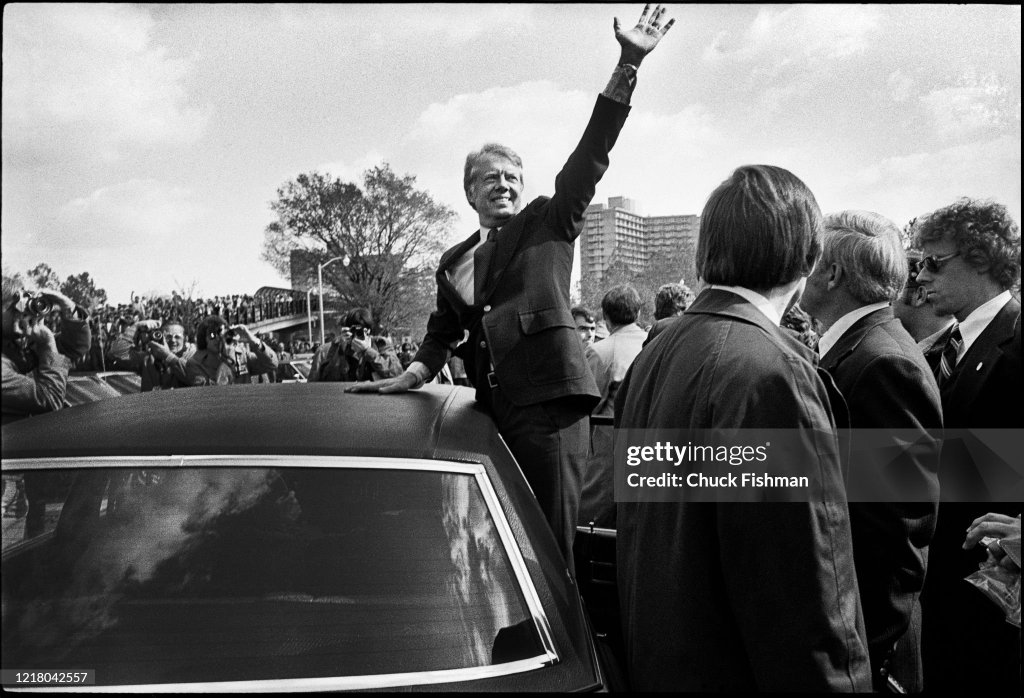
President Ford, deviating from his pledge not to attack his rival, declared today that the election of Jimmy Carter as President would threaten world stability, weaken American security and alter the foundations of the foreign policy pursued by the United States for three decades. The choice in the election one week from today, the President said in Pittsburgh this morning, is between his own fidelity to bipartisan “traditions that can keep us strong and at peace” and a Democratic candidate “venturing into the unknown with a doctrine that is untested untried and, in my view, potentially dangerous.” Mr. Ford criticized the former Georgia Governor’s plans to reduce defense spending, to withdraw some troops and nuclear weapons from abroad and to disavow military intervention in Yugoslavia if the Soviet Union should do so. He said Mr. Carter’s approach “has a strong flavor of isolationism” and that “if it is applied to practice in the same way that it is described in campaign oratory, there is a significant risk it could lead to a major international crisis.”
Senator Dole qualified his recent characterization of World War II and the Vietnam conflict as “Democrat wars,” saying they were not partisan wars but that American weakness led to the first and American indecision to the second. The Republican vice-presidential candidate, addressing a campaign rally in Ohio, said both were fought for what was perceived at the time to be in the national interest. In his nationally televised debate on October 15 with his Democratic counterpart, Senator Walter F. Mondale, Mr. Dole suggested that the Democrats were responsible for the four wars in which the United States has been involved in this century. The remark not only drew anger from his opponents in this election, but also brought widespread criticism even among supporters of President Ford and his running mate. Still, Senator Dole continued until today to justify his use of the phrase on the ground that, if the Democrats kept bringing up the Watergate affair, it was fair to raise questions about wars that had occurred under their administrations.
Mr. Carter campaigned in Columbia, South Carolina, and then in Illinois from south to north with a promise of aggressive but prudent action to replace “stagnation.” He said the time was past for bluffing other nations by saying the United States would send in troops. Asked if he would intervene if Israel were losing a war, he said he would not start naming every country and what he would or would not do. Carter cancelled a planned stop in New Jersey, fearing a confrontation with tax protesters.
President Ford approved yesterday a Civil Aeronautics Board decision granting the airlines some increases in winter-season promotional fares on the North Atlantic but rejecting other major ones that the carriers had sought. The decision meant that, unless there are diplomatic complications, there will not be the customary winter‐season reductions on such fares as the 60‐day advance‐purchase, the 7‐to‐8‐day group fare, and other special bargains.
The White House tapes used as evidence in the Watergate cover-up trial may be reproduced, broadcast and sold to the public in records, the United States Court of Appeals in Washington ruled, as soon as a suitable plan for their distribution is developed. By a vote of 2-1, it reversed last year’s decision of District Judge John Sirica banning their distribution at least pending final decision on the appeals of four former Nixon aides in the Watergate cover-up trial. The appeals court acted at the behest of the three commercial television networks, the Public Broadcasting System, an association of radio broadcasters, and a record manufacturer, and over the strong opposition of Mr. Nixon. Tonight, the office of Mr. Nixon’s lawyer, Herbert J. Miller, announced that the former President would appeal. “The effect of the Court of Appeals decision is to permit the commercial exploitation of recordings of Presidential conversations subpoenaed for use in a criminal trial,” the law office said in a brief statement. “Accordingly, we will appeal.”
Corruption and personal scandal, when charged against congressional candidates for re-election, are widely ignored by their constituents despite the concern since the Watergate case over political ethics. Re‐election appears probable for 20 of 21 Representatives who have been publicly linked, either by judicial bodies or in investigations by the press, with either political wrongdoing or personal scandal during the 94th Congress. Interviews with perhaps 1,000 voters in Congressional races in four parts of the nation in which scandal is an issue indicate that, ironically, the Watergate scandals — once thought to have ushered in a new era of morality for public servants — appear instead to have hardened the electorate to corruption charges, at least at the local level. “I don’t believe a word of it,” said a voter in Salt Lake City in the sort of refrain heard repeatedly in response to questions about corruption charges.
Louisiana Governor Edwin W. Edwards said he saw nothing wrong with American businessmen paying bribes to foreign officials if their governments approved. “I’m all for that,” Edwards said. “I think one of the most reprehensible things that the press and national government has done has been to inhibit American business from doing business with foreign governments in accordance with the mode of operations in those foreign countries.” Edwards’ remarks came a day after he admitted that his wife accepted a $10,000 cash gift from South Korean businessman Tongsun Park. He has characterized Park as a close personal friend.
[Ed: Edwards was such a sleaze.]
A federal judge dismissed three private lawsuits to force former Rep. Wayne L. Hays (D-Ohio) and Elizabeth Ray to repay the government for her salary as a staff member for his committee. Miss Ray has said she was put on the payroll solely to be Hays’ mistress. U.S. District Judge Thomas A. Flannery said in Washington he was dismissing the suits for lack of jurisdiction. But he said the Justice Department would be free to file its own suit against Hays and Miss Ray. The suits were filed under the False Claims Act, which allows private citizens to attempt recovery of money allegedly obtained from the government by fraud.
The teamsters union’s major pension fund, which has been charged with improper activities for 20 years and under investigation by the Federal Government, announced yesterday the resignation of 11 trustees as part of “a major reorganization” of its board of trustees. The resignations, coupled with one last month, mean that 12 of the 16 trustees have left under pressure of threatened Government action against them. The resignations are the result of the largest Federal push against the union since James R. Hoffa, former Teamster president, was sent to prison nearly a decade ago.
The Food and Drug Administration is expected to review next year a proposal to restrict over-the-counter drugs that combine aspirin with antacids. A study group said last week the combination could be harmful to people with ulcers because aspirin can cause internal bleeding. The danger, the study said, is that a person with an upset stomach and a headache could aggravate an ulcer with such a drug. An FDA spokesman said the study panel would seek further outside opinion before submitting a report next year.
The skipper of a rescue boat testified he did not hear a Norwegian tanker signaling the ferry George Prince shortly before the 664-foot Frosta rammed and sank the crowded ferry. Lones J. Gagnard, 50, captain of the ferry Olie K. Wilds which rescued most of the survivors, told a Coast Guard inquiry in New Orleans he heard no radio warnings or whistle blasts until after the collision. Frosta pilot Nick Colombo has testified he repeatedly called the George Prince, warning it was on a collision course.
A New York judge ruled that the state’s law calling for the death penalty for certain crimes was unconstitutional because it is cruel and unusual punishment. Justice Peter J. McQuillan said the concept of mandatory sentences for criminals had been consistently discredited. His ruling, which came in a case involving the conviction of Joseph Velez for the murder of an off-duty policeman, has the effect of at least temporarily removing all pending death sentences in the state.
Nassau and Suffolk Counties may be crucial in the presidential contest for New York State’s electoral votes. President Ford, Vice President Rockefeller and Jimmy Carter will all be campaigning there this week. A New York Times survey, as well as other polls, indicate that there is a large undecided vote on Long Island. The Times survey also sees the suburbanite of Long Island and Rockland and Westchester Counties as the middle-of-the-road swing voter, who is also more likely to vote than other residents of the state.
The New York State election ballot was changed, not yet finally, by two court rulings. The Appellate Division of the State Supreme Court overturned a lower-court ruling and put the name of Eugene McCarthy, Independent candidate for President, back on the ballot. In another reversal, it ruled that Daniel Patrick Moynihan, the Democratic candidate for the United States Senate, could also appear on the Liberal Party line. The Court of Appeals will hear arguments in both cases today.
New York State’s death penalty law is unconstitutional, Justice Peter McQuillan ruled in state Supreme Court in the first legal test since the United States Supreme Court’s landmark decision last summer. He found that the law mandating execution for murder of a policeman or prison guard was “cruel and unusual” in that it gave judge and jury no leeway in deciding an appropriate sentence.
The West Point lawyer who first challenged the United States Military Academy’s handling of the problem of honor code violations has resigned from the Army after being passed over for promotion. Captain Arthur Lincoln, a West Point graduate with 10 years’ service, will take a legal position with a Boston-based corporation.
Law enforcement officers from the sheriff’s department in Catoosa County, Georgia, killed five of seven lions (six females and one male) who had been set free by a vandal from a private zoo near Ringgold, Georgia, the night before. During their rampage, the lions “killed four dogs, a cow and a pet wolf”. One was recaptured, while another, a 400 lb (180 kg) lioness, remained free until the next day, when it was killed while charging at one of the deputies.
Stocks advanced broadly after opening higher. Dow Jones industrials rose 10.14 points to close at a high for the day of 948.14. Bond prices rose moderately after a week-long slide, with investor demand for some new issues stronger.
Dow Jones Industrial Average: 948.14 (+10.14, +1.08%)
Born:
Jeremy Wotherspoon, Canadian speed skater, world champion in spring skating 1999, 2000, 2002 and 2003, and in the 500 meter world championship in 2003, 2004 and 2008; in Humboldt, Saskatchewan, Canada.
Miikka Kiprusoff, Finnish National Team and NHL goaltender (Olympics, bronze medal, 2010; NHL All-Star, 2007; San Jose Sharks, Calgary Flames), in Turku, Finland.
Steve Kelly, Canadian NHL centre (NHL Champions, Stanley Cup-Devils, 2000: Edmonton Oilers, Tampa Bay Lightning, New Jersey Devils, Los Angeles Kings, Minnesota Wild), in Vancouver, British Columbia, Canada.
Kelvin Garmon, NFL guard (Dallas Cowboys, San Diego Chargers, Cleveland Browns), in Fort Worth, Texas.
Florence Kasumba, Ugandan-born actress; in Kampala, Uganda.
Died:
Aldo Vera Serafin, 43, Cuban exile and former director of intelligence for the Cuban police agency, was killed in a drive by shooting while walking on a sidewalk in San Juan, Puerto Rico,
Arrigo Benedetti, 66, Italian journalist and news magazine editor.

