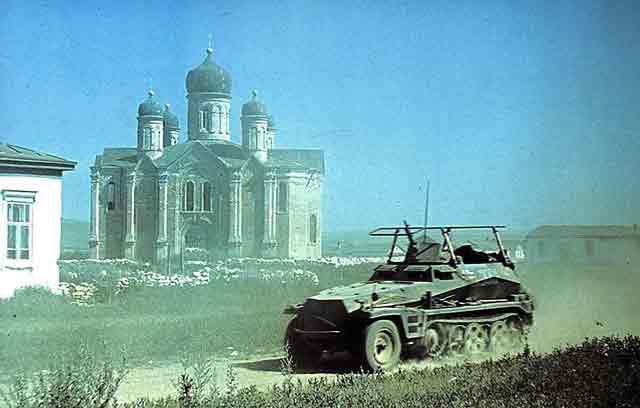
On 7 October 1941, Joseph Stalin does something that only a few months previously would have been unthinkable: he lifts the ban on religion in order to boost morale. This is one of a series of moves that Stalin makes to reintroduce defunct aspects of Russian Empire ways, such as removing Commissars from the decision-making process at all army headquarters. Due to previous persecution, in 1941 there are only about 500 churches remaining open out of the 54,000 in existence prior to World War I. However, this decision by Stalin permits thousands of Russian Orthodox churches to reopen until there ultimately are 22,000 in the 1950s.
The importance of this cannot be overstated. The Russian Empire prior to the 1917 Revolution was a very religious place. The Russian Orthodox Church wielded a great deal of influence and enjoyed official status. The Communist government quickly began suppressing or at least greatly discouraging religion in the 1920s. It founded the League of Militant Atheists in 1925, for instance. Suppression and discouragement of religion was a central tenet of the Soviet State, reflecting Vladimir Lenin’s famous comment that:
“Religion is the opium of the people: this saying of Marx is the cornerstone of the entire ideology of Marxism about religion. All modern religions and churches, all and of every kind of religious organizations are always considered by Marxism as the organs of bourgeois reaction, used for the protection of the exploitation and the stupefaction of the working class.”
Given this attitude toward religion, Stalin must be very worried to go to the extreme of allowing it again.
Indeed, Stalin has good cause to be worried, even frightened, by the pace of the Wehrmacht advance on 7 October 1941. The German panzers shrug off the light snowfall during the night. It melts quickly but does have the unfortunate effect of making the dirt roads even muddier than before. The panzers make good progress anyway as Soviet resistance falters. German 10th Panzer Division (General Fischer) enters the Vyazma suburbs by 10:30 and completes the city’s capture later in the day. Fischer’s men continue north and link up with 7th Panzer Division of Panzer Group 3 (Reinhardt). This closes another massive encirclement around more than four Soviet armies (16th, 19th, 20th, 24th and part of the 32nd Army).
The Soviet troops in the new pocket, however, are not beaten yet. General Yeremenko (Eremenko), who was wounded on Monday while at the front but escaped from the fast-moving spearhead of General Guderian’s 2nd Panzer Army, arrives in Bryansk only to find panzers outside his headquarters and is forced to flee again. Stalin has called in Georgy Zhukov, his top man, from Leningrad to take over Ivan Konev’s critical Western Front and finds there is no continuous Soviet line any longer. Zhukov has to talk Stalin out of finding Konev guilty of incompetence and executing him. Late in the day, with the situation crumbling everywhere, Stalin bows to the inevitable and orders a general withdrawal back toward Moscow.
German armored forces broke through the Vyazma Defense Line, completing the encirclement of the Soviet West Front. Four armies (16, 19, 20 and 24) were caught in the trap. German 10th Panzer Division captured Vyazma, Russia at 1030 hours. Georgy Zhukov, who had been recalled from Leningrad, Russia and sent to report on the situation on the West Front, arrived at Ivan Konev’s headquarters to discover that there was no information concerning the Vyazma encirclement. He was forced to report to Joseph Stalin that there was no longer a continuous front in the west, and the large gaps could not be closed because the command had run out of reserves.
Army Group Centre encountered snowfall overnight for the first time in the drive on Moscow.
The Soviet mine storage hulk Blokshiv No. 1 was sunk by German artillery in Kronstadt harbour.
Rovno, Poland: SS men take 17,000 Jews to pits outside the town, ordering them to strip before shooting them dead. Those who refuse to undress have their eyes gouged out.
Finland, responding to diplomatic queries from Britain and the United States, indicated that it was fighting a defensive war to regain territories lost to the Soviet Union in 1940 and, although it may seem they are fighting at the side of the Germans, they were fighting for Finland against the aggression of the Soviet Union. The Finns stated that “Finland wages her defensive war free from all political obligations, but grateful that she need not fight alone this time… Finland cannot understand how Great Britain, with whom Finland wished and wishes to retain peaceful relations, could regard herself, merely because Finland on this occasion is not alone in fighting the Soviet Union, as forced to treat her as an open enemy.”
Official Greek sources in Cairo and half-starved Greek refugees who reached Egypt and Palestine in rowboats said today that there had been wholesale executions throughout Greece in a ruthless campaign to crush resistance against Axis domination.
The Turkish Government agreed today to deliver chromium to Germany in 1943, after the expiration of the present agreement with Great Britain. In exchange, Germany will immediately deliver war materials to Turkey.
There were no Bomber Command operations from 5 to 10 October, because of unfavorable weather conditions.
Light cruiser HMS Aurora, carrying the Commander in Chief, Home Fleet, arrived at Scapa Flow at 1000/7th from Seidisfjord. The Commander in Chief transferred his flag to battleship HMS Prince of Wales.
Aircraft carrier HMS Furious arrived at Philadelphia to refit. The aircraft carrier returned to England in April 1942.
Destroyer HMS Active, in the escort of convoy QP.1, took anti-submarine trawler HMS Ophelia in tow when she developed a defect to her boilers. The destroyer was ordered to take the trawler directly to Seidisfjord. Due to bad weather, the ships were diverted to Akureyri where they arrived on the 10th. The destroyer departed that day at 1230 for Scapa Flow, where she arrived at 0800/12th.
Destroyer HMS Lightning departed Scapa Flow at 1930 for Rosyth to carry out boiler cleaning and repairs. The destroyer arrived at 1430/8th.
Minelayer HMS Port Quebec, escorted by surveying ship HMS Scott, laid minefield SN.24 A.
U-502, commanded by Kapitänleutnant Jürgen von Rosenstiel, damaged British whaling ship Svend Foyn (14,795grt), straggling behind convoy HX.152, in 60-37N, 21-44W. At 1617 hours on 7 Oct 1941 the Svend Foyn, a straggler from convoy HX.152, was torpedoed on the starboard side by U-502 but managed to escape and reached Reykjavik in tow on 11 October, assisted by HMS Sunflower (K 41) (LtCdr J.T. Jones, RNR). On 6 Dec 1941 she was towed for seven days to Liverpool for permanent repairs at Birkenhead, returning to service in May 1942. The 14,795 ton Svend Foyn was carrying oil fuel and aircraft and tanks as deck cargo and was bound for Liverpool, England.
Sloops HMS Shoreham and HMS Falmouth arrived at Suez from the East Indies to join the Suez Escort Force.
On a patrol over Sicily, a Fulmar of 800X Squadron force landed off Syracuse. Petty Officer A. Jopling and Lt J. S. Manning were rescued and made prisoners of war.
Egyptian lighthouse tender Aida was damaged by German bombing at Zafarana, in the Gulf of Suez. The tender was beached at Zafarana to avoid sinking. There were no casualties in the tender.
A convoy of German steamers Salzburg and Trapani, escorted by Italian destroyer Sella and torpedo boat Castelfidardo, departed Suda for Piraeus. On the 7th, submarine HMS Talisman unsuccessfully attacked this convoy in 35-45N, 24-08E.
Today in Washington, President Roosevelt conferred with Congressional leaders on revision of the Neutrality Act, discussed price fixing and agricultural production with Secretary Wickard and members of the Farm Organization Committee on Agricultural Production, and conferred with Myron C. Taylor, his personal envoy to the Vatican.
The Senate was in recess, but its Defense Investigation Committee heard John M. Carmody, Federal Works Administrator, and others on defense housing.
The House passed the bill to expand the lending authority of the Reconstruction Finance Corporation by $1,500,000,000, rejecting an amendment to withhold aid to Russia, received the Vinson bills providing for a 7 per cent limit on profits from defense contracts and to authorize the acquisition of 400 ships for local defense purposes, and adjourned at 3:38 PM until noon tomorrow.
In Seattle, Washington, President Franklin D. Roosevelt addresses the largest labor organization in the U.S., the American Federation of Labor (AFL), stating, “The threat of Hitlerism is directed not only at labor, even though labor is among the very first that will suffer therefrom. It is aimed at all of us-every man, woman and child who believes in freedom. It menaces everything that we cherish as Americans and free men.” President Roosevelt said the time has come when federal machinery for adjusting labor disputes “must be used” by labor and management “before any recourse is taken to a strike or lockout.” In the interests of national defense, the president said that the establishment of peace between labor organizations would be a patriotic step toward the creation of true national unity. Speaking on the same significant theme, Secretary of Labor Frances Perkins told the 600 A.F.L. convention delegates and a throng of visitors that “strikes which hamper the national effort have inevitably brought an avalanche of unfavorable comment to the labor movement.”
President Roosevelt and Prime Minister Winston Churchill emphasized the importance of the future development of international trade as a foundation for a better world order, in messages read last night at the world trade dinner of the twenty-eighth National Foreign Trade Convention at the Hotel Pennsylvania. Sumner Welles, Undersecretary of State, who read President Roosevelt’s message, followed it up with a detailed statement of the long-range program envisioned by our government for the reconstruction of world economy after the war. He said the basic aim of the United States was the elimination of destructive trade warfare between nations, and the institution of a policy of international cooperation. Mr. Welles, warning that a world society of order, security and peace would be possible only if those responsible for planning it were willing to make the sacrifices that would be required, reviewed the “list of errors of omission and of commission of the past.” He said many nations, including the United States, had been inclined to look upon foreign trade as a “cut-throat game.”
President Roosevelt told reporters today new orders of the government of Panama forbidding the arming of ships flying that nation’s flag made rapid revision of the American neutrality act more than ever urgent. He made this statement at a press conference. Earlier in the day he was reported to have informed congressional leaders, mostly from the senate, the act should be revised to let armed American ships carry supplies into British and other belligerent ports. For two hours and a half Mr. Roosevelt and the legislators had discussed the ins and outs of the situation. One conferee said the prevalent opinion of the gathering was that Mr. Roosevelt’s recommendations should be carried out, but there was disagreement on procedure. A second meeting was scheduled for tomorrow.
President Roosevelt, it was learned today, has approved the creation of a new government agency, called the Office of Facts and Figures, to cooperate with the established government departments in presenting to the American people a more detailed and coherent picture of the Administration’s defense and foreign policies. The administration of this new agency has been offered to Archibald MacLeish, Librarian of Congress. The new director will report to Fiorello H. La Guardia, Director of the Office of Civilian Defense, in whose quarters the Office of Facts and Figures is now being set up. The new agency, which has also been approved by those members of the President’s Cabinet dealing with national defense, will not be a super-press bureau. It will not issue any “handouts” or have any direct contact with the press. It will be a small organization working within the government in order not only to get more facts to the public but to correlate the unwieldy mass of disconnected and sometimes contradictory information which is now put out by the various government press departments.
A bill to limit profits from production for the national defense program to 7 per cent of manufacturing cost was introduced in the House today by Representative Vinson of Georgia, chairman of the Naval Affairs Committee.
As one of many tests of American sentiment toward the war, the American Institute of Public Opinion has asked voters throughout the country at various times in the Fast few months the question whether they think President Roosevelt is going too far or not far enough in aiding Britain. Over the past several months, the percentage saying “too far” has crept up from 21 to 27 percent. The fraction saying “just right” is still a majority, however, at 57 percent.
Only a small part of the American aeronautical equipment reaching the British air force is being shipped under the Lease-Lend Act, but in the first seven months of this year $284,000,000 worth of planes, engines and other aeronautical equipment were shipped to Britain’s air forces in various parts of the world by American producers, Colonel John H. Jouett, president of the Aeronautical Chamber of Commerce of America, Inc., said tonight.
The Federal Works Administration will withhold a contract for 300 defense houses in Michigan from the Currier Lumber Company of Detroit, low bidder by $431,000, on the order of Sidney Hillman, Associate Director General of the Office of Production Management, in the interest of labor stability in the building trades, it was learned tonight.
Relief agencies worked unceasingly tonight to aid hundreds of families left homeless by a tornado which swept through the eastern edge of Kansas City and suburban communities late yesterday, killing three persons and Injuring 135 others. All stricken areas were blocked off by police to prevent looting as the job of clearing wreckage went ahead under the direction of the Red Cross. City Manager L. P. Cookingham estimated the number of badly damaged houses at 150.
A 13-year-old boy was killed and 12 others were injured, some seriously, when a speeding Chicago-to-New York Grand Trunk freight train ripped up tracks and demolished one end of the main depot in Lansing, Michigan, late today. Fears others in the station might have been trapped in the wreckage were lessened as hastily summoned rescue crews, including 100 state policemen, reported finding no more dead or injured.
TU 4.1.1 (Captain Marion Y. Cohen) assumes escort duty for convoy ON 22 at the MOMP. Although there are no U-boat attacks on the convoy, ships of TU 4.1.1 carry out depth charges attacks on suspicious contacts (see 8 and 9 October).
Panamanian President Arnulfo Arias fled the country after his government was toppled in a U.S.-backed coup.
The Report on Japanese on the West Coast of the United States, often called the Munson Report, was submitted to the administration of U.S. President Franklin D. Roosevelt. Roosevelt had designated Munson as a special representative and gave him the task of gauging the loyalty of Japanese Americans of Japanese Americans living in California and the West Coast of the United States, many of whom lived on military bases and important manufacturing facilities. Munson found that “There is some Japanese problems on the West Coast, but it has not yet reached a state in which we should fear them as a country” concluding that there was “a remarkable, even extraordinary degree of loyalty among some of this generally suspect ethnic group, but there were some Issei that remained loyal to their home country, Japan, and its Emperor.” Roosevelt would receive the report on November 7, 1941.
The Japanese today announced that the Chinese had recaptured Ichang, westernmost outpost of the Japanese in China, but said a Japanese counter-attack in progress in that area of Western Hupeh Province since Saturday had repelled eight Chinese divisions near Shasi on the Yangtze River.
Chinese armies, launching their own counter-offensive, have entered Ichang and are fighting in the streets. Chinese said huge fires raging in the city indicated that the Japanese were preparing to abandon it. The battle at Ichang, gateway to the upper Yangtze and its deep gorges, was said to be a see-saw affair, with possession of the heights on the southern shore opposite the city as the main objective.
The Japanese military spokesman said today that the Japanese forces in Northern Hunan were now concentrating on defensive preparations between the Hsinhsiang and Milo Rivers, ready for any Chinese attack. He ridiculed Chinese reports of a Japanese defeat, forced evacuation of Japanese forces from Changsha and Chinese attacks on the Japanese rear guard. “Chinese forces never have been closer than forty to forty-five miles to our rear guard,” the spokesman said. “Not once has there been contact between the Chinese and Japanese Armies.” During the Japanese withdrawal northward from Changsha the spokesman declared only remnants of the Chinese forces that had been shattered by the Japanese southward advance had been encountered and that these had been scattered and mopped up. He declared that Chungking’s claims were only “paper victories,” the same as Chinese reports of attacks on the Japanese rear guard which he stressed should have been attempted.
Although what actually happened around Changsha may remain a mystery for some time, foreign observers here emphasize that the Japanese withdrawal gave the Chinese an excellent chance for propaganda which apparently they are utilizing to the utmost.
The Japanese spokesman further declared that Japanese forces were firmly entrenched at Chengchow n Honan Province, from which strategic center they would be able to advance westward or southward and also would be able to control the crossings of the Yellow River west of Chengchow.
John Curtin is duly sworn in as the Prime Minister of Australia. Curtin became the 14th Prime Minister of Australia.
Dow Jones Industrial Average: 124.42 (-1.41)
Born:
Enrique Antonio “Tony” Silvester, Panamanian-American R&B singer-songwriter (The Main Ingredient — “Everybody Plays The Fool”), in Panama (d. 2006).
Martin Murray, British rock guitarist (The Honeycombs, 1963-64 — “Have I the Right?”), in London, England, United Kingdom.
Larry Young [aka Khalid Yasin], American hard-bop and jazz-fusion Hammond B-3 organist (Unity), in Newark, New Jersey (d. 1978).
John Ford Noonan, American playwright (“A Coupla White Chicks Sitting Around Talking”), in Stamford, Connecticut (d. 2018).
Leonard Brown, American trading card writer and co-creator of Mars Attacks, in Brooklyn, New York, New York (d. 2026).
Gary Hill, NBA shooting guard (San Francisco Warriors, Baltimore Bullets), in Rocky, Oklahoma (d. 2009).
Naval Construction:
The Royal Navy Isles-class minesweeping trawler HMS Ironbound (T 284) is laid down by the Kingston Shipbuilding Co. (Kingston, Ontario, Canada). She is transferred to the Royal Canadian Navy before completion and commissions as the HMCS Ironbound (T 284).
The Kriegsmarine (German Navy) Type IXC/40 U-boat U-190 is laid down by AG Weser, Bremen (werk 1036).
The Royal Navy Shakespeare-class minesweeping trawler HMS Othello (T 76) is launched by Hall, Russell & Co. Ltd. (Aberdeen, Scotland).
The Royal Canadian Navy Bangor-class (VTE Reciprocating-engined) minesweeper HMCS Vegreville (J 257) is launched by Canadian Vickers Ltd. (Montreal, Quebec, Canada).
The Royal Australian Navy Bathurst-class minesweeper-corvette HMAS Cairns (J 183) is launched by Walkers Ltd. (Maryborough, Queensland, Australia).
The Royal Navy Fairmile B-class motor launch HMS ML 278 is commissioned.
The U.S. Navy Barnegat-class small seaplane tender USS Humboldt (AVP-21) is commissioned. Her first commanding officer is Commander William Gosnell Tomlinson, USN.
The U.S. Navy patrol gunboat USS Williamsburg (PG-56) [ex-Aras] is commissioned. Her commanding officer at commissioning is Lieutenant Commander Frederick Sherman Hall, USN. It also served as a presidential yacht for Harry Truman from 1945 to 1953.

