The Soviet Government has announced a plan of legislation for the next five years to codify Mikhail S. Gorbachev’s blueprint for the reconstruction of Soviet society. The latest issue of the official gazette of the Supreme Soviet, the nominal legislature, lists 38 measures to be prepared through 1990, ranging from laws on voting and referendums to legislation on economic incentives, pricing, the press, the structure of the Government and even the activities of the K.G.B., the intelligence and internal security agency. The list of laws and decrees to be drafted or revised appeared to cover most of the fields in which Mr. Gorbachev has called for changes in his campaign to modernize and revitalize the economy and society. Soviet sources said the measures were apparently to deal with the problem that many of the proposed changes contravene existing legislation.
President Reagan, responding defensively to conservative criticism, said today that he was opening negotiations with Michael S. Gorbachev “without illusions” about the Soviet Union. At the same time, Mr. Reagan sought to dampen expectations for the two days of talks he will hold with the Soviet leader in Iceland this weekend, warning against “false hopes.” He said he viewed the talks as largely “laying the groundwork” for a later visit by Mr. Gorbachev to the United States. The President’s remarks, made to a group of corporate executives at the White House, were his longest so far on the Iceland meeting, which was sought by Mr. Gorbachev.
The majority leader of the House of Representatives said today that House Democrats were ready to delay a resolution of arms-control issues to avoid tying President Reagan’s hands before he meets with Mikhail S. Gorbachev. The majority leader, Jim Wright of Texas, said a confrontation on the arms issues within the Congress and between the Congress and the White House could be put off until after the Iceland meeting this weekend and after the regular summit meeting that is expected to follow. “I believe we can find a way to have a modus vivendi to allow him to go to the summit without feeling that he had been repudiated publicly by Congress,” Representative Wright told reporters. “We have indicated to the President that we would be willing to do that. I think this is a means of accommodating him and proving to the world that we are willing to set aside our internal disagreements.
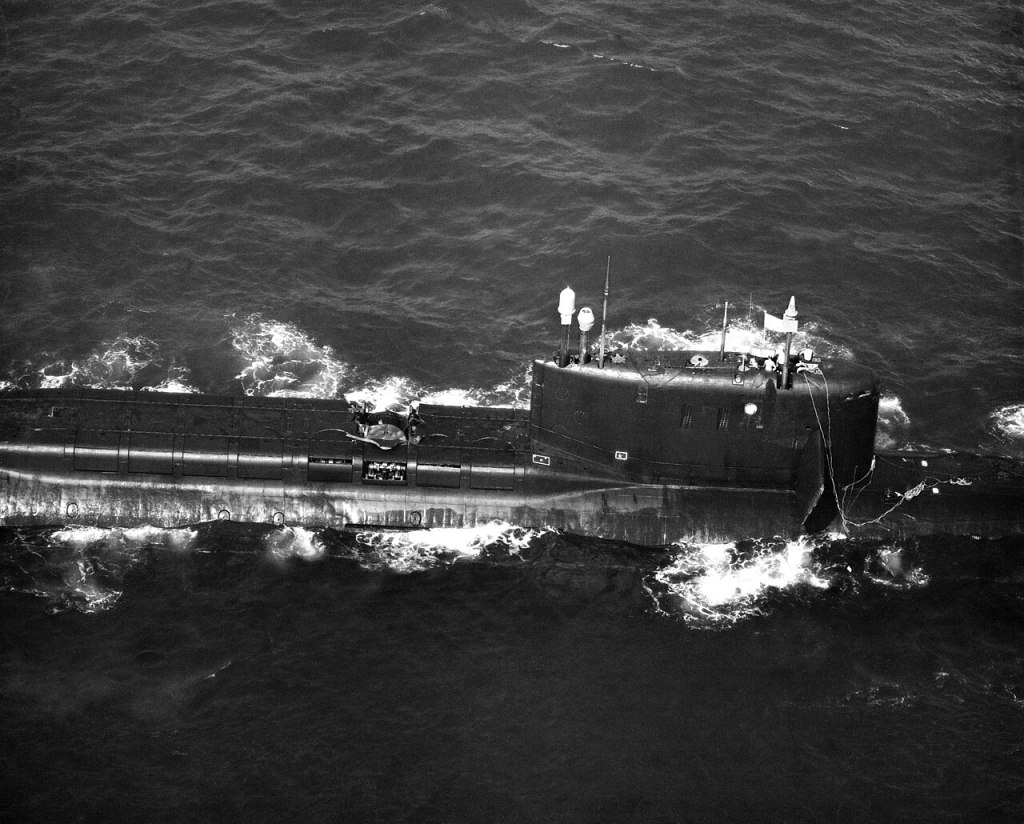
Crippled Russian nuclear submarine K-291 sank in the Atlantic Ocean in 18,000 feet of water 1,200 miles east of New York early today. Several hours later, the Soviet press agency Tass confirmed the loss, and said the crew had been evacuated to Soviet ships nearby after the hull became flooded. On Saturday, Tass said three crewmen had died in a fire and explosion on Friday. The Pentagon said the 20-year-old 9,400-ton submarine, of a class which is code-named by NATO as Yankee-I, was carrying 16 ballistic missiles, each armed with two nuclear warheads. The Pentagon said it sank about 4 AM, New York time, in 18,000 feet of water, about 600 miles east of Bermuda.
Secretary of State George P. Shultz initially opposed the expulsion of 25 members of the Soviet Mission to the United Nations whom the United States identified as intelligence operatives, according to Administration officials. The officials also said Mr. Shultz eventually persuaded President Reagan to delay the move after it emerged as a stumbling block in negotiations over Nicholas S. Daniloff, an American journalist who was being held in Moscow. The 25 diplomats, identified by Federal agents as the Soviet Union’s most important intelligence operatives in New York, and were ordered on September 17 to leave the United States by October 1. But officials said that at the urging of Mr. Shultz, President Reagan subsequently agreed to let 11 of the intelligence officers remain in this country for two additional weeks as a “grace period.”
Pope John Paul II said today that some of the most serious problems of Roman Catholicism were a result of the vigorous internal debate in the church in the last two decades. In the most important speech of his four-day visit to France, the Pope acknowledged that the church was facing a critical shortage of priests, and he said resigned acceptance of this trend endangered the vitality of Catholicism. Preaching to 5,800 priests and seminarians gathered under a huge blue tent, John Paul repeatedly insisted on a return to traditional role models for the clergy and rejection of efforts to let laymen perform some important priestly functions.
UNESCO’s Director General, who has been at the center of a dispute over how the organization has been run, said today that he would not seek a third term of office. The present mandate of the Director General, Amadou-Mahtar M’Bow of Senegal, as head of the 159-nation United Nations Educational, Scientific and Cultural Organization, expires in November 1987. The unexpected announcement was made at a closed meeting of UNESCO’s governing 50-nation Executive Board. It ended months of growing concern among Western and other member countries that Mr. M’Bow, a 65-year-old former Senegalese Education Minister, would run for a third six-year term, with a good chance of re-election.
The Reagan Administration’s reported resort to a policy of deception to throw Colonel Muammar el-Qaddafi of Libya off balance has aroused little hostile press commentary and no perceptible protest among West European allies of the United States. While the campaign of deception has been front-page news in the United States, few Western European newspapers or magazines have given major attention to it, and a number of prominent ones have ignored it altogether. Among the latter are publications normally unfriendly to the Reagan Administration.
Prime Minister Shimon Peres denied what he called a “sensationalist” report describing Israel as the world’s sixth-ranked nuclear power. The report, in the Sunday Times of London, said Israel has stockpiled about 100 atomic weapons in a secret underground factory at Dimona in the Negev. “Israel… will not be the first to introduce nuclear weapons into the region,” Peres was quoted as saying at the weekly Cabinet meeting. Israeli officials have acknowledged that there are nuclear research facilities at Dimona, but they have denied or refused to comment on reports that Israel possesses nuclear weapons.
The trial of an ethnic Albanian with dual United States-Yugoslav citizenship on charges of anti-Yugoslav activity and propaganda ended today and the verdict will be announced Wednesday, court sources said. They said the prosecution and the defense reaffirmed their original positions in final arguments at the trial of Peter Ivezaj, which began Friday. Gojko Lausevic, the prosecutor, said Mr. Ivezaj engaged in anti-Yugoslav demonstrations and activities in Detroit, Chicago and Washington. Mr. Ivezaj, 30 years old, of Sterling Heights, Mich., was jailed in August while in Yugoslavia with his family. He emigrated to the United States in 1972.
A video recording of three French hostages kidnapped in Lebanon more than a year ago was received by an international news agency in Moslem West Beirut today. Also today, Israeli aircraft struck deep inside north Lebanon almost to the Syrian border in the latest attack on suspected Palestinian guerrilla bases in the country. The videotape of the three Frenchmen was accompanied by a typewritten statement from the Islamic Holy War organization in which it blamed the French Government for the hostages’ continued detention and offered to exchange them for 17 men imprisoned in Kuwait after being convicted of terrorist offenses. It urged Prime Minister Jacques Chirac to intervene with the Kuwaiti Government.
A Jordanian accused of trying to blow up an El Al jumbo jet told British investigators that Syrian military intelligence officers had supplied him with an official Syrian passport, $12,000, a bag with deadly explosives hidden in a false bottom and training on how to detonate the bomb, a prosecutor said here today. The Jordanian, Nezar Hindawi, 32 years old, is charged with giving the carry-on bag to an unwitting Irish woman who was pregnant with his child. On the first day of his trial at the Old Bailey, he saw the woman, Anne-Marie Murphy, for the first time since April 17, when she believed herself to be on the way to Israel to marry her lover. Miss Murphy, who has since had the baby, described to a jury of seven men and five women how Mr. Hindawi parted from her at Heathrow Airport that morning, having assured her that he would fly on another flight and meet her in Tel Aviv.
Egyptians criticize Hosni Mubarak for lacking decisive leadership and a clear vision. Five years after Mr. Mubarak became President following the assassination of Anwar el-Sadat, a leading Egyptian political writer voiced a widespread comment in saying, “Mubarak inherited power, but never seized it.”
Iraq said it sent waves of warplanes to strike industrial and oil targets in southwestern Iran. A statement by the military command said that three oil and gas installations and a sugar plant in Iran were hit in one raid, while other planes struck at Iran’s Kharg Island oil terminal on the Persian Gulf. Iran acknowledged Iraqi bombing of industrial targets in the region, and Tehran’s official news agency reported that two Iraqi jets were shot down over Kharg. Earlier, an Iraqi bomber was shot down over the southern sector of the 730-mile-long battlefront, the agency added.
Prime Minister Rajiv Gandhi was quoted today as having said that his country was not as concerned with security as it should be and that this lapse was partly responsible for the attempt on his life last week. “The real thing is that we do not have a security-oriented mentality anywhere in the country,” Mr. Gandhi said in an interview in The Indian Express. In an unrelated incident, a local reporter said a brief power failure at a meeting addressed by the Prime Minister today had caused “total confusion.” The witness said there was only one guard behind Mr. Gandhi when the lights came on a minute later.
Floodwaters rose to seven feet in suburban Manila as a storm lashed the Philippine capital area with torrential rains and strong winds. Officials said at least 14 people died. About 6,000 families fled their homes, and schools and offices were closed. Transportation, electricity and communications services were disrupted. The Philippine weather service said 20 inches of rain had fallen in the Manila area since the storm struck Sunday. The storm, named Carmen, packed winds of up to 35 mph as it moved west toward the South China Sea.
Shipping companies shut port facilities on Canada’s West Coast, locking out 3,700 longshoremen in an attempt to gain contract concessions on the unloading of container cargoes. The lockout closed the ports of Vancouver and Prince Rupert, British Columbia, which handle almost half of Canada’s annual grain exports, valued at about $3 billion. The shutdown was the second major blow to Canadian grain farmers in a month. A four-week strike in Ontario paralyzed eastern grain shipments until the past weekend, when a settlement was reached.
Canada was awarded the Nansen Medal, the highest distinction bestowed by the United Nations for aid to refugees. The annual award, previously accorded only to individuals, went to the people of Canada “in recognition of the major and sustained contribution made to the cause of refugees in their country and throughout the world over the years,” said the announcement, made in Geneva. U.N. High Commissioner for Refugees Jean-Pierre Hocke said Canada has always supported international efforts on behalf of refugees and has an honorable record of receiving people fleeing persecution in all parts of the world.
The Defense Ministry said tonight that a rebel supply plane had been shot down in southern Nicaragua and that the sole survivor had identified himself as an American military adviser in El Salvador. Nicaragua said the three other crew members were killed in the crash on Sunday afternoon and were also identified as Americans by the survivor. The Defense Ministry said the survivor of the incident had identified himself as Eugene Hafenfuf, 35 years old.
Argentina’s President Raul Alfonsin opened the 16th Inter-Parliamentary Union conference by urging delegates to identify concrete steps that can be taken to head off nuclear war. Such steps “could lead to negotiations on the adoption of international obligations in the field of disarmament,” Alfonsin told nearly 800 delegates from 103 nations, meeting in Buenos Aires. Besides disarmament, agenda items for the six-day conference include the worsening trade terms for Third World nations, apartheid in South Africa and the Anglo-Argentine dispute over the Falkland Islands.
A white policeman barred a black United States Government employee from an airport lounge and then pushed the American Consul General when he protested, a newspaper reported today. The police, however, said that the employee, Vusi Zwane, was stopped from entering a room where the departing United States Ambassador, Herman Nickel, was giving a television interview on Saturday because Mr. Zwane did not have authorization. Business Day, a Johannesburg paper, said the incident occurred at Jan Smuts Airport during Mr. Nickel’s departure after four years as envoy. The United States Embassy said in a statement, “We very much regret the incident at Jan Smuts Airport concerning one of our senior employees.” Mr. Zwane, a South African black, works for the United States Information Service.
Gary Kasparov remained alone atop the chess world tonight when Anatoly Karpov, the rival from whom he wrested the championship 11 months ago, agreed to a draw that ended his hopes to regain the title. Karpov, playing white, offered the draw on his 32d move, thereby giving Kasparov the last half-point he needed to assure himself of at least a tie in the 24-game series. Kasparov leads the series by 12 points to 11, with one game to play. Even if Karpov won the final game and tied the score, the champion would retain his title under the rules of the match.
President Reagan’s continuing popularity is not transferring directly to Republican Congressional candidates, but the political sea change toward the Republican Party that Mr. Reagan set in motion in 1980 is clearly helping them in this fall’s elections, The New York Times/CBS News Poll has found. A key factor in how well Republican candidates are doing, the survey indicated, is that many more voters think of themselves as Republicans now than did four years ago. The result is a narrow lead nationally of 43 percent to 39 percent for Democratic candidates for the House of Representatives. Such results, if they held up in November, would most likely produce only the smallest of shifts in the current partisan division when results in the 435 separate House races are totaled. The last time the party in control of the White House gained seats in the House of Representatives in an off-year election was 1934. The average off-year loss by the party in power in the last 100 years is 38 seats and since World War II, 30. In 1982 the Republicans lost 26 seats.
The President and First Lady participate in a ceremony to kick-off National Drug Abuse Education and Prevention Week.
President Reagan attends a briefing for supporters.
The Senate passed by voice vote and sent to President Reagan a bill financing the CIA, the National Security Agency, the Defense Intelligence Agency and other U.S. intelligence-gathering operations in fiscal 1987. Although specific amounts and programs are classified, the bill bars the CIA from using secret funds to aid the contra rebels in Nicaragua and keeps the door open for possible aid to rebels in Angola. The bill contains only parts of an amendment by Senator Jesse Helms (R-North Carolina), a CIA critic, including a request to require a review of intelligence findings by more than one intelligence source — a practice officials say is ålready commonplace.
The Senate convenes today in Washington for the impeachment trial of U.S. District Judge Harry E. Claiborne, but the first event of its kind in 50 years will not be the full-blown proceeding sought by the convicted tax evader. Majority Leader Bob Dole (R-Kansas) announced that the Senate was in no mood to rehear a case already presented to federal courts and repeated in part before a Senate impeachment committee last month. For the first time, millions of cable-television viewers can follow an impeachment trial, which will be beamed around the country.
The Senate voted tonight to extend and strengthen the law protecting the public and the environment from chemical pesticides. The legislation, which was unanimously approved by voice vote, is similar to a bill that has already been passed by the House. The measure would require the Environmental Protection Agency to speed up retesting of pesticides already on the market to assure their safety. The manufacturers of these insecticides, herbicides and other pesticides would be assessed fees to help finance retesting the chemicals.
The anti-drug bill approved by the Senate last week has created a dilemma for the Democratic leadership of the House. With Congress set to adjourn this week, the leaders must decide within a few days how to deal with the sensitive issue of the death penalty.
The House passed legislation to allow the financially troubled Farm Credit System, the nation’s largest farm lender, to stretch out loan losses and the costs of refinancing high-interest bonds over periods of up to 20 years. The move, which has been described by even some backers as a “juggling of the books,” would permit bookkeeping changes that would hide some huge losses. Member banks also would be allowed to set their own interest rates to prevent the flight of their best customers.
Lawyers opened court maneuvers today in a new phase of Brown v. Board of Education, the historic case that 32 years ago ended legally sanctioned segregation of schools in the United States. In a case filled with historic echoes, a lawyer opened arguments to show that, despite edicts of the 1950’s, blacks in Topeka still have not gained full redress of the grievances that sent them into the Federal District Court here in the first place, 35 years ago. The lawyer, Richard Jones, said he would show that the school district had failed to recognize the principle pronounced in 1954 by Chief Justice Earl Warren that “separate educational facilities are inherently unequal,” and failed to follow both a 1955 edict enunciated by Chief Justice Warren, that desegregation proceed “with all deliberate speed,” and a 1958 order that segregated districts must act to destroy “root and branch” all vestiges of the effects of their racially separated past. In his turn, Gary Sebelius, the lawyer representing the defendants, the Topeka Board of Education and the Kansas Board of Education, said he would not try to defend the policies and actions that led to the original case. He said he would show that since the Warren Court decision was handed down, the boards had made progress toward integration in a changing district.
Opening its new term today, the Supreme Court agreed to decide whether Jews, Arabs and members of other minority groups who do not belong to distinct nonwhite races may bring racial discrimination suits under an 1866 civil rights law. The Court also agreed to decide whether government-owned airports can ban the distribution of religious, political and other literature in their buildings and whether an Illinois obscenity law violates the Constitution. Among other issues the Court agreed to resolve were whether it should overrule a 125-year-old Supreme Court decision that Federal courts have no power to order a state’s Governor to extradite a fugitive to another state; whether a New York law authorizing warrantless searches of automobile junkyards violates the Constitution, and whether a city may make it a crime to oppose “in any manner” a police officer in the execution of his duty. These were among 22 cases the Court agreed to hear, as William H. Rehnquist, the new Chief Justice, took his seat at the center of the Court’s bench and Justice Antonin Scalia joined in hearing the first four arguments of the 1986-87 term. The 1866 civil rights law was raised in two appeals, one brought by members of a Maryland synagogue against eight men who are accused of defacing it with Nazi and anti-Semitic slogans, and the other involving a college instructor who asserts that he had been denied tenure because he is Arab.
A Federal district judge said today that the key to a case by fundamentalist parents challenging Alabama textbooks was to define secular humanism and to prove that it was taught in public schools. The suit seeks to have 39 social studies and history texts and seven home economics books removed from Mobile County schools.
Rain and lightning near the Kennedy Space Center forced the National Aeronautics and Space Administration to delay until Wednesday the shuttle Atlantis’ planned trip to the launch pad for seven weeks of tests, including astronaut escape drills. The first shuttle “rollout” since the January 28 Challenger disaster had been set to begin early today but was postponed 24 hours because of lightning within 25 miles of the Florida spaceport. Atlantis is on tap for the second post-Challenger flight in May, 1988 — after a February flight of the Discovery.
A man linked to the Aryan Nations white supremacist group was arrested and charged today in recent bombings that the Federal Bureau of Investigation said were set as a diversion for planned bank robberies. Robert Pires was charged with three counts of bombing and one of attempted bombing. A Kootenai County magistrate, John Luster, set bond for Mr. Pires this evening at $500,000.
The president of a New York company involved in a probe of alleged corruption in Chicago city government was charged in a scheme to use bribes to obtain city contracts to collect overdue fines and bills in both cities, federal officials said. Bernard Sandow and his company, Systematic Recovery Services Ltd., were charged with conspiracy and mail fraud, said U.S. Atty. Anton Valukas at a Chicago news conference. Sandow, 54, faces up to 15 years in prison under terms of a proposed plea agreement, Valukas said. The agreement still has to be approved by a federal judge. A hearing is expected within days.
Poor people are more likely to get cancer and die from it than others, results of a two-year study showed. The American Cancer Society said in New York that people living below the poverty level, regardless of race, have a cancer survival rate that is 10% to 15% below the national average of about 50%, and that poor Americans’ risk of developing lung cancer is 60% greater than average.
Two police detectives were arrested today as part of the Federal Bureau of Investigation inquiry into the Miami Police Department. They are charged with shooting into the home of a drug dealer cooperating with the Federal authorities.
Ten LaRouche aides were indicted on Federal fraud charges as hundreds of law-enforcement officers raided the political extremist’s headquarters in Virginia. Officials said several people named in the 117-count indictment were among Lyndon H. LaRouche Jr.’s top advisers.
Mortgage rates fell sharply in September, to the levels of last spring, the Federal Home Loan Bank Board reported. It was the third consecutive decline and the first time since May that both fixed- and adjustable-rate mortgages fell.
Business costs for mental health are soaring. Large companies are spending 7 to 15 percent of health-care dollars on psychiatric care, with drug and alcohol cases absorbing more than a third of the total. In contrast, health-care cost containment in general is taking hold.
Flood crests moved downstream across the Middle West yesterday, allowing some people to return to flooded houses from Oklahoma to Illinois, but other communities were threatened as water from up to two feet of rain drained toward the Mississippi River. The National Guard was sent to help evacuate two trailer parks threatened by a levee break in Missouri.
Rudolf Flesch, the literacy expert, died of heart disease at Dobbs Ferry (New York) Hospital at the age of 75. Dr. Flesch wrote “Why Johnny Can’t Read” and many other books about language.
Major League Baseball:
The Orioles announce that third base coach Cal Ripken, Sr., father of star shortstop Cal Ripken, Jr., will manage the club in 1987.
NFL Monday Night Football:
Steve Largent of the Seattle Seahawks and Charlie Joiner of the San Diego Chargers set National Football League receiving records tonight, as the Seahawks routed the Chargers, 33-7. Largent caught a pass in his 128th consecutive game, and Joiner surpassed Don Maynard’s record for career reception yardage. Largent, who was once considered too small and too slow to be an N.F.L. receiver, broke Harold Carmichael’s record by taking a 17-yard slant-in from Dave Krieg with 4 minutes 16 seconds gone in the second quarter. Krieg, who threw for three touchdowns tonight, had missed him with four previous attempts, causing Largent to throw his hands out in frustration on the fourth.
San Diego Chargers 7, Seattle Seahawks 33
Prices rose yesterday on Wall Street, but the big news was the low volume of stock that changed hands as investors, not knowing whether the nation’s economy is improving or slowing, turned from participants into spectators. “Everyone is laying low, waiting for clarification,” said Walter Wulkan, the director of investment strategies at Gruntal & Company. The Dow Jones industrial average, which has been alternating up days and down days recently, rose 10.27 points yesterday, to 1,784.45. Trading volume dipped to 88.3 million shares, from the 128.1 million on Friday. Yesterday’s volume was the lowest since May 19, when only 85.5 million shares were traded.
Dow Jones Industrial Average: 1784.45 (+10.27)
Born:
Olivia Thirlby, American actress (“Juno”, “Dredd”), in New York, New York.
Janice Sue Meghan Myers [Meg Myers], American singer-songwriter, in Nashville, Tennessee.
Nic Harris, NFL linebacker (Buffalo Bills, Carolina Panthers), in Alexandria, Louisiana.
Cody Glenn, NFL linebacker (Indianapolis Colts), in Rusk, Texas.
Sha’reff Rashad, NFL safety (Washington Redskins), in Summerville, South Carolina
Edgmer Escalona, Venezuelan MLB pitcher (Colorado Rockies), in La Guaira, Venezuela.
Died:
Rudolf Flesch, 75, Austrian-born American literacy expert (“Why Johnny Can’t Read”), of heart disease.
Alexander Kronrod, 64, Russian mathematician and computer scientist, known for the Gauss–Kronrod quadrature formula, of a stroke.

