Administration officials said today that they hoped to use the talks in Iceland next week between President Reagan and Mikhail S. Gorbachev to spur arms control agreements at a full-scale summit meeting in the United States. The officials said a major aim of the Reagan Administration was to set a firm date for the summit meeting and thus put pressure on the two sides to make further progress on arms control. The United States expectations for the Iceland meeting were echoed in Moscow. A Soviet spokesman said Moscow’s primary hope was to give a “strong impulse” to arms control talks. The American officials also said today that the meeting in Iceland could be useful in identifying areas on which to concentrate to make progress on medium-range arms and other arms issues. But they sought to dampen expectations that a breakthrough on arms control could be achieved on short notice. President Reagan and Mikhail S. Gorbachev will meet in Reykjavik on October 10 and 11.
A Soviet Foreign Ministry spokesman said today that the Kremlin hoped the Iceland meeting with President Reagan would give a “strong impulse” to arms-control negotiations. The spokesman, Boris D. Pyadyshev, said at a news briefing that the most promising area was medium-range missiles, an assessment shared by the United States. One obstacle to agreement was lifted when the Soviet Union said British and French national arsenals did not have to be included in a Soviet-American accord. However, Mr. Pyadyshev said, “a whole number of factors give rise to deep alarm.” “The solution of the central problem of our time, the problem of security for all, has not budged an inch,” he said. “Soviet-American talks in Geneva on nuclear and space arms are marking time. Indeed the entire process of the Moscow-Washington dialogue is actually in the same state. Only a semblance of constructive work is being created.”
Reactor No. 1 at the Chernobyl nuclear power station resumed producing power for commercial use, more than five months after the plant suffered the world’s worst nuclear accident, Soviet television reported from the scene. “After five months of silence, the turbines have started working,” a reporter said. The Ukraine power station was shut down after an explosion and fire in the No. 4 reactor April 26. That reactor is being entombed in concrete, but the undamaged No. 2 reactor also is expected to resume output soon.
“He never wanted to emigrate,” Irina L. Valitova said today of her husband, Yuri F. Orlov, trying to explain the crosscurrents of joy, anticipation and wistfulness that have buffeted her since she learned that they were the two dissidents chosen to leave by October 7 under a Soviet-American accord. Mr. Orlov, a physicist and human rights campaigner, was sentenced in 1978 to seven years in labor camp and five years in internal exile. He has been living since 1984 in the Siberian village of Kobyai, in Yakutia.
For the first time in 18 years, the French Government has canceled all police leaves amid warnings by senior Government officials that a new wave of terrorist attacks could begin here soon. The last time the police in this country were mobilized and leaves canceled was during the huge student and worker demonstrations of May 1968. “The repeated threats of which our country is the target cannot be taken lightly,” said Robert Pandraud, the Deputy Minister of the Interior in charge of security. He called on the French people to be “vigilant” and added, “The police forces have just received new instructions to intensify their efforts to gain further information and assure security.” The appeal for vigilance was similar to one in September just before a wave of terror blasts began in Paris. Those attacks, mostly in crowded commercial districts, left 10 people dead and 162 wounded in less than two weeks.
Britain’s opposition Labor Party called for phasing out the country’s 18 nuclear power plants in a “decades-long process,” ignoring pleas from unions that thousands would lose their jobs and “the lights would go out” when coal supplies are used up. But a stronger motion that would have committed the party to nuclear plant closures within five years failed at Labor’s annual conference in Blackpool. The party, in its bid to oust Prime Minister Margaret Thatcher’s Conservative Party, also adopted a motion pledging to apply sanctions against South Africa because of its apartheid policies.
When Glenys Kinnock, the wife of the leader of the Labor Party, bumped into the American Ambassador at the party’s annual conference here, she didn’t try to hide her displeasure. Neil Kinnock, her husband, had just finished promising that Britain would remain a “full and firm member” of the Atlantic alliance after a Labor Government had terminated its “nuclear illusion,” ridding the country of all American as well as British nuclear weapons. The Labor leader asserted that if voices in Washington, such as that of Defense Secretary Caspar W. Weinberger, suggested the alliance would be strained, they were simply responding to Conservative Party cries for help. Now here was the Ambassador, Charles H. Price 2d, making himself available for television interviews confirming that Mr. Weinberger really spoke for the Reagan Administration and most Americans when he warned about the risks in Labor’s stand. Mrs. Kinnock let him know, bystanders later said, that she thought his statement of an American position was an unwarranted interference in a British debate.
Egypt’s five legal opposition parties boycotted an election for a Government advisory body today, as President Hosni Mubarak urged citizens to vote “for the sake of democracy.” “Every citizen must go to the polls and vote, whether for or against,” Mr. Mubarak said as he cast his vote in the Cairo suburb of Heliopolis in a by-election for 70 members of the 210-seat Shura Council.
The United States has intensified an extensive covert campaign to exploit what it believes are psychological weaknesses of the Libyan leader, Colonel Muammar el-Qaddafi, according to Government officials familiar with the plans. The officials said the plan involves the planting of false information in the foreign press and in the Libyan exile community. The intent is said to be to encourage opponents in the Libyan military or political structure to overthrow Colonel Qaddafi. Among the themes stressed is the concept that Colonel Qaddafi is frightened and losing his grip on power in Libya. American intelligence has drawn up several psychological portraits of Colonel Qaddafi that suggest that he is paranoid, often out of touch with reality and tormented by the fear that he may soon be toppled, according to Administration officials. The C.I.A. program is intended to play upon such psychological weaknesses. Thus far, by all accounts, Colonel Qaddafi has remained in control of his regime. The officials said the program was a continuation and expansion of an effort begun late last year by the Central Intelligence Agency. That program was disclosed in several press reports, but officials said at the time that they nonetheless intended to continue with it. “It’s a No. 1 priority,” said one knowledgeable governmental official. “The activity is proceeding at a very high level.”
Secretary of State George P. Shultz accused the Soviet Union of not acting as forcefully as the United States to block the flow of weapons to Iran in its seven-year war with Iraq. Speaking at the United Nations to the Gulf Cooperation Council, made up of Saudi Arabia and small Persian Gulf sheikdoms, Shultz also reiterated the U.S. commitment to ensure the free flow of oil exports from the gulf. Gulf states have expressed fears that Iran might attack them if it triumphs in its “final offensive” against Iraq.
A Pakistani official said today that four gunmen who seized a Pan American World Airways jumbo jet last month may have been on a suicide mission, planning to blow up the plane in midair with 400 people aboard. “There is now an indication they would have blown up the plane in the air,” a Foreign Ministry spokesman said. He said he could not reveal details because the investigation of the hijacking, in which 20 people were killed, was still in progress. The four gunmen, whom Pakistani officials have said are Palestinians, were arrested at the end of the 17-hour hijacking at the Karachi airport on September 5, and a fifth man was arrested several days later.
Three shots were fired during a prayer meeting in New Delhi attended by India’s Prime Minister Rajiv Gandhi and President Zail Singh, but the two leaders were not hurt, the Press Trust of India news agency reported. “The two leaders are unhurt,” a government spokesman said, adding that it was unclear whether it was an assassination attempt. The gunman, wearing a military uniform, was hiding in a bush near a memorial to Mohandas K. Gandhi when he fired the shots. The news agency said the prime minister’s security men overpowered the gunman, who was about 100 yards from the prime minister when the incident took place.
The arrest by the Philippine military of a top Communist leader appeared today to have jeopardized the cease-fire talks on which President Corazon C. Aquino has based her counterinsurgency policy. Meanwhile, the military was placed on a state of alert to guard against reprisal attacks, and Mrs. Aquino was said to have asked that members of the Government’s negotiating panel be given special protection. The President met this morning for nearly two hours with her National Security Council, including Defense Minister Juan Ponce Enrile, who has argued for stronger military action against the insurgents. After the session, her press secretary, Teodoro Benigno, quoted Mrs. Aquino as saying, “The Government keeps the door open for a cease-fire.”
New Zealand’s Labour Government introduces a Goods and Services Tax (GST), adding 10% to the cost of most goods and services.
The government of Canadian Prime Minister Brian Mulroney outlined a plan for the second half of its term, promising to lower some personal income taxes, step up the battle against drug and alcohol abuse, combat violent pornography and consider new ways to fight regional disparity. But the lower tax rates, part of an effort by the ruling Progressive Conservative Party to simplify the tax system, will be accompanied by unspecified tax increases in other areas. Governor-General Jeanne Sauve, who delivered the speech written by Mulroney during the opening session of Parliament, also asserted sovereignty over the Canadian Arctic, reflecting disagreement with Washington, which considers the Northwest Passage to be international waters.
U.N. officials in Khartoum, citing “technical reasons,” abruptly canceled the start of the “Operation Rainbow” emergency food airlift to aid hunger victims in southern Sudan. The inaugural flight was scheduled to carry 16 tons of high-protein food from Khartoum to government-held Juba. The delay followed repeated rebel threats to shoot down the chartered C-130 Hercules aircraft because its destination was a government-held town in the southern region largely controlled by guerrillas.
The South African Foreign Minister called Farm Belt Senators tonight and said Pretoria would cut off grain purchases from the United States if the Senate voted Thursday to override President Reagan’s veto of a bill imposing economic sanctions on South Africa. The Foreign Minister, Roelof F. Botha, also said Pretoria would no longer transport shipments of American grain through its territory to neighboring black-governed countries. Senator Richard G. Lugar, an Indiana Republican who is chairman of the Foreign Relations Committee, told a hastily called news conference that the threat amounted to “intimidation and bribery” and “an affront to the decency of the American people.” His voice trembling with anger, Mr. Lugar asserted, “I find this entire action — by a Foreign Minister of a foreign country, calling Senators off the floor — to be despicable.”
More than a quarter of a million black mineworkers stayed away from their jobs today to mourn the 177 men killed last month in South Africa’s worst gold-mining disaster. The protest was the largest recorded among the country’s 550,000 black mineworkers, but it did not, by initial accounts, draw the same widespread support as earlier mass labor protests. Labor leaders said 275,000 other workers, particularly in the chemical and metal industries, had supported the miners in actions ranging from brief stoppages to one-day strikes.
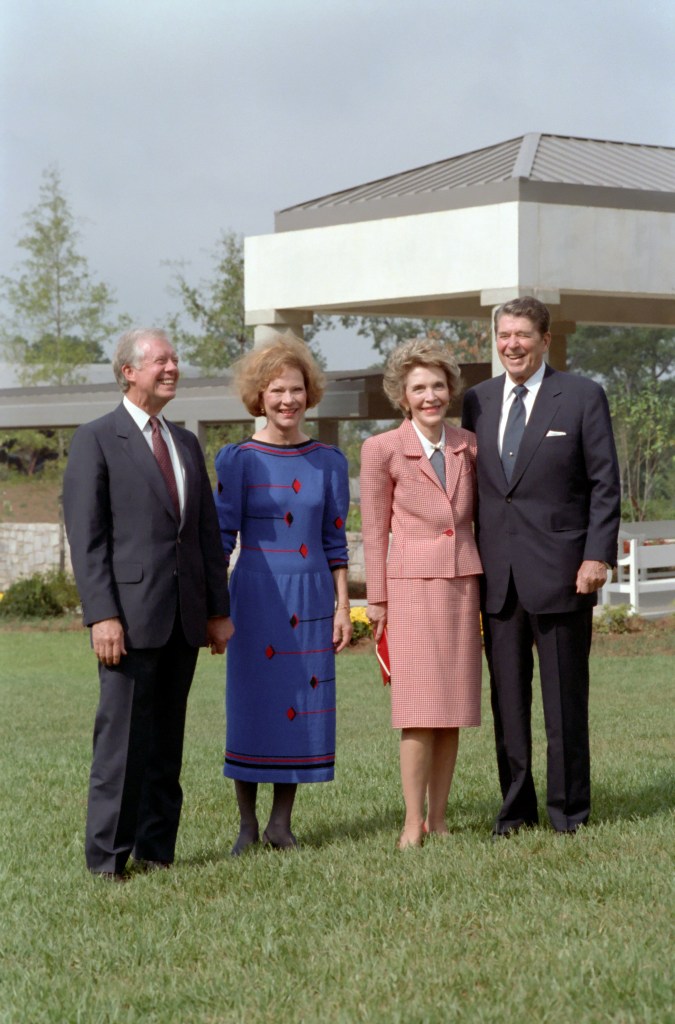
The Jimmy Carter Presidential Library and Museum in Atlanta, Georgia is dedicated. The President and First Lady Participate in a tour of the Carter Presidential Center. Ronald Reagan, in Atlanta, dedicated Jimmy Carter’s new Presidential library and museum and celebrated the man whom he defeated in 1980 as a President whose life and career “is distinctively and gloriously American.” Mr. Reagan said he and Mr. Carter had joined one another in “mutual respect.” “For myself, I can pay no higher honor than to say simply this,” he said. “You gave of yourself to your country, gracing the White House with your passion and intellect and commitment.”
President Reagan yesterday signed into law a measure imposing a contract settlement in the seven-month dispute between the Maine Central Railroad and a union representing track maintenance workers. Mr. Reagan said that while he was reluctant to have the Government “inject itself into the collective bargaining process,” he felt he had to sign the legislation to avoid the potential of a national rail strike.
The Federal Bureau of Investigation has formed a special team of agents to investigate disclosures of sensitive Government information to news organizations, and officials said the squad was at work on about a dozen cases. The bureau said the four-man team was created earlier this year because of concern that such investigations needed to be better organized and assigned to highly experienced agents. Bureau officials said the inquiries were being conducted under espionage statutes that prohibit unauthorized disclosures of classified information.
House and Senate negotiators reached agreement today on a bill that sets spending limits for United States intelligence agencies, leaving intact a Senate amendment that the Central Intelligence Agency asserts is an unwarranted interference. The amendment, sponsored by Senator Jesse Helms, Republican of North Carolina, was vigorously resisted by William J. Casey, the Director of Central Intelligence. Mr. Casey called the legislation “micromanagement” of the C.I.A. by Congress, and he made extensive attempts to derail it before the Senate acted last week. The amendment was attached to the bill that sets spending ceilings and extends or establishes programs for the Government’s various intelligence agencies. Its text, like nearly all of the provisions of the bill, was kept secret.
Congressional negotiators agreed on legislation ordering the safe but costly removal of cancer-causing asbestos from up to 30,000 public schools. Within hours, the House endorsed the legislation, a compromise version of separate plans passed by the House and Senate. Senator Robert T. Stafford (R-Vermont), chairman of the Environment Committee, predicted easy Senate approval within a week. The Environmental Protection Agency issued a statement supporting the bill’s goals but listing its reservations about its “many regulatory requirements.” The EPA said it would decide in the next few days whether to recommend a veto to President Reagan.
Only a playwright with a devilish sense of humor could have invented the scene that took place Tuesday on the floor of the Senate, when two of the senators’ most urgent political priorities crashed headlong into one another. One was the anti-drug bill, a $1.4 billion election year response to what members of Congress perceive as voter demand to do something about drug abuse. The other was a balanced budget, a goal to which members have pledged themselves not only by word but by statute. This was the scene on Tuesday: the time had come to vote on the anti-drug bill, but no one had figured out how to pay for it. For nearly two hours, as the Senate remained in nominal session with a series of quorum calls, the key players, sometimes visible in silhouette through the glass door of the Republican cloakroom, sometimes huddled in plain view on the Senate floor, tried to puzzle their way out of a bind. Finally, the word came: there was no money to spare, every other program was stretched to the limit, but the need for the anti-drug program was so urgent that the time had come to “break the budget,” in the words of Pete V. Domenici, the New Mexico Republican who heads the Budget Committee. There were protests from a few, like Gary Hart, Democrat of Colorado, who said the Senate ought to be willing to raise taxes rather than increase the deficit. But it took only minutes for the Senate, by voice vote, to endorse the notion of exceeding the budget ceiling to pay for the drug measure. The bill then passed without further debate by a vote of 97 to 2.
A Senate panel that gathered evidence for the impeachment trial of imprisoned Nevada federal Judge Harry E. Claiborne filed its report with the full Senate. The Senate will vote — possibly by next week — whether to remove Claiborne from office for failing to report nearly $107,000 on his 1979 and 1980 tax returns.
The monthly premium that the nation’s 30 million Medicare patients pay for physicians’ services will climb on January 1 from $15.50 to $17.90, the government announced. The $2.40-a-month, or 15.5%, increase will come at the same time that the elderly face steeper charges for their first day’s stay in a hospital in 1987. It also will hit as the nation’s Social Security beneficiaries are getting their lowest annual cost-of-living adjustment ever. Social Security spokesman James M. Brown said it is likely to be in the range of 1% to 1.5%.
Fuel economy standards for 1987 and 1988 automobiles will be eased, sparing some auto makers, including General Motors Corp., millions of dollars in penalties for past fuel economy law violations, government sources said. The Transportation Department is expected to announce the change in government fuel economy requirements later this week, possibly today. According to the government sources, the average fuel economy standard for a manufacturer’s fleet will be lowered from 27.5 m.p.g. to 26 m.p.g. for 1987 and 1988 model cars.
A strike by 30,000 longshoremen shut shipping operations in more than a dozen East Coast ports from Maine to Virginia in the first industrywide strike against the East Coast shippers since 1971. The issues include a proposal by shipowners for a two-tier wage system.
A panel indicted John A. Zaccaro, the husband of former Representative Geraldine A. Ferraro, the Democratic candidate for Vice President in 1984. The grand jury has been investigating assertions of bribery in the awarding of cable television franchises in Queens.
Robert E. Chambers Jr. was freed from jail on $150,000 bail. The 20-year-old defendant, who is charged with strangling Jennifer Dawn Levin, 18, in Central Park, must remain in New York City and report each day to a Roman Catholic priest.
Texas legislators finally agreed on a compromise plan to keep the state treasury solvent. The package includes increased sales and gasoline taxes, spending cuts and bookkeeping devices that will provide enough cash through August 31, the end of the state’s fiscal year.
A court, upholding Bill Baxley as the Democratic nominee for Governor of Alabama, overturned a judge’s order for a second Democratic primary runoff. An aide to State Attorney General Charles Graddick, who led in the voting but was opposed by the State Democratic Party, said he would take his appeal for another runoff to the Supreme Court.
A Federal grand jury indicted a Tennessee sheriff and his top investigator today on charges of protecting drug dealers and conspiring to sell drugs. The sheriff, C. David Seaton Jr., who has been in office in Hardin County for 12 years, and Richard Hammett, his chief investigator, were among 14 people named in the indictment, said W. Hickman Ewing Jr., United States Attorney for western Tennessee. Sheriff Seaton, 44 years old, is the ninth present or former Tennessee sheriff to be indicted on drug charges in the past four years. Seven have been convicted, and the others pleaded guilty to criminal offenses not related to drugs. Sheriff Seaton and Mr. Hammett were accused of conspiring to possess and distribute cocaine and marijuana and cultivate marijuana in Hardin County, Mr. Ewing said.
A federal appeals panel ruled that Burlington Northern Railroad Co. can require employees involved in accidents or returning from seasonal furloughs to take a drug test. The Brotherhood of Maintenance of Way Employees had sought to block the testing on grounds that it was a major change from the union’s contract. U.S. District Judge Donald E. O’Brien in Iowa refused to block the testing of employees involved in accidents, but issued an injunction against testing of workers returning from a seasonal furlough. Both sides appealed the ruling to the U.S. 8th Circuit Court of Appeals.
Union leaders for workers of defunct Frontier Airlines accepted the conditions of a job offer for about 4,000 of their members from former rival Continental Airlines. Frontier workers are expected to vote on the offer following meetings today and Friday with Continental executives and union leaders. Meanwhile, the Department of Transportation gave final approval to Continental’s parent, Texas Air Corp., to take over Eastern Airlines, and the Justice Department said it would not object to Texas Air’s plans to buy People Express Inc., which owns Frontier.
A nurse who was acquitted of six murders was sentenced in Albany, Georgia, to 17 years in prison for injecting a potentially fatal dose of a heart-stopping drug into plasma given to a patient. Terri Rachals, 25, also received three years probation and was ordered to surrender her nursing license while serving her sentence and to undergo periodic psychological tests after her release.
The Rev. Pat Robertson celebrated the 25th anniversary of his Christian Broadcasting Network in Virginia Beach, Virginia, with his backers’ singing and evangelical fervor.
A partial eclipse of the Sun will be visible in most of the United States tomorrow afternoon as the moon passes between the Earth and the Sun and briefly turns the Sun into a thin crescent. Astronomers have cautioned people emphatically not to look at the eclipse without proper eye protection.
Canadian children’s author Robert Munsch publishes “Love You Forever”.
Major League Baseball:
At Atlanta, the Cincinnati Reds, down 4–3, put 2 runners on in the 7th with Dave Parker at bat. The Braves replace pitcher Paul Dedmon, sending him to left field and bring in Paul Assenmacher, who gives up an RBI single. Dedmon then returns to get out Eric Davis. In the 9th, Barry Larkin singles, steals second base, and scores on a single. The Reds win, 6–5.
A meaningless game on the way to the American League playoffs may turn out to have substantial significance for the Boston Red Sox. In the second inning of tonight’s game with the Baltimore Orioles, Roger Clemens, the team’s leading pitcher and an almost certain Cy Young Award winner, was struck on the elbow of his pitching arm by a line drive off the bat of John Stefano, a reserve catcher for the Orioles. The blow hit Clemens’s right elbow and rose in a high, slow arc over the second baseman’s head, landing in short right field. Clemens, ahead by 4–1 in a game the Red Sox eventually won by 11–7, left the mound almost immediately, accompanied by the Red Sox trainer, Charlie Moss. The hushed, near-capacity crowd — more as an expression of helplessness — rose and weakly applauded the injured pitcher as he walked to the dugout.
The Chicago White Sox topped the Seattle Mariners, 3–1. Reid Nichols drove in three runs, including the tie-breaker with a homer in the sixth, as Chicago handed Seattle its sixth straight loss.
Danny Jackson of Kansas City pitched a no-hitter for eight innings against the California Angels tonight, but had to settle for a two-hit, 2–0 shutout victory. Jackson struck out five and walked three. Dick Schofield broke up the no-hitter by Jackson (11–12) with a ground single into right leading off the ninth. One out later, Doug DeCinces singled. With two outs, Rick Burleson walked before Gary Pettis hit a fly ball to right to end the game. It was the fourth time this season that opposing pitchers have gone into the ninth with a no-hitter against the Angels.
The Detroit Tigers nipped the Milwaukee Brewers, 2–1. Chet Lemon’s RBI double in the eighth inning boosted Detroit past Milwaukee, spoiling the debut of manager Tom Trebelhorn.
The Minnesota Twins pummeled the Cleveland Indians, 12–3. Cleveland’s Joe Carter hit a three-run homer to highlight a 15-hit offense and Tom Candiotti threw an eight-hitter with a career-high 12 strikeouts.
The Mets viewed tonight’s 6–4 victory over the Expos in 10 innings as an excellent tune-up for the playoff series against Houston, which starts a week from tonight. “It feels like spring training,” said Howard Johnson, who replaced Ray Knight at third base in the sixth inning and ended up getting the hit that drove in the deciding runs in the 10th inning. “The games right now are to get ready for Houston and hopefully the World Series.” Johnson singled with two out, scoring Gary Carter with the go-ahead run in the 10th inning to rally New York.
In the game that might have been Ron Guidry’s last as a Yankee pitcher, Don Mattingly stroked two hits last night in his pursuit of Wade Boggs for the American League batting title. Mattingly thought one of the hits would be a double that would aid him in his pursuit of Lou Gehrig for the Yankee season record, but Jesse Barfield thwarted that thought. Barfield, Toronto’s strong-armed right fielder, also spoiled Guidry’s game, belting two home runs that propelled the Blue Jays to a 3–0 victory in the Yankees’ last home game of the season. The outcome shaved the Yankees’ lead to one-half game over the Blue Jays in their quest for second place.
The San Diego Padres beat the Los Angeles Dodgers, 3–2. Rookie right-hander Jimmy Jones and Rich Gossage combined on a five-hitter, and the San Diego Padres held on to win after scoring their runs in the first inning.
Mike Krukow’s bid for his 20th victory of the season went bing, bang, boom at Candlestick Park. Run-scoring double by Glenn Davis in the first. Bing. Two-run homer by Terry Puhl in the fifth. Bang. Home run into the upper deck by Alan Ashby in the sixth. Boom. Krukow, 19–9, was relieved in the seventh. Bye-bye. Houston pitchers Danny Darwin, Aurelio Lopez, Charlie Kerfeld, and Dave Smith combined for a four-hit shutout. Davis, Puhl and Ashby applied the grease for Krukow’s slide to the showers as the Astros disappointed a paid and laid-back afternoon crowd of 9,881 with a 5–0 victory over San Francisco. That denied Krukow from becoming the Giants’ first 20-game winner since lefthander Ron Bryant led the National League with 24 victories in 1973.
The Pittsburgh Pirates edged the St. Louis Cardinals, 4–3. Johnny Ray hit a home run with one out in the eighth inning to boost Pittsburgh. Ray lined a 3–0 pitch off loser Ray Soff, 4-2, into the right-field stands, snapping a 3–3 tie.
Oakland clubs Texas, 9–7, using three-run homers from Jerry Willard and Terry Steinbach and a solo homer from Dave Kingman. For Kingman, it is his 35th and last Major League homer, the most ever in the 20th century by a player in his final season.
The scheduled game between the Chicago Cubs and the Phillies at Philadelphia was cancelled due to rain.
Cincinnati Reds 6, Atlanta Braves 5
Baltimore Orioles 7, Boston Red Sox 11
Seattle Mariners 1, Chicago White Sox 3
California Angels 0, Kansas City Royals 2
Detroit Tigers 2, Milwaukee Brewers 1
Cleveland Indians 12, Minnesota Twins 3
New York Mets 6, Montreal Expos 4
Toronto Blue Jays 3, New York Yankees 0
Los Angeles Dodgers 2, San Diego Padres 3
Houston Astros 5, San Francisco Giants 0
Pittsburgh Pirates 4, St. Louis Cardinals 3
Oakland Athletics 9, Texas Rangers 7
Dow Jones Industrial Average: 1782.9 (+15.32)
Born:
Jurnee Smollett-Bell, American actress (“Lovecraft Country”), in New York, New York.
Aaron Poreda, MLB pitcher (Chicago White Sox, San Diego Padres, Texas Rangers), in Walnut Creek, California.
Jon Cooper, NFL center (Minnesota Vikings), in Fort Collins, Colorado.

