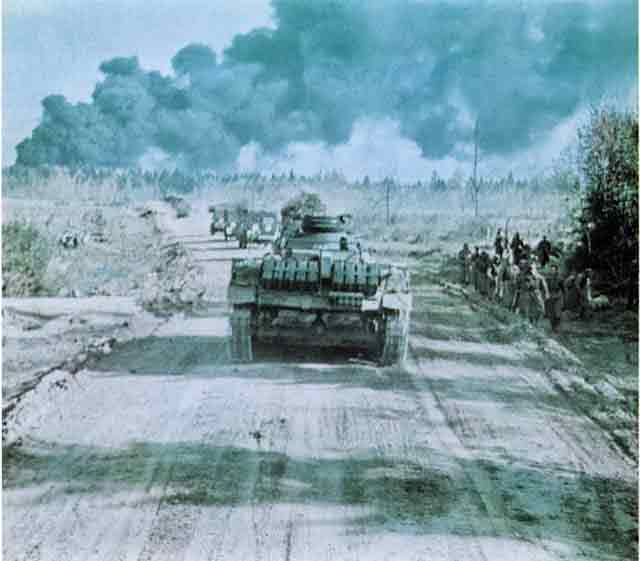
The Battle of Moscow officially began. While Operation Typhoon got off to an early start at the end of September when General Guderian’s Panzer Group 2 launched its attacks, the main offensive involving the rest of the army begins today. Adolf Hitler issues an Order of the Day to the entire German Army (Heer) that makes clear his intentions in the lengthy order which is read out to the troops. It reads in part:
“Today begins the last great, decisive battle of this year. It will hit this enemy destructively and with it the instigator of the entire war, England herself. For if we crush this opponent, we also remove the last English ally on the Continent. Thus we will free the German Reich and entire Europe from a menace greater than any since the time of the Huns and later of the Mongol tribes.”
As per usual, Hitler goes to great pains in his order to place the blame for the entire war on England. This is an odd thing to do when encouraging his troops to attack east, and it would have been fair for his troops to wonder why they are attacking east when England, the supposed instigator of the war, lies to the west. But, as usual, Hitler includes some very tortured reasoning to justify his position even if it isn’t particularly inspiring for the actual battle he is writing the order about.
On a more general note, Hitler’s Order of the Day revealing in other ways, too. It is full of anti-Semitic rhetoric which pins the blame for Germany’s problems on the usual suspects:
“This is a result of nearly a 25-year Jewish rule that, as Bolshevism, is basically similar to the general form of capitalism. The bearers of this system in both cases are the same: Jews and only Jews.”
If anyone ever wonders why there are so many atrocities on the Eastern Front by the Wehrmacht, one need look no further than orders like this one of 2 October 1941. What somewhat ironic is that Stalin is not particularly a friend of the Jews either, but details like that don’t enter into Hitler’s worldview.
As with many orders issuing from the Fuhrer’s Headquarters, it is unclear how the ordinary rank and file feel about this one. For instance, it is the last battle — of 1941. Even that is slightly disingenuous because, as OKH Chief of Staff Franz Halder has noted previously in his daily war diary, Moscow is still far away and it will take an entire campaign just to come close enough to the Soviet capital to actually attack it. Thus, it will take more than one battle for the Wehrmacht to end 1941 successfully, and perhaps many more — assuming that it does end successfully, that is.
Five major German formations — Panzer Group 3 (Colonel General Hermann Hoth), Panzer Group 4 (Colonel General Erich Hoepner), and 2nd Army, 4th Army, and 9th Army — now join General Guderian’s Panzer Group 2 coming up from the southwest. It is a more powerful combination of forces than at any time to date in the war, and they all are pointed directly at Moscow. Panzer Group 3 advances five miles between Soviet 19th and 30th Army, Panzer Group 4 in the north advances 25 miles, and gains are achieved all up and down the line. General Guderian is so confident that he splits his forces into two prongs at Sevsk, one heading toward Bryansk and the other toward Orel. The Soviet defenses appear to be crumbling, and the German field marshals and generals breathe a sigh of relief that the final assault on Moscow has come late, but not too late.
They hope.
The main thrust of Operation TYPHOON began as the 3rd and 4th Panzer Armies in the north join with 2nd Panzer in attacks against the Soviets. The remainder of the German Armeegruppe Mitte launched Operation TYPHOON, the attack on Moscow, Russia. Meanwhile, the German Panzergruppe 2 under General Guderian was split into two pincers at Sevsk, Russia; the northern pincer moved toward Bryansk while the northeastern pincer moved toward Orel. 2,000 German tanks advanced against the Russian lines in this the “last, great decisive battle of the war”, according to Hitler, in a communiqué to his troops, broadcast before the battle commenced. Forces have been withdrawn from south and north to boost the German assault, which many generals had wanted to make several weeks ago before Hitler ordered a diversion to capture industrial and coal-mining areas in the south. Today’s attack makes rapid progress. It needs to as it faces not only dogged Soviet resistance, but also the onset of the Russian winter.
For Leningrad, this assault has offered some respite. Field Marshal von Leeb has failed to take the city by storm, and his tanks have been assigned to Typhoon. Hitler still expects von Leeb to succeed, using artillery and aerial bombardment and the oldest siege weapon, starvation. Hitler says Leningrad “will fall like a leaf.” In Leningrad itself over 4,000 have died in 200 artillery bombardments and 23 air raids in the past month. The first deaths from starvation have been reported.
At Žagarė, Lithuania, SS Einsatzkommandos machine-gun 2,146 Jews to death.
While Himmler is in the Ukraine, Heydrich informs Hitler of the scheduled deportations of all German Jews to specific locations in the Ostland.
The SS executes Czech premier Alois Elias in Berlin.
Paul Collette, the man who tried to assassinate Pierre Laval in August, was sentenced to death. The following day Philippe Pétain commuted the sentence to life imprisonment.
During the night explosive charges destroy six Paris synagogues. SS Standartenführer Helmut Knochen and the SD are thought to be responsible. One of Knochen’s men, Obersturmführer Hans Sommer, had provided the dynamite and the transport to a small flying squad, who were all members of Eugène Deloncle’s MSR (Mouvement Social Révolutionnaire; a Fascist organization).
Himmler arrives in Kiev, which he believes is an ancient German city known as Kiroffo.
After sundown, in England, United Kingdom, German bombers attacked the Tyneside and Tees-side areas in northern England (50 were killed, 250 buildings were destroyed, shipbuilding and repairing facilities at South Shields severely damaged) and Dover area in southeastern England (10 killed).
RAF Bomber Command, Day of 2 October 1941
6 Blenheims to Le Havre did not reach target.
RAF Bomber Command, Night of 2/3 October 1941
6 Halifaxes to Brest, bomb bursts claimed in area of warships. No losses.
At Peenemunde, third Messerschmitt Me 163A rocket-powered prototype aircraft, piloted by Heini Dittmar, achieved an unofficial world speed record of 623.85 mph. Previous flights showed that the aircraft expended almost all its fuel climbing to altitude. Today test pilot Dittmar was towed to 13,000 feet by a Bf110 before casting off. Dittmar said that the Me 163 suffered severe vibration and loss of control for a moment and he had thought that he had “had it at last”. Security will prevent the Germans claiming it as an official world record.
Finnish MTB Nuoli and Sisu attack enemy ships in Suursaari harbour, without results.
Heavy cruiser HMAS Shropshire relieved heavy cruiser HMS London in 74-50N, 56-00E at 0500 in convoy QP.1. Heavy cruiser London returned to Archangel, arriving at 1530/3rd.
Destroyer HMS Escapade relieved destroyer HMS Antelope at 1700 in 70-00N, 13-00W in convoy PQ.1. Destroyer Antelope arrived at Seidisfjord at 1000/3rd to refuel. She departed at 1345 for Scapa Flow, arriving at 1700/4th.
Convoy ON.22 departed Liverpool, escorted by destroyers HMS Broke, HMS Mansfield, and HMS St. Albans, corvette HMS Eglantine, and anti-submarine trawlers HMS Coventry City and HMS King Sol. Destroyer HMS Wolverine joined on the 4th. These escorts were relieved on the 7th by American destroyers USS Dallas, USS Eberle, USS Ellis, USS Ericsson, and USS Upshur. The American ships were detached when the convoy was dispersed on the 15th.
T/Sub Lt (A) D. E. Smith RNVR, was killed when his Walrus of 751 Squadron sank in River Tay.
British steamer Southport (572grt) was damaged when she blown off the blocks by German bombing in the Tyne Dock, South Shields.
U-562, commanded by Oberleutnant zur See Horst Hamm, sank CAM ship Empire Wave (7463grt) from convoy ON.19 in 59-08N, 32-26W. At 0652 hours on 2 October 1941 the unescorted Empire Wave (Master Clement Porter McLay), a straggler from convoy ON.19, was torpedoed and sunk by U-562 about 500 miles east of Cape Farewell. The master, 19 crew members, five gunners and five other DEMS personnel (RDF and catapult operators) abandoned ship in one lifeboat, but they were never seen again after losing contact with the other lifeboat that contained 23 crew members, one gunner, one DEMS personnel and five RAF personnel. The men in the latter boat were picked up by the Icelandic trawler Surprise on 16 October and landed at St. Patrick’s Fjord, Iceland. However, one man had died of exposure in the lifeboat and two other men died after being taken to a hospital at Reykjavik. The 7,463 ton Empire Wave was carrying ballast and was bound for Halifax, Nova Scotia.
U-575, commanded by Kapitänleutnant Günther Heydemann, sank Dutch steamer Tuva (4652grt) in 54-16N, 26-36W. At 0709 hours on 2 Oct 1941, U-575 fired three torpedoes at the three ships in convoy ON.19A and heard two detonations on a first ship and one detonation on a second. However, only Tuva (Master A. van Duin) was hit aft on the port side and sank in a short time after breaking in two. The crew abandoned ship in two lifeboats and two rafts, but had to left a man behind who was trapped under a piece of debris. The survivors were picked up after about one hour by HMCS St. Croix (I 81). The 4,652 ton Tuva was carrying ballast and was bound for Tampa, Florida.
U-431, commanded by Kapitänleutnant Wilhelm Dommes, sank British steamer Hatasu (3198grt) 600 miles east of Cape Race. At 2345 hours on 2 Oct 1941 the Hatasu (Master William Johnston Meek), a straggler from convoy ON.19, was hit by one of two torpedoes from U-431 about 600 miles east of Cape Race. The ship opened fire with a stern gun and forced the U-boat to dive, but broke in two and sank after being hit by a coup de grâce at 0028 hours on 3 October. The master, 33 crew members and six gunners were lost. Seven crew members were picked up from a lifeboat after seven days by USS Charles F. Hughes (DD-428) and landed at Reykjavik. The 3,198 ton Hatasu was carrying ballast and was bound for New York, New York.
Light cruiser HMS Edinburgh and destroyers HMS Cossack, HMS Zulu, ORP Piorun, and ORP Garland departed Gibraltar escorting British steamers Leinster and City of Durban to England. Light cruiser Edinburgh, destroyer ORP Garland, and Polish troopship Sobieski arrived in the Clyde on the 10th. Destroyers Cossack and Zulu were detached en route and met aircraft carrier HMS Argus for escort to Gibraltar.
The Mediterranean Fleet was at sea from Alexandria for exercises. The Fleet returned to Alexandria on the 3rd.
An Italian convoy of German steamers Castellon (2086grt) and Savona (2120grt) departed Naples on 29 September escorted by torpedo boats Calliope and Pegaso for Tripoli. On the 2nd, submarine Perseus sank steamer Castellon 10 miles 311° from Benghazi in 32-30N, 19-09E. Attacks on steamer Savona were unsuccessful.
Submarine HMS Utmost made an unsuccessful attack on a steamer in 37-53N, 12-05E.
Submarines HMS Trusty and HMS Upholder arrived at Malta after patrol off Cape Vito and Naples.
Anti-submarine trawler HMS Klo reported being attacked by a submarine off Alexandria. Destroyers HMS Kandahar and HMS Jaguar searching the area were unable to make contact.
Anti-submarine trawler HMS Lydiard attacked a submarine contact off Haifa. The trawler was joined by destroyer HMAS Vendetta and corvette HMS Hyacinth, without success. The destroyer and the corvette returned to port on the 3rd.
A. S. I. S. ship Churruca (1847grt) was sunk due to an accidental explosion at Alexandria.
The cargo and the ship were later salved.
Convoy HG.74 departed Gibraltar escorted by destroyers HMS Foresight and HMS Forester, aircraft carrier HMS Audacity, sloop HMS Deptford, and corvettes HMS Arbutus, HMS Convolvulus, HMS Cowslip, HMS Marigold, HMS Penstemon, HMS Rhododendron, and HMS Vetch. Destroyers Foresight and Forester were detached and destroyers HMS Duncan and HMS Rockingham departed Gibraltar on 4 October and joined on the 6th. Sloop HMS Enchantress, escort vessel HMS Hartland, and corvette HMS Vervain joined on the 8th. Destroyer Duncan was detached on the 9th. On the 8th, convoy SL.88 rendezvoused with the convoy. Destroyer HMS Blankney and ocean boarding vessel HMS Corinthian joined the convoy on the 9th and were detached on the 11th. Destroyer Rockingham was detached on the 12th and sloop Enchantress was detached on the 17th. The convoy arrived at Liverpool on the 18th.
President Roosevelt today in Washington conferred with Viscount Halifax, the British Ambassador; the Right Rev. Mgr. Michael J. Ready of the National Catholic Welfare Conference, James M. Cox, former Governor of Ohio; Edward J. Flynn, chairman of the Democratic National Committee, and transacted official business. He sent to the Senate the nomination of Arthur Bliss Lane to be Minister to Costa Rica.
The Senate approved the bill extending the time for manufacturers of defense materials to apply for tax amortization, received the Gillette resolution for an investigation of Axis propaganda groups in the United States, heard Senator Guffey assail chain newspapers and Senator Pepper advocate Presidential revocation of bans against American shipping in war zones, and recessed at 1:20 PM until noon Monday. An Interstate Commerce subcommittee approved voluntary mergers of telegraph companies and the committee investigating oil shortages heard J. J. Pelley of the Association of American Railroads.
The House heard Representative Fish criticize President Roosevelt for his statement on the status of religion in Soviet Russia, and adjourned at 1:40 PM until noon Monday.
Viscount Halifax, who returned yesterday from London, conferred with President Roosevelt today on the war situation and the need for accelerating Anglo-American production for quick delivery at the fighting fronts. On leaving the Executive Offices the British Ambassador told reporters that the situation in Russia and the Middle East, as well as latest British technical and political information were canvassed in the fifty-minute conversation. Declaring that “the important thing is to increase production on your side and ours and to deliver it as rapidly as possible to Russia and to us,” the Ambassador for the first time mentioned, although in a most circumspect way, the problem created by strikes in this country. “There are two elements in the development of production,” Lord Halifax told reporters. “One is on the side of management, which should foresee all the controlling factors and overcome them. The other is on the side of workers, their willingness to make sacrifices and put in all the labor they can as hard as they can. In other words, it is important that every one realizes an all-out effort is all that is going to do the job.”
The American Banker Association pledged support of the defense program, endorsed price control and recommended reduction of non-essential government spending today after Treasury Secretary Morgenthau asserted an “all-out” tax bill would be needed next year. The organization’s convention commended the policy of seeking to meet a large proportion of rearmament costs through taxation, but maintained that “the burden should be distributed equitably over the whole population” and held that the “power of taxation must not be used to destroy enterprise. Morgenthau told the bankers that the tax law which went into effect yesterday was only a “good start,” and that “the tax bill next year will have to be a genuinely all-out bill, a genuine levy upon all in accordance with their ability to pay, if it is to raise the necessary revenue, check inflation and take the profit out of war.” Secretary Morgenthau urged several thousand bankers to postpone loans for non-defense projects that would involve competition for materials urgently needed for the nation’s defense effort. He asked them to take this action without waiting for the government’s priorities list to become broader, in a speech at the concluding session of the American Bankers Association’s convention.
The White House issued a statement today saying it was hopeful that an ‘entering wedge” for the practice of complete freedom of religion in Russia “is definitely on its way.” This statement followed an outburst of criticism elicited by President Roosevelt’s recent statement that the Russian constitution permitted freedom of religion. There were several replies that this constitutional provision meant little or nothing in practice.
When the present war ends the United States “must throw the full weight of its influence to the support of an international order based on law,” or it “must outstrip the rest of the world in naval, air, and perhaps military force,” Justice Robert H. Jackson of the Supreme Court said tonight at a dinner of the American Bar Association. “The tragedy and irony of our present position is that we who would make no commitment to support world peace are making contributions a thousand fold greater to support a world war,” Justice Jackson said. “We who would not agree to even economic sanctions to discourage infraction of the peace are now imposing these very sanctions against half the world in an effort to turn the fortunes of war.”
Justice Jackson declared that only well-considered steps toward closer international cooperation and more certain justice could justify the sacrifices which this country was resolved to make. The conquest of lawlessness and violence among nations was a challenge, he said, to modern legal and political organizing genius. The American people were inclined to look cynically at all peace plans at this time, Justice Jackson reasoned, because of their disappointment and frustration at the interruption of a peace they had expected to be permanent. He said that both the isolationists and the advocates of collective security had been disillusioned, the latter at not finding the world as well organized for peace as they had believed and the former at not finding the United States as well insulated from war as they had supposed.
While administrative authorities continued their study today of plans for removing the restrictions of the Neutrality acts on American shipping, Senator Pepper of Florida, forecaster of many foreign policy moves in the past, urged President Roosevelt to revoke the proclamations which had brought the act into force.
President Roosevelt warns in his latest article in Collier’s Magazine that this country cannot afford, under modern conditions of warfare, to wait until it is physically attacked “before starting to shoot.”
Final returns in a coast-to-coast check-up of public sentiment on President Roosevelt’s “shoot at sight” order indicate that this measure is one of the most widely approved of all Administration steps yet taken to cope with the foreign crisis. 62% of respondents approve; only 28% disapprove.
A Senate committee, told that the railroads could begin hauling 200,000 barrels of petroleum dally to the eastern seaboard within two weeks, unofficially reaffirmed today its findings that a threatened gasoline shortage could be avoided if proper steps were taken.
Former U.S. Supreme Court Justice Louis D. Brandeis was reported gravely ill tonight after a heart attack. A close friend of the Brandeis family disclosed the retired jurist, who will be 85 years old next Nov, 13, suffered the attack yesterday and had been constantly under a physician’s care since. Appointed to the court by President Wilson, Brandeis became the teammate of the late Justice Oliver Wendell Holmes in frequent dissenting opinions. Brandeis retired from the Supreme Court on Feb. 13, 1939 after serving 23 years.
The American motion picture industry tonight was called “the modern Benedict Arnold” by Sen. Burton K. Wheeler, Montana Isolationist, who at the same time warned his audience that American boys may eventually be fighting under the red flag of communism. Speaking at an America First rally in the Olympic auditorium in Los Angeles, the Montana senator said that the leaders of the motion picture business are anxious to send American sailors into battle and American soldiers into the “European and Asiatic slaughtering pens.” “The modern Benedict Arnold is the silver screen,” Wheeler said. “I cannot understand how American leaders in the great motion picture industry are willing to pervert their genius from entertainment to war propaganda.”
An injunction to break the boycott established by Local 3 of the International Brotherhood of Electrical Workers, A.F. of L., against the products of eleven major electrical manufacturers was recommended yesterday by John Kirkland Clark, special master, in a report filed in Federal court.
Twenty-four persons were injured, three of them seriously, late today when an explosion ripped through three buildings in the heart of Cumberland, Maryland. Crews of firemen and police searched the twisted wreckage for bodies. The blast endangered the lives of hundreds of persons on their way home from work. Two business establishments were destroyed by the explosion. Police were unable to determine the cause of the blast immediately, but various reports blamed the explosion on leaking gas mains, natural gas beneath the buildings and the refrigeration plant In the meat market.
The Western film “Honky Tonk” starring Clark Gable and Lana Turner premiered at the Capitol Theatre in New York City.
The motion picture “One Foot in Heaven” is released today. Directed by Irving Rapper, this drama stars Fredric March, Martha Scott, Beulah Bondi and Gene Lockhart; Gig Young appears in an uncredited bit part. The plot concerns a minister and his wife facing various problems as church life and 20th century America clash. The film is nominated for the Best Picture Academy Award but loses to “How Green Was My Valley.”
Major League Baseball, World Series, Game 2:
Game 2 of the 1941 World Series between the Brooklyn Dodgers and the New York Yankees is again played in Yankee Stadium. The Yanks lead the series 1–0. The starting pitchers for today are Whit Wyatt (22–10 with a 2.34 ERA for the season) for the Dodgers and Spud Chandler (10–4 with a 3.19 ERA) for the Yankees. Going into this game, the Yankees have won ten consecutive World Series Games. The Yankees jump off to a 2-run lead but the Dodgers tie it up in the 5th inning. In the 6th inning, the Dodger’s first baseman Dolf Camilli hits a single, scoring right fielder Dixie “The People’s Choice” Walker with the final run of the game and the Dodgers win 3–2. The winning pitcher is Whit Wyatt; the losing pitcher is Spud Chandler who was replaced by Johnny “Fireman” Murphy in the 6th inning. The series is now tied 1–1.
Brooklyn Dodgers 3, New York Yankees 2
President Franklin D. Roosevelt rejects Japanese Prime Minister Konoe’s request to meet and discuss Pacific and Far Eastern questions. In response to the Japanese government’s multiple requests for peace talks, the U.S. reiterated its requirement that Japan withdraw its forces from China and Indochina before any such talks could take place. This would lead directly to the fall of the “moderate” Konoe government.
Japan still is continuing negotiations with the United States in an effort to adjust differences between the two powers, Koh Ishii, government information bureau spokesman, said today, but other informed quarters admitted that the outlook was not “too bright.” The latter blamed Washington in part for the fact that the Netherlands Indies is supplying quantities of war materials to Russia while denying the same supplies to this country. Informed quarters generally forecast a new period of acute tension in Southeast Asia, where Britain and the United States were accused of “Intensifying their anti-Japanese encirclement policy.”
With Washington conversations between the United States and Japan believed approaching a decisive stage, Colonel Hayao Mabuchi, director of the intelligence section of Imperial headquarters, today reiterated the Army’s determination to finish the China incident” by armed force and again repudiated any peace based on the status quo ante as “suggested by countries hostile to Japan.”
With both Chinese and Japanese claiming a gigantic victory in the two-week campaign in Hunan Province, the Japanese today launched a new offensive 500 miles to the north, in Honan Province, apparently aimed, as was the other, at erasing the stigma of an old defeat. Chengchow appears to be the objective.
Japanese submarine HIJMS I-61 was lost in an accidental collision with a gunboat off Iki Island, 33-40N, 129-40E. The entire crew of seventy was lost on the submarine. In February 1942, the submarine was salved and broken up at Sasebo.
General MacArthur chooses Major General Lewis H Brereton, whom he had known in the First World War, as his Air Commander.
Dow Jones Industrial Average: 126.15 (-0.7)
Born:
Ron Meagher, American rock bassist (The Beau Brummels — “Just A Little”), in Oakland, California.
Naval Construction:
The U.S. Navy Castor-class general stores issue ship USS Pollux (AKS-4) is laid down as SS Nancy Lykes, a Maritime Commission type (C2-Cargo) hull, under Maritime Commission contract (MC Hull 131) by the Federal Shipbuilding and Dry Dock Co. (Hoboken, New Jersey, U.S.A.).
The U.S. Navy PC-461-class (173-foot steel hull) submarine chaser USS PC-476 is laid down by the Defoe Shipbuilding Co. (Bay City, Michigan, U.S.A.).
The Kriegsmarine (German Navy) Type VIIC U-boat U-636 is laid down by Blohm & Voss, Hamburg (werk 612).
The Kriegsmarine (German Navy) Type VIIC U-boat U-821 is laid down by Oderwerke AG, Stettin (werk 821).
The U.S. Navy Fletcher-class destroyers USS Fletcher (DD-445) and USS Radford (DD-446) are laid down by the Federal Shipbuilding & Drydock Co. (Kearny, New Jersey, U.S.A.).
The Royal Navy’s last battleship, HMS Vanguard (23), sole ship of her class, and the world’s last battleship to be built, is laid down by John Brown and Co. (Clydebank, Scotland, United Kingdom). She will not be completed until 1946.
The Kriegsmarine (German Navy) Type VIIC U-boat U-598 is launched by Blohm & Voss, Hamburg (werk 574).
The Royal Navy Fairmile B-class motor launch HMS ML 282 is commissioned.
The Regia Marina (Royal Italian Navy) Acciaio-class submarine Platino is commissioned.
The Kriegsmarine (German Navy) Type VIIC U-boat U-377 is commissioned. Her first commanding officer is Kapitänleutnant Otto Köhler.
The Kriegsmarine (German Navy) Type VIIC U-boat U-590 is commissioned. Her first commanding officer is Kapitänleutnant Heinrich Müller-Edzards.
The Royal Canadian Navy Flower-class corvette HMCS Louisburg (K 143) is commissioned. Her first commanding officer is Lieutenant Commander William Franklin Campbell, RCNVR.
The Royal Navy escort aircraft carrier HMS Charger (D 27; former Rio de la Plata) is commissioned. Her (brief) first commander is Captain George Abel-Smith, RN. Two days later she is returned to the U.S. and eventually will commission into the U.S. Navy as USS Charger (AVG-30, then ACV-30, finally CVE-30).

