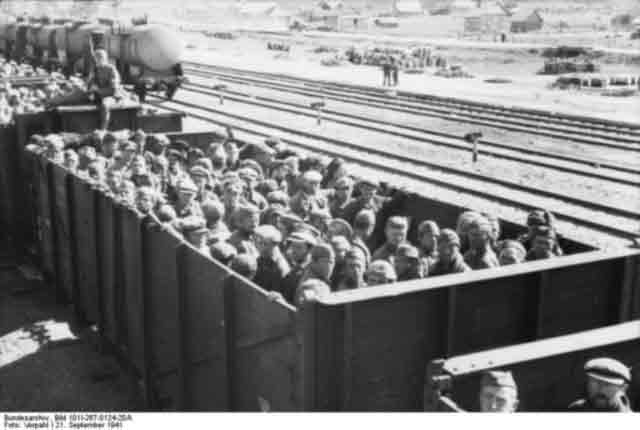
The situation on the Eastern Front that looked so stable for Joseph Stalin just a week or two ago suddenly has taken a precipitous turn as of 21 September 1941. Kiev now is lost, Leningrad is encircled except over Lake Ladoga, and about a million men have been lost on the southern front. It isn’t that the war is lost, but a question begins to arise: are the troops fighting as hard as they can?
Already, there are signs of disintegration in the Red Army. In fact, entire units in the southern sector of the front — the area with the least love for the Soviet regime — going over to the enemy. For instance, Major Kononov’s 436th Infantry Regiment of Soviet 155th Rifle Division deserted en masse around 19 September and goes into German service as a Don Cossack unit. Old regional rivalries in the area are reasserting themselves as Soviet control and intimidation wanes, with Ukraine a particular area of concern at the moment. As the Germans advance, they offer opportunities to defect to tribes that dislike Moscow and Stalin, a Georgian whom many instinctively dislike.
Stalin knows this could spell real trouble. The Soviet Union dwarfs the Reich and has a huge manpower edge (roughly 3:1). However, if the Soviet state fragments, that advantage is lost and may even reverse. While Stalin always has been a suspicious loner ready to believe the worst of anyone, this tendency suddenly mushrooms into outright fear. A tone of rising paranoia begins to creep into official communications from the Kremlin, and it is distinctively unfriendly toward anyone who might pose a threat.
There are two instances today of Stalin exerting tightening his grip. He personally sends a message to his top general, Georgy Zhukov, who recently took over in Leningrad. He is not worried about the military situation, perilous as it is. Instead, the note to Zhukov (also addressed to local leaders Andrei Zhdanov, Nikolai Kuznetsov, and Vsevolod Merkulov, but everyone knows who is really in charge) inquires on a much more mundane and seemingly trivial incident.
Stalin notes that the Germans have been using local Soviet citizens as messengers to demand a surrender of the besieged garrison. Again, Stalin is not worried about the contents of the messages or the response — it is the messengers themselves that concerns him. Stalin writes that these ordinary Soviet citizens are “more dangerous than the fascists” and must be executed for becoming involved. Now, Leningrad is a special case — it was a focal point of the Bolshevik Revolution in 1917 and has a long history of acting contrary to Moscow’s wishes. However, another incident today shows that this is not an isolated concern of Stalin’s.
Marshal Shaposhnikov at the Kremlin issues Stavka VGK Directive No. 002202. While ostensibly requesting a routine status report from Colonel-General Kirponos (who, unbeknownst to the Stavka already is dead), the directive is quite revealing. It states:
“The Stavka of the Supreme High Command demands that you report immediately: 1. Whether or not your units have abandoned Kiev? 2. If Kiev has been abandoned, whether or not the bridges been blown up? 3. If the bridges have been blown up, then who will vouch for the fact the bridges have been blown up?”
Note the last portion of the inquiry. The Stavka wants not only to know that the bridges have been blown, but it wants proof that they have been blown. There’s no trust there, and Stalin no longer even trusts his top generals on the spot. It’s obvious that whoever “vouches” for the fact that the bridges have been destroyed will pay with his life if they are not, or if the job was done improperly.
All of this seems extremely alien to Western eyes, almost incomprehensible. Orders are orders, and they are expected to be carried out. If they are not carried out, then a reason will be provided and perhaps a court-martial arranged, but it is simply assumed that everyone is at least operating with patriotism. However, paranoia rages in the Soviet Union at the best of times, and these are hardly the best of times for Joseph Stalin.
Soviet troops evacuate the capital, Riga, and the Germans capture the key naval base at Oesel.
The Soviet Baltic Red Fleet at Kronstadt is attacked by 180 Luftwaffe Stuka which dive bombers sink or damage nine ships, including battleship Marat, which settles on the bottom after losing its bow by a 1000 kg bomb hit. Much of the Naval dockyard is destroyed.
The Soviet 37th Army surrenders to the Germans ending resistance in Kiev. Meanwhile, the German 11th Army reaches the Sea of Azoz, cutting off the Crimean Peninsula.
Soviet forces attacked the Rumanian 15th Infantry Division near Odessa, Ukraine by landing 1,617 troops of the 3rd Naval Rifle Regiment (by Soviet cruiser Krasni Kavkaz, cruiser Krasni Krym, destroyer Boyki, destroyer Besposhchadny, destroyer Bezuprechny, and destroyer Frunze) and by launching 157th and 421st Rifle Divisions on the ground. Destroyer Frunze was sunk by German Ju-87 Stuka dive bombers in the action.
The Mediterranean U-boat Campaign began when U-371 passed Gibraltar.
Allied convoy ON.18 departed Liverpool, England, United Kingdom with destroyers HMS Leamington, HMS Saladin, HMS Skate, and HMS Veteran in escort.
There is a total eclipse of the sun in China.
RAF Bomber Command, Day of 21 September 1941
12 Blenheims and 6 Hampdens on Circus operations to Gosnay and Lille. No losses.
U-201, commanded by Oberleutnant zur See Adalbert Schnee, sank British steamer Runa (1575grt) in 46-20N, 22-23W and British steamers Lissa (1511grt) and Rhineland (1381grt) in 47N, 22W from convoy OG.74.
At 2250 hours on 21 September 1941 the Runa (Master Hugh McLarty) in convoy OG.74 was torpedoed and sunk by U-201 north-northeast of the Azores. Twelve crew members and two gunners were lost. The master, seven crew members and one gunner were picked up by HMS Deptford (L 53) (LtCdr H.R. White, RN) and landed at Gibraltar. The 1,575-ton Runa was carrying coal and was headed for Lisbon, Portugal.
At 2320 and 2321 hours on 21 September 1941, U-201 fired torpedoes at the convoy OG.74 north-northeast of the Azores and reported two ships sunk. The ships hit were Lissa and Rhineland.
The master, 21 crew members and four gunners from the Lissa (Master Donald MacQuarrie) were lost. The 1,511-ton Lissa was carrying coal and was headed for Lisbon, Portugal.
The Rhineland (Master John Thorburn Gilroy) was sunk by a coup de grâce at 2341 hours. The master, 22 crew members and three gunners were lost. The 1,381-ton Rhineland was carrying coal and bags of mail and was headed for Gibraltar.
Italian submarine Ascianghi set on fire by gunfire the Palestinian steamer Antar (389grt) in 33-57N, 35-04E. The crew landed at Tyre. Whaler HMS Southern Isle proceeded to the area and took the hull in tow, but it sank on the 23rd before they could arrive in harbour.
Minelaying cruiser HMS Manxman departed Portsmouth and laid minefield JU off Dieppe.
British tanker Vancouver (5729grt) was sunk on a mine about two miles 263° from Sunk Light Vessel in 51-51N, 1-31E.
Soviet destroyer Frunza was sunk by German bombing east of Tendra Island in the Baltic.
Soviet submarine Stereguschy was sunk by German bombing off Peteroff.
Minelaying cruiser HMS Latona and destroyers HMAS Napier, HMS Kingston, and HMS Hotspur departed Alexandria on Serial 7 of the SUPERCHARGE operation. The ships arrived back at Alexandria on the 22nd.
British troopship Glengyle departed Alexandria for the Canal Area to relieve troopship Glenroy at the Combined Operations Training Centre at Kabret. Destroyers HMS Hero and HMS Jackal met troopship Glengyle off Alexandria and escorted her to Port Said. Destroyers Hero and Jackal arrived back at Alexandria on the 22nd.
Corvettes HMS Peony, HMS Hyacinth, and HMS Erica departed Beirut on an anti-submarine sweep.
At sunset, the flag of Cruiser Squadron 15 was hauled down from light cruiser HMS Naiad. Vice Admiral E. L. S. King CB, MVO, was ordered to the appointment of Assistant Chief Naval Staff (Trade) in the Admiralty. Captain W. H. A. Kelsey DSC, assumed the duties of Senior Officer, 15th Cruiser Squadron, and Senior Officer, Suez Escort Force.
Light cruiser HMS Edinburgh arrived at Gibraltar after escorting convoy WS.10 to the Capetown.
Destroyer HMS Lively departed Gibraltar to join convoy WS.11X.
Dutch submarine HNLMS O.21 departed Gibraltar for patrol in the Mediterranean to support HALBERD operations.
Convoy ON.19 departed Liverpool. It was escorted from 22 September by destroyers HMS Beagle, HMS Montgomery, HMS Roxborough, and HMS Salisbury, corvettes HMS Heather, HMS Lobelia, and HMS Narcissus, minesweepers HMS Britomart, HMS Gossamer, and HMS Leda, and anti-submarine trawler HMS Norwich City. The convoy was joined on the 23rd by corvettes HMCS Alberni and HMCS Kenogami and minesweeper HMS Hussar. The minesweepers were detached on the 25th. Corvettes Alysse and HMCS Mayflower joined the convoy on the 27th and with corvettes HMCS Alberni and HMCS Kenogami escorted the convoy when rest of the escorts were detached. Corvette HMCS Mayflower was detached on 6 October. The convoy was dispersed on 7 October and the other three corvettes were detached.
President Roosevelt will arrive in Washington early tomorrow from Hyde Park prepared to do his utmost to have the new $5,985,000,000 lend-lease appropriation approved by Congress as quickly as possible. With the situation in Russia underlining the possibility that Nazi pressure against Britain will increase, and the danger to the United States become more acute, the President believes it imperative that amplified armaments production under the lend-lease program be started immediately, officials indicated today. Before leaving Hyde Park this evening after a quiet weekend the Executive asked legislative leaders and representatives of the Senate and House Appropriations Committees to confer with him at the White House shortly after his arrival.
Senator Clark, Idaho Democrat, an opponent of administration foreign policies, said today that congress probably would be asked to write into the pending $5,985,000,000 lend-lease appropriation a prohibition against aid to Russia, but Senator George, Georgia Democrat, said this would be a fatal mistake. Clark told reporters that such a proposal had been discussed by the senate’s so-called non-intervention group. President Roosevelt said recently that there was no present need to make lend-lease funds available to the Soviets because they had resources upon which to draw for cash payments.
President Roosevelt in a Jewish New Year’s message today called upon the nation to rededicate itself “to the task which lies before us, in order that all peoples may live as equals.” His message was read by Dr. Stephen S. Wise, noted Jewish leader, in a C.B.S. broadcast sponsored by the United Jewish Appeal commemorating the opening of the year 5702 in the Hebrew calendar. The text of the president’s message: “At this tragic hour in modern civilization, I extend to the Jewish people of America my sincere greetings for the new year, in the confident hope that the temporary darkness which appears to encompass the world shall not extinguish the light of liberty and the blessings of peace and freedom. Accordingly, with a united devotion to the just cause of tolerance and peace, we must rededicate ourselves to the task which lies before us, in order that all peoples may live as equals.”
Chairman Martin Dies of the House committee investigating un-American activities, said last night that President Roosevelt had asked him to defer an investigation of Japanese espionage on the West Coast and that he would comply. Presumably the request was made because the inquiry might affect adversely the progress of Japanese — American diplomatic conversations, Mr. Dies said. The chairman said that the committee would “defer to the Administration’s wishes.” Mr. Dies said that the inquiry would have revealed many sensational facts, and one committee member described the potential Japanese espionage organization in America as “greater than the Germans ever dreamed of having in the Low Countries.” He said that it would be a “tremendous force to reckon with in event of war”
The Justice Department has been asked to take action under the anti-trust laws against “priority profiteers,” who have raised prices of some chemicals from 100 to 400 percent. At the Office of Price Administration it was said that the offenders, numbering more than two score, were mainly brokers, many in business less than a year. These brokers were charging exorbitant prices, officials declared, for commonly used chemicals essential to the manufacture of drugs, paints, textiles, dyes and plastics. A large part of their business is believed to be with small users who fear more drastic priority restrictions and shortages and who feel compelled to buy at any price asked.
The Keep America Out of War congress said today it disagrees with and regretted Charles A, Lindbergh’s statement in Des Moines, Iowa, “on the relation of American citizens of Jewish origin or faith to the drive for war.”
Freedom of the seas is essential to the national defense and political freedom of the United States, Dr. William Y. Elliott, former chairman of the Department of Government at Harvard University, said tonight in a debate with Representative Hamilton Fish Jr., Republican, of New York, who charged that “the whole issue of freedom of the seas is filled with the rankest kind of hypocrisy, quibbling and hair-splitting.”
Three more ships were tied up today by the Seafarers’ International union (A.F.L.), bringing the total of strikebound vessels throughout the country to 19, and the union reiterated it would strike every foreign-run ship under contract with it “as soon as it hits an American port.” S.I.U. heads said the three ships, all owned by the Alcoa Steamship Co., were the Alcoa Pathfinder, docked at Brooklyn, the Alcoa Patriot, at Tacoma, Washington, and the Alcoa Cutter, at New York. All arrived yesterday.
Seamen on three more ships arriving in United States ports went on strike yesterday as the Seafarers International Union, A.F. of L., denounced as “intimidation” the action of the government in seizing three other vessels and sailing two of them under Maritime Commission operation.
A tropical hurricane sweeping in from the Gulf of Mexico today prompted the army to disperse 400 planes in south Louisiana to safer areas. Coastal residents we warned by the coast guard to seek shelter inland. The storm, which the weather bureau said was centered at 7 PM about 225 miles south of Port Eads, Louisiana, at the mouth of the Mississippi river, was headed toward the zone in which 500,000 troops are camped for maneuvers. The warning to coastal dwellers to seek safety extended from Pascagoula, Mississippi, to Morgan City, Louisiana, while storm warnings from the approaching blow went up from Carrabelle, Florida, to Sabine, Texas.
Major League Baseball:
In their last home game of the year, the Red Sox beat the Yankees, 4–1, behind Harris and clinch 2nd place. Williams is 1-for–3, hitting his 36th homer. Joe Cronin adds a homer and triple. Joe Gordon ties the Major League record with 11 assists at second base.
In the fight for third place in the American League, the visiting Tigers take the opener with the White Sox, 6–3, behind Tommy Bridges. The second game goes 14 innings and ends in a 1–1 tie with each team collecting 8 hits. Starters Johnny Rigney and Schoolboy Rowe go the distance.
Elmer Riddle pitched his fourth shutout of the season for Cincinnati today to beat Pittsburgh, 2–0, and gain his eighteenth victory against four defeats — the best pitching record in the National League. Riddle gave only six hits as the Reds swept the three-game series to take a five-and-one-half game hold on third place — virtually clinching that position.
The Cleveland Indians and St. Louis Browns traded shut-outs today, the Indians grabbing the opener, 14–0, and the Browns taking the nightcap, 3–0. Approximately 7,500 fans in League Park saw Lefty Al Smith hurl his eleventh victory by holding the Browns to five hits in the first game, four of them singles. His team-mates, including four rookies, collected eighteen safeties. Jeff Heath and Rookie Hank Edwards each tagged four hits.
Mosel Tov. With four Jews in their starting lineup, including the battery of Harry Feldman and Harry Danning, the Giants beat the Braves, 4–0, in the opener, then pile on to win, 15–4, in game 2. Feldman (1–0) wins his first Major League game in the opener, tossing an 8-hit shutout, as Morrie Arnovich and Sid Gordon each have a hit. Babe Young hits his 25th homer. Johnny McCarthy (4 hits, 4 RBI) and Ken O’Dea (4 hits, 4 runs) pace a 20-hit attack in game 2.
35,909 fans are on hand at Shibe Park, many traveling from Brooklyn to cheer for the Dodgers. Brooklyn wins the opener, 8–3, behind Johnny Allen, and the Phillies win the nightcap 6–3. Phillies outfielder Danny Litwhiler hits a 1st inning grand slam off Luke Hamlin to start the scoring. The Dodgers now lead by a game.
The Cardinals sweep a Sunday doubleheader from the Cubs, 6–5 and 7–0, as Musial goes 6-for–10. In the opener, Musial scores the winning run in the 9th inning, racing home from second base on a topped ball that’s fielded by catcher Clyde McCullough. The sweep moves the Cardinals one game in back of Brooklyn.
In the first of two at Griffith, the Senators push across 2 runs in the 9th to beat the A’s, 6–5. The Nats complete the sweep in the nightcap with a 6–2 win behind Early Wynn (3–0). George Case goes hitless and his consecutive-game hitting streak ends at 20.
New York Yankees 1, Boston Red Sox 4
Detroit Tigers 6, Chicago White Sox 3
Detroit Tigers 1, Chicago White Sox 1
Pittsburgh Pirates 0, Cincinnati Reds 2
St. Louis Browns 0, Cleveland Indians 14
St. Louis Browns 3, Cleveland Indians 0
Boston Braves 0, New York Giants 4
Boston Braves 4, New York Giants 15
Brooklyn Dodgers 8, Philadelphia Phillies 3
Brooklyn Dodgers 3, Philadelphia Phillies 6
Chicago Cubs 5, St. Louis Cardinals 6
Chicago Cubs 0, St. Louis Cardinals 7
Philadelphia Athletics 5, Washington Senators 6
Philadelphia Athletics 2, Washington Senators 6
A preliminary study of the virtual economic blockade of Japan by the United States and the British Commonwealth through the stoppage of trade gives an indication that if this blockade is maintained beyond six months Japan will have “to plead for an economic truce with America and Britain and sue for a military armistice with China.”
Counter-attacking Chinese today halted a southward Japanese drive that had gained ground in Northern Hunan Province, dispatches from the front said tonight. The Chinese reports said heavy casualties had been inflicted upon the Japanese central force of 10,000 men, about a third of the entire foroe of the invaders participating in the campalgn.
The Japanese Army’s latest big drive to rout Chinese Communists from Northern Shansi and Hopeh Provinces has been no more successful than their previous futile attempts, Chinese arriving from the region reported today.
Canton dispatches disclose that Japanese forces are attacking vigorously north of Canton and along the eastern bank of the East River. The Japanese launched the offensive Thursday at the time of the new Hunan Province push. They report considerable progress by columns that marched simultaneously from bases at Tsengshin, Fukwo, Shenkong and Fayun, forty to fifty miles east and northeast of Canton. On Friday the Japanese attacked in the West River area and south of Canton.
The Imperial Japanese Navy battleship HIJMS Mutsu departs Yokosuka.
Born:
R. James Woolsey Jr., American lawyer and director of Central Intelligence Agency (1993-1995), in Tulsa, Oklahoma (d. 2026).
Jack Brisco, American professional wrestler (NWA World Heavyweight Champion 1973–1975), in Seminole, Oklahoma (d. 2010).
Tony Moon, American doo-wop singer, arranger, guitarist (Dante & the Evergreens — “Alley Oop”), producer, and songwriter (“Soldier of Love (Lay Down Your Arms)”), in Los Angeles, California.
Naval Construction:
The Royal Navy MMS I-class motor minesweeper HMS MMS 79 (J 579) is commissioned. Her first commanding officer is T/Lieutenant John Henry Campbell Collier, RNVR.
 History Diaries