The slow-moving strategic arms talks resumed in Geneva today, their future now beclouded by a Presidential campaign in the United States. After a summer‐long recess, American and Soviet negotiators renewed their discussions of a treaty that would impose ceilings on the strategic weapons permitted the two nations‐an objective that President Ford and Leonid I. Brezhnev, the Soviet leader, agreed upon in principle at Vladivostok two years ago. With no political desire to call attention to the talks, the United States handled the resumption in low‐keyed fashion. The State Department did not even put out an announcement, as it has in the past, that the American delegation, headed by U. Alexis Johnson, was returning to Geneva. With détente no longer a popular political cause and with no progress to point to in the negotiations, the United States evidently did not want to raise the strategic arms issue in the Presidential campaign. The talks resumed with both sides still deadlocked over whether the proposed treaty should cover a long‐range bomber being deployed by the Soviet Union and the cruise missile being developed by the United States. The American delegation, according to officials, returned with no new proposals or concessions to offer on the two interrelated weapons issues, both of which emerged after the Vladivostok meeting.
At Vladivostok an agreement was reached in principle that a new treaty should limit each side to 2,400 strategic missile launchers and bombers and that within that overall total each side would be limited to 1,320 launchers for missiles carrying multiple warheads. For more than a year, the two sides have been negotiating with no success over whether the bomber and the cruise missile, which is a highly accurate, jet‐powered drone, should somehow be included within these overall limitations. As described by policy‐making officials, the United States position is that it is now up to the Soviet Union to make a move to break the deadlock. To a certain extent, it was acknowledged, this position was influenced by a desire not to take any potentially controversial initiatives in the midst of the election campaign. It is unclear whether the Soviet Union also will feel inhibited by election‐year politics in the United States from making a move. On that point, there is divided opinion within the United States Government.
Amphibious tractors waddled ashore from Namsen Fjord and discharged shouting United States marines. Helicopters dumped a company of reserves from Kansas and Missouri onto high ground above the beachhead. Jets flew cover for the maneuver, being conducted by the Atlantic alliance. Under a bright sun and a flawless sky it was magnificent, but an American marine major and a British marine captain noted that in wartime such an operation would be possible only at night. With King Olav V of Norway and other dignitaries among the spectators yesterday, however, the high point of the exercise had to be carried out in daylight. It is the largest held in the North Atlantic Treaty Organization’s northern command, involving 200 ships, including 30 submarines. 900 aircraft and approximately 80,000 people. According to Vice Admiral John J. Shanahan Jr.. who commands both the United States Second Fleet and the multinational NATO striking fleet involved in the exercise, it is not a war game in which one side or the other wins but a training exercise whose object is to test doctrine and tactics in conditions approximating those of warfare. The political importance is to demonstrate to the Soviet Union that NATO is capable of coming to Norway’s aid in the event of a Soviet attack across central Norway aimed at securing submarine bases on the North Atlantic.
Defense Secretary Donald H. Rumsfeld confirmed that he overrode the Army’s recommendation that its tank of the future be totally U.S.-made. Instead, Rumsfeld said in a letter to the House Armed Services Committee, he chose to make the new XM1 a hybrid U.S.-German design. Some members of the committee who were critical of Rumsfeld’s decision wanted him to testify in person. He declined. In his letter to the committee, Rumsfeld said he wanted to make key parts of the U.S. tank compatible with those of a new German tank.
Preliminary dismantling of the Soviet Union’s most advanced fighter plane, flown to Japan by a Soviet air force defector, has shown that the MIG-25 is heavier and probably slower to accelerate than expected, military sources said. Discovery that the plane is made mostly of relatively heavy alloy steel rather than titanium or other lightweight metals was the first information to come from the study of the plane at Hakodate airport in northern Japan. Japanese and U.S. experts are dismantling the plane.
The Navy has flown special underwater search equipment to Scotland and will start hunting for a sophisticated F-14 fighter plane on the Atlantic Ocean floor as soon as weather permits, the Pentagon said. The jet rolled off the deck of the carrier John F. Kennedy last week and rests 1,900 feet below the surface about 75 miles northwest of Scapa Flow, Scotland. The jet has a top-secret Phoenix missile system aboard.
The Polish Communist Party’s leadership has been severely shaken by its finding that it lost touch with public opinion. That was the inevitable conclusion last June when workers, rioting after the sudden announcement of a sharp rise in food prices, forced the cancellation of measures that are economically essential. According to a high Communist source, among the efforts the Government had made to test the likely reaction was to consult the first secretaries of the 50 provincial party committees. Only one warned that the increases would cause popular unrest; the others said the people understood the need for the move and would accept it. Furthermore, the source said, Soviet leaders expressed misgivings over the Polish plans, suggesting that the increases were too big and too sudden to be imposed without risk. Warsaw’s answer was that the Polish Communists knew their country better than the Russians did and had prepared their plan well enough to be satisfied that it would work.
Britain gave up hope of finding alive 10 seamen believed trapped in the minesweeper HMS Fittleton that capsized and sank in the North Sea off the Dutch coast after colliding with the British frigate Mermaid. The death toll stands at 12, with the bodies of two being recovered after the collision. Five British Navy divers and six Dutch divers tapped the hull of the sunken minesweeper in the hope that the 10 missing men might have been trapped in an airlock. They reported no response.
The Spanish government has lifted its ban on display of the Basque nationalist flag in northern provinces in an effort to reduce tension there, according to sources in Madrid. The use of guns by police has also been restricted, the sources said. The measures were reportedly the result of a fact-finding tour of the Basque provinces by Interior Minister Rodolfo Martin Villa. The provinces have been swept by street violence and a recent strike involving as many as 250,000 workers.
The Strømme Foundation was founded in Norway as a volunteer development organization to provide “microfinance” (small, low-interest loans) to impoverished people in the Third World to help them bring themselves out of poverty.
The Lebanese National Assembly will meet in Syrian‐controlled territory of eastern Lebanon on Thursday to inaugurate Elias Sarkis as President. The decision to hold the session under the protection of the Syrian Army was made by the assembly’s speaker, Kamal Assad, a Muslim, after it had become clear that neither the Lebanese authorities nor the Arab League’s peacekeeping force could assure the safety of the Christian and Muslim deputies in Beirut. The session, if held as planned, will be the first outside the capital in Lebanon’s history. Originally, it was planned that the ceremony would be at the Esseily Villa, a private residence in no man’s land near the only crossing point between the generally Christian districts of east Beirut and the mostly Muslim areas of west Beirut.
The Thai government said it would ask former Prime Minister Thanom Kittikachorn to leave the country to head off growing student protests over his return from exile. The former military strong man, ousted from power in 1973 student-led uprising, returned to Thailand from Singapore Sunday and immediately entered the Buddhist monkhood. Observers said Thanom might be allowed to stay in Thailand until the death of his 91-year-old father, who has been ill for some time.
The United Nations General Assembly convened with a silent tribute to the late Mao Zedong, the admission of the Seychelles to membership, and the withdrawal by North Korea of its resolution demanding that United States troops leave South Korea. With the future of southern Africa dominating the session, delegates were waiting to hear from Mr. Kissinger.
Piece by piece, the top-secret MIG-25 jet fighter flown to Japan by a defecting Soviet pilot was being further taken apart at a civilian airfield in northern Japan today, while diplomats here in the capital pondered potential repercussions of the incident in relations with the Soviet Union. The Russians have been demanding its immediate return, but the official Japanese reply is that they must keep it long enough to investigate the violation of Japanese airspace and other issues.
The Batasang Bayan was founded by the Government of the Philippines as a consultative advisory council to help word the decrees issued by President Ferdinand Marcos during his rule by decree during a period of martial law. The advisory council was abolished after two years, being discontinued on October 30, 1978.
Left-wing Panamanian students, demonstrating against the government of General Omar Torrijos because of rising food prices, ended their occupation of the National University in Panama City after troops used tear gas and truncheons throughout the night to force them out. The more than 100 students left in university buses after pleas by Rector Elgio Solis and under a safe-conduct agreement with authorities.
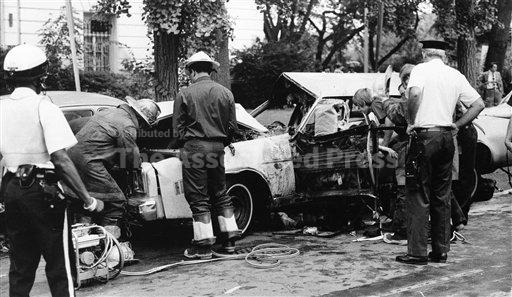
Orlando Letelier of Chile, who had served as the South American nation’s Foreign Minister, Minister of the Interior and Defense Minister, as well as Chile’s Ambassador to the United States, was assassinated by a car bomb in Washington, D.C. by agents of President Augusto Pinochet’s secret police, the Dirección de Inteligencia Nacional (DINA). The blast which took place in front of the Romanian Embassy in Washington, also killed Letelier’s co-worker at the Institute for Policy Studies, Ronni Karpen Moffitt. At 9:35 in the morning, as Letelier was driving to the Institute with Moffitt and her husband, a plastique bomb affixed beneath the car below the driver’s seat, exploded, mortally wounding both Letelier and Moffitt. Michael Townley, a U.S. native who had worked for the Pinochet government, would later be convicted of carrying out the assassination.
Secretary Kissinger told President Nyerere of Tanzania that Prime Minister Ian Smith of Rhodesia had accepted the principle of black majority rule within two years. President Nyerere said he felt that “a basis for movement forward is there,” but he cautioned that negotiations still depended on Mr. Smith’s honoring the pledge he apparently gave to Secretary Kissinger in Pretoria, South Africa, on Sunday. Mr. Nyerere’s tone was in marked contrast to the gloom he displayed at a news conference six days ago, when Mr. Kissinger arrived here to start his shuttle trip between black and white Africa. Prime Minister Ian D. Smith emerged today from consultations with his Cabinet saying that the question of accepting proposals for a Rhodesian settlement that he had discussed with Secretary of State Henry A. Kissinger required cautious deliberation since it involved “the future of Rhodesia and the lives of our people.”
Britain cast a hopeful but skeptical eye today on reports from southern Africa that Rhodesia’s white leadership was prepared to transfer power to the black majority. In contrast to the rising optimism that has been generated by Secretary of State Henry A. Kissinger’s present round of African diplomacy, officials at the Foreign Office here said they wanted to see a “firm commitment” by the Rhodesian leader, Ian D. Smith, before they could pronounce the mission a success. The officials, who mirrored the thinking of Foreign Secretary Anthony Crosland, suggested that Mr. Smith might be engaging in an old and favorite device of his — buying time on the premise that Mr. Kissinger might not be in office much longer to enforce any bargain he strikes. The British are, of course, eager to have Mr. Kissinger’s efforts succeed, since it was they who gave early warnings to the United States that failure to solve the Rhodesian question could exhaust the patience of black African leaders and lead to widespread racial warfare on the continent.
Inflation continued its steady pace in August, but lower meat prices partly offset the spurts in gasoline, clothing and medical care. The Labor Department said the August consumer price increase was again five-tenths of 1 percent, as in June and July.
President Ford’s finances while a congressman were under examination in his home district and in connection with his golfing weekends with a steel company lobbyist. The White House press secretary said Mr. Ford needed no defending because “nobody has said there has been any wrongdoing.”
Jimmy Carter proposed combining all federal agencies concerned with energy policy in a single cabinet-level department as a first step toward a new national energy program. Some saw the statement as a defense against charges of “fuzziness” on actual plans for government reorganization.
The House of Representatives, failing to heed an appeal to “regulate the regulators,” rejected tonight legislation that would have given Congress sweeping veto power over rules and regulations of the Federal departments and agencies. Although there were 285 votes in favor of the measure and 135 in opposition, the bill failed to pass because it was brought up under an expedited procedure requiring a two‐thirds vote. With Congress pushing to adjourn by the end of next week, it appeared that the legislation, long sought by many Representatives to answer constituents’ complaints about growing Federal bureaucracy, was dead for this session. In another legislative development, the House passed by a vote of 315 to 86 and sent to the Senate a measure prohibiting all interstate off‐track parimutual betting on horse races.
The retirement dreams of millions of Americans could become nightmares unless Congress and the Internal Revenue Service act to help people make rational selections of Individual Retirement Accounts, a House subcommittee was told today.
A Senate-House conference committee failed today to reach agreement on a bill to reform the nation’s scandal-ridden grain inspection system after intensive lobbying by Secretary of Agriculture Earl L. Butz and his top assistant against a Senate compromise proposal.
Five members of a Croatian nationalist organization were indicted by a federal grand jury in New York City on air piracy charges stemming from the hijacking of a Trans World Airlines jetliner September 10. The defendants — Zvonko Busic, his wife, Julienne, Petar Matanic, Frane Pesut and Mark Vlasic-are expected to enter pleas later this week. They are being held on $1 million bail each.
The mail fraud and racketeering charges against Maryland Governor Marvin Mandel are “accusations searching vainly for truth,” Mandel’s lawyer told a federal jury in Baltimore during his opening statement. Federal prosecutors have charged that Mandel and his four codefendants W. Dale Hess, brothers William and Harry Rodgers and Ernest Cory Jr. -devised a scheme to conceal the true identity of the owner of Marlboro Race Track. Prosecutors told the jury that Hess and the Rodgers brothers bought the track in 1971 and gave Mandel two bribes worth about $200,000. In return, they said. Mandel tried to push through legislation favorable to the race track. Cory allegedly falsified the documents for the scheme.
The Internal Revenue Service is checking the tax returns of 375 persons believed to be among the nation’s top-ranking traffickers in illicit narcotics, IRS Commissioner Donald C. Alexander said. The disclosure came during an explanation of the IRS’ efforts to assist the Drug Enforcement Administration’s war against the $10 billion annual traffic in heroin and other drugs. A July 27 pact between the two agencies gives the IRS responsibility for pursuing high-level dealers who violate tax laws by failing to report and pay taxes on their profits.
A nationwide search was under way for 4,500 former employees of a west Chicago company who might have been affected by radioactive thorium dust. A federal official said the plant had been operated by the Lindsay Light and Chemical Co. from the mid-1930s to 1973. A study in Denmark indicated that thorium could cause liver cancer, and the government wants to track down the entire work force of the plant to determine the causes of death among the ex-employees. The results will help determine federal safety standards for firms that produce thorium.
Senate sources said the Ethics Committee refused to call witnesses in its investigation of alleged Gulf Oil Co. payments to Senate Minority Leader Hugh Scott of Pennsylvania and refused to open Scott’s sealed financial records or turn them over to the Internal Revenue Service. The committee, meeting in closed session, voted 5 to 1 last week to drop its inquiry of Scott and about two dozen other senators alleged to have received Gulf money. The committee first rejected a move by Sen. Edward W. Brooke (R-Massachusetts) to broaden the probe.
Sluggish retail sales in August and September after an upward trend in June and July have disappointed the nation’s retail merchants, who had expected a normally hectic back-to-school season.
The nationwide strike against the Ford Motor Company by more than 165,000 of its workers headed into its second week tonight, and despite a lengthy session at the “main table” between company negotiators and representatives of the United Automobile Workers, no measurable progress was made toward resolving the key issues that could end the walkout.
General Motors will encourage sales of its new line of scaled-down cars by pricing them an average of 4.9 percent more than their 1976 predecessors, as compared with an overall average increase of 5.8 percent for all G.M. automobiles. The move Is intended to counter the attempts of other manufacturers to compete with the new line.
Former Representative James Hastings, a Republican from upstate New York who abruptly quit his House seat last December, was indicted by a federal grand jury in Washington on charges of fraudulently concealing kickbacks from his staff. He was said to have used the proceeds to buy boats, automobiles and snowmobiles and to pay the college tuition bills of his children.
New York Lieutenant Governor Mary Anne Krupsak is urging Theodore Weiss, the Democratic nominee for the House of Representatives seat held by Bella Abzug — who lost in her race for the Senate nomination — to stand aside and let Mrs. Abzug try to regain the House seat. Miss Krupsak cited concern that the “male-dominated” Democratic Party would be blamed for Mrs. Abzug’s absence from Congress, but he said he had no intention of giving up his effort to win the seat.
The National Center for Disease Control said today that a nationwide shortage of polio vaccine has developed at a time when demand for the drug is greatest because of mass immunization among school children. A spokesman said no vaccine was available at public health facilities in Washington, where the estimated need between September and December calls for a supply of 10,000 doses. Only 2,000 doses are on hand in California, where 300,000 doses are needed. South Carolina reported a supply of only 50 doses, compared with an estimated need of 68,000. Pennsylvania had 1,000 doses against a need of 50,000. The center said polio vaccine was being rationed in other states because of the critically short supply.
Thou shalt not pirate, says a music publisher who is suing the Roman Catholic Archdiocese of Chicago for allegedly using his hymns without permission. F.E.L. Publications of Los Angeles charged copyright infringement and seeks $180,000 in damages in a suit filed in federal court in Chicago. The suit names John Cardinal Cody, archbishop of Chicago, and five churches as defendants. Dennis J. Fitzpatrick, composer-owner of F.E.L., alleged that Catholic churches print F.E.L.-copyrighted songs in their hymnals without paying $100 a year per church for a license. An archdiocese spokesman said lawyers were studying the suit and had no comment.
Raymond Dingle and Charles H. Henry were granted U.S. Patent No. 3,982,207 for their invention of the quantum well laser under the title “Quantum Effects in Heterostructure Lasers” after applying on March 7, 1975.
Asylum Records releases “Small Change”, the fourth studio album by singer-songwriter Tom Waits; his best-selling album until 1999, features the songs “Tom Traubert’s Blue” and “The Piano Has Been Drinking (Not Me)”.
Wings performs in Zagreb, Yugoslavia.
Major League Baseball:
Luis Tiant pitched a three-hitter and gained his 20th victory of the season as the Red Sox won the opener of a twi-night doubleheader, 7–1, but their seven-game winning streak was stopped by the Brewers in the nightcap, 3–1. Tiant did not allow a hit for 6 ⅓ innings before George Scott tripled and scored the Brewers’ run on an infield out by Mike Hegan. Cecil Cooper hit a three-run homer for the Red Sox. Rick Kreuger, who pitched the second game for the Red Sox, also hurled hitless ball for 6 ⅓ innings, although giving up one run, until the Brewers broke a 1–1 tie with a pass to Dan Thomas, a sacrifice and single by Jack Heidemann. Ernie Whitt accounted for the Red Sox run with a homer in the fifth for his first major league hit.
Although allowing only three hits, Frank Tanana (17–10) faced defeat until the Angels rallied for two runs in the ninth inning to edge the Rangers, 2–1. Danny Thompson doubled in the fifth inning to drive in the Rangers’ run. In the ninth, Ron Jackson batted for Bruce Bochte and tied the score with the Angels’ first pinch-homer in two years. Mario Guerrero walked and gave way on the paths to Mike Easler, who moved to second on a sacrifice by Andy Etchebarren and scored the winning run when Dave Chalk singled.
Bob Randall batted in five runs with two doubles and a sacrifice fly in addition to hitting a single, while Larry Hisle accounted for three RBIs with a single and homer as the Twins defeated the White Sox, 13–6. Lyman Bostock had a perfect night with 4-for-4, driving in two runs and scoring three. The Twins put the game away with a seven-run outburst in the third inning, including a double by Randall with the bases loaded.
The Pirates won the first game of a doubleheader, 4–3, but then lost valuable ground in the Eastern Division race by bowing to the Cubs in the second game, 2–1, in 13 innings. As a result of the split, the Pirates fell five lengths behind the pace-setting Phillies, who won over the Cardinals. The Cubs took a 2–1 lead in the opener before Richie Zisk tied the score with a homer in the sixth inning. Willie Stargell doubled with one out in the ninth and Dave Parker was passed intentionally. After the runners moved up on an infield out by Richie Hebner, Rennie Stennett drove them home with a single. The Cubs came back with one run in their half of the ninth, but Jim Rooker made his first relief appearance of the season, replacing Bruce Kison (14–8) with one away, and fanned both Wayne Tyrone and Mick Kelleher to save the game. In the nightcap, the Cubs picked up an unearned run in the third inning. The Pirates tied the score in the fourth when Zisk walked, Parker singled and Hebner hit a sacrifice fly. Bob Moose, following Jerry Reuss and Dave Giusti to the mound, appeared in the 13th and retired the first two Cub batters but Jerry Morales then doubled and Manny Trillo slashed a single to pin the Pirates with their fourth defeat in the last five games.
The Reds clinched their fifth West Division title in seven years by defeating the Padres, 9–1. With 10 games to play, the Reds had a 12-length lead over the second-place Dodgers. The Padres scored their run off Pat Zachry (14–5) in the first inning on singles by Bill Almon and Johnny Grubb and Dave Concepcion’s bad throw. The Reds tied the score in the fourth and took command of the game with two runs in the fifth on a single by Joe Morgan, double by George Foster and single by Concepcion. Johnny Bench and Tony Perez batted in two runs apiece with bases-loaded singles in the sixth. Singles by Morgan and Foster added the final two tallies in the seventh.
Mark Fidrych (17–9), the Tigers’ star rookie, gained his 17th victory of the season by defeating the Indians, 5–3. Mickey Stanley started the Tigers’ scoring with a two-run double in the first inning. Another run crossed the plate on an error in the seventh before Ben Oglivie provided the deciding blow, hitting a homer with a man on base. The Indians loaded the bases against Fidrych in the eighth and counted two runs on a single by Rick Manning and the final tally on a forceout by Larvell Blanks.
Phil Niekro (16–11) scattered nine hits and pitched the Braves to a 6–2 victory over the Astros. The Braves, who also collected nine hits, scored twice in the first inning on a single by Willie Montanez, pass to Dave May and singles by Jim Wynn and Tom Paciorek. Niekro was assured of the decision when the Braves added a pair in the third. Wynn singled for his second RBI of the game and the other run counted when Wynn’s hit bounced past Jose Cruz in left field for an error.
The Royals extended their West Division lead to seven games by defeating the Athletics, 3–1, for their fifth straight victory. Doug Bird (12–9), who started for the Royals, won his first game since August 23, pitching six innings. The Royals used three relievers with Larry Gura finishing for his first save of the season. The division leaders struck for their first two runs with two out in the third when Jim Wohlford and George Brett walked and Hal McRae and John Mayberry singled. The A’s counted their run in the sixth on doubles by Bert Campaneris and Joe Rudi, but the Royals added an insurance tally in the eighth on another walk to Brett, a single by McRae and sacrifice fly by Mayberry.
Dan Warthen (2–8), making his first start since returning from Denver (American Association), allowed only two hits and pitched the Expos to a 4–0 victory over the Mets. Lee Mazzilli accounted for both hits with singles in the fifth and eighth innings. Ellis Valentine and Earl Williams socked back-to-back homers in the sixth to beat Jerry Koosman. The Expos iced the verdict with a pair of unearned runs in the eighth.
After trailing, 7–0, the Orioles capped their comeback by erupting for three runs in the 10th inning to defeat the Yankees, 11–8. Thurman Munson doubled for his 100th RBI of the season in the Yankees’ early attack on Ross Grimsley. The Yankees held an 8-3 lead going into the seventh when the Orioles rallied to tie the score. Lee May topped the outburst with a two-run single. In the 10th, Andres Mora singled. Tom Shopay, running for Mora, scored the tie-breaking run on singles by May and Ken Singleton. Mark Belanger then provided insurance with a single, driving in the Orioles’ last two tallies.
Breaking out of a 3-for-40 slump, Dick Allen hit two doubles and a homer to spark the Phillies to a 5–1 victory over the Cardinals. A double by Allen, walk to Mike Schmidt, singles by Johnny Oates and Larry Bowa and an error by Hector Cruz produced three runs in the fourth inning. Schmidt hit his 36th homer of the season in the sixth and Allen whacked his 15th in the eighth inning.
A homer by Ron Cey in the eighth inning provided the Dodgers’ winning run in a 3–2 victory over the Giants. Cey also scored in the second, hitting a single, advancing on a wild pitch and crossing the plate on a single by John Hale. Bill Buckner doubled in the third, moved up on an infield out and stole home. The Giants picked up a run on a triple by Gary Alexander and single by Jim Barr in the sixth and tied the score when Bobby Murcer homered in the seventh.
Milwaukee Brewers 1, Boston Red Sox 7
Milwaukee Brewers 3, Boston Red Sox 1
Texas Rangers 1, California Angels 2
Minnesota Twins 13, Chicago White Sox 6
Pittsburgh Pirates 4, Chicago Cubs 3
Pittsburgh Pirates 1, Chicago Cubs 2
San Diego Padres 1, Cincinnati Reds 9
Cleveland Indians 3, Detroit Tigers 5
Atlanta Braves 6, Houston Astros 2
Oakland Athletics 1, Kansas City Royals 3
New York Mets 0, Montreal Expos 4
Baltimore Orioles 11, New York Yankees 8
St. Louis Cardinals 1, Philadelphia Phillies 5
Los Angeles Dodgers 3, San Francisco Giants 2
A new 44-month high was scored by the stock market, with volume on the New York Stock Exchange the highest in nearly six months. New yearly highs were posted by such prominent issues as I.B.M., Exxon, American Telephone and Polaroid. Analysts said the recent steady decline in interest rates had helped set the stage for the sudden performance, which one trader said came “out of the blue.”
Stock prices advanced steadily and swiftly. The Dow Jones industrial average rose 20.28 points to close at 1,014.79, breaking through a narrow trading range of the past seven months and more. The bond market, usually sensitive to news of inflation, did not react to the latest Consumer Price Index increases.
Dow Jones Industrial Average: 1014.79 (+20.28, +2.04%)
Born:
Steve Heiden, NFL tight end (San Diego Chargers, Cleveland Browns), in Rushford, Minnesota.
Pedro Santana, Dominican MLB second baseman (Detroit Tigers), in San Pedro de Macoris, Dominican Republic.
Miguel Luque Ávila, Spanish swimmer and two time Paralympic gold medalist; in Granollers, Catalonia.
Olga Pogodina [as Olga Stanislavovna Bobovich], Russian TV and film actress; in Moscow, Russian SFSR, Soviet Union.
Jonas Bjerre, Danish rock singer and guitarist (Mew; Apparatjik), and visual artist, in Frederiksberg, Copenhagen, Denmark
Died:
Orlando Letelier, 44, Chilean economist and politician, assassinated in Washington, D.C.
Benjamin Graham, 82, British-born American economist and investor known as “the father of value investing”, co-author of the 1934 Security Analysis and author of the 1949 bestseller The Intelligent Investor.
 History Diaries