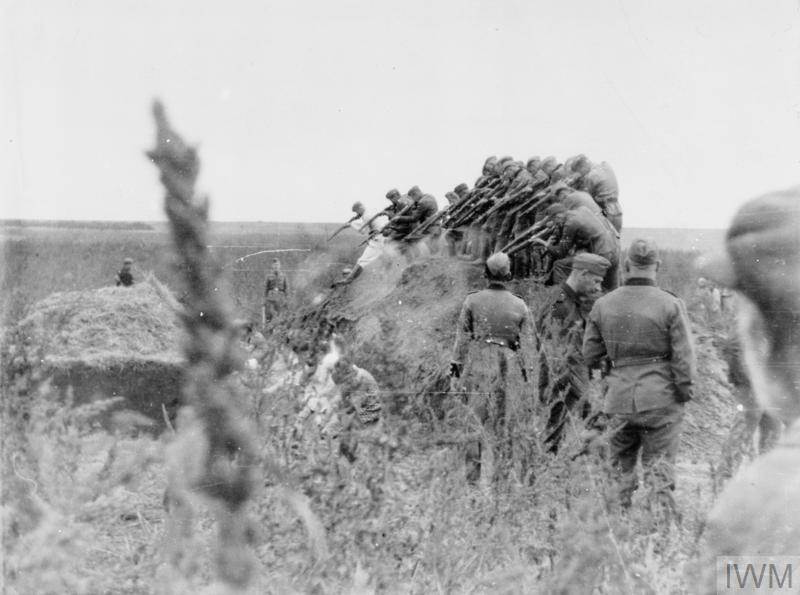
Bastards.
The Wehrmacht began Operation BARBAROSSA on 22 June 1941 with a strength of over 3 million men. However, its units have taken significant casualties to go along with massive territorial gains. On 14 September 1941, OKH Chief of Staff Franz Halder sets forth in his daily war diary the true state of the German Army (Heer) in the East.
Halder notes that the army has an “average actual strength” of 3.4 million men. Naturally, with an army that large, a large proportion of the army is devoted to logistical support and is not on the front lines.
Halder sets forth figures for the entire army:
11,125 officers and 328,713 others wounded;
4,396 officers and 93,625 others killed;
387 officers and 21,265 others missing.
The total for all war-related (and not medical) casualties is:
15,908 officers and 443,603 others;
A total of 459,511 total casualties.
Halder calculates this as 13.5% of the Eastern Army that has been killed, wounded, or is missing.
Halder does not end there. He also gives figures for the tank strength of General Guderian’s Panzer Group 2, which has led the way for Army Group Center and now has a critical mission to encircle Kyiv:
Third Armored Division 20% fit and 80% lost/under repair;
Fourth Armored Division 29% fit and 71% lost/under repair;
Seventeenth Armored Division 21% fit and 79% lost/under repair;
Eighteenth Armored Division 31% fit and 69% lost/under repair
Halder does not comment on the figures. However, he puts them right after a highly optimistic comment that:
“There are some indications that the enemy might be passing to the defensive on the entire front. His aggressive effort on the central front has markedly decreased, but we have no evidence that he is moving elements out of the line to shift them to the south.”
The casualty figures are not alarming at first glance. Operation Barbarossa has been going on for almost three months, and one must expect losses in a hard-fought campaign. However, this was supposed to be an easy campaign, a “kick the rotten door in and take over” campaign as Hitler said. It is not turning out that way.
However, from a larger perspective, the Heer’s casualty figures are alarming. The war in the East was supposed to be easy, and by the most optimistic projections, it already was supposed to be over. However, none of the three German Army Groups has achieved its objective yet. While Leningrad is all but encircled, it shows no signs of yielding. Kyiv is close to being captured, but there are a million Soviet troops defending it and subduing them will take some time. Moscow remains far off the Army Group Center front and an entire campaign will be necessary just to approach it.
Looking at the details also shows some warning signs. It may accurately be said that the German panzer divisions are the greatest offensive weapon in the world. However, while the front-line forces of the Heer are broad, they are not deep. The Germans have their best forces at the front and maintain few reserves. A loss of efficiency of the panzer arm inevitably must slow the entire German offensive. General Guderian’s have lost about 75% of their effective strength and their most important battles remain to be fought.
Another unwelcome development from the German perspective is the sudden appearance of RAF Hurricanes flying from Vaenga in the Far North of Russia. There are two squadrons, Nos. 81 and 134, which arrived at Archangel on 7 September 1941. The Hurricane pilots attack the German Stuka dive bombers which heretofore have had little opposition. Stukas are no match for Hurricanes and this greatly inhibits their assistance to the army’s attacks on Soviet defenses.
For what was supposed to be a quick and easy campaign, the Eastern Front is turning into an endless quagmire.
3rd and 16th Panzer Divisions linked up at Lokhvitsa, completing the encirclement of Kiev.
The unfinished Soviet cruiser Petropavlovsk (formerly the German cruiser Lützow) was sunk at Leningrad by German artillery.
The German Armeegruppe Mitte encircled two full Soviet Armies near Kiev, Ukraine.
3 Pz. Div. (GL Walter Model) contacts 1st Panzer Army’s 16 Pz. Div. (GL Hans Hube) near Lubny, Ukraine.
The German XXXXI Armeekorps (motorized) attacked Soviet positions southwest of Leningrad, Russia, while Soviet troops counterattacked into the flanks of the German assault.
General Georgii K. Zhukov is named Commander in Chief, Leningrad Front and takes command of the defense of the city. He orders the harshest of punishments for dereliction of duty and orders immediate counterattacks. His actions, in large part, save the city from the Germans.
Finnish Foreign Minister Vaino Tanner in a speech at Vaasa: “Although we happen to be brothers-in-arms of Germany, there is no difference of opinion among us that our war concerns Finland alone. We have no part in the World War, and we do not want to become involved in its battles.”
Hitler’s order of 1 September, that all Jews under German rule must wear a yellow star of David, comes into effect.
Hans-Joachim Marseille shot down the Australian Hurricane fighter flown by Lieutenant Pat Byers over Bardia, Libya, his 18th kill.
A poorly executed raid by Rommel, forces his 21st Panzer Division to run out of fuel. The RAF commences bombing the exposed German units and Rommel again places his German units out of fire and orders the Italians to guard the flanks. Meanwhile, British naval forces fail in their attempt to achieve a landing at Tobruk.
Four time bombs exploded in the central telephone exchange of Zagreb, Croatia. The explosions crippled the city’s telephone system and injured a German major and 13 others.
The U.S. Navy provided escorts for British convoy HX.150, the first time that the Americans took a direct part in the North Atlantic campaign.
RAF Bomber Command, Day of 14 September 1941
12 Blenheims on sweep off the Dutch coast. Ships were attacked but not hit. No losses.
Heavy cruiser HMS London departed Hvalfjord for Scapa Flow, arriving on the 16th.
Light cruiser HMS Penelope departed Scapa Flow for Akureyri, arriving on the 16th.
Minelaying cruiser HMS Welshman departed Scapa Flow at 0900 on completion of gunnery and anti-submarine working up. The minelaying cruiser proceeded to Loch Alsh.
Destroyers HMS Jackal and HMS Hotspur departed Haifa for an anti-submarine sweep. The destroyers returned to Haifa on the 16th.
Australian destroyer HMAS Vendetta and Corvette HMS Salvia arrived at Famagusta with British steamer Salamaua. The destroyer remained with the steamer to escort it to Haifa. The corvette proceeded to Beirut.
Submarine HMS Thunderbolt unsuccessfully attacked German steamer Tinos, escorted by torpedo boat Polluce thirty miles northwest of Benghazi.
Submarine HMS Proteus departed Gibraltar with stores for Malta. When she did not send a message after her test dive, destroyer HMS Vidette was dispatched to search for her. However, the submarine arrived back at Gibraltar on the 15th with radio problems. The submarine was able to proceed later on the 15th.
Convoy SL.87 departed Freetown escorted by destroyer HMS Brilliant, corvettes HMS Amaranthus and HMS Asphodel, and anti-submarine trawler HMS Sarabande to 16 September. French sloop Commandant Duboc joined on the 15th and escorted to 22 September. Sloop HMS Bideford, corvette HMS Gardenia, and escort vessels HMS Gorleston and HMS Lulworth joined on the 16th and escorted to 6 October. The convoy arrived at Liverpool on 6 October.
President Roosevelt returned to the capital tonight from a weekend cruise with his top defense chiefs on Chesapeake Bay aboard the yacht USS Potomac.
President Roosevelt is expected to give congress tomorrow a second accounting of expenditures from the $7,000,000,000 Lend-Lease fund, a report likely to be followed soon by a request for another appropriation probably totaling about $5,000,000,000 for aid to Britain and other nations fighting the axis. In his first report to congress on June 11, just 74 days after the $7,000,000,000 fund was appropriated, Mr. Roosevelt said that all but approximately $2,750,000,000 had been allocated. At that time, however, only about $75,000,000 actually had been spent, and this gave rise in congress to some complaints that Britain had received little real help in the way of ships, planes and munitions.
The House of Representatives will reconvene tomorrow after a month’s vacation and will take up as its first major piece of business, the compromise $3,583,900,000 tax bill which was rewritten by a joint committee of house and senate members after the two chambers had passed differing versions. The measure is scheduled for consideration on Wednesday, and leaders are hopeful that the legislation will clear both chambers by the end of the week.
The American Legion’s committee on National defense tonight urged elimination of geographical limitations on the nation’s armed forces which would prevent them from carrying a defense war to the “enemy’s front yard.” The resolution, embodying a demand for better pay for the army and navy, was presented to the legion’s executive committee with the recommendation that it be submitted to the national convention this week.
General Robert E. Wood, national chairman of the America First committee, announced tonight that an “independent group” of 58 “prominent Americans’” had united in a public condemnation of President Roosevelt’s address last Friday as a “grave threat to democratic principles of majority rule.” The group included former Gov. William H. (Alfalfa Bill) Murray of Oklahoma and Philip LaFollette of Wisconsin; Alice Roosevelt Longworth; Charles A. Beard, historian; Irvin S. Cobb, writer; President Ray Lyman Wilbur of Leland Stanford university; George N. Peek, former chief of the agricultural adjustment administration, and several persons prominent in the America First committee. “The president has decreed that shooting shall begin,” the group’s joint statement charged. “His edict is supported neither by congressional sanction nor by popular will.”
Thomas E. Dewey declared here today that Charles A. Lindbergh had been guilty of “an inexcusable abuse of the right of freedom of speech” in his address at an America First Committee rally at Des Moines on last Thursday.
W. W. Waymack, chief editorial writer of the Des Moines Register & Tribune, said in a radio address today that Charles A. Lindbergh was “blindly prejudiced” and “unfair to all three” when he called the British, the Jews, and the Roosevelt administration America’s war agitators. “And,” Waymack said, “he ignores the real culprit Adolf Hitler.” Waymack spoke at the invitation of the Fight for Freedom committee, a national group dedicated to defeat of Hitler and totalitarianism.
The International Association of Machinists, bargaining agents for 44,000 employees of Lockheed and Vega Aircraft factories, accepted a new contract today which will give them nearly $25,000,000 in increased wages during the coming year. A 10-cent an hour blanket increase for every individual on the payroll July 1 was made retroactive to that date.
The strike called Saturday on three ships in New York loaded with important cargoes for United States bases in the West Indies was extended yesterday to two other vessels here, two in Mobile and two in New Orleans by the Seafarers International Union.
Patrick T. Fagan, district president of the United Mine Workers (C.I.O.), said tonight that about 38,000 soft-coal miners in six States would go on strike tomorrow at “captive” mines of seven steel corporations on the sole demand that the companies grant a union shop.
With the consolidation of the powers of the airways traffic control division of the Civil Aeronautic Administration and the locally hired operators of airport control towers, the direction of private and commercial air traffic will be brought more directly under the supervision of the Federal Government, it was learned at La Guardia Field yesterday.
Army General Headquarters (GHQ) maneuvers commence in Louisiana. Army’s neglect of aviation support for its ground troops during the interwar period compels it to ask the Navy to provide planes to take part. Five Navy (VB 2, VF 41, VF 72, VS 5, and VS 42) and four Marine Corps (VMF 111, VMO 151, VMSB 131, and VMSB 132) squadrons take part in the large-scale war games.
Weather, arbiter of military history, threatened tonight to influence the start of “the greatest field exercise the Army has ever staged, the biggest it probably ever will stage,” as a tropical storm curved in toward the Gulf coast.
As TF 15 proceeds toward Iceland, destroyer USS Truxtun (DD-229) reports submarine emerging from the fog 300 yards away, but low visibility and uncertainty as to the position of USS MacLeish (DD-220), also in the screen of TF 15, prevents Truxtun from opening fire. After the submarine submerges, Truxtun, MacLeish and USS Sampson (DD-394) make depth charge attacks with no verifiable result.
Major League Baseball:
Boston increases its second place margin over the White Sox by sweeping a pair, 9–2 and 5–1, In game 1, Jimmie Foxx starts the Boston scoring with a grand slam in the 1st inning off Ted Lyons. The drive gives him 102 RBIs for the season, the 13th straight year he’s reached the century mark. Dom DiMaggio, Finney, and Williams continue to pummel the vet, as the Sox collect 14 hits. In game 2, the Fenwaymen thwart Thornton Lee’s bid for a 20th win. In game 1, Ted Williams draws a walk for the 19th consecutive game stretching back to August 24. This is a new Major League record that will be quietly broken by Roy Cullenbine in 1947. Williams total for the 19 games is 36 walks. He is walkless in game 2, but triples in 4 at bats.
The Cubs walloped the Braves, 10–3, after absorbing a 8–6 defeat, in a double-header today before 14,752 fans. Boston blasted three pitchers for fifteen hits in the first game. Chicago turned the tables in the second contest and hammered Johnny Hutchings and Art Johnson for sixteen hits. The game was called on account of darkness after eight innings.
In Cincinnati, five hundred fans arrive from Louisville aboard “The Pee Wee Reese Special.” The Dodger shortstop responds with 3 hits in a 7–5 Dodger win. MacPhail announces after the game that World Series ticket applications will be accepted.
Incredible as it may have seemed to 38,851 onlookers, Cleveland’s forlorn and downtrodden Indians still appear to have some fight left in them. In fact, they looked to have quite a bit of it at the Stadium yesterday when, after losing the first game of a double-header behind Bob Feller, 6–3, they lashed back in the nightcap, routed Marvin Breuer in the eighth with a five-run explosion and beat the Yankees in this one 5–2. To make it doubly certain the umpires called the game at the close of the eighth on account of darkness. Charlie Ruffing, tossing a neat three-hitter, took Feller’s measure in the first engagement, and took it thoroughly indeed. A two-bagger by Big Red scored two of three Yankee runs in the seventh to finish Rapid Robert’s efforts, so that when Harry Eisenstat came to the mound in the eighth for the Tribe a three-run homer by George Selkirk merely made it a little more decisive.
The Browns shoved the Athletics into the American League cellar by sweeping a doubleheader today as Washington beat Detroit. The Browns took the opener, 7–2, behind good pitching by Bob Muncrief. In the afterpiece Denny Galehouse outpitched Porter Vaughn for a 5–1 victory.
The Pirates were in a virtual tie for third place for about ten minutes today, but the Phillies took them right out again with a five-run rally in the ninth inning which won the second game of a doubleheader, 6–3. In the first game Max Butcher scored his sixteenth victory of the year for Pittsburgh, 2–1. Rip Sewell, pitching the nightcap, held a 3–1 lead going into the ninth when two infield hits, an error by Sewell, a walk and Bob Bragan’s single with the bases full did the damage.
The Cards move 1 ½ games behind the Dodgers by sweeping the Giants in a Sunday twinbill. In the opener, Lon Warneke outpitches Hubbell, 1–0, and in the nightcap, reliever Howard Krist (10–0) wins, 6–5, in 10 innings. Krist’s 10–0 year, except for Tom Zachary in 1929 (12–0), is the best season without a loss.
The Senators turn a unusual 3–6 triple play in the 2nd inning, as Mickey Vernon turns Higgins’s liner into a triple play and beat the Tigers, 2–0. Pitcher Sid Hudson allows 4 hits and scores both runs in beating the Tigers for the 6th time this year.
Chicago White Sox 2, Boston Red Sox 9
Chicago White Sox 1, Boston Red Sox 5
Boston Braves 6, Chicago Cubs 3
Boston Braves 3, Chicago Cubs 10
Brooklyn Dodgers 7, Cincinnati Reds 5
Cleveland Indians 3, New York Yankees 6
Cleveland Indians 5, New York Yankees 2
St. Louis Browns 7, Philadelphia Athletics 2
St. Louis Browns 5, Philadelphia Athletics 1
Philadelphia Phillies 1, Pittsburgh Pirates 2
Philadelphia Phillies 6, Pittsburgh Pirates 3
New York Giants 0, St. Louis Cardinals 1
New York Giants 5, St. Louis Cardinals 6
Detroit Tigers 0, Washington Senators 2
A further indication that conversations in Washington hold out hope for peace in the Pacific was seen here today in the announcement that Kaname Wakasugi would leave for the United States tomorrow afternoon.
Although the growing threat of the Japanese in Indo-China has recently caused an increase in British defense preparations in Burma, most Burmese continue to oppose cooperation with Britain in the European war.
The British Government invites the dominions to send a cabinet minister to Britain for discussions. The Australian representative, former Prime Minister Si Earl Page, is instructed to seek reinforcements for Singapore, Malaysia.
Born:
Joan Trumpauer Mulholland, American civil rights activist, Freedom Rider, and first white student to enroll at Tougaloo College, in Washington, District of Columbia.
Lee Calland, NFL cornerback (Minnesota Vikings, Atlanta Falcons, Chicago Bears, Pittsburgh Steelers), in Louisville, Kentucky.
Alberto Naranjo, Venezuelan musician, in Caracas, Venezuela (d. 2020).
Naval Construction:
The Royal Navy MMS I-class motor minesweeper HMS MMS 28 (J 528) is commissioned. Her first commanding officer is T/Lieutenant Christopher Wingfield Ellerby, RNVR.
 History Diaries