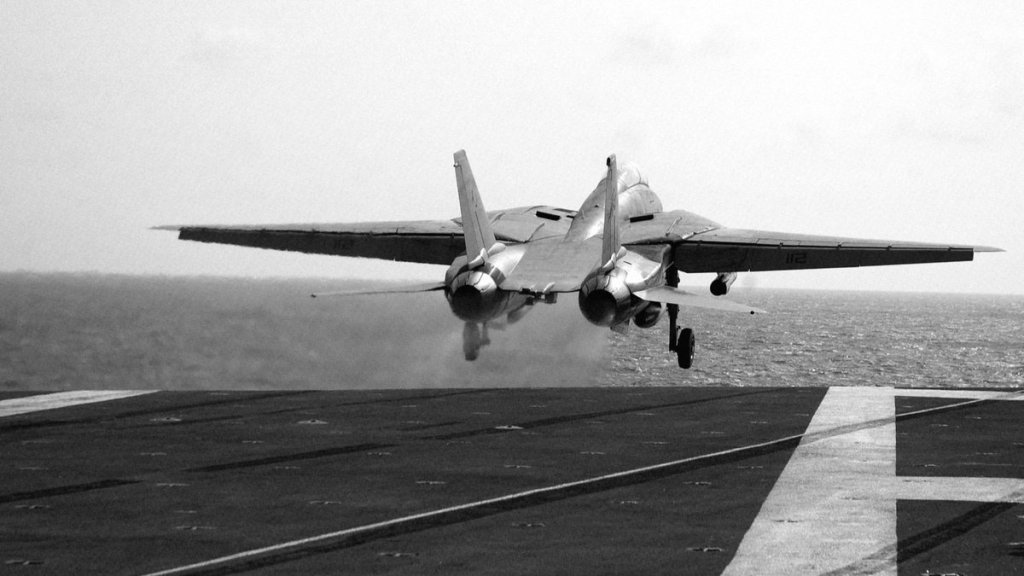
An F-14 fighter plane, equipped with one of the new top secret AIM-54 Phoenix air-to-air guided missiles and the F-14’s computerized firing and tracking system, accidentally rolled off of the deck of the U.S. Navy aircraft carrier USS John F. Kennedy and plunged into the North Atlantic Ocean and sank to a depth of 1,890 feet (580 m) at a location 75 miles (121 km) northwest of Scotland, prompting a salvage operation to prevent the Soviet Union from getting the newest U.S. weapon first. According to the U.S. Navy, the F-14 had been on the forward flight deck in preparation for a catapult-assisted take-off when the automated control system began powering up one of the jet’s engines. Because the brakes were locked, the F-14 veered at an angle across the deck while the pilot and navigator were inside. Before the pilot could activate the fuel-cutoff valve, the jet fighter rolled off the side of the carrier while the two crew ejected to safety. The loss of the F-14 came two weeks after one of the Soviet Union’s newest jet fighters, a MiG-25, had been landed in Japan by a defecting pilot of the Soviet Air Forces. The missile was finally located on October 31. Recovery of the jet and the missile cost $2.4 million, “about 15 percent of the Tomcat’s original cost of $16 million.”
The White House described as an “outrageous lie” a report in Aviation Week and Space Technology that Secretary of State Henry A. Kissinger ordered the CIA to slant intelligence estimates on the new Soviet Backfire bomber, putting it in the intermediate, not long-range class. The magazine said that the secretary already had conceded to the Russians that the plane would not be considered in the heavy bomber category in treaty negotiations, “and is making sure intelligence estimates confirm his position.” The White House in denying the “slanderous attack on the integrity” of Kissinger and the CIA said, “Aviation Week has an obligation to set the record straight.”
President Ford will sign a $104.3 billion defense appropriation bill that includes provisions delaying full-scale production of the B-1 bomber, White House Press Secretary Ron Nessen said. The bill would limit spending for the supersonic bomber between now and February to $87 million a month.
The House approved legislation authorizing $36 million in aid for Spain as part of a new Spanish-American military base treaty. The vote was 331 to 34. The measure, which contains an expression of congressional interest in the evolution of the democratic process in Spain. now goes to the Senate for approval.
About 200 housewives, angered by a recent wave of violence in Belfast. Northern Ireland, blocked streets in a spontaneous protest for peace. The women, part of a recently formed Movement for Peace, took to the streets as Protestant extremists continued to burn buses and hijack trucks in protest against conditions faced by their imprisoned comrades.
The pound fell again despite a sharp improvement in Britain’s foreign trade balance. This indicated continued pessimism about the painstaking efforts to rebuild its economy, with threats of major strikes, more inflation and attacks on Prime Minister Callaghan by his Labor Party’s left wing.
There was phlegmatic consternation aboard the HMS Bronington. The Royal Navy vessel, a mine hunter, was patrolling off the coast of eastern England during a NATO war exercise, hunting mines, when it found one. The disorder came when it turned out to be real, not make-believe. The 1,000-pound floater apparently was a leftover from World War II. The Bronington’s skipper, Prince Charles, heir to the British throne, ordered the area cleared and blew up the mine. Meanwhile, in other parts of the realm, his mother, Queen Elizabeth II, also was performing her duties. A medieval-sounding announcement in London made known that the Rev. John C.L. Hawkins had been appointed to the rather singular post of head of “the rectory of Sigglesthorne and Rise with Nunkeeling and Bewholme, in the County of Humberside and the Diocese of York.”
Riot police broke up scattered demonstrations in Bilbao, Spain, charging demonstrators in the center of the city who had set fire to a barricade of rubbish. Outside the city, police fired rubber bullets to disperse a demonstration of more than 50,000 workers who were striking for the second day to protest the killing of a Basque demonstrator last week. A weekend of agitation in Catalonia and the Basque country has increased fears in Madrid that regional demands for autonomy may become the single most disruptive issue in Spain’s political transformation from dictatorship to democracy. The northern provinces of Vizcaya and Guiptlzcoa were paralyzed yesterday and today by work stoppages and demonstrations by hundreds of thousands of Basques in protest against the killing last Wednesday of an 18‐year‐old Basque youth at a pro‐autonomy rally in Fuenterrabia. in Catalonia thousands of peoples rallied near Barcelona and other cities last Saturday in the first officially authorized observance of Catalan Day since the civil war. From both regions the message to Madrid has been the same — return of the political and cultural rights that the Franco regime destroyed. How Madrid deals with these demands is expected to determine to a large extent how peaceful Spain’s overall change will be.
Princess Beatrix of the Netherlands and her husband, Prince Claus, a former West German diplomat, arrived in Bonn for a two-day official visit to include dinner with President Walter Scheel and a meeting with Chancellor Helmut Schmidt.
Northeastern Italy was shaken for the fourth consecutive day by earthquakes that caused heavy damage and renewed panic among tens of thousands of residents. Two persons have been killed. The latest quakes demolished hundreds of buildings already weakened by a quake last May 6 that killed nearly 1,000 people in Udine and other towns of the Friuli region. The stricken area is also being plagued by cold and persistent rain.
Fighting subsided in Lebanon, raising cautious hopes for ending the 17-month civil war. The focus of peace efforts shifted from Syria to Egypt as leaders of Lebanese factions and government officials met with Cairo leaders. Lebanese Premier Rashid Karami met with Egyptian President Anwar Sadat, and right-wing Lebanese leader Pierre Gemayel met with Foreign Minister Ismail Fahmy. Lebanese President-elect Elias Sarkis is also expected in Cairo. The Cairo talks followed a week of intensive consultations in Damascus under the auspices of President Hafez Assad.
A U.N. seat for Vietnam will be considered by the Security Council after the American elections in November. The surprise postponement followed French negotiations with Hanoi to head off an immediate vote that the United States was ready to veto. Secretary of State Kissinger was said to have suggested this formula.
The International Red Cross completed its evacuation from Vietnam of foreigners who had been stranded since the fall of South Vietnam on April 30, 1975, bringing out the last 215 non-Vietnam residents on a flight from Ho Chi Minh City (formerly the South Vietnamese capital, Saigon) to Bangkok in Thailand. In all, more than 3,000 people had been repatriated after Vietnam allowed them to leave.
The Moscow-Peking breach survives, as evidenced by China’s rejection of messages of condolences on Chairman Mao’s death from the Communist parties of the Soviet Union and its allies. Observers outside China also note that the previous itinerary for former Defense Secretary James Schlesinger to the border areas of Tibet and Sinkiang had been restored by his Chinese hosts.
All 20 members of the cabinet of Japan’s Prime Minister Takeo Miki resigned at his request in the wake of the Lockheed bribery scandals as an effort to stop a split between his ruling Liberal Democratic Party before the expiration of the terms of the 511 members of the House of Representatives and a planned election for a new house.
The Soviet Union charged tonight that the Japanese Government had colluded with the United States in obstructing the pilot of a MIG-25, a swift and high-flying interceptor and reconnaissance jet, from returning to the Soviet Union. In the first public Soviet comment since the pilot landed in Japan a week ago in the advanced jet, the official Tass press agency contended in a long statement that the pilot, Lieutenant Viktor I. Belenko, lost his bearings September 6 on a routine training flight and landed on the northern Japanese island of Hokkaido because of a lack of fuel. Instead of letting him contact Soviet consular officials, Tass said, Japanese authorities placed Lieutenant Belenko in “strict isolation.” it characterized his brief meeting with Soviet officials four days later as a “farce” that showed the pilot had been drugged.
Trinidad Prime Minister Eric Williams led his People’s National Movement to an easy victory in general elections. Williams’ movement won 24 of 36 parliamentary seats against nine opposition parties. The leftist United Labor Front received 10 seats and the Democratic Action Congress two. An estimated 250,000 to 300,000 votes were cast.
Secretary Kissinger was received in Tanzania with some skepticism about his efforts to convince black leaders of American sincerity in seeking to solve the future of South-West Africa and Rhodesia peacefully. As he arrived in Dar es Salaam, the Tanzanian government issued a statement questioning the depth of American commitment to black majority rule in southern Africa. The leaders of Botswana, Zambia, Angola and Mozambique were said to share this view.
Prime Minister Ian D. Smith of Rhodesia left here grim‐faced today after a four-and-a-half-hour meeting with Prime Minister John Vorster of South Africa in which the two men had what were described as “a full and frank exchange of views” on the Rhodesian situation. The 57‐year‐old Rhodesian leader was uncharacteristically brusque as he walked swiftly past reporters outside Mr. Vorster’s office, turning away questions on his attitude toward efforts by the United States and South Africa to bring a peaceful transition to majority rule in the breakaway colony. Mr. Smith told reporters that he was in a hurry to fly back to Rhodesia, where he was to speak at a closed session of the congress of the Rhodesian Front Party at Umtali. Mr Vorster was unavailable for comment, but an aide read a brief communiqué.
Fresh violence was reported in Soweto tonight at the end of the second day of a three‐day protest strike that has kept tens of thousands of workers away from their jobs at white‐owned businesses in Johannesburg. But the police and black reporters differed widely in their casualty counts. The state‐owned South African Broadcasting Corporation said that police opened fire when demonstrators attacked private cars and taxis carrying commuters back to the black South African township. The demonstrators were said to have stoned the vehicles, dragged their occupants into the streets and to have beaten them. The radio network gave no casualty figures. But earlier, The World, a newspaper for blacks, had quoted one of its reporters in the township as saying that a total of 16 blacks had been killed in clashes between police and demonstrators since the strike began yesterday. Major General David J. Kriel, Assistant Police Commissioner in charge of riot control, dismissed the report as “nonsense.”
The National Emergencies Act was signed into law by U.S. President Ford, allowing the automatic termination of existing states of emergency in the U.S. effective September 14, 1978, and providing a two year limit on the duration of emergencies unless renewed by the U.S. president. The U.S. presidential proclamations of states of national emergency declared in the Emergency Banking Act of 1933 by Franklin D. Roosevelt during the Great Depression, by Harry S. Truman on December 16, 1950 during the Korean War, would be the most notable of the early terminations, and by Richard M. Nixon in 1970 (during a postal strike) and in 1971 (because of worsening economic conditions) were all terminated. The new law also put a check on the U.S. President’s military authority by giving Congress the right to end any future national emergencies by revisiting the issues every six months.
While new government figures show that unemployment exceeded 10% in 32 cities and three states during July. President Ford contended that his efforts to reduce inflation would eventually bring unemployment under control. He also said on the Today Show he took “some pride” in the record number of persons working-88 million. Unemployment — which stood at 5.5% when Ford took office in August, 1974 — rose to a high of 8.9% in May, 1975, before going down. The decline ended as unemployment jumped to 7.8% in July and to 7.9% in August. Latest Labor Department figures indicate that joblessness in 81 cities and 17 states exceeded the national rate during July. Modesto, California, at 14.5%, had the nation’s highest jobless rate.
The Pentagon is preparing to ask the White House to approve a military budget of about $130 billion for the 1978 fiscal year ‐ $9 billion more than it estimated only seven months ago and $18 billion more than Congress voted for the current fiscal year. The Congressional aides who disclosed this information and most of the Administration officials who confirmed it judged that President Ford was unlikely to make major cuts ir the request. Some attributed the proposed increase to the eagerness of the Joint Chiefs of Staff to exploit the public’s currently favorable mood toward military spending and the parallel desire of the White House to charge Jimmy Carter with being soft on defense. Others maintained that the proposed increase merely reflected a more sober assessment of the Soviet threat and the need to keep real growth in the defense budget at 5 to 7 percent each year. Pentagon officials do not say that the Soviet Union has done anything unexpected in the last seven months, but they point out that Moscow has continued to enlarge and modernize its forces. “The Russians aren’t coming. They’re here.” one official said by way of explaining the proposed new budget. All agreed that the increase was virtually inherent in Congress’s approval of a $112 billion defense budget this year with $104 billion in outlays.
Jimmy Carter predicted that if he became president, by 1981 the economy would produce more than $60 billion in new federal funds. He told reporters in Phoenix that this was a realistic expectation and would make possible new expenditures for federal programs. He apparently was seeking to rebut charges that his promises would mean more deficit financing.
Not all the family is sticking closely to the White House. Susan Ford will officially open the South Carolina Ford Committee headquarters in Columbia Thursday, according to William Harrison, the state committee’s executive director.
The Joint Congressional Committee on Atomic Energy, with substantial assistance from the Ford Administration, approved a bill today that would tighten United States control over the spread of nuclear explosives. The bill, which originated in the House of Representatives, faces an uncertain future because the Senate has had on its agenda a much tougher bill that has made its way to the floor without Joint Committee approval. The stronger bill was drafted by Charles H. Percy, Republican of Illinois; Abraham A. Ribicoff, Democrat of Connecticut, and John H. Glenn Jr., Democrat of Ohio. It provides severe penalties for countries found to be violating United States safeguards designed to prevent the use of nuclear technology and material for the manufacture of atomic weapons, up to breaking off commerce and communications with such countries.
World Bank President Robert S. McNamara and National Urban League Executive Director Vernon Jordan were present for the formal opening of Yale University’s new school of organization and management. The two are advisers for the graduate school, along with Vice President Rockefeller, Senator Hubert H. Humphrey (D-Minnesota), automaker Henry Ford II, John Gardner of Common Cause and 13 other industry and public officials.
The Senate voted 80 to 4 to extend for nearly six years the federal revenue-sharing program that would return $41.2 billion to states, counties and local governments with few strings attached. The legislation would increase the program’s annual outlay from the current $6.65 billion in increments of $200 million each year. The bill provides more money over a longer period of time than a similar House-passed measure. The difference must be worked out in a conference before the bill can be sent to President Ford. He has sought legislation close to that approved by the Senate.
The Ford Motors strike is on, Leonard Woodcock of the United Auto Workers announced after neither side moved on major issues at their meeting. How long it may last must await indications when negotiations resume; an official of the U.A.W. Ford local said either two weeks or two months.
The Attorney General told the F.B.I. to stop its investigation of the Socialist Workers Party, which has gone on since 1938. Edward Levi acted after review committees said that the party’s activities did not warrant it.
FBI Director Clarence M. Kelley was among 10 persons subpoenaed to appear Friday at a contempt of court hearing in Scranton, Pa., for two men under investigation for allegedly helping to harbor fugitive Patricia Hearst two years ago. Defense attorneys for Jay Weiner of Philadelphia and Philip Shinnick of Livingston, N.J., issued the subpoenas. The prosecution is attempting to quash Kelley’s subpoena. The hearing stems from Weiner’s refusal to testify before a grand jury about Miss Hearst’s stay in 1974 at a South Canaan, Pennsylvania, farmhouse, and Shinnick’s refusal to provide a sample of his handwriting, hair and fingerprints.
Daniel Patrick Moynihan narrowly edged out Representative Bella Abzug in the contest for the Democratic nomination to the United States Senate from New York. The three other candidates trailed far behind. In the Republican primary, the incumbent, James Buckley, defeated his challenger by a margin of 3 to 1, with Representative Peter Peyser conceding within 90 minutes of the closing of the polls.
Striking nurses and 15 hospitals in the Seattle area reached a tentative agreement to end one of the largest and longest health care strikes in recent history, a federal mediator announced. Both sides will now vote on the agreement, but no details were available. The nurses had demanded raises totaling 35% over three years, while the hospital council had offered increases of 18%. Nurses now have a base pay of $950 a month.
Deposits of 5 cents each will be charged on all bottles or cans of soft drinks or beer sold on federal property, the government has decided. The Environmental Protection Agency issued the regulations, effective a year from now, in an effort to reduce littering. In the meantime, the program will be tested at six to 10 military installations. The EPA noted that Oregon and Vermont have reduced throw-aways considerably with laws requiring deposits.
The Environmental Protection Agency has secretly decided to postpone for two years regulations reducing the amount of poisonous lead in gasoline, the Natural Resources Defense Council, an environmental group, claimed. NRDC accused the EPA of being “stamped into its decision by the oil industry, without consulting anyone but oil interests.” The group said EPA would attempt to justify the decision by citing oil industry studies that indicate the low-lead regulations could lead to a gasoline shortage next summer. EPA promptly denied the allegations, saying it had made no decision and, in fact, was still reviewing comments.
The Agriculture Department obeyed a federal court ruling and ordered a halt to production of meat containing ground bone for use in hot dogs, bologna, pizza and other processed foods. Consumer leaders waging a legal fight against the “mechanically deboned meat” products said they were pleased but they also demanded a ban on sales of powdered bone products currently in storage and a recall of foods containing such products. The process consists of crushing bones with attached fragments of meat that cannot be recovered by traditional hand deboning methods.
Major League Baseball:
Two rookies — Mark Lemongello of Astros and Al Autry of the Braves — made their major league debuts with victories as the clubs split a twi-night doubleheader. Lernongello pitched seven innings in the opener and came out with credit for a 4–3 victory. Enos Cabell homered in the seventh to provide the Astros’ winning run. Autry worked five innings for the Braves in the nightcap and was the winner when Willie Montanez broke a tie by smashing a three-run homer in the third to beat the Astros by the same 4–3 score.
Overcoming a 6–0 deficit, the Orioles battled their way to a 9–7 victory over the Tigers to extend their winning streak to six games. The Tigers kayoed Ross Grimsley in the third inning while building up their early lead, but the Orioles rallied for five runs in their half of the third, including a homer by Doug DeCinces with two men on base. The Tigers picked up a tally in fourth, chasing Dave Pagan, but rookie Dennis Martinez (1–0) made his major league debut and pitched scoreless ball the rest of the way to gain credit for the victory. The Orioles won with four runs in the seventh. Mark Belanger hit a sacrifice fly to drive in the tie-breaking tally and when Rusty Staub threw wild after making the catch, an insurance run crossed the plate.
Andy Hassler (5–10) allowed only five hits and had the support of three double plays while pitching the Royals to a 2–1 victory over the White Sox. The Royals, who collected 10 hits, scored their initial run in the first inning when George Brett tripled to drive in Amos Otis. The White Sox picked up their marker in the third on singles by Jim Essian and Ralph Garr and a double by Alan Bannister. Garr was thrown out at the plate trying to score on Bannister’s blow. The Royals won with a run in the fourth. Hal McRae led off with a double and moved to third when Al Cowens beat out an infield hit. Cowens then stole second and when catcher Essian’s throw went into center field, McRae scored.
Although tapped for 10 hits, Tommy John (9–10) was able to pitch the Dodgers to a 9–0 shutout victory over the Reds. John also walked four, but the Reds left 12 men on base. The Dodgers collected 15 hits, including a homer and three singles by Steve Garvey, who batted in three runs. Ed Goodson also accounted for three RBIs with a homer.
Making his first start since September 29, 1971, Grant Jackson (6–1) allowed only four hits in seven innings and gained credit for the Yankees’ 8–2 victory over the Indians. Roy White, batting at a .500 clip during an eight-game streak, stroked four hits and scored three runs to lead the Yankees’ attack.
The Brewers snapped their seven-game losing streak when Robin Yount drove in a run with a single in the 10th inning to defeat the Red Sox, 3–2. George Scott led off the stanza with a single. After Mike Hegan struck out, Darrell Porter forced Scott. Dan Thomas was hit by a pitch, moving Porter to second in position to score on Yount’s hit.
The Athletics, after winning the first game of a doubleheader, 4–2, slipped 4 ½ lengths behind the Royals in the West Division race by losing the second game to the Twins, 4–3. Vida Blue (15–12) was the winner of the opener with batting help from Gene Tenace, who drove in three runs with a single and homer. Dan Ford rapped a round-tripper for the Twins. In the nightcap, the A’s had a circuit clout by Claudell Washington, while Mike Cubbage connected with a man on base for the Twins. With the score tied, 3–3, Craig Kusick opened the Twins’ ninth with a double, Cubbage beat out an infield hit and Ford singled to drive in the winning run.
The Phillies, who were held hitless in the first four innings, broke loose in the fifth to score all their runs for a 3–2 victory over the Expos. Tim Foli singled and Earl Williams homered for the Expos’ pair in the fourth. Greg Luzinski and Dick Allen drew walks to open the Phillies’ rally in the fifth. Ollie Brown singled for the first hit off Woodie Fryman to load the bases. After Larry Bowa forced Luzinski at the plate, Allen scored when Bob Boone forced Bowa at second. Tony Taylor batted for Jim Lonborg (16–9) and singled, driving in Brown with the tying tally. Garry Maddox then extended his batting streak to 10 games with a double to plate Boone with the deciding run.
A two-run rally in the ninth inning brought the Mets a 4–3 victory over the Pirates, who dropped six games behind the Phillies in the Eastern Division race. Joe Torre homered with a man on base for the Mets in the fourth, but the Pirates held a 3–2 lead going into the ninth inning with one of their runs coming on a circuit clout by Rennie Stennett. Dave Kingman opened the Mets’ rally with a single and scored the tying run on singles by John Stearns and pinch-hitter Ed Kranepool. Bud Harrelson forced Leo Foster, running for Kranepool, and when the Pirates failed to complete the double play, Stearns came home with the deciding run.
Bobby Murcer smashed a two-run homer in the fifth inning and then hit for the circuit again with a man on base in the ninth to power the Giants to a 7–6 victory over the Padres. The Giants jumped off to a 5–0 lead before the Padres rallied for all their runs in the sixth, sending 11 men to bat against four pitchers. The Giants went to their bullpen twice more with Randy Moffitt (6–5) finally gaining the victory on the strength of Murcer’s second homer.
Three-run bursts in the first and second innings carried the Cubs to a 6–3 victory over the Cardinals behind the pitching of Rick Reuschel (13–10). In the first, Joe Wallis, Bill Madlock and Jose Morales hit singles for the first run. After a pass to Larry Biittner, George Mitterwald singled with two out to drive in two runs. The Cubs’ trio in the second counted on singles by Rick Monday, Wallis, Madlock and Morales, together with errors by Garry Templeton and Willie Crawford.
After the Angels rallied for three runs in the seventh inning to tie the score, Jerry Remy knocked in two teammates with a single in the ninth to beat the Rangers, 6–4. The Angels’ tallies in the seventh counted on two walks, a triple by Dan Briggs and single by Bill Melton. Andy Etchebarren singled with one away in the ninth and stopped at third on a double by Ron Jackson. Dave Collins struck out before Remy came through with his clutch single.
Houston Astros 4, Atlanta Braves 3
Houston Astros 3, Atlanta Braves 4
Detroit Tigers 7, Baltimore Orioles 9
Kansas City Royals 2, Chicago White Sox 1
Los Angeles Dodgers 9, Cincinnati Reds 0
New York Yankees 8, Cleveland Indians 2
Boston Red Sox 2, Milwaukee Brewers 3
Oakland Athletics 4, Minnesota Twins 2
Oakland Athletics 3, Minnesota Twins 4
Montreal Expos 2, Philadelphia Phillies 3
New York Mets 4, Pittsburgh Pirates 3
San Francisco Giants 7, San Diego Padres 6
Chicago Cubs 6, St. Louis Cardinals 3
California Angels 6, Texas Rangers 4
Stock prices fell in expectation of a strike at Ford Motors. The Dow Jones Industrials, dropping 4.65 points, closed at 978.64. Bond yields for top-grade state issues fell to their lowest level since early 1975 as South Carolina sold $70 million of them.
Dow Jones Industrial Average: 978.64 (-4.65, -0.47%)
Born:
Vladimir Tushinsky, Russian serial killer and pedophile who killed at least five girls and women over a three-and-a-half-year period. Though sentenced to life imprisonment rather than execution, he died from “sudden cardiac arrest without signs of violent death” while being transferred to another prison. (d. 2016).
Mirko Giansanti, Italian motorcycle road racer (140 x Grand Prix starts, 12 x podiuns) and executive (GYTR GRT Yamaha sporting director), in Termi, Italy (d. 2023).
Jeremy Dunham, American video game designer (Rocket League), in Portland, Oregon.
Died:
Paul Karadordevic, 83, regent of the Kingdom of Yugoslavia from 1934 to 1941 during the minority of his nephew, King Peter II. His funeral in Paris attracted three men who were the last kings of their nations— including Constantine II of Greece, Umberto II of Italy and Michael of Romania— and a pretender to the throne of France, Henri, the Count of Paris, the great-great-grandson of Louis Philippe I.
 History Diaries