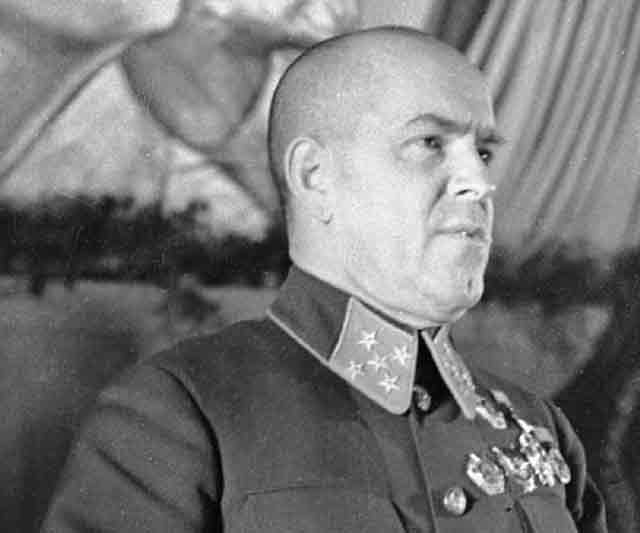
General Georgii K. Zhukov, Commander-in-Chief Leningrad Front, arrives in Leningrad to replace Marshal Kliment Voroshilov. He has orders from Soviet Premier Joseph Stalin to take command and save the city from capture. German Chancellor Adolf Hitler by this time has already decided not to storm the city but to starve it into surrender.
Throughout World War II, the Germans learn certain “tells” about Soviet intentions. For instance, when Soviet units suddenly stop using their radios and “go dark” in a certain sector, that invariably means they are about to launch an offensive there. Every army has such tendencies, though some are more subtle than others.
The presence of General (later Marshal) Georgy Zhukov in a sector was such a “tell.” Zhukov was a close Stalin confidante and the hero of, among other things, the victory over the Japanese at Khalkin Gol in Manchukuo/Mongolia in August 1939. Whether or not Zhukov was a military genius, which he apparently was, he had Stalin’s absolute backing and could count on whatever resources he required to achieve his ends. For the Germans, it was an ominous indication that the Soviets placed great importance on whatever was planned for that area.
On 13 September 1941, Zhukhov flies into besieged Leningrad along with Major-Generals Ivan Ivanovich Fediuninsky and Mikhail Semenovich Khozin. As soon as he steps off the plane, Zhukov walks over to Marshal Kliment Voroshilov, himself one of the top Soviet commanders, and hands him a note from Stalin. It names Zhukov as Voroshilov’s replacement:
“Hand over the Front to him and come back by the same plane. Stalin.”
And that was it. Zhukov was in command at Leningrad.
For the garrison of Leningrad, Zhukov arrives like the first icy winds of winter. He institutes the death penalty for dereliction of duty, orders immediate costly but effective counterattacks, and brings the scattered military and civilian forces available for the defense under a tight grip.
Zhukov sends General Fedyuninsky to the headquarters of the 42nd Army. Fedyuninsky finds General Ivanov, commander of the army, “sitting with his head in his hands, unable to even point out the location of his troops.” Fedyuninsky reports this to Zhukov, who replies, “Take over the 42nd Army — and quick.”
Meanwhile, the Germans are still pressing in on Leningrad. Army Group North commander Field Marshal von Leeb is under orders to sends his panzer divisions south for the attack on Moscow, but he uses them today to tighten the grip on Leningrad. General George-Hans Reinhardt’s XLI corps (1st and 6th Panzer and 36th Motorized Divisions) and General Wilhelm von Chappius’ 38th Army Corps (1st, 58th, 254th, and 291st Infantry Divisions) break through the Soviet line north of Krasnoe Sela. L Army Corps takes Krasnogvardiesk in conjunction with Reinhardt’s troops.
While von Leeb does advance a bit closer to Leningrad, this does not really accomplish much. He has been ordered to blockade the city, not take it, and he already has done that. Von Leeb already is under orders to relinquish the panzers and send them south for the drive on Moscow. Small gains on the city’s outskirts mean little. Using the armor in fierce attacks causes losses and wear and tear, and the panzers are already in bad shape after having had little downtime since Operation Barbarossa began on 22 June 1941. Thus, for no real benefit, von Leeb impairs the effectiveness of armor that might make a difference in the advance planned toward Moscow. This is typical behavior for the German generals, who tend to focus on their own army’s affairs at the expense of the greater good of the German war effort.
XXIV Panzer Corps took Lokhvytsia. German forces under Kleist and Guderian link near Lokhvitsa. This cuts the pocket of 600,000 Soviet soldiers east of Kiev. Chernigov on the Desna is evacuated under German attacks.
The German OKW determined that Soviet prisoners of war would receive fewer rations than prisoners of other nationalities.
Finnish coastal defense ship Ilmarinen struck a mine and sank in the Gulf of Finland; 271 were killed, 132 survived. The 271 are 7% of the entire Finnish naval arm. It is the costliest loss in the history of the Finnish Navy.
The New York Times reports:
The appalling conditions under which some 3,000,000 Polish Jews must struggle to live in 300 ghettos throughout Nazi-dominated Poland are revealed by authoritative statistics received in the United States and made public here yesterday by Dr. Henry Szoszkies. Starvation stalks throughout the ghettos and the death rate has risen to three and in some places to fifteen times the normal mortality rate, according to Dr. Szoskies, who was general manager of the Central Cooperative Bank in Poland until the outbreak of the war.
Hans-Joachim Marseille shot down a British Hurricane fighter over Sofafi, Libya, his 17th kill. The Hurricane fighter was flown by Sergeant Nourse.
The food shortage is beginning to bite in the Third Reich. In a report soon to be issued by the ministry for food and nutrition, Germans will be urged to be more economical in the way that they eat potatoes. “In every household in Germany, potatoes should now only be served in their skins,” it says. “It is most important that in canteens and restaurants, potato peelers are not used.”
Werner Mölders married Luise Baldauf (née Thurner), widow of a friend who had been killed in combat. They would have one daughter, Verena, born after Mölders’ death.
A Soviet motor torpedo boat sank German auxiliary patrol boat VP.308 off of the Porkkala Peninsula in the Gulf of Finland.
Norwegian passenger ship Barøy was sunk in the Vestfjord by a Fairey Albacore of 817 Squadron, Royal Australian Navy.
Iran ordered the departure of Axis diplomats.
RAF Bomber Command, Night of 13/14 September 1941
Brest
147 aircraft of 6 different types. The 3 warships in the harbour could not be spotted through smoke-screens. 120 aircraft bombed approximate positions. No aircraft lost.
Minor Operations: 8 Hampdens and Wellingtons to Le Havre, 1 O.T.U. sortie. No losses.
Aircraft carrier HMS Victorious, heavy cruisers HMS Suffolk and HMS Devonshire, and destroyers HMS Somali, HMS Matabele, and HMS Punjabi arrived at Scapa Flow at 1900/13th.
Light cruiser HMS Euryalus departed Rosyth for Scapa Flow, arriving later that day.
Destroyer HMS Anthony arrived at Scapa Flow at 2130 from Rosyth following boiler cleaning.
Convoy ON.16 departed Liverpool, escorted by destroyers HMS Malcolm, HMS Sardonyx, and HMS Watchman. The convoy was joined on the 14th by anti-submarine trawlers HMS Northern Gem, HMS Northern Pride, and HMS Northern Spray. Corvettes HMS Arabis and HMS Petunia joined on the 15th. Destroyers HMS Badsworth and HMS Lamerton were with the convoy on 17 and 18 September when they were detached. Destroyers Malcolm, Sardonyx, and Watchman were detached on the 19th. Destroyer HMCS Columbia joined on the 19th. Destroyer HMCS Skeena and corvettes HMCS Orillia, HMCS Rimouski, and HMCS Wetaskiwin joined on the 20th and the corvettes Arabis and Petunia and the trawlers were detached. Destroyer HMCS Columbia was detached on the 24th. The convoy was dispersed on the 27th.
P/T/A/Sub Lt (A) J. A. Dowling RNVR, and Naval Airman W. Sands were killed when their Proctor of 755/756 Squadron crashed near Stratford on Avon.
British steamer Bloomfield (1417grt) was sunk by German bombing in 61-50N, 6W. The entire crew was rescued.
Submarine HMS Tigris sank Norwegian steamer Richard With (905grt) off Breisund in 70-50N, 23-57E.
German auxiliary patrol boat VP 308 (trawler Oscar Neynaber:314grt) was sunk by a Soviet motor torpedo boat off Porkkala in Finnish waters.
Finnish coastal defense ship Ilmarinen was mined and sunk in the Gulf of Finland. Thirteen officers and two hundred and fifty eight men were lost on the ship. One hundred and thirty two survivors were picked up by patrol boats.
Corvette HMS Peony arrived at Alexandria from Beirut.
British steamer Empire Guillemot, which had arrived at Gibraltar in convoy OG.73, departed Gibraltar for Malta escorted through the day by corvettes HMS Gentian and HMS Jasmine in Operation PROPELLER. The steamer safely arrived on the 19th.
Submarine HMS Thunderbolt unsuccessfully attacked Italian minesweeper Zirona off Benghazi.
Submarine HMS Thrasher unsuccessfully attacked a steamer in the Gulf of Sirte.
Corvettes HMS Jonquil and HMS Spiraea departed Gibraltar escorting tanker Noreg.
Light cruiser HMS Manchester and destroyer HMS Firedrake departed Gibraltar for repairs received during the SUBSTANCE operation. The ships proceeded for Philadelphia and Boston, respectively. They were given local escort by destroyer HMS Heythrop to 25W.
Submarine HMS Trusty arrived at Gibraltar from Holy Loch, where she had departed on the 6th.
President Roosevelt, cruising on Chesapeake Bay with his chief war-production aides, worked tonight on plans to speed the flow of armaments into the anti-Axis arsenal while the American Navy prepared to purge Atlantic defense routes of raiding warcraft. The next three or four days, informed quarters predicted, should bring some indication as to the effectiveness of the United States Atlantic patrol in carrying out its shoot-on-sight orders against any Axis interloper. Some time will be required, it was explained, to transform, if such a move is necessary, a purely scouting patrol into task forces to ferret out submarines and surface raiders.
The Senate committee inquiring into alleged movie propaganda for war today called Charles Chaplin, movie comedian, to testify October 6 about his picture, “The Great Dictator,” as meantime, Wendell L. Willkie and Senator Nye, North Dakota Republican, each accused the other of injecting racial prejudice into the hearings. Willkie, counsel for the movie industry, asserted in a statement that he was “shocked” at what he described as the “race prejudice” exhibited by Charles A. Lindbergh in talk at Des Moines and by Nye in testimony before the committee. Lindbergh had charged that the “British, the Jewish and the Roosevelt administration groups” were leading this country toward war. Nye had testified that the movie industry contained many of foreign birth who were interested in involving this country in a defense of their homelands.
Reporting that Wendell L. Willkie has decided to take an active part in the off-year elections of 1942, associates of the 1940 Republican Presidential nominee said today that he would work and speak for those Republican candidates who have backed President Roosevelt’s foreign policy. Mr. Willkie’s friends reported that he had made three political decisions:
- He will work within the Republican Party to make it one standing for “internationalism” rather than “isolationism.”
- He will spend all his spare time working for the nomination and election of those Republicans who have supported Administration foreign policy.
- He will keep silent in campaigns where Democrats supporting Mr. Roosevelt’s foreign policies are fighting Republicans who oppose them.
Mr. Willkie, it was said authoritatively, is particularly anxious to help in the re-election campaigns of such men as Senator Ball, Republican of Minnesota, who have supported Administration foreign policy legislation.
The government has run head-on into its own system of defense priorities. Heywood Bell, custodian of the senate office building, said today he had been unable to obtain steel cables to replace worn ones on the building’s elevators. “I guess we’ll have to use rope,” he said.
General John J. Pershing, commander of the American armies during the First World War, observed his eighty- first birthday quietly today at his apartment at Walter Reed hospital and sent his personal greetings to the 1,500,000 men now under arms. In a special message published in the Army and Navy Journal, Pershing hailed the soldiers of 1941 as the best anywhere and declared they were ready to “defend their country at all costs.” “This was shown In 1917 and will be again should the need arise,” the message said.
District Attorney Thomas E. Dewey, Republican candidate for Governor in 1938, announced yesterday his support of Mayor La Guardia for renomination in the Republican primary election on Tuesday.
Mayor La Guardia, as director of the Office of Civilian Defense, announced yesterday the appointment of Mrs. Eleanor Roosevelt, wife of the President, as an assistant director of civilian defense. The announcement was made in the city’s office at La Guardia Field.
Negotiations for a rapprochement between John L. Lewis and the left-wing forces in the C.I.O. have been started with a view to welding a united front of Lewis supporters and leftists at the national C.I.O. convention, tentatively scheduled to open in Detroit Nov. 17.
Major League Baseball:
The beat goes on. Cleveland Indians manager Peckinpaugh announces he has fined and suspended Roy Weatherly for not hustling in the series with the Senators. Weatherly will be paid off for the rest of the season and removed from the roster, but he will be back with the Tribe next year.
The Red Sox strengthened their grip on second place in the American League today by defeating the Browns, 7–2, for their fourth straight victory. The Browns, who had beaten the Red Sox twelve times in twenty-one games before today, were held to eight hits by the veteran Jack Wilson.
After tying the score twice today, the Cubs defeated the Phillies, 5–4, in the eleventh inning when Rufus Melton walked Bill Nicholson with the bases full and nobody out.
A low-flying line drive in the eighth inning that missed Johnny Rucker’s desperate bid for a shoestring catch and rolled for a double brought defeat to Hugh East, rookie right-hander, and to the Giants in their farewell appearance of the campaign against the champion Reds at Crosley Field today. The Reds scored three in the frame to win, 6–4.
Coming up with four runs after two of their number had been retired in the ninth inning at the Stadium yesterday, the truculent Tigers, dethroned American League champions, shot a farewell broadside into the Yankees that probably will rankle the Bronx Bombers throughout the Winter. The Tigers beat the Yankees, 5–3, to square their season series between the teams at eleven wins each.
Dick Fowler, 20-year-old rookie right-hander, pitched the Athletics to a 3–1 victory over the White Sox today in his major league debut.
Nick Strincevich came through for the Pirates today, giving only four hits after he had replaced Dick Conger in the second to shut out the Braves, 1–0.
The Dodgers Whit Wyatt beats the Cards Mort Cooper 1–0 in St. Louis before 33,691, the largest paid attendance in St. Louis since June 18, 1927. Dixie Walker’s double in the 8th is the first Dodger hit. Walker then relays a stolen sign to Billy Herman, who singles him home. The Dodgers again lead the National League by 2 games. Bill Klem umps his final game in the majors, hanging up his whisk after a record 5369 games umped. Klem had retired at the end of last season, but umped in 11 games this season, all at second base.
The Washington Senators tied the ball game in the ninth inning then went on to defeat Cleveland, 6–5, in the eleventh today to gain an even break in a four-game series with the Indians.
St. Louis Browns 2, Boston Red Sox 7
Philadelphia Phillies 4, Chicago Cubs 5
New York Giants 4, Cincinnati Reds 6
Detroit Tigers 5, New York Yankees 3
Chicago White Sox 1, Philadelphia Athletics 3
Boston Braves 0, Pittsburgh Pirates 1
Brooklyn Dodgers 1, St. Louis Cardinals 0
Cleveland Indians 5, Washington Senators 6
Conviction that the United States would not “desert” the Chungking Chinese government In any rapprochement that might be effected with Japan was voiced today by Senator George, Georgia Democrat, Influential member of the senate foreign relations committee. “The Chinese have no reason to worry about any action we might take,” George told reporters.
Seigo Nakano, president of the Fascist party — Tohokai — told a mass meeting in Hibiya Hall today that time was running short and that unless the United States and Britain accepted Japan’s terms soon Japan and Germany would have to blast their way to Singapore and the Persian Gulf to establish contact with each other.
The Imperial Japanese Navy battleship Kongo arrives at Sasebo.
Dow Jones Industrial Average: 127.28 (+0.1)
Born:
David Clayton-Thomas [Thomsett], Canadian singer-songwriter (Blood, Sweat & Tears — “Spinning Wheel”), in Kingston upon Thames, Surrey, England, United Kingdom (d. 2026).
Ahmet Necdet Sezer, Turkish politician (10th President of Turkey), in Afyonkarahisar, Turkey.
Willie Murrell, ABA small forward (Denver Rockets, Miami Floridians, Kentucky Colonels), in Taft, Oklahoma (d. 2018).
Tadao Ando, Japanese architect, in Minato-ku, Osaka, Japan.
Died:
Elias Disney, 82, Canadian-American construction worker, entrepreneur, and father of Roy and Walt Disney.
Naval Construction:
The Kriegsmarine (German Navy) Type 39 torpedo boat T24 is launched by F Schichau, Elbing, East Prussia (werk 1483).
The Kriegsmarine (German Navy) Type XIV U-boat U-378 is launched by Howaldtswerke AG, Kiel (werk 9).
The Kriegsmarine (German Navy) Type VIIC U-boats U-459 and U-460 are launched by Deutsche Werke AG, Kiel (werk 290 and 291).
The U.S. Navy Aloe-class net tender USS Rosewood (YN-26; later AN-31) is placed in service. Her first commanding officer is Lieutenant D. Nicoli, Jr., USNR.
The Royal Canadian Navy Flower-class corvette HMCS Drumheller (K 167) is commissioned. Her first commanding officer is A/Commander George Humphrey Griffiths, RCN.
 History Diaries