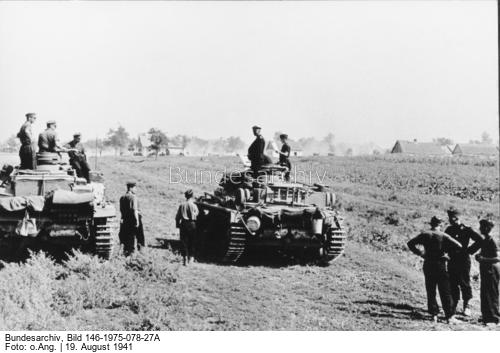
German General Buhle on 19 August 1941 delivers a report on an inspection tour he has made of Army Group South. As General Halder notes in the OKH war diary, Field Marshal von Rundstedt says that “Replacements urgently needed,” and those that have arrived so far have been of “indifferent quality.” The artillery cannot keep up with the pace of the advance because the horses that drag it are in poor shape. About 60% of the panzer force is in combat condition, which leaves little margin for error. Divisions are in varying states of readiness, with some in good shape, but some “less good” or even “poor.”
In the Far North sector, Army Group Norway finally concedes that Group F of Finnish III Corps is stuck north of Ukhta (Kalevala). After a week of probing attacks, it has gotten nowhere. The Army Group shifts some of the troops to the attack on Loukhi on the Murmansk railway, which also has gotten stuck fast, and allocates a battalion to battles further north.
The Finnish 6th Division of XXXVI Corps embarks on an offensive during the early morning hours toward the Murmansk railway. It is foggy with spells of intense rain, and the main force achieves surprise and gets off to a good start. The objectives are Nurmi Lake and Nurmi Mountain, about halfway between Kayrala and Allakurtti. The main column reaches Lehtokangas by late afternoon, but the flank formations make virtually no progress. Still, it is the first movement in the area for some time, and the Germans continue to push forward with great hopefulness. They begin bringing forward a reserve regiment to reinforce the main thrust.
German X Corps narrowly averted being encircled near Lake Illmen in northern Russia, saved by a counterattack by LVI Corps.
In the Army Group North sector, the Soviets continue attacking the German position at Staraya Russa, but the Germans are dug in and are not being dislodged. At Novgorod, the Soviets finally are pushed out of the entire city by the end of the day after the Germans dislodge some holdouts in the eastern areas. General Hoepner’s Panzer Group 4 breaks out toward the Luga Highway, which leads to Leningrad. However, a single camouflaged KV-1 tank wreaks havoc on the lead tanks and delays the advance. German 18th Army attacks Tallinn, Estonia.
In the Army Group Center sector, a German Cavalry division of the 2nd Army captures Gomel and advances through it to the east. The main problem for the Germans in this sector is poor roads. The usual Soviet attacks at Yelnya are repulsed.
In the Army Group South sector, the 11th Army crosses the Bug River with XI Corps. The Red Air Force attacks German troops in the Dneipr bend. At Dnepropetrovsk, the German attack begun by “Panzer” Meyer’s small reconnaissance force holds its ground, and a Soviet counterattack with 100 tanks is beaten off, with 52 Soviet tanks destroyed. The Germans are trying to capture a bridge at Cherkasy. The Soviet Fifth Army is retreating, and the Germans fear they may escape from the trap they are trying to spring between General Guderian’s Panzer Group 2 heading down from the north and General von Kleist’s Panzer Group 4 driving north to meet it. Soviet Rear Admiral G.V. Zhukov (no relation to Red Army General Georgy) takes command of the Soviet defense of Odesa.
The Soviet 2nd Destroyer Division attacks a German/Romanian convoy near Odesa, Ukraine. The destroyers fire over 450 shells but apparently cause little damage.
The Soviets scuttle river monitor Vidista at Kyiv to avoid capture.
Soviet submarine M-33 (Lt Surov) unsuccessfully attacks Romanian submarine Delfinul off Constanza, Romania.
Soviet submarine L-4 (Lt Cdr Polyakov) lays 20 mines off Cape Olinka, Romania.
The Soviets have been evacuating isolated positions in Estonia via ship, and this has led to some tragedies. Today is another one, as the Luftwaffe bombs and sinks 3767-ton Soviet hospital ships Sibir in the Gulf of Finland. There are about 400 people on the ship who perish. By international law, sinking a hospital ship is a war crime, and the ships are clearly marked. On the Eastern Front, however, the Germans, in particular, have openly renounced the norms of warfare.
Germany and Romania sign the Tiraspol Agreement. Romania annexes the Transnistria territory from the Soviet Union.
Joachim von Ribbentrop requested Japan to join in the attack on the Soviet Union by attacking Vladivostok in eastern Russia; Japan responded by saying that such a venture would require much time for deliberation and planning. Japan has already decided on the Southern Strategy.
The Germans execute Szmul Tyszelman and Henri Gautherot at the Vallée-aux-Loups in Châtenay-Malabry, Hauts-de-Seine. Tyszelman and Gautherot were among a group of about 100 demonstrators who staged a protest on 13 August 1941 at the Strasbourg – Saint-Denis metro station in Paris. The protest featured the group singing “La Marseillaise” and carrying the tricolor flag. This incident induced the German occupation authorities in France to ban the French Communist Party, and this, in turn, induces the communists to arm themselves and kill German soldiers. The entire situation escalates quickly, and by the end of August the Germans are executing numerous hostages and the resistance fighters are assassinating Germans.
The older Jewish children left in Byelaya Tserkov are loaded into three trucks, taken to the nearby rifle-range, and executed. 90 of the younger children are held back in wretched conditions.
Einsatzkommando 8, in conjunction with local collaborators, executes 3000+ Jews in Mogilev, Belorussia.
At Kiselin, Ukraine, 48 Jews are executed on the outskirts of town with the assistance of Ukrainian police.
German Propaganda Minister Joseph Goebbels recounts in his diary a discussion that he has with the Führer:
“We talked about the Jewish problem. The Führer is convinced that his earlier prophecy in the Reichstag is proving correct, that if the Jews succeed again in provoking another world war it would end with the annihilation of the Jews. This is being proved in these weeks and months with an apparently eerie certainty. In the East, the Jews must pay for this.”
The Germans are still trying to figure out the most efficient way to exterminate large groups of people. At the moment, the usual method on the Eastern Front is to march people out of town to pits and shoot them. However, this is having a poor effect on German troop morale, so other methods are being tried.
Hitler later has dinner with his cronies and justifies his orders that can send thousands of men to their deaths:
“If I am reproached with having sacrificed a hundred or two thousand men by reason of the war, I can answer that, thanks to what I have done, the German nation has gained, up to the present, more than two million five hundred thousand human beings. If l demand a tenth of this as a sacrifice, nevertheless I have given 90 percent. I hope that in ten years there will be from ten to fifteen millions more of us Germans in the world. Whether they are men or women, it matters little: I am creating conditions favorable to growth.”
He predicts that Ukraine and the Volga region will become the “granaries of Europe,” England, he implies, will wither away on the fringes of humanity because “It is not tolerable that the life of the peoples of the Continent should depend upon England.” Naturally, the United States and the Americas do not even enter the equation because, in Hitler’s worldview, they simply don’t count.
Operation TREACLE begins to land Polish troops at Tobruk to bolster the beleaguered Australians there. Operation TREACLE, the replacement of Australian troops in Tobruk with the Polish Carpathian Brigade, moves into high gear today. The timing is based upon the phases of the moon, as the British wish to avoid casualties by the Luftwaffe as much as possible. Tonight, Royal Navy destroyers HMS Hasty, Jervis, and Kimberley depart Alexandria with a large force of the Polish troops. The operation is covered by the cruisers of the 7th and 15th Cruiser Squadron.
The Luftwaffe (Junkers Ju 87 Stukas) bombs and sinks Royal Navy whaler HMT Thorbryn off Tobruk. There are eight deaths, while 18 crew are taken as prisoners. Thorbryn is towing two lighters, one of which sinks (LCT-12, killing the skipper) and the other of which drifts ashore in an area of German control (skipper is taken as a prisoner). Overall, taking the three ships as a whole, 9 out of 29 men perish.
Royal Navy submarine HMS Tetrarch (Lt Cdr Greenway) attacks an Italian freighter (the Cadamosto) just outside of Benghazi harbor but misses.
Royal Navy submarine HMS Unbeaten (Lt Woodward) unsuccessfully attacks an Italian convoy about 15 miles north of Pantelleria.
Operation GUILLOTINE, the British reinforcement of Cyprus, continues. Australian sloop HMAS Parramatta escorts transport Kevinbank to Famagusta.
Italian minelayers Aspromonte and Reggio lay minefield SN-43 in the Sicilian Strait.
An Italian convoy departs from Naples bound for Tripoli.
In Operation GAUNTLET, a joint Anglo/Canadian/Norwegian expedition (Force K) arrives at Spitzbergen on August 19 to evacuate Norwegian and Russian mining communities. To prevent the Germans from using the coal mines on Spitzbergen, the British dynamite them. The operation lasts until 3 September. The Germans have considered, but rejected, invading Spitzbergen, but the British do not know this.
Replacement prosthetic leg for captured Douglas Bader was dropped by a British bomber over Saint-Omer, Pas-de-Calais, France with permission by German Luftwaffe leaders. After the delivery, the British bomber took the opportunity to surprise-attack a power station in occupied France (though the attack would fail to materialize due to weather).
The Kriegsmarine has had multiple sightings of Convoy OG.71 which have enabled it to assemble a U-boat wolf pack in its path (these include Luftwaffe sightings and sightings by both U-106 and U-201). OG.71 is heading south to Gibraltar. Today the German preparation pays off with multiple sinkings southwest of Ireland:
U-204 (Kptlt. Walter Kell) sinks 1060-ton Norwegian destroyer HNoMS Bath (43 survivors, 89 deaths, two of the 42 survivors also later pass away from wounds)
U-201 (ObltzS Adalbert Schnee) sinks 3255-ton British liner Aguila (157 dead).
U-201 sinks 1809-ton Ciscar (13 deaths, 35 survivors)
U-559 (ObltzS Heidtmann) sinks 1584-ton British freighter Alva (one death).
RAF Bomber Command, Day of 19 August 1941
18 Blenheims on Circus operations to Gosnay and Hazebrouck; only Hazebrouck was bombed. 3 Blenheims lost. 2 Fortresses to Düsseldorf turned back.
RAF Bomber Command, Night of 19/20 August 1941
Kiel
108 aircraft — 54 Wellingtons, 41 Hampdens, 7 Stirlings, 6 Halifaxes — to railway targets but icing conditions and thick cloud cover over Bremen resulted in only 67 aircraft claiming to bomb in the target area. 3 Wellingtons and 1 Hampden lost. Kiel reports heavy rain during the raid, no casualties, 1 house hit by an un-exploded Flak shell and swimming-bath buildings damaged by incendiary bombs. Bombs also fell on the airfield at Holtenau, just north of Kiel.
Minor Operations: 6 Wellingtons and 3 Whitleys to Le Havre, 3 Hampdens minelaying in the Frisians. No losses.
A USAAF P-40 Warhawk crashes at Reykjavik, Iceland, killing pilot Lieuenant George Meeks, when he flies into a radio mast while landing and drops into the sea. He is the first U.S. soldier to perish in Iceland. A new airfield being built at Keflavík is named “Meeks Field” in his honor before being renamed simply Keflavik Field.
At Malta, RAF Hurricanes shoot down three Macchi 200 fighters after they patrol near Grand Harbour in the morning. In the evening, five Italian bombers drop incendiary bombs on Zeitun, killing 2 and wounding five without loss to themselves.
U-boat attacks on convoy OG.71, escorted by sloop HMS Leith, corvettes HMS Campanula, HMS Hydrangea, HMS Bluebell, HMS Campion, HMS Wallflower, and HMS Zinnia and anti-submarine trawler HMS Lord Nuffield, began on the 19th and continued through 23 August.
On the 19th, Norwegian Town-class (former USS Hopewell, DD-181) destroyer HNoMS Bath (Lt Cdr C. F. T. Melsom RNorN), which had been detached the evening before, was travelling behind the convoy. The destroyer was sunk by U-204, commanded by Kapitänleutnant Walter Kell, in 49N, 17W, SW of Ireland. On 18 Aug 1941, HNoMS Bath (I 17) (LtCdr C.F.T. Melsom, RNoN) of the 5th Escort Group was detached from convoy OG.71 and was proceeding behind the convoy about 400 miles southwest of Ireland, when hit amidships by one G7e torpedo from U-204 at 0205 hours on 19 August. The U-boat then fired a coup de grâce from the stern torpedo tube, but it passed underneath the vessel, which shortly thereafter capsized to port and sank within 6 minutes. As the vessel sank, her depth charges exploded and killed the commander and many other survivors swimming in the water. 39 survivors were picked up by HMS Hydrangea (K 39) (Lt J.E. Woolfendon, RNR) and all but nine transferred to HMS Wanderer (D 74) (Cdr A.F.St.G. Orpen, RN), which picked up four survivors herself. The survivors were taken to Gibraltar, but two of them died of wounds en route. The commander, two Norwegian officers, 68 Norwegian ratings, two British officers and ten British ratings were lost.
Submarine U-559, commanded by Oberleutnant zur See Hans Heidtmann, sank British steamer Alva (1584grt) in 49N, 17W on the 19th. At 0208 hours on 19 August 1941, U-559 fired a salvo of four torpedoes at the convoy OG.71 about 600 miles west of Ushant, observed one hit and heard one double and one single detonation. The assessment of the BdU was that two ships of 17,000 grt had been sunk and another ship of 7000 grt damaged. In fact, only the Alva (Master Cyril Spenser Palmer) was sunk in this attack. One crew member was lost. The master, ten crew members and two gunners were picked up by the Clonlara, but nine of them died when this vessel was sunk by U-564 (Suhren) on 22 August. The survivors were picked up by HMS Campion (K 108) (LtCdr A. Johnson, RNVR) and landed at Gibraltar on 24 August. Eight crew members and three gunners were picked up by the Empire Oak which was sunk by the same U-boat later on 22 August. Four shipwrecked men from Alva were lost and the survivors picked up by HMS Campanula (K 18) (LtCdr R.V.E. Case, DSC, RD, RNR), transferred to HMS Velox (D 34) (LtCdr E.G. Roper, DSC, RN) and landed at Gibraltar on 25 August. The 1,584 ton Alva was carrying coal and was headed for Lisbon, Portugal.
Submarine U-201, commanded by Oberleutnant zur See Adalbert Schnee, sank British steamer Ciscar (1809grt) in 49-10N, 17-40W and British steamer Aguila (3255grt) in 49-23N, 17-56W. At 0406 hours on 19 August 1941, U-201 fired a salvo of four torpedoes at the convoy OG.71 west-southwest of Fastnet Rock and observed two detonations on a tanker and two further detonations on two ships beyond her. Schnee claimed three ships sunk with 20,000 grt, but in fact the Ciscar and Aguila were sunk.
The Aguila (Master Arthur Firth) was the ship of the convoy commodore (Vice.Admiral Patrick E. Parker, DSO, RN) and sank within 90 seconds after being hit by two torpedoes. The commodore, five naval staff members, five gunners, 54 crew members and 88 passengers were lost. The master, five crew members, one naval staff member and two passengers were picked up by HMS Wallflower (K 44) (LtCdr I.J. Tyson, RN) and landed at Gibraltar. Five crew members and one passenger were rescued by the Empire Oak, but five of them were lost when this ship was sunk by U-564 (Suhren) on 22 August. One crew member was picked up by HMS Campanula (K 18) (LtCdr R.V.E. Case, DSC, RD, RNR), transferred to HMS Velox (D 34) (LtCdr E.G. Roper, DSC, RN) and landed at Gibraltar on 25 August. Among the passengers on board the Aguila were 21 women from the WRNS (Women’s Royal Navy Service) who had volunteered for cypher and wireless duties in Gibraltar. None of the Wrens survived the sinking. As a tribute to their memory, a lifeboat named Aguila Wren was built and launched on 28 June 1952 for the Royal National Lifeboat Institution. The 3,255 ton Aguila was carrying passengers, general cargo, and mail and was headed for Lisbon, Portugal.
The master, 29 crew members and five gunners from the Ciscar (Master Edward Lenton Hughes) were picked up by Petrel and landed at Lisbon. Nine crew members and four gunners were lost. Four crew members from the Ciscar were later repatriated on the Cervantes, which was sunk by U-124 (Mohr) on 26 September. Three of them were lost. The 1,809 ton Ciscar was carrying general cargo and government stores and was headed for Gibraltar.
Submarine U-204 made two attacks on the 19th and reported sinking two steamers, but none were reported.
Destroyers HMS Gurkha and HMS Lance from convoy WS.10 X reinforced the convoy from 20 to 23 August. Destroyer HMS Vidette, which departed Gibraltar on the 21st, from 21 to 23 August. Destroyers HMS Boreas and HMS Wivern reinforced the convoy from 22 to 23 August.
Submarine U-564 made four attacks on the 22nd and sank British steam tug Empire Oak (484grt) and British steamer Clonlara (1203grt) in 40-43N, 11-39W. She reported damaging two other steamers. Eleven crew and three gunners were missing from the tug. Eight survivors from steamers Alva and six survivors from Aguila were missing. Destroyer HMS Boreas rescued four survivors from the tug. Corvette HMS Campanula picked up the remainder of the survivors. Eleven crewmen were lost on the steamer.
Submarine U-201 sank British steamers Stork (787grt) and Aldergrove (1974grt) in 40-43N, 11-30W on the 23rd. She reported damaging two other steamers.
One naval rating was lost on steamer Aldergrove. Destroyer HMS Boreas rescued four survivors from the steamer. Corvette HMS Campanula rescued the remainder of the survivors.
Nineteen crewmen were lost on steamer Stork. Three crewmen were rescued by corvette HMS Campion.
Submarine U-564 on the 23rd damaged Norwegian steamer Spind (2129grt) in 40-43N, 11-39W. The submarine reported damaging another steamer.
Corvette HMS Zinnia (Lt Cdr C. G. Cuthbertson DSO RNR) was sunk by U-564 in 40-43N, 11-39W west of Portugal on the 23rd. A/Sub Lt M. T. Edwards RNVR, T/Sub Lt J. Halliday RNVR, and T/Sub Lt J. B. Miller RNVR, and forty six ratings were lost on the corvette. Her survivors were picked up by corvette HMS Campion.
The submarine reported sinking two other steamers on the 23rd.
Submarine U-552 sank damaged Norwegian steamer Spind (2129grt) in 40-43N, 11-39W. The entire crew was rescued by destroyer HMS Boreas.
Heavy cruiser HMS London departed Scapa Flow for boiler cleaning in the Clyde, arriving on the 20th.
Destroyer HMS Inglefield departed Rosyth after boiler cleaning and arrived at Scapa Flow that day.
Leading Airman E. S. Ingle and Leading Airman G. R. Watson of 1 SFTS Netheravon were killed when their Hart crashed at Claverton, three miles ESE of Bath.
Italian submarine Tazzoli sank Norwegian tanker Sildra (7313grt) in 5-30N, 12-50W. The entire crew was rescued.
Motor barge Golden Grain (101grt) was sunk on a mine in 51-35-18N, 1-03-18E. The crew of three was all lost.
Soviet hospital ship Sibir (3767grt) was sunk by German bombing in the Gulf of Finland. Some 400 passengers were lost on the ship.
Operation TREACLE began. Six thousand troops of the Polish Carpathian Brigade were ferried to Tobruk, covered by the cruisers of the 7th and 15th Cruiser Squadrons. On the first night of TREACLE, destroyers HMS Jervis, HMS Kimberley, and HMS Hasty departed Alexandria for Tobruk in the first series. The destroyers arrived back at Alexandria on the 20th.
Whaler Thorbryn (Lt Cdr J. F. Hall RNR), towing two D. lighters, was sunk by German bombing in 32N, 24-09-15E off Tobruk. T/Lt D. C. Wilson RNVR, T/Lt W. B. Chisholm RNVR, and six ratings were killed on the whaler. Hall, T/Sub Lt (E) R. Firing RNVR, T/Lt (E) K. A. Larsen RNR, and sixteen ratings were taken prisoner. One D lighter was sunk and the second drifted onto the enemy coast. Skipper P. D. Jackson RNR, was killed and T/Skipper J. J. Fortune RNR taken prisoner.
Light cruiser HMS Galatea arrived at Suez to join the Mediterranean Fleet.
Anti-aircraft cruiser HMS Coventry departed Alexandria for the Canal Area. The cruiser arrived at Suez on the 20th. There she escorted liners Ile de France (43,450grt), Nieuw Amsterdam (36,287grt), and Orion (23,371grt) to Port Taufiq.
Destroyer HMS Hotspur departed Alexandria to relieve destroyer HMS Havock at Haifa. Destroyer Havock arrived back at Alexandria on the 20th.
Submarine HMS Tetrarch unsuccessfully attacked Italian steamer Cadamosto, which was arriving at Benghazi from Tripoli.
Submarine HMS Unbeaten unsuccessfully attacked a convoy of liners Marco Polo, Esperia, Neptunia, and Oceania, escorted by destroyers Vivaldi, Da Recco, Gioberto, and Oriano and torpedo boat Dezza, fifteen miles north of Pantelleria. After the attack, the convoy was joined by destroyers Maestrale, Grecale, and Scirocco. The convoy arrived at Tripoli on the 20th.
Australian sloop HMAS Parramatta departed Port Said escorting motor transport ship Kevinbank to Famagusta in Serial S.23 of the GUILLOTINE operation. The sloop arrived on the 21st and then sailed for Port Said.
Convoy OG.72 departed Liverpool. On the 20th, destroyers HMS Chelsea, HMS Croome, HMS Heythrop, and HMS Wolverine, sloop HMS Rochester, corvettes HMS Carnation, HMS Heliotrope, HMS La Malouine, and HMS Mallow, and catapult ship HMS Maplin joined the convoy. Destroyer HMS Duncan departed Londonderry on the 22nd and joined the convoy. Destroyers Chelsea and Wolverine were detached on the 23rd. Destroyers Croome and Heythrop were detached on the 27th and arrived at Gibraltar on the 30th. Destroyer HMS Lance joined the escort from patrol on the 26th and destroyer HMS Boreas departed Gibraltar on the 27th to join. Destroyer Duncan arrived at Gibraltar on the 31st. The convoy arrived at Gibraltar on 1 September with destroyers Boreas and Lance, sloop Rochester, corvettes Mallow, Heliotrope, Carnation, and La Malouine, and catapult ship Maplin.
Today in Washington, President Roosevelt signed the $275,000,000 Flood Control Authorization Bill and issued two proclamations, one placing six architectural materials and articles under export control and the other calling attention to the increased accident rate and requesting a safety campaign. His callers included Senators O’Daniel and Smathers. He held a press conference in the afternoon.
The Senate heard criticism and support of the President’s meeting with Prime Minister Winston Churchill, confirmed the nomination of Willis R. Peck as Minister to Thailand, received the nomination of Brigadier General Eugene Beybold to be chief of Army Engineers and of Frederick H. Osborn as brigadier general in command of the Army morale branch and recessed at 1:43 PM to noon Thursday. The Banking and Currency Committee approved an increase of $200,000,000 for the FHA defense insurance; the Finance Committee heard further opposition to tax bill provisions.
The House was in recess.
By quoting Abraham Lincoln and drawing a parallel, President Roosevelt said indirectly but nonetheless clearly today the people do not realize this nation has a war to win, and that “hard, tough fighting” will be necessary to win it. Moreover, he said the war would, if necessary, continue through 1943. In his first press conference since his return to Washington after his meeting at sea with Prime Minister Winston Churchill, the President read a statement that Abraham Lincoln made to Mrs. Mary A. Livermore of Chicago in 1862, in which Lincoln was quoted as having said the people “have no idea that the war is to be carried on and put through by hard, tough fighting.” There was a parallel in the situation today, Mr. Roosevelt emphasized. The President said flatly, in reply to questions, that he thought many people in the United States had not awakened to the danger to this country and that people all over the world had not realized the world danger.
Secretary of the Interior Harold L. Ickes said tonight the United States was “in grave danger” of war and predicted rationing of gasoline and oil would be extended to the Pacific coast. Ickes, who also is defense oil coordinator, told a press conference how near the nation was to war “depends on the place you are and who you’re talking to.” “With Lindbergh, you’re 1,000 miles away, but I don’t pretend to be omniscient,” Ickes said. “I don’t know how close we are to war, but I think we are in grave danger as part of the civilized world.”
Selectees and national guardsmen will be held in service an average of less than 18 months, instead of the 30-month hitch authorized by law, the army announced today. Military sources said the statement, which also asserted almost 200,000 selectees, guardsmen and others would be released before Christmas, should give a pronounced “lift” to troop morale. The scheduled releases are subject to the condition “this country does not become more involved in the international situation.”
An assertion that President Roosevelt “in violation of the Constitution” had entered into an “offensive and defensive alliance” with Winston Churchill to “destroy the common enemy” and create a new world order was made in the Senate today by Senator Hiram Johnson. California Republican. The charge was vigorously denied by Senator Alben W. Barkley of Kentucky, Majority leader. The debate, in which Senators Arthur H. Vandenberg, Michigan Republican; Bennett Champ Clark, Missouri Democrat, and Robert A. Taft, Ohio Republican, also participated, was set off by Senator Barkley’s attack on an article appearing in today’s Chicago Tribune and other papers. Senator Barkley said that Chesly Manly, a Tribune correspondent here, had “deliberately falsified” in the article by asserting that party leaders who met with the President yesterday learned the “grand strategy of the new Anglo-American-Russian alliance for the defeat and disarmament of Germany and Italy, that an invasion of the Continent would be necessary to accomplish this, and that an American expeditionary force would be required.”
Brigadier General Lewis B. Hershey, federal selective service director, said today the war department’s plan to let drafted men go home after an average of 18 months’ service meant more men would have to be drafted. Hershey, here to speak at the American Legion state convention, told newspapermen draft calls would be increased to about 70,000 men a month, near the maximum allowed by law.
Rear Admiral Richard E. Byrd assured a mass meeting in Madison Square Garden last night that President Roosevelt was not trying to push this nation into war, but declared that his duty was to preserve American democracy at all costs, and that slavery was infinitely worse than war.
Associate Justice Frank Murphy of the United States Supreme Court declared here tonight that although the American people “are unequivocally and unalterably opposed” to communism, the democracies should support Russia in its campaign with Germany because the philosophy of nazism is the world’s “overshadowing menace.”
Senator Byrd, Virginia Democrat, today demanded complete reorganization of the defense production system and told the senate “social gains” and “everything else” must yield to the rearmament effort. “America has the capacity in labor and raw materials to outproduce any other nation in the production of mechanized equipment,” he said. “In that job for the past two years we have failed and miserably failed, and the sooner we as a nation realize it the better we can remedy our mistakes and go forward. He called for suspension of the 40-hour work-week and substitution of a full week working basis. Moreover, he charged not a single army camp has an adequate supply of military equipment.
A general sales tax and a broadening of the income tax base were urged upon the Senate Finance Committee today by Livingston W. Houston as representative of the National Association of Manufacturers. Mr. Houston, who is chairman of the association’s finance committee, also recommended an increase in the normal 4 percent rate on individual incomes and approved the provision in the House bill raising to 30 percent the normal tax on corporations earning more than $25,000 a year. While taking such steps as a precaution against inflation, Congress, he said, should make drastic reductions in non-military expenditures. He reasoned that “economy in non-defense spending is as effective a method of financing defense activity as raising additional revenue through taxation.”
The U.S. Department of the Navy announced tonight that five naval fliers were killed and another believed drowned in three crashes two in Florida and one in New York involving four planes.
Major League Baseball:
Pittsburgh Pirates manager Frankie Frisch is ejected (and fined $50) by umpire Jocko Conlan from the 2nd game of a doubleheader when he appears on the field with an umbrella to protest the playing conditions at Brooklyn’s Ebbets Field. The rainy argument is later portrayed in a famous oil painting by Norman Rockwell. The Dodgers sweep, winning 9–0 and 6–2, behind Curt Davis and Hugh Casey. Brooklyn now has a two-game lead over St. Louis.
White Sox pitchers Thornton Lee and John Humphries each throw shut outs against the A’s. Lee wins, 4–0 and Humphries , 1–0. McCrabb and Babich are the losing pitchers.
Jimmy Bloodworth belted one of Southpaw Al Milnar’s pitches over League Park’s short right field wall in the twelfth inning today to give Washington an 8–6 triumph over the slump-ridden Indians, who have dropped six in a row.
In game 2 at Detroit, Joe DiMaggio jams his spikes sliding into second base on a double and sprains his ankle. He will be out till September 19th. The Yanks win, 8–3, after losing the opener, 12–2, to Hal Newhouser.
Red Sox lost a pitchers’ duel, 3–2, and then won a slugfest, 10–7, in dividing a doubleheader with the Browns today in games decided by ninth-inning rallies. Ted Williams, Boston’s slugger, hit three home runs during the afternoon, giving him a total of twenty-six for the season.
The scheduled game between the New York Giants and the Cubs at Chicago was postponed due to rain. The game will be made up as part of a doubleheader tomorrow.
The scheduled doubleheader between the Cincinnati Reds and the Phillies at Philadelphia was postponed due to rain. One game will be made up as part of a doubleheader on September 18.
The scheduled game between the St. Louis Cardinals and the Braves at Boston was postponed due to rain. The game will be made up as part of a doubleheader on September 17.
Pittsburgh Pirates 0, Brooklyn Dodgers 9
Pittsburgh Pirates 2, Brooklyn Dodgers 6
Philadelphia Athletics 0, Chicago White Sox 4
Philadelphia Athletics 0, Chicago White Sox 1
Washington Senators 8, Cleveland Indians 6
New York Yankees 3, Detroit Tigers 12
New York Yankees 8, Detroit Tigers 3
Boston Red Sox 2, St. Louis Browns 3
Boston Red Sox 10, St. Louis Browns 7
The United States is still awaiting a complete and satisfactory explanation of Japan’s refusal to permit the departure of more than 100 Americans from Japan on the liner President Coolidge, Secretary of State Cordell Hull said today.
To “meet the challenge of the situation,” the Japanese Cabinet decided yesterday to put the entire shipping industry, including ship crews and shipbuilding, under State control.
Wake Detachment, 1st Defense Battalion, Fleet Marine Force (Major Lewis A. Hohn, USMC), arrives at Wake Island in cargo ship USS Regulus (AK-14) to begin work on defense installations. The first permanent military garrison was established at Wake Atoll, which will soon consist of 449 men of the U.S. Marine Corps 1st Defense Battalion under the command of U.S. Navy Commander Winfield Scott Cunningham.
German raider Komet has been operating off the Galapagos Islands recently. Today, it scores its third success in the area, sinking 9,036-ton British freighter Devon about 200 miles southwest of the islands. The entire crew of Devon survives and board Komet as prisoners.
Dow Jones Industrial Average: 125.57 (-0.05)
Born:
Fred Lasher, MLB pitcher (World series-Tigers, 1968; Minnesota Twins, Detroit Tigers, Cleveland Indians, California Angels), in Poughkeepsie, New York (d. 2022).
Christopher Cerf, American book editor, writer (“National Lampoon”), Emmy Award-winning television producer (“Free To Be You and Me”; “Between the Lions”), and Grammy Award-winning songwriter (Sesame Street — “Put Down the Duckie”; “Born To Add”), in New York, New York.
Milford Graves, American avant-garde and free jazz drummer, percussionist (New York Art Quartet), and educator (Bennington College, Vermont, 1973-2012), in Jamaica, Queens, New York, New York (d. 2021)
Died:
Samuel Tyszelman, 20, Polish-born Jewish Communist and member of the French Resistance (executed).
Naval Construction:
The U.S. Navy PC-461-class (173-foot steel hull) submarine chaser USS PC-465 is laid down by George Lawley & Sons Inc. (Neponset, Massachusetts, U.S.A.).
The Royal Navy River-class frigate HMS Swale (K 217) is laid down by the Smiths Dock Co., Ltd. (South Bank-on-Tees, U.K.). She is transferred to the South African Navy on 26 July 1945, becoming postwar the HMSAS Swale (K 217).
The Royal Navy Fairmile B-class motor launch HMS ML 363 is launched by United Engineers (Singapore). Lost incomplete at Singapore in February 1942.
The Kriegsmarine (German Navy) Type IXC U-boat U-509 is launched by Deutsche Werft AG, Hamburg (werk 305).
The Вое́нно-морско́й флот СССР (ВМФ) (Soviet Navy) “M” (Malyutka)-class (3rd group, Type XII) submarine M-121 is launched by Marti Yard (Nikolayev, U.S.S.R.) / Yard 198.
The Royal Navy Fairmile B-class motor launch HMS ML 288 is commissioned.
The Royal Navy harbor defence motor launch HMS HDML 1044 is commissioned.
The Royal Navy Isles-class minesweeping trawler HMS Mull (T 110) is commissioned. Her first commanding officer is T/Lieutenant Douglas Mitchell MacDonald, RCNVR.
The Royal New Zealand Navy Kiwi-class minesweeping trawler HMNZS Moa (T 233) is commissioned. Her first commanding officer is Lieutenant Commander Philip George Connolly, DSC, RNZNVR.
The Kriegsmarine (German Navy) Type VIIB U-boat U-87 is commissioned. Her first commanding officer is Oberleutnant zur See Joachim Berger.
The Royal Canadian Navy Flower-class corvette HMCS Sorel (K 153) is commissioned. Her first commanding officer is T/Lieutenant John Wesley Dowling, RCNR.

