The Soviet Union’s contention that it is the truest friend of the third world reached crescendo pitch as the nonaligned nations met this week in Colombo, Sri Lanka. “When it comes to consolidating national independence and the economy, the countries of Asia, Africa and Latin America can rely on the complete support of the socialist countries,” the official press agency Tass recently asserted, echoing the familiar theme. Yet by one key index — foreign economic assistance — Moscow’s contention does not appear borne out by the facts. The Soviet foreign aid program offers a fraction of the amount rendered by the United States. Moreover, Soviet aid is highly selective, politically pragmatic and relatively inflexible, according to some Western and third world diplomats who have studied its operation. While the Soviet press gives glowing accounts of prestige projects like the Bhilai steel plant in India, an overall breakdown of Soviet aid performance is kept secret. This is thought not only because the total aid looks skimpy by Western standards but also because foreign aid is not overly popular with average Russians, some of whom, have told foreigners that the money could better be spent improving their own living standards. The State Department has put Moscow’s 1975 economic aid commitments at $1,264 million. This excludes assistance to Cuba and Vietnam, Communist allies for which figures are too hard to come by. Actual deliveries of Soviet aid last year were $415 million, much spilling over from pledges of earlier years.
After two years in power, the Greek Government of Prime Minister Konstantine Karamanlis still enjoys extraordinary popularity and prestige here and abroad. “Karamanlis has made his name in Western Europe. He’s a person of stature in the world,” said a Western diplomat. “And since we’re not that well endowed with great figures, that’s a big plus for Greece.” The main question facing the Government is whether the Prime Minister can use that personal authority to modernize this relatively poor and backward nation of nine million people and make it a full partner in the European Common Market. Mr. Karamanlis’s chief frustration today is the bitter dispute with Turkey over Cyprus and the Aegean Sea. But while that controversy has drained away the Government’s time and resources, it has also produced an unusual — and very useful — feeling of national, unity.
A medium-strength earthquake struck the town of Denizli in southwestern Turkey, killing four persons and injuring 28. The tremor lasted only five seconds, but damaged scores of buildings, severed power lines and tore gaping holes in roads. Turkish authorities said the quake measured 4.6 on the Richter scale.
Prime Minister James Callaghan summoned his vacationing cabinet for an emergency session to deal with Britain’s drought and consider the possibility of importing water from Scotland and Ireland. The current drought is the driest on British records, which go back to 1727. Water rationing is in force in some areas, and, with no end in sight, damage to crops, livestock and industry has the makings of a national disaster.
Palestinian guerrillas fired Soviet-made surface-to-surface missiles today at rightists’ strongholds in the eastern sector of Beirut. The missiles, which have a range of 16 miles, were fired from the Palestinians’ positions on the southern approaches to Beirut. Earlier, 155‐millimeter shells from Christians’ artillery positions in the eastern hills overlooking the capital struck Moslem residential areas. Twelve people were reported injured, five seriously. These exchanges have dashed hopes for an agreement to stop shelling of residential areas. The agreement was reported to have been arranged last night in a telephone conversation between Saeb Salam, a Muslim leader and a former prime minister, and Pierre Gemayel, the head of the Phalangist Party, the principal rightist organization. There was a feeling in some quarters that “the second half of the civil war is about to begin.” Kamal Jumblat, the leader of the leftist-Muslim alliance, made a fiery speech yesterday to his Muslim Druse followers at his home village of Mukhtara in the Shuf mountains 22 miles south of here, calling upon all his supporters to report to the front lines in the hills of Sannin, Ain Tura and Matein in the eastern mountains, “because the mountain war will determine the fate of Lebanon.”
A precise definition of nonalignment still proves illusive even in Yugoslavia, one of the founders of the movement currently holding a meeting in Colombo. Sri Lanka. Whatever it is, 85 nations and the Palestine Liberation Organization now meet the test for full nonaligned membership, with 11 others classed as observers and nine as guests. The Madrid newspaper Pueblo concluded that all of them had been drawn together by “a mystic force,” and, perhaps surprisingly, many here agree. Under the rules laid down by Yugoslavia, India, Egypt and the other co‐founders of the movement in 1961, nonalignment primarily meant dissociation from any major military bloc, specifically those led by the Soviet Union and the United States. But today the criteria, never satisfactorily explained, are evidently subtle.
In an attempt to defuse a political crisis caused by his return from exile, the Thai government ordered former Dep. Premier Praphas Charusathien to leave the country within seven days. The action was not expected to mollify 20,000 students who held a rally in Bangkok to demand his arrest. Praphat returned secretly to Thailand last Sunday from almost three years of exile in Taiwan to seek medical treatment. The student protesters hold him personally responsible for the deaths of 72 persons in 1973 demonstrations that toppled the government of which he was a part.
Both North Korea and the United States took steps to increase the readiness of their military forces on the Korean peninsula after the killing of two American guards in the Korean demilitarized zone by troops of the North Korean Army. The dead Americans, who were killed in a dispute over tree pruning, were identified as Captain Arthur Bonifas, 33 years old, of Newburgh, New York, and Lieutenant Mark Barrett, 24, of Columbia, South Carolina. The United Nations military commander in Korea, General Richard G. Stilwell, accused the North Korean Army of deliberate murder in the deaths of the two Americans. At noon, 25 hours after the officers were beaten to death in an altercation over the pruning of trees in the zone, the English‐language radio service of the American forces broadcast an order for any of the 40,000 servicemen on leave or pass to return to their units immediately. “We have taken the precaution in a moce of increasing the readiness status of the forces in the area,” a United States Embassy spokesman said. “This has been done in view of the unprovoked and premeditated assault which occurred in the joint security area and resulted in the murder of two U.S. officers and injury of U.S. and Korean personnel.” Five hours later the North Korean Central News Agency reported that President Kim Il Sung had ordered an alert for North Korean military units and reserves. Such alerts are announced frequently by the Korean Communists, whose diplomatic representatives abroad warn daily of imminent invasions from the South.
The U.S. Government’s high‐level group that deals with world crises was convened last night and this morning to discuss military and diplomatic responses to the steppedup tension in Korea caused by the killing of two American military officers yesterday by North Korean guards. Administration officials said today that the consensus of the meetings of the Washington Special Action Group of the National Security Council was that an outbreak of military action seemed unlikely. But, as a precautionary move and as a warning to North Korea, the Pentagon was ordered to place the 41,000 American forces in South Korea on a more combatready status. On a scale of 1 to 5, “one” being a wartime footing, the American forces were placed on DefCon — Defense Condition — 3 instead of the normal DefCon 4, the State Department said. During the Cuban missile crisis of 1962, American forces were on DefCon 2 status; during the Middle‐East alert of 1973, they were on DefCon 3. In addition, to strengthen the American — South Korean air strength in the area, the Pentagon announced that a 20‐plane squadron of F‐4 Phantom fighter‐bombers had been sent to South Korea from Okinawa and that a squadron of F‐111 jet fighter‐bombers was being sent to South Korea from its home base at Mountain Home, Idaho. The United States has about three squadrons of planes in South Korea and the South Koreans have 200 aircraft. But the North Koreans have about 600.
Japanese Prime Minister Takeo Miki’s opponents within the ruling Liberal Democratic Party have collected enough signatures to demand a party meeting in their efforts to force Miki to step down. The party has been rocked by charges that government officials took bribes and questioned payments from Lockheed Aircraft Corp. in its attempts to influence sales in Japan.
Cultures from Olga Kamckey, a Canadian woman suspected of having Lassa fever, proved negative, the Center for Disease Control in Atlanta told the Ontario Health Ministry. An assistant deputy health minister said in Toronto that this meant the 56-year-old St. Catharine’s, Ontario, woman had been exposed at some time to the rare African disease and had Lassa antibodies in her blood, but does not have an active case now. Toronto’s Etobicoke General Hospital, where Mrs. Kamckey was admitted August 2, was returned to full operation after being closed to visitors and new patients last week because of fears that the fever might spread.
The U.S. Roman Catholic hierarchy charged the Ecuadorian government with suppression of religion for breaking up a meeting of U.S. and Latin-American churchmen. “The action was an unwarranted and unjustifiable intrusion by a state in the legitimate exercise of the pastoral ministry of the church,” said Archbishop Joseph L. Bernardin of Cincinnati, president of the National Conference of Catholic Bishops, and Bishop John J. Fitzpatrick of Brownsville, Tex., chairman of the conference’s committee on the church in Latin America.
A retired army general and an executive of the Italian Fiat automotive firm were shot and killed in a new outburst of political violence in Argentina. Police blamed leftist guerrillas. Police sources said General Omar Actis, appointed earlier this month to head a state organizing committee of the 1978 World Soccer Cup, was cut down by five men who attacked him on a street in the Buenos Aires suburb of Wilde. Carlos Bergometti, 38, who was killed in Cordoba, was the fifth Fiat executive to be assassinated in the last four years in Argentina.
The South-West Africa People’s Organization today rejected the announced provisional date of December 31, 1978, for the territory’s full independence from South Africa and the planned creation of an interim government.
South African policemen opened fire on a crowd of stone-throwing blacks after they stormed four factories in an industrial area of Port Elizabeth. On the second day of anti-government rioting in that city, the number of people killed rose to 14, and the number of wounded to 28. The attack occurred a few hours after representatives of South African industry appealed to the government for wide-ranging racial reforms, adding to the pressure being put on the government by much of the white community, including the parliamentary opposition, churches and the traditionally pro-government Afrikaans press.
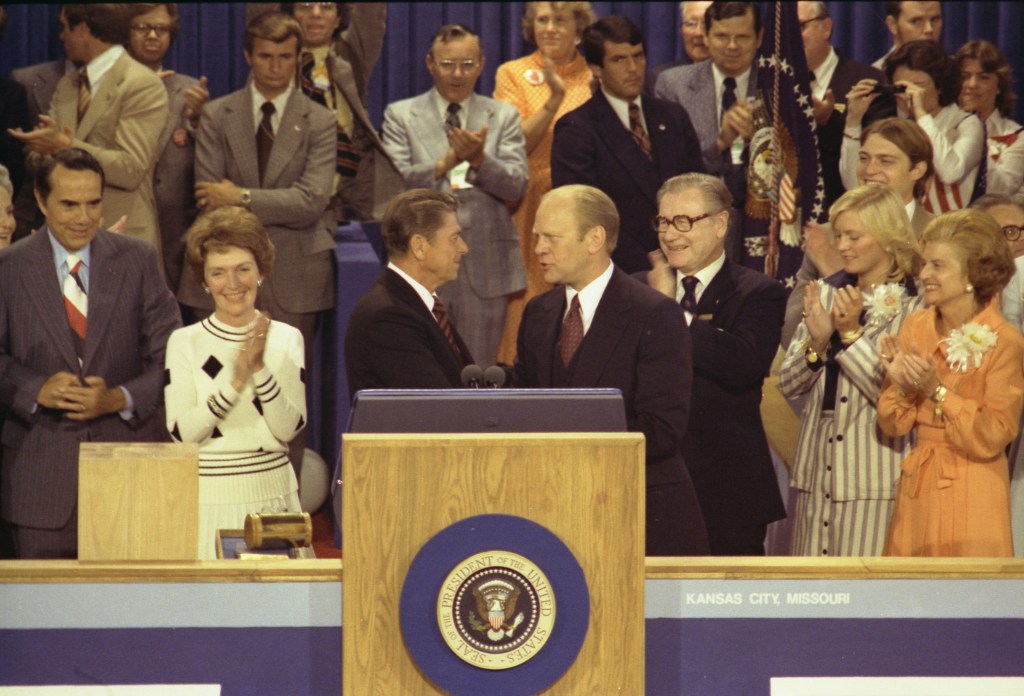
U.S. President Gerald Ford edged out challenger Ronald Reagan, 1,187 to 1,070 in delegate votes, on the first ballot to win the Republican Party presidential nomination at the Republican National Convention at Kemper Arena in Kansas City. Ford, the only U.S. president who had never been elected as either the presidential or vice-presidential nominee, had succeeded to the office after initially being confirmed by the U.S. Senate as Vice President of the United States in 1973 to fill the vacancy left by the resignation of Spiro Agnew, and then being sworn in after the resignation of President Richard Nixon. The balloting was close enough between Ford and Reagan that in an alphabetical roll-call of the U.S. states’ delegations, he didn’t receive the necessary 1,131 majority until receiving the 20 votes from the West Virginia delegates at 12:29 in the morning local time. Ford then drove to Reagan’s hotel and met with the former California governor for 27 minutes.
Later in the day, President Ford selected Bob Dole, Republican U.S. Senator for Kansas, as his running mate to be the Republican nominee for Vice President of the United States. In addition, for the first time since 1960, the nominees of the two parties agreed to nationally-televised presidential debates as Ford made the challenge and Democratic nominee Jimmy Carter accepted.
President Ford surprised his fellow Republicans with his selection of Senator Robert Dole of Kansas as his running mate. The delegates at the Republican National Convention ratified the President’s choice, a conservative known for his aggressive partisanship. A movement by some Southerners to draft Ronald Reagan fizzled. In his address to the final session of the convention, President Ford pledged to fight “with total will” to win a great victory. Mr. Ford offered to debate on television with Jimmy Carter, his Democratic rival, and Mr. Carter later accepted.
In selecting Senator Robert Dole as his running mate, President Ford made a decision that conformed to the wishes of Ronald Reagan and brought to the Ford ticket an aggressive and articulate political infighter. In a post-midnight conference with his defeated rival, President Ford asked Mr. Reagan to comment on a list of six vice-presidential prospects. Sources close to both men agreed that Mr. Reagan spoke most warmly of Senator Dole.
It seemed in a farewell meeting that Ronald Reagan believed that his active political career was over. He said he would resume his work as a commentator on national affairs and do what he could to help the Ford ticket. He praised President Ford’s choice of Senator Robert Dole as his running mate and said they faced a difficult battle against Jimmy Carter. States with strong political machines and their influence on wavering delegates were a big factor in his losing the nomination, according to Mr. Reagan. “The convention turnaround was in the machine states,” he said.
Many of the convention delegates spoke gravely of the Ford ticket’s prospects in November, while staunch supporters of Ronald Reagan threatened to sit back and watch the ticket lose in the South and West. “I’m afraid Ford is going to have to write off a large part of the South,” Guy Hunt, chairman of the pro-Reagan delegation from Alabama, said.
Both major Presidential nominees said last night that they were prepared to meet in the first televised Presidential campaign debates since 1960. President Ford, in his acceptance speech before the Republican National Convention, said that he was ready to “debate the real issues” with Jimmy Carter, the Democratic nominee in the forthcoming campaign. Mr. Carter, who earlier had agreed in principle to meeting Mr. Ford before the television cameras, reaffirmed his desire in a statement from his home in Plains, Ga. after the President spoke in Kansas City. “l hope the format will allow tough cross‐examination of the candidates by the news media,” Mr. Carter said.
Acting reportedly under instructions from the Justice Department, agents of the Federal Bureau of Investigation assigned to investigate a series of burglaries by their colleagues removed, a source said, “file cabinet after file cabinet” from the F.B.I.’s headquarters in Washington and its field office in New York City. It was also learned that Wallace LaPrade, an assistant F.B.I. director who heads the Manhattan office, authorized some of the burglaries that are under investigation.
The Justice Department asked a federal judge to dismiss three private suits against Rep. Wayne L. Hays (D-Ohio) and his former mistress, Elizabeth Ray, that seek to recover any federal money she received without working for it. An official said one purpose of the action was to preserve Justice’s right to file a civil suit to recover the money later after it completes its criminal investigation. Hays, who has announced he is retiring, was stripped of his House committee chairmanships after Miss Ray’s public accusation that she was given a $14,000 clerical job on the federal payroll solely to serve as his mistress.
The Food and Drug Administration has recommended that strict controls be put on the distribution of Darvon, the third most prescribed drug, because abuse of the controversial painkiller can cause dependence or death. FDA Commissioner Alexander M. Schmidt made the request to the Justice Department’s Drug Enforcement Administration. Control of Darvon and other drugs containing propoxyphene is “clearly warranted,” Schmidt said. The DEA had urged the FDA in 1973 to limit prescriptions of propoxyphene to no more than five refills in a six-month period. The FDA turned down the request but reconsidered after a study implicated propoxyphene in thousands of overdose deaths over a period of years.
Virginia studied the possibility of new restrictions on the shipping of cargo in Chesapeake Bay as efforts began to right an acid-laden barge that capsized off Mathews County on the western shore. The study of shipping regulations came a day after the 125-foot Allied Chemical Co. barge capsized with 250,000 gallons of acid aboard. Four-fifths of the cargo was sulfuric acid, a violent corrosive, and the rest was oleum, also called fuming sulphuric acid and also dangerous. Only a small amount of acid has leaked out but the Coast Guard said more might escape when efforts were made to turn the barge upright.
A district court judge in Salt Lake City refused to call off the sex solicitation trial of Rep. Allan T. Howe (DUtah), whose attorneys had claimed that prejudicial publicity had made it impossible to find an impartial jury. Judge Bryant Croft also denied dismissal motions claiming entrapment, the unconstitutionality of the antiprostitution law and sexual discrimination against men. Croft’s ruling cleared the way for Howe’s trial a second time on a charge that he tried to buy sex from two policewomen posing as prostitutes. The trial is scheduled to begin Monday.
A federal judge permitted government attorneys to introduce into evidence a confession from William A.H. Williams that he kidnaped newspaper executive Reg Murphy in 1974. Williams, however, told the court in Key West, Florida, that FBI agents intimidated him and his family when they arrested him. But FBI agent James C. Guess denied the charge and said Williams confessed he did the Atlanta kidnapping. Murphy at the time was editor of the Atlanta Constitution — which paid $700,000 in ransom — and now is editor-publisher of the San Francisco Examiner. Williams’ conviction and 40-year prison sentence two years ago were overturned on grounds of pre-trial publicity and the prosecution’s errors.
Permission to use the pesticide DDT has been given to Butte County (California) authorities to aid them in their battle of a small outbreak of bubonic plague in the northern part of the county. Both the state Department of Health and the federal Environmental Protection Agency granted permission for limited use of the chemical, which was banned four years ago. A county official said ground squirrel burrows on 15 acres would be dusted with the chemical this week in an effort to kill the fleas that carry the plague. He said a number of ground squirrels had been found dead in the area.
General Motors Corp. was fined $1,250 after entering a plea of no contest to charges of violating state air pollution control laws at the GM plant in Van Nuys, California on May 25 and June 10. Municipal Judge Morton Rochman imposed the fine and placed the corporation on two years’ probation. The two-count misdemeanor criminal complaint against GM was filed by City Attorney Burt Pines.
A tropical depression that dumped flooding rains on south Florida grew to Tropical Storm Dottie off West Palm Beach and a hurricane watch was ordered for the Georgia and North Carolina coasts. Dottie was packing top winds of 40 mph and forecasters at the National Hurricane Center in Miami said the season’s fourth storm could become a hurricane by today. At the latest report Dottie was just off the Florida coast east of Vero Beach.
Evidence of the subatomic phenomenon called “naked charm” has been seen in some 50 high-energy physics experiments at the Fermi National Accelerator Laboratory in Batavia, Illinois, according to an announcement yesterday in New York at Columbia University.
Jerry West, the Los Angeles Lakers’ “Mr. Clutch,” who came out of Cheylan, West Virginia (population 500) to become a pro basketball legend, was named today as coach of his former team.
Major League Baseball:
In a meeting of two pitchers in a slump, Ken Brett (7–8) emerged a winner for the first time since July 25, while Rick Wise failed in a fourth consecutive try for his 10th victory as the Chicago White Sox defeated the Boston Red Sox, 4–2. Jorge Orta had two hits for the White Sox, scoring one run and driving in another. Jack Brohamer accounted for two RBIs with a single and sacrifice fly. Rick Burleson batted in both runs for the Red Sox.
Breaking through a five-man infield defense set up by the Braves, pinch-hitter Mike Lum lashed a line drive past the glove of first baseman Willie Montanez for a run-scoring single in the 11th inning to bring the Reds a 3–2 victory. The Braves picked up both their runs in the first inning. The Reds came back with a counter on singles by Cesar Geronimo and Pete Rose around a sacrifice in the second and tied the score in the seventh when Rose tripled and Rod Gilbreath threw wildly on the relay from the outfield. Tony Perez set up the Reds’ winning run with a single in the 11th and went to third one out later when Darrel Chaney threw the ball away on a grounder by Dave Concepcion. The Braves then brought in left fielder Tom Paciorek and placed him on the right side of the infield, but Lum wrecked the setup with his game-winning hit.
A superb relief performance by Jim Crawford enabled the Tigers to defeat the Angels, 4–3. Crawford replaced Ray Bare with two men on base and two away in the sixth inning, struck out Leroy Stanton and then allowed only one hit the rest of the way. The Tigers scored all their runs off Paul Hartzell, with the deciding marker counting in the fourth inning on a single by Ron LeFlore. Sid Monge, relieving Hartzell following LeFlore’s single, retired the last 14 batters in succession, striking out seven. Bob Jones and Mario Guerrero homered for the Angels in the fifth. Guerrero’s blow was his first in the major leagues.
The Dodgers erupted for four runs on two homers in the ninth inning and defeated the Mets, 6–5. The Mets counted four runs in the eighth, two scoring on a double by Joe Torre, and added a tally in the ninth for a 5–2 lead. Ted Sizemore and Bill Buckner set the Dodgers’ rally in motion with singles and Steve Garvey hit a homer to tie the score and knock out Skip Lockwood. Bob Apodaca relieved and Ron Cey, the first batter he faced, hit a homer to win the game for the Dodgers.
A three-run homer by Gorman Thomas in the second inning and triples by Von Joshua and George Scott in the fifth paced the Brewers to a 6–4 victory over the Royals. Thomas’ blow followed a single by Sixto Lezcano and pass to Tim Johnson. Joshua led off the fifth with his triple and scored, breaking a 3–3 tie, on a sacrifice fly by Robin Yount. Scott then tripled and continued home when Frank White threw wild on the relay. The run became earned when Mike Hegan followed with an infield grounder on which Scott would have scored.
Pitching no-hit relief over the last 2 ⅓ innings, Bill Campbell racked up his 15th save of the season when the Twins defeated the Orioles, 5–4. The Orioles took a 4–2 lead with two runs in the sixth inning, one scoring on a homer by Ken Singleton and the other on a double by Dave Duncan. The Twins came right back with three runs in their half of the sixth. Larry Hisle walked and scored on a double by Steve Brye. Butch Wynegar singled and so did Roy Smalley, driving in Brye. After a pass to Mike Cubbage loaded the bases, Lyman Bostock drew a walk with two out to force in Wynegar.
Taking over the league lead in batting with an average of .344, Jay Johnstone smashed four hits, including a two-run homer, as the Phillies defeated the Astros, 7–1. Mike Schmidt hit his 32nd homer of the season, tying injured Dave Kingman of the Mets for the league lead. Schmidt whacked his drive in the first inning and Johnstone followed with his circuit clout after a single by Greg Luzinski. Steve Carlton (15–4) held the Astros to five hits and racked up his fifth victory in succession.
John Candelaria (12–4) scattered nine hits for his third shutout of the season and scored the game’s only run while pitching the Pirates to a 1–0 victory over the Giants. Duffy Dyer walked in the fifth inning and was forced on an attempted sacrifice by Candelaria, who then came home on two-out singles by Omar Moreno and Richie Zisk. Candelaria twice pitched his way out of bases-loaded jams, retiring Darrell Evans on a roller to shortstop in the first inning and Chris Speier on a popup to short in the sixth.
Boog Powell, suffering through the worst season of his 15-year major league career with only 18 previous RBIs to his credit, broke loose with two homers and a single, driving in five runs, to lead the Indians to a 7–5 victory over the Rangers. Powell hit his first homer of the game after a pass to Rico Carty to help the Indians take a 4–0 lead in the fourth inning. The Rangers, who lost their sixth straight, came back to assume a 5–4 advantage, but Carty walked again in the eighth and Powell followed with his second homer of the game. Powell also singled Rick Manning home in the ninth for his fifth RBI. Dave LaRoche picked up his 13th save for the Indians. Jeff Burroughs hit two doubles and a homer for the Rangers.
Boston Red Sox 2, Chicago White Sox 4
Atlanta Braves 2, Cincinnati Reds 3
California Angels 3, Detroit Tigers 4
New York Mets 5, Los Angeles Dodgers 6
Kansas City Royals 4, Milwaukee Brewers 6
Baltimore Orioles 4, Minnesota Twins 5
Houston Astros 1, Philadelphia Phillies 7
Pittsburgh Pirates 1, San Francisco Giants 0
Cleveland Indians 7, Texas Rangers 5
The stock market plunged yesterday, with the Dow Jones industrial average falling 11.13 points to 983.88 its most precipitous decline in almost three months. Investors were concerned over President Ford’s choice of Senator Robert J. Dole of Kansas as his running mate and the killing of two American officers by North Koreans, analysts said, as well as by the dwindling strength of the economic recovery. One analyst commented that Senator Dole’s “lack of previous visibility, when combined with the somewhat colorless character of President Ford, tends to increase the chances of Jimmy’s Carter’s election in November.”
Dow Jones Industrial Average: 983.88 (-11.13, -1.12%)
Born:
Brad St. Louis, NFL long snapper (Cincinnati Bengals), in Waverly, Missouri.
Régine Chassagne, Canadian rock singer-songwriter, keyboardist, and accordion player (Arcade Fire), in Montreal, Quebec, Canada.
Ucu Agustin, Indonesian journalist and documentary filmmaker; in Sukabumi.
Died:
Alastair Sim, 75, Scottish actor (Christmas Carol, Green for Danger).

