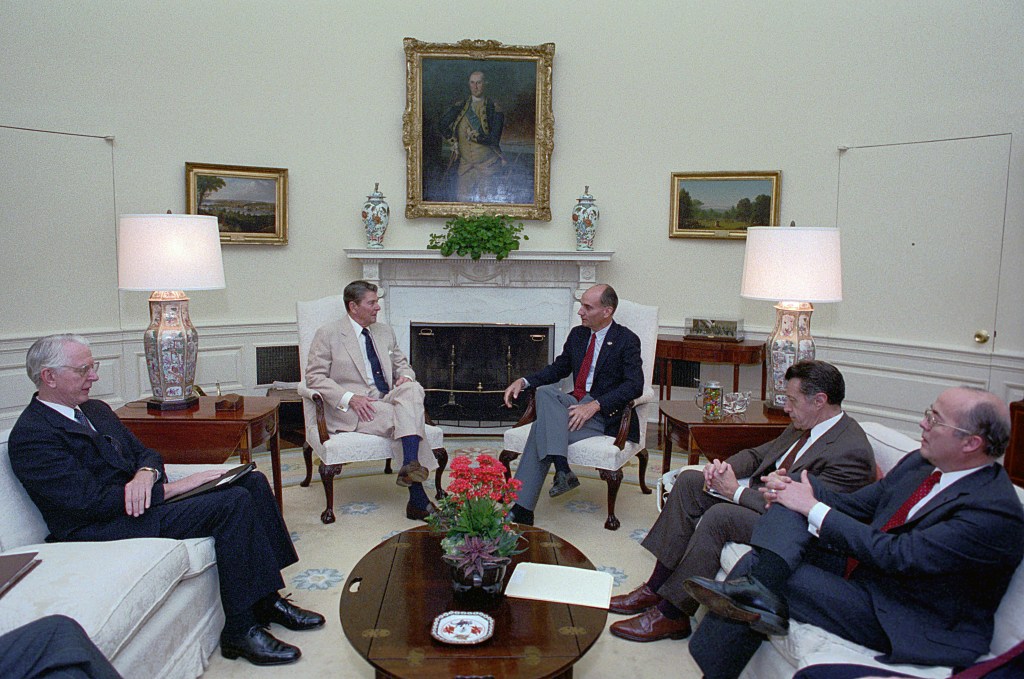
President Reagan said today that the United States had agreed to a Soviet “work plan” that would lead to a summit meeting later in this year and that both nations had moved beyond “misunderstanding and suspicion.” Mr. Reagan’s remarks came as American officials said the United States and the Soviet Union had tentatively agreed to a meeting between Secretary of State George P. Shultz and the Soviet Foreign Minister, Eduard A. Shevardnadze, on Sept. 19 and 20 in Washington. The meeting is designed to set the stage for a meeting in the United States between Mr. Reagan and the Soviet leader, Mikhail S. Gorbachev. In a speech today that the White House officials termed a positive assessment of United States-Soviet relations, Mr. Reagan said his letter on arms control sent last Friday to the Mr. Gorbachev “underlines my determination to keep the momentum going.”
Defense Secretary Caspar W. Weinberger warned that the United States faces a “hollow strategy” in the future because of declines in the growth of military spending. Weinberger, in a speech at a National War College conference in Washington, cited bipartisan support for the military after a period of divisiveness at the end of the Vietnam War. He said it is important to maintain record levels of spending for continued rearmament and for research on the “Star Wars” missile defense program.
The White House said today that President Reagan, after a contentious meeting on Monday, was undecided whether to support a Republican-backed Senate bill to allow the sale of subsidized grain to the Soviet Union. An official said the issue was difficult to resolve in this election year because it pitted the Senate majority leader, Robert Dole of Kansas, who says the subsidies are needed by farmers, against Secretary of State George P. Shultz, who has opposed subsidized exports to the Soviet Union. The issue has become a major problem because of conflicting domestic political and foreign policy considerations. Neither choice, a White House official said, is “particularly appealing.”
The Ukrainian newspaper Pravda Ukrainy said today that the former chief engineer of the Chernobyl nuclear station had been ousted by the Communist Party. The plant official, N. Fomin, was dismissed from his job last month. He was accused of having failed to take proper precautions in conducting an experiment that lead to the Chernobyl nuclear accident in April. In the Soviet Union, where party membership improves many aspects of life, loss of the party card is often more disgraceful than the loss of a job. Pravda Ukrainy also reported the dismissal of T. Zavalnyuk, the nuclear safety chief for the Soviet Southwest. His superior, Yevgeny V. Kulov, who was the national safety director, was among four top officials discharged earlier. Party penalties have also been imposed on T. Parashin, head of the party cell at the power plant, and against Aleksandr S. Gamanyuk, party chief in Pripyat, which was evacuated after the accident and is now a ghost town.
Authorities in Austria confiscated U.S.-made computers believed headed for the Soviet Union. U.S. Customs officials have begun an investigation into the attempted diversion of the computers, bought in West Germany. U.S. sources, who questioned why West Germany granted an export license for the computers, have described the seizure as the “tip of the iceberg” of a network funneling sensitive equipment to Soviet Bloc countries. The computers, built under license by a West German subsidiary of Tektronix Inc., in Beaverton, Oregon, were seized at the Vienna airport.
A bomb exploded at a luxury seaside hotel filled with tourists in Marbella, Spain today, wounding a 9-year-old boy, the authorities said. Ten minutes before the blast, which occurred at the Don Carlos Hotel, a man who said he represented Basque separatist terrorists called a radio station to warn of the attack.
The Icelandic Prime Minister met with the United States Ambassador today to express anger over Washington’s stand in a dispute concerning Iceland’s whaling industry. Saying that Iceland had been pressed by Washington into ending its centuries-old hunt for whales, Prime Minister Steingrimur Hermannsson said later at a news conference that he told the ambassador, Nicholas Ruwe, of his anger at Washington’s handling of the affair.
A car-bombing killed 30 people and wounded 180 in the second such incident in the Beirut area in two days. An auto packed with explosives and mortar shells exploded in a crowded marketplace in Muslim West Beirut. The blast occurred as a funeral mass was being held at a Maronite Catholic Church in West Beirut for the 31 people killed in a Beirut suburb bombing Monday. On Monday, a car bomb devastated a three-block area in the Ain el-Rummaneh residential quarter of East Beirut. The blast today occurred as a mass funeral was being held at a Maronite Catholic Church in West Beirut for the 31 victims in Monday’s car bombing. No group has taken responsibility for either of the blasts. The explosion today occurred in the Barbir area at the eastern end of Corniche Mazraa, one of West Beirut’s busiest thoroughfares. The area was filled with street vendors, taxi cabs and shoppers at a makeshift market under a bridge that leads to East Beirut.
The Iranian navy detained an Arab commercial vessel near the Strait of Hormuz, the Kuwaiti News Agency reported. It said the vessel, belonging to a company jointly owned by Iraq and the six Arab nations of the Persian Gulf, was taken to an unspecified Iranian port. The report gave no other details. Earlier, Iraqi warplanes fired at the Cypriot tanker Polikon, which was traveling on Iran’s oil export routes. No reports were available on damage or any casualties that might have resulted. Iran and Iraq have been at war for nearly six years.
The dispute over the sinking of an environmentalist group’s ship in Auckland harbor in New Zealand, an incident that shook France for months, is finally over. That, at any rate, was the view that prevailed last week after New Zealand handed over to the French two secret agents who were serving prison terms for their role in the sinking last year of the Rainbow Warrior, the flagship of the environmentalist group Greenpeace. The ship was preparing to lead an protest flotilla to a French nuclear testing site in the South Pacific. The freeing of the two officers, Maj. Alain Mafart and Capt. Dominique Prieur, who will spend three years on a French military base in the South Pacific under an agreement with New Zealand, brought relief here.
Supporters of Mexico’s conservative opposition party ended their five-day sit-in on a bridge connecting Ciudad Juarez with El Paso, Texas, and traffic began moving across it again. Francisco Barrio, former gubernatorial candidate of the National Action Party, said the sit-in accomplished its purpose of uniting the community to protest alleged vote fraud by the ruling Institutional Revolutionary Party. The decision to abandon the sit-in came after rumors that the army was getting ready to drag the protesters off the bridge. Barrio said his party plans new actions to continue pressuring the government to nullify the July 6 elections in Chihuahua state.
The Jamaican opposition People’s National Party captured an early lead today in provincial elections marred by reports of stolen ballots and violence that left two people dead and 20 wounded. The elections, for council positions in 13 parishes and Kingston, were a test of support for Prime Minister Edward P. G. Seaga’s Jamaica Labor Party and his economic austerity policies.
In what appears to be an effort to strengthen government authority in El Salvador, the commander of the Salvadoran Army has announced a new national plan for reconstructing war-torn areas of the country. “We are passing through a crucial period,” the head of the army, General Adolfo Blandon, said after a news conference Monday. “Reuniting all forces is now very important to strengthening democracy.”
Rebels killed three European volunteer workers and two Nicaraguan officials in an ambush near the Honduran border, and the Sandinista government said it blames the United States for their deaths. Two other Nicaraguans were reported wounded. The killings occurred when the U.S.-supported contras opened fire on two trucks in Jinotega province, 130 miles north of Managua, the government said. A spokesman said a formal protest has been sent to the United States. The European victims were identified as a West German, a Swiss and a Frenchman who recently became a Nicaraguan citizen.
Nicaragua charged that the Reagan Administration was moving toward another Vietnam by financing anti-Government guerrillas in Nicaragua. President Daniel Ortega Saavedra, speaking before the United Nations Security Council, said Nicaragua would continue to defend its right to self-determination.
A report by a congressional delegation accused Chile of permitting human rights violations so severe that they justify cutting off international development bank loans. Rep. Bruce A. Morrison (D-Connecticut), who led a delegation to Chile earlier this year, said the group received evidence of torture, imprisonment without charges, random killings and other rights violations. “Failure of the United States to oppose development bank loans to Chile is contrary to U.S. law and damaging to the interests of democracy in that country,” Morrison said. A subcommittee of the House Banking Committee is expected to start hearings today on the Chilean situation.
South African President P. W. Botha delivered a hostile response today to the latest Western initiative to promote racial dialogue here, telling Britain’s Foreign Secretary that “South Africa should be left in peace.” Mr. Botha spoke at a news conference as the Foreign Secretary, Sir Geoffrey Howe, wound up a seven-day visit to southern Africa. He was representing the 12-nation European Community in a quest for political concessions from Pretoria on South Africa’s crisis. Western diplomats said the seeming failure of his mission seemed certain to increase pressure on West European countries, particularly Britain, the biggest foreign investor in South Africa, to approve economic sanctions against Pretoria. In the nation’s turmoil, meanwhile, the authorities reported five more blacks slain, three by fellow blacks and two by security forces. The violence centered on the Eastern Cape region, whose black townships are among the most defiant in the country.
The Reagan Administration told Congress today that it had signed an agreement with South Africa to increase textile imports from that country. The disclosure provoked fierce criticism on Capitol Hill, where lawmakers have been considering strict economic sanctions against South Africa. Larry Speakes, the White House spokesman, said the agreement, which was negotiated by the office of the United States Trade Representative on June 27, would allow a 4 percent increase in textile imports. He said the pact would actually limit South Africa’s share of the American market, which has been rising rapidly. “On balance, this agreement will help American producers,” Mr. Speakes said.
Members of the Senate Judiciary Committee moved quickly today to draw the lines of ideological engagement as they began hearings on the nomination of William H. Rehnquist to be Chief Justice of the United States. As they prepared for what is expected to be a grueling examination of the conservative Supreme Court Justice on Wednesday, several members of the committee stressed that they faced one of the most important decisions they will ever make. Before making a short opening statement, Mr. Rehnquist listened as Republican Senate leaders, a Democratic Senator, Dennis DeConcini of Arizona, and former Attorney General Griffin B. Bell heaped praise on President Reagan’s choice and declared their support for him. But Senator Edward M. Kennedy, Democrat of Massachusetts, assailed Justice Rehnquist for what he called an “appalling record on race” and said he was “too extreme to be Chief Justice.”
President Reagan announced today that the United States would go ahead with plans to resume the production of chemical weapons. In a letter to Congress, Mr. Reagan said that he had satisfied Congressional objections to the production of a new generation of nerve-gas weapons and that the United States must maintain a “safe and viable stockpile” until a comprehensive ban on chemical weapons could be worked out. Chemical weapon production had been halted by President Richard M. Nixon in 1969. Congress had required the President to certify that the North Atlantic Treaty Organization had worked out plans calling on the United States to provide the chemical weapons for the military needs of the alliance. In the letter today, Mr. Reagan said the allies had approved the plans during consultations in May and June.
Rep. Guy Vander Jagt (R-Michigan), chairman of the National Republican Congressional Committee, said that he introduced legislation to repeal the 22nd Amendment to clear the way for President Reagan to seek a third term. Changing the Constitution would require approval of three-fourths of the states. The amendment, which limits the President from serving more than two full terms, was ratified in 1951 after the four-term presidency of Franklin D. Roosevelt. Reagan has said he would support repeal of the amendment for future presidents.
President Reagan places a call to former President Richard M. Nixon.
President Reagan greets members of the White House kitchen staff while returning to the Oval Office.
President Reagan heard final arguments today on whether to build a new space shuttle to replace the lost Challenger and will make a decision on the issue in the next several days, according to Larry Speakes, the White House spokesman. The chief problem remains how to finance a new shuttle orbiter in a period of tight budgets, Mr. Speakes indicated. These and other space issues were discussed at a wide-ranging meeting between the President and his national security and space aides.
President Reagan’s top advisers on space policy recommended that he wait a few months before seeking funds for a replacement of the shuttle Challenger, a senior White House official said. The official, speaking on condition he not be identified, said most of the President’s advisers appeared to share the view that the Administration should move ahead with construction of some unmanned rockets to “clear out the backlog” of satellite launches caused by the grounding of the space shuttles in the wake of the January 28 Challenger disaster.
The House of Representatives refused to hold the line on its own spending today, rejecting an attempt to reduce the $1.3 billion legislative appropriation for 1987 to this year’s level. The House also rejected an amendment to do away with the operators who push buttons for Congressmen in automatic elevators in the three House office buildings. Representative Bill Frenzel, Republican of Minnesota, proposed an amendment cutting the bill’s spending priorities across-the-board to keep the total budget for the House and Congressional agencies at $1.259 billion, the 1986 level. The move was defeated, 209 to 199.
An attempt by the conservative American Legal Foundation to limit American radio and television appearances by people deemed to be Soviet propagandists was rejected by the Federal Communications Commission. James C. McKinney, the commission’s mass media bureau chief, said the First Amendment precludes the commission from interfering with the editorial process by directing broadcasters in the selection or rejection of particular program material.
Kenneth Ferguson, the co-pilot of a DC-3 that crashed, killing singer Rick Nelson and six others, said he was “nervous” about a troublesome cabin heater before a fire forced the plane down, federal documents revealed. But the National Transportation Safety Board statements of fact on the crash said that pilot Brad Rank kept turning the heater on to try to get it to work properly. The board has yet to determine the cause of the cabin fire December 31, 1985, which caused the crash near DeKalb, Texas, though sources said the heater is a key focus of the investigation.
Health care spending consumed $425 billion last year, equal to 10.7% of all goods and services produced by the U.S. economy, the annual report released by the Health and Human Services Department said. The 10.7% of gross national product devoted to health care was the highest on record and compared to 10.3% in 1984. But the rate of growth was the slowest in 20 years. Health expenditures in 1985 were up 8.9% from 1984’s $390.2 billion, the second year in a row that the rise was below the double-digit levels of the previous two decades.
Democratic politicians joined farmers suffering through a record drought when a train carrying 77 boxcars of donated Indiana hay arrived in Columbia, South Carolina. Lieut. Gov. Mike Daniel, the party’s gubernatorial candidate, rode the locomotive and waved as it rumbled past television news cameras.
After a three-month experiment, the Senate entered the television age for keeps today, voting 78 to 21 to permit gavel-to-gavel television coverage of its proceedings on a permanent basis. The Senate thus joins the House of Representatives, which has allowed television coverage since 1979. No figures are available on the size of the audience, but the cable television public affairs network C-Span, which is providing the coverage, says that the channel that carries the House proceedings has a potential audience of 25 million people, while the new Senate channel can reach eight million. For special events, as the hearings on confirmation of William H. Rehnquist to be Chief Justice of the United States, the Senate proceedings are picked up by public broadcasting stations.
The stern-wheeler Delta Queen carried 47 citizens of the Soviet Union into Dubuque, Iowa today, one stop on a peace cruise down the Mississippi River. The Russian group, which included the astronaut Grigory Grechko, and 130 Americans traveling with them on the eight-day trip from St. Paul to St. Louis were greeted by about 750 people as they got off the boat in Dubuque for a day of touring and a picnic. At a morning news conference aboard the Delta Queen the Russians said they were seeking to lessen the threat of nuclear war. A Connecticut group, Promoting Enduring Peace, is sponsoring the trip.
The Chicago City Council rejected a proposed homosexual rights ordinance after strong opposition from the Roman Catholic Church. The council voted 30 to 18 to table the measure, which would have barred discrimination in employment, housing and civil rights on the basis of “sexual orientation.” The existing city code prohibits discrimination on the basis of race, color and religion. Supporters had packed the chamber gallery. An estimated 250 people demonstrated against the measure outside City Hall.
Scott Benson threatened to kill his mother in a quarrel over his dog and she sent him to a psychiatric ward, a witness said today in the murder trial of Scott’s uncle, Steven Wayne Benson. The witness, Joyce Quinn, a former secretary for Scott and his mother, Margaret H. Benson, who was heir to a tobacco fortune, said Scott threatened to kill his mother at least six times in the Sept. 12, 1983, quarrel at the family’s estate in Naples, Fla. Ms. Quinn said Scott was taken to the psychiatric ward of Naples Community Hospital, where he spent a week and a half.
San Francisco has surpassed Philadelphia in population, becoming the nation’s fourth largest urban area, while Washington slipped two places to 10th, the Census Bureau reported. It said New York remained well ahead of all other metropolitan regions in the new population estimates for 1985, with Los Angeles second and Chicago third.
Mourners honored Averell Harriman at a Manhattan funeral service that attracted leading officials of the nation, state and city — a testimony to a career that spanned more than half a century and the entire world. He was a former New York Governor, diplomat, foreign policy negotiator, Cabinet member and close adviser to four Presidents.
The U.S. Football League suffered a resounding defeat in Federal District Court in Manhattan when a jury found that the National Football League had violated only one of nine antitrust and common law charges brought against it by the U.S.F.L. and awarded the four-year-old league only $1 in damages.
Major League Baseball:
Joe Cowley pitched a two-hitter over eight and two-thirds innings tonight and Ron Kittle hit a two-run homer as the White Sox beat the Boston Red Sox, 4–1, and ended an eight-game losing streak. After the game, it was announced that Kittle had been traded to the Yankees in a deal that sent Ron Hassey to Chicago. Chicago’s skid was its longest since 1978, when it lost nine in a row. Boston lost for the ninth time in the last 12 games.
The Detroit Tigers downed the Cleveland Indians, 6–3, as pinch-hitter Dave Bergman, singled with the bases-loaded in the 11th inning to help give the Tigers the victory. With one out, Dwight Lowry drew a walk from Bryan Oelkers (1–2). Lowry took second on a groundout and Alan Trammell was intentionally walked. After Dickie Noles relieved Oelkers, Chet Lemon’s infield single loaded the bases. Bergman followed with a slow bouncer to the third baseman, Brook Jacoby, whose throw skipped past the first baseman, Joe Carter. Bergman was credited with a single that scored Lowry, and Trammell scored on an error charged to Jacoby. Darrell Evans then delivered a run-scoring single, his third hit of the game.
David Palmer spaced four-hits over 7 ⅔ innings, and Dale Murphy hit his 15th home run to power Atlanta over the Astros, 1–0. Palmer, 7–8, dominated the Astro hitters, allowing only two baserunners as far as second. He struck out seven and walked three. Gene Garber finished up for his 13th save. Two of the four hits Palmer surrendered were infield singles. Mike Scott, 10–7, was equally effective, retiring 16 straight batters before Glenn Hubbard singled with one out in the sixth for the Braves’ first hit. Scott struck out 10 in eight innings to increase his major-league leading total to 197. The loss was Scott’s second in his last six decisions.
Dave Stieb, flashing the form that won him the American League earned run average title last season, pitched a four-hitter through 6 ⅔ innings to lead Toronto over the Royals, 5–2. Stieb, 3–10, had three walks and two strikeouts. Tom Henke got the final out for his 15th save.
The San Francisco Giants bowed to the Los Angeles Dodgers, 2–1. Fernando Valenzuela pitched a six-hitter, and Greg Brock and Reggie Williams hit sacrifice flies for Los Angeles. Valenzuela (14–6) struck out 11 batters for the third time this season.
Tonight, another Yankee pitcher underwent another thrashing and the Yankees lost to the Milwaukee Brewers, 6–4. This time it was the rookie Scott Nielsen, and the problems he experienced were exceptional even for this struggling staff. He pitched to seven batters in the first inning, gave up six hits, and he was able to record an out only when a Brewer runner ran past another on the basepaths. From there, the Yankees put up a good wall. Al Holland took them through the fifth in relief and gave up just a run. Brian Fisher pitched two scoreless innings and the offense as usual rustled up some runs, including two on a homer by Dave Winfield in the eighth. But the deed had been done.
Kent Hrbek hit a two-run homer and Kirby Puckett tripled, doubled and singled for Minnesota as the Twins beat the Mariner, 4–2. Frank Viola, 11–8, gave up two runs on six hits in 6 ⅔ innings. Roy Lee Jackson finished with two-hit relief for his first save.
Their offense and their defense have had a stabilizing presence this season, but last night both betrayed the Mets. They split a doubleheader with the Chicago Cubs at Shea Stadium, and the difference was this: Ron Darling survived a lack of support; Rick Anderson and Doug Sisk did not. Darling pitched a six-hit shutout to win the opener, 3–0, but the Mets were muzzled by a rookie pitcher in the second game and lost, 2–1, before 45,731 who were dampened but not disheartened by the occasional rain. There was no effect in the standing, except that the Mets moved another day closer to the National League East title. Montreal was rained out at Pittsburgh, leaving the Expos 16 – games out of the lead.
Jose Canseco’s tie-breaking single sparked a three-run rally in the seventh inning led Oakland past California, 4–2. Angels starter Ray Chadwick, making his major-league debut, took a two-hitter and 2–1 lead into the seventh inning but got pinned with the loss. Dwayne Murphy led off with a single and took third on a double by pinch-hitter Donnie Hill. Tony Phillips tied the score 2–2 with a force-out.
The Phillies use the long ball to subdue the visiting Cardinals, 12–7. Von Hayes hits a grand slam and collects 5 RBIs, Juan Samuel has a 3-run homer and Glenn Wilson adds a 2-run homer. Vince Coleman steals three bases for St. Louis to give him 68 on the year.
Garry Templeton lined a two-out single in the bottom of the ninth inning to drive in pinch-runner Jerry Royster from second base and give San Diego a 2–1 victory over the visiting Reds. The rally came off of reliever Ron Robinson, 8–2, who struck out Steve Garvey to open the inning, but walked Graig Nettles. After Bruce Bochy struck out, Royster went to second on Marvell Wynne’s single, setting the stage for Templeton. Bill Gullickson, seeking his fourth consecutive victory, started for the Reds and allowed the Padres just five hits and one run in the eight innings. The Reds scored a run in the second off starter Dave Dravecky when Eric Davis got an infield single to shortstop, stole second and third, and scored on Tony Perez’s single to center.
The Texas Rangers nipped the Baltimore Orioles, 6–5. Scott Fletcher’s double off the left-field wall with two out in the bottom of the 12th inning scored Oddibe McDowell from first base with the winning run. McDowell had singled off Odell Jones (1–1). Greg Harris (5–9), the fourth Texas pitcher, earned the victory with four innings of scoreless, three-hit relief.
The scheduled game between the Pittsburgh Pirates and the Expos at Montreal was postponed due to rain. The game will be made up as part of a doubleheader on September 17.
Boston Red Sox 1, Chicago White Sox 4
Detroit Tigers 6, Cleveland Indians 3
Atlanta Braves 1, Houston Astros 0
Toronto Blue Jays 5, Kansas City Royals 2
San Francisco Giants 1, Los Angeles Dodgers 2
New York Yankees 4, Milwaukee Brewers 6
Seattle Mariners 2, Minnesota Twins 4
Chicago Cubs 0, New York Mets 3
Chicago Cubs 2, New York Mets 1
California Angels 2, Oakland Athletics 4
St. Louis Cardinals 7, Philadelphia Phillies 12
Cincinnati Reds 1, San Diego Padres 2
Baltimore Orioles 5, Texas Rangers 6
Concerns about interest rates and the economy lingered on Wall Street yesterday, causing a moderate drop in stock prices that resulted in blue-chip issues closing at their lowest levels in more than two months. For the most part, investors were inactive because they feared that the quarterly Treasury Department refunding, the size of which will be announced today, might drive interest rates higher. Trading volume on the New York Stock Exchange dipped to an anemic 115.7 million shares from Monday’s slightly more lively 128 million. The Dow Jones industrial average, a 36-point loser on Monday, fell another 7.03 points yesterday, to 1,766.87. It was the worst level for the Dow since it closed at 1,758.18 on May 19.
Dow Jones Industrial Average: 1766.87 (-7.03)
Born:
Anton Belov, Russian National Team and NHL defenseman (Olympics, 2014; Edmonton Oilers), in Ryazan, Russian SFSR, Soviet Union.
Died:
Gordon Mills, 51, British songwriter (Tom Jones — “It’s Not Unusual”), of cancer.

