At OKH headquarters, chief of operations General Franz Halder on 30 July 1941 continues to see the glass half-full rather than half-empty. Facing tremendous resistance before Kyiv, he rather hopefully writes:
“In Army Group South, the weeks of grinding at the Russian front in the Ukraine are beginning to tell. The enemy front is crumbling.”
However, in the very next sentence, a shadow appears on this rosy evaluation:
“Nothwithstanding, we must expect that owing to the absence of any pressure from the Romanians and the existence of several well-preserved enemy divisions in the sector of the Front Group South, an attempt will be made to hold the coastal district around Odessa. Odessa may become a Russian Tobruk.”
Halder’s rather gratuitous slap at the Romanians (whose leader, Ion Antonescu, today pledges his military’s support throughout the campaign) is symptomatic of growing stress on the front for the Wehrmacht. Before setting out on Operation Barbarossa, allied involvement was considered helpful but not necessary. In fact, Hitler did not secure Romanian participation until virtually the last moment. Now, however, Romanian failures are portrayed as the cause of major problems. The endemic German scapegoating of its allies has just begun.
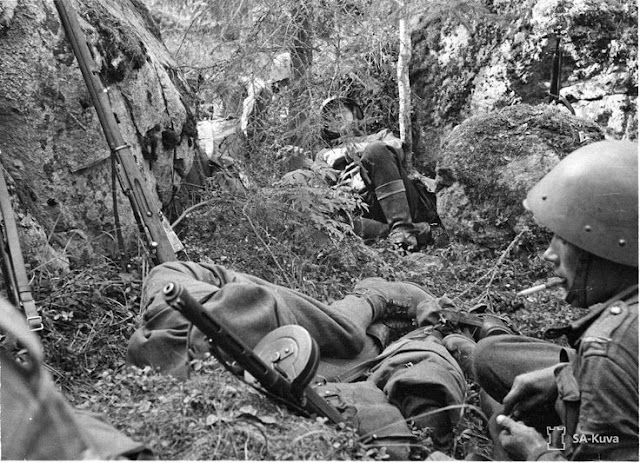
In the Far North sector, the Axis advance is stalled except on a few fronts where Finnish troops are taking advantage of their forestland expertise to confound the Soviets. Finnish Group J of 14th Division of III Corps has reached a strongly defended So’yanga canal between Lake Pyaozero and Lake Topozero. In a daring assault, the Finns smuggle a battalion of Group J across the western tip of Top Lake. This effectively flanks the Soviet canal position between the lakes and provides the leverage the Finns need to pry them out of their defenses. Meanwhile, Group F also is advancing on two fronts (moving along the north shore of the large Sredneye Kuyto Lake and along the Korpi Yarvi — Ukhta (Kalevala) road) to the Yeldanka Lake area. As this advance develops, it places Group F about 12 miles northwest of Ukhta, putting further pressure on the Soviet defenders in the sector.
The way now appears open to Kestenga and, much further beyond, the strategically critical Murmansk railway line. The Stavka, realizing the danger, begins transferring reinforcements (the independent Grivnik brigade and the 88th Rifle Division) to defend Kestenga. Both sides rely upon the very few roads in the endless wilderness, which greatly aids the defense. This particularly delays the Germans, who are unfamiliar with the wilderness and, like the Soviets, prefer to remain on the roads. However, the Finns have proven in the Winter War that they are comfortable operating off the roads, which greatly reduces the ability of the Soviets to simply blockade a road and thereby stop the Axis advance.
In the Army Group North sector, the German I Corps (General of the Infantry Kuno-Hans von Both) pushes Soviet General Morozov’s 11th Army and General Berzanin’s 27th Army out of Staraya Russa. This position south of Lake Ilmen becomes the linchpin of the German line for much of the next three years.
In the Army Group Center sector, the Soviet 20th Army leads the 16th and 19th armies in an attempt to break out of the pocket near Smolensk. The Soviets do manage to open a hole in the perimeter, aided by other attacks by Soviet forces to the east. A relatively small number of Soviet troops escape. However, the Wehrmacht’s Panzer Group 2 and 3 quickly seal the front again and trap 300,000 Soviet soldiers for good.
German 17th and 18th Panzer Divisions of 47 Corps are so depleted from a month of fighting and maneuvering that the OKH considers merging them. The truth is, though, that many other divisions are in similar states. Still, even in their depleted states, panzer divisions can still hold their own against the Soviet formations opposing them.
General Zhukov activates a new front, the Reserve Front. It contains the 24th Army, 28th Army, 29th Army, 30th Army, 31st Army, and 32nd Army. This is a sign of Soviet strength, as it demonstrates that the Soviets have entire armies that they have not yet been committed while the Wehrmacht has very few reserves at hand. Zhukov’s task is to batter the advanced German position at Yelnya.
In the Army Group South sector, the Soviet commands are more worried about following a Stavka order to defend the Dnieper River crossings than they are defending Kyiv. The German Sixth Army, after first trying to batter the Kyiv defenders frontally, now is sliding around the Soviet concentration to potentially encircle it. Considering that the Soviets have 1.5 million troops in the area, an encirclement would be disastrous to the Red Army, but Stalin has ordered the position held. In fact, he is so adamant about this that he has demoted his chief military lieutenant, General Georgy Zhukov, to the command of a new front defending Moscow near Yelnya.
The Luftwaffe bombs and sinks Soviet submarine S-6 off Saaremaa, Estonia.
The British Fleet Air Arm launched the raid on Kirkenes and Petsamo, but it was unsuccessful. Aircraft from Force P of the British Home Fleet carried out attacks on German installations in Finland. Aircraft from the aircraft carrier HMS Victorious (38) struck Kirkenes and aircraft from the aircraft carrier HMS Furious (47) struck Petsamo. The raid was planned as a secret strike from aircraft carriers HMS Victorious and Furious, but somebody at Whitehall apparently forgot that daylight is 24-hours long in the extreme northern latitudes during the summer. The Germans who occupy Petsamo with Finnish acquiesence indeed spotted the massive Royal Navy fleet on the 29th and are lying in wait for the attacks. Little damage was done due to early detection by the Germans and 24 of the attacking aircraft were lost to antiaircraft fire and German fighters. Overall Operation EF is a flaming disaster of wasted effort and lost planes for the British.
Petsamo (today Petchenga in Russia) by the Arctic Sea was at the time Finnish territory. Acquired by Finland in the Peace of Tartu in 1920, it was the only harbor Finland had that was ice-free around the year. During the 1920’s there were found substantial deposits of nickel, which made the area very important as the war came closer. The Soviets occupied the area in the Winter War of 1939-40, but returned it to Finland after the war (except the formerly Finnish half of the Rybachi Peninsula) for reasons that are still debated. As the German troops, as agreed with Finland, took over the northern Finland before the start of the Barbarossa, also the nickel of Petsamo all went to Germany. Finland lost the Petsamo territory finally in 1944 to Soviet Union. As said, the territory was Finnish, but effectively controlled at this time by the Germans.
Antonescu writes to Hitler that Rumania will fight beside Germany until the Soviet Union is destroyed.
President Roosevelt’s crony Harry Hopkins arrives at Archangel in Russia’s far north and proceeds to Moscow for talks. The Soviets are quite happy to see Hopkins because they covet U.S. lend-lease aid. Timed to coincide with Hopkins’ visit, the United States officially announces that it will indeed supply lend-lease supplies to the Soviet Union. This is an open-ended commitment with no strings attached, and these two factors will cause problems in the future for relations between the two powers.
The Sikorski–Mayski agreement was signed in London between the Soviet Union and the Polish government-in-exile. As the first step in what will become an increasingly convoluted and insincere relationship, the Soviets execute an agreement (the “Sikorski–Mayski agreement”) with the Polish government-in-exile, led by General Sikorski, in London. The agreement provides in part:
“The Government of the U.S.S.R. expresses its consent to the formation on territory of the U.S.S.R. of a Polish Army under a commander appointed by the Polish Government in agreement with the Soviet Government, the Polish Army on territory of the U.S.S.R. being subordinated in an operational sense to the Supreme Command of the U.S.S.R., in which the Polish Army will be represented. All details as to command, organization and employment of this force will be settled in a subsequent agreement.”
This is not an ideal arrangement. Basically, it makes such a Polish army a mercenary force for the Soviet Union. It does meet the Soviet goal as to the formation of a Polish Army (ultimately known as the Anders Army after its commander Władysław Anders) from 25,700 POWs held in the USSR.
Winston Churchill grandly proclaims this treaty as:
“…proof of the fact that hundreds of millions of men all over the world are coming together on the march against the filthy gangster power which must be effectively and finally destroyed.”
The treaty is only a first step and creates a great deal of ambiguity. More importantly for the Poles, they have no way to enforce proper conditions for the Anders Army and no recourse if it is misused or maltreated.
In Rastenburg, Hitler orders assaults towards Leningrad and the Ukraine rather than a frontal attack on Moscow as he issues Führer Directive 34:
The Führer and Supreme Commander of the Armed Forces.
The Führer’s Headquarters, 30th July, 1941.
14 copies
Directive No. 34
The development of the situation in the last few days, the appearance of strong enemy forces on the front and to the flanks of Army Group Center, the supply position, and the need to give 2nd and 3rd Armored Groups about ten days to rehabilitate their units, make it necessary to postpone for the moment the further tasks and objectives laid down in Directive 33 of 19th July and in the Supplement of 23rd July.
I therefore order as follows:
I. Army
- In the northern sector of the eastern front the main attack will continue between Lake Ilmen and Narva towards Leningrad, with the aim of encircling Leningrad and making contact with the Finnish Army.
North of Lake Ilmen this attack will be covered in the Volkhov sector; south of Lake Ilmen it will be carried northeastwards only so far as is required to protect the right flank of the attack north of the lake. The situation around Velikiye Luki will have been previously cleared up. All forces not required for these operations will be transferred to take part in the flank attacking north of Lake Ilmen. The intended thrust by 3rd Armored Group against the high ground around Valdai will be postponed until armored formations are fully ready for action. Instead, the left flank of Army Group Center will advance sufficiently far northeastwards to afford protection to the right flank of Army Group North.
Estonia must first of all be mopped up by all the forces of 18th Army; only then may Divisions advance towards Leningrad.
- Army Group Center will go over to the defensive, taking advantage of suitable terrain.
Attacks with limited objectives may still be mounted in so far as they are necessary to secure favorable springboards for our offensive against Soviet 21st Army.
2nd and 3rd Armored Groups will be withdrawn from the front line for quick rehabilitation as soon as the situation allows.
- Operations on the southeastern front will, for the present, be conducted only by formations of Army Group South.
Their objective must be to destroy the strong enemy forces west of the Dnieper River and, in addition, by securing bridgeheads near to the south of Kiev, to establish the conditions necessary for bringing 1st Armored Group later to the eastern bank of the Dnieper River.
The 5th Red Army, fighting in the marshland northwest of Kiev, must be brought to battle west of the Dnieper River and annihilated. Any danger that it might break through to the north across the Pripet River must be countered in good time.
- Finnish Front:
The attack in the direction of Kandalaksha will be halted. The threat to the flank of the Mountain Corps from the Motovski Bight is to be eliminated. Only so many forces are to be left with XXXVI Corps as are necessary for defense and to give the impression of further offensive preparations.
In the area of III (Finnish) Corps, an attempt will be made to cut the Murmansk railway, particularly towards Louhi. All forces suitable for this attack will be moved to this area; other available forces will be transferred to the Karelian Army. Should difficulties of terrain bring the offensive to a standstill in the area of the III (Finnish) Corps too, the German forces will be withdrawn and employed with the Karelian Army. This applies particularly to mobile units, tanks, and heavy artillery.
The 6th Mountain Division will join the Mountain Corps, using all available transport routes. The Foreign Office will settle whether the railway through Sweden to Narvik may also be used.
II. Air force.
- Northeastern Front:
The Air force will switch the main weight of air attack to the northeastern front by attaching the bulk of VIII Air Corps to 1st Air Fleet. These reinforcements will be moved up in time to go into action at the beginning of the offensive by Army Group North and at its vital point (early morning 6th August).
- Center:
The task of such units of the Air force as remain with Army Group Center is to afford such fighter cover as is absolutely necessary on the 2nd and 9th Army fronts and to support possible local attacks. Attacks on Moscow will continue.
- Southeastern Front:
Tasks as already laid down. It is not proposed to reduce the strength of the air forces with Army Group South.
- Finland:
The main task of 5th Air Fleet is to support the Mountain Corps. The offensive by III Finnish Corps will also be supported at favorable points.
Preparations are to be made for the employment of forces in support of the Karelian Army should this be necessary.
[Signed]
Adolf Hitler.
In poor visibility, Royal Navy submarine HMS Cachalot (Lt Cdr H. R. B. Newton) is rammed by an Italian torpedo boat Achille Papa off Benghazi. The Cachalot’s commander orders the ship abandoned, and it sinks in 200 feet of water. The torpedo boat rescues all but one crewman. The submarine is carrying 18 passengers (naval personnel traveling to Alexandria) and they become prisoners, too.
Operation STYLE commences when a large force leaves Gibraltar. This is another supply mission to Malta. British Force X, led by lighter cruisers Arethusa and Hermione, carry troops and supplies to Malta that had been on troopship Leinster, which grounded and was scratched from Operation SUBSTANCE. While not involving a major convoy, Operation STYLE does involve numerous diversions and feints over the next few days.
At Tobruk, No. 8 Commando stages a special operation to basically kidnap an enemy soldier from the no-man’s land in order to gather military intelligence. It is a typical mission, and successful, but the young officer, David Sutherland, who writes about it adds a few personal thoughts:
“My own feelings at being besieged in Tobruk were depression and unease. The experienced enemy had the initiative. One did not know what was going to happen next. Our job was to rest by day and patrol in no-man’s-land during the night.”
Sutherland’s feelings are not unique. The Australian commanders know that morale is suffering because of the trying conditions within the Tobruk perimeter, and already have begun shipping some soldiers out for rest and recreation at Mersa Matruh. While Mersa Matruh is hardly a garden spot, at least there the men don’t have to suffer through continual artillery barrages and wonder where their next meal is coming from.
Royal Navy submarine Olympus (Lt Cdr Dymott) is operating off Cape Camino when it makes an unsuccessful attack on an Italian freighter.
Operation GUILLOTINE, the British reinforcement of Cyprus, continues with Australian sloop Parramatta escorting transport HMS Gujarat to Famagusta.
At Malta, Governor Lt. General Dobbie sends a telegram to the War Department warning that food supplies are an issue because wheat mills are concentrated in one small area of the island and need to mill about 100 tons of flour every day to feed the population. He warns that, even with stockpiles of food, without the wheat mills, Malta could only withstand a siege for 100 days.
An Axis convoy departs from Naples to Tripoli. It includes four freighters escorted by an Italian destroyer and four torpedo boats.
Royal Navy submarine HMS Unique (Lt Collett) lands commandos at the western tip of Calabria, Italy. Their mission is to sabotage railways and trains.
Hitler orders Bormann to stop all seizures of monasteries or other Church property without first obtaining his personal permission. Bormann passes the order along to the Gauleiters the following day.
German occupiers forbid the political parties SDAP, VDB, ARP, RKSP, CHU, and SGP in the Netherlands.
United States recognized Czechoslovak government-in-exile in London.
After some quiet days due to poor flying weather, the RAF resumes normal operations. During the day, RAF Bomber Command sends 43 Blenheim bombers to attack the Kiel Canal and also sweeps along the coast. The day is pretty much a disaster because of the fierce anti-aircraft and fighter defenses, which down 7 of the bombers.
RAF Bomber Command, Day of 30 July 1941
43 Blenheims to Kiel Canal and on sweeps off the Dutch and German coasts. Ships were attacked and hit but 7 Blenheims were lost.
RAF Bomber Command, Night of 30/31 July 1941
Cologne
116 aircraft — 62 Wellingtons, 42 Hampdens, 7 Halifaxes, 5 Stirlings — dispatched but the recent spell of bad weather continued; thunderstorms and icing were encountered and the crews could only report ‘Cologne believed hit’. Cologne confirms only 3 high-explosive and 300 incendiary bombs, no casualties and 6 buildings damaged. 2 Hampdens and 1 Wellington were lost and 6 more aircraft crashed in England. The British pilots do their best but wind up bombing blind through clouds and thunderstorms. Most of the bombloads wind up dropping harmlessly in the countryside, with minimal damage to Cologne itself. Once again the raid causes more damage to the attackers than the target, as the Germans shoot down 2 Hampdens and one Wellington and six more planes crash while trying to make it back to base.
12 Whitleys to Boulogne turned back.
U-371, commanded by Kapitänleutnant Heinrich Driver, sank British steamer Shahristan (6935grt) and Dutch steamer Sitoebondo (7049grt) in 35-19N, 23-53W from convoy OS.1.
At 0138 hours on 30 July 1941 the unescorted Shahristan (Master Eric Henry Wilson), dispersed from convoy OS.1, was torpedoed and sunk by U-371 southeast of the Azores. The master, 38 crew members and 26 passengers were lost. 33 survivors were picked up by the Spanish tanker Campeche and 37 survivors by the HMS Sunflower (K 41) (LtCdr J.T. Jones, RNR) and landed at Ponta Delgada, Azores. Six survivors were rescued by HMS Derbyshire (F 78) (Capt E.A.B. Stanley, DSO, MVO, RN) and landed at Gourock. The 6,935-ton Shahristan was carrying passengers, government stores, and general cargo and was headed for Basrah, Iraq.
At 0246 hours on 30 July 1941 the unescorted Sitoebondo (Master Antonie Verhoef), dispersed from convoy OS.1, was hit by a torpedo from U-371 southeast of the Azores, after they had witnessed the sinking of Shahristan about one hour earlier by the same U-boat. She sank after being hit by two coups de grâce at 0254 and 0337 hours. The 71 crew members and six passengers had abandoned ship in three lifeboats after the first hit when the ship settled by the stern. The occupants of two boats were picked up by the Spanish tanker Campeche the next day. Two crew members on a raft were rescued by the Spanish tanker Campero after about six days. The third boat with twelve crew members and two passengers was never found. The 7,049-ton Sitoebondo was carrying general cargo and was headed for Calcutta, India.
Battleship HMS Malaya, armed merchant cruiser HMS Esperance Bay, and destroyers HMS Castleton, HMS Charlestown, and HMS Croome departed Scapa Flow at 2130 for Rosyth where they arrived at 1300 on the 31st. The armed merchant cruiser later continued on to London. The screen returned to Scapa Flow arriving at 2130 on the 31st.
Anti-aircraft ship HMS Curacoa departed Scapa Flow at 1230 and escorted convoy WN.59 from Pentland Firth. The ship and convoy arrived at Methil at 1130 on the 31st.
Minelayer HMS Port Quebec, escorted by survey ship Scott, laid minefield SN.21C of the Northern Barrage.
Submarine HMS Seawolf unsuccessfully attacked U-562 off Lorient.
German fishing vessel Pickhuben (238grt) was lost on a mine in the southern North Sea.
Australian sloop HMAS Parramatta departed Port Said escorting motor transport ship Gujarat to Famagusta in Serial S.10 of the GUILLOTINE Operation. The ships arrived at Famagusta on 1 August and sloop Parramatta departed that day for Port Said.
Corvette HMS Delphinium departed Alexandria to relieve corvette HMS Peony, with defects, at Famagusta.
Motor torpedo boat MTB.104, which had been laid up with defects at Port Said, departed Port Said for Alexandria to be paid off.
Submarine HMS Cachalot (Lt Cdr H. R. B. Newton), which departed Malta on the 26th, was rammed and sunk by Italian torpedo boat Papa north of Benghazi. Only one rating was lost. The remainder of the crew was rescued by the Italian torpedo boat. Newton, Sub Lt C. E. S. Beale, Lt J. E. F. Dickson, T/Lt R. D. C. Hart RNVR, Lt (E) E. H. Player DSC, and sixty two ratings were taken prisoner. Lt R. P. Lucey, additional for submarine depot ship HMS Medway, T/Lt A. J. Piggot RNR, additional for base ship HMS St Angelo, and eighteen ratings, travelling as passengers for Alexandria on the submarine, were also picked up and also made prisoners of war. Dickson later escaped captivity.
In Operation STYLE, British Force X of light cruisers HMS Hermione and HMS Arethusa and cruiser minelayer HMS Manxman with destroyers HMS Sikh and HMS Lightning departed Gibraltar on the 31st carrying the troops and supplies that had been on troopship Leinster and light cruiser HMS Manchester which had not reached Malta during Operation SUBSTANCE. Battleship HMS Nelson (Flag Vice Admiral Force H), battlecruiser HMS Renown, aircraft carrier HMS Ark Royal and destroyers HMS Cossack, HMS Maori, HMAS Nestor, HMS Faulknor, HMS Fury, HMS Foresight, HMS Forester, HMS Foxhound, HMS Encounter, and HMS Eridge departed Gibraltar on the 30th to create a diversion for this operation. Force S. was oiler RFA Brown Ranger and destroyer HMS Avon Vale which departed Gibraltar on the 30th. On the return to Gibraltar, destroyers Avon Vale and Eridge were exchanged. On the 31st/1 August, destroyers Cossack and Maori were detached to bombard the harbor of Alghero, Sardinia and fire star shells for a night raid by aircraft from aircraft carrier Ark Royal. On 1 August, a Swordfish of the 810 Squadron landing on the aircraft carrier Ark Royal crashed injuring the pilot, Lt (A)C. M. Jewell, which died of wounds and killing observer, Sub Lt (A) L. A. Royall, and gunner of the aircraft and A/Lt D. G. Bowker, A/Lt (E) T. I. Gay, and two ratings of the deck party, Leading Airman H. F. Huxley and Stoker Hunt.
Light cruiser Hermione rammed and sank Italian submarine Tembien off Tunis in 36-21N, 12-40E on 2 August. The light cruiser sustained light damage. On 2 August, light cruisers Hermione and Arethusa, minelaying cruiser Manxman, and destroyers Sikh and Lightning arrived at Malta. They unloaded the reinforcements and departed later that day with destroyer HMS Farndale with her condenser problems repaired. However, destroyer Farndale with further problems had to return to Malta for additional repair. Aircraft carrier Ark Royal flew off Hurricanes to Malta on 2 August. Force H and the Malta reinforcement group returned to Gibraltar on 4 August. Battlecruiser Renown was docked for repairs to bulge plating.
British steamers Settler and Clan MacNaughton, en route to Freetown, and Ardeola and British Honor, en route to Las Palmas and Trinidad, respectively, departed Gibraltar, escorted by destroyers HMS Vidette and HMS Vimy and trawlers HMS Arran and HMS Copinsay. On the 31st, trawler Arran was forced to return to Gibrlatar with defects. Destroyer Vidette was detached on 2 August and Vimy on 3 August to return to Gibraltar. Trawler Copinsay continued with the Freetown ships.
Convoy OG.70 departed Liverpool, escorted by corvettes HMS Auricula, HMS Marigold, and HMS Samphire. On the 31st, catapult ship HMS Maplin, sloop HMS Deptford, and corvette HMS Convolvulus joined the convoy. Destroyers HNoMS St Albans, HMS Campbeltown, and HMS Wanderer were with the convoy during the day and were detached that night. Catapult ship Maplin was also detached on 1 August. Corvettes HMS Coreopsis, HMS Jonquil, and HMS Spiraea and anti-submarine trawler HMS Stella Carina from convoy HG.69 joined on 6 August. Destroyers HMS Encounter and HMAS Nestor departed Gibraltar on 6 August and joined on 8 August. Destroyer HMS Foresight from convoy HG.34 F also joined on 8 August. Destroyer Encounter, sloop Deptford, and corvettes Auricula, Convolvulus, Jonquil, Marigold, and Samphire were detached on 10 August and arrived at Gibraltar on 13 August. The convoy arrived at Gibraltar on 12 August with destroyers Foresight and Nestor and corvettes Coreopsis and Spiraea.
Today in Washington, President Roosevelt in a message to Congress requested authority to establish ceilings for prices and rents to combat inflation. He nominated Rexford Guy Tugwel to be Governor of Puerto Rico. His callers included Mayor La Guardia, Director of Civilian Defense; Sergeant Alvin C. York and Representative Lyndon Johnson. Late in the afternoon he conferred with General Marshall, Chief of Staff, and Admiral Stark, Chief of Naval Operations.
The Senate opened debate on the Draft Extension Bill, confirmed the nomination of James Connors to be Collector of Customs at Juneau and recessed at 4:42 PM until noon tomorrow. The Steering Committee chose Senator Walter F. George of Georgia to be chairman of the Finance Committee, Senator Tom Connally of Texas to be chairman of the Foreign Relations Committee and made other committee assignments. The defense investigating committee heard testimony on construction at Fort Bragg, North Carolina.
The House began general debate on the new tax bill after adopting a rule limiting debate, received a bill to give the Maritime Commission investigational authority and adjourned at 5:03 PM until noon tomorrow. The Military Affairs Committee approved a resolution authorizing extension of the draft term; the Rivers and Harbors Committee heard testimony from persons opposed to the St. Lawrence waterway.
U.S. President Franklin D. Roosevelt issued Executive Order 8839 establishing the Economic Defense Board. Vice President Henry A. Wallace was named its chairman. The board was created to develop and coordinate policies protecting the international economic relations and national defense of the United States.
President Roosevelt asked congress today for power to regulate prices to check inflation, and many members of the national legislature immediately expressed approval. Their comments indicated debate would center about methods, rather than the goal. President Roosevelt warned Congress in a special message today that “we face inflation unless we act decisively and without delay,” and requested broad statutory authority for the establishment of ceilings on prices and rents and to curb excesses in the field of installment credit.
Defense of the Pacific Coast by the United States and Canada was discussed today with President Roosevelt by Mayor La Guardia of New York. The Mayor, American chairman of the Joint United States-Canadian Defense Board, met with the board yesterday in Montreal.
In an impressive plea for the United States to retain selectees, National Guardsmen and Reserve officers under arms “for the duration,” Senator Thomas of Utah told the Senate today that Germany had a trained fighting force nearly five times greater than when Hitler gave the signal which started the new world war in September, 1939. Answering a demand from Senator Tobey, New Hampshire Republican, that some one tell the American people wherein they are more imperiled today than a year ago. Senator Thomas declared that Germany had 260 trained divisions as against fifty-four and one-half at the outset of the war and, that despite her earlier reverses, Italy, the other European Axis partner, had been rejuvenated and restored to a high state of war-mindedness. The exchange took place two hours after the opening of debate on the resolution extending the active service of selectees, Guardsmen and reservists. Only a few members were on the floor, but the galleries were filled to capacity, including a liberal sprinkling of khaki-clad selectees and National Guardsmen from the Twenty-Ninth Division at Fort Meade, Maryland.
Senator Connally of Texas, veteran of two wars who holds that “a vigorous and firm foreign policy is essential to secure respect for our rights abroad and the security of our people at home,” was designated chairman of the Senate Foreign Relations Committee today. Senator George of Georgia, who became head of the committee after the death of Senator Pittman last year, withdrew to become chairman of the Finance Committee, succeeding the late Senator Harrison. The Democratic steering committee, which made the nominations, also added Senators Lee and Tunnell to the Foreign Relations Committee to succeed Mr. Harrison and former Senator Byrnes, who was appointed to the Supreme Court.
The House voted today, 203 to 168, to take up the $3,529,200,000 defense revenue bill under a “semi-closed” rule which will permit an outright vote on whether to delete the mandatory joint income tax return for husbands and wives. The division was not regarded as a test of what final House action on the joint return would be. The division of the vote was, For the “semi-closed” rule, 193 Democrats and ten Republicans; against, thirty Democrats, 134 Republicans, three Progressives and one American Labor party member. General debate on the measure began immediately after this vote, under an agreement that it would continue through Friday, when the House adjourns until Monday. Then the measure will come up for the only amendments which can be offered, those by the Ways and Means Committee, or one from the floor to strike out the joint return provision.
The United States formally recognized the Czechoslovak government-in-exile in London. The United States extended diplomatic recognition today to the Provisional Government of Czecho-Slovakia in Great Britain under the Presidency of Dr. Eduard Benes. Similar action had previously been taken by Britain and Soviet Russia.
In Moscow, Harry L. Hopkins, declaring that “anybody who fights Hitler anywhere is on the right side,” tonight offered Premier Joseph Stalin an immediate flow of United States war supplies to aid Russia’s fight against Germany’s armies.
Thomas E. Dewey, the first reform District Attorney Manhattan has had since the days of Whitman and Jerome, announced today that he was not a candidate for re-election.
Resumption of work at the Navy Yard in Brooklyn and on other vital defense construction by striking members of Electrical Workers Union, Local 3, was predicted yesterday as a result of the intervention of Sidney Hillman, co-director of the Office of Production Management in Washington.
Director William S. Knudsen of the Office of Production Management classified food production as a semi-military job today and pledged “every possible assistance” to agriculture, to assure sufficient supplies of farm labor, equipment and machinery for food processing.
U.S. Navy Task Group 2.5, comprising aircraft carrier USS Yorktown (CV-5) (VF 42, VS 41, and VT 5), light cruiser USS Brooklyn (CL-40), and destroyers USS Roe (DD-418), USS Grayson (DD-435), and USS Eberle (DD-430), departs Hampton Roads, Virginia, for 3,998-mile neutrality patrol that will conclude at Bermuda on 10 August.
Major League Baseball:
Tot Pressnell’s brilliant relief pitching gave the Cubs an even break with the Phillies in a doubleheader today. The Phils, breaking loose with six runs off Jake Mooty in the fifth, captured the opener, 8–4. Cy Blanton lasted out the game although the Cubs touched him for fourteen hits, five by Stan Hack. In the second game the Phillies made their bid for a sweep by knocking Starting Pitcher Vance Page out of the box in the third. But Pressnell took over at this point and yielded only three hits the rest of the way. The Cubs won that one, 5–3.
On rain-soaked Crosley Field, in a battle twice interrupted by downpours for a total of thirty minutes, Bill McKechnie’s club inflicted upon the Giants ‘ their eighth shut-out of the year. Meanwhile Cincinnati hammered three of Colonel Bill Terry’s hurlers for sixteen hits to win, 9–0, and rise from fourth to third place at the Pirates’ expense. Bucky Walters coasted to his thirteenth victory.
Sam Chapman smacked a home run with one on in the eleventh inning tonight to give the Athletics a 5–3 victory over Chicago after the White Sox had tied the ball game in the ninth with a two-run rally.
The Braves defeated Pittsburgh, 3–2, tonight in an exciting ten-inning game in which Big Jim Tobin held his former Pirate teammates to a lone hit for seven innings, then almost was beaten. Young Ed Stewart misjudged Bud Hassett’s liner in the tenth and it went for a triple. Sebastian Sisti and Dick West followed with singles, which, with an infield out by Paul Waner, gave Boston two runs. The Pirates scored once in their half of the tenth and had the tying and winning runs on the sacks when Debs Garms ended the game by popping to Hassett.
The Brooklyn Dodgers lost again to the St. Louis Cardinals today. A three-run rally against Mace Brown and Hugh Casey in the eighth inning brought the Gas House Boys from behind to win, 6–4, and gave Ernie White, stellar young southpaw, his sixth straight triumph and Brown his second setback.
A two-run rally in the ninth inning, climaxed by Cecil Travis’s double into deep left field, gave the Senators a 7–6 victory over the Indians tonight. Bobby Feller, trying for his twentieth victory of the season, was removed for a pinch hitter in the ninth after yielding nine blows.
The scheduled game between the Detroit Tigers and the Yankees at New York was postponed due to rain. The game will be made up as part of a doubleheader tomorrow.
The scheduled game between the St. Louis Browns and the Red Sox at Boston was postponed due to rain. The game will be made up as part of a doubleheader tomorrow.
Philadelphia Phillies 8, Chicago Cubs 4
Philadelphia Phillies 3, Chicago Cubs 5
New York Giants 0, Cincinnati Reds 9
Chicago White Sox 3, Philadelphia Athletics 5
Boston Braves 3, Pittsburgh Pirates 2
Brooklyn Dodgers 4, St. Louis Cardinals 6
Cleveland Indians 6, Washington Senators 7
The Dutch East Indies government which suspended a trade agreement providing huge oil deliveries to Japan was described today by an angry press as a “tool” of the United States. There were warnings issued that “Japan’s patience is not endless.” The newspaper Nichi Nichi said “Japan is unlikely to be reckless at a time of crisis, but will stake her national existence if necessary, regardless of consequences.”
Japanese aircraft conduct major attack against Chungking. During a bombing raid on Chungking, Japanese aircraft damaged the U.S. Navy Gunboat Tutuila (PR 4). While the bomb causes no damage to the ship, Tutuila’s motor boats are badly damaged and the motor sampan cut loose from its moorings. There are no casualties.
Within hours of damaging the U.S. gunboat USS Tutuila (PR-4) in a bombing raid, Japan has formally apologized to the USA. The Japanese aircraft dropped a bomb 8 yards astern. There is no damage to the ship nor are there any casualties, but the motor boats are badly damaged. It is unlikely, however, that the latter will be re-assured. The State Department is certain now that Japan, having moved into Indochina, has its eyes on the Dutch East Indies and is testing United States resolve. There seems to be at least a grain of truth to this, as observers on the ground report that the Japanese bombers, far from trying to avoid hitting the US ship, actually go out of their way to target it.
Four days ago the USA and Britain froze all Japanese assets, and two days ago they cut off almost all its oil. If Japan is to go to war, it must do so before very long.
A definite warning that Japan’s new move southward might lead to war was given by Foreign Secretary Anthony Eden in the House of Commons today. “I cannot believe that statesmanship in Japan is entirely dead or blind,” the Foreign Secretary said in a statement obviously directed to the, more moderate opinion in Japan. “And I sincerely trust that those responsible for the destinies of the Japanese Empire will reflect while there is yet time on whither their present policies are leading them.”
The Chinese Consul-General in Honolulu, King-Chau Mui, delivers a radio address from Hilo, Hawaii. He calls for the “development of the international war front today” in order to preserve the “security of peace, justice, and freedom.”
U.S. Army Chief of Staff George C. Marshall makes clear to the War Department Staff that, given the appointment of General Douglas MacArthur as the new commander in the Philippines, it is now official U.S. policy to defend the Philippines. However, that said, the European Theater of Operations remains the top priority.
Governor-General of the Philippines Frank Murphy proposes creation of a “National Defence Commission for the Far East” to meet in Singapore and to coordinate regional defence with Dutch and UK representatives. The proposal is ignored.
Imperial Japanese Navy CruDiv 7 (Mogami, Mikuma, Kumano and Suzuya) arrives with an army convoy at Saigon.
Australian troop convoy US.1B departed Melbourne with Dutch steamer John Van Oldenbarnevelt (19,429grt), British steamer Katoomba (9424grt), and Dutch steamers Marnix Van St Aldegonde (19,355grt) and Sibajak (12,226grt). Steamer Katoomba proceeded only to Fremantle. Steamer Sibajak proceeded to Singapore.
The long-overdue Tatuta Maru docked in San Francisco late today under a tenseness reflected in the announcement of N.Y.K. line officers that the ship would take on necessary fuel and supplies’ and leave for Japan about noon Friday. All manner of stories of anxiety, or planned escapes by rowboats, of demands that the ship land, and of consternation at reports of a return to Japan came from the 243 passengers. The ship was due in last Thursday, and had been hovering off the Golden Gate ever since. Around 100 American citizens were aboard. Passengers said there had been no shortage of food and that they had been treated well, but that for a 24-hour period last Thursday they were not allowed to hear radio reports.
A committee consisted of U.S. Treasury, State, and Justice Department officials granted an exception of the rule to freeze Japanese national assets so that Tatsuta Maru’s owners could withdraw enough funds to pay for fuel for a return trip to Japan.
Seventeen Japanese fishing boats seized off Hawaii for alleged spy activities. The U.S. Navy decides to inspect 17 Japanese fishing trawlers parked off the main islands of Hawaii. When they find radio transmitters, cameras, and a reserve officer of the Imperial Japanese Navy on each ship, the USN ships detain all of the spy ships.
Dow Jones Industrial Average: 128.95 (-0.24)
Born:
Paul Anka, Canadian-American singer (“Put Your Head on My Shoulder”; “Lonely Boy”), and songwriter (“It Doesn’t Matter Anymore”; “She’s A Lady”), in Ottawa, Ontario, Canada.
Bob Barton, MLB catcher (San Francisco Giants, San Diego Padres, Cincinnati Reds), in Norwood, Ohio (d. 2018).
Died:
Mickey Welch, 82, American Baseball HOF pitcher (third to 300 career wins; Troy Trojans, New York Giants), dies from complications of gangrene of the foot.
Naval Construction:
The U.S. Navy 77-foot Elco patrol motor torpedo boat USS PT-60 is laid down by the Electric Launch Company Ltd. (Elco), (Bayonne, New Jersey, U.S.A.).
The Kriegsmarine (German Navy) Type VIIC U-boat U-382 is laid down by Howaldtswerke AG, Kiel (werk 13).
The Royal Navy “U”-class (Third Group) submarine HMS Unseen (P 51) is laid down by Vickers Armstrong (Barrow-in-Furness, U.K.).
The Royal Navy Bangor-class (Reciprocating-engined) minesweeper HMS Ingonish (J 69) is launched by North Vancouver Ship Repairs Ltd. (Vancouver, British Columbia, Canada). She is transferred to the Royal Canadian Navy upon completion and commissions as HMCS Ingonish (J 69).
The Kriegsmarine (German Navy) Type IXC U-boat U-508 is launched by Deutsche Werft AG, Hamburg (werk 304).
The Royal Navy Vosper 70-foot motor torpedo boat HMS MTB 220 is commissioned.
The U.S. Navy 77-foot Elco patrol motor torpedo boat USS PT-44 is completed and placed in service with Motor Torpedo Boat Squadron Two (PTRon 2).
The Royal Navy “T”-class (Second Group) submarine HMS Trusty (N 45) is commissioned. Her first commanding officer is Lieutenant Commander William Donald Aelian King, DSO, DSC, RN.
The Kriegsmarine (German Navy) Type IXC U-boat U-504 is commissioned. Her first commanding officer is Korvettenkapitän Fritz Poske.
The Royal Navy Flower-class corvette HMS Stonecrop (K 142) is commissioned. Her first commanding officer is Lieutenant Jeffry Vanstone Brock, RCNVR
The Royal Navy Hunt-class (Type II) escort destroyer HMS Puckeridge (L 108) is commissioned. Her first commanding officer is Lieutenant Herbert Bernard Acworth, RN.
 History Diaries