The Man Who Would Not Shoot
In the Far North sector on 20 July 1941, Finnish VI Corp (General Talvela) continues pressing southward along the eastern shore of Lake Ladoga and east of there. His forces are approaching Salmi, about a quarter of the way down the length of the lake. Soviet 452nd Motorized Infantry Regiment arrives at Salmi and sets up a defensive perimeter. Just beyond Salmi is the 1939 border, and the Germans would like the Finns to cross it — but that is up to Finnish commander Marshal Mannerheim.
Lieutenant Fred Luther and of the German 2nd Rannikkoiskukompania (Coastal Shock Company) are landed as reinforcements on the strategically important Finnish island of Bengtskär, whose 52m lighthouse provides a commanding view of the entry to the Gulf of Finland and thus the approach to Leningrad.
There is heavy and confused fighting along the Litsa River outside Murmansk. However, the lines do not change, and both sides are slowly beginning to accept a stalemate.
At Polarnoye (Polyamy) in Kolafjord, at the entrance to the inlet to Murmansk, Junkers Ju 87 Stukas of the Luftwaffe bomb and sinks Soviet Project 7 (Gnevny-class) destroyer Stremitelny (Стремительный, “Impetuous”).
The Luftwaffe (Junkers Ju 87 of 12 Staffel, LG 1) bombs and sinks Soviet patrol boat Shtil at Ura Guba behind the Murmansk front.
In the Army Group Center sector, General Guderian’s Panzer Group 2 eliminates Soviet opposition at Yelnya on the far side of the Desna River. The 10th Panzer Division (General Schaal) takes heavy casualties but holds this exposed bridgehead, and it draws close scrutiny within the Kremlin. Guderian cannot expand the position because he is under orders to assist Army Group South in capturing Kyiv, but he does put SS Division “Das Reich” into the bridgehead. These orders leave the German Yelnya position in a defensible but vulnerable orientation that is subject to repeated counterattacks. In military parlance, it is a “lightning rod” for the enemy.
The Soviets prepare a counterattack at Smolensk with Soviet 24th Army, 28th Army, 29th Army, and 30th Army. The Germans beat off the blows, but it is a sign of things to come. General Zhukov orders four reserve armies forward for the Smolensk operation. The objective is to rescue three trapped Soviet armies — 16th, 19th, and 20th — in the Smolensk suburbs. These armies attempt a breakout at the Nevel-Gorodok road but are stopped by the 19th Panzer Division.
In the Army Group South sector, Soviet Marshal Budenny (Budonny) commands a large group of forces at Southwestern and Southern Fronts. In total, Budenny has about 1.5 million soldiers at his disposal — one of the largest commands of all time, behind only national leaders such as Hitler or British Prime Minister Winston Churchill. Budenny is one of the most maligned generals of World War II, and his most distinguishing credentials are his stunning handlebar mustache and the fact that he is one of Stalin’s favorite comrades at drunken orgies. It is easy to see how Budenny could handle the brewing cauldron of trouble better, which would have ramifications across the entire Eastern Front.
Budenny, however, is hamstrung by Stavka orders to defend Kyiv and Vinnytsia (Vinnitsa)/Uman without retreating. Stalin essentially has given Budenny unheard-of hordes of men as a sort of test — to see whether that is sufficient to stop the Wehrmacht. With all sorts of opportunities to retreat and form a solid defensive line behind the Dneipr, Budenny instead keeps his troops in an exposed position west of the river. German 17th Army (General Karl-Heinrich von Stülpnagel) continues advancing to the south of Uman while the German 11th Field Army (General Karl-Heinrich von Stülpnagel) advances to the north. German Panzer Group 1 also heads toward Uman. It is an obvious trap, but Budenny and the Stavka do nothing to avoid it.
Stalin takes over as People’s Commissar of Defense from Marshal Semyon Timoshenko, who is demoted to command of the Western Front. Stalin is careful throughout the war to buttress his unchallenged control of the Soviet government with top military posts and ranks normally not taken by civilian leaders.
Stalin makes Lavrentiy Beria the new commander of the NKVD, which is formed out of the Commissariats of Home Affairs and National Security. This forces Vsevolod Merkulov to step down as the People’s Commissar of State Security (NKGB, which now becomes the GUGB) of the Soviet Union and become Deputy People’s Commissar of the NKVD.
Stalin marks his “appointment” by issuing an order to “purge all unreliable elements” in the military. In practice, this means having state security (now the NKVD) detain and interrogate any soldiers who escape German encirclement. These interrogations are not gentle, and the soldiers remain under suspicion of being spies henceforth.
The Soviet Union resumed diplomatic relations with the countries occupied by Germany.
Churchill wrote back to Stalin explaining that opening a new front in the west was at present out of the question. “To attempt a landing in force would be to encounter a bloody repulse, and petty raids would only lead to fiascos doing far more harm than good to both of us”, Churchill wrote. “You must remember that we have been fighting alone for more than a year, and that, though our resources are growing, and will grow fast from now on, we are at the utmost strain both at home and in the Middle East by land and air, and also that the Battle of the Atlantic, on which our life depends, and the movement of all our convoys in the teeth of the U-boat and Focke-Wulf blockade, strains our naval resources, great though they may be, to the utmost limit.” Churchill did agree to conduct air and sea operations in the north to attack enemy shipping.
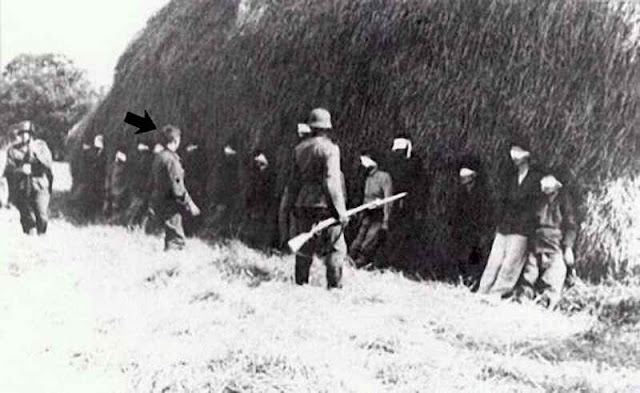
A Wehrmacht soldier of the 714th infantry division, identified as Josef Schulz (or Schultz), refuses to participate in executing 16 suspected “partisans” in Serbia. The executions take place anyway within the barracks of Smederevska Palanka, southeast of Belgrade. Schultz’s commanding officer immediately orders Schulz into the line with the partisans, shoots Schulz dead, and buries him with the partisans. The incident is completely forgotten until the early 1960s when two German weeklies publish some photographs of the incident that lead a West German Bundestag member, Wilderich Freiherr Ostman von der Leye, to identify the person on the photographs as Josef Schulz. There is serious disagreement as to whether the person in question was Schultz, but that the incident happened with some Wehrmacht soldier is accepted.
Reichsführer-SS Heinrich Himmler orders Odilo Globocnik, the local SS- und Polizeiführer at Lublin, to prepare to cleanse the district of Jews and Poles. The goal is to make it purely Germanic.
In the continuing uprising of 13 July in Montenegro, insurgents capture Bijelo Polje. Reflecting the growing power of the rebels, the 180 soldiers and officers in the town are taken prisoner or killed. Italian troops not only are not counterattacking, but they are also retreating to fortified strongholds at Pljevlja, Nikšić, Cetinje, and Podgorica.
Bishop Galen of Munster, known as a courageous critic of the Nazis, expresses his hope for a German victory in Russia. The Nazis use patriotic statements in his pastoral letters to enlist volunteers for SS units recruited in Holland and other occupied countries.
Just after midnight a message from Churchill was read over the air by a mysterious “Col. V. Britton” (actually BBC news editor Douglas Ritchie) calling upon the people of Nazi-occupied Europe to mobilize under the V for Victory campaign. Citizens of occupied Europe within the broadcast’s range were urged to chalk letter V’s in public places and tap out the Morse Code version of the letter – three dots and a dash – to make known their confidence in Allied victory.
Brendan Bracken was named the British Minister of Information. Tighter centralized control of British news and propaganda services was announced today when Brendan Bracken, the swashbuckling Tory MP who has been Churchill’s Parliamentary Private Secretary, took over as Minister of Information (MOI). It is expected that there will be a more systematic and rigorous censorship in future. This follows calls from politicians in all parties for greater and more ruthless use of propaganda as a main war weapon. That goes particularly for the BBC’s overseas services. Lord Moyne, the Colonial Secretary, said in the House of Lords last week: “We must remember that we alone in the Old World have a free press, and that no other country now enjoys our advantage of quick information and well-informed comment which the British press provides.” In Fleet Street, journalists smiled. What they print is already vetted by the MOI.
The Guinea Pig Club forms, made of severely injured airmen treated by Archibald McIndoe at Queen Victoria Hospital, East Grinstead, England.
The dangerous nightly Tobruk Express run is made by Australian destroyer HMAS Stuart and minelaying cruiser HMS Latona. The ships operate on an extremely tight schedule which is intended to get them well away from the port by daylight to avoid Luftwaffe attack. However, the ships arrive late and things go disastrously wrong during the unloading process, so the Australians in the port can only unload about 50 tons of Latona’s much-larger cargo before it must button up and depart. Both ships arrive back at Alexandria safely.
Italian torpedo boat Circe sank British submarine HMS Union with depth charges southwest of the Italian island of Pantellaria between Sicily and Tunisia. Royal Navy submarine HMS Union (Lt R.M. Galloway), on its fourth patrol out of Malta, spots a small Axis convoy departing from Tripoli. It represents a tempting target, as two tugs (German Max Berendt and Italian Ciclope) are towing disabled German freighter Menes. Union attacks 25 miles southwest of the fortified Italian island of Pantelleria, but misses. Italian torpedo boat Circe responds by dropping depth charges that sink the Union. There are 31 deaths, everybody on board the submarine.
Royal Navy submarine HMS Utmost is operating near the island of Ustica north of Palermo, Sicily and attacks a freighter, but misses.
Royal Navy submarine HSM Tetrarch is operating in the Aegean when it unsuccessfully attacks an unidentified freighter.
In Operation Guillotine, New Zealand light cruiser Leander, destroyer Kingston, and destroyer Jervis (Jervis goes directly to Cyprus) depart Haifa on the 20th for Port Said. There, they embark on troops for transport to Famagusta, Cyprus. The ships all make it safely to Cyprus during the night.
As part of Operation Substance, a supply mission to Malta, Royal Navy submarines HMS Upright and Unique depart from Malta. They take up stations off the Italian coast in order to waylay any Italian ships departing to attack the Operation Substance convoy.
RAF Bomber Command, Day of 20 July 1941
12 Blenheims on a coastal sweep off French coast. 6 British Blenheim bombers damaged a tanker off Le Touquet, France with three high explosive bombs and several incendiary bombs, forcing the ship to beach near Berck-sur-Mer to prevent sinking. Two British aircraft and one German Bf 109 fighter were shot down. 3 Stirlings on a raid to Hazebrouck turned back.
RAF Bomber Command, Night of 20/21 July 1941
Cologne
113 aircraft — 46 Wellingtons, 39 Hampdens, 25 Whitleys, 3 Stirlings — to attack railway targets but thick cloud resulted in scattered bombing. Cologne reports only minor damage and 3 people killed. Minor Operations: 15 Wellingtons and 9 Whitleys to Rotterdam caused fires in the dock area, 9 O.T.U. sorties. There were no aircraft losses from any operation on this night.
Lieutenant Walter Nowotny remains adrift in the Baltic after being shot down on the 19th. He prepares for death, writing a goodbye note and observing German shore batteries firing at Soviet destroyers.
Werner Mölders is promoted to the rank of Oberst and banned from further combat flying. As a propaganda hero, Mölders is considered too valuable now to risk in the air war. He is transferred to the Reich Air Ministry in Berlin, where he effectively is placed in reserve pending reassignment.
Nine RAF Wellington bombers based at Malta attack railway yards at Naples, causing extensive damage.
U-126, commanded by Kapitänleutnant Ernst Bauer, damaged British steamer Canadian Star (8293grt) with gunfire in 49-15N, 21W, after the steamer had evaded torpedoes from the submarine. At 0100 hours, U-126 (Bauer) sighted the unescorted and zig-zagging Canadian Star (Master Charles James Whatley Jones) and followed her until 0242 hours, when two G7e torpedoes were fired at the ship in 49°15N/21°00W about 650 miles west of Lands End. Both were avoided by the ship because their tracks could be seen due to phosphorescence and Bauer decided to attack with the gun. The U-boat shelled its victim for about 10 minutes and scored three hits but accurate return fire forced them to break off the attack. Bauer finally gave up the attack about one hour later when it became clear that the ship was escaping too fast for the U-boat, at a speed well over 16 knots. The ship had been en route from Liverpool to Auckland with passengers and general cargo, goverment stores and mail. She arrived at Curaçao on 30 July and was repaired. The 8,293-ton Canadian Star was carrying passengers, general cargo, government stores, and mail and was bound for Auckland, New Zealand.
U-95, commanded by Kapitänleutnant Gerd Schreiber, damaged British steamer Palma (5419grt) with gunfire in 50-14N, 17-53W after an unsuccessful torpedo attack. At 0505 hours, U-95 fired two torpedoes at the unescorted Palma (Master Basil Amos Gammon) but missed. The U-boat then tried to stop the merchant with gunfire at 0528 hours, but had to break off the gun duel after 11 minutes due to problems with the deck gun and give up the chase because the ship was running zigzagging courses at high speeds. They reported one hit, but in fact three had been scored. The 5,419-ton Palma was carrying 700 tons of general cargo, bound for Capetown.
Aircraft carrier HMS Furious, escorted by destroyers ORP Garland, HMS Castleton, and HMS Charlestown and arrived at Scapa Flow at 1900 on the 21st from Greenock after flying practices in the Pentland Firth.
Light cruiser HMS Euryalus, escorted by destroyer HMS Worcester, arrived at Rosyth to complete fitting out.
Anti-aircraft ship HMS Pozarica departed Scapa Flow to join the Western Approaches after fitting out.
British steamer Umvuma (4419grt) was damaged by German bombing off Number 57 Buoy, off the Humber. The vessel was able to proceed to Humber.
Soviet destroyer Stremitel’ny was sunk by German bombing off Polarnoye.
Minelaying cruiser HMS Latona and Australian destroyer HMAS Stuart departed Alexandria carrying supplies to Tobruk. At Tobruk, the cruiser was able to unload only 50 tons of her cargo due to a delay in arrival and difficulties in unloading. The ships arrived back at Alexandria on the 21st.
An Italian convoy composed of damaged German steamer Menes in tow of Italian tug Ciclope and German tug Max Berendt departed Tripoli on the 17th escorted by Italian torpedo boat Circe. On the 20th, Submarine HMS Union (Lt R. M. Galloway) attacked the convoy south southwest of Pantelleria and was sunk in return by the torpedo boat. Galloway, Lt D. L. Carr, Lt R. D. C. G. Simmons, Lt D. A. Tarrant RNR, and twenty eight ratings were lost on the submarine.
Submarine HMS Utmost unsuccessfully attacked a steamer off Ustica.
Submarine HMS Tetrarch unsuccessfully attacked a steamer in the Aegean.
In Operation GUILLOTINE, New Zealand Division light cruiser HMS Leander and destroyer HMS Kingston departed Haifa on the 20th for Port Said, where they arrived that day to embark troops and supplies in serial S.2 A of the Operation. The supplies were unloaded at Famagusta during the night of 20/21 July. Destroyer HMS Jervis with troops from Haifa also disembarked at Famagusta during the night of 20/21 July in Serial S.2B of the Operation. Cruiser Leander and destroyer Kingston arrived back at Haifa on the 21st.
Light cruiser HMS Edinburgh, cruiser minelayer HMS Manxman, and destroyers HMAS Nestor, HMS Lightning, HMS Farndale, HMS Avon Vale, and HMS Eridge departed Gibraltar at 0145 to meet arriving convoy WS.9C. Light cruisers HMS Manchester and HMS Arethusa and destroyers HMS Cossack, HMS Maori, and HMS Sikh arrived at Gibraltar at 0329 escorting troopship Leinster. Destroyers HMS Fearless, HMS Foxhound, HMS Firedrake, HMS Beverley, HMS Fury, HMS Foresight, and HMS Forester arrived at Gibraltar to refuel.
Submarines HMS Upright and HMS Unique departed Malta for Operation SUBSTANCE.
Convoy OG.69 departed Liverpool escorted by corvettes HMS Begonia, HMS Jasmine, HMS Larkspur, HMS Pimpernel, and HMS Rhododendron and anti-submarine trawler HMS St Nectan. Corvettes HMS Alisma, HMS Dianella, HMS Kingcup, and HMS Sunflower joined on the 21st. On the 26th, corvettes Alisma, Dianella, and Kingcup were detached. On the 27th, corvette Sunflower was detached. Corvette Begonia detached on the 28th, and corvette Rhododendron on the 30th. Corvette HMS Fleur de Lys and anti-submarine trawlers HMS Lady Hogarth and HMS Lady Shirley joined the convoy on the 27th. Destroyers HMS Faulknor, HMS Fury, and HMS Forester departed Gibraltar on the 28th to escort this convoy, but they were later recalled for Operation STYLE. Steamer Adjutant of the convoy arrived at Gibraltar on 1 August with corvettes Jasmine, Pimpernel, and Larkspur and anti-submarine trawler St Nectan. The corvettes went back out and arrived with the convoy on 2 August.
President Roosevelt asked all radio broadcasting companies today to send representatives to the White House at 11 AM tomorrow to make a recording of his message to Congress in which he will ask authority to extend the service of selectees, National Guardsmen and Reserve officers beyond the year set by law and keep the Army intact during the emergency. This was a surprising innovation as heretofore only messages which the President has delivered in person at the Capitol have been broadcast, and it means that he considers this a message to the nation as well as to Congress. The recording will be made in the Oval Room of the White House from which Mr. Roosevelt usually makes his “fireside chats” to the people. As the message is expected to be delivered to Congress at noon, the recordings probably will be ready for broadcast simultaneously with the arrival of the message at Capitol Hill. The method for extending Army service is still in dispute in Congress, but even leading members of the opposing bloc concede that the legislation will pass.
Alf M. Landon announced reluctant support today of proposals to keep selectees and national guardsmen under arms beyond a year. Republican 1936 Presidential nominee Alf Landon gives a speech broadcast over the CBS radio network. He accuses President Roosevelt of giving only “mere campaign oratory” during his re-election campaign in 1940. He notes:
“Lack of confidence in the word of its chief executive is a real disintegrating force in any nation and any army.”
Landon does, however, offer support for continuing the draft, which is due to expire soon without congressional action. He does so grudgingly, however, concluding that “The President has the country out on the limb now, and we have got to strengthen the tree at the base.”
“I am compelled by circumstances, brought about partly by the president’s policies, to take the position that it is unsafe to release from service these men who have had some physical training and some fundamentals of military coordination,” the 1936 Republican presidential nominee added.
Production of two-engine bombers was nearly doubled the first six months of this year, U.S. defense officials said today in disclosing gains in combat plane output had been far greater than indicated by announced increases in manufacture of all types of aircraft. Published figures of the Office of Production Management, which do not designate types, show aircraft production increased 42 percent from January to June. It was learned in other authoritative quarters, however, that two-engine bomber production gained 92 percent, output of one-engine dive and torpedo bombers 146 percent, and that of pursuit, observation and other military aircraft, 142 percent. Only in the heavy bomber class the giant four-motored craft was there no appreciable gain in the six months. Some defense officials attributed this to delays in obtaining certain parts. More than 20,000 different parts are required for one of the planes, not including those in the engines.
Chairman Reynolds, North Carolina Democrat, has declined to join other members of the Senate Military Committee in recommending speedy passage of defense property seizure legislation, a revised version of a bill Reynolds himself had introduced at request of the War Department. In telling reporters of his decision, the committee chairman said today he feared the powers granted the president under the measure might be so broad as to permit seizure of newspaper and radio stations deemed necessary to further the defense program.
President Roosevelt was urged today to Invoke the provisions of the Russell-Overton amendment to the Selective Service Act and take over the strike-bound plant of Air Associates, Inc., in Bendix, New Jersey, in order that “the interests of national defense will be furthered.”
When the Army, in September concentrates half a million men in Louisiana for the nation’s greatest peacetime war game, newspaper and radio reporters and photographers will be subject to “capture” by the side opposing the one to which they are attached.
Major League Baseball:
The Dodgers could do no better than break even with the Pirates, winning the opener, 5–1, and losing the nightcap by the same score. Only a ninth-inning homer by Muscles Medwick prevented Johnny Lanning from being the first right-hander to whitewash the Brooks this year. Medwick, first up in the final frame, belted No. 12 into the lower left-field tier. Lew Riggs hit a pinch home run off Rip Sewell in the wake of a triple by Medwick in the seventh that was enough to win the first game. But Dolph Camilli, finding the bases full of Dodgers in the eighth, cleared them with a three-bagger to add to Sewell’s discomfiture. These two blows gave Curt Davis, who had replaced Freddy Fitzsimmons in the fourth, his sixth triumph.
Although outhit in both games, the Cardinals swept a doubleheader today with the Braves. The scores were 4–2 in the twelve-inning opener and 7–3 in the afterpiece, halted after eight innings by the Sunday law.
The Chicago White Sox defeated Connie Mack’s visiting Philadelphia Athletics today, 2–1, in the first half of a double-header, but the visitors gained an even break with a 4–1 decision in the 13-inning nightcap.
The Senators made it look easy in beating the Indians, 8–4, today, then lost the second game, 5–1, on errors that broke a seventh-inning tie. George Archie helped Washington get off to a lead in the first contest with a triple in the second inning and a double in the fourth, making it 3–0.
Joe DiMaggio collects 3 doubles and a home run as the Yankees go 17 innings with the Tigers before winning 12–6 at Detroit. Also homering are fellow outfielders Keller and Henrich, both coming in the 17th. The 6 runs in the 17th inning sets the American League record.
With the aid of a favoring wind, Johnny Rucker coaxed his first home run of the campaign into the upper right-field stand to give the Giants their first brush with the Cubs in the twin bill at the Polo Grounds yesterday. The score was 7–5. In the nightcap Hal Schumacher suffered a blistering shared by Ace Adams, the Giants took a licking measured by 7–4 and the upshot of the whole thing found the Giants hanging onto third place in the National League standing by a scant 2 points.
The Phillies made only three runs on twenty-one hits today. while Cincinnati got ten runs on fifteen safeties to down the cellar dwellers, 7-1 and 3-2. Paul Derringer was nicked for thirteen blows in the opener, but ended a five-game losing streak by being tight in the pinches. Lee Grissom hurled a four-hit ball in the nightcap, but suffered his ninth defeat.
The Browns blended hitting and pitching today to capture a twin bill from the third-place Red Sox and stretch a winning streak to four games, their longest of the season. St. Louis swept the series, also having won a double-header yesterday. Bob Muncrief, lanky speedball ace, pitched a 10–0 shutout in the second game. Almost as good was John Niggeling’s 6–3 triumph in the opener. The Browns got twenty-eight hits, fifteen coming in the first game. George McQuinn hit two homers in the first contest and one in the nightcap to make it fourteen for the season.
Pittsburgh Pirates 1, Brooklyn Dodgers 5
Pittsburgh Pirates 5, Brooklyn Dodgers 1
St. Louis Cardinals 4, Boston Braves 2
St. Louis Cardinals 7, Boston Braves 3
Philadelphia Athletics 1, Chicago White Sox 2
Philadelphia Athletics 4, Chicago White Sox 1
Washington Senators 8, Cleveland Indians 4
Washington Senators 1, Cleveland Indians 5
New York Yankees 12, Detroit Tigers 6
Chicago Cubs 5, New York Giants 7
Chicago Cubs 7, New York Giants 4
Cincinnati Reds 7, Philadelphia Phillies 1
Cincinnati Reds 3, Philadelphia Phillies 2
Boston Red Sox 3, St. Louis Browns 6
Boston Red Sox 0, St. Louis Browns 10
Former Finance Minister Victor Paz Estenssoro was arrested today at Tarija, in the heart of the Bolivian oil fields. The police said he was there “in connection with a Nazi Putsch” which has thrown this country into a state of siege and resulted in an expulsion order against the German Minister.
Reports of new clashes between Chungking’s Central Government forces and Communist army units were officially confirmed today. A War Office communique said that on June 25 detachments of the Eighteenth Route Army in North Kiangsu Province attacked the district government of Suchow, killed a sectional chief, kidnapped seventy district guards and seized rifles and machine guns. On June 26 other detachments of the Communist forces in Southwest Shantung Province were alleged to have attacked and killed scores of guerrilla fighters who were engaged in harassing operations against the Japanese.
The new Cabinet of Premier Prince Fumimaro Konoe is expected to hold its first formal business meeting Tuesday morning to discuss practical measures for the execution of its policies and is expected to announce its attitude then, the Domei news agency reported today.
Japanese luxury ocean liner Hikawa Maru arrived at Osaka, completing her 73rd round trip across the Pacific.
Born:
Vladimir Lyakhov, Ukrainian Soviet cosmonaut (Air Force Group 4; Soyuz 32/34, 1979; T-9, 1983; TM-6/Mir EP-3/TM-5, 1988), in Antratsyt, Ukrainian SSR, Soviet Union.
Don Chuy, NFL guard (Los Angeles Rams, Philadelphia Eagles), in Newark, New Jersey (d. 2014).
Kurt Raab, German actor who worked with Rainer Werner Fassbinder, in Bergreichenstein, Germany (d. 1988).
Died:
Lew Fields, 73 or 74, American vaudeville performer, theatre manager and producer.
Naval Construction:
The Royal Navy “L”-class destroyer HMS Lively (G 40) is commissioned. Her first commanding officer is Lieutenant Commander William Frederick Eyre Hussey, DSC, RN.

