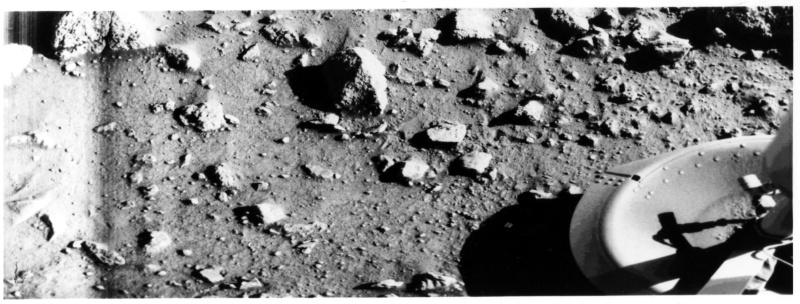
The Viking 1 lander successfully landed on Mars at 11:53:06 UTC (7:53 a.m. Eastern time), touching down at Chryse Planitia after a descent from the Viking orbiter more than three hours earlier. Viking 1 made the first successful landing on Mars today and transmitted spectacular photographs of a rocky, wind-scoured desert plain, the site for the first direct search for life on another world. Responding to automatic computer commands, the lander’s rockets fired, its parachute unfurled, protective shielding broke away. more rockets were fired-and then, touchdown. It was 19 minutes, because of the great distance between Mars and Earth, now more than 212 million miles, before confirmation of the safe landing reached the control rooms here at the Jet Propulsion Laboratory. “Touchdown!” announced Richard Bender, one of the flight controllers. “We have touchdown. We have several indications of touchdown.” It was an emotional moment for the scientists and engineers of the $1 billion Viking project, many of whom had spent eight years preparing for this day. Chemical analysis of the Martian atmosphere showed “a small component of nitrogen.” Until now the absence of any evidence of that gas stood as a major obstacle to speculation that life might exist on the planet.
Only seven years ago a man on the moon radioed back to earth the historic message — “That’s one small step for man, one giant leap for mankind.” And now mankind has taken another giant leap. Earthmen, or at least their mentalities, have reached their first planet with the landing on Mars of Viking I. The human who took that first step and opened a new age now lives on a farm outside of Lebanon, Ohio, with his wife and two children. Neil Alden Armstrong, 46, a professor of aerospace engineering at the University of Cincinnati, has shunned the spotlight since. But he was back in the news with President Ford’s proclamation of July 20, 1976, as Space Exploration Day to honor the men and the exploits of Apollo II and Viking I. With Armstrong on the historic flight were Edwin (Buzz) Aldrin, who descended with Armstrong to the Sea of Tranquility in the Eagle lander, and Michael Collins, who remained in the Apollo capsule. A few months ago Armstrong was quoted as saying he “had hoped the moon shot would take our minds away from the more mundane and temporal problems that have faced us. But,” he added quietly, “we still appear to be tied up with today’s problems.”
Unfavorable economic news, political warfare on the Government’s left and right, and trade union anger at proposed cuts in public spending drove the British Cabinet into a series of emergency meetings today and caused turmoil in Parliament. The economic news was that unemployment had reached its highest point in any month since World War II — nearly 1.5 million, or 6.3 percent of the working population. This is not flagrantly high by American standards but is regarded by supporters of Britain’s welfare state as embarrassing if not intolerable. Government spokesmen pointed out that the total included many students who had just finished school and were seeking work. They also pointed out that other economic indicators — including a rate of inflation that is now half of last summer’s figure of 28 percent — provided evidence that the Government’s anti-inflation strategy was paying dividends. But the left wing of the Labor Party, and the unions that have so far supported the Government’s stringent limits on wage increases, were not at all happy and the Government was under more pressure than at any time since James Callaghan became Prime Minister in April.
The body of a Soviet freighter captain who disappeared shortly before he was to sail home was found in the River Tyne not far from Newcastle, England, with a large brass weight tied to the belt, police reported. They said Captain Anatole Mankevitch drowned either as a result of an accident or suicide, and ruled out the possibility of a crime. Police reported that the weight tied to his belt came from his ship and was 3 feet long but “not heavy enough to drag a man down unless he wanted to go under.”
Thirteen workers have been sentenced to prison terms ranging from three to ten years for their part in riots last month that forced the Polish Government to withdraw food‐price increases. Seven persons were convicted today of damaging state property and blocking railroad traffic in the Warsaw suburb of Ursus. During the demonstration on June 25, workers in a tractor factory blocked a main railroad line to the city and derailed a locomotive. No injuries were reported. Six workers were convicted and sentenced yesterday in Radom, an industrial city 62 miles south of Warsaw, the Polish preys agency reported. They were charged with having attacked people and property. Both trials were closed to Western reporters, and the government‐controlled press reported little about them.
Paris is getting nervous about crime in its subway system. Although the 76‐year‐old Metro is not comparable in danger or dirt to the New York system, a recent case of violence has stirred controversy between one of the nation’s largest labor unions and the Paris police. The union, the General Federation of Workers, which is heavily influenced by the French Communist Party, asserts that the increasing mechanization of the system has made travelers easy prey for robbers, especially in the night hours before the system shuts down at 1 AM. The police say that the situation is being exaggerated. Some officials suggest privately that the union is using the recent incident to dramatize its demands for additional personnel to operate and patrol the trains and 344 stations. Many travelers on certain Metro lines at night have noticed an increase in the number of young hooligans rushing through the cars, mocking old people, jostling anyone in their way and conversing loudly and vulgarly.
Efforts to get Syria and the Palestine Liberation Organization to negotiate an end to their hostilities in Lebanon hung in the balance today as some P.L.O. leaders reportedly balked at the timing, and conditions of the proposed talks. Earlier in the day it had been reported that Yasser Arafat, the P.L.O. chairman, had agreed with the Syrians to start negotiations in response to strong pressure from Libya, which is acting as mediator. But when it came to naming a delegation, Mr. Arafat reportedly found several of his colleagues unwilling to serve because of continued bitterness against the Syrians. In Damascus, President Hafez al-Assad made a three-hour defense of Syria’s military intervention in Lebanon at the beginning of June, reiterating that the basic aim was to stop the Lebanese civil war. “We will never bow to any demand by any Palestinians to withdraw from Lebanon,” the Syrian leader said in a speech at a political rally that was broadcast by the Damascus radio. He said Syria had given arms and ammunition to the Palestinians and the Lebanese leftist-Muslim alliance until Kamal Jumblat, the leftist leader, had told him in March that his Lebanese forces were out for total military victory over the right-wing Christians.
A State Department official conceded for the first time that India used U.S.-supplied deuterium in detonating its initial atomic blast. Acting Asst. Secretary of State Myron Kratzer testified at an unprecedented Nuclear Regulatory Commission hearing that the Indians mixed the deuterium with their material to develop their first nuclear device. Earlier witnesses at the hearing urged the commission to ban future sales of enriched uranium reactor fuel to India. Kratzer said safeguards on fuel sales are adequate and he added that stopping sales to India would impose a “severe hardship” on 80 million Indians dependent on atomic power.
The Burmese government announced the arrest of a group of army officers who, it said, had plotted to kill President Ne Win and the secretary of the State Council, U San Yu. Burmese state radio said the plot had been foiled and the ringleaders arrested July 2. The announcement said the plot was engineered by three army captains and supported by 11 other officers.
The United States withdrew its last combat troops from Thailand and Indochina after 26 years. U.S. Air Force Master Sergeant George Leroy Davis, designated by the U.S. Air Force to be the last combat soldier, boarded a Cathay Pacific airliner with his wife and two children, and departed at 10:30 in the morning. About 250 American military advisers remained as part of military aid agreement between the U.S. and Thailand. At the height of the American presence in Thailand, 48,000 troops were stationed in 93 installations around the Asian kingdom. The United States completed its military withdrawal from Thailand, leaving behind about 245 advisers and $388 million in equipment as the only vestiges of more than a decade of providing a military presence in mainland Southeast Asia.
Prosecutors investigating Lockheed payoffs in Japan arrested another officer of the aircraft firm’s former sales agent in Tokyo on charges of destroying evidence. Tatsuya Nakai, 46, a section chief at Marubeni Corp., was the third Marubeni employee arrested on Lockheed-related charges in two days and the 14th person arrested in the course of Japan’s Lockheed investigation. One of the 14 has been released.
A proposed Latin American and Caribbean news agency was approved by a committee at a regional communications conference sponsored by the U.N. Educational, Scientific and Cultural Organization in Costa Rica. Passage by the full conference was believed almost certain. The news service would be an “agency or a pool or consortium” of agencies. according to the proposal. Governments supporting the initiative said the agency was needed to balance coverage by existing international news services. A consensus proposal that there be an international right-of-reply to news stories, also was approved by two committees.
The Argentine army announced that its troops had killed Mario Roberto Santucho, considered the No. 1 guerrilla leader in South America. Military sources said the death of Santucho, 40, was a devastating blow to the Argentine guerrilla movement. The private news agency Noticias Argentinas reported that the same troops who shot Santucho Monday in a Buenos Aires suburb also killed Gorriaran Merlo, Santucho’s second in command of the People’s Revolutionary Army.
A nightclub and a restaurant in Salisbury’s city center were attacked with hand grenades tonight. A white man was injured and the owner of the restaurant was slightly hurt. United Press International quoted a police spokesman as saying, “This is an act of terrorism.” A black man was seen running from La Boheme, a nightclub, soon after the blast, the police said. Two minutes earlier, a grenade had been thrown through a window of the Pink Panther steakhouse and exploded amid 30 diners. A customer at the steakhouse, Andrew Craig, suffered head and neck wounds. Hospital physicians described his condition as serious.
At least one black man was reported killed tonight when police reinforcements were rushed to the coal-mining center of Witbank, South Africa, 75 miles east of Johannesburg, which was in the grip of the most serious rioting since the widespread anti-Government upheavals last month. Reports from the scene said that about 3,000 black youths had poured out of black townships and attacked people and buildings in areas occupied by Indians and people of mixed descent, who are called colored here. Few details were available, and it was unclear how the reported death had occurred. However, the riot policemen, armed with automatic rifles, were acting under standing Government orders to suppress fresh outbreaks of violence with all necessary force. The possibility of a chain reaction was raised by a police report of at least one outbreak elsewhere. At midnight, rioters were said to have set fire to several buildings in Khutsong. a black township near Carletonville, a mining town southwest of Johannesburg.
The turmoil that has been swirling through many nations’ currencies has now swept into gold, long a major component, along with the dollar, of the world’s monetary reserves. In only five business days, the price of gold has tumbled nearly 12 percent, from $122 an ounce last Wednesday to $107.75 at its close today in London. Today alone it fell nearly $6. The drop has been so abrupt, gold experts here said, that South Africa, the world’s leading producer of gold, now faces political as well as economical’ consequences unless the price recovers quickly. “If you take the gold out of South Africa,” said Richard Lockwood, a mining expert for a brokerage firm in London, “you’ve got one of the worst economies in the world.” Experts also expected difficulties for the Soviet Union, another major producer. Ironically, they said, the Russians helped bring on the decline in the price of gold by selling large quantities of gold to pay for American wheat.
President Ford gained substantial delegate strength today to pull within 18 votes of the total needed to gain a first-ballot nomination at the Republican National Convention. Amid conflicting claims from the rival Republican camps, The New York Times determined from the best available information and a canvass of the delegates involved that Mr. Ford had a net gain of 10 delegates while Ronald Reagan had a net increase of one. The new tally by The Times listed 1,112 delegates for Mr. Ford ‐ 18 short of the 1,130 needed for nomination — and 1,064 for Mr. Reagan, with 83 still uncommitted. Thirteen of the 83 said they were leaning to Mr. Ford and three to Mr. Reagan. James A. Baker, a deputy chairman of the President Ford Committee, claimed the conversion of several delegates and proposed to certify the President’s strength by making public the identities of all Ford delegates once they constitute a convention majority. The proposal to list the delegates by name and address was the latest move in a war of nerves between supporters of the President and of Mr. Reagan. Mr. Baker dismissed as “blowing smoke” the largely unsubstantiated claim yesterday by John P. Sears, the Reagan campaign manager, to 1,140 delegates for the former California Governor — 10 more than needed for nomination.
Jimmy Carter sharply disagreed today with President Ford’s 1974 pardon of President Nixon before what the Democratic nominee termed Mr. Nixon’s “inevitable conviction” in an “open trial.” While contending that he did not “criticize President Ford for the pardon,” Mr. Carter termed it “improper or ill-advised.” The pardon issue was raised as Mr. Carter held his first formal news conference since accepting the Democratic Presidential nomination in New York City last week. As he squinted into the early afternoon sun from the steps of the 55‐year‐old red brick high school he had attended here, Mr. Carter was asked to comment on President Ford’s remark at a news conference yesterday that whether the pardon became a campaign issue was “up to the American people,” and that he “would do it again” under the same circumstances. “Had I been President,” the Democratic nominee replied, “I would not have pardoned President Nixon until after the trial had been completed in order to let all the facts relating to his crimes be known.”
Representative Les Aspin, Democrat of Wisconsin, told the House Ethics Committee today that he had lent a copy of a Congressional report critical of intelligence activities to the Central Intelligence Agency and had let a news agency reporter look at a few pages of the report. But Representative Aspin told the committee that he did not know who had given the controversial report to CBS News correspondent Daniel Schorr. Mr. Schorr has said he supplied a copy of the report to The Village Voice, the New York weekly, which published the entire report. Mr. Schorr has since been suspended by CBS News. Mr. Aspin, who was a member of the House Intelligence Committee, which prepared the report, told the Ethics Committee that he had lent his entire copy of the report to a C.I.A. official and had given “a few pages to a reporter for Reuters, the British news agency.
American criminal Gary Gilmore was arrested after murdering two Brigham Young University students in separate incidents in Utah. He would later become the first person in the United States to be executed after the restoration of the death penalty. The day before his arrest, Gilmore had killed Max Jensen, a 25-year-old night attendant at a Sinclair gas station, during a robbery in Orem, Utah. He followed hours later with the killing of Bennie Bushnell, a night manager at the City Central Motel in Provo. In both cases, the victims had cooperated with Gilmore’s instructions to lie face down, and he shot both in the back of the head anyway. Gilmore was caught after he accidentally shot himself in the hand while attempting to dispose of the murder weapon, a .22-caliber pistol. Convicted of Jensen’s murder on October 7 and given the death sentence the same day, Gilmore refused to appeal the verdict or the sentence and would be executed by firing squad on January 17, 1977, less than six months after the murders, becoming the first person to be legally executed in the United States since the restoration of the death penalty.
Shirley Temple Black was sworn in at the White House as the nation’s first woman chief of protocol. President Ford told her she had earned the “very important post” for her outstanding service as a representative at the United Nations and more recently as ambassador to the African nation of Ghana. The former child movie star, now 48, took the oath on a Bible held by her husband, Charles Black. As chief of protocol, Mrs. Black will take on the duties of officiating at the visits of foreign heads of state and dignitaries and in contacts with the Washington diplomatic corps. She replaces Henry Catto, who has been named as ambassador to U.N. organizations in Geneva.
The chairman of a House health subcommittee called for a White House meeting to try to resolve the impasse over insurance coverage for the planned swine flu immunization program. Rep. Paul Rogers (D-Florida) urged President Ford to summon top insurance executives and drug manufacturers to a conference. Finding insurance coverage for the four companies who are making the vaccine is the chief obstacle to the plans, according to Dr. Theodore Cooper, assistant secretary for health in the Department of Health, Education and Welfare.
Congressional investigators have issued a blistering indictment of the Food and Drug Administration, pharmaceutical makers, doctors and research scientists, charging them with exposing humans to unnecessary risks in testing new drugs. The General Accounting Office also reported that the testing procedures could result in F.D.A. approval of a new drug for public use based on “inaccurate and unreliable data.” The Congressional investigating unit disclosed instances of “alarming adverse reactions” to new drugs that went unreported and the death of eight soldiers in an Army test of a drug intended to prevent malaria. Despite continued controversy over many aspects of the regulation of prescription drugs in recent years, the general accounting Offices report indicated that little progress had been achieved in assuring their safety. The report covered F.D.A.’s actions from 1963 to 1975.
Russell B. Long, chairman of the Senate Finance Committee, promised today to give the panel a new opportunity to vote for or against each of 73 provisions of the pending tax bill, most of which benefit just one company or industry. Senator Long made the commitment after an unusually heated session of the committee during which Senator Edward M. Kennedy was, in effect, called a demagogue by one Republican member and accused of not knowing what he was talking about by another. Mr. Kennedy, Democrat of Massachusetts, has emerged as a leading foe of the kind of narrow‐interest tax legislation that the committee will be reconsidering. The entire Senate, meanwhile resumed work on the tax bill and voted to keep all of the 1975 anti‐recession tax cuts in effect at least through the end or 1977. The Finance Committee had votd to terminate the most broadly applicable of the tax cuts, the $35 per person tax credit, in mid‐1977.
Dr. Alexander Schmidt, commissioner of the Food and Drug Administration since 1973, is resigning Dec. 1 to return to the staff of the University of Illinois. An aide said the school would announce today Schmidt’s appointment as vice-chancellor. A spokesman said his departure was not prompted by a Senate investigation of alleged irregularities and pro-business bias of the agency. As Schmidt disclosed his plans, 34 current and former FDA employees were testifying that the agency still failed to protect the public’s health — two years after the Senate launched its inquiry. They told two Senate subcommittees of documents mysteriously missing from files, pressure to approve drugs before testing was complete and other malpractices.
Threatening a nationwide strike to dramatize that the U.S. Postal Service “is going down the drain,” union leaders accused the Ford administration of trying to ruin the mail service. Presidents of 53 local postal unions, representing 25% of the nation’s 600,000 postal workers, voted for a “nationwide job action by Aug. 20” unless certain conditions were met, said Moe Biller, president of the New York area union.
The Westinghouse Electric Corp. reached agreement in Pittsburgh on new three-year wage contracts with three striking unions, bringing a quick end to the first nationwide walkout against the company in 20 years. The agreements, covering 47,000 employees at 87 of the company’s 123 plants, were reached with the International Union of Electrical Workers, the United Electrical Workers and the International Brotherhood of Electrical Workers. The new contracts, patterned after agreements the unions reached with General Electric Co. last month, included pay increases totaling $1.10 an hour after three years and nearly unlimited inflation protection. The average hourly wage under old contracts was $5.15.
A Marine drill sergeant was found guilty yesterday of dereliction of duty in the pugil‐stick death of Pvt. Lynn McClure, a 20‐year‐old recruit fatally beaten in training. In convicting S. Sgt. Henry C. Wallraff, the four‐man board acquitted him of two other counts in the beating of Private McClure, whose death at the Marine recruit depot set off a Congressional investigation of military recruiting and training. The court‐martial board was to hear more evidence before sentencing Sergeant Walraff. 27, of St. Croix. Minnesota. S. Sgt. Harold Bronson, the man who actually conducted the pugil stick bout, was acquitted last month of all charges in the first court‐martial over the case. Pugil sticks are 16‐pound, padding‐tipped poles used for bayonet training. Sergeant Bronson’s defense successfully argued that he was following‐orders.
Veteran radio commentator Lowell Thomas, who has been admitted to Presbyterian Medical Center in Denver, said he would undergo tests for seven to 10 days. “Apparently I have an infection of some sort, and I don’t know if the doctors are sure they know what it is,” Thomas said. Thomas, 84, was flown from Santa Rosa, Calif., Sunday night after complaining that he didn’t feel well. Accompanying him was his son, Alaska Lieutenant Governor Lowell Thomas Jr.
A marble tombstone thought possibly to have marked Torn Paine’s final resting place apparently is just the stone of an admirer, according to Frances Gale, a college student doing research on Hudson Valley architecture. A six-foot obelisk engraved “in memory of” the Revolutionary War pamphleteer was unearthed at a farm near Tivoli, New York. The opposite side bore a similar legend for John G. Lasher. The discovery aroused excitement because scholars have been unable to locate Paine’s grave. Miss Gale said she had found a Kingston, New York, newspaper article dated September 9, 1874, that said Lasher, “a staunch follower of Tom Paine,” had ordered a monument for his hero and erected it in his front yard.
It was a day like all other days today at the Olympic swimming pool. The American men and East German women won all the gold medals and all in world‐record time. This was the third of seven days of Olympic swimming.. There were three evening finals, and the two for men went to Californians. Seventeen‐year‐old Brian Goodell of Mission Viejo won a tingling 1,500‐meter freestyle race in 15 minutes 2.40 seconds. Two races later, John Hencken of Santa Clara took the 100‐meter breast‐stroke in 1:03.11, his third world record for the distance in two days. Between those finals, Petra Thumer of East Germany, age 15½, won the women’s 400‐meter freestyle after a long battle with Shirley Babashoff of Fountain Valley, California, America’s best female swimmer. The time was 4:09.89. good enough to have won the men’s gold medal in 1964.
Major League Baseball:
In a game that saw each club enjoy a seven-run outburst, the New York Yankees defeated the Chicago White Sox, 14–9, in a contest that was stopped by rain with one out in the last half of the eighth inning. The White Sox scored their seven runs in the first, featuring a homer by Bill Stein with two men on base. The Yankees came back in the second with a similar spree, sending 12 men to bat. After the White Sox picked up a tally in the third, the Yankees decided the outcome with four runs in the fourth on a walk to Roy White, singles by Thurman Munson and Chris Chambliss, a double by Graig Nettles and pinch-single by Carlos May.
Jerry Koosman racked up his fifth straight victory for the Mets, pitching a five-hitter to defeat the Reds, 2–1. All runs scored in the first inning. The Mets got their pair off Gary Nolan on singles by Felix Millan, John Milner and Ed Kranepool plus a sacrifice fly by Mike Vail, while the Reds scored in their half on a homer by Pete Rose.
A triple by Phil Garner with the bases loaded in the ninth inning provided the Athletics’ deciding blow in a 7–4 victory over the Indians. With the score tied, 3–3, Bill North opened the ninth by drawing a walk. Don Baylor bunted safely and Joe Rudi sacrificed. North was thrown out at the plate on a grounder by Billy Williams, but Sal Bando singled to drive in Baylor. After a pass to Gene Tenace loaded the bases, Garner cracked his triple. The Indians came back with one run in their half of the ninth, but it was far from enough.
The Orioles smashed four homers and defeated the Royals, 10–3, behind the pitching of Wayne Garland, who racked up his 12th victory of the season. Bobby Grich drove in five runs, including three with a homer, one with a triple and another on a walk with the bases loaded. Lee May rapped two round-trippers and Reggie Jackson hit one in the Orioles’ slugfest.
After scoring twice in the first inning on a single by Bill Buckner, a walk, single by Ron Cey and sacrifice fly by Bill Russell, the Dodgers got a run on Davey Lopes’ first homer of the season in the second and defeated the Cardinals, 3–2.
Two sacrifice flies by Don Money and back-to-back homers by George Scott and Hank Aaron paced the Brewers to a 6–2 victory over the Angels. The Brewers scored a run in the first inning on a triple by Von Joshua and the first of Money’s flies. Hank Aaron, holder of the record for most career home runs in Major League Baseball since breaking the record of Babe Ruth in 1974, hit the 755th and final home run of his career, playing for the Milwaukee Brewers at home against the California Angels. He retired at the end of the 1976 season. Aaron’s MLB record of 755 would stand for 31 years until broken on August 7, 2007 by Barry Bonds of the San Francisco Giants. Jerry Augustine wins for the Brewers today.
A Metropolitan Stadium crowd of 30,425, largest of the season for the Twins, saw the home club succumb to Tigers’ rookie Mark Fidrych, 8–3. Fidrych trailed, 3–0, until Rusty Staub smashed a homer with two aboard to tie the score in the sixth inning. Then, in the same stanza, the Tigers took the lead with a run on a double by Jason Thompson and single by Aurelio Rodriguez. Ron LeFlore hit a two-run homer in the seventh and Staub accounted for his fourth RBI of the game with a sacrifice fly in the eighth.
Don Carrithers turned in his first complete game for the Expos in nine starts this season and defeated the Braves, 4–3. The Expos nicked Andy Messersmith for singletons in the first two innings and then decided the outcome with two runs in the third. Andre Thornton drew a walk and was forced by Larry Parrish. Pete Mackanin singled, sending Parrish to third. Barry Foote followed with a single, scoring Parrish. Mackanin took third on the play and counted what proved to be the winning run on a sacrifice fly by Pepe Frias.
The Pirates exploded for six runs in the first inning and won the opener of a twi-night doubleheader, 9–5, but the Astros came back to take the nightcap, 4–3, on a sacrifice fly by Ed Herrmann in the ninth inning. The Pirates’ outburst in the lidlifter included a triple by Manny Sanguillen with the bases loaded. Sanguillen also picked up a fourth RBI later in the game with a sacrifice fly. John Candelaria posted his 10th victory with relief assistance from Kent Tekulve. Enos Cabell was the Astros’ standout in the nightcap. In the seventh inning, an infield hit by Cabell, two walks and a sacrifice fly by Greg Gross tied the score at 3–3. Then in the ninth, Cabell tripled and scored the winning run on Herrmann’s fly.
At San Diego, Randy Jones shuts out the Phillies for the third time this season. Winning for the 17th time, Jones pitched the Padres to a 3–0 victory for the sensational lefthander’s third shutout of the Phillies this season. The Padres banged Steve Carlton for all their runs in the fourth inning. Johnny Grubb doubled, took third on a safe bunt by Tito Fuentes and scored when Willie Davis forced Fuentes. Dave Winfield tripled, driving in Davis, and then scored himself on a sacrifice fly by Mike Ivie.
The Cubs broke Ed Halicki’s 25-inning scoreless streak and defeated the Giants, 3–2. Halicki allowed only three hits going into the eighth when the Cubs erupted for their runs on a single by Manny Trillo, double by Mick Kelleher, intentional pass to Rick Monday and singles by Joe Wallis and Bill Madlock.
After losing eight previous meetings with the Rangers this season, the Red Sox turned around and gained a 4–2 victory. The Red Sox bunched three hits for a run in the first inning, scored again on a double by Cecil Cooper in the fourth and clinched the outcome with two runs in the sixth. Denny Doyle and Rick Burleson hit back-to-back singles and both crossed the plate on a grounder by Cooper and a throwing error.
New York Yankees 14, Chicago White Sox 9
New York Mets 2, Cincinnati Reds 1
Oakland Athletics 7, Cleveland Indians 4
Baltimore Orioles 10, Kansas City Royals 3
St. Louis Cardinals 2, Los Angeles Dodgers 3
California Angels 2, Milwaukee Brewers 6
Detroit Tigers 8, Minnesota Twins 3
Atlanta Braves 3, Montreal Expos 4
Houston Astros 5, Pittsburgh Pirates 9
Houston Astros 4, Pittsburgh Pirates 3
Philadelphia Phillies 0, San Diego Padres 3
Chicago Cubs 3, San Francisco Giants 2
Boston Red Sox 4, Texas Rangers 2
Stock prices moved lower yesterday for the sixth session in a row as most precious metal issues — which generally climb when the rest of the market slumps — joined the downtrend. The Dow Jones industrial average, closing at its lowest level in five weeks, finished at 988.29 with a loss of 2.54 points. Trading volume, meanwhile, was virtually unchanged from Monday’s modest pace.
Dow Jones Industrial Average: 988.29 (-2.54, -0.26%)
Born:
Erica Hill, American journalist and news anchor (“CNN Newsroom”, “Weekend Today”), in Clinton, Connecticut.
Terry Fair, NFL cornerback (Detroit Lions, Carolina Panthers, St. Louis Rams), in Phoenix, Arizona.
Ray Giroux, Canadian NHL defenseman (New York Islanders, New Jersey Devils), in North Bay, Ontario, Canada.
Andrew Stockdale, Australian rock musician (Wolfmother), in Brisbane, Queensland, Australia.

