The spearheads of Army Group North reach the Luga River on 14 July 1941. The Luga is the last natural barrier before Leningrad. Leningrad is of top priority because the Finns are coming down on the other side, and linking up with them would free up a lot of formations. However, the real action is in the south, where a major battle appears to be shaping up around Kyiv.
General Halder notes in his war diary that General Erfurth has told him that Finnish leader Mannerheim is “showing a certain passive resistance against the idea of an operation east of Lake Ladoga.” This is the first sign of Finnish reluctance to advance beyond what Finland considers to be its rightful historic lands and into Russia. “There are some misunderstandings, it seems,” Halder concludes, noting that he has sent someone to “clear up the situation.”
In the Far North Sector, German General Dietl’s attempt to get the advance toward Murmansk moving again fails as the Soviets land the 325th Rifle Regiment at the Bay of Litsa for a counterattack against German Army of Norway. Further south, however, the Finns continue making progress in Karelia. Their Army of Karelia takes the important road junction of Loimola and Muanto northeast of Lake Ladoga, sending the defending Soviet 7th Army and 23rd Army reeling back toward the lake. With the Wehrmacht advancing toward Leningrad swiftly from the southwest, Soviet forces in Karelia stand a good chance of being cut off.
In the Army Group North sector, German commandos of the Brandenburg special forces unit don Red Army and drive up in captured Soviet trucks in a daring operation to capture twin bridges at Porechye over the Luga River. Oberst Erhard Raus’s grenadiers, aided by an attached group of “Brandenburg” special-operation troops driving captured Soviet trucks and dressed in Russian Army uniforms, seized the twin bridges over the Luga River at Porechye on 14 July,1941 — thus fording the last natural obstacle to Heeresgruppe Nord’s ultimate goal of the capture of Leningrad. Soviet Luga Operational Group counterattacks but cannot dislodge the Germans. German 6th Panzer Division takes a bridgehead over the Narva River. Soviet 11th Army, which has under command 41st and 22nd Rifle Corps and the 1st Mechanized Corps, counterattacks at Soltsy after Hoepner’s 4th Panzer Group takes it. General Hoepner’s 4th Panzer Group advances into the Lake Peipus area, while General von Manstein attacks toward Novgorod.
Observing the German forces reaching the River Luga thus expecting a rapid victory in northern Russia, Hitler ordered the arms industry to switch production from guns and tanks to aircraft and submarines.
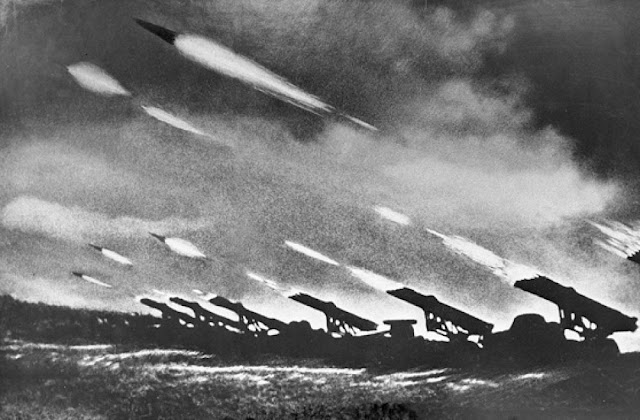
In the Army Group Center sector, the Soviets deploy an experimental battery of seven Katyusha mobile rocket launchers for the first time near Orsha/Smolensk in Vitebsk Province. The goal is to recapture a railway station with two Soviet ammunition trains. Under the command of Captain Ivan Flyorov, the unit fires two volleys of 16-rockets each. The barrage destroys the advancing German unit of tanks and armored vehicles and chases them out of the town, enabling the Soviet recapture of the trains. This successful introduction causes the Red Army to expand the use of the Katyushas and organize new Guards mortar batteries for the support of infantry divisions (Guards units are those that have been honored for some success on the battlefield and given extra units). This use of Katyusha rockets is a tonic to Soviet morale and ushers in an entirely new class of weapons — mobile rocket launchers.
General Guderian’s 2nd Panzer Group continues to roll eastward and, late in the day, reaches the outskirts of Smolensk. His troops report that some of the enemy troops are running away “in wild flight,” according to General Halder’s war diary, but also some Soviets are trying to hold their positions. A Soviet counterattack centered on Gomel begins on the south flank of the army group, apparently to relieve pressure on Smolensk. General Hoth’s 3rd Panzer Group heads toward a major Soviet troop concentration centered at Nevel.
In the Army Group South sector, a Soviet counterattack at Zvyagol gains steam. OKH sends the 25th Motorized Division and the SS Adolf Hitler Division to clear the Zvyagol/Zhytomyr highway. This is an important conduit to III Corps further up the road, which already is under pressure itself and running low on ammunition. Elsewhere on the front, the heavy fighting at Berdichev is dying down, with 11th Army having taken 2000 casualties. Outside of Kyiv, the 13th Infantry Division cuts railroad lines into Kyiv from the west and south.
General Franz Halder, the OKH operations boss, is losing his patience with Führer Headquarters. He writes in his war diary regarding back-and phone calls between the Wofschanze and the front commands:
“Those futile telephone conversations continue until long past midnight; they only accomplish killing in field commands any desire to shoulder responsibility and waste everyone’s time. The Führer’s eternal meddling in matters, the pattern of which he does not understand, are becoming more than anyone can stand.”
Halder follows this with a brief note that another Führer order has just arrived regarding troop strength.
Spanish General Agustin Munoz Grandes, the commander of the Spanish volunteer Blue Division, flies to Berlin for talks regarding the Wehrmacht’s use of the Blue Division on the Eastern Front.
Wilhelm Keitel appeared on the cover of the American news publication Time Magazine.
Amon Göth was promoted to the rank of SS-Untersturmführer.
6,000 Lithuanian Jews are exterminated at Viszalsyan Camp by German Einsatzgruppen SS with the assistance of local collaborators
Hitler issues an appendix to Führer Directive 32:
The Führer and Supreme Commander of the Armed Forces
Führer Headquarters, 14th July 1941.
13 draft copies
[Appendix to Directive 32]
On the basis of my intentions for the future prosecution of the war, as stated in Directive 32, I issue the following general instructions concerning personnel and equipment:
General:
Our military mastery of the European continent after the overthrow of Russia will make it possible considerably to reduce the strength of the Army. Within the limits of this reduced Army, the relative strength of the armored forces will be greatly increased.
The manning and equipment of the Navy will be limited to what is essential for the direct prosecution of the war against England and, should the occasion arise, against America.
The main effort of equipment will be devoted to the Air Force, which will be greatly strengthened.
Manpower:
The future strength of the Army will be laid down by me, after receiving proposals from Commander-in-Chief Army.
The Replacement Army will be reduced to conform with the diminished strength of the Army.
The Chief of the High Command of the Armed Forces will decide, in accordance with my directives, on the employment of the manpower which will become available for the Armed Forces as a whole and for the armaments industry.
The Class of 1922 will be called up at the latest possible date, and will be distributed by the High Command of the Armed Forces in accordance with the future tasks of the various branches of the Armed Forces.
Arms and Equipment:
The Armed Forces as a whole.
The arming and equipment of troops will be reduced to the requirements of the situation in the field, without reference to existing establishment scales.
All formations not intended for actual combat (security, guard, construction, and similar units) will be armed basically with captured weapons and second line equipment.
All requests for general Armed Forces equipment will be immediately reduced or rejected in relation to available supplies, need, and wear and tear. Continued manufacture of such weapons as can be proved to be necessary will be decided in agreement with the Minister for Armaments and Munitions.
Plant (buildings and machine tools) already in use will not be expanded unless it can be shown that existing equipment cannot be put to full use by the introduction of shift working.
Work on all such permanent buildings for industry and the Armed Forces as are intended for use in peace-time, rather than for the immediate prosecution of the war and for the production of arms, will be halted. Construction directly necessary for the conduct of the war and for armaments will remain subject to the regulations of the General Plenipotentiary for Building. Buildings erected by civilian contractors will be limited by him to such as are most essential to the war effort.
Contracts of all kinds which do not comply with these principles will be immediately withdrawn.
The manpower, raw materials, and plant released by these measures will be made available for the main tasks of equipment and placed, as soon as possible, at the disposal of the Minister of Armaments and Munitions for use elsewhere.
Army:
The extension of arms and equipment and the production of new weapons, munitions, and equipment will be related, with immediate effect, to the smaller forces which are contemplated for the future. Where orders have been placed for more than six months ahead all contracts beyond that period will be cancelled. Current deliveries will only continue if their immediate cancellation would be uneconomic.
The following are exceptions to these limitations:
The tank program for the motorized forces (which are to be considerably reinforced) including the provision of special weapons and tanks of the heaviest type.
The new program for heavy anti-tank guns, including their tractors and ammunition.
The program for additional equipment for expeditionary forces, which will include four further armored divisions for employment in the tropics, drawn from the overall strength of the armored forces.
Preparations for the manufacture of equipment unrelated to these programs will be halted.
The Army’s program for anti-aircraft guns is to be coordinated with that of the Air Force, and represents a single unified scheme from the manufacturing point of view. All available plant will be fully employed in order to achieve the delivery targets which I have laid down.
Navy:
The Navy will continue its submarine program. Construction will be limited to what is directly connected with this program. Expansion of the armaments program over and above this is to be stopped.
Air Force:
The overall armaments program will concentrate on carrying out the expanded Air Armaments program which I have approved. Its realization up to the spring of 1942 is of decisive importance for the whole war effort. For this purpose all available manpower from the Armed Forces and industry will be employed. The allocation of aluminum to the Air Force will be increased as far as possible.
The speed of the program, and the extent to which it can be fulfilled, will be linked to the increased production of light metals and mineral oil.
The program for powder and explosives will concentrate upon the requirements of the Air Force (bombs and anti-aircraft ammunition) at the expense of the requirements of the Army. Buildings will be restricted to the barest essentials and confined to the simplest type of construction.
Production of explosives will be limited to the existing basis.
It is particularly important to ensure supplies of raw materials and mineral oil. Coal production and the extension of the light metal, artificial rubber, substitute materials, and liquid fuel industries will be supported by the Armed Forces in every way, particularly by the release of miners and specialist workers. The construction of the necessary plans for the extended air armaments industry will be developed simultaneously.
The allocation of manpower, raw materials, and plant will be made in accordance with these principles.
The Chief of the High Command of the Armed Forces will issue the necessary orders for the Armed Forces, and the Minister for Armaments and Munitions for his sector, in mutual agreement.
[signed]
ADOLF HITLER
The Armistice of Saint Jean d’Acre was signed, ending the Syria–Lebanon Campaign in Allied victory. The Armistice of Saint-Jean d’Acre (also known as the “Convention of Acre”) is signed at the Sidney Smith Barracks on the outskirts of the city of Acre. The armistice agreement provides that the 37,563 Vichy French military and civilian personnel in the Levant will be repatriated to France in eight convoys in August and September. The French can retain their side-arms and remain in their units, but their equipment is handed over to the British victors. The Armistice provides that local levees of Syrian and Lebanese volunteers, organized as the Special Troops of the Levant, remain free and simply revert to British command.
An exchange of prisoners also is required, but the British are upset when they learn that the French took many prisoners out of the country. Demanding their return, the British hold Vichy commander General Henri Dentz and 29 of his senior officers in detention in Palestine until they are handed over.
The Convention of Acre effectively ends the campaign in Syria and Lebanon. From a strategic perspective, this is a big win for the Allies because it ensures the safety of the oil route from Basra/Baghdad in Iraq to Haifa, Palestine. It also removes the threat of a concentric attack on Egypt should General Rommel’s Afrika Korps make further advances.
The agreement contained no reference to the Free French.
Prime Minister Winston Churchill makes a speech in Parliament which becomes known as the “Do your worst… and we shall do our best” speech. In it, he pays tributes to the “courage, the unconquerable grit and stamina of our people” during the Blitz. He warns that the Blitz is not yet over, saying “We do not expect to hit without being hit back, and we intend with every week that passes to hit harder.”
The uprising in Montenegro against Italian rule continues. Today, the rebels take Mojkovac, killing Italian gendarmes. The revolt (the 13 July Uprising) continues adding new supporters throughout the regime.
German Ju 88 bombers based in Crete, Greece attacked Suez, Egypt, damaging harbor facilities and ships in port. The British troopship Georgic was bombed in the Gulf of Suez with the loss of 26 lives and beached.
Australian destroyer HMAS Vendetta runs supplies during the night along with British destroyer Hero. While tied up and unloading, an accident happens during which its hull is breached. It sails to Mersa Matruh anyway, where it undergoes temporary repairs and then heads to Alexandria.
An Axis convoy of five freighters departs Tripoli bound for Naples. The RAF sends Swordfish torpedo-bombers from Malta to attack, but they can’t find the convoy.
Jam is rationed in Holland.
James Lacey shot down a German Bf 109 fighter.
RAF Bomber Command, Day of 14 July 1941
29 Blenheims on coastal sweeps from Cherbourg to Holland and to Hazebrouck railway yards. Many targets were attacked. 2 aircraft lost. British Blenheim bombers of No. 2 Group attacked Le Havre, France, damaging dock facilities at a cost of two bombers shot down by German fighters.
One of the Blenheims lost on this day was, according to our calculations, the 1,000th Bomber Command aircraft lost so far in the Second World War. Of these losses, 328 had occurred during day operations and 672 by night. The casualty rate by day so far in the war — 4.2 percent — was exactly double the 2.1 percent of the night casualty rate. A total of 40,346 sorties had been flown, 7,737 by day and 32,609 by night. Approximately 28,642 tons of bombs had been dropped since the beginning of the war.
RAF Bomber Command, Night of 14/15 July 1941
Bremen
78 Wellingtons and 19 Whitleys to 3 aiming points, the shipyards, the goods station and the Altstadt. Crews reported ‘the whole town was ablaze’. 4 Wellingtons lost.
Hannover
85 aircraft — 44 Hampdens, 21 Wellingtons, 14 Halifaxes, 6 Stirlings — to a rubber factory and the city centre. Many fires were observed. 2 Wellingtons lost.
Minor Operations: 6 Wellingtons to Rotterdam, 10 Hampdens minelaying in the Frisians and Elbe. No losses.
Junkers Ju-88 bombers based on Crete attack Suez, damaging ships and harbor infrastructure. British troopship Georgic of Convoy WS-9A (Winston Special) is hit and set afire. The ship drifts to the beach, entangling itself with landing ship Glenearn on the way, which also is badly damaged. There are 26 deaths. Glenearn later has to be towed to Bombay in August 1941, while Georgic is out of action until March 1943, when it arrives in England for repairs.
At Malta, a Malta-based reconnaissance plane flown by Flight Officer Adrian Warburton is flying over Catania, Sicily on a routine reconnaissance flight when the Italians at an airfield mistake his plane for an Italian one. The ground crew flashes Warburton a green light to land on the field, so Warburton drops his wheels and pretends to make a landing approach. However, at the last second, he makes a strafing run on the planes parked along the runway.
Heavy cruiser HMS Berwick departed Scapa Flow for turbine repairs at Rosyth. En route, the cruiser experienced further engine defects. Destroyer HMS Tartar departed Scapa Flow at 0500 and destroyer HMS Heythrop at 0600 to join the cruiser. En route, destroyer Heythrop was recalled and arrived back at Scapa Flow at 0030 on the 15th. The cruiser was safely escorted to Rosyth by destroyer Tartar, which arrived back at Scapa Flow at 0900 on the 15th.
Destroyer HMS Wells arrived at Scapa Flow at 2000 from Loch Alsh to carry out a short program of practices.
Anti-aircraft ship HMS Curacoa departed Scapa Flow at 0900 to carry out exercises in Pentland Firth and then join convoy WN.52 off Duncansby Head. The convoy was taken to Methil, arriving at 1100 on the 15th.
British cruiser minelayer HMS Adventure departed Scapa Flow for Loch Alsh, where she arrived that evening.
Minesweeper HMS Franklin was damaged in a collision with two merchant ships in the North Sea, and repaired at Aberdeen from 14 July to 23 August.
A Swordfish of 821 Squadron crashed at Ballantrae, en route from Detling-Prestwick to Hatston. T/A/Sub Lt (A) S. F. J. Wood RNVR, Leading Airman F. B. Bavidige, and passenger Air Mechanician M. Robinson were killed.
Swedish steamer Aspen (1305grt) was sunk by German bombing forty five miles from Rotterdam. Two crewmen were missing on the steamer.
Italian submarine Morosoni sank British steamer Rupert de Larrinaga (5358grt), from dispersed convoy OG.67, in 36-18N, 21-11W. Forty four survivors were picked up by Spanish tanker Campeche (6382grt).
Italian submarine Malaspina sank Greek steamer Nikoklis (3576grt), from dispersed convoy OG.67, 105 miles southwest of the Azores. Seventeen crew members were lost on the steamer.
The German 1st Motor Torpedo Boat Flotilla with S.28, S.27, S.40, S.101, and S.26 attacked a Soviet convoy near Ekholm without success.
Light cruisers HMS Naiad and HMS Phoebe, Australian light cruiser HMAS Perth, and destroyers HMS Griffin, HMS Havock, HMS Kimberley, and HMS Hotspur departed Haifa at 1800 to return to Alexandria, arriving on the 15th. British cruiser HMS Ajax and destroyers HMS Jackal, HMAS Nizam, HMS Hasty, and HMS Kingston remained on station on the Syrian coast and anti-aircraft ship HMS Carlisle remained at Beirut.
During the night of 14/15 July, Destroyer HMS Hero and Australian destroyer HMAS Vendetta ran supplies to Tobruk. Destroyer Vendetta was holed while alongside, but was able to return to Alexandria after temporary repairs at Mersa Matruh.
Submarine HMS Osiris damaged Italian steamer Capo D’Orso (5293grt) in 36-27N, 11-54E.
A German-Italian convoy of steamers Rialto (6099grt), Andrea Gritti (6338grt), Sebastino Venier (6311grt), Barbarigo (5293grt), and Ankara (4768grt) departed Tripoli for Naples escorted by destroyers Malocello, Fucliere, and Alpino and torpedo boats Procione, Pegaso, and Orsa. Submarine HMS Union departed Malta at 0100 to intercept a convoy south of Pantelleria. Swordfish aircraft departed Malta on 14 and 15 July to attack this convoy, but no contact was made. Submarine HMS P.33 sank steamer Barbarigo on the 15th eight miles south of Pantelleria in 36-27N, 11-54E. The submarine sustained hull damage from heavy depth charging. The convoy arrived at Naples on the 16th. Submarine P.33 arrived at Malta for repairs on the 16th.
British troopship Georgic of convoy WS.9 A was bombed by German bombers in Suez Bay. The troopship was set afire and drifted to the beach, fouling and slightly damaging landing ship Glenearn en route. Twenty six on the troopship were killed. Australian light cruiser HMAS Hobart was able to later pass a line to landing ship Glenearn towing her free. Troopship Glenearn departed Suez for Bombay on 1 August in the tow of British steamer City of Kimberley (6169grt). The troopship was salved in November and towed to Bombay. Troopship Georgic arrived in UK 1 March 1943 for repairs.
Destroyers HMS Fearless, HMS Foxhound, HMS Fury, HMS Foresight, and HMS Forester departed Gibraltar at 1746 to meet convoy WS.9C, arriving from the UK.
Sloop HMS Scarborough and corvette HMS Geranium departed Gibraltar for exercises in the Atlantic. Scarborough returned to Gibraltar to escort convoy HG.68 departing Gibraltar on the 18th, while Geranium arrived back at Gibraltar on the 18th, escorting British oiler Hornshell.
Convoy OB.346 departed Liverpool, escorted by sloop HMS Wellington, corvettes HMS Clover and HMS Vervain, and escort ships HMS Culver and HMS Landguard. On the 15th, destroyers HNoMS St Albans and HMS Westcott, catapult ship HMS Maplin, and corvettes HMS Auricula, HMS Hibiscus, HMS Marigold, and HMS Perwinkle joined. Destroyers St Albans and Westcott were detached on the 18th, corvettes Auricula and Marigold on the 20th, corvettes Hibiscus and Perwinkle on the 21st, corvettes Clover and Vervain on the 23rd, and catapult ship Maplin on the 28th. On the 31st, destroyer HMS Wrestler, sloop HMS Bridgewater, and corvettes HMS Amaranthus and HMS Bergamot joined the convoy which arrived at Freetown on 1 August.
President Roosevelt conferred in Washington today with Congressional leaders and General George C. Marshall, Chief of Staff, on the question of keeping selectees in the Army for more than one year. He sent to the House a request for a $800,000,000 authorization for Navy shore facilities.
The Senate approved the bill to establish a uniform promotion system for Federal employees; received the nomination of Matthew F. McGuire to be associate justice of the United States District Court of the District of Columbia and recessed at 2:34 PM until noon tomorrow. The Interstate Commerce Committee reported favorably the oil pipeline construction bill; the Military Affairs Committee postponed consideration of property requisitioning bills; approved the bill providing penalties for sabotage in the capital area and approved the bill tightening restrictions on the photographing of military and naval equipment.
The House considered District of Columbia bills; heard criticism of Representative Joseph W. Martin’s charges against the progress of the defense program and adjourned at 2:03 PM until noon tomorrow. The Naval Affairs Committee approved the bill authorizing $585,000,000 for expansion of shipbuilding repair and ordnance manufacturing equipment and the Rivers’ and Harbors Committee heard further opposition to the St. Lawrence seaway.
Congressional leaders decided at a conference with President Roosevelt today to press for immediate enactment of legislation to hold selectees, national guardsmen and reservists in service for more than one year. The decision was made despite some earlier doubts in administration quarters on Capitol Hill that congress would be willing to take the step. In a compromise move to avoid a legislative storm over proposals to extend the military service of selectees, national guardsmen, reservists and enlisted men for the duration of the national emergency, the Administration sidetracked, today the resolution which would empower the President to send the temporary soldiers outside of the Western Hemisphere if deemed in the interest of national defense. An informal determination of this course was made at a White House conference between the President and Congressional leaders of both major parties. After the spokesmen from Capitol Hill told the President that insistence on the two proposals, extension of service and removal of the prohibition against sending selectees and guardsmen abroad, might precipitate such a reaction as to endanger the defense program, the second one simply was not mentioned again. The two moves were recommended by General George C. Marshall, Chief of Staff of the Army, who sat in at the White House conference.
Secretary Knox, it was learned today, told the Senate Naval Affairs Committee on Friday that the United States had no agreement with the British for joint naval action in the Atlantic and that no American warship had even entered the combat zones as now defined by. President Roosevelt. The areas patrolled had extended far beyond their original boundaries, the Secretary was reported as saying, but at least until last week, when he testified, the Navy was merely following a policy of “patrol.” This did not mean, Mr. Knox was said to have added. that the United States would not protect its ships going to Iceland, just as it would protect them going to South America. If any ships en route to Iceland with supplies for the’ American Army of Occupation were refused passage, he added, the United States Navy would “know how to act.” But he testified that he did not anticipate any trouble in this regard, since the Germans, with the exception of the Robin Moor incident, had been “exceedingly careful” not to “annoy” American vessels.
Three Germans under arrest in this country, including Dr. Kurt Heinrich Rieth, former Minister to Austria, will be released to sail on the Navy transport West Point in exchange for Americans held by the Nazis, it was indicated by official sources here tonight. While officials here would not confirm a report that the three men had already been released to sail back to Europe with the Axis consular agents who will travel on the former liner America, they forecast that the deal would be consummated by which two American correspondents, Jay Allen, of the North American Newspaper Alliance, and Richard Hottelet, of The United Press, would be released by the German Government as an exchange. Dr. Rieth is held on charges of having obtained his visa by fraudulent and misleading statements. The two other Germans are Dr. Manfred Zapp and Guenther Tonn, both indicted for failing to register with the State Department as alien propagandists.
Secretary of the Interior Harold L. Ickes charged last night that Charles A. Lindbergh was a mouthpiece of the Nazi party line in the United States. Speaking at a Bastille Day meeting at the Manhattan Center, in New York, under the sponsorship of the France Forever organization, Mr. Ickes declared that Mr. Lindbergh had waited for his cue from Berlin before making public his views on the break-up of the Nazi-Soviet pact and the German attack on Russia. The speech was one of the most bitter attacks ever made on Mr. Lindbergh by any member of the Roosevelt Administration; it ranked alongside the remarks of the President at a press conference last April to the effect that the aviator belonged to the category of defeatists and appeasers who were akin to the Copperheads of the Civil War. After that statement by the President, Mr. Lindbergh resigned his Air Corps Reserve commission.
The Office of Production Management recommended five companies tonight to operate seven new government-owned aluminum plants to increase the nation’s output by 600,000,000 pounds a year. The plants, their capacities and the sites tentatively recommended to the war department by O.P.M. are: Aluminum Company of America, three plants; one of 100,000,000 pounds capacity in Arkansas, one of 90,000,000 pounds capacity in the Bonneville-Grand Coulee area, and a third of 150,000,000 pounds at Massena, N. Y. Union Carbide & Carbon Co., one plant, 60,000,000 pounds at Spokane, Wash. Reynolds Metals Co., one plant, 100,000,000 pounds at Lister, Ala. Bohn Aluminum & Brass Co., one plant, 70,000,000 pounds, at Los Angeles. Olin Corp., one plant, 30,000,000 pounds at Tacoma, Wash. The increased production, together with 200,000,000 pounds to be obtained from Canada, will boost the American supply to 1,400,000,000 pounds a year.
In an effort to coordinate United States defense efforts and Canadian war efforts, a group of four Canadians, members of the new Joint Economic Committee, arrived in Washington today from Ottawa and will spend several days conferring with the American branch of the committee, the chairman of which is Alvin H. Hansen of the Federal Reserve Board.
The House Naval Affairs Committee approved a Presidential request today for $585,000,000 for expansion of shipbuilding and repair and ordnance manufacturing facilities at more than, fifty shore stations. There was only one dissenting vote, cast by Representative Vincent of Kentucky.
Dr. Vannevar Bush, head of the Office of Scientific Research and Development, and Dr. James B. Conant, head of the National Defense Research Committee received the British MAUD report. The MAUD Committee report, “’Use of Uranium for a Bomb”, concluded that an atomic bomb was feasible.
Captain Robert Henry English, Jr. was named the commanding officer of USS Helena, relieving Captain Max Burke DeMott.
Major League Baseball:
Literally, figuratively and dramatically the Dodgers squeezed a 1-0 victory out of their game with the Cubs at Ebbets Field today. It seemed that every one in the park, including the Cubs, sensed Leo Durocher’s strategy when he strode to the plate as a pinch hitter in the ninth inning of a scoreless struggle, and the BrookIyn pilot bunted home the run that gave Kirby Higbe his thirteenth triumph of the campaign. Durocher dropped a perfect bunt, and Joe Medwick scored from third to win it.
The Reds ended an up-hill tattle against the Braves today by cutting loose for a three-run drive in the thirteenth inning and a 7–4 victory.
The Chicago White Sox and the New York Yankees play a single game in Comiskey Park, Chicago, Illinois. Yankee star Joe DiMaggio hits a single off White Sox pitcher Johnny Rigney and extends his hitting streak to 54 consecutive games. The Yankees lose, 7–1.
In Cleveland, Bob Feller (18–4) strikes out 7 and allows just five Boston hits as the Indians beat the Red Sox, 4–1. Jeff Heath knocks in 2 runs and is given 4 intentional walks.
Tommy Bridges, aided by the almost-counted-out Charley Gehringer, hurled the Tigers to a 4–2 victory today over the Philadelphia Athletics. Bridges gave five hits in his fifth triumph, struck out seven and walked four, one of the passes being intentional.
Down 2–0 in the bottom of the ninth inning, with the Pirates Truett Sewell working on a two-hit shutout, the New York Giants bang out four hits in a rally to win, 3–2. Carl Hubbell gets the win for New York.
The Cardinals fell three and one-half games behind the pace-setting Dodgers today as the Phillies ended a nine-game losing streak by beating St. Louis, 5–4. A. single by Bobby Bragan with the bases full in the eighth inning drove in the tying and winning runs and gave the veteran Si Johnson his second victory of the season against five defeats.
The Browns manage just 4 hits but beat the visiting Senators, 6–4. Losing pitcher Ken Chase allows 3 hits in 2+ innings, but walks 7. Cecil Travis has 3 hits and scores 3 runs to run his batting streak to 24 straight games, which will be the second longest this year.
Chicago Cubs 0, Brooklyn Dodgers 1
Cincinnati Reds 7, Boston Braves 4
New York Yankees 1, Chicago White Sox 7
Boston Red Sox 1, Cleveland Indians 4
Philadelphia Athletics 2, Detroit Tigers 4
Pittsburgh Pirates 2, New York Giants 3
St. Louis Cardinals 4, Philadelphia Phillies 5
Washington Senators 4, St. Louis Browns 6
The Argentine foreign ministry announced tonight that Ecuador has accepted the proposal made by the United States, Brazil and Argentina to mediate the border dispute with Peru. Ecuador expressed willingness to establish the suggested “no man’s land” about 10 miles on either side of the disputed frontier, but suggested that demilitarization of the area be carried out in such a manner that the evacuated garrisons would be guarded by police, it was said.
German raider Komet makes a rendezvous with supply ship Anneliese Essberger.
In Paris, Japanese Ambassador Kato asks Vice-Premier Darlan for French official recognition of the Japanese puppet regime in Nanking, China. Darlan vaguely replies that he will look into it. Kato also submits a list of Japanese demands for use of air and naval bases in southern French Indochina — which would come in handy for attacking Indonesia, Hong Kong, the Philippines, and Singapore.
Britain followed the United States today in promising to negotiate for abolition of extra-territorial rights in China when peace is restored. The British assurances were embodied in an exchange of notes between Chinese Foreign Minister Quo Tai-chi and British Ambassador Sir Archibald Clark-Kerr.
After an announcement by the Japanese at the weekend that, having accomplished their object of cutting supply routes, they had withdrawn from the areas near Swatow where they had landed, the Chinese reported today that their resistance had been effective and that they had inflicted heavy casualties, taken more than a hundred Japanese prisoners and reoccupied invaded towns.
Japanese Ambassador Hiroshi Oshima informed German Foreign Minister Joachim von Ribbentrop that, in regards to the 10 July 1941 request for Japan to attack Vladivostok, Russia, Japanese Foreign Minister Yosuke Matsuoka was in agreement with the proposal but the Japanese cabinet in general did not agree with such a suggestion.
Closing of the Japanese port of Kobe to foreigners for 10 days from tomorrow was reported today and word ran through the Far East that a new Japanese move was pending, probably against French Indo-China. Word filtering out of Japan said also that reservists had been called to active duty in the army. Kobe is a likely point of embarkation for any troop movement to the south. (London sources predicted a Japanese attack on Indo-China and Thailand as preparation for a drive against the oil and rubber-producing islands of the Netherlands East Indies. They expected Japan to try to catch Britain and the United States involved in the Atlantic and to establish sea and air bases at Saigon and Bangkok from which to threaten British Singapore.)
Dow Jones Industrial Average: 127.89 (+0.09)
Born:
Maulana Karenga, scholar and activist, in Parsonsburg, Maryland.
Tatyana Kuznetsova, Soviet cosmonaut (youngest person selected for space training at 20 but never flew), in Moscow, Russian SFSR, Soviet Union (d. 2018).
Naval Construction:
The U.S. Coast Guard light icebreaker and medium endurance cutter USCGC Storis (WAGL-38) is laid down by the Toledo Shipbuilding Company (Toledo, Ohio, U.S.A.). She would serve the Coast Guard for 64 years.
The U.S. Navy YMS-1-class auxiliary motor minesweeper USS YMS-59 is laid down by the Gibbs Gas Engine Co. (Jacksonville, Florida, U.S.A.).
The U.S. Navy YMS-1-class auxiliary motor minesweeper USS YMS-133 is laid down by the Western Boat Building Co. (Tacoma, Washington, U.S.A.)
The U.S. Navy Accentor-class coastal minesweeper USS Victor (AMc-109) is laid down by the Snow Shipyards Inc. (Rockland, Maine, U.S.A.).
The Royal Navy “S”-class (Third Group) submarine HMS Simoom (P 225) is laid down by the Cammell Laird Shipyard (Birkenhead, U.K.).
The U.S. Navy Gato-class submarine USS Herring (SS-233) is laid down by the Portsmouth Navy Yard (Kittery, Maine, U.S.A.).
The Royal Navy River-class frigate HMS Itchen (K 227) is laid down by Fleming & Ferguson Ltd. (Paisley, Scotland).
The Royal Navy LCT (Mk 2)-class landing craft, tank HMS LCT 107 is launched by Swan Hunter and Wigham Richardson Ltd. (Wallsend-on-Tyne, U.K.).
The Forces Navales Françaises Libres (Free French Naval Forces) Fairmile B-class motor launch St. Guenole is commissioned.
The Royal Navy Fairmile B-class motor launch HMS ML 271 is commissioned.
The U.S. Navy Accentor-class coastal minesweeper USS Ostrich (AMc-51) is commissioned.
The U.S. Navy coastal patrol yacht USS Topaz (PYc-10) [ex-Doromar] is commissioned.
The Royal Navy Dance-class anti-submarine trawler HMS Quadrille (T 133) is commissioned into service. Her first commanding officer is T/Lieutenant Harold Fletcher Hayes, RNVR.

