The United Nations Security Council ended four days of inconclusive debate on Israel’s rescue of hijacked hostages in Uganda without condemning the Israeli raid or approving a rival resolution against hijacking and terrorism. African members withdrew a resolution to condemn Israel in the absence of the nine votes needed to carry it and with the prospect of a United States veto. The British-American resolution received only six votes.
A steady downpour dampened enthusiasm for the Bastille Day parade down the Champs Elysees in Paris but brought joy to farmers in the drought-plagued French countryside. The rain and low clouds forced cancellation of a scheduled flight by military jet planes and helicopters above Paris’s main avenue and cut crowds to tens of thousands compared with hundreds of thousands in past years. President Valery Giscard d’Estaing and other dignitaries on the reviewing stand were drenched. Bastille Day, France’s national holiday, commemorates the storming and destruction of the Bastille prison at the beginning of the revolution in 1789. The parade was made up of 6,000 uniformed men and 560 military vehicles. It included for the first time an entire mechanized brigade. Tanks and other vehicles rumbled down the broad avenue from the starting point at the Arc de Triomphe, then split into two columns before the reviewing stand at the Palace de la Concorde.
The Spanish Parliament agreed today after a month’s delay to liberalize the penal code. The revised code establishes the principle that political parties, propaganda and meetings are now legal with specific exceptions. Until now, they have been banned. In the period between the approval of the Law on Assembly and Association and the changes today in 10 articles of the penal code, what was permitted by one part of the legal system was prohibited by another. The Parliament vote today was 245 to 175. A sizable rightist minority sought to make the changes as small as possible and to keep the bill as restrictive as possible.
Unlimited fines for anyone using water without permission are threatened in a bill the government is proposing to Parliament to help Britain through its worst drought in 250 years. The bill would allow regional water authorities to cut supplies by two stages once they get the go-ahead from the Environment Ministry.
The U.S. Army and its contractors succeeded earlier this month in blocking a plan, worked out between the Defense Department and the West German Defense Ministry, for the two nations to build common components for their new main battle tank, Pentagon sources said today. The result has been new strains in the already complicated negotiations between the two major allies in the North Atlantic Treaty Organization over standardizing major weapons. The issue may now be elevated to the highest level of the two governments when the West German Chancellor, Helmut Schmidt, arrives here tomorrow for meetings with President Ford. According to diplomatic sources, the tentative plan calls for Chancellor Schmidt to raise the tank issue with President Ford. The new main battle tank has developed into a symbolic test of whether the two allies can standardize at least some of their weapons. At this point, each side is independently developing its own tank — the United States the XM‐1, which is being competitively developed by the General Motors Corporation and Chrysler Corporation, and the Leopard II being developed for the West German Army. Under a 1973 agreement worked out by former Defense Secretary James R. Schlesinger, the Leopard II tank is to be tested by the United States Army this fall against the winner, to be chosen next week, of the competition between General Motors and Chrysler.
A charred body believed to be that of a former Nazi officer once sentenced to death for killing 71 American prisoners of war was found inside his burned-out house near Vesoul, France. Police said the victim, tentatively identified as ex-SS Colonel Joachim Peiper, 61, once a member of SS chief Heinrich Himmler’s staff, might have been shot before the blaze. Formal identification awaited an autopsy. Peiper was sentenced to death for ordering the execution of U.S. prisoners in Belgium during Hitler’s Ardennes counteroffensive in 1944. The sentence was commuted to life and he was freed in 1956 after serving 10 years.
Portuguese Army General António Ramalho Eanes was sworn in to office as the new president of Portugal after having been elected on June 27. Portugal’s new President, General Ramalho Eanes, pledged today, to defend his country’s young democracy with authority and efficiency. General Ramalho Eanes made his commitment in a formal ceremony in which he was sworn in as the first Portuguese President to be elected by free, universal suffrage. The inauguration, which took place before the newly elected Assembly of the Republic, was formal, sober and meticulously organized, reflecting the changed mood of the country after two years of revolutionary romanticism. Wearing a gray dress uniform with six golden stars on his sleeve, the 4I‐year‐old general delivered his address with unsmiling determination. He was interrupted frequently by standing applause from the benches of the non‐Communist majority — the Socialists, the Popular Democrats and Christian Democrats — that supported him.
Israel is to add six missile boats to its navy, doubling the size of its long‐distance combat fleet, according to authoritative sources. The vessels, the first of which will be delivered in January 1977, will be built in Israel at a cost of $15 million each. The Israeli Government maintains that they are necessary to preserve a naval balance in the eastern Mediterranean in view of purchases abroad by Arab governments. The only such purchases listed by the International Institute of Strategic Studies in London are Libyan. Libya has ordered 10 fast patrol boats from France and lour 550‐ton patrol craft from Italy. Delivery dates were not announced. Some United States sources maintain that the Israelis’ expansion will tip the balance in their favor. The Egyptian Navy, the sources noted, while numerically superior and deploying larger ships, suffers, as do the other Egyptian military services, from shortages of spare parts. According to one source, “only a trickle” of spare parts for ships obtained from the Soviet Union has arrived this year.
Syrian artillery and armored forces today withdrew from strategic hills dominating the vital port city of Saida in southern Lebanon, Palestinian officials said. News of the withdrawal came a few hours after foreign ministers of the Arab League countries meeting in Cairo concluded a two‐day meeting during which the Syrian‐Palestinian conflict here was recognized as the principal aspect of the Lebanese civil war. The Syrian action, though far from what the Palestinians had demanded, coincided with a growing feeling among Lebanese politicians that the threat of a Palestinian‐Syrian showdown battle for control of west Beirut had receded. Last week, many officials and citizens here took the threat of such a battle seriously and fled the city. The withdrawal from Saida was in response to a request by the Libyan Prime Minister. Abdel Salam Jailoud, who has been seeking to mediate between the Syrian Government of President Hafez al‐Assad and the Palestine Liberation Organization for the last two months. Four battalions were withdrawn this morning, another was pulled back yesterday.
A 6.5 magnitude earthquake killed 573 people in and around the city of Singaraja in Indonesia, in the Buleleng Regency area located on the north side of the island of Bali. A severe earthquake struck three densely populated districts on the Indonesian island of Bali, killing at least 52 people, reports reaching Jakarta said. Estimates of the number injured ranged up to 350. The epicenter of the quake, which also rocked eastern parts of Java and registered 5.6 on the Richter scale, was believed located in the Bali Strait. Initial reports indicated that the worst destruction appeared to have been in the subdistricts of Buleleng in the north, and Jembrana and Tabanan in the south.
By a vote of 130 to 124, Canada’s House of Commons approved the permanent abolition of the death penalty, which had been the maximum punishment for murder, treason or piracy. The ban became law on July 16 upon being given royal assent. The only remaining capital crime was for treason within the Canadian military. In 1967, a five-year moratorium on capital punishment had been passed, and no legal executions had taken place in Canada since the moratorium expired in 1972. The last executions in Canada had been carried out on December 11, 1962, when convicted murderers Ronald Turpin and Arthur Lucas were hanged.
Informed sources in Montreal reported a plan under preparation with strong United States support for Taiwan to take part in the Olympic Games. The five-member delegation would march as the Republic of China under its national flag, but the marchers would be accredited delegates already inside Canada. The sources said if Canada persisted in barring Taiwan, the United States was prepared to pull its 425-member squad out of the games.
Two traffic policemen were shot dead in a Mexico City suburb by presumed terrorists who stole their guns and fled, a police spokesman said. A young girl was wounded. The spokesman reported that from the way the killers acted and from descriptions given by witnesses, the three men and one woman were believed to be members of the September 23rd Communist League. He quoted witnesses as saying the killers opened fire with handguns and submachine guns from a green Datsun, instantly killing the two policemen.
A border clash between the armies of El Salvador and Honduras killed several Salvadoran soldiers. On July 22, the Chiefs of Staff of both nations’ armies met at the town of El Amatillo on the Honduras side of the border and agreed to a cease-fire, to be enforced by placing their sides of the border under direct military control.
Kidnapped U.S. executive William Niehous may be released this week by his Venezuelan guerrilla captors, a Caracas newspaper reported. Niehous, 45, of Toledo, Ohio, manager in Venezuela for Owens-Illinois, was abducted February 27 by seven armed men who later identified themselves as members of the so-called “Group of Revolutionary Commands.” The Caracas newspaper El Nacional said its sources reported the guerrillas had demanded $2.3 million and added that “it appears that Owens-Illinois is willing to contribute a large part of the large amount of money demanded by the kidnappers.”
Aparicio Méndez, a 71-year-old lawyer, and the chairman of the 51-member ruling Council of the Nation, was appointed by the council to be the new president of Uruguay to replace acting president Alberto Demicheli effective September 1. The council had removed Juan Maria Bordaberry from office on June 12.
Black nationalist guerrillas ambushed three cars carrying whites, killed an 8-year-old girl and wounded five persons, Rhodesian security forces announced. The communique said Rene du Plessis was killed when machine-gun fire raked her family’s car. Her father, Paul, 32, was reported wounded along with Lorraine Lamb, 18.
Blacks in South Africa are often forced by financial hardship to drop out of their optional school system, which is vastly inferior to the separate system for whites that is compulsory for those aged 6 to 16. The outlay for each white student will be 17 times more than for a black student starting next January, and despite a growing budget for black education the gap between the two systems has been widening.
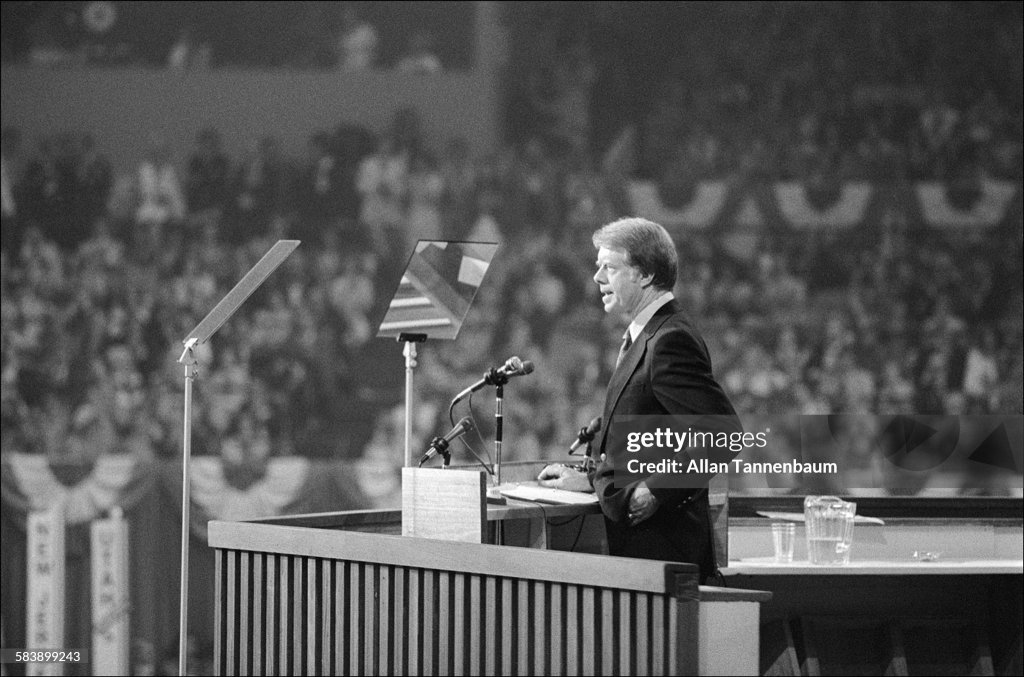
On the first round of balloting, former Georgia Governor Jimmy Carter won the Democratic Party nomination for candidate in the upcoming U.S. presidential election. The final vote for Carter at the Democratic National Convention at Madison Square Garden in New York City was 2,338 ½ for Carter, and 330 and 301 for his closest competitors, U.S. Representative Morris K. Udall of Arizona and Governor Jerry Brown of California, respectively. By an overwhelming margin, the Democratic National Convention ratified Mr. Carter’s startling electoral ascendancy of the last six months, made him the first major‐party nominee from the Deep South since Zachary Taylor in 1848 and installed him as the early favorite to capture the White House in November. It seemed appropriate when Ohio put Mr. Carter over 1,505 votes — a majority — for it was the Georgian’s sweep of that state’s June 8 primary that started the stampede of party leaders toward him.
Mr. Carter indicated he had made his choice of a vice-presidential running mate but took elaborate precautions to prevent disclosure before tomorrow. Senator Walter Mondale’s name was most frequently mentioned by members of the Carter circle, but there was also informed betting on Senator Edmund Muskie. It was the most important day in Jimmy Carter’s life. As he sat and talked in his suite on the 21st floor of the Americana Hotel, the prize for which he had toiled 19 long months—the Democratic nomination for President of the United States — lay only 12 hours ahead. He seemed as calm as if he were spending the day inspecting peanuts back in Plains, Georgia, instead of discussing in his orderly and almost detached manner, his choice for Vice President, his acceptance speech and his plans for the campaign. No, Mr. Carter said. He would not name the man he had tentatively selected as his running‐mate, not until a news conference this morning. He would tell the winner and the five losers in the Vice‐Presidential sweepstakes by telephone only a few minutes in advance. “I thought about it last night,” he said very softly, “and by this morning there was one man pre‐eminent in my mind. It’s conceivable that I’ll change my mind — I’m not positive yet — but I don’t think so.”
Organized labor is staging a comeback in Madison Square Garden after losing much of its political effectiveness in the Democratic convention of 1972. But the voices of George Meany and the old-line A.F.L.-C.I.O. unions no longer dominate. More than two-thirds of the 550 to 600 delegates who are union members are the product of an independent drive by a coalition of eight unions that decided to end their risky reliance on a single labor-backed presidential candidate. Many of the 418 Labor Coalition Clearinghouse delegates were chosen under the banner of Jimmy Carter but others as backers of Representative Morris Udall and Senator Henry Jackson. One of the coalition leaders, Leonard Woodcock of the United Automobile Workers, announced after a meeting with Mr. Carter that they favored Senator Mondale for Vice President but would he very comfortable with Senator Muskie.
Ronald Reagan swung east today on a two-day raiding expedition among New Jersey and Pennsylvania convention delegations leaning heavily to President Ford in the Republican Presidential nominating contest. But Mr. Reagan’s opening meeting with most of New Jersey’s 67 delegates at an airport motel this evening was more an exercise in coyness than a public conversion session. If a single delegate was moved by Mr. Reagan’s hour of talking to vote for the former California Governor at the Republic National Convention in Kansas City, Mo., next month, he or she declined to step forth to reporters waiting outside the reception.
President Ford celebrated his 63d birthday today with his doctor proclaiming him in “excellent health.” As a surprise, his wife Betty took him to lunch at the fashionable Sans Souci Restaurant, near the White House. He had a chefs salad preceded by two martinis. Mr. and Mrs. Ford also shared a half bottle of white wine sent over by reporters and a cake, heavily laced with liqueur, presented by the restaurant. The President received this morning a six‐month “interval physical examination” by his personal physician, William M. Lukash, who later issued a statement saying that “the President feels exceptionally fit and is looking forward to continued good health.”
President Ford signed a $32.5 billion weapons procurement bill today that authorizes production of the new B-1 bomber and a record $6.7 billion naval shipbuilding program. At the same time, he called for more efforts to cut waste in defense spending. Also signed by the President was a bill appropriating $8.3 billion in fiscal year 1977 for the Treasury Department, Postal Service, General Services Administration, the Civil Service Commission and the Executive Office of the President. A third measure signed provides $6.6 billion in 1977 budget authorities for activities of the State, Justice and Commerce Departments, the Federal judiciary, the Small Business Administration and the United States Information Agency.
An unidentified United States ambassador solicited from the Aluminum Company of America at least $25,000 that was paid to officials and political parties of a foreign country, according to papers filed by the company with the Securities and Exchange Commission in Washington. The incident occurred in 1971 or 1972. The country was not identified hut was one of 13 in which the company did a substantial business, a spokesman said.
James W. Plummer, undersecretary of the Air Force since December 1973, is quitting to become executive vice president of the Lockheed Missiles & Space Co., his employer for 18 years before he went to the Pentagon. The Defense Department said Plummer had agreed to remain in his $39,000-a-year job for several months to maintain continuity in the office. During that period, a statement said. Plummer will be “completely disqualified from participating in any matter impacting on the interests of Lockheed or any of its subsidiaries” and will not participate in any decision involving aerospace procurement.
A Suffolk County (Boston) grand jury handed down a dozen secret indictments against four unidentified persons in connection with two July 2 bombings in Boston, one at a National Guard armory in Dorchester and for blowing up of a plane at Logan International Airport. Assistant District Attorney John Gaffney said Joseph A. Aceto, 23, of Portland, Maine, appeared before the grand jury, “but I cannot go into detail on what he did or said.” The Boston Globe, however, said Aceto told police he was responsible for the armory and airliner explosions. It said Aceto also gave the names of two other persons involved.
A Federal Bureau of Investigation agent invoked his Fifth Amendment right against self-incrimination yesterday in response to questions about burglaries, wiretapping and other intelligence operations against the Socialist Workers Party, according to a party representative. The agent, Joseph Furrer, refused to answer about 80 questions, citing his Fifth Amendment privilege, according to Cathy Perkus of the Political Rights Defense Fund. Several bureau officials said they could recall no previous occasion when an F.B.I. agent took the Fifth Amendment in a public legal proceeding. The F.B.I. had disclosed that agents conducted 92 burglaries at party offices and two at the homes of party associates from 1960 through 1966.
The union striking 57 hospitals and nursing homes in the New York City area said it was considering dropping some emergency services in view of the lack of progress toward ending a walkout that began July 7. Representatives of residents and interns at many of the facilities announced their support of the strike as a federal mediator met with the League of Voluntary Hospitals. The National Union of Hospital and Health Care Employees, composed mainly of nonprofessionals, struck the private, nonprofit hospitals for at least a cost-of-living increase. But the league says it has no money because of insufficient Medicaid and Blue Cross payments, which in turn is the result of the state and city financial crisis.
Westinghouse Electric Corp. asked for an injunction against the International Brotherhood of Electrical Workers to limit wildcat picketing at its Cheswick plant outside Pittsburgh. The IBEW members walked out Monday and 38 Westinghouse plants across the country are affected. The strikers were joined Tuesday by about half of the 21,700 members of the International Union of Electrical Workers who went out to protest their union’s extension of their contract with Westinghouse on a day-to-day basis. The contracts of the four unions at Westinghouse expired Sunday.
A mine rescue team accompanied by Federal and state mine safety officials today began breaking down the seals at the Scotia Coal Company mine in Whitesburg, Kentucky where 11 men were killed in the second of two fatal methane gas explosions four months ago. The bodies of the 11 men, two of them Federal mine inspectors, are still inside the mine, which was sealed March 19. It will be another two months or more before the rescue team reaches the bodies to remove them. They lie about three and a half miles from the mine entrance the rescuers dug into, 1,300 feet below the surface, where they were struck down in a flash explosion March 11. The March 11 blast was the second to rock the mine in a 60‐hour period. Fifteen miners were killed in the first blast, on March 9. The 11 killed subsequently had entered the mine to secure it so that they could begin an investigation into the causes of the first blast.
The toll in yesterday’s commuter-train crash in New Canaan, Connecticut rose to two dead and 29 injured today while investigators for several agencies began searching for an explanation of the rush-hour accident. Nineteen‐year‐old Elizabeth: S. Hadden, who had been trapped in the wreckage of a Cosmopolitan car for two and a half hours as rescuers tried to free her, died this morning at Norwalk Hospital. Miss Hadden, who had recently moved here from Ohio with her father, was one of many passengers clustered around the motorman’s cab at the front of the 5:27 PM train out of Grand Central Terminal. A second woman, Nancy Siegal, 36 died instantly of a fractured skull when she was crushed between the cab and a seat.
An outside group of experts consulted by the National Cancer Institute has recommended that the agency discontinue the routine use of X-ray screening for breast cancer in symptom-free women under the age of 50, according to informed sources. A preliminary report drafted under the leadership of Dr. Lester Breslow of the University of California at Los Angeles is now in the hands of officials of the cancer institute and of the American Cancer Society. The two organizations are joint sponsors of a nationwide breast cancer screening program in 27 centers involving more than 250,000 women, half of whom are between 35 and 49. The program uses both physical examinations and X-rays. Officials of the two agencies are seriously considering whether to make changes in the screening program. They have invited the program directors from around the country to Washington on Monday to discuss the options. The meeting will be open to the public.
Thunderstorms and heavy rain soaked east and south Texas, causing some streams to overflow. There were showers and thundershowers also in the lower Mississippi Valley, Iowa, the eastern Great Lakes and along the New England coast. It was hot in the upper Mississippi Valley while cooler air moved into western Montana. The eastern third of the United States had partly cloudy to cloudy skies while the rest of the nation was mainly clear. Temperatures were in the normal range for the time of the year.
Taiwan will try to take part in the Olympic Games, at least on a token basis, under a plan drawn up today with strong support from both the United States and the International Olympic Committee. Unless the new proposal is accepted by the Canadian Government, the United States is prepared to pull its 425-member team out of the Games.
Major League Baseball: No games today as the All-Star Break concludes.
The stock market churned indecisively yesterday in the area just above the 1,000 mark in the Dow Jones industrial average and closed virtually unchanged in declining volume. The Dow industrials were lower in the morning, swung into plus territory early in the afternoon and then slipped in late trading to close down 0.90 at 1,005.16.
Dow Jones Industrial Average: 1005.16 (-0.90, -0.09%)
Born:
Ľuboš Bartečko, Slovakian National Team and NHL left wing (Olympics, 2002, 2006, 2010; St. Louis Blues, Atlanta Thrashers), in Kezmarok, Czechoslovakia.
Larry Parker, NFL wide receiver (Kansas City Chiefs), in Bakersfield, California.
Teddy Afro (stage name for Tewodros Kassahun Germamo), popular Ethiopian singer and dissident; in Addis Ababa, Ethiopia.
Kirsten Sheridan, Irish film screenwriter, and director (“In America”; “August Rush”), in Dublin, Ireland.
Died:
Joachim Peiper, 61, Nazi German war criminal and SS officer who had been convicted of the Malmedy massacre of American prisoners of war, was killed in a fire at his home in the village of Traves, Haute-Saône in France by French survivors of the war. He had been living in France since 1956 after serving nine years of a life sentence.

