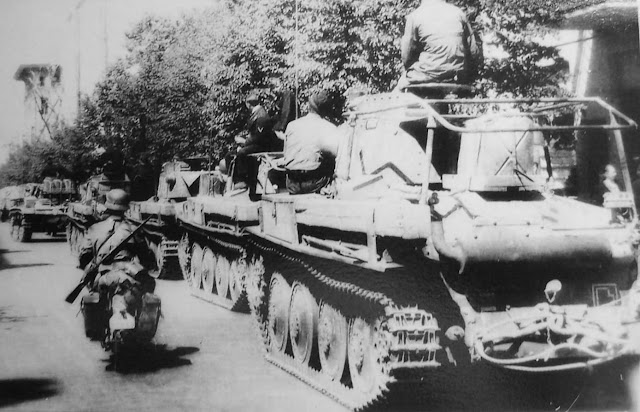
Finland declared war on the Soviet Union. The Continuation War began.
Early in the morning, the Red Air Force bombs Helsinki, five other Finnish towns, and 19 airfields in Finland. The force includes 263 bombers and 224 fighter aircraft, bombing 15 cities, towns, and villages. Major targets include Helsinki, Kotka, Turku, Loviisa, Forsby, and Porvoo.
It is a massive Soviet effort that includes 460 planes. The Soviets lose 23-27 planes. In addition, the Soviets shell the Finnish positions on the island of Morgonland and other Baltic islands, some of which the Finns already have evacuated. The Soviets claim the airstrikes in Finland are aimed at German targets, as German forces are known to be operating from Finland.
There is another artillery duel between Finnish and Soviet forces at Hanko. These Soviet attacks are not accidents. Moscow radio broadcasts a threatening statement:
“The Finnish militarists have flagrantly violated the Soviet-Finnish peace treaty. The rulers of Finland have begun military operations against our country . . . The Soviet Union has fulfilled the peace treaty conscientiously. But the rulers of Finland, under orders from Hitler, have plunged the long-suffering Finnish people into a war against the Soviet Union. Scoring the most elementary of international laws and the vital interests of their own people, the Finnish warmongers have again launched a campaign against the Soviet Union. . . . The ignoble rulers of Finland have not learned any lesson from the campaign of the winter of 1939 and 1940. They are asking for another, a final, lesson, and that lesson the Finnish perpetrators of fascism will get.”
The Soviet statement is partly correct and partly false. While Finland has laid mines in the Baltic and allowed German troops to operate from its soil against the Soviet Union, Finland has not fired a shot against the Soviet Union since the Winter War. It has complied with the treaty that ended that war aside from the actions of its partner, Germany. So, both sides have an argument about who is in the wrong.
Most observers likely would agree, though, that allowing an enemy to freely use your territory to attack them (as Finland has done) is an act of war. So, the Soviets would have had the better case to declare war on Finland than vice versa — if they had done so, that is, and not simply attacked. Very few hands are completely clean on the Eastern Front.
Finnish Prime Minister Rangell had planned a speech to Parliament today regarding remaining neutral and taking only defensive measures. However, in light of the Red Air Force attacks, he quickly changes his speech to include a more bellicose tone:
Finland has become the object of an attack by the Soviet Union, which has started acts of war against Finland. Due to this, Finland has undertaken defending itself by all available military means
Finland immediately declares war on the Soviet Union. This is done by the roundabout means of a simple unanimous vote of confidence in the present Finnish government. In fact, everyone “knows” that the Finns are German allies and preparing an attack of their own anyway. The Soviet air attacks, however, give the Finns a pretext for declaring war at once.
The Finns now grant the Germans permission to begin full-scale reconnaissance and carry out flights from Finnish territory. The Finnish IV Army Corps is granted permission to fire on available artillery targets, but for the time being, Finnish troops are not allowed to cross the frontier (that does not happen in force until July 10, 1941).
Finland has multiple military objectives, but the government fundamentally only has one goal: to recover territory lost during the Winter War. Finnish troops head toward Leningrad, the Svir River, and the Murmansk railway. This is known as the “Continuation War.” While Finland is a “co-belligerent” of Germany, it is waging a completely separate campaign. While it coordinates operations with OKW, it does not take orders from Berlin and often disregards the German military’s wishes.
The Finns do not attack at once upon the government’s declaration of war, preferring to bide their time and pick a time and place that works with ally Germany. Instead, Finland’s military continues mobilizing its forces and planning its axes of advance. The Soviets are too hard-pressed further south and actually withdraw forces from the border region with Finland around this time.
In the far North of Finland, the Soviets reinforce their defenses around Murmansk. With both England and the USA promising aid, the northern seaports have become vital elements of Soviet strategy and must be defended. The Germans are more interested in securing the nickel mines and plants along the border than attacking Murmansk at this time.
In Stockholm, Sweden the Riksdag sanctioned the passage of the German Wehrmacht’s Engelbrecht Division from Norway across Swedish soil to the front in Finland. With troops needed in Finland and no longer in Narvik, the Wehrmacht needs to move troops by train through neutral Sweden with the Swedish government’s permission. This is the only quick route from northern Norway to the Baltic and a critical line — maintaining use of it is a top priority for the Wehrmacht in Scandinavia. The Swedish government (Riksdag) now permits the Wehrmacht to send one division at a time along the railway. The German 163rd Infantry Division (often called the Engelbrecht Division after its commander) begins to move its 15,000 troops, equipment, and supplies.
The Swedish government announced that it would allow the Germans to move forces up to one-division strong through Sweden from Norway to Finland. The Swedes stated “Our chief interest is to maintain our liberty and stay outside of the conflict, and the government came to the conclusion that the only way to do so was to accept the German-Finnish demand.”.
Beginning of the Kaunas pogrom, a five-day massacre of Lithuanian Jews by local partisans and invading German forces. Lithuanian militiamen in Kovno were encouraged by German security officers to stage a pogrom, and that night 1,500 Jews were murdered with particular savagery. In Kaunas, political prisoners who have been released by the general uprising learn that Soviet security officers (some of whom reputedly are Jewish) are being held in the Lietukis car garage. They recognize some of their former captors. In a scene that will be repeated many times during World War II, the released prisoners kill the captive Soviets with blunt instruments.
More generally, local citizens engage in a rampage against Jews. This is known as the Kaunas pogrom. It is a sensitive topic, obviously, and there has been debate as to how much the recently arrived local German troops incite the locals to engage in anti-Semitic horror and how much is simply score-settling by locals (something that is quite common during World War II).
In any event, the pogrom lasts for five days. Jews are taken by locals to The Seventh Fort (or VII Fort, which is a defensive fortification built in Žaliakalnis district of Kaunas), one of many ad hoc prisons outside the city, and imprisoned before their eventual fates. It is estimated that 10,000 Jews are beaten and then shot there by the end of July.
Anti-semitic activities also take place elsewhere in Lithuania. The events in Kaunas, however, are etched deeply into the memory of Lithuania.
The German advance in Russia continued. Operation BARBAROSSA continues moving eastward toward Leningrad, Moscow, and Kyiv. All of these operations are lumped together by the Russians as the “border defensive battles,” which isn’t particularly descriptive (understandable, since they don’t go well for the Soviets). So, just for clarity and consistency, I use the names western sources have applied to events on the eastern front.
The forces of Soviet West Front principally deployed in the Bialystok salient are threatened by a double envelopment by the infantry of Army Group Center. The German attacks threaten to complete one of the first of the great circling movements. The Soviet 3rd and 4th Armies are being surrounded near Bialystok. The first encirclement is closed by Hoth’s and Guderian’s forces near Baranovichi.
Army Group North under Field Marshal Ritter von Leeb is led forward by General Eric Hoepner’s 4th Panzer Group. Following behind it are 16th and 18th Armies. In total, Army Group North controls 20 infantry, three panzer, and three motorized infantry divisions. Overhead, support is provided by Luftflotte 1 (the First Air Fleet). Kaunas and Vilnius have fallen, and the Soviets are retreating everywhere.
At the Battle of Raseiniai, which began on 23 June, the Germans of the 6th Panzer Division first encountered Soviet KV heavy tanks. One slipped through the German lines and proved impervious to the German anti-tank weapons. It has remained in place behind the lines, withstanding a pounding by 50-mm anti-tank guns and panzers in the vicinity. Early today, after almost two days, the Germans finally knock the KV out by bringing an 88 mm Flak gun through nearby woods and blasting the KV multiple times from the rear. The crew, incredibly, survives all this and only is killed by a pioneer engineer who climbs on the tank and pushes grenades through the holes made by the Flak gun.
As the day ends, the Soviet 8th Army is falling back to the Jonava about 48 km (30 miles) northeast of Kaunas, while the Soviet 11th Army is retreating toward the Desna. Marshal Semyon Timoshenko of the Stavka orders Front Commander Colonel General Vasily Kuznetsov to form a defensive line along the Western Dvina. Timoshenko releases the 21st Mechanized Corps (Major-General Dmitry Lelyushenko) with 98 tanks and 129 guns, from the Moscow Military District to help form this line.
After a successful surprise attack by elements of the 6th Panzer Division that captures two key bridges at Dvinsk during the early morning hours, the 8th Panzer Division captures Dvinsk. The bridges are wired for demolition, but the attack is so quick that the Soviets don’t have time to blow them. The division then continues its northeastward advance toward Leningrad.
In Army Group Center, the Soviets launched a counterattack on the 24th toward Grodno. The attack, however, missed the leading German tanks of the 3rd Panzer Group, which already had driven further east to Vilnius. Today, the Soviet counterattack is crushed and the commander of Soviet 6th Cavalry Corps is taken captive. General Pavlov, in charge of Western Front, orders a general withdrawal to Slonim in order to block the way to Minsk. In the evening of 25 June, the German XLVII Panzer Corps cut between Slonim and Vawkavysk, forcing Pavlov to order the withdrawal of all troops in the salient behind the Shchara River at Slonim to avoid encirclement. Most formations could not break contact with the Germans, and due to the loss of fuel and transport assets those who could break out, had to withdraw on foot. This withdrawal opened the southern approaches of Minsk. The Soviet 13th Army evacuates Maladzyechna, northwest of Minsk.
The Wehrmacht in the central sector has its eyes on a larger strategy than simply brushing off the Soviet counterattacks. General Hoth and General Guderian aim their panzer groups for a large-scale pincer move around the Soviet forces to the vicinity of Baranovichi.
In Army Group South, the Battle of Brody continues. This is a major tank battle, and along the front Soviet tanks outnumber the panzers 3229-728. However, in the most effective classes of tanks, the Germans have 355 with main guns of 50 mm or larger, while the Soviets only have 443 T-34s and KVs. So, while there is a great disparity in raw numbers, in fact, the destructive power of the respective forces is much more balanced from the raw numbers.
While it characterized as one continuous battle, the Battle of Brody actually is a series of disjointed Soviet tank charges against the advancing Wehrmacht. All these attacks do is grind down the Soviets’ starting numerical advantage.
On the 24th, the Soviet 22nd Mechanized Corps attacks toward Voinitsa, Ukraine. It is making little progress and losing large numbers of tanks. The Soviets today move large numbers of tanks on a 500-km drive to the northwest of Brody, and, as the commander of the 8th Mechanized Corps, Ryabyshev, later writes, half of the tanks break down and the ones that make it are worn out. Some Soviet formations, such as the 15th Mechanized Corps, drive around following orders that are out of date and never even see the Germans.
German Army 1.Panzergruppe captured Dubno and Lutsk in Ukraine.
Reichsführer-SS Heinrich Himmler and his adjutant, Joachim Peiper, embark on his headquarters train “Heinrich” for an inspection tour of the eastern front. Hitler’s new headquarters in Rastenburg, the Wolf’s Lair, conveniently is situated on a (closed) railway line, making visits to and from there by train very convenient for German leaders and foreign dignitaries.
The British send General Mason-MacFarlane by air for Moscow to head a military mission. This is a hazardous route that includes crossing occupied Norway and Finland. General Brian Horrocks replaces him in command of the 44th Infantry Division.
Colonel General Vasily Kuznetsov was ordered by Semyon Timoshenko to organize a defense along the Daugava River (Western Dvina).
The Australian 25th Brigade at Jezzine has no success in its attempts to advance north through the mountains. The Australian commander falls ill and is replaced by Brigadier Plant, who favors using artillery and small infiltration patrols and air power to wear out the defending Vichy French defenders rather than continue futile ground attacks. Plant, a veteran of Gallipoli, considers this terrain worse. British air strength is increasing – Beirut will now be bombed every night until the Australian offensive on the Damour commences.
General Wavell, still the Middle East Commander until Claude Auchinleck arrives from India, joins U.S. observer Averell Harriman on an inspection tour of East Africa.
Douglas Bader shot down two German Bf 109F aircraft.
British submarine HMS Parthian sank French submarine Souffleur by torpedo off Syria.
French Lieutenant E. Boulé, a prisoner of war at Oflag IV-C at Colditz Castle, Germany, was nearly successful at his escape. Dressed as a young German woman and readily walking away from the castle, he accidentally dropped his watch and was caught when a German guard returned the watch to him.
Churchill reads his Battle of the Atlantic directive of March 6, to the House of Commons, meeting in Secret Session.
He also reports on the improvements to the clearance of goods especially from the congested ports of the west coast. Goods are now shipped inland to ‘sorting depots’ from where they are more properly despatched. Railway lines to the ports have been enlarged and junctions improved and the number of mobile cranes increased.
During the day, a report was released that, for the week ending at 0600 hours on 25 Jun 1941, about 39 people were killed and 116 were seriously injured in Britain due to German bombing; none of the casualties were from London, England, United Kingdom. After dark, German bombers bombed Southampton, England, United Kingdom and dropped many naval mines in surrounding waters.
RAF Bomber Command, Day of 25 June 1941
24 Blenheims on Circus operations to Hazebrouck and St-Omer, 10 Blenheims on coastal sweep but no ships seen. 1 Blenheim lost.
In the first, RAF Bomber Command sends a force of Blenheim bombers under heavy fighter escort to northern France to attack the Hazebrouck marshaling yards. They cause widespread damage as an ammunition train explodes which includes the destruction of a bridge.
The other mission is to St. Omer, where the Luftwaffe has an important airfield. The elite German JG 26 fighter squadron is based at St. Omer, and they do not take kindly to being attacked. The Germans shoot down five Spitfires during the raid on Hazebrouck and lose at least two during the St. Omer raid. RAF ace Douglas Bader files claims for the two Luftwaffe planes, while Oblt. “Pip” Priller of I,/JG 26 claims a Spitfire over Gravelines.
RAF Bomber Command, Night of 25/26 June 1941
Bremen
56 Wellingtons and 8 Whitleys; severe electrical storms prevented most aircraft reaching the target. 1 Wellington lost.
Kiel
30 Hampdens and 17 Wellingtons. 1 Hampden lost. Kiel reports light damage with 1 person killed.
Minor Operations: 6 aircraft to Rotterdam, 1 each to Cologne and Diisseldorf, 1 Hampden minelaying in Frisians, 7 sorties. No losses.
During the day, three Luftwaffe bombers are lost during an attack on Newcastle. It is unknown what happened to them.
The Luftwaffe sends some bombers to attack Southampton and the surrounding area. The Germans drop many parachute mines, each of which can destroy a row of houses. For the week ending at dawn on the 25th, the government reports that there were 39 killed and 116 seriously wounded, with no casualties in London.
The RAF attacks Gazala and the Italian positions at Debra Tabor.
An Italian troopship convoy sets off from Naples bound for Tripoli. It is composed of transports Esperia, Marco Polo, Neptunia, and Oceania. Escorts include four destroyers (Aviere, Da Noli, Geniere, and Gioberti). British aircraft based on Malta attack the convoy. The British cause some light damage to transport Esperia but lose a Swordfish of RAF No. 830 when it crashes into the side of the Esperia.
During an air battle near Malta, Hurricane fighter pilots claim three Machhi 200 fighters shot down and an Italian bomber badly damaged. There are a couple of bombing raids on Malta that cause damage at Zeitun, Zabbar, and Safi.
U-108, commanded by Kapitänleutnant Klaus Scholtz, sank Greek steamer Ellinico (3059grt) in 55N, 38W.At 0620 hours on 25 June 1941 the Ellinico, dispersed from convoy OG.65, was hit amidships by one torpedo from U-108 and sank by the stern within three minutes. The ship had been spotted at 2037 hours the day before and missed with two torpedoes just after midnight. The 3,059-ton Ellinico was headed for Wabana, Newfoundland.
U-108 later sank Greek steamer Nicolas Pateras (4362grt), a straggler from convoy OB.336, in 55N, 38W. At 1614 hours on 25 June 1941 the Nicolas Pateras, dispersed from convoy OB.336, was hit amidships by one torpedo from U-108 south of Greenland. The U-boat then surfaced, began shelling the ship at 1713 hours and fired 97 shells until she sank by the bow at 1755 hours. The gun crew had some problems with the heavy seas and strong wind during firing. The 4,362-ton Pateras was carrying ballast and was headed for Father Point, Canada.
U-75, commanded by Kapitänleutnant Helmuth Ringelmann, sank Dutch steam merchant Schie (1967grt) west of Ireland. At 1135 hours on 25 June, U-75 fired a stern torpedo on a steamer of estimated 4000-tons, which had been chased for the last three hours in a south-south westerly direction. The torpedo hit and caused the ship to sink by the stern within four minutes. There were no survivors and no distress signal was sent. Most probably this vessel was the Schie (Master P. Hermsen). A long time it was thought that Schie was sunk in convoy OB-336 by U-203 (Mützelburg) on 24 June 1941, but the ship was straggling from the convoy, so it is not possible that she was sunk in the attack. The 1,967-ton Schie was carrying Ballast and was headed for Curaçao.
U-77, commanded by Kapitänleutnant Heinrich Schonder, sank Greek steamer Anna Bulgaris (4603grt) in 55N, 38W. At 0436 hours on 25 June 1941 the unescorted Anna Bulgaris (Master Petros N. Glinos) was hit aft by a stern torpedo from U-77 about 600 miles south of Cape Farewell. The U-boat had spotted the ship at 2136 hours the day before and hit her with a dud at 0030 hours. The Germans observed how the survivors abandoned ship in lifeboats before she sank, but they were never seen again. The 4,603-ton Anna Bulgaris was carrying ballast and was headed for Montreal, Canada.
Light cruiser HMS Nigeria and destroyers HMS Bedouin, HMS Tartar, and HMS Jupiter departed Scapa Flow at 2100 on Operation EC to locate German weather ship Lauenberg (344grt). The ships proceeded to Skaalefjord to first refuel. The ships departed on the 26th. On the 28th, weathership Lauenburg was captured off Jan Mayen Island in 73-02N, 3-13W.After a thorough search of the vessel, weathership Lauenburg was sunk by destroyer Tartar. The ships arrived at Scapa Flow after the operation on the 30th, destroyers Bedouin and Tartar at 1630 and destroyer Jupiter at 2200.
Destroyer HMS Liddesdale was damaged by German bombing in the North Sea, but had no time out of action.
Minefield SN.70B was laid by Minelayers HMS Agamemnon and HMS Menestheus, escorted by destroyers HMS Brighton, HMS Castleton, and HMS Wells. The operation was covered by light cruisers HMS Kenya and HMS Arethusa which departed Scapa Flow on the 23rd. Light cruiser HMS Aurora relieved Arethusa on the 25th. Arethusa went to Iceland Faroes patrol. On the 25th, destroyer Brighton came out of a dense fog and hit Kenya starboard side abreast B turret. No deaths are reported and there is no reference to any injuries. However, one man was reportedly thrown or jumped into the water, but was rescued. Kenya proceeded to Scapa Flow, arriving on the 27th, and later to the Tyne for repairs. Brighton, whose bow was severely damaged, was escorted to Reydarfjord by Aurora and Wells. Destroyer HMS Eclipse sailed from Reykjavik to provide additional anti-submarine support for the minelayers. Destroyer HMS Echo departed Hvalfjord to assist on the 25th and arrived on the 26th at Reydarfjord where the damaged destroyer and Aurora had arrived. Eclipse arrived at Loch Alsh on the 27th after assisting the escort. Kenya departed Scapa Flow for Rosyth on the 28th, arriving on the 29th. On the 28th, Brighton departed for the Clyde in tow of tugs Marauder and Thames escorted by Aurora and Echo. The escort ships were reinforced en route by destroyer HMS Lightning, which departed Scapa Flow at 1700/29th. Brighton, still under tow, detached in the North Minches. Aurora, Lightning and Echo arrived at Scapa Flow at 0200 on 1 July. Brighton arrived in the Clyde on 1 July without her bow, which had broken away en route.
Minelayer HMS Teviotbank, escorted by destroyer HMS Walpole, laid minefield BS.65 off the east coast of England.
Steamer Dashwood (2154grt) was sunk by German bombing in 52-59N, 1-52E. The entire crew were rescued.
Trawler Isle of Wight (176grt) was damaged by German bombing off Scarborough.
New Zealand Division light cruiser HMS Leander and destroyers HMS Decoy, HMS Havock, and HMAS Nizam swept north of Beirut during the night of 25/26 June. At dawn on the 26th, the force bombarded the Damur area.
Submarine HMS Parthian sank French submarine Souffleur off Beirut, in 33-49N, 35-26E at 1242.
Australian light cruiser HMAS Perth and anti-aircraft cruiser HMS Carlisle departed Alexandria at 1530/25th to relieve cruisers HMS Leander and HMS Coventry off Syria. Cruiser Carlisle had been in the floating dock at Alexandria from 21 to 25 June. Light cruiser Perth was only partially repaired from the Crete bombing damage. New Zealand Division light cruiser Leander and anti-aircraft cruiser Coventry off Syria were relieved by Australian light cruiser Perth and Anti-aircraft cruiser Carlisle on the 26th. Cruisers Leander and Coventry departed Haifa and joined the Battle Fleet at sea. They returned to Alexandria on the 27th.
Destroyers HMS Hasty and HMS Jaguar departed Haifa to return to Alexandria.
Submarine HMS Rorqual departed Alexandria on a supply run to Malta.
Estonian steamer Estonia (1181grt) was seized by German forces.
An Italian convoy of troopships Esperia, Marco Polo, Oceania, and Neptunia departed Naples for Tripoli, calling at Taranto on the 27th.The convoy was escorted by destroyers Aviere, Geniere, Gioberti, and Da Noli and was given cover by heavy cruisers Trieste and Gorizia and destroyers Corazziere and Carabiniere. Destroyer Ascari departed Messina on the 25th and joined the covering force. Submarine HMS Urge, already on patrol off Messina, and submarines HMS Unbeaten and HMS Upholder, at Malta, were ordered to intercept the convoy. When no contact was made, submarines Unbeaten and Upholder returned to Malta on the 27th. In British air attacks on the convoy on the 25th, Sub Lt (A) D.A.R. Holmes and Leading Airman J.R. Smith were lost when their Swordfish of the 830 Squadron hit the side of the ship being attacked. Liner Esperia received light damage from the air attacks. Destroyer Ascari arrived at Messina on the 29th. The convoy arrived at Tripoli on the 29th.
Aircraft carrier HMS Furious, light cruiser HMS Hermione, and destroyers HMS Legion and HMS Lance and destroyers HMS Faulknor, HMS Fearless, HMS Forester, HMS Foxhound, and HMS Fury, which joined on the 24th, arrived at Gibraltar.
Submarine HMS Osiris departed Gibraltar for Malta with seventy tons of petrol.
Dutch submarine HNLMS O.23 departed Gibraltar for patrol in the Gulf of Genoa.
President Roosevelt signed bills in Washington today authorizing $50,000,000 for construction of bases for small naval craft, extending jurisdiction of American prize courts to cover captured aircraft; authorizing the Navy to use vessels stricken from its register as targets, and clarifying the rights of the Navy to require fewer than four years of training for aviation cadets. He issued an executive order instructing executive agencies to take steps to eliminate discrimination against Negroes and others in defense jobs.
The Senate was in recess. An Agricultural subcommittee heard William S. Knudsen and Sidney Hillman, directors general of the Office of Production Management, support a bill for TVA development on the Cumberland River in Tennessee.
The House passed and sent to the Senate an $895,821,275 deficiency appropriation bill; received a resolution for investigation of recommissioning of World-War-type submarines; heard Representative Wadsworth of New York deny charges that disciplinary legislation was needed for draftees; heard Representative Taber of New York criticize employment of Robert J. Brady in the office of Price Administration and Civilian Supply, and adjourned at 3:50 PM until noon tomorrow. A Labor subcommittee heard representatives of the American Federation of Labor and the Catholic Church urge creation of a post-war economic commission; the Rivers and Harbors Committee heard opposition to the St. Lawrence seaway.
U.S. President Franklin D. Roosevelt issued Executive Order 8802 which forbade discrimination in the defense industry. The order called for the “Full Participation In The Defense Program By All Persons, Regardless Of Race, Creed, Color, Or National Origin”
President Roosevelt decided today not to apply the Neutrality Act to the Russian-German conflict, and thereby left American ships free to carry arms or any other materials across the Pacific to the Soviet Union. Sumner Welles, acting secretary of state, announced the president’s decision at a conference. Welles said that Russia had made no request for American aid and had sent no communication to the Washington government in response to Mr. Roosevelt’s promise of yesterday to extend all assistance possible to the Soviets.
Isolationist Senator Robert Taft of Ohio gives a radio speech in which he argues that the United States now is safer because of Germany’s attack on Russia:
“The Russian war certainly postpones for many months any attack which Hitler could possibly make; and makes even more certain a defense of the United States sufficient to discourage any military or naval attack.”
Rather than declare war on anybody, Taft says that it would be wiser to avoid foreign wars and simply help England fight its war:
“This country can be united on a policy of no intervention in Europe and aid to Britain. We can make that aid infinitely more effective if we abandon the role of world benefactor; if we leave Balkan politics alone; if we avoid a Communist alliance; if we adhere to the simple policy of aiding Britain.”
He concludes, “The Russian war has weakened every argument for intervention.” Roosevelt already, on the 24th, has promised aid to Russia to fight Germany.
The House of Representatives passed and sent to the Senate a $467,046,600 expenditure for new naval aircraft today together with $25,000,000 to spur lagging naval plane production by expanding the plants which manufacture them.
More than half of the work of modernizing defenses of the fleet against air attack has been completed, Secretary of the Navy Knox said at a press conference today. Responding to a question about the progress of work under a special $300,000,000 appropriation by the Congress, the Secretary revealed that this work is far ahead of anything heretofore believed possible. There are critical shortages, he said, in some things which are needed, particularly in some types of anti-aircraft guns, but he said substitutes are being improvised. and “the Navy is ready for action.” The Secretary declined to predict when the work would be concluded, but said this would be determined largely by the times at which units of the fleet could be spared.
Mourned by the state and nation he had served for more than 30 years, Pat Harrison, one of Mississippi’s greatest senators, was buried today with simple but Impressive services attended by many of the nation’s leaders or their representatives. After services in the flower-banked First Methodist church, the body of the state’s senior senator was laid to rest in Evergreen cemetery near the Gulf of Mexico.
Reliable United States sources estimated today that 500 American-born youths now are serving with the R.A;F. “Officially the United States government knows nothing about these men, who probably enlisted In Canada,” the source said, “but from what we’ve heard the number is ever increasing.”
Leon Henderson, Federal Price Control Administrator, stated today that the Chrysler Corporation had refused to rescind price increases on new cars and the Office of Price Administration and Civilian Supply would be forced “to take the pricing of automobiles out of the hands of the industry.” An over-all price ceiling for automobiles, effective in the new-model year which begins August 1, will be drawn up, Mr. Henderson said, to cover not only manufacturers’ prices but to regulate the mark-up allowed to dealers and “in all probability trade-in values as well.”
Twelve hundred striking machinists voted 5 to 1 to return to the jobs they quit in San Francisco shipyards May 10, an observer reported from a closed meeting just before midnight tonight. He said they would go back to work Monday. The observer came to a window where he told reporters the tabulation of the vote had just been completed but that no one was being allowed to leave the hall just yet. The meeting was behind locked doors. E. C. Davison, International financial secretary of the union, appeared at the meeting called to reopen discussion of all issues in the strike. He flew here from Washington to urge that the men return to work. After he finished, debate opened on the floor with each speaker restricted to five minutes. The strike, in its forty-seventh day, has tied up $500,000,000 worth of defense orders in 11 shipyards on the bay.
U.S. Navy Task Group 2.7, comprised of the light cruisers USS Philadelphia (CL-41) and USS Savannah (CL-42) and destroyers USS Lang (DD-399) and USS Wilson (DD-408), departed Hampton Roads for a 4,762-mile neutrality patrol that will conclude on July 8 at Bermuda.
The motion picture “Caught in the Draft” is released in the U.S. This comedy, directed by David Butler, stars Bob Hope, Dorothy Lamour, and Eddie Bracken. Hope, a movie star who cannot stand loud noises, tries to avoid the draft by getting married but falls in love with a colonel’s daughter (Lamour). Then he and his two buddies accidentally enlist in the Army and his adventures in basic training are followed.
In Newton, Massachusetts, 700 fans pay $1 each to watch Ty Cobb and Babe Ruth play golf. Cobb wins 3–2, but Ruth will beat him in 2 days. A third match will be played later this summer.
47-year-old spitballer Snipe Conley pitches a 9-inning 11–7 win for Dallas (Texas League) over San Antonio. Conley, who holds the Texas League record for consecutive wins (19), last pitched in 1928.
Major League Baseball:
At Boston, Red Sox veteran Lefty Grove pitches 9 innings to win, 7–2, over Cleveland for his 5th win of the year and the 298th of his career. The Red Sox knocked the Indians out of first place today behind the seven-hit pitching of Grove (5–2), who allowed only one Indian to reach base in the last three innings, Lou Boudreau receiving his fourth walk of the game in the ninth. Boston reached Jim Bagby for nine hits, including Ted Williams’s fourteenth homer in the fourth with one mate aboard to tie the score. The Sox then scored five in the seventh to pull away.
The New York Giants, scoring three runs in the first inning, closed their second Western jaunt of the year with a triumphant flourish today by polishing off Jimmy Wilson’s Cubs in the series final, 4–1. Another exceptionally fine pitching performance by young Bob Carpenter was featured in this victory
Masterful hurling by a youngster and veteran, a glimpse of powerhouse hitting and errors by the opposition combined today to give the Reds both ends of a twin bill with tail-end Philadelphia. 8–3 and 5–1. The 1940 champs unleashed a thirteen-hit attack to give sophomore Elmer Riddle his seventh victory without defeat this season in the opener, and although the Georgian allowed eleven hits he never was in trouble. The second game was ex-Yankee Monte Pearson — and Phillie misplays — all the way. Monte scattered five hits and the only one that counted was his initial pitch to Danny Litwhiler, first up in the ninth. Danny homered for the Phils’ lone tally.
The Yankees set back the St. Louis Browns, 7–5. In the second game of a three game baseball series at Yankee Stadium in New York City, St. Louis Browns pitcher Denny Galehouse gives up a home run to Yankee center fielder Joe DiMaggio extending DiMaggio’s hitting streak to 37-games.
The Athletics won their second victory of the season from the Tigers today, sewing up a 5–4 decision by scoring three runs in the fourth inning. The Tigers had won eight of their nine earlier games with the Philadelphians. Al Brancato’s triple drove in the deciding runs in the fourth and sent Schoolboy Rowe to the showers. Dick Siebert opened the inning with a single. Frankie Hayes walked and Pete Suder singled, counting Siebert. Then Brancato hit his triple, tallying Hayes and Suder.
The Brooklyn Dodgers edged the Pittsburgh Pirates, 5–4. Kirby Higbe, who replaced Hugh Casey at the start of the seventh with the contest in a 3–3 deadlock, achieved his first victory over the Pirates since he entered the National League. Cookie Lavagetto, who singled two runs across in the sixth, doubled Billy Herman home with the winning tally in the eighth to send Ken Heintzelman down to his sixth defeat.
The Cardinals had to win today or lose the National League lead to Brooklyn so they pounced on Boston again, this time, 6–2, and kept that half-game margin. Ernie White, rookie hurler, won his fifth game of the season, struck out nine Braves and allowed only seven hits but his string of scoreless innings was snapped at twenty-seven when Sebastian Sisti singled in the second driving in Boston’s two runs.
In the top of the 13th inning, the White Sox pull off a triple steal against the Senators and score 2 runs to win, 2–0. Joe Kuhel is on the front end of the American League’s only extra-inning triple steal. The Sox manage just 5 hits off Sid Hudson, while Sox starter Johnny Rigney allows 6 in 13 frames.
Cleveland Indians 2, Boston Red Sox 7
New York Giants 4, Chicago Cubs 1
Philadelphia Phillies 3, Cincinnati Reds 8
Philadelphia Phillies 1, Cincinnati Reds 5
St. Louis Browns 5, New York Yankees 7
Detroit Tigers 4, Philadelphia Athletics 5
Brooklyn Dodgers 5, Pittsburgh Pirates 4
Boston Braves 2, St. Louis Cardinals 6
Chicago White Sox 2, Washington Senators 0
A Chinese source in Canton reports that the Japanese have begun to withdraw recent reinforcements that had been placed in Canton, Swatow and Amoy in South China. It is thought that this signifies the strengthening of the Manchurian garrisons. An unconfirmed report states that approximately fifty Japanese warships of various types have passed the east Kwangtung coast heading north, while numbers of Japanese ships along the coast and in Formosa are being commandeered for troop transportation. It is also reported that Japanese army and navy commanders are meeting on Hainan Island to discuss the new situation.
The Japanese government demanded that the French allow the landing of Japanese troops in French Indochina. Japanese warships took up naval stations off Indochinese ports. The Japanese desire military bases in southern Indochina and decide to use force if necessary to get them. The high command also sets 10 August as the deadline for a decision to attack the Soviet Union in conjunction with Operation Barbarossa. There are no plans to attack the USSR and no forces have been allocated for that purpose, but the Japanese do have a large military presence in China and Manchukuo which could be sent on an invasion.
Foreshadowing important decisions, the Japanese Cabinet and army and navy authorities sat in almost continuous conferences in Tokyo today. The climax was a liaison conference between the government and the High Command and an extraordinary Cabinet session. Later the Premier, Prince Fumimaro Konoe, was received by Emperor Hirohito. Following his audience, Prince Konoe conferred with Marquis Koichi Kido, Lord Keeper of the Privy Seal. Such conferences are held only when great affairs of state are up for consideration. According to the Japan Times Advertiser. “the topic of discussion at the momentous session was a question of supreme importance arising from the outbreak of Russian-German hostilities.” No decision was announced and apparently none has been made because it was officially stated: “In view of the rapid changes in the international situation the government will call a special Cabinet meeting in the future if necessary so as to leave nothing undone to achieve the purpose of the total warfare structure.” But if the press and a speech by the War Minister, Lieutenant General Eiki Tojo, are any reflection of the discussions, their drift is becoming plain.
Dow Jones Industrial Average: 123.52 (+0.28)
Born:
David T. Walker, American session soul/R&B, and jazz guitarist (The Jackson 5; Marvin Gaye; Donald Byrd; Stanley Turrentine), in Tulsa, Oklahoma.
Denys Arcand, French Canadian film director (“Jesus of Montreal”, “The Barbarian Invasions”), in Deschambault, Québec, Canada.
Eddie Large [McGinnis], British comedian (“Little and Large”), in Glasgow, Scotland (d. 2020).
Curt Farrier, AFL defensive tackle (Kansas City Chiefs), in Yakima, Washington.
Died:
Stepan Skitalets, 71, Russian poet, in Moscow.
Naval Construction:
The U.S. Navy PC-461-class (173-foot) submarine chaser USS PC-492 is laid down by the Dravo Corp. (Pittsburgh, Pennsylvania, U.S.A.).
The Royal Navy “R”-class destroyer HMS Racehorse (H 11) is laid down by the John Brown Shipbuilding & Engineering Company Ltd. (Clydebank, Scotland).
The U.S. Navy Fletcher-class destroyers USS Claxton (DD-571), USS Dyson (DD-572), USS Harrison (DD-573), and USS John Rodgers (DD-574) are laid down by the Consolidated Steel Corp., Ltd. (Orange, Texas, U.S.A.).
The Royal Navy LCT (Mk 2)-class landing craft, tank HMS LCT 106 is launched by Swan Hunter and Wigham Richardson Ltd. (Wallsend-on-Tyne, U.K.).
The Royal Navy LCT (Mk 2)-class landing craft, tank HMS LCT 117 is launched by Tees-Side Bridge (Middlesbrough, U.K.).
The Royal Navy MMS I-class motor minesweeper HMS MMS 59 (J 559) is launched by J & G Forbes & Co. Ltd. (Sandhaven, England, U.K.).
The Royal Canadian Navy Bangor-class (VTE Reciprocating-engined) minesweeper HMCS Medicine Hat (J 256) is launched by Canadian Vickers Ltd. (Montreal, Quebec, Canada).
The Royal Navy Bangor-class (Turbine-engined) minesweeper HMS Poole (J 147) is launched by A. Stephen & Sons Ltd. (Glasgow, Scotland).
The U.S. Navy 77-foot Elco patrol motor torpedo boat USS PT-37 is launched by the Electric Launch Company Ltd. (Elco), (Bayonne, New Jersey, U.S.A.).
The Royal Canadian Navy Flower-class corvette HMCS Midland (K 220) is launched by the Midland Shipyards Ltd. (Midland, Ontario, Canada).
The Royal Navy Flower-class corvette HMS Ranonculus (K 117) is launched by William Simons & Co. Ltd. (Renfrew, Scotland). She is transferred to the Forces Navales Françaises Libres (Free French Naval Forces) upon completion, commissioning as Renoncule.
The Royal Navy “N”-class destroyer HMS Nonpareil (G 16) is launched by William Denny & Brothers (Dumbarton, Scotland). She is transferred to the Koninklijke Marine (Royal Netherlands Navy) before completion, and commissions as HrMs (HNMS) Tjerk Hiddes.
The Вое́нно-морско́й флот СССР (ВМФ) (Soviet Navy) Project 68 (Chapayev-class) light cruiser Zheleznyakov (Железняков) is launched by A Marti (Leningrad, U.S.S.R.) / Yard 194..
The Royal Navy Fairmile B-class motor launch HMS ML 256 is commissioned.
The Royal Navy harbor defence motor launch HMS HDML 1068 is commissioned.
The U.S. Navy Pipit-class coastal minesweeper USS Plover (AMc-3) [ex-wooden hull fishing trawler M/V Sea Rover] is commissioned.
The U.S. Navy Accentor-class coastal minesweeper USS Fulmar (AMc-46) is commissioned. Her first commanding officer is Lieutenant (j.g.) A. Russell, USNR.
The U.S. Navy Accentor-class coastal minesweeper USS Jacamar (AMc-47) is commissioned. Her first commanding officer is Lieutenant (j.g.) Walter Patrick Wrenn, Jr., USNR.
The U.S. Navy 77-foot Elco patrol motor torpedo boat USS PT-23 is commissioned.
The Kriegsmarine (German Navy) Type VIIC U-boat U-403 is commissioned. Her first commanding officer is Oberleutnant zur See Heinz-Ehlert Clausen.
The Royal Canadian Navy Flower-class corvette HMCS Lethbridge (K 160) is commissioned. Her first commanding officer is T/Lieutenant William Mahan, RCNR.
The Kriegsmarine (German Navy) Type 1936A destroyer Z29 is commissioned. Her first commanding officer is Korvettenkapitän (Lieutenant Commander) Curt Rechel.

