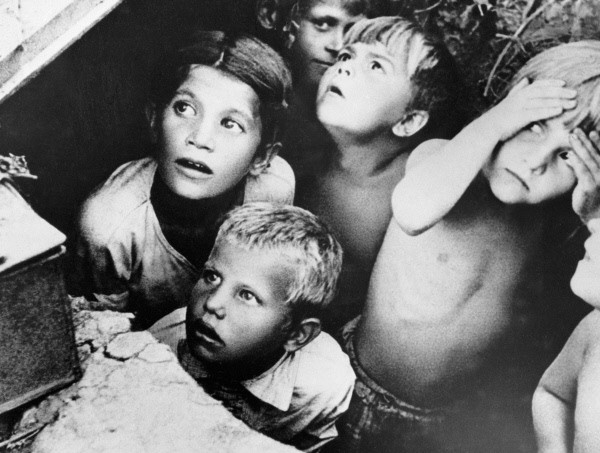
German troops captured the Baltic cities of Kaunas and Vilnius. German Armeegruppe Nord moved into Lithuania and Byelorussia, seizing Vilnius and Kaunas. The German advance in Russia continued. At Brest-Litovsk the Soviet garrison is assaulted by forces of German 4th Army of Army Group Center.
Vilnius and Kaunas had already been liberated by Lithuanian freedom fighters on June 23, a declaration of the restoration of the independence of Lithuania being broadcast over the radio the same day. A national government operated from June 24 to August 5 without German recognition.
Operation Barbarossa continues rolling eastward and northward on 24 June 1941. The day features various futile Soviet counterattacks that show convincingly that the Soviets do not even know where the advancing Germans are from one hour to the next. The Germans enter Kaunas (10th Army) and Vilnius (Panzer Group 3).
Army Group North beats off a powerful Soviet counterattack against 4th Panzer Group at the Battle of Raseiniai. Soviet Lieutenant-General Vasily Ivanovich Morozov takes his 11th Army back to Kaunas on the Niemen. The Soviet 8th Army also is taking a beating.
In Army Group Center, Soviet General Dmitry Pavlov orders his 6th and 11th Mechanized Corps and the 6th Cavalry Corps to attack toward Grodno to stop the panzers. The German 4th Army besieges Soviet defenders at Brest-Litovsk.
The German 3rd Panzer Group, however, already has passed through Grodno and is in Vilnius. Instead, the Soviets hit the following German infantry of V Army Corps of the German 9th Army, supported by Luftwaffe air attacks. This accomplishes nothing.
Army Group South, led by 11th and 16th Panzer Divisions, begins the day 40 miles inside of Soviet territory. The 13th and 14th Panzer Divisions have reached the Styr River. German 17th Army takes Nemirov.
The Soviets under General Ivan Bagramyan attempt a counterattack at 04:00 today as part of the Battle of Brody but make no progress. The Soviet 22nd Mechanized Corps attacks toward Voinitsa, but the Germans make quick work of their tanks. Soviet armor and infantry are widely separated and it takes time to assemble them into a cohesive fighting force. The Soviets have powerful forces in the vicinity, but almost all are in the process of forming up today and make no attacks.
Ambassador Bergen reports to Berlin that the Vatican has welcomed the new turn of events and that a Vatican spokesman shortly after the invasion had told him that the alignment of atheistic Russia on the side of the Western democracies had robbed the latter of all justification to speak of a crusade for Christianity.
Moscow: the Headquarters of the Red Air Force reported concerning the previous days operations: “Our aerial forces have fought successfully to protect our towns and military installations. They have fought in the air and supported the counterattacks of the ground troops. In the course of the day 51 enemy aircraft were destroyed by our fighter planes and ground defenses. One enemy plane was forced to land at an airfield near Minsk.”
The German News Bureau announced: “An attempt by the Soviet air force on Tuesday morning to fly weak forces into East Prussia, has been frustrated by the German air defense. The enemy aircraft encountered such accurate flak fire that they were forced to turn around at once and to jettison their bombs over open country.”
The German News Office announced: “Since early Monday morning the Luftwaffe has continued its successful attacks on Soviet military airfields. Large numbers of Russian aircraft were destroyed on the first day of battle, and we can now report that a great many more aircraft have been shot down on the same day.”
Hitler arrives at the Wolf’s Lair for the first time.
The first mass executions by the Germans are carried out overnight in the Lithuanian city of Gargždai. The entire Jewish adult male population (200 men) is exterminated. The remaining 300 women with children would be killed on September 14 and 16, 1941. The killings were perpetrated by Einsatzgruppe A under the command of SS Brigadeführer Walter Stahlecker, and documented in the Jäger report.
Moscow is bombed by 100 aircraft this night.
The German embassy staff are taken to Kostroma-on-Volga where they are billeted in a workers’ rest home for five days. Before being taken across Russia to Leninakan, near the Armenian-Turkish border, and kept their while the exact procedure for the exchange of exchange of personnel is being worked out by the protecting powers and Turkey, the country of transit.
Soviet Air Force Directorate chief Pavel Rychagov, as well as his wife Maria Nesterenko, a famed aviatrix, were arrested during the purge of the Soviet Air Force.
Soviet Deputy Defense Commissar General Kirill Meretskov was arrested by agents of the 3rd NKO Directorate. He would later be cleared of suspicion in September 1941 and was given front line command once again.
Ivan Bagramyan attempted to launch a counterattack against German advances in Ukraine, but it would fail to achieve much due to the unprepared state of his troops.
In Russia a Council of Evacuation was set up with emergency powers to oversee the evacuation of machinery, skilled workers and food stuffs on a large scale, away from the German advance.
Recruitment of volunteers willing to fight with Germany on the eastern front begins in Spain and Denmark.
Large demonstrations began in Madrid, Spain in support of the German invasion of the Soviet Union; demonstrations soon spread to other parts of Spain.
Hitler approves the use of a special “volunteer” Spanish formation on the Eastern Front. This becomes the famous Spanish Blue Division.
Hungary broke relations with the Soviet Union.
While not yet officially at war, the Finns continue laying mines in the Baltic. Finnish troops occupy the Aaland Islands.
The Leningrad (St. Petersburg) Military District is renamed Soviet Northern Front. Its commander is General Popov. General Aleksei Antonov is appointed Chief of Staff, Southwestern Front.
The British Foreign Secretary, Anthony Eden, announces an Anglo-Soviet mutual aid agreement.
The German E-Boat S.35 discovered the Soviet submarine S-3 (N. A. Kostromityev) off Steinort, Germany and fired several torpedoes which all missed. S-3 was then sunk by depth charges and hand grenades.
The Soviets take the German embassy staff from Moscow south to Kostroma-on-Volga and house them in a worker’s settlement. Their destination is Turkey once arrangements are made for the safe conduct of Soviet embassy personnel from Berlin.
At some point during this week — details are very sketchy — Soviet Premier Joseph Stalin attempts to broker a peace deal with Hitler through a Bulgarian diplomat, Ivan Stamenov. Foreign Minister Molotov has Lavrentiy Beria arrange this by using one of Beria’s subordinates, NKVD officer Pavel Sudoplatov, who has a “casual” lunch at a Moscow restaurant with the diplomat. Sudoplatov explains to Stamenov what to say to Hitler. Stalin is willing to offer huge concessions for peace, including Ukraine and all of the areas granted to him in the “secret protocol” to the 23 August 1939 Molotov/Ribbentrop Pact in the Baltic States. Stalin does, though, demand to know why Hitler invaded the USSR.
Hitler turns Stalin down flat and will not even consider the offer. This is one of Hitler’s biggest mistakes. These revelations were hidden for many years but came to light during the period after Stalin died from natural causes in the 1950s. There are few other details of this little-known incident, but there is no reason to doubt that it happened. This peace offer was classified as treason and was one of the charges used to condemn Beria to death. The others involved — including the Bulgarian Stamenov diplomat used as the go-between — submitted affidavits confirming the incident. Sudoplatov confessed to it under interrogation and also was convicted of treason, serving 15 full years in prison (yes, there are many questions about the validity of such “proof,” but there was a lot of corroboration). Molotov was never tried for treason despite his deep role in the incident, but gradually fell out of favor, lost his positions one by one, and by 1962 was a “non-person” in the Soviet bureaucracy.
The Battle of Merdjayoun in Lebanon ended in Allied victory. The Australian 25th Infantry Brigade recaptures Merdjayoun early today.
The Australian 2/14 Battalion tries to advance north from Jezzine. They are stopped cold in the hills north of town by Senegalese defenders who have excellent defensive positions.
The Vichy French make a stand at Jebel Mazar, a tall (1,600 feet above the road) hill on the Damascus/Beirut road. They stop the British 16th Brigade advancing west from Damascus. French observers on the Jebel call in accurate Counter-Battery Fire.
The Vichy French garrison at Palmyra continues its successful defense of the town and airfield. Arab auxiliaries, led by Arab Nationalist leader Fawzi el Kawakji, ambush a British supply convoy in conjunction with French armored cars.
New Zealand light cruiser HMNZS Leander and destroyers Hasty and Jaguar park off the coast north of Beirut and shell Vichy French positions before dawn.
The British forces at Alexandria have been conducting nightly supply missions to the embattled Australian garrison at Tobruk without too much trouble. Tonight, however, the Luftwaffe (Junkers Ju 87 aircraft of II Staffeln, Sturzkampfgeschwader 2, Luftwaffe) is waiting for the “Tobruk Express” about 20 miles (37 km) northeast of Tobruk. During the incessant attacks:
The Luftwaffe bombs and badly damages tanker Pass of Balmaha, which its crew abandons.
The Luftwaffe bombs and sinks sloop HMS Auckland, with 34 deaths, 164 survivors (two die later), and 8 wounded.
The Pass of Balmaha is taken in tow by destroyer HMAS Waterhen and brought to Tobruk, where its fuel is unloaded. It is then taken back to Alexandria.
The Luftwaffe drops leaflets to the besieged Australians in Tobruk which read:
AUSSIES
After Crete disaster Anzac troops are now being ruthlessly sacrificed by England in Tobruch and Syria.
Turkey has concluded pact of friendship with Germany. England will shortly be driven out of the Mediterranean.
Offensive to relieve you totally smashed.
YOU CANNOT ESCAPE
Our dive bombers are waiting to sink your transports. Think of your future and your people at home. Come forward – show white flags and you will be out of danger!
SURRENDER!
British House of Commons voted for the second £1,000,000,000 war credit of the year as war expenditure now exceeded £10,250,000 per day.
Before dawn, Royal Navy submarine HMS Utmost lands some Commandos for a mission to destroy a railway line in Italy. The railway is used to bring supplies for shipments to North Africa. Two Commandos, Lt D R Schofield, Royal Fusiliers, and Lance Corporal F C Morgan, row ashore and place charges on the railway line. Then, they return to the waiting submarine. Unfortunately for their mission, their attempt to destroy a passing train fails when the charges fail to explode. Undeterred, the two men row ashore again and fix them. This time, they just blow up the tracks and return to the submarine without incident.
Scirè launched manned torpedoes into Grand Harbour, Malta; they failed to damage any enemy vessels.
British cargo ship Brockley Hill was torpedoed and sunk off Cape Farewell, Greenland by German submarine U-651.
RAF Bomber Command, Day of 24 June 1941
18 Blenheims on a Circus operation to Comines power-station. No Blenheims lost.
RAF Bomber Command, Night of 24/25 June 1941
Cologne
32 Whitleys and 22 Wellingtons; the main city passenger station was the aiming point. No aircraft lost. Cologne reports only 11 bombs, 5 houses damaged, no casualties.
Kiel
25 Hampdens and 23 Wellingtons to dock areas. 1 Wellington lost. Kiel reports only a light mid with 11 people injured.
Düsseldorf
23 Wellingtons and 8 Manchesters, no losses.
Minor Operations: 3 Wellingtons to Emden, 1 to Boulogne and 2 O.T.U. sorties. 1 Wellington was lost from the Emden raid and the one sent to Boulogne was shot down into the sea off Harwich by ‘friendly’ anti-aircraft fire.
The Red Air Force attempts a raid against East Prussia. It accomplishes little. According to the German News Bureau:
“An attempt by the Soviet air force on Tuesday morning to fly weak forces into East Prussia, has been frustrated by the German air defense. The enemy aircraft encountered such accurate flak fire that they were forced to turn around at once and to jettison their bombs over open country.”
The Luftwaffe continues its own raids on Soviet airfields, destroying many planes on the ground. A large fraction of Soviet planes are obsolete, so their destruction is fairly routine for the experienced German pilots. The Luftwaffe bombs Moscow with 100 bombers after dark.
The Luftwaffe raids Benghazi and Tripoli.
U-203, commanded by Kapitänleutnant Rolf Mützelburg, attacked convoys HX.133 and OB.336.
Norwegian steamer Soløy (4402grt) was sunk in 44-39N, 39-43W from convoy HX.133. At 0331 hours on 24 June 1941, U-203 fired a spread of two torpedoes at a ship of 15.000 grt in convoy HX.133 during a surface attack by night, but the first did not detonate and the second missed the intended target and struck another ship in the convoy. Two minutes later, a second spread of two torpedoes was fired and one detonation was heard, but no observations could be made because the U-boat had to crash dive. The only ship hit during the attack was the Soløy. The Soløy (Master Arne H. Sørensen) was struck on the port side in the after part of #4 hold and received a leak in the tunnel. It was not possible for the first engineer to close the tunnel door, so the ship started to sink and was gone after 15 minutes. While the crew successfully launched the port lifeboat, the other boat on starboard had to be cut loose because a seaman got his hand jammed during the lowering. The boat broke apart after the fall into the sea and its occupants were thrown into the water. However, all men survived and were later picked up by Traveller and landed at Liverpool on 3 July. The 4,402-ton Soløy was carrying wheat and was headed for Hull, England.
Eight hours later, British steamer Kinross (4956grt) was sunk by U-203 in 55-23N, 38-49W from convoy OB.336. At 1200 and 1205 hours on 24 June 1941, U-203 attacked the convoy OB.336 southeast of Cape Farewell and reported two ships sunk. In fact, only the Kinross (Master James Robson Reed) was hit and sunk. The master and 36 crew members were picked up by HMCS Orillia (K 119) (T/LtCdr W.E.S. Briggs, RCNR) and landed at Reykjavik. The 4,956-ton Kinross was carrying ballast and was headed for Father Point, Canada.
U-371, commanded by Kapitänleutnant Heinrich Driver, sank Norwegian steamer Vigrid (4765grt), straggling from convoy HX.133, in 55N, 41W. At 1132 and 1133 hours on 24 June 1941, U-371 fired two torpedoes at the Vigrid (Master Harald Holst) about 400 miles southeast of Cape Farewell and hit her between #1 and #2 hold and #4 hold, causing her to sink rapidly after the second hit. The ship straggled about 40 miles behind the convoy HX.133 after engine troubles in the evening of 23 June. The master, 33 crew members, three gunners and ten passengers (American Red Cross nurses) abandoned ship in four lifeboats of which two set sail to Greenland while the others set course for Iceland. One of the latter boats was never heard of again, while the other was located by HMS Keppel (D 84) (Cdr A.M. Sheffield, RN) in 60°38N/23°15W on 13 July and the surviving two officers, three crewmen and two passengers were brought to a hospital in Londonderry on 17 July. Meanwhile, the two boats sailing for Greenland stayed together but came into storms and heavy seas and one boat disappeared one night, while the other was found by USS Charles F. Hughes (DD 428) on 5 July and the master, two officers, six crewmen, one gunner and four passengers were landed at Reykjavik on 8 July after a fruitless search for the other lifeboat. The 4,765-ton Vigrid was carrying general cargo, including spelter, copper, iron, and steel and was headed for Manchester, England.
U-651, commanded by Peter Lohmeyer, sank British steamer Brockley Hill (5297grt), straggling from convoy HX.133, in 58-30N, 38-20W. At 2106 hours on 24 June 1941 the Brockley Hill (Master James Howard Williams) in convoy HX.133 was torpedoed and sunk by U-651 southeast of Cape Farewell. The master, 37 crew members and four gunners were picked up by the Saugor and landed at Loch Ewe. The 5,297-ton Brockley Hill was carrying grain and was headed for London, England.
Heavy cruiser HMS Suffolk and destroyer HMS Echo arrived at Iceland from Denmark Straits patrol.
Fast minelayer HMS Manxman arrived at Scapa Flow to work up.
Anti-aircraft ship HMS Alynbank departed Scapa Flow at 2300 and met convoy WN.44 in Pentland Firth. At noon on the 25th, the ship transferred to convoy EC.37 off Buchan Ness. Sloop HMS Black Swan departed Scapa Flow at 1300/25th to provide additional protection for the convoy. In North Channel, the sloop was detached and proceeded to Belfast to join the Western Approaches following working up at Scapa Flow. The anti-aircraft ship transferred to convoy WN.45 at 0500/26th and provided cover to Methil where they arrived at noon on the 27th.
British steamer Levenwood (803grt) was damaged by German bombing off Tees Bay. The steamer arrived at Hartlepool in tow on the 25th.
Soviet submarines S-1, M-71, M-80, Ronis (ex-Latvian), and Spidola (ex-Latvian) were scuttled at Libau.
New Zealand Division light cruiser HMS Leander and destroyers HMS Hasty and HMS Jaguar shelled the Syrian coast north of Beirut at dawn on the 24th. Minesweeper HMS Harrow swept the coast off Sidon.
Corvette HMS Peony was sailed to Haifa and corvette HMS Hyacinth to Famagusta from Alexandria.
The British Tobruk convoy was attacked by aircraft. Tanker Pass of Balmaha was damaged by bombing and abandoned. Sloop HMS Auckland (Cdr M.S. Thomas DSO) was sunk in 32-15N, 24-30E at 1530. LT (E) C.L. Meadley, thirty two ratings and the NAAFI manager were killed on the sloop. Three ratings died of wounds. Surgeon Lt C.J. Robarts and seven ratings were wounded. Sloop HMAS Parramatta picked up the one hundred and sixty two survivors, including Cdr Thomas, Lt D.G.D. Hall-Wright, Lt A.P. Culmer, Lt J.F. House, Surgeon Lt C.J. Robarts, and T/A/Sub Lt P. Whitehead RNVR and proceeded to Alexandria, arriving on the 25th. Australian destroyers HMAS Vendetta and HMAS Waterhen arrived to assist. They picked up the survivors from Auckland. Destroyer Waterhen took the Pass of Balmaha in tow and proceeded to Tobruk, screened by destroyer Vendetta. The tanker was unloaded on the 28th and escorted from Tobruk by sloop Parramatta and anti-submarine whaler HMS Southern Maid.
Light cruiser HMS Neptune arrived at Simonstown.
British seaplane carrier HMS Albatross was docked for refitting at Simonstown. The refitting was completed on 4 August.
Convoy OG.66 departed Liverpool, escorted by destroyers HMS Bath and HMS Walker, sloop HMS Scarborough, and ocean boarding vessel HMS Malvernian. On the 25th, destroyer HMS Vanoc and anti-submarine trawlers HMS Cordella, HMS Fandango, HMS Morris Dance, HMS Norse, and HMS Sarabande joined the convoy. Corvette HMS Hydrangea joined the convoy on the 26th. The destroyers and the corvette were detached on the 29th. The ocean boarding vessel left the convoy on the 30th. On 3 July, destroyers HMS Faulknor, HMS Fearless, HMS Forester, HMS Lance, and HMS Legion joined the convoy. On 4 July, corvette HMS Coreopsis and anti-submarine trawlers HMS Lady Hogarth and HMS Lady Shirley joined the convoy. Destroyers HMS Eridge and HMS Farndale joined on 6 July. Destroyers Legion and Lance were detached on 3 July, destroyer Faulknor on 5 July, destroyers Fearless and Forester on 6 July, and arrived at Gibraltar on 8 July with sloop Scarborough and anti-submarine trawlers Fandango, Morris Dance, Sarabande, Codrelis, Norse, and local escorts.
Convoy HG.66 departed Gibraltar escorted by destroyers HMS Farndale and HMS Wishart, sloop HMS Folkestone, corvette HMS Azalea, Dutch submarine HNLMS O.21, anti-submarine trawler HMS Stella Carina, and three motor launches as additional local escort. The trawler was detached later that day. Destroyer Wishart was detached on the 27th. Destroyer Farndale was detached on the 30th. Submarine O.21 was detached on 1 July. On 4 July, the convoy was met by destroyers ORP Garland, HMS Maori, HMS Sardonyx, and HMS Westcott and on 5 July by destroyer HNoMS ST Albans and corvettes HMS Freesia and HMS Myositis. Sloop Folkestone was detached on 8 July. The convoy arrived at Liverpool on 9 July.
In Washington, President Roosevelt said at his press conference today that Russia would be given all possible American aid. His callers included Emil Schram, Chief of the Reconstruction Finance Corporation, and John M. Carmody, Federal Works Administrator.
The Senate was in recess. The Commerce Committee opened hearings on the bill authorizing a shipping priorities system.
The House rejected a Senate change in the Federal Housing Administration extension bill; received the President’s veto of the bill creating a Navy budget officer, and adjourned at 4:35 PM until noon tomorrow. The Rules Committee sent the May anti-strike bill to the floor for consideration probably Friday; the Naval Affairs Committee approved the Vinson anti-strike bill; the Rivers and Harbors Committee heard opposition to the St. Lawrence Seaway, a labor subcommittee opened hearing on resolutions for creation of post-war economic conditions.
President Roosevelt said at a press conference, “Of course we are going to give all the aid we possibly can to Russia..” U.S. President Franklin D. Roosevelt announced at a press conference that he intended to send aid to the USSR in response to the German invasion of the Soviet Union. Roosevelt didn’t answer the question of whether the aid would be under the Lend-Lease arrangements.
Roosevelt unfroze about $40 million in Soviet assets. Carrying forward the policy of favoring Russia against Germany, President Roosevelt promised all possible American help for the Soviets today and released “frozen” Russian assets to permit the purchase of needed materials in the United States. The president told his press conference that Russia had not yet submitted any list of items needed by the red forces to hold back the German onslaught and until such a request came, he did not have the foggiest idea of what the United States would supply. He said also that he did not know whether aid would be given under the lease-lend act or through Russian purchases and he declined to answer a direct question whether he deemed the defense of Russia essential to the defense of the United States.
German Chargé d’Affaires Hans Thomsen replied to U.S. Undersecretary of State Sumner Welles’s June 20 note concerning the Robin Moor sinking. “I have the honor to advise you,” Thomsen wrote, “that I do not find myself in a position to pass on…the text of a message to Congress from the President of the United States for the information of my government”
Senator Bennett C. Clark, Democrat of Missouri, declared he was opposed to aiding Russia and was convinced more than ever by the latest war developments that America should keep out of Europe’s conflicts in a talk last night before 2,500 members of the Brooklyn Chapter of the America First Committee.
Full aid under the lease-lend act to the Soviets in their attempt to stem the Nazi invasion was urged yesterday by The Daily Worker, Communist newspaper, in a front-page editorial. [Lol]
Fifteen days after they moved in, pushing C.I.O. pickets aside, troops were withdrawn today from the big North American Aviation plant in Inglewood, California. Lieut.-Col. Charles E. Branshaw, who directed the army’s restoration of production on $196,000,000 in orders for the United States and Great Britain, remains in charge, however. The 1,500 troops, composed chiefly of the 15th Infantry from Fort Lewis, Wash., moved to bivouac quarters on nearby Municipal airport. There was no indication when they would leave the area.
The government sought in vain today for substantial numbers of machinists to man the complex lathes and drill presses and other power tools with which ships are built. A.F.L. and C.I.O. machinists, on strike since May 10 in 11 Bay area shipbuilding and repair yards, disregarded a navy request that they return to work on $500,000,000 worth of defense orders pending negotiations. The navy set up registration desks today to enlist all possible machinists under federal civil service and thus fill the jobs of the 1,700 strikers. But the results did not begin to fill the needs. Possibly 60 men applied at the vast Bethlehem shipbuilding plant, which normally hires 900 machinists. Of these only nine were accepted under civil service immediately. About 20 applied at the Moore drydock on the East bay. Most of those who applied for civil service rating said they were non-union men; union officials said all were.
The United Mine Workers Union policy committee today directed 150,000 miners in the Southern Appalachian bituminous coal fields to cease work as of July 8 unless the Harlan County (Kentucky) Coal Operators Association agrees before that date to accept the collective bargaining contract which the twelve other groups of Southern operators now are ready to sign.
Admitting the receipt of large sum of money from a subsidiary of the Soviet Commissariat for Foreign Trade, defense witnesses in the trial of the Bookniga Corporation for failing to register as a propaganda agent, introduced documents and contracts today tending to show that these payments were all of a business nature, instead of subsidies which government witnesses had indicated.
Admiral Husband E. Kimmel, commander-in-chief of the U. S. fleet, tonight left San Francisco by plane to rejoin his flagship USS Pennsylvania with the main battle fleet in Hawaiian waters. Admiral Kimmel boarded the Pan-American Philippine clipper after deploring any action interfering with the production of naval ships and said “the interest of America must every time come first.” He reiterated a statement he made yesterday in San Diego that the United States may be at war “at any moment.”
Joseph Kennedy Jr. enlists in the U.S. Naval Reserve.
The U.S. Federal Communications Commission (FCC) grants 1st commercial TV licenses to New York City experimental stations W2XBS, as WNBT (NBC), and W2XAB, as WCBW (CBS).
Boeing breaks ground for Plant II at the Stearman facility in Wichita, Kansas, where B-29s will be built.
Major League Baseball:
The third-place Red Sox pulled within three games of first place today by slaughtering three of the pace-setting Indians’ pitchers for eighteen hits, including three homers, to gain a 13–2 triumph before a crowd of 8,000 that included Babe Ruth. Cleveland shortstop Lou Boudreau pulls off a hidden ball trick on Boston’s Skeeter Newsome in the 2nd inning, but the Sox shrug it off to win.
The Giants came up with another of their spectacular rebounds today and behind Cliff Melton’s highly commendable left-handed pitching flattened the Cubs, 3–1, in the second contest of a three-game series. The Cubs’ Hank Leiber is beaned on the head by an errant Melton pitch in the eighth and is taken to the hospital but is said to not be seriously injured.
Two ninth-inning errors robbed Bucky Walters of a shut-out today as, with five-hit hurling, he pitched and batted the Reds to a 5–1 victory over their “jinx” opponents, the Philadelphia Phillies.
In baseball, the New York Yankees begin a three game series against the St. Louis Browns in Yankee Stadium, New York City. Joe DiMaggio is hitless until the 8th inning when he singles against Browns pitcher Bob Muncrief thus extending DiMaggio’s hitting streak to 36-games. Browns’ manager Luke Sewell asks Muncrief why he didn’t walk DiMaggio in the eighth to end the streak. Said Muncrief: “That wouldn’t have been fair, to him or to me. Hell, he’s the greatest ballplayer I’ve ever seen.” The Yankees won the game 9-1, as Left Gomez spins a five-hitter, and had a shutout until the last inning. Red Rolfe, Tommy Henrich, and Joe Gordon homer for the Yankees.
Singles by Rudy York and Bruce Campbell, followed by Pinky Higgins’s long fly that scored York, gave Detroit a run in the ninth inning tonight and a 2–1 victory over the Athletics. Philadelphia tied the score in the eighth on Wally Moses’s single and a three-bagger by Bob Johnson.
Making his first start in six weeks, Brooklyn’s lanky Curt Davis tonight made it a good one by shutting out the Pirates with five widely scattered singles as the Dodgers won, 8–0, for their fourth straight triumph.
The Cardinals were hotter than the weather today — 90 degrees and a broiling sun — as they smothered the Braves, 13–1. Lean Lon Warneke, defeated his last two times out, limited Boston to four hits. One was Max West’s home run in the second. It was Warneke’s eighth victory. Johnny Hopp smashed his second home run of the year in the big sixth, scoring two runners ahead of him. His circuit blow and West’s went to the top of the right-field pavilion.
Washington climbed out of the American League cellar by defeating the White Sox today as Stout Dutch Leonard limited Chicago to eight hits in capturing a 6–3 decision. Washington nailed Thornton Lee for ten hits and was aided by four White Sox errors.
Cleveland Indians 2, Boston Red Sox 13
New York Giants 3, Chicago Cubs 1
Philadelphia Phillies 1, Cincinnati Reds 5
St. Louis Browns 1, New York Yankees 9
Detroit Tigers 2, Philadelphia Athletics 1
Brooklyn Dodgers 8, Pittsburgh Pirates 0
Boston Braves 1, St. Louis Cardinals 13
Chicago White Sox 3, Washington Senators 6
German raider Kormoran, disguised as Japanese freighter Kinka Maru, approaches Madras to lay mines. However, the Germans notice another ship shadowing them. They take this to be a British auxiliary cruiser (it apparently is AMC Canton). However, the ship eventually disappears. Kormoran Captain Detmers decides not to take any chances and cancels the minelaying mission.
The USAAF 3rd and 20th Pursuit Squadrons on Luzon, Philippine Islands, shifted to Clark Airfield due to flooding at Nichols airfield, 17th to Iba for gunnery qualification. SS President Pierce arrives with 96 more pilots.
Japanese bombers attacked Chungking (Chongqing), China, damaging the British Consulate among other buildings.
Japan asserted pressure on France for Indochina.
Meeting in a tense atmosphere with all members present, the Cabinet today debated the political, military and economic issues created for Japan by the Russian — German hostilities but failed to produce the anticipated statement clarifying Japan’s policy.
Koh Ishii, Japanese cabinet information bureau spokesman, gave an affirmative answer today when asked whether Japan intended to fulfill her obligations under both the Berlin — Rome-Tokyo alliance and her neutrality pact with Soviet Russia. “Yes, of course,” Ishii declared, when the query was made at a foreign press conference. He declined further comment, but indicated a statement of Japanese policy in regard to the situation created by the outbreak of war between Germany and Russia would be issued in a few days.
Captured whaler “Adjutant,” which now has a German prize crew, arrives in New Zealand waters for minelaying operations.
New Zealand Division light cruiser HMS Achilles departed Wellington escorting British liner Aquitania (44,786grt) to Bass Strait. On the 30th, the light cruiser joined liners Queen Mary (81,235grt), and Queen Elizabeth (83,673grt) to form convoy US.11A.
Dow Jones Industrial Average: 123.24 (-0.73)
Born:
Charles Whitman, American mass murderer (He becomes the infamous Austin “Texas Tower Sniper”), in Lake Worth, Florida (d. 1966).
Art Heyman, NBA and ABA shooting guard and small forward (ABA Champions-Pipers, 1968; ABA All-stars, 1969; NBA: New York Knicks, Cincinnati Royals, Philadelphia 76ers; ABA: New Jersey Americans, Pittsburgh-Minnesota Pipers, Miami Floridians), in New York, New York.
Erkin Koray, Turkish singer-songwriter, in Kadıköy, Istanbul, Turkey (d. 2023).
Naval Construction:
The U.S. Navy YMS-1-class auxiliary motor minesweeper USS YMS-46 is laid down by Wheeler Shipbuilding Corp. (Whitestone, Long Island, New York, U.S.A.).
The U.S. Navy Auk-class minesweeper USS Sheldrake (AM-62) is laid down by the General Engineering and Dry Dock Co. (Alameda, California, U.S.A.).
The Nihon Kaigun (Imperial Japanese Navy) aircraft carrier HIJMS Hiyo (飛鷹; “Flying Hawk”) [laid down as ocean liner Izumo Maru] is launched by Kawasaki, (Kobe, Hyōgo Prefecture, Japan).
The Royal Navy Fairmile B-class motor launch HMS ML 178 is commissioned.
The Royal Navy Fairmile B-class motor launch HMS ML 203 is commissioned.
The U.S. Navy 77-foot Elco patrol motor torpedo boat USS PT-22 is commissioned.

