Poland’s Prime Minister Piotr Jaroszewicz announced that effective June 27, the nation’s Communist government would end its five-year-old policy of food price freeze, implemented after the events of December 1970. Jaroszewicz informed a gathering at the Sejm, that on Sunday the price of sugar was to double overnight, along with a 69% increase in the price of meat and 30% for butter and cheese. In order to prevent hoarding, the Prime Minister said, state stores would limit sales on Friday and Saturday, and cash compensations to wage earners, students, pensioners and low-income groups.
Sweden outlined a proposal for an informal group of experts to study a possible international system for detecting underground nuclear blasts. The plan, aimed at speeding agreement on a total ban on underground tests, was proposed by Swedish delegate Ulf Ericsson at a session of the 30-nation Geneva Disarmament Conference. Ericsson said the group should consider a global network of seismological stations for detecting underground explosions.
French President Valery Giscard d’Estaing said at a luncheon in London that France and Britain are building a new “entente” based on economic cooperation. The French president’s use of the word “entente” was viewed as an allusion to the “entente cordiale” forged between the two countries in 1903 when British King Edward VII made a state visit to Paris and was seen as strengthening political ties that already had been improved during his present state visit.
The District Court of Zagreb today sentenced five Croatian separatists to death for planting a time bomb in 1975, then commuted the punishment to 20 years’ imprisonment for each, the official Yugoslav press agency Tanyug reported.
Heavy fighting continued today around a besieged Palestinian refugee camp on the southeastern outskirts of Beirut, where several fires burned out of control. The Beirut radio, which is controlled by leftists, said that Palestinian guerrillas had expanded their defense perimeters outside the Tell Zaatari camp. which Lebanese Christian militiamen brought under siege two days ago. There were conflicting reports about fighting at a nearby mostly Christian Palestinian camp, Jisr el‐Pasha. A spokesman for the right‐wing National Liberal Party of Interior, Minister Camille Chamoun said the camp had “for all military intents and purposes fallen. But this was denied by Palestinian and leftist spokesmen. Less than four miles southwest of the fighting, meanwhile, commercial jets flew in and out of the Beirut airport for the second day.
Egypt and Syria took relatively cautious steps today toward political and military cooperation. Ending a two‐day conference here that was designed to smooth over bitter disputes between the two nations, ranking officials of both countries expressed satisfaction that their talks had been friendly and fruitful. But the conference communiqué made it clear, by its omissions and its reserved language. that the two countries had failed to resolve two of their major disputes: Syria’s objection to the Egyptian‐Israeli Sinai agreement of last fall and the recent Syrian intervention in the Lebanese civil war. These problems were the principal ones that moved Saudi Arabia and Kuwait to press the Egyptians and the Syrians to have a conference. which involved seven hours ,of talks at the Nasseria Palace. A previously scheduled meeting was postponed.
The first session of the National Assembly of reunified Vietnam opened today after 30 years of war and separation. Of the Assembly’s 492 seats, 249 were filled by North Vietnamese and 243 by South Vietnamese. Hanoi was proclaimed to be the capital of the united country, Reuters reported from Singapore, monitoring the Hanoi radio Friday. Present for the ceremony were practically all members of the steering committee of the Vietnamese Workers Party and the main political and military leaders of the North and South. The convening of the Assembly was the first main legal step to cement reunification of North and South Vietnam. In a few days, Vietnam is expected to have a new cabinet and a new constitution.
Chinese authorities correctly forecast two strong earthquakes in Yunnan province last month, enabling tens of thousands of people to be moved to safe areas, the New China News Agency reported. Seismological departments gave warnings 8 minutes before the first shock, NCNA said. Precautionary measures greatly reduced casualties and loses, the news agency said. The quakes occurred May 29.
In South Korea, about a dozen Christian activists have been secretly arrested over the last few weeks in Seoul, allegedly on suspicion of pro-Communist activities, sources reported today.
Manila was formally restored to its status at the capital of the Philippines by Ferdinand Marcos with the issuance of Presidential Decree 940, replacing nearby Quezon City, which had been made the capital on October 12, 1949.
The uncertainties of big power rivalry and concern about the posture of Communist Indochina were at the forefront of the opening of the ninth annual meeting of the Association of Southeast Asian Nations in Manila. Urging concrete steps toward establishing a zone of peace, freedom and neutrality in the region, Philippine President Ferdinand E. Marcos called on the organization’s neighbors to accept the group’s call for closer cooperation in the interest of peace and prosperity.
Three prison guards and an inmate, who was being allowed to attend a family baptism, were machine-gunned to death as they walked through the gates of the jail at Culiacan, Mexico, police said. They said the shooting apparently was related to gang warfare among drug-traffickers. A woman passerby also was wounded, police said.
ABC News commentator Howard K. Smith revealed that U.S. President Lyndon Johnson had told him, during a White House visit, that the assassination of John F. Kennedy had been instigated by Cuban premier Fidel Castro. Smith wrote a thorough note of the conversation after leaving the White House, and recalled that Johnson had said “I’ll tell you something that will rock you. Kennedy was trying to get Castro, but Castro got to him first.” Smith told a television audience, “I was rocked all right. I begged for details. He refused, saying ‘it will all come out one day.’” Smith added that “Mr. Johnson often dealt in blarney; and what he told me may have been that.” He added that he had decided to make the conversation public because the U.S. Congress had recently discussed making its own investigation of the assassination.
The first break in a Bolivian miners’ strike occurred, when 3,000 tin miners agreed to return to work. The leaders of miners at Huanuni and Viloco signed an agreement with Labor Minister Mario Vargas Salinas that included withdrawal of troops sent to Huanuni, release of several imprisoned union leaders, return of a radio station occupied by soldiers and a guarantee of no reprisals against strikers.
Argentina’s armed forces, three months after having overthrown President Isabel Martinez de Perón, are in a bitter struggle with left‐wing extremists, many of whom have been killed. Argentine security forces killed 10 leftist guerrillas today in two separate gun battles, authorities said. An army spokesman said three men and two women were killed in a clash with security forces in Bahia Blanca, 425 miles south of Buenos Aires. There were no immediate details. The other incident involved five guerrillas, including one woman, trying to blow up a radio transmitting station in La Plata, outside Buenos Aires. Last night a policeman was killed by gunmen in a suburb of Buenos Aires. He was the 42d policeman slain since the military took full power March 24. Since the start of the year 540 Argentines have been killed in political violence.
The 47 nations of the Organization of African Unity opened a summit meeting that is expected to focus on tightening sanctions against the continent’s two white minority regimes, South Africa and Rhodesia. The annual meeting, Africa’s most important political and economic conference, also is expected to see strong opposition to the United States and Britain over development of a U.S. naval base on Diego Garcia, a strategic island in the Indian Ocean.
Secretary General Kurt Waldheim expressed “regrets” today that Angola’s request for United Nations membership had been blocked yesterday in the Security Council. The statement implied criticism of the United States, which had vetoed the admission of Angola. While pleasing to members of the 47 countries of the African group, the Secretary General’s action evoked surprise among diplomats because he does not usually comment on such developments. He did not speak out in 1975. for example when the United States, in reaction to the denial of membership for South Korea, vetoed admission for North and South Vietnam.
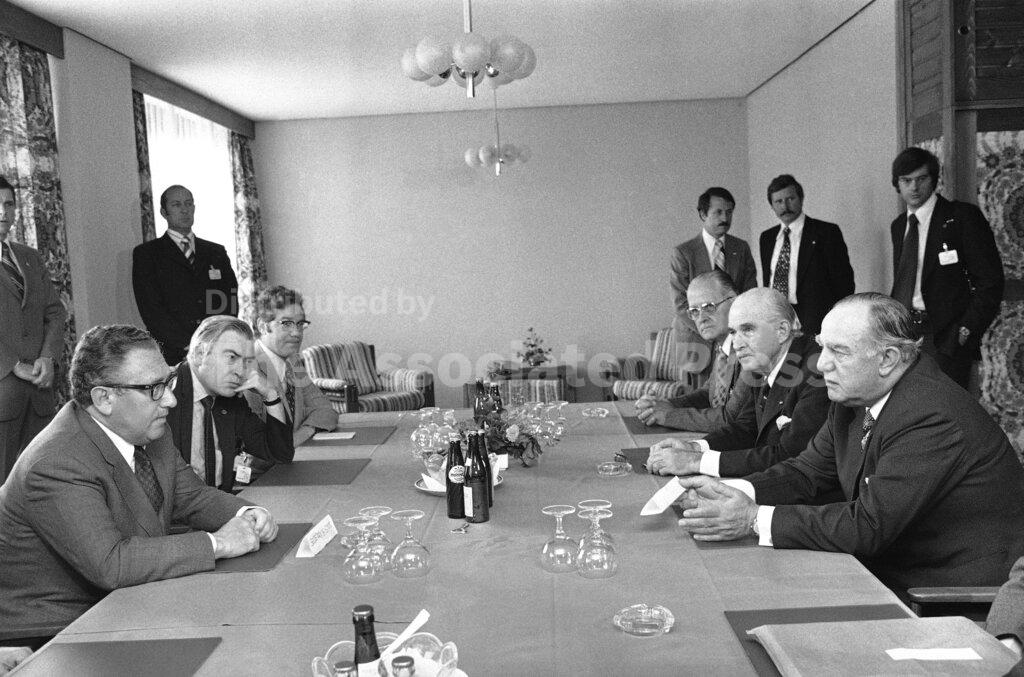
Secretary of State Henry Kissinger said that “a process is in motion” that he hopes will produce a negotiated solution and avoid a racial war in southern Africa. It was apparent at a news conference In Munich, following two days of talks in Bavaria with Prime Minister John Vorster of South Africa, that Mr. Kissinger believed Mr. Vorster was amenable to such a solution and that it could be worked out with South African, West European and American cooperation.
A Principal’s office in Hlengisi Primary, Nyanga, outside Cape Town, South Africa, is burnt down; part of the broader resistance against the oppressive new Bantu Education policy of Afrikaans as a teaching medium in their schools. “We know that those events will he with us for many years, for good or evil, and that we would he truly mad to ignore them or to pretend that they are not what they are,” Sir de Villiers said, referring to the violence in black townships and universities that left 140 dead and 1.128 injured.
Sir de Villiers Graaff, opposition leader in the South African Parliament, said today that the country’s white minority would be “mad” to ignore the black riots of the past week, which he attributed to the Government’s persistence in a system of organized racial discrimination.
The Supreme Court, in what was regarded as a landmark ruling, struck down laws that extended federal minimum wage and maximum hour provisions to 3.4 million state and municipal employees. The Court responded affirmatively to challenges by 21 states, several cities, the National League of Cities and the National Governors Conference, which had opposed a 1974 law that made the extension possible. The opposition contended that the legislation would be prohibitively expensive and would bring the federal government into matters that should he left to states and municipalities.
President Ford would be at least as strong a Republican presidential nominee in the South and West as would Ronald Reagan, according to the latest national survey of voter attitudes by the New York Times and CBS News. But the survey also found that if the election were held today, Jimmy Carter would swamp either Republican by a margin of about 2 to 1.
President Ford proposed legislation that would restrict the power of the courts to order busing as means to desegregate schools. He said that “our domestic tranquility and the future of American education” were at stake, and that the intention of his proposed legislation was to make busing “a last resort.”
The Speaker of the House called him a genius, the Senate majority leader likened him to Franklin Roosevelt, and Congressmen from all over the country gave him a standing ovation. All in all, It was a pleasant and profitable day in the life of Jimmy Carter, the Presidential candidate whose campaign has more often than not focused on the vices rather than the virtues of this old city. But with a first‐ballot nomination now firmly in hand — The Associated Press’s delegate count today recorded that mathematical certainty — the man who has never before held or sought Federal office kept a long and busy schedule of appointments here with his party’s Washington leadership, smiling all the way, trading political quips and solidifying his own role as the Democrats’ new national spokesman and symbol. He was ebulliently confident, quietly conciliatory, jocular arid jovial, and at times even deferential, almost like a small‐town boy on his first visit to Capitol Hill. And when he flew home to Georgia at the end of the day, he seemed immensely pleased.
The Senate voted to raise taxes by $1 billion on wealthy investors and corporations that take advantage of big tax loopholes. It would raise the minimum tax and extend it to an additional 230,000 persons. Under current law, the tax is 10% of specified deductions, which are generally available only to high-income investors and corporations. But $30,000 of preference income plus the person’s regular income tax are exempt from the minimum tax. The plan would increase the tax rate to 15% and allow the taxpayer to exempt either $10,000 or his regular income tax, whichever is higher.
The tax bill being considered by the Senate contains separate provisions that appear likely to provide benefits of thousands of dollars, possibly millions, for relatives of Senator Russell Long, Democrat of Louisiana, chairman of the Senate Finance Committee. Members of Senator Long’s family are beneficiaries of numerous trusts that receive royalties from oil land leases that were acquired years ago by Huey Long, the Senator’s father.
The House approved and sent to the Senate an appropriations bill for $56.2 billion. It included funding for a variety of employment and social programs and possibly invited a veto because, Republicans said, the measure for the Labor and the Health, Education and Welfare departments and related agencies was more than $3.5 billion over President Ford’s budget. The excess could reach $9.6 billion if sums were added later for programs still in the mill, including a big employment program. The bill includes $400 million for public service jobs and nearly $600 million for summer jobs for 1 million youths.
Agents of the Federal Bureau of Investigation kidnapped a radical political figure in an attempt to frighten him and deter his political activities, according to a source close to the bureau. The incident, which is said to have occurred in the last five years, could become part of an intensive Justice Department investigation into the alleged use of other illegal techniques by the F.B.I. — including burglary.
The Supreme Court in a 5 to 4 decision upheld as constitutional municipal zoning regulations that attempt to restrict the number of local motion pictures theaters that show pornographic films. The Court specifically upheld a Detroit law that an “adult theater” may not be within 1,000 feet of any two other “regulated uses,” including not only “adult” theaters but adult bookstores and bars and hotels. The Detroit law had been challenged as unconstitutional by operators of two adult theaters.
The most sophisticated jet fighter in the U.S. arsenal, the Navy’s $20 million F-14, was temporarily grounded because of two crashes that killed four crewmen this week. Officials of Grumman Corp., which makes the plane, had no comment. The Navy has 203 F-14s, packed with complicated electronic equipment. Its swing-wing system is operated by computer. Its Phoenix weapons system is capable of simultaneously tracking and firing missiles toward targets nearly 100 miles away. In more than 65,000 flying hours, 16 planes have been lost, three of them due to engine troubles. Both recent crashes were at Miramar Naval Air Station, California.
Almost all of Long Island’s oceanfront was reopened to swimming but the nation’s largest public beach was kept closed to sweltering New Yorkers because of mysterious sludge and sewage deposits that have plagued the area for more than a week. Nassau County officials said all county beaches except Jones were reopened to swimming after the health department said it was lifting its ban. Earlier, a spokesman said Robert Moses State Park would be reopened to swimming today.
Plans for immediate reforms ordered by House Democrats following the payroll-sex scandal hit a snag in the House Administration Committee. Opponents of the sweeping payroll and expense accounting changes, ordered to be enacted at once by the House Democratic Caucus, began a drive to force action instead by the full House. Backers have contended that the full House would kill some or most of the reforms.
The international race of Tall Ships from Bermuda to Newport, Rhode Island, plagued by light winds, came to a premature end when captains of 12 out of 16 square-riggers agreed to move up the race deadline by two days. A spokesman said the leading square-rigger, the 267-foot Dar Pormoza of Poland, still had 362 miles to go on the 634-mile Bermuda-Newport leg of the transatlantic race. The early end will enable the big ships to motor to Newport in time for events scheduled to commemorate their visit. Even under engine power, however, the big ones won’t arrive until Saturday afternoon. The 80 ships in lesser categories will be permitted to finish the race normally.
Most of Long Island’s beaches were reopened for swimming. But Jones Beach State Park will remain closed because sewage, which had closed the other beaches, had washed up in the last 24 hours, There was some question whether the beaches would qualify for disaster aid.
Interior Secretary Thomas S. Kleppe issued a sharply worded letter to the Nuclear Regulatory Commission criticizing its approval of a nuclear power plant next to the Indian Dunes National Lakeshore in Washington. “I wish to emphasize that the location of this plant is most inappropriate” Kleppe wrote to NCR chairman Marcus A. Rowden. The NRC said it had no immediate comment. Kleppe called the proposed plant an eyesore that would be visible from the national lakeshore area and would create other environmental problems and interfere with management of the lakeshore. Despite its opposition to the project, the interior never took legal action to block it, a fact that weighted strongly in the decision last April by the U.S. Court of Appeals clearing the way for the NCR to issue a construction permit.
The oil industry does not have the technology necessary to remove oil from underneath Arctic ice without unnecessary risk says Mayor Eben Hopson of Alaska’s North Slope Borough. Hopson told the Canadian-U.S. Beaufort Sea Conference that he opposes the planned drilling of 40 exploratory wells 40 miles off the Tuktoyakuk Peninsula by the Domed Petroleum Co. An announced candidate for Alaska’s single seat to the U.S. House of Representatives, Hopson said the time has come for the five Arctic nations to negotiate an Arctic Seabed Treaty “before the oil industry rushes pell-mell out into the Arctic Ocean in a dangerous and irresponsible way.”
Top‐seeded Chris Evert and Arthur Ashe reached the round of 16 at the All‐England Club today, Miss Evert granting a lone game to Lesley Hunt, who took her to three sets in 1974, and Ashe blunting the heavy serves and strokes of Mark Edmundson, the Australian champion, 7–5, 6–2, 8–6, with his best showing at Wimbledon so far.
Major League Baseball:
Rowland Office, who had hit safely in 29 straight games, was stopped on his streak in three official times at bat, but the Braves nevertheless defeated the Expos, 2–1. The Expos scored in the first on a walk to Pepe Mangual and two-out single by Jose Morales, but the Braves came back with their pair in the second on a single by Darrel Chaney, an error on which Jerry Royster was safe and a double by Earl Williams, which drove in both runners, giving the victory to Dick Ruthven. Office hit .408 during the streak, which began on May 23rd, when he was hitting .206. No one with 100 at bats this century has started a batting streak of 27 games or more with a lower average. Dan Uggla, in 2011, will start streaking with a sub-.200 average.
Mark Fidrych, Tigers’ prize rookie righthander, survived one shaky inning and beat the Red Sox, 6–3, for his seventh victory in eight decisions. The Red Sox had their only shot at Fidrych in the fourth when they scored three runs, two on homers by Fred Lynn and Carl Yastrzemski, to take a 3–1 lead. The Tigers, however, came back with three in the sixth on a single by Ben Oglivie, a scoring double by Rusty Staub and homer by Jason Thompson. A triple by Aurelio Rodriguez helped the Tigers add their final pair in the eighth.
Bobby Bonds homered with a man on base in the first inning and the Angels made those tallies stand up for a 2–1 victory over the Athletics. Dave Collins singled ahead of Bonds’ belt. The A’s lone run counted in the eighth on a triple by Phil Garner and single by Bill North.
Jerry Morales, who doubled and scored the Cubs’ tying run in the ninth inning, smashed a homer in the 13th to defeat the Pirates, 2–1. Willie Stargell homered for the Bucs’ tally in the second. Morales, after hitting his two-bagger in the ninth, scored on another double by George Mitterwald.
After failing to hold a 4–0 lead, Philadelphia came back to defeat the Reds, 5–4, scoring their deciding run on a pinch-single by Ollie Brown in the seventh inning. Garry Maddox and Dick Allen homered for the Phillies to help build up their lead, but the Reds rallied to tie the score in the sixth with three of their markers coming on Johnny Bench’s first homer since May 28. However in the seventh, Allen doubled, stopped at third on another double by Jay Johnstone and scored on Brown’s pinch-single.
Ted Sizemore upset the Astros’ strategy with two singles, driving in three runs, to lead the Dodgers to a 5–1 victory. With the game tied, 1–1, the Dodgers opened the fifth inning with singles by Dusty Baker and Steve Yeager. After both runners advanced on a wild pitch, the Astros passed Bill Buckner intentionally to get at Sizemore, who singled to score two runs. Again in the seventh, after a walk to Yeager and a sacrifice, the Astros passed Buckner and Sizemore singled to drive in his third run.
After scoring three runs in the third inning, the Twins picked up another tally on a homer by Steve Braun in the fourth and defeated the White Sox, 4–2. In the third, a walk, single by Braun and wild throw by Rich Gossage on a bunt resulted in the first run, with two others following on a wild pitch and single by Mike Cubbage.
After retiring 21 straight batters, Doyle Alexander lost his stuff, but the Yankees came back with Mickey Rivers’ fourth hit of the night to beat the Indians, 6–5. With the aid of a two-run homer by Graig Nettles, Alexander had a 5–0 lead going into the eighth inning when the Indians erupted for four runs, two counting on a homer by Alan Ashby. Rico Carty homered off reliever Sparky Lyle to tie the score in the ninth, but the Yanks scored the winning run in their half on a walk to Nettles, force-out by Oscar Gamble, double by Willie Randolph and single by Rivers.
Celebrating his 25th birthday, Ken Reitz hit a single, double and triple to lead the Giants’ attack in an 8–5 victory over the Padres. The Giants, smashing a 2–2 tie, sent 11 men to the plate and scored six runs in the sixth inning with the aid of triples by Reitz and Derrel Thomas and doubles by Glenn Adams and Darrell Evans.
The Rangers, who seized on physical and mental errors, defeated the Royals, 5–2, sending the Kaycee club down to its sixth straight loss. Jeff Burroughs hit a bloop double that could have been caught and scored the Rangers’ first run on a single by Roy Howell in the second inning. In the third, singles by Gene Clines and Mike Hargrove around an error resulted in another run. Hargrove took third on a single by Toby Harrah and scored when the Royals failed in an attempted rundown of Harrah. Also in the fifth, when Lenny Randle was picked off second, Fred Patek hit the runner with a throw, allowing Randle to race home.
Montreal Expos 1, Atlanta Braves 2
Detroit Tigers 6, Boston Red Sox 3
Oakland Athletics 1, California Angels 2
Pittsburgh Pirates 1, Chicago Cubs 2
Philadelphia Phillies 5, Cincinnati Reds 4
Los Angeles Dodgers 5, Houston Astros 1
Chicago White Sox 2, Minnesota Twins 4
Cleveland Indians 5, New York Yankees 6
San Diego Padres 5, San Francisco Giants 8
Kansas City Royals 2, Texas Rangers 5
Glamour and blue‐chip issues led a stock market upturn yesterday that put the Dow Jones industrial average above the 1,000 level at the close. Trading was moderate. Gainers ran well ahead of losers throughout the session, which closed with the Dow up 7.21 points at 1,003.77.
Dow Jones Industrial Average: 1003.77 (+7.21, +0.72%)
Born:
Jean-Yves Leroux, Canadian NHL left wing (Chicago Blackhawks), in Montreal, Quebec, Canada.
Daniel Santiago, NBA center (Phoenix Suns, Milwaukee Bucks), in Lubbock, Texas.
Jason Tucker, NFL wide receiver (Dallas Cowboys), in Waco, Texas.
Travis McGriff, NFL wide receiver (Denver Broncos), in Gainesville, Florida.
Brock Olivo, NFL running back (Detroit Lions), in St. Louis, Missouri.
Sameera Aziz, Saudi Arabian film director and businesswoman; in Khobar, Saudi Arabia.
Gabriel Felbermayr, Austrian economist, in Steyr, Austria.
Alika Kinan, Argentine civil rights activist; in Córdoba, Argentina.
David Bagration, Spanish businessman and a pretender to the throne of the abolished monarchy of Georgia as a descendant of King George XII; in Madrid, Spain.
Died:
Juliette Elmir, 66 or 67, Lebanese-Argentine nurse and political activist.
General Liu Wenhui, 80, Communist Chinese government minister who had switched his allegiance from Chiang Kai-shek to Mao Zedong.
Domenico Mallardo, Italian organized crime leader in the Campania region and leader of Mallardo clan crime family, was killed by the rival Maisto clan, beginning a bitter gang war between the Mallardo and Maisto crime families.
 History Diaries