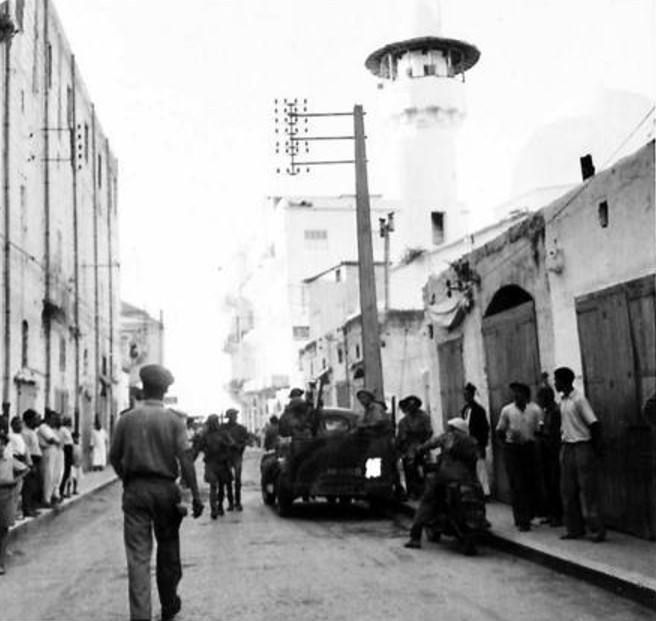
The Battle of Damascus began in Syria. At 20:30 on 18 June 1941, the 5th Indian Brigade start heading twelve miles north toward Damascus. This begins the Battle of Damascus, perhaps the defining event of Operation Exporter.
After hand-to-hand fighting, the Indian troops take Mezzeh, on the Damascus-Beirut road about three miles west of Damascus. This accomplishes the major goal of cutting communications between the two cities. The Indian troops are now to head east and take Damascus. That is the plan, at least.
However, the Vichy French destroy their convoy of anti-tank guns and other supplies. The Vichy French troops then put pressure on the Indian troops at Mezzeh with Renault R35 tanks even though the town was supposed to be merely a stepping-stone to a further advance on Damascus. The day ends with the Indian troops desperately trying to defend Mezzeh rather than advancing further north.
Vichy French destroyers Guepard and Valmy sortie out of Beirut Harbor and bombard the advanced Australian positions at Sidon. They don’t tarry long, however, because the Royal Navy is nearby.
Overhead, six Gloster Gladiators bounce a formation of Vichy French Dwoitine D.520 fighters. The Gladiator biplanes shoot down two of the French planes over Kissoue. These apparently are the final two claims by Gloster Gladiator pilots of World War II.
The fierce Vichy French resistance has caused more British and Australian effort than anticipated. This has caused some command difficulties as British General Henry Maitland Wilson has retained sole command at the King David Hotel in Jerusalem. For a simple campaign, such a command arrangement would have sufficed, but the French are showing signs of digging in. Thus, Australian Lieutenant General Thomas Blamey, Deputy Commander in Chief, Middle East Command, gives tactical authority to Lieutenant General John Lavarack General I Corps.
Behind the scenes, the Vichy French already see how things are going and quietly open negotiations with the British through the American Consul-General in Beirut. The Vichy government asks what terms the British and Free French would accept.
Four days to BARBAROSSA.
A German defector to Russian territory says the attack will be made at 4 AM on 22 June. Like every other warning, it is ignored by Stalin. During warfare, such a warning would be given great credence, but this warning is brushed off because it is a time of peace. Another warning from the Soviet embassy in London also is filed.
A German-Turkish ten-year friendship pact was signed at Ankara. While Hitler ideally would like Turkey to join the war on its historic enemy Russia, he realizes that is not going to happen. However, he gets the next-best thing today when Turkey signs a ten-year non-aggression pact (Türkisch-Deutscher Freundschaftsvertrag) with Germany. German ambassador to Turkey Franz von Papen signs on behalf of the Reich, while Turkish Minister of Foreign Affairs Şükrü Saracoğlu signs for Turkey. Germany, of course, has a similar pact with the Soviet Union.
Hitler meets with Ion Antonescu and lets him in on the details of the “great secret” Operation BARBAROSSA, including the opening date.
The Luftwaffe continues its reconnaissance flights over the Soviet Union. One at the Soviet Koshka Yavr airbase 25 km southeast of Zapolyarny in the Murmansk Oblast comes under anti-aircraft fire. German troops are assembling across the border in Finland to invade the Soviet Union and try to seize the port of Murmansk.
The Kriegsmarine lays mines in the Baltic
General Halder confers with the Romanian Minister of War and tours the “front.”
Soviet Ambassador to Germany Vladimir Dekanozov suddenly requests an audience with the Foreign Ministry. Hitler flies into a panic and fears that the Soviets have uncovered his invasion plans. The last thing he wants is some desperate offer made to try to stop Operation BARBAROSSA when it is in the final stages of preparation. He spends a long time discussing the matter with Foreign Minister Joachim Ribbentrop and his adjutants Engel and Hewel. They decide that Hitler and Ribbentrop need to “disappear” for a few days to avoid any awkward questions. They even consider fleeing to Berchtesgaden.
However, Dekanozov shows up unannounced at the Foreign Ministry at 18:00 on the 19th, makes some small-talk, transacts some mundane business, cracks a few jokes, and leaves. Everyone then breathes a huge sigh of relief and Hitler stays in Berlin. It is probably the most uncomfortable Hitler has been during the entire war.
Soviet Premier Joseph Stalin, completely unruffled by the mounting piles of warnings on his desk about a coming German invasion, leaves Moscow on a vacation down south.
The British re-establish their positions after the failed Operation BATTLEAXE. British 7th Armored Division and Indian 4th Infantry Division have withdrawn to their original positions and, in some cases, behind them.
The Royal Navy makes a supply run to Mersa Matruh, sending troopship Glenroy and net-layer Protector. They carry troops, gasoline and other supplies for the retreating British troops.
British press reported details of development of radiolocation technology (later more popularly known by its American acronym RADAR) and its use in Battle of Britain.
King George and Queen Elizabeth tour munitions factories and shipyards in Tyneside.
U-138 (Oblt.z.S. Franz Gramitsky), on its fifth patrol and operating west of Cadiz, is sunk in a depth-charge attack by Royal Navy destroyers HMS Faulknor, Fearless, Foresight, Forester, and Foxhound. The submarine broaches the surface before it goes down long enough for the crew to scuttle it and for the entire 27-man crew to escape and survive the day to become POWs aboard the Faulknor. U-138 has sunk six ships totaling 48,564 tons and damaged one ship of 6,993 tons.
Polish destroyer ORP Kujiwiak, just commissioned, is attacked by the Luftwaffe. There is one fatality from an exploding ammunition locker, but otherwise, the damage from the machine-gun fire of the German planes is minor.
Hans-Joachim Marseille was granted medical leave; he would depart Libya for Berlin, Germany shortly.
RAF Bomber Command, Day of 18 June 1941
6 Blenheims on a Circus operation to a German camp at Bois de Licques. No Blenheims lost.
RAF Bomber Command, Night of 18/19 June 1941
Bremen
100 aircraft — 39 Hampdens, 37 Wellingtons, 24 Whitleys. 3 Wellingtons and 3 Whitleys lost. Low cloud hindered the attack.
Brest
57 Wellingtons and 8 Stirlings; none lost. Haze and smoke-screens prevented identification of warship targets.
There were 2 O.T.U. sorties.
The RAF bombs Benghazi. During air battles, the Bf 109s of I,/JG 27 shoot down three Brewster Buffaloes.
U-552, commanded by Kapitänleutnant Erich Topp, sank British steamer Norfolk (10,948grt) in 57-17N, 11-14W. At 0328 hours on 18 June 1941 the unescorted Norfolk (Master Frederick Lougheed) was torpedoed by U-552 about 175 miles northwest of Malin Head and sunk by two coups de grâce at 0419 and 0438 hours. One crew member was lost. The master, 63 crew members and six gunners were picked up by HMS Skate (H 39) (Lt F.P. Baker, DSC, RN) and landed at Londonderry. The 10,948-ton Norfolk was carrying general cargo, including steel plates and mail and was headed for New Zealand.
Destroyer HMS Impulsive departed Scapa Flow at 0200 for Immingham for refitting and installation of TSDS equipment. The destroyer arrived at 1830
Heavy cruiser HMS Cumberland arrived at Scapa Flow en route to refitting after duty in the South Atlantic and escorting convoy SL.76 with light cruiser HMS Sheffield.
Light cruiser HMS Edinburgh arrived at Scapa Flow from Denmark Straits patrol.
Light cruiser HMS Manchester and destroyer HMS Achates arrived at Iceland from Denmark Straits patrol.
Polish destroyer ORP Kujiwiak, working up, was attacked by German aircraft. Machine gun from the aircraft set off the four inch ready use ammunition locker. One man was killed. The destroyer called at Dundee to repair and land the dead man. The destroyer arrived at Scapa Flow to work up on the 20th.
Destroyer HMS Bath departed Scapa Flow at 1400 after working up practices and arrived at Liverpool at 1630/19th.
Destroyer HMS Windsor departed Dundee at 1430 on completion of repairs to continue working up practices. The destroyer arrived at Scapa Flow at 2350.
Destroyer HMS Intrepid departed Scapa Flow at 2100 for Iceland to join the anti-submarine force operating there. The destroyer arrived at Reykjavik at 1340/20th.
Anti-aircraft ship HMS Alynbank departed Scapa Flow at 0630 and escorted convoy WN.41 from Pentland Firth. In the afternoon, the ship transferred to convoy EC.34 covering this convoy until its arrival in Pentland Firth. Ship Alynbank arrived at Scapa Flow at 2330.
British fishing vessel Doris II (6grt) was sunk on a mine three cables southeast of Outer Bar Bell Buoy off Sheerness. The crew of two was missing.
Destroyers HMS Faulknor, HMS Fearless, HMS Foresight, HMS Forester, and HMS Foxhound, returning to Gibraltar after escorting aircraft carrier HMS Victorious away, attacked a submarine contact. The U-138, commanded by Oberleutnant zur See Franz Gramitzky, was sunk west of Cadiz, Spain in the eastern Atlantic Ocean by depth charges from the destroyers HMS Faulknor (H 62), HMS Fearless (H 67), HMS Forester (H 74), HMS Foresight (H 68), and HMS Foxhound (H 69). Of the ship’s complement, all 27 survived. During its career under two commanders the U-138 sank 6 ships for a total of 48,564-tons and damaged 1 ship for a total of 6,993-tons.
Destroyer HMS Wishart departed Gibraltar to join troopship HMS Scythia and destroyer HMS Duncan, arriving from Freetown.
Ocean boarding vessel HMS Marsdale departed Gibraltar on Western Patrol in company with Norwegian steamer Sydhav and destroyer HMS Fury as local escort.
French destroyers Valmy and Guepard bombarded British advanced positions in Syria for a short time.
Australian sloop HMAS Parramatta and British tug St Issey and anti-submarine whaler HMS Southern Sea returned to Alexandria from Mersa Matruh.
British troopship Glenroy carried five lighters, some stores, petrol, and military personnel and netlayer HMS Protector carried a full load of cased petrol to Mersa Matruh where it was unloaded on the 18th.
Convoy SL.78 departed Freetown escorted by armed merchant cruiser HMS Esperance Bay to 27 June, sloop HMS Bridgewater to 21 June, and corvettes HMS Armeria, HMS Ashodel, HMS Aster, and HMS Burdock to 28 June. Heavy cruiser HMS Shropshire was with the convoy on 26 to 27 June. The cruiser was ordered to leave the convoy and position herself one hundred miles west of the convoy. After further attacks on the 27th, armed merchant cruiser Esperance Bay also left the convoy. Corvette HMS Fleur de Lys departed Gibraltar on the 27th and was with the convoy on the 29th. The convoy was ordered dispersed on the 29th and the corvette returned to Gibraltar. On 7 July, destroyers HMS Chelsea, HMS Mansfield, and HMS Verity, catapult ship HMS Pegasus, corvettes HMS Arbutus to 11 July, HMS Begonia, HMS Convolvulus, HMS Jasmine, HMS Larkspur, HMS Pimpernel, and HMS Rhododendron joined the convoy, and arrived at Liverpool on 12 July.
Today in Washington, President Roosevelt conferred with Mayor La Guardia, Director of the Office of Civilian Defense, and later talked with Frank Knox, Secretary of the Navy, Ben Cohen and William J. Donovan. In the afternoon he conferred on Negro discrimination in defense with Secretary Knox, Secretary Stimson, Mr. La Guardia, William S. Knudsen, Sidney Hillman, Walter White, A. Phillip Randolph and others.
The Senate was in recess. The Military Affairs Committee opened hearings on the property requisitioning bill; the Appropriations Committee approved the $935,905,000 Relief Bill.
The House held memorial services for members of Congress who have died; received the Military Affairs Committee report of Selective Service Act amendments and adjourned at 1:01 PM until noon tomorrow. The Rivers and Harbors Committee heard Secretary Knox and Governor Lehman testify for the St. Lawrence seaway; the Immigration Committee approved a bill barring for one year entry of aliens after internment in foreign countries; the Military Affairs Committee heard request for legislation making TVA accountable to the Controller General, and the Ways and Means Committee completed discussion on excess profits and individual income taxes.
President Roosevelt meets with Secretary of the Navy Frank Knox and William “Wild Bill” Donovan. They talk about setting up a new intelligence organization based upon the British MI6, which Donovan studied during his recent European visit. This will become the Office of Strategic Services, or OSS, which will morph into the Central Intelligence Agency, or CIA.
The United States prepared tonight to reject Germany’s protest over the expulsion of her consuls, and at the same time acted to place the tightest restrictions on immigration into this country from German-controlled countries. American consular agents abroad were instructed to refuse entry visas to persons with relatives residing in countries occupied by another nation. No specific country was named but it was learned that the order was issued with Germany in mind. The whole was aimed at excluding “fifth columnists” or persons who might have “an obligation to act as foreign agents here.
Two defense officials suggested today that the defense outlay of the United States might be increased to $100,000,000,000 to match the war efforts of the Axis powers. The present $44,000,000,000 program was called merely “a drop in the bucket” by Joseph L. Trecker, co-chief of the sub-contracting department of the Defense Contract Service, in an address at a meeting of DCS field representatives called to expedite the spreading of defense work among more and more factories. Asserting that Germany now had a war machine which costs in excess of $100,000,000,000, Mr. Trecker declared that the United States must “be prepared to go the route alone if necessary,” and added that this “may well require an expenditure in excess of $100,000,000,000.” Robert L. Mehornay, chief of the DCS, told the final session that “you can find plenty of people in Washington who will tell you that the program may go to $100,000,000,000.
The War Department is planning a large pool of reserve equipment — aircraft and anti-aircraft, tank and anti-tank — over and beyond the present organizational requirements. Several thousand more light and medium tanks and thousands of anti-aircraft and anti-tank guns on mobile and self-propelled mounts are to be contracted for to bring American factories to peak capacity and to keep their wheels turning without let-down or lay-off. The new orders, many of which are still to be placed, were decided upon after various officials of the Office of Production Management stated publicly and privately that our present defense schedule was not only too small to match the Axis effort, but also that if it was not materially increased some of the factories now working on defense orders might be forced to reduce employment and curtail their effort when the present orders were filled. It was also pointed out that many factories are not yet working at top capacity, and that some with machine tools which were adaptable to defense orders had only recently been tapped.
Two important developments tonight gave promise that A.F.L. and C.I.O. machinists might end their wage strike which has affected $500,000,-000 worth of defense constructions In 11 San Francisco bay shipyards since May 10. They were: 1. The national defense mediation board recommended that the Bethlehem Steel Corp. plant sign a closed shop contract with the bay cities metal trades council. 2. Harvey Brown, president of the A.F.L. International Association of Machinists, called the A.F.L. strikers into a mass meeting to plead with them to return to work, and the mediation board’s Bethlehem decision was a strong card in his hand. Bethlehem’s refusal to sign a union contract was one of the strikers’ chief reasons for staying out.
In the face of a charge by Senator Downey, California Democrat, that the legislation would create a “military dictatorship” over small businesses, Undersecretary of War Robert Patterson urged congressional approval today of the army’s request for authority to requisition private property for defense uses. Patterson was outlining the objectives of the measure to the Senate Military Affairs Committee when Downey interrupted to say that the broad powers asked by the department would ruin tens of thousands of small businesses. “I look with horror on this,” Downey declared. He contended that the chief purpose of the measure was to give military officials authority to take over machine tools and supplies now held by small business and concentrate them in the plants of large defense contractors.
Felix Frankfurter, Associate Justice of the Supreme Court, gives the Commencement address at Radcliffe College, Cambridge, Massachusetts. He gives a rationale for the war:
“One of the most current of these evasions of thought is that “war never settles anything.” The Civil War settled slavery. This war will settle the quality of your lives and your children’s lives. It simply is not true that war never settles anything. I respect the convictions of a conscientious objector to war and I believe I understand the philosophy underlying Gandhi’s non-resistance. But the relentless choice events may force on every individual cannot be met by such a fair-sounding pernicious abstractions as that “war never settles anything.”
The U.S. Navy, which receives no men from the draft, began an intensive drive for recruits to man the growing fleet today and issued “stand-by” orders to all reservists not hitherto called into active service. Meanwhile, Secretary of the Navy Knox, asserting that “we are going to live in a disturbed world for a long time,” urged house committee approval of the St. Lawrence Seaway and electric power project. The seaway would open the Great Lakes to ocean-going commerce and Knox stressed the desirability of building ships along the lakes where they would be “reasonably secure from attack.”
Fifty-six Army nurses, all volunteers for foreign service, were praised for their fearlessness tonight by Captain Harry G. Karakas, post chemical officer, after they underwent an intensive course in chemical warfare training at Fort Dix, New Jersey, today.
A jury in Federal Court tonight returned a verdict of guilty against ten Italian seamen accused of putting their vessel, the Aussa, out of commission while it was moored at Port Newark.
A new field of employment for women, that of acting as clerks in grocery stores, is opening in the United States under pressure of the defense program and by Fall thousands of women who know how to plan meals, have an aptitude for cooking and are experienced in problems the average housewife faces in preparing meals for the family, will be behind the counters of neighborhood stores.
The U.S. Naval Pacific Fleet Exercise No. 1, which commenced off the coast of California on May 14, concluded.
In a Northeast Arkansas League at Paragould, home team pitcher Clarence “Hooks” Iott strikes out 25 Batesville batters, allowing 2 hits in a 4–2 victory. Iott hits a homer at the plate. Hooks will have cups of coffee with the Browns this year and later with the Yankees.
Heavyweight Champion Joe Louis kept his crown by the slimmest of margins last night when he knocked out Challenger Billy Conn in the thirteenth round of their scheduled 15-round title bout at New York’s Polo Grounds. For 12 rounds, the “Pittsburgh Kid” gave Louis more than he took from the champion, but in the thirteenth the “Brown Bomber” started “firing and chopped Conn down in less than a minute and a half. It is his first serious defense after a string of “bum of the month” opponents.
Major League Baseball:
Schoolboy Rowe returned to the mound for the Tigers today to defeat the Red Sox, 5 to 2. He held Boston to eight hits and the only extra base drive off the Schoolboy came in the fourth inning, when Jimmy Foxx whacked his tenth homer with none on. The. victory gave the Tigers a two-to-one edge in a four-game series. Mickey Harris started for the Red Sox and Mike Ryba pitched the last inning. Detroit sewed up the victory in the fifth with a three-run rally. Frank Croucher started with a double. Then Rowe, Pat Mullin and Bruce Campbell hit singles, and with a dropped throw at third by Jim Tabor, the visitors took the game.
Starting where he had left off in the tenth inning yesterday, when he sorely frightened the Dodgers with a home run off Whit Wyatt, Hank Leiber hit two against Luke (Hot Potato) Hamlin on his first two trips to the plate today to give the Cubs a 5–1 margin over the Brooklyn forces. Three consecutive homers spread over two contests may be a record of some sort, but one thing is certain — the last two were a severe headache for Lippy Leo Durocher and his boys.
Rookie Alva Javery outpitched Johnny Vander Meer tonight to give the Boston Braves a 4–2 victory over the Cincinnati Reds and an even break in a two-game series. The young righthander weathered several strong threats by the Reds, who tried their best to put on one of their classic ninth-inning rallies.
In baseball, the New York Yankees play the Chicago White Sox at Yankee Stadium in New York City. The Yankee’s star center fielder Joe DiMaggio hits a single off White Sox pitcher Thornton Lee and extends his hitting streak to 31-games. The Yankees lose, however, 3–2, as the Sox score two in the eighth to win it.
Robert Feller won his fourteenth game of the season today as the Indians defeated the Athletics, 14–2, and increased their American League lead to three games over the Yankees. Feller gave just four hits, the same number as last week when he shut out the A’s, 2–0, for his thirteenth victory, while his mates slammed out seventeen hits, including five home runs and four doubles. Eight of their hits and seven of their runs, including Lou Boudreau’s two-run homer, came in the second inning and drove Les McCrabb out of the box to be replaced by Chubby Dean.
The Giants play an 11-inning 2–2 tie in Pittsburgh because of a regulation that states that no inning can be started after 11:50 p.m. The game is held up in the 4th inning so that the fans can listen to a broadcast of the title fight between local favorite Billy Conn and Joe Louis.
Johnny Hopp set the tempo with a first inning home run and the St. Louis Cardinals went on from there to win from the Phillies today, 7–3. Max Lanier had a shut-out until the eighth inning, when his control failed and three runs scored. Until then the left-hander had pitched twenty-one consecutive scoreless innings. In fifty-three innings this year only sixteen runs have been scored off Lanier, who now has five victories and two defeats.
The Browns beat Washington, 3–2, tonight to stay in front of the Senators in the American League’s “battle for the cellar.” Only 7,500 fans turned out for the second night-time major league contest held in the capital. George McQuinn singled in the seventh, stole second and scored the winning run on Roy Cullenbine’s single.
Detroit Tigers 5, Boston Red Sox 2
Brooklyn Dodgers 1, Chicago Cubs 5
Boston Braves 4, Cincinnati Reds 2
Chicago White Sox 3, New York Yankees 2
Cleveland Indians 14, Philadelphia Athletics 2
New York Giants 2, Pittsburgh Pirates 2
Philadelphia Phillies 3, St. Louis Cardinals 7
St. Louis Browns 3, Washington Senators 2
An exchange of notes between China and Britain today announced the delimitation of the Burmese-Chinese boundary. It had not been defined since the British annexation of Upper Burma in 1885. Fixing of the boundary, for many years the subject of Chinese-British negotiations, became more urgent because of construction of the Yunnan-Burma railway, which will go through an area that has been under dispute.
The ceremonial phase of puppet Chinese leader Wang Ching-wei’s state visit to Japan reached its climax today when Emperor Hirohito and Empress Nagako received him at the Imperial Palace and gave a state banquet for him at noon.
Japan discontinued negotiations with the Netherlands Indies for economic agreement. stating “The reply of the Netherlands of June 6 is not only very unsatisfactory but asserts in connection with the question of the acquisition of essential materials and goods, to which Japan attaches importance, that their quantities may be decreased at any time to suit their own convenience.”
Japan announced today that she had demanded the right to share with “third powers” — the United States and Britain were indicated — in the economic fruits of the Netherlands Indies. Acknowledging months of negotiations with the Netherlands to that end had been broken off at Batavia in an unsatisfactory stalemate, Japan said she would “hold fast to her just and fair contentions.” Describing the Japanese requests as “very reasonable” in view of the economic concessions enjoyed by third powers in the Indies, Koh Ishii, Cabinet Information Bureau spokesman, declared: “If such Japanese requests were dealt with on a basis of promoting economic cooperation between Japan and the Netherlands Indies the solution of these questions would be very simple. However, along with the intensification of economic warfare the situation surrounding the Netherlands Indies made the smooth progress of negotiations difficult.”
that
twenty
Dow Jones Industrial Average: 123.5 (+0.38)
Born:
Delia Smith, British cook and television presenter (“Delia Smith’s Cookery Course”, “How to Cook”), in Woking, England, United Kingdom.
Elizabeth Franz [Frankovitch], American stage actress (“Death of a Salesman”, “Sister Mary Ignatius Explains It All for You”), in Akron, Ohio (d. 2025).
Paul Brown, MLB pitcher (Philadelphia Phillies), in Fort Smith, Arkansas.
Died:
Thomas H. Rynning, 75, Norwegian-born American army officer and law enforcement official.
Naval Construction:
The U.S. Navy YMS-1-class auxiliary motor minesweeper USS YMS-44 is laid down by the Wheeler Shipbuilding Corp. (Whitestone, Long Island, New York, U.S.A.).
The U.S. Navy SC-497-class (110-foot wooden hull) submarine chaser USS PC-535 (later SC-535) is laid down by the Luders Marine Construction Co., Stamford, Connecticut.
The Regia Marina (Royal Italian Navy) Animoso-class torpedo boat Ardimentoso is laid down by Cantieri Ansaldo (Genova, Italy).
The U.S. Navy Gato-class submarine USS Peto (SS-265) is laid down at the Manitowoc Shipbuilding Co, Manitowoc, Wisconsin.
The keel for the civilian ship Steel Architect was laid down at Tacoma, Washington, United States by Todd Pacific Shipyards. She will be acquired by the U.S. Navy and after conversion emerge as the escort aircraft carrier USS Copahee (AVG-12, later CVE-12).
The Forces Navales Françaises Libres (Free French Naval Forces) Fairmile B-class motor launch ML 262 is commissioned.
The Royal Navy harbor defence motor launch HMS HDML 1025 is commissioned.
The Royal Navy Shakespeare-class minesweeping trawler HMS Romeo (T 10) is commissioned. Her first commander is T/Skipper William Ritchie Hastie Stewart, RNR.
The U.S. Navy 77-foot Elco patrol motor torpedo boat USS PT-26 is commissioned.
The Kriegsmarine (German Navy) Type VIIC U-boat U-753 is commissioned. Her first commanding officer is Korvettenkapitän Alfred M. von Mannstein.
The Вое́нно-морско́й флот СССР (ВМФ) (Soviet Navy) Project 7U-class (Storozhevoy-class) destroyer Smely (Смелый, “Valiant”) is commissioned.
 History Diaries