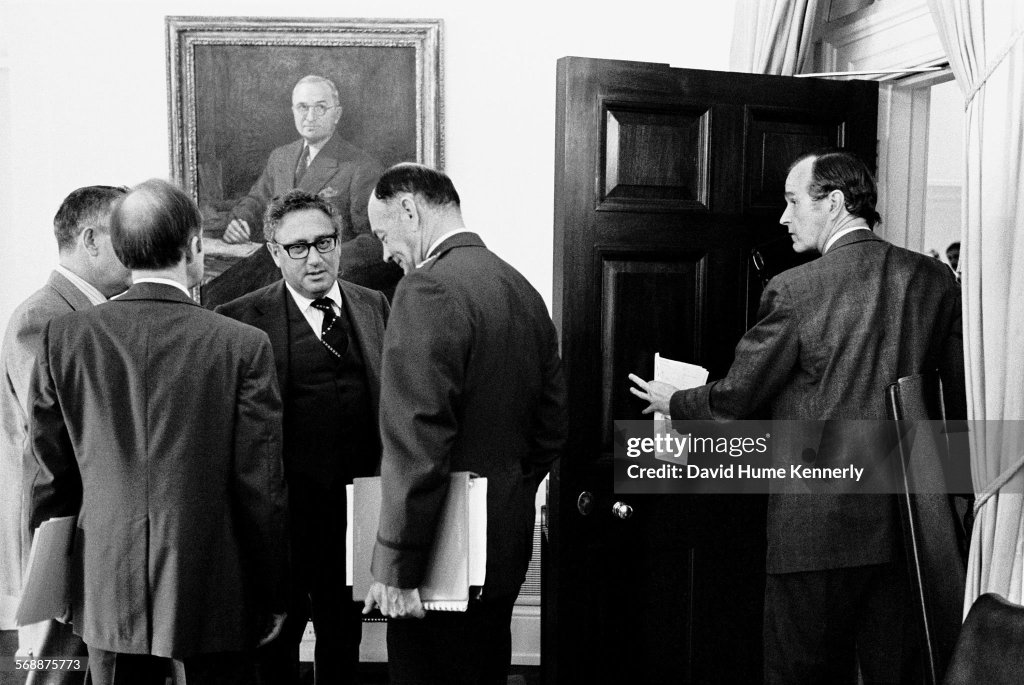
President Ford has directed the United States Embassy in Beirut to evacuate Americans from Lebanon, a State Department official said early today. There are roughly 1,400 American citizens in the country. Mr. Ford ordered the embassy is Beirut to provide an overland convoy to evacuate all those who wished to leave Beirut. A State Department spokesman said he was unsure when the evacuation would begin, but noted shortly after 1 AM that it was already past daybreak — 7 AM — in Beirut. The spokesman said the United States Embassy in Beirut would remain open, and only those embassy people not essential to continuing operations will leave. The order followed the abduction and killing Wednesday in Beirut of the United States Ambassador to Lebanon. Francis E. Meloy Jr., an aide and their driver. This morning, the State Department issued this brief statement: “Due to the continuing uncertainty of the situation in Beirut, the President has directed the United States Embassy there to organize a departure of an overland convoy of those United States citizens who wish to depart at this time. “Only those Embassy officials not essential to our continuing operations are leaving with them. The American Embassy in Beirut is to remain open to continue our efforts to bring an end to the strife that has brought tragedy to Lebanon.”
The United States Embassy in Beirut “strongly urged” all remaining American citizens in Lebanon to leave the country. But Beirut stayed relatively quiet and the Americans seemed to show little interest in doing so. A 13-vehicle convoy organized by the British Embassy was on its way to Damascus and it included a van carrying coffins containing the bodies of the United States Ambassador, Francis Meloy, and the American economic counselor, Robert Waring, who were slain on Wednesday.
Italy’s momentous election campaign came to a close tonight as Communists and Christian Democrats both promised a stable and secure future if voters would support them in the national balloting on Sunday and Monday. At the same time, they warned that disaster would befall the country if their advice went unheeded and Italians turned to their opponents. Ugo La Malfa, head of the small Republican Party, predicted that no party would be able to form a government after the election. Large rallies in central Rome and national television speeches concluded 45 days of campaigning for an election that no one really wanted and no one could avoid. Last ‐ minute opinion polls showed that the Christian Democrats, the governing party for 30 years, would probably emerge on top again. But there was a large undecided vote, and no one was ruling out the possibility of a Communist victory.
Silvia Gingold, a slight, long‐haired and softspoken 29‐year‐old teacher of French and social science, is, uncomfortable at the center of a political controversy that has shaken some West Europeans’ faith in the solidity of West German democracy. She is one of the victims of the “radicals decree,” a government edict that bans from the civil service those deemed potentially disloyal to the Constitution. But when the Government of the State of Hesse dismissed missed Miss Gingold last year, it did more than add just one one more to the 328 dismissals on political grounds that its statistics show. It created a symbol for those here and elsewhere in Europe who warn against a revival of practices of the Nazi past. Miss Gingold is a member of the two German groups most persecuted in Hitler’s times: She is a Communist and a Jew. Miss Gingold harbors no suspicion that anti‐Semitism was a factor in her dismissal. But her Jewishness has been accented in the many protests and extensive press and television coverage occasioned by it.
President Hafez al‐Assad of Syria said today that he favored a pan-Arab peacekeeping force in Lebanon and insisted there were “no serious problems” between Syria and other Arab countries over the Lebanese crisis. He spoke to reporters after a second round of talks with President Valéry Giscard d’Estaing, in which, according to the Syrian Information Minister Ahmad Iskandar Ahmad, there was “an identity of views on all questions discussed.” The visit, Mr. Assad’s first to a Western nation in his six years in power, represents a Syrian effort to get French approval of Syrian military intervention in Lebanon. The French position has been that a political solution could only be found, in the words of the French Foreign Minister, Jean Sauvagnargues, “by the Lebanese themselves,” without any foreign intervention, political or military.
Jordan is firmly but unostentatiously giving Syria the staunchest public approval in the Arab world for the military intervention in Lebanon. King Hussein, without use of emotional language, has made it clear in public statements that he supports the intervention of his northern neighbor. The King, now visiting the Soviet Union, has also made the point that he feels the Palestine Liberation Organization in Lebanon is wrong to resist the Syrian intervention. The monarchy here, which expelled Palestinians guerrillas after bitter and bloody fighting 1970 and in 1971, has also moved recently to stifle any possible serious opposition to the Syrian intervention among the people of Jordan, about half of whom are Palestinians. The Jordanian Government has temporarily closed a newspaper. Al Rai, that carried a mildly worked editorial criticizing the. Syrian intervention because it led to the killing of Palestinians by Syrian and Syrian supported forces in Lebanon.
Flooding in Bangladesh killed at least 143 people after torrential monsoon rains caused landslides and led to rivers overflowing their banks.
In a surprise announcement today, the Thai Government said that Foreign Minister Pichai Rattakul had just returned from Cambodia, where agreement was reached on border demarcation and the establishment of embassies. The Foreign Ministry said Mr. Pichai had returned yesterday from a secret two‐day visit in which he talked with Ieng Sary, Cambodia’s Deputy Prime Minister in charge of foreign affairs. The announcement said that the talks, held “in a friendly atmosphere,” had resulted in agreement to establish embassies in both capitals, to demarcate a 10‐mile stretch of their common border and a Cambodian pledge to furnish details by the end of this month of an undisclosed number of Thai fishermen arrested by the Cambodian authorities for fishing in Cambodian waters. The exact part of the border to be demarcated was not publicly defined.
The Angolan Peoples Revolutionary Court heard today a calm but firm plea by an American lawyer that the 13 mercenaries on trial here be treated as prisoners of war under the Geneva Convention. “The defendants cannot he tried for the crime of being mercenaries because there is no such law, although there should be one,” Robert Cesner Jr., a trial lawyer from Columbus, Ohio, said. Thirteen British and American mercenaries risk the death penalty as the trial neared its conclusion on its eighth day with the final statements by the defense.
Rioting spread to a number of black townships around Johannesburg, South Africa. Prime Minister John Vorster assured the country over radio and television that “there is definitely no reason for any panic” and said that orders had been given to maintain law and order at all costs. “This government will not be intimidated,” he said. On the third day of the rioting, the police stopped giving out official casualty figures when the death toll reached 60 with more than 800 wounded. With apprehension running high among the country’s 4.5 million whites, there had been speculation that Mr. Vorster might postpone his talks with Secretary of State Henry A. Kissinger, scheduled to take place in West Germany next Wednesday and Thursday. However, the Prime Minister emphasized in his broadcast that the talks would go ahead, and that his white‐minority government would not restrain police action to deal with the rioters for fear of diplomatic consequences. “If, as it would seem to me, people have the idea that the Government, in view of my intended talks, will now hesitate to act, they are making a mistake,” he said.
Moses Dineka, a quiet man who hates violence, was on the lookout for a weapon when he returned to Soweto last night from his job in a Johannesburg restaurant. “I must have a stick or something,” said Mr. Dineka, as he cleared a table in the coffee shop of the Carlton Hotel. “If I have nothing, they will say I am with the white man, and they will kill me.” In common with many residents of the riot‐torn township, Mr. Dineka, aged 20, is more worried by gangs of marauding black youths than he is by the riot police who have been battling them continuously for the last three days. Among the 220,000 Sowetans who commute to jobs in Johannesburg every day, there is deep bitterness about apartheid and a sense that this week’s explosion was perhaps inevitable. But there is also a strong feeling that the rioters, however successful they may have been in attracting world attention to the injustices of apartheid, have done far more harm to the black community than to the country’s white rulers. “They are destroying our clinics, our banks, our stores, even some of our homes,” said Sarah Muzibeko, a domestic worker who sat knitting a choirboy’s shawl as she waited for her bus home to Soweto.
William Eteki, secretary general of the Organization of African Unity, said in Addis Ababa that the shootings in Soweto — he spoke before news had arrived of the spread of the South African riots to other townships — “constituted a new affront by the minority racist regime in Pretoria against the international community.” He said that the O.A.U. was willing “to oppose violence with violence if such is the method adopted by the retrograde Pretoria regime.” In Zambia, where President Kenneth Kaunda more than any other black leader had sought to maintain channels of dialogue with Prime Minister John Vorster of South Africa, the Government newspaper, The Daily Mail, said today that the rioting signaled a new era of racial conflict. The killings of Africans, the paper said “marks the beginning of a prolonged racial war that the whites will lose in the end.” The editorial contended further that “when people begin to show visible signs that they are fed up with their oppressors and even take to the streets to emphasize their point, there is no turning back.”
The U.N. Security Council was called into emergency session last night at the request of 47 African nations to consider a resolution on the situation in South Africa. Members from Africa asked the Council to “strongly condemn” the South African Government for resorting to “massive violence” against black citizens and to act speedily on the racial riots that began Wednesday in Soweto, a black township near Johannesburg. The demands were made in a proposed resolution that also called on South Africa to end violence against the African people and to take urgent steps to end its policy of apartheid, or racial separation. The text spoke of apartheid as a “crime against the conscience and dignity of mankind and a serious danger to peace and security.” The proposed resolution would ask the Security Council to express deep shock over the deaths which began when the police fired on student demonstrators in Soweto protesting Government orders that they be taught courses in Afrikaans. The draft resolution was submitted after midnight, by eight of the Council members — Libya, Sweden, Panama, Guyana, Pakistan, Benin, formerly Dahomey, Tanzania and Rumania.
Representative Wayne Hays resigned under pressure by his colleagues as chairman of the House Administration Committee, a move that had been sought by the Democratic leadership since it was alleged that Mr. Hays had appointed his mistress, Elizabeth Ray, to the committee’s staff. His removal from the most powerful of his four chairmanships whetted demands by members of both parties for sweeping reforms in the House. Democratic leaders met several times throughout the day to consider the form and content of the proposals they will make next week to change the housekeeping operations of the chamber to avoid more controversy. “The Hays resignation is not the end of it,” said Representative Thomas P. O’Neill Jr. of Massachusetts, the majority leader. “We will announce reform proposals next week and have remedial legislation out by the July 2 recess.”
President Ford canceled an election campaign trip to Iowa today after having directed the United States Embassy in Beirut to assist American citizens who wanted to leave Lebanon. Ron Nessen, the White House spokesman, said that the Iowa trip had been called off “because of the impending evacuation and the situation in Lebanon.” In a personal statement on Lebanon, Mr. Ford avoided the word “evacuation” with regard to the estimated total of 1,400 American citizens still in the country. The President had been scheduled to attend a testimonial dinner in Des Moines for Mary Louise Smith, the Republican Party’s national chairman, before the selection of Iowa’s delegates to the Republican National Convention.
Representative Allan Howe of Utah, who was recently arrested on charges of soliciting prostitutes in Salt Lake City, told a group of his supporters there that he would run for re-election. He said that his constitutional rights had been abused by the police and the press and he repeated his assertion that the arrest was a “setup or trap by vindictive and politically motivated people.” His statement, made before a cheering audience of about 150 supporters in the City and County Building, came six days after he was arrested in Salt Lake City’s red‐light district. He allegedly solicited two police decoys posing as prostitutes. He charged that the decoys had falsely reported a conversation he had had with them. In a transcript, which the police originally said was a tape‐recording but which actually was only a report by one decoy, Mr. Howe allegedly offered to pay $20 for two sex acts.
A federal district court judge in Washington issued a “preliminary” injunction that will prevent the Ford administration from implementing its proposed cutbacks in food stamps. Judge John L. Smith included the injunction in a ruling that found that the Agriculture Department had “exceeded its congressional mandate” when it promulgated regulations that would cut $1 billion from food stamp benefits.
The growth in the gross national product, the nation’s total output of goods and services, is likely to slow substantially in the current quarter to considerably less than 5 percent on an annual basis, government economists said today. This assessment, based on figures now available, came as the Commerce Department revised slightly upward the annual rate of G.N.P. growth for the first quarter, from 8.5 percent to 8.7 percent. Corporate profits in the first quarter were also revised upward, to $85.7 billion at an annual rate after taxes. Almost all economic forecasts have projected a moderation in G.N.P. growth in the second quarter compared with the torrid pace of the first. But now it appears that this slowdown will be much more marked than the consensus forecast implied. So far, there appears to be no sense of alarm or deep concern in the Government about this prospect. But one official said today, “I can’t help feeling just a little uneasy.”
Expressing party unity but displaying very little of it, the Democrats staged a major fundraising event here last night at which all the major party leaders except Governor Edmund G. Brown Jr. of California canceled appearances. Jimmy Carter telephoned to ask Robert S. Strauss to continue on the job as Democratic national chairman through the November election. Senators Hubert H. Humphrey of Minnesota and Edward M. Kennedy of Massachusetts telephoned to praise Mr. Strauss, the honored guest. But it was Governor Brown who captured most of the attention, signed the most autographs, and received the most applause and squeals from some 5,000 persons in attendance. “I think unity has its place, but so does diversity,” he told reporters who asked why he alone, among the Democratic Presidential contenders, had not rallied behind Mr. Carter. He called the windfall endorsements of Mr. Carter after last Tuesday’s primaries a “rush to judgment” and he said he would continue his campaign. Asked about being Vice President, Mr. Brown said: “I’m not interested in it, I’m not seeking it, and I wouldn’t accept it if Mr. Carter were to offer it.”
Leaders of a Roman Catholic missionary order in Baltimore acknowledged that its representatives raised about $20 million in the last two years “to feed and clothe the poor” abroad but spent only about $500,000 on overseas missions. Instead, the fundraising arm of the Society of the Catholic Apostolate, also known as the Pallottine Fathers, spent $16 million to conduct its extensive direct-mail charity appeal, invested other millions in Florida real estate, and also made loans to politicians.
The trial of S.L.A. terrorists William and Emily Harris will apparently begin on schedule. The State Supreme Court refused yesterday to grant a stay in the trial, apparently clearing the way for it to start Monday. The court refused to consider the appeal , which was based on grounds of pretrial publicity. Leonard Weinglass, the Harrises’ attorney, said, “We have no further recourse.” The Harrises had sought a delay of up to one year in the trial, contending that publicity surrounding them and their former traveling companion, Patricia Hearst, had made selection of an impartial jury impossible.
The Senate Internal Security Subcommittee heard testimony today that radical groups were planning disruptive demonstrations at Fourth of July Bicentennial events. “The organizations planning to disrupt the Bicentennial come from both the so‐called Old Left and New Left and almost all of them consider themselves Marxist‐Leninist,” said Willliam R. Kintner, the chief witness. Mr. Kintner, former Ambassador to Thailand who is now a University of Pennsylvania political scientist, was joined by the Philadelphia and Wash ington policemen in warning of possible terrorist acts at Fourth of July events. Before the hearing started, Senator Strom Thurmond, Republican of South Carolina, who presided, had the room cleared of some 60 to 70 young people who described themselves as supporters of the People’s Bicentennial Commission. Last month Senator James O. Eastland, Democrat of Mississippi who is the subcommittee chairman, issued a report calling the People’s Bicentennial Commission “a propaganda and organizing tool for a small group of New Left political extremists.”
The chairman of the House Armed Services Committee, Representative Melvin Price, caned on the Defense Department yesterday to establish a “special blue ribbon panel” of civilian and military experts to investigate the honor systems at the three service academies. As a cheating‐scandal investigation at West Point entered its third month, Mr. Price, an Illinois Democrat, asked the Defense Secretary, Donald H. Rumsfeld, to act “without delay.” More than 160 cadets face expulsion and 250 other cases are being examined. The request was accompanied by committee staff recommendations that special attention be paid to the question of “due process” in administration of the house code at West Point and in the “rigidity” with which cadets there administer the code.
Private Lynn McClure was a troublemaker who brought on his own fatal injuries by antagonizing his fellow marines during a training exercise, government witnesses testified today at the court‐martial of Sgt. Harold Bronson. Sergeant Bronson, 30 years old, is the first of four marines scheduled for courts‐martial in Private McClure’s death. In his first public statement about the case. Sergeant Bronson told reporters outside the courtroom that he had no regrets about the pugil stick training bouts in which Private McClure was beaten into a convulsive coma. “We didn’t promise him a rose garden,” the drill instructor (D.I.) said. “I think I’m a good D.I. and I was doing my job. We were trying to prepare them for combat. I’m innocent of the charges and I think I’ll be proven innocent.”
An attempt by federal mediators to find a cost‐of‐living formula that would break the impasse in the long rubber workers strike appears to have failed, sources close to the Federal Mediation and Conciliation Service said today. The sources said that the formula proposed by the United Rubber Workers, which struck the Big Four rubber companies on April 21, would add about 35 cents an hour to pay packets over three years, assuming an a inflation rate of 6 percent a year. By contrast, the Firestone Tire and Rubber Company, the union’s target for a first contract, has submitted a formula that would yield about 25 cents, the sources said.
NASA launched Gravity Probe A, the first attempt to measure with high precision the rate at which time passes in a weaker gravitational field in a test of the equivalence principle postulated by Albert Einstein. The probe was launched to a height of 10,000 kilometers (6,200 mi) above the Earth and remained in space for 1 hour and 55 minutes. Its measurements confirmed Einstein’s prediction of the flow of time being slowed by a predictable rate in relation to gravity.
The long and largely uneventful flight of Viking 1, a spacecraft launched from the earth 10 months ago to look for life on Mars, is scheduled to reach a critical phase tomorrow night when the spacecraft’s engine will fire for about 40 minutes to put the craft into an orbit around Mars.
A Joseph William Turner watercolor auctioned for £340,000.
Major League Baseball:
Baseball Commissioner Bowie Kuhn voids the A’s sales, totaling $3.5 million, of Joe Rudi and Rollie Fingers to the Red Sox, and Vida Blue to the Yankees, saying they are “not in the best interest of baseball.” He also may have provoked the biggest series of lawsuits in baseball. Charles Finley, owner of the Oakland team, declared he would sue and said the commissioner “sounds like the village idiot.” A’s owner Charlie Finley files a $10 million damage suit against Kuhn, and will refuse to use any of the 3 players until June 27th.
Bill Madlock connects for a grand slam in the 7th and the Cubs win on the road beating the Braves, 6–4. Carl Morton, who started for the Braves and had a 3–1 lead, passed Dave Rosello and Champ Summers in the seventh and gave up a bases-loading single by Jose Cardenal before yielding the mound to Max Leon, who was the victim of Madlock’s jackpot wallop.
With a double by Jim Rice as the key blow, the Red Sox scored two runs in the ninth inning and defeated the Angels, 3–1. The loss was the fourth in a row for Andy Hassler this season and 15th in succession since April 29, 1975. With two down in the ninth, Carl Yastrzemski singled and scored the tie-breaking run on Rice’s double. Rico Petrocelli followed with a single to add an insurance marker.
A sacrifice fly by Roy White in the 14th inning scored Fred Stanley and gave the Yankees a 3–2 victory over the White Sox, who went down to their eighth straight defeat. With one out, Stanley singled and went to third when White Sox reliever Dave Hamilton threw wildly on an infield hit by Mickey Rivers. White then followed with his game-winning sacrifice fly.
Cookie Rojas, no longer an everyday player for the Royals, got a chance to start at third base and responded by driving in three runs to help beat the Indians, 5–3. The veteran singled home one run in the second, doubled to account for another in the seventh and hit a sacrifice fly for the final marker in the ninth. Royals’ catcher Buck Martinez threw out four Indians trying to steal.
Dave Roberts pitched his seventh complete game of the season for the Tigers and defeated the Twins, 4–2. The Tigers got off to a two-run start with a double by Ron LeFlore, walk to Dan Meyer, single by Rusty Staub and error by Rod Carew on a grounder by Jason Thompson. Bill Freehan homered in the fourth and the Tigers’ final run counted in the eighth on a double by Staub and single by Alex Johnson.
Five singles in the eighth inning resulted in three runs and provided the Dodgers with a 6–5 victory over the Expos. Singles by Ellie Rodriguez, Ed Goodson and Bill Buckner accounted for the first run to put the Dodgers ahead, 4–3. Steve Garvey and Ron Cey then followed with run-scoring singles to enable the Dodgers to withstand a two-run pinch-homer by Jose Morales in the Expos’ half of the ninth inning.
Backed by John Milner and Ed Kranepool, who drove in the Mets’ runs with homers, Tom Seaver defeated the Giants, 3–2, allowing only two hits. Milner accounted for the Mets’ first marker in the fourth inning, but a homer by Darrell Evans in the fifth and run-scoring triple by Derrel Thomas in the sixth put the Giants ahead, 2–1, before Milner walked in the Mets’ half of the sixth and, after a forceout by Wayne Garrett, Kranepool hit for the circuit.
Hank Aaron hit his fifth homer of the season and 750th of his major league career with one out in the ninth inning to power the Brewers to a 3–2 victory over the Athletics. Aaron’s blow was the third of game for the Brewers, who also had round-trippers by George Scott and Bernie Carbo. It is Aaron’s 3rd home run in 3 games.
With a crowd of 50,635 on hand to watch a battle between the N. L.’s division leaders, the Phillies had the benefit of a three-run homer by Mike Schmidt and defeated the Reds, 6–5. Dick Allen also homered for the Phils, while George Foster smashed two for the Reds. With the Phillies clinging to a 3–2 lead, Dave Cash and Larry Bowa singled in the fifth inning and Schmidt hit his circuit clout to decide the game’s eventual outcome.
Manny Sanguillen rapped four singles in four trips to lead the Pirates’ attack in a 7–3 victory over the Astros. Sanguillen drove in two runs. Al Oliver also accounted for two RBIs with a double, while Willie Stargell contributed a homer. The Astros had circuit clouts by Cesar Cedeno and Leon Roberts.
With Pete Falcone pitching, the Cardinals handed Randy Jones his third defeat of the season against 12 victories by beating the Padres’ ace, 7–4. The loss snapped Jones’ personal seven-game winning streak. The Padres took a 3–0 lead on homers by Dave Winfield and Mike Ivie before the Cardinals went to work with four runs in the fourth on three singles and an inside-the-park homer by Hector Cruz. Then in the fifth, Lou Brock, who was celebrating his 37th birthday and return to the lineup after a three-game absence with an injured right hand, also hit an inside-the-park homer with Don Kessinger on base to seal Jones’ defeat.
Lee May and Andres Mora each homered with two men on base and Reggie Jackson added a solo swat to carry the Orioles to a 9–4 victory over the Rangers. Rudy May, making his first appearance for the Orioles since being obtained in a 10-player deal with the Yankees, gained the decision, pitching 8 ⅓ innings before Dyar Miller came in to finish.
Chicago Cubs 6, Atlanta Braves 4
Boston Red Sox 3, California Angels 1
New York Yankees 3, Chicago White Sox 2
Kansas City Royals 5, Cleveland Indians 3
Detroit Tigers 4, Minnesota Twins 2
Los Angeles Dodgers 6, Montreal Expos 5
San Francisco Giants 2, New York Mets 3
Milwaukee Brewers 3, Oakland Athletics 2
Cincinnati Reds 5, Philadelphia Phillies 6
Houston Astros 3, Pittsburgh Pirates 7
San Diego Padres 4, St. Louis Cardinals 7
Baltimore Orioles 9, Texas Rangers 4
Profit taking stalled the stock market’s current advance yesterday in continued active trading. Blue-chip issues, active and higher on Thursday, fell back enough yesterday to give the Dow Jones industrial average a 1.31-point loss at 1,001.88. The market as a whole actually outperformed the Dow, with advances leading declines.
Dow Jones Industrial Average: 1001.88 (-1.31, -0.13%)
Born:
Blake Shelton, American country music singer (“Boys ‘Round Here”; “God Gave Me You”; “Honey Bee”); in Ada, Oklahoma.
Alana de la Garza, American actress (“Law & Order”, “FBI”), in Columbus, Ohio.
Jeremy Powell, MLB pitcher (Montreal Expos), in Bellflower, California.
Brady Haran, Australian-born educational video producer; in Glenelg, South Australia.
 History Diaries