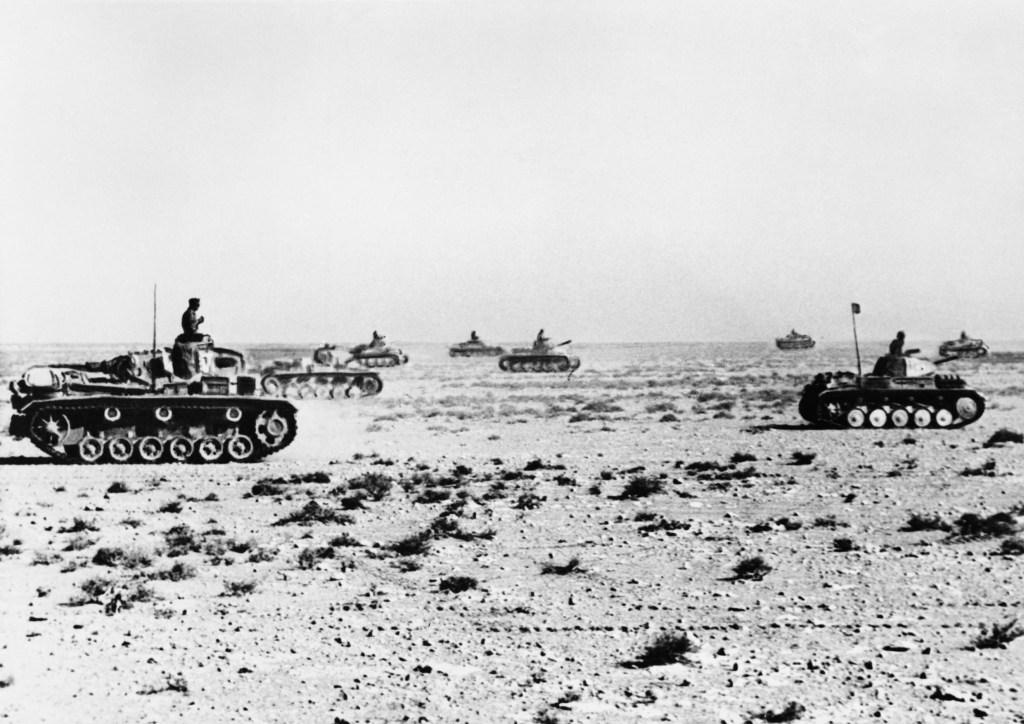
Operation BATTLEAXE continues. It is Day 2 of Operation BATTLEAXE, the latest British attempt to push the Germans and Italians back from the Libyan frontier and relieve Tobruk. Today does not go any better than the opening day of the offensive for the British, and it runs tight today due to smart and quick German ripostes. The British move south to the Sidi Omar area, where action continues throughout the morning. Two-pounder and Besa fire cause much damage among a large concentration of Germans, who later withdraw in a north-easterly direction.
The 11th Infantry Brigade attacks into Halfaya Pass, a critical objective that divides the front into thirds, with the pass being the center section. Afrika Korps Major Wilhelm Georg Bach controls the outnumbered Axis forces in the Pass, and the British quickly surround him. Bach, an unorthodox officer who flouts Wehrmacht convention by being indifferent about his attire and kindly to his men, is an expert with 88 mm flak guns being used in an anti-tank role, and he puts his skills to good use. He holds out throughout the day and continues destroying British tanks. This is the linchpin of the German defense, and it holds despite great privations.
The attack at Halfaya had not been as successful as had been hoped, and although Fort Capuzzo was taken at bayonet point by the infantry the Germans were reported to be forming for a strong counterattack.
The 15th Panzer counter-attacked around Capuzzo by night, while the 5th Light made a hook around the British left flank, with the aim of reaching the Halfaya Pass and cutting off both British divisions from supply or escape down the escarpment. The 4th Indian Division struggles to hold 15th Panzer. Halfaya remains in German hands. General Walter Neumann-Silkow, the Commander of the 15th Panzer Division, attacks the lone British success of the opening day of the British offensive, Fort Capuzzo, at 06:00. Neumann-Silkow has 80 tanks and forms them into two columns. Like the British in Halfaya Pass, however, the advancing panzers run into the fierce anti-tank fire from 25-pounders and tanks hull-down in well-chosen defensive positions. The panzer force loses 50 tanks within four hours, and the attack is over by noon. This is a mirror-image of the failed British tank attack on Halfaya Pass and Hafid Ridge on the 15th. This failure frees the Scots Guards to pursue them, and the British take the Sollum barracks on the east flank. This further isolates Bach in Halfaya Pass.
Meanwhile, the German 5th Light Division also attacks down the coastal sector at dawn. It rolls southward past Hafid Ridge, shadowed by the 7th Armoured Brigade and 7th Support Group. The panzers once again demonstrate their superiority over the British tanks, standing off and shelling the British while still out of range of British tank fire. The Germans thereby eliminate their true threat — the vulnerable towed British 25-pounder anti-tank guns. Once those are gone, the Panzer IIIs (50 mm gun) and Panzer IVs close and destroy the thinly armed British cruiser tanks. The battle goes so poorly for the British that they have to retreat not just to their starting positions, but east of them — losing ground. The day ends with 5th Light continuing to harass the retreating British tank force. By nightfall, 7th Armoured Brigade was down to just 25 tanks.
German troops launched limited counterattacks at British positions in Libya; the attack at British troops on Fort Capuzzo was fought off, but the series of skirmishes toward Hafid Ridge saw many British tanks destroyed by the superior German Panzer III and Panzer IV tanks. At 1600 hours, Erwin Rommel decided to launch a decisive counterattack on the next day.
General Erwin Rommel keeps close tabs on the battle and notices the brilliant success on the flank by the 5th Light Division. At 16:00, Rommel orders the 15th Panzer Division to leave only a screen against the advancing Scots Guards and shift its tanks to support 5th Light’s advance. The British at first try to continue attacking into Halfaya Pass, but after dark the British accept defeat. They consolidate their remaining Matilda Tanks (over half have been destroyed) as a blocking force while the British infantry withdraws back into Egypt. The British only have 21 cruiser tanks left in the 7th Armoured Brigade and 27 Matildas in the 4th Armoured Brigade.
The events of 15 June effectively end Operation BATTLEAXE. However, the battle is not over. Now, the Afrika Korps is on the offensive due to superior equipment and tactics. While the British Army still holds Fort Capuzzo, the Germans are advancing into position not only to cut them off but stream further east into Egypt.
Overhead, Luftwaffe ace Hans-Joachim Marseille takes damage to this fighter in the aerial battles over the battle. Oil spraying on his windshield blinds him, but he is “talked down” to a safe landing by flight leader Reiner Pöttgen.
Galeazzo Ciano met with Joachim von Ribbentrop in Venice, Italy. When Ciano asked Ribbentrop about the rumors of a German attack on the Soviet Union, Ribbentrop denied the rumors, but he shared the confidence that, should war really break out, a German victory would be achieved very quickly.
In anticipation of BARBAROSSA, Finnish troops are withdrawn from the island of Morgonland, which they were using to observe Soviet naval traffic at the occupied port of Hanko, on the south-westerly tip of Finland, and the surrounding waters are mined by both sides.
Finnish Naval HQ also gives orders to prepare for occupying the Åland Islands, which are demilitarised in peacetime. These islands have been a perpetual bone of contention between the Finns and the Soviets but have minimal strategic significance because they are demilitarized in peacetime. These preparatory moves are indicative of Finnish motivations to settle old scores with the Soviets and recover lands they believe belong to them for historical and pragmatic reasons.
Field Marshal Albert Kesselring meets with Field Marshal Fedor von Bock. Kesselring commands Luftflotte 2, which is to operate in support of Bock’s Army Group Center (Heeresgruppe Mitte) on the road to Moscow. Kesselring and others move to their forward headquarters in anticipation of the 22 June 1941 scheduled start to Operation Barbarossa.
Reich port authorities are ordered to prevent any Soviet vessels from leaving. German U-boats already have carte blanche to sink Soviet vessels, so this is probably a necessary move because U-boats are lurking around all Baltic ports.
Six days to BARBAROSSA.
Vichy French tanks defeated the British Royal Fusiliers battalion which had been surrounded at Quneitra, French Mandate of Syria and the Lebanon; 177 officers and men surrendered at 1900 hours. Despite this disaster in his rear, Brig Lloyd (5 Ind Bde) sends one Indian battalion to the Kuneitra road to cut off the French in turn, and aggressively continues his advance on Damascus. Alarmed by the general French counter-attack over the whole front, Generals Wilson and Lavarack throw in their few reserves. Leading elements of 16 Brit Brigade arriving from Egypt are diverted to Deraa; 2/3 MG Bn is sent to hold crossings on the Jordan; Brig Berryman (BGRA 1st Aust Corps) is placed in command of all troops around Merdjayoun. Further north, Indian and Free French troops advanced toward Damascus. Out at sea, British torpedo bombers sank Vichy French destroyer Chevalier Paul carrying ammunition from Toulon, France.
Operation EXPORTER continues. The Battle of Kissoué, which controls access to Damascus, reaches a climax on 16 June 1941. Vichy French resistance has stiffened, and a company of the 7th Chasseurs d’Afrique advance to take Quneitra (Kuneitra or El Quneitra) from the Royal Fusiliers. The French tanks surround the town and at 19:00 take 13 British officers and 164 other ranks prisoner.
The French thus save Damascus for the moment. However, the British remain on the offensive by bringing in the 16th British Brigade from Egypt (diverted from other operations). This forces the Vichy French to withdraw their forces attempting to outflank the advancing British and prepare for a frontal defense. During the French withdrawal, British troops take up positions above the road the French must use and kill over 50 troops before withdrawing during the night.
The Vichy French are held at Jezzine, which the 25th Australian Brigade holds with difficulty. At Merdjayoun, Brigadier Berryman takes command.
The war at sea heats up. Vichy destroyer Chevalier Paul, carrying supplies to Syria and Lebanon, is sunk near Latakia by British Swordfish of RAF No. 815 Squadron (one plane shot down). There are six deaths and nine wounded. French destroyers Valmy and Guepard pick up the survivors. While they withdraw, Guepard and Valmy are damaged by Royal Navy destroyers Jervis and Kimberley.
Another French destroyer, Vaquelin, makes port in Beirut with supplies, but the RAF damages it there. The Royal Navy, meanwhile, continues providing support to the Australians advancing north from Sidon.
Aldershot, Hampshire: In military custody, Rudolf Hess tries to commit suicide by throwing himself off a staircase, but only breaks a leg.
British invasion fears continue during prime summer weather. Upon unconfirmed reports of a German sortie from Brest, the Home Fleet is brought to one hour’s notice. However, the ships leaving port are only freighters and the alert is canceled.
Winston Churchill gave a radio speech from London accepting an honorary degree of Doctor of Laws from the University of Rochester in New York. Churchill told his American listeners that it gave him “comfort and inspiration to feel that I think as you do, that our hands are joined across the oceans, and that our pulses throb and beat as one … A wonderful story is unfolding before our eyes. How it will end we are not allowed to know. But on both sides of the Atlantic we all feel, I repeat, all, that we are a part of it, that our future and that of many generations is at stake..”In his radio address shortly after receiving this degree, he urged the American people to join the Allies in the fight against Germany. “United we stand, divided we fall.” Churchill says in part:
“But what is the explanation of the enslavement of Europe by the German regime? How did they do it? It is but a few years ago since one united gesture by the peoples, great and small, who are now broken in the dust, would have warded off from mankind the fearful ordeal it has had to undergo. But there was no unity. There was no vision. The nations were pulled down one by one while the others gaped and chattered. One by one, each in his turn, they let themselves be caught. One after another they were felled by brutal violence or poisoned from within by subtle intrigue.”
England, he implies, now is the “old lion with her lion cubs at her side” standing ready to deter aggression, alone against hunters who are armed with deadly weapons and impelled by desperate and destructive rage” after the others have been overcome. It is classic Churchill, one of his best speeches.
Westminster: Commenting on industrial unrest, Capt. J. Henderson Stewart MP, declared in questioning the Minister of Labour, Ernest Bevin: “Today, when the flower of our land has been mowed down through lack of arms to defend themselves, arms factories at home are frequent scenes of deliberate slacking, deliberate idleness and shameless agitation for higher and higher wages for the same work done.”
British unemployment figures for May 1941 was at its lowest, showing 243,656, compared to over 600,000 one year prior.
General Eugen Meindl is awarded the Knight’s Cross for his leadership in the opening phase of the battle for Crete and especially for the overall performance of his regiment in this campaign.
The Luftwaffe raids Gloucester with 60 bombers.
The RAF conducts “Circus No. 14.” This is a raid on Boulogne, with ten No. 11 Group fighter squadrons escorting ten Coastal Command Blenheim bombers. Luftwaffe fighters of elite I,/JG 26 (Adolf Galland) intercept the formation, and the RAF loses two Blenheims and nine Supermarine Spitfires. The Luftwaffe loses four Bf-109s, and two of the pilots perish.
During this action, Lt. Joseph “Pips” Priller shoots down a Spitfire and a Blenheim over Boulogne. Galland, meanwhile, downs a Hurricane. Both men will wind up the war with 100 victories (Galland with 104, Priller with 100) and are considered two of the greatest fighter pilots of the war — if not all time.
RAF Bomber Command: 2 Group: In operations against ‘squealers’, short-wave radio equipped trawlers used as early warning stations by the Luftwaffe in the North Sea, 3 Blenheims of 21 Sqn. sink a trawler, but not before one aircraft had struck the ships mast and cartwheeled into the sea.
The RAF identifies a requirement for 350 high-altitude Spitfire Mk.VIs with pressure cabins.
RAF Bomber Command, Day of 16 June 1941
25 Blenheims on coastal sweeps off Holland and Germany. Several ships were attacked including a trawler well out to sea and suspected of being a radio warning ship. One of the Blenheims attacking this ship was so low that it hit the trawler’s mast and crashed into the sea. 3 Blenheims were lost on this day.
RAF Bomber Command, Night of 16/17 June 1941
Cologne
105 aircraft — 47 Hampdens, 39 Whitleys, 16 Wellingtons, 3 Halifaxes — but again bombing was poor with only 55 high-explosive bombs and 300 incendiaries recorded in Cologne, causing scattered damage, but 19 people were killed and 17 injured. 2 Whitleys and 1 Wellington lost.
Düsseldorf
65 Wellingtons and 7 Stirlings, haze prevented target identification. 58 aircraft claimed to have bombed Düsseldorf but the records show only 2 heavy bombs in the southern suburb of Wersten, which destroyed several houses, killing 4 people and injuring 23. A few bombs were reported in 4 other towns around Duisseldorf No aircraft lost.
Duisburg
39 Wellingtons; 1 lost.
Boulogne
7 Wellingtons; none lost.
Total effort for the night: 223 sorties, 4 aircraft (1.8 percent) lost.
At Malta, a Wellington bomber arriving from Gibraltar crashes in the sea on approach to Hal Far airport. The entire crew perishes. Another Wellington fails to arrive and is presumed lost.
Minelayers HMS Agamemnon and HMS Menestheus with destroyers HMS Brighton, HMS Castleton, HMS St Marys, and HMS Wells departed Loch Alsh on the 15th. Light cruiser HMS Aurora departed Scapa Flow for anti-aircraft support on the 15th. British minefield SN.66 in the Iceland Faroes field was laid on the 16th by Minelayers Agamemnon and Menestheus covered by light cruisers HMS Aurora, HMS Nigeria, and HMS Kenya.
Battleships HMS King George V and HMS Nelson and destroyers HMS Bedouin, HMS Intrepid, HMS Jupiter, HMAS Nestor, HMS Punjabi, and HMS Eskimo were brought to one hour’s notice on the report of two unidentified ships departing Brest. When it was found these two ships were merchant ships, the notice was cancelled.
British steam trawler Atlantic (167grt) was damaged by German bombing three miles southeast of Eddystone. The trawler returned to Plymouth on the 16th.
French destroyer Chevalier Paul was sunk by British aircraft near Latakia in 35-18N, 35-18E at 0400 as she attempted to carry supplies to Syria. The attack was made by six British Swordfish of 815 Squadron. One was shot down and its crew of Lt M.G.W. Clifford and Sub Lt P. Winter were taken prisoner. The survivors from the destroyer were picked up by French destroyers Valmy and Guepard which also picked up the crew of the downed British aircraft. Six French sailors were lost in the destroyer and nine wounded. The French destroyers were engaged at 0400 by destroyers HMS Jervis and HMS Kimberley and both French destroyers suffered some damage.
Light cruiser HMS Naiad and destroyers HMS Kingston, HMS Havock, and HMS Jaguar departed Alexandria to relieve light cruiser HMS Phoebe and destroyers HMS Griffin and HMS Defender.
Submarine HMS Unbeaten unsuccessfully attacked a large, zigzagging liner south of the Messina Strait.
Submarine HMS Clyde arrived at Gibraltar from patrol in the Mediterranean. She had on board seven Italian prisoners from Italian steamers Sturla (1195grt) and Giovanni Bottigliere (331grt).
Convoy OB.335 departed Liverpool, escorted by destroyers HMS Ripley and HMS Sherwood, sloop HMS Fleetwood, and corvettes HMS Celandine and HMS Nasturtium. The convoy was joined on the 23rd by armed merchant cruisers HMS Cheshire and HMS Derbyshire. The escorts were detached on the 24th. The convoy arrived at Halifax on 2 July.
Convoy HX.133 departed Halifax, escorted by armed merchant cruiser HMS Wolfe and destroyer HMCS Annapolis. Destroyer HMCS St Croix joined the convoy on the 17th. Destroyer Annapolis was detached on the 20th. Convoy BHX.133 departed Bermuda on the 14th escorted by ocean escort armed merchant cruiser HMS Laconia. The convoy rendezvoused with convoy HX.133 on the 20th and the armed merchant cruiser was detached. On the 20th, destroyer HMCS Ottawa and corvettes HMCS Chambly, HMCS Collingwood, HMCS Orillia, and HMS Violet joined and destroyer St Croix was detached. Corvette HMS Polyanthus joined on the 23rd. Destroyers HMS Malcolm, HMS Ripley, HMS Scimitar, and HMS Watchman, sloop HMS Fleetwood, corvettes HMS Arabis, HMS Celandine, HMS Gladiolus, and HMS Nasturtium, and minesweepers HMS Niger and HMS Speedwell joined on the 27th. Armed merchant cruiser Wolfe and the Ottawa escort group were detached on the 27th.Sloop Fleetwood and corvettes Gladiolus were detached on the 27th. On the 29th, destroyer Ripley and corvette Nasturtium were detached. Destroyers Malcolm, Scimitar, and Watchman and corvette Celandine were detached on the 30th. In Home Waters, the convoy was escorted by destroyer HMS Icarus, catapult ship HMS Maplin, and anti-submarine trawlers HMS Northern Gem, HMS Northern Pride, and HMS Northern Wave. The convoy arrived at Liverpool on 3 July.
In Washington, President Roosevelt canceled today a projected trip this week to Hyde Park and Harvard University. He conferred with Viscount Halifax, the British Ambassador, and later talked with Army, Navy and British-aid officials.
The Senate approved the bill authorizing a $250,000,000 network of defense highways, confirmed. the nomination of Luther Harr as Bituminous Coal Counsel, completed action on the bill authorizing $50,000,000 for naval bases, approved a resolution authorizing an investigation of the parity-prices structure, received a bill for an independent military air force and recessed at 3:07 PM until noon Thursday. The defense investigation committee heard. Secretary Ickes, the Judiciary Committee approved a bill to authorize the President to regulate travel.
The House passed the bill increasing the pensions of dependents of World War veterans, passed the bill authorizing lowering of the load line for coastwise. tankers, completed action on the bill allowing seizure of aircraft and adjourned at 5:31 PM until noon tomorrow. The Military Affairs Committee approved amend-, ment of the Selective Service Act and amended the defense plant seizure legislation; the Ways and Means Committee received a new excess-profits tax plan.
President Roosevelt ordered the closing of all German consulates in the United States and expulsion of their German employees no later than July 10, on the grounds of improper activities “inimical to the welfare of this country…” The United States forced the closure of German and Italian consulates, expelling the diplomats. The United States requested the withdrawal of German and Italian consular staffs by July 10, 1941. “It has come to the knowledge of this Government that agencies of the German Reich in this country, including German consular establishments, have been engaged in activities wholly outside the scope of their legitimate duties. These activities have been of an improper and unwarranted character. They render the continued presence in the United States of those agencies and consular establishments inimical to the welfare of this country.” The U.S. State Department also requested that the German government “remove from United States territory all German nationals in anywise connected with the German Library of Information in New York, the German Railway and Tourist Agencies, and the Trans-Ocean News Service,” and that those agencies and their affiliates “shall be promptly closed.”
The Germans, of course, quickly respond in kind.
The funds of the German-American Bund and other Nazi or Fascist organizations will be immobilized by President Roosevelt’s freezing order, it was stated today by John W. Pehle, Assistant Secretary of the Treasury, who is in charge of control of foreign funds.
The House Military Affairs Committee today approved a bill that would lower the maximum draft age from 36 to 28, in defiance of the Senate which voted the president discretionary power to exempt those above 28. The committee acted after Brigadier General Lewis B. Hershey, acting director of selective service, testified that there are 8,000,000 registrants in the 21 to 28 age range but that an additional 1,000,000 will reach this range each year starting with the second national draft registration on July 1.
All missing survivors of the torpedoed American freighter Robin Moor were landed at Capetown tonight by a British ship which happened to see their lifeboats after they had drifted 13 days on the hot mid-Atlantic. Chief Officer Melvin Munday of Bethlehem, Pa., the officer who boarded the submarine, told how he pleaded with the commander of the vessel, which was “without question, German” to spare the Robin Moor. Failing In that plea, the officers of the Robin Moor declared they had given this firm warning to the submarine crew: “You will be sorry if you carry out your threat to sink our ship.” A few minutes later, the Robin Moor went down.
President Roosevelt, although recovered from his sore throat, canceled today a plan to attend the Harvard commencement exercises. Rear Admiral Ross T. McIntire, his physician, thought too much activity unwise following an illness and, accordingly, suggested that the President stay in Washington, it was explained. Mr. Roosevelt will receive Crown Princess Juliana of the Netherlands and her consort, Prince Bernhard, at the White House tomorrow. The royal couple are expected to stay as guests until late Wednesday. They are bearing personal messages to the President from Queen Wilhelmina, now an exile in London, according to Stephen Early, Presidential secretary.
The editorial for the New York Times reveals the disarray of Roosevelt’s defense program: “In the ninety days following passage of the act (Lend-Lease) the United States had sent to Britain, China and other nations fighting in defense of freedom less than $11,000,000, of newly produced supplies. And of this $8,000,000 represented agricultural products.”
U. S. Navy Secretary Frank Knox said tonight that the people of the United States are “at the very hour of decision” when they must make a choice similar to that made by Canadians in relation to the war. He said that Canada has gone further along the “path of defiance to those who seek military domination over us,” but that recent declarations of President Roosevelt have left no doubt that “we are determined to travel the same route the same self-respecting route that you are traveling.” Knox spoke in Montreal in connection with the Canadian victory loan drive. His speech was broadcast throughout Canada and the United States.
The government acted today to guard consumers against any unwarranted increases in bread prices, and also halted a proposed shipment of 252,000 gallons of oil to Japan from the east coast where a petroleum shortage is threatened, Leon Henderson, price administrator, sent a letter to leading bakeries asking them not to advance bread prices without consulting his office. Aides of Interior Secretary Ickes said he had secured agreement of the Sinclair Consolidated and Standard Vacuum Oil companies to halt loading of the oil aboard the Japanese ship Azuma Maru at Philadelphia.
The Senate Defense Investigating Committee called on the Aluminum Co. of America today to produce U.S. records for examination after Secretary of the Interior Ickes had charged the huge firm with “recalcitrance” and “obstruction” of the preparedness program. Chairman Truman, Missouri Democrat, said the aluminum company had “ignored” 8 or 10 committee requests for information. “The Aluminum Co. of America is a very large corporation, but hardly large enough to defy the United States senate,” Truman told I. W. Wilson, production vice-president of the company.
Philip Murray, president of the Congress of Industrial Organizations, sent a letter to all C. I. O. affiliates today declaring that he had never encouraged “the current slander campaign against the loyal Americans who represent the C. I. O. and its unions,” and denying the “great many speculative and often highly fantastic stories in the public press about splits, purges, Red-hunts… taking place in the C. I. O.”
The first U.S. federally-owned airport, National Airport, opened in Washington, District of Columbia.
Jacqueline Cochran, American flier, will co-pilot a bomber to Great Britain, it was disclosed today. Miss Cochran will make the ferry trip as first officer of the bomber and after arriving in England will study women’s air activities in the war, it was said.
The U.S. Marine Corps established the 1st Marine Brigade (Provisional) at Charleston, South Carolina, United States under the command of Brigadier General John Marston. The brigade was soon to be transferred to Iceland.
Rear Admiral Joseph K. Taussig is detached as Commandant Fifth Naval District and Commander Naval Operating Base, Norfolk, Virginia.
Major League Baseball:
Jake Mooty pitched the Cubs to a 3–1 victory over the Phillies today. He was aided by three double plays. Babe Dahlgren, big first baseman bought yesterday from the Braves, took part in all three twin killings, the last with the tying runs on base in the ninth inning. Dahlgren got one hit and two bases on balls in four trips to the plate and handled twelve chances.
At Cincinnati, Johnny Vander Meer’s wildness gives the Giants 2 runs in the first as they go on to beat the Reds, 6–0, behind Bill Lohrman’s 3-hitter. Vandy walks the first four batters to set an National League mark, and does it on just 21 pitches. Junior Thompson relieves and adds a 5th consecutive walk to set the National League record to start a game.
The Yankees down the Indians, 6–4. New York Yankees centerfielder Joe DiMaggio ties the Yankee record for hitting streaks (held jointly by Roger Peckinpaugh and Earle Combs, both of whom attend this game) at 29 games when he gets a double to left field in the fifth inning. The record is at risk (at least in pure terms) when a rain delay in the middle of the fifth inning almost ends the game. However, after an hour the game resumes and DiMaggio quickly gets his hit against Cleveland Indians pitcher Al Milnar.
Ken Chase scored his first victory in two months by pitching Washington to a 3–1 triumph over the Tigers today. The Senators took the series, two games to one. Buck Newsom, pitching sensation of last year, was pounded for nine hits in six innings and suffered his eighth defeat of the season. He gave way to Archie McKain, who yielded two more blows.
The scheduled game between the Boston Braves and the Pirates at Pittsburgh was postponed due to wet grounds and cold. The game will be made up as part of a doubleheader on September 12.
Philadelphia Phillies 1, Chicago Cubs 3
New York Giants 6, Cincinnati Reds 0
Cleveland Indians 4, New York Yankees 6
Detroit Tigers 1, Washington Senators 3
The First Canadian Tank Brigade departs from Canada, bound for England.
As further evidence of improving relations between Japan and Russia, it was announced today that Japanese and Russian delegations had agreed on border demarcation between Manchukuo and Outer Mongolia, which in the Russo-Japanese neutrality pact Japan recognized as being under Soviet control. The actual work of demarcation is to begin on June 27 and it is expected to be completed within two months. Absence of an exact border line led to numerous border incidents between Russian and Japanese forces that culminated in the Battle of Nomonhan. But though two border conferences were held at Chita shortly after it, they failed to reach an agreement. The third Chita conference, convened after the Russo-Japanese neutrality pact, was quickly successful.
The U.S. government hands the Japanese a sharp diplomatic protest, stating that in 11th and 14th June, a twin-engine Japanese military aircraft had flown over Guam at very high altitude. The Japanese government denies all knowledge of this. The U.S. Ambassador in Tokyo, Joseph Grew, delivers a diplomatic protest over Japanese Imperial Air Force flights over the U.S. naval base at Guam on 11 and 14 June. The Japanese government denies any culpability in the matter. Grew, incidentally, is wary of Japanese intentions, having cabled Washington in January 1941 with warnings of a brewing Japanese attack.
Harold L. Ickes, defense oil coordinator, prevented today the shipment of 252,000 gallons of lubricating oil to Japan on the Japanese tanker, Azuma Maru, which was awaiting its cargo at Philadelphia. A spokesman for Mr. Ickes said that the action was taken “not on a question of international oil policy but on coordinating supplies on the East coast.”
A leader of the Japanese militarist faction sounded a new warning against American participation In the European war. Admiral Nobumasa Suyetsugu, former home minister and chairman of the central corporative council, declared that “Japan would have to be ready to participate” on the side of the axis if the United States joined the conflict.
The first public hint of differences of opinion in Japanese Government quarters appeared today in the strongly nationalistic newspaper Nichi Nichi. In an article on the relations between Premier Prince Fumimaro Konoe and Foreign Minister Yosuke Matsuoka, Soho Tokutomi, Nichi Nichi’s premier political commentator writes: “I am compelled to say that there are some things that do not satisfy us. Putting it frankly, I would suggest that Prince Konoe take Matsuoka under his wings and employ him as his mouthpiece. The current international situation is of such a nature. that the Premier and the Foreign Minister will have to be of one mind and work as a unit.”
Dow Jones Industrial Average: 121.95 (-0.09)
Born:
Lamont Dozier, American songwriter and producer (Holland–Dozier–Holland — “Heat Wave”; “Where Did Our Love Go”; “You Keep Me Hanging On”), in Detroit, Michigan (d. 2022).
Roger Kochman, AFL halfback (Buffalo Bills), in Pittsburgh, Pennsylvania.
Bill C. Bradley, ABA shooting guard (Kentucky Colonels)
Naval Construction:
The Royal Navy LCT (Mk 2)-class landing craft, tank HMS LCT 140 is laid down by Stockton Construction (Thornaby, U.K.).
The Royal Navy Bangor-class (Reciprocating-engined) minesweeper HMS Hunda (T 298) is laid down by Ferguson Bros. Ltd. (Port Glasgow, Scotland).
The Kriegsmarine (German Navy) Type XB U-boat U-220 is laid down by F. Krupp Germaniawerft AG, Kiel (werk 626).
The Kriegsmarine (German Navy) Type VIIC U-boats U-221 and U-222 are laid down by F. Krupp Germaniawerft AG, Kiel (werk 651 and 652).
The Royal Canadian Navy corvette HMCS Vancouver (K 240) [ex-HMCS Kitchener] is laid down by Yarrows Ltd. (Esquimalt, British Columbia, Canada).
The Royal Navy “R”-class destroyer HMS Rapid (H 32) is laid down by the Cammell Laird Shipyard (Birkenhead, U.K.).
The Royal Navy “S”-class destroyer HMS Scorpion (G 72) is laid down by Cammell Laird Shipyard (Birkenhead, U.K.). After service with the Royal Navy she is sold to the Netherlands and serves as the HNLMS Kortenaer until 1962.
The U.S. Navy Benson-class destroyers USS Gansevoort (DD-608) and USS Gillespie (DD-609) are laid down by the Bethlehem Shipbuilding Corp., (San Francisco, California, U.S.A.).
The Royal Navy LCT (Mk 2)-class landing craft, tank HMS LCT 109 is launched by Vickers Armstrong (Newcastle-on-Tyne, U.K.).
The Royal Navy minesweeper HMS Seaham (J 123) is launched by Lobnitz & Co. Ltd. (Renfrew, Scotland).
The Kriegsmarine (German Navy) Type VIIC U-boat U-406 is launched by Danziger Werft AG, Danzig (werk 107).
The Royal Navy Fairmile B-class motor launch HMS ML 274 is commissioned.
The Royal Navy harbor defence motor launch HMS HDML 1026 is commissioned.
The U.S. Navy transport ship USS Mount Vernon (AP-22) [ex-SS Washington] is commissioned. Her first commanding officer is Commander Donald B. Beary, USN.
The U.S. Navy transport ship USS West Point (AP-23) [ex-SS America] is commissioned. Her first commanding officer is Commander Frank H. Kelley, Jr., USN.
The U.S. Navy transport ship USS U.S. Grant (AP-29) [ex-SS König Wilhelm II, and USAT U.S. Grant] is commissioned. Her first commanding officer is Captain Herbert Ross Hein, USN.
The U.S. Navy cargo ship USS Delta (AK-29) [launched as SS Hawaiian Packer], lead ship of her class of 2, is commissioned. Her first commanding officer is Commander Colin de Vere Headlee, USN.
The Royal Navy Fairmile C-class motor gun boat HMS MGB 312 is commissioned.
The Royal Navy Fairmile C-class motor gun boat HMS MGB 314 is commissioned.
The Вое́нно-морско́й флот СССР (ВМФ) (Soviet Navy) Project 26bis (modified Kirov-class) light cruiser Molotov is commissioned.
 History Diaries