Soviet diplomats warned today that the Soviet Union would stop adhering to the 1979 treaty limiting nuclear arms, possibly starting “a chaotic arms competition,” as soon as the United States exceeds the numbers of weapons permitted by the unratified accord. The Reagan Administration has said the United States might breach the 1979 treaty’s limits later this year. “When the U.S. breaks out of those agreements, all the limitations provided for in them will become invalid,” a Soviet official said at a press conference at the Soviet Embassy today. He was referring to both the 1979 treaty, known as SALT II, and the 1972 strategic arms accord, called SALT I. In a statement implying that the Soviet Union would increase its strategic nuclear arms above the limits in the treaty, which was never ratified by the United States, Oleg M. Sokolov, the embassy’s second ranking diplomat, said, “Should the current arms control regime be allowed to disintegrate, a chaotic arms competition might ensue.”
But Mr. Sokolov and another embassy official, Vitaly L. Churkin, suggested that the Administration might change its mind about breaching the 1979 treaty’s limits on the number of weapons capable of carrying more than one nuclear warhead. Any United States decision to adhere to the limits of the accord would be viewed positively by the Soviet Union, they said. President Reagan and other Administration officials have said repeatedly this week that they no longer consider the treaty to have any force. In May, when the Administration deployed a new Trident submarine carrying missiles with several warheads, it removed from service two older ballistic missile submarines, keeping the United States within the treaty’s limits. But it said this was done for reasons unrelated to the treaty’s strictures. The Administration will approach the treaty’s boundaries once again later this year when the 131st B-52 bomber is equipped with several nuclear cruise missiles. When that occurs, the Administration says, it will not necessarily remove another submarine from service, although such a step would put the United States back into technical adherence to the treaty’s limits for several more months.
A West German accused of smuggling sensitive American high-technology equipment to the Soviet Union was extradited to the United States from Britain today, the Customs Service announced. The agency’s head, William von Raab, said the West German, Werner Bruchhausen, was No. 2 on its list of 10 most-wanted suspects in technology smuggling. He said Mr. Bruchhausen had been indicted for illegally shipping advanced communications and computer systems to Moscow. An agency spokesman said Mr. Bruchhausen was arrested by Britain last year.
City of Berlin, Germany dedicates Léon Jessel Platz, a small town square, in memory of composer killed — at age 70 — by the Gestapo in 1943.
President Reagan said today that the United States had recently been set back in its efforts to win the release of the American hostages in Lebanon and that his hopes for a breakthough had led to a “great disappointment.” Responding to questions from a group of out-of-town newspaper editors and broadcasters at the White House, Mr. Reagan caused some surprise while discussing the five Americans who are being held in Lebanon. “We’re right now in one of those moments in which we have had the great disappointment,” he said. “But the channel that we had been following and that we thought was going to be successful failed.” The President declined to discuss details of American efforts for the hostages, saying, “That would be counterproductive.” Asked what the Administration was doing about the hostages, Mr. Reagan replied, “We’re not sitting idle.”
John Cardinal O’Connor left New York Thursday night for a visit to Lebanon under secrecy about the full nature of the visit and his itinerary. “It’s an extremely dangerous trip,” said Msgr. Peter G. Finn, a spokesman for the Archdiocese of New York. “The safety factor is very much a concern, and we had no intention of issuing any statement in the hopes that he was in Lebanon and going about his business before anyone was aware.”
Lebanese Muslim leaders and Syrian officials announced today that a special force of the Lebanese Army would be deployed around three Palestinian districts in Beirut to subject them to Lebanese laws. The Lebanese and Syrian officials, in a statement after two days of talks in Damascus, said they would not allow fighters of the Palestine Liberation Organization to return to Beirut. The Lebanese Army force will also be charged with maintaining order in militia-ruled Muslim West Beirut, the announcement said. It added the militias would close their offices and withdraw gunmen from the streets. Government sources here said the force would be made up of 500 men from two mainly Muslim brigades of the army. Among the Lebanese taking part in the Damascus discussions with Vice President Abdel Halim Khaddam of Syria were Prime Minister Rashid Karami; Nabih Berri, the head of the mainstream Shiite movement Amal; Walid Jumblat, the chief of the mostly Druse Progressive Socialist Party, and Sunni and Shiite clerics. For three weeks, Amal fighters have been battling Palestinian guerrillas in the districts of Sabra, Shatila and Burj al Brajneh, and 115 people have been reported killed.
In a little-noted passage of a rambling speech broadcast earlier this week, Colonel Muammar el-Qaddafi, the Libyan leader, gave some details of what he described as a private meeting months ago with William A. Wilson, the American Ambassador to the Vatican. Colonel Qaddafi said the two, who conferred in the Libyan’s quilted tent, discussed United States-Libyan relations. The Libyan said relations were strained because of disagreements over the future of Tunisia. Mr. Wilson has persistently refused to comment on his trips to Libya. The spokesman to the Embassy to the Holy See, William Barnes, said he could not comment. And there was no independent confirmation of the Libyan’s description of the meeting.
Forty-seven members of the Tamil minority were reported killed today by men in army uniforms who burned down a village and by an air force helicopter gunship that opened fire on three passenger vans. More than 4,000 people have been slain in the three years of fighting between the Sinhalese-dominated Government and Tamil separatists. Residents of the Trincomalee area said the uniformed men had stormed the village of Ichchilampatti, 22 miles to the south, where they killed 21 Tamils and set most houses ablaze. At Mannar, on the northwest coast, residents and the authorities said the helicopter’s guns had destroyed three vans and killed at least 26 Tamils. A spokesman for the Security Ministry asserted the passengers were Tamil rebels who fired at the gunship.
In an effort to demonstrate Washington’s confidence in the interim Government of Haiti, the United States announced today that it would provide Port-au-Prince with an emergency grant of $20 million to avert a budget crisis. The grant is the most tangible show of Washington’s support for the Haitian Government, which took over after President Jean-Claude Duvalier fled the country on February 7. In addition to the economic aid, which will be used to finance the imports of fuel to run Haiti’s electric power stations and other needed foreign imports, the Reagan Administration is considering some security assistance to help Haiti train and equip a disciplined police force to maintain order as Haiti moves toward elections. No force has effectively replaced the Duvalier secret police, a State Department official said.
United States officials say Ernest Bennett, the father-in-law of former President Jean-Claude Duvalier, was a prominent figure in narcotics trafficking here and was sometimes referred to as “the Godfather.” One official said Mr. Bennett, one of the most powerful and wealthy men in Haiti until his son-in-law fell from power four months ago, had been the “main local contact” for one of four or five rings of Colombian smugglers who were shipping cocaine through here to the United States. Mr. Bennett left Haiti shortly before Mr. Duvalier fled on Feb. 7, and United States and Haitian authorities say they do not know where he is living. Officials of both countries said no criminal charges had been filed against him.
Panama’s military chief, General Manuel Antonio Noriega, has said reports that he was engaged in gun running and drug trafficking were directed against his country, not himself. President Eric Arturo Delvalle called the charges lies. General Noriega and Mr. Delvalle spoke at a cocktail party Thursday night after an emergency meeting at which they and other top Government officials discussed the allegations, which were reported in an article in the Thursday issue of The New York Times. The newspaper quoted Central Intelligence Agency and senior United States officials as saying General Noriega controls arms, drugs and money-laundering operations conducted by his military subordinates. General Noriega, asked about the allegations, said, “The action isn’t against me; it’s against Panama.”
A senior State Department official today warned a group of Latin American military officers against involvement in narcotics trafficking, saying the illegal drug business was “rapidly becoming a regionwide menace.” The remarks, in a speech by Elliott Abrams, Assistant Secretary of State for Inter-American Affairs, came a day after The New York Times reported that evidence gathered by American intelligence officials showed that the Panamanian armed forces chief, General Manuel Antonio Noriega, had been extensively involved in illicit money laundering and narcotics activities. Speaking to a graduating class of officers at the Inter-American Defense College, Mr. Abrams made no mention of Panama or of General Noriega. But he denounced drug trafficking and those who engage in it, telling the officers, “Their growing power and the corruption it breeds endangers not only civilian institutions but yours.”
Most of Argentina’s business and industry came to a halt today in a Peronist-led protest against the economic austerity measures put in place a year ago by the Government of President Raul Alfonsin. Leaders of the Peronist-controlled General Labor Confederation said their 24-hour action was also a rejection of “plans demanded by foreigners” to deal with Argentina’s $50 billion foreign debt by holding down wage and price increases and by putting more of the economy in private hands. Leaders of the confederation said more than 90 percent of the work force supported the strike, but the federal police said absenteeism in Buenos Aires was 70 to 80 percent. Outside the capital, there appeared to be less support.
Bishop Desmond M. Tutu met today for the first time in six years with President P. W. Botha, a day after South Africa imposed its newest and most severe emergency decree. After emerging from the 90-minute meeting in Cape Town, Bishop Tutu, recipient of the 1984 Nobel Peace Prize and one of the nation’s leading black spokesmen, criticized the decree, the third in modern South African history. ‘Brittle Calm’ Predicted “This is not likely to help restore law and order,” Bishop Tutu said of the emergency declaration, which bans political demonstrations and gives the police wide powers of search and seizure. “If we do have any calm it will be brittle, it will be sullen, and at the slightest chance it will be broken again.” Bishop Tutu criticized the decree after emerging from the 90-minute meeting with President P. W. Botha. The authorities reported that eight people were killed overnight, seven of them in what was termed “black-on-black violence.”
President Reagan urged restraint by both the white South African Government and its black opposition. Mr. Reagan said through a spokesman that he had sent a personal message to President P. W. Botha, calling for “massive restraint” and criticizing Pretoria’s declaration of a national state of emergency. The message was delivered orally to Mr. Botha in Cape Town by Herman W. Nickel, the United States Ambassador. The White House issued a statement that a spokesman said was essentially the same message. In the statement, Mr. Reagan said the 10th anniversary of fierce riots in Soweto township outside Johannesburg, which will be marked on Monday, had “become a symbol of black aspirations for freedom, equal rights and full political participation.” He said it was an appropriate time for the United States to renew its call on “all parties to exercise maximum restraint in searching for solutions to South Africa’s severe political crisis.” The President said, “Violence by those who enforce apartheid and by those opposed to it has become so common that South Africa risks becoming a continuing tragedy.” Mr. Reagan also sharply criticized the emergency declaration, which bans political demonstrations and gives the police wide powers. He cited his “deep feelings” that the Government should permit peaceful protests.
British Prime Minister Margaret Thatcher rejected a suggestion this evening that she might have to go along with economic sanctions against South Africa in order to prevent ruptures in the 49-nation Commonwealth. Asked by a television interviewer whether Britain could afford to resist sanctions if the other Commonwealth countries were demanding them, Mrs. Thatcher replied, “But if I were the odd one out and I were right, that wouldn’t matter, would it?” The Prime Minister’s responses apparently represented a hardening of the guarded position she staked out for herself Thursday in response to a report by a Commonwealth mission that had sought to mediate between the South African Government and its black opposition. The Commonwealth report, made public here at the same time that a state of emergency was being proclaimed in South Africa, called for “concerted action of an effective kind.”
A Senate subcommittee has voted to cut the Pentagon’s program to develop advanced defenses against nuclear missiles by nearly $800 million, a reduction that nonetheless allows the program more than $4 billion next year, Congressional sources said today. The panel also voted to freeze funds for a new mobile intercontinental missile at current levels, according to Senator John W. Warner, a Virginia Republican who is the subcommittee chairman. That move cuts in half the funds that would be available in the 1987 fiscal year for the missile, dubbed Midgetman. Officials familiar with the subcommittee’s work on next year’s strategic military budget said the two cuts were the most substantial made by the panel, which generally favors the plan for a defense against attacking missiles. But foes of the missile defense research moved closer to their goal of holding next year’s budget for the program to this year’s level of $2.8 billion plus a 3 percent allowance to make up for inflation. Two more Senators, including Orrin G. Hatch, Republican of Utah, endorsed a letter to the leaders of the Armed Services Committee that has already been signed by 46 members, urging that growth in the antimissile research program be sharply curtailed. The research program’s opponents said that Senator Hatch’s endorsement today surprised them and that it might help persuade other conservatives to endorse the move, possibly gaining a majority of the Senate. Senator Bill Bradley, Democrat of New Jersey, also added his support to the move to curtail the program’s budget.
President Reagan, saying the United States must press on with its space program, told the National Aeronautics and Space Administration on Friday to carry out management reforms recommended after a blue-ribbon panel’s investigation of the Challenger space shuttle accident. A week after receiving the 256-page final report, the President summoned NASA Administrator James C. Fletcher to the White House for a discussion of the presidential commission’s findings and told him to submit a report in 30 days detailing how the commission’s recommendations will be carried out. Reagan later released a letter formally directing the space agency “to implement its recommendations as soon as possible.” There was no immediate comment from NASA officials on the directive, but in recent days they had already indicated that they agreed with the major recommendations. In its report made public Monday, the presidential commission called not only for redesign of the rocket booster that triggered the catastrophe but also an overhaul of NASA management from its field centers to its Washington headquarters. Reagan indicated Friday that he specifically intends for the civilian space agency to comply with recommendations relating to the space program’s management.
The space agency today released a videotape showing its top officials being briefed Feb. 21, 1985, on the history of the booster rocket problems that eventually caused the explosion of the space shuttle Challenger. The tape appears to establish that a broad range of top space agency officials were made fully aware of the problem months earlier than had been acknowledged. The videotape shows Lawrence B. Mulloy, chief of the booster rocket program at the Marshall Space Flight Center, providing officials of the National Aeronautics and Space Administration with a two-and-a-half-minute briefing at a flight readiness review. Throughout the briefing, Mr. Mulloy described erosion problems in the O rings that seal separate segments of the booster rockets. But he concludes that the erosion “represents an acceptable risk.”
President Reagan participates in a ceremony to present the National Security Medal to Lieutenant General Bennett L. Lewis.
President Reagan participates in a ceremony to present the President’s Award for Distinguished Federal Service to Charles E. Allen.
In a surprising challenge to special favors in the tax-revision bill, the Senate voted today to remove a tax break that would apply to only one oil company. The special preference would have given the Unocal Corporation a $50 million tax break to help offset the debt it took on last year in successfully fighting a takeover by T. Boone Pickens. It was the first element of the Finance Committee’s bill to be rejected by the Senate. The vote was 60 to 33.
The Reagan Administration issued new rules today that cut the amount of asbestos permissible in the workplace by 90 percent. The rule, by the Occupational Safety and Health Administration, is intended to protect more than 1.3 million workers who are exposed to airborne asbestos on the job. Asbestos fibers are among the deadliest of industrial materials to which workers are exposed. When inhaled, they are the direct cause of asbestosis, a lung disease. They also cause lung cancer and mesothelioma, an incurable form of cancer that attacks internal linings of organs.
Senators offered a budget compromise that would increase military and domestic spending by $7.3 billion only if President Reagan and the House of Representatives accept revenue increases to pay for it. If the increases are not approved, the military budget would be cut $27 billion below Mr. Reagan’s request and most new initiatives for domestic spending would be dropped.
The Rev. Pat Robertson, in a sharp attack on the Supreme Court, said today that opponents of abortion could look to the “wonderful process of the mortality tables” to change the composition of the Court and bring about a reversal of its latest decision on abortion. The television evangelist, a potential Republican Presidential candidate, drew rousing applause at the National Right to Life Committee’s national convention here as he denounced the Court’s 5-to-4 decision on Wednesday reaffirming a constitutional right to abortion. Mr. Robertson described the Justices as “despots” who had turned the Federal Constitution into “a sentence of death.” The tone of Mr. Robertson’s remarks was in stark contrast to the more temperate speech delivered later in the day by Representative Jack F. Kemp, Republican of upstate New York, another Presidential hopeful. Mr. Kemp received four standing ovations and was repeatedly interrupted by applause as he recited the legislative victories to restrict abortion that his side has won in recent years. He made only a passing reference to the latest Supreme Court decision.
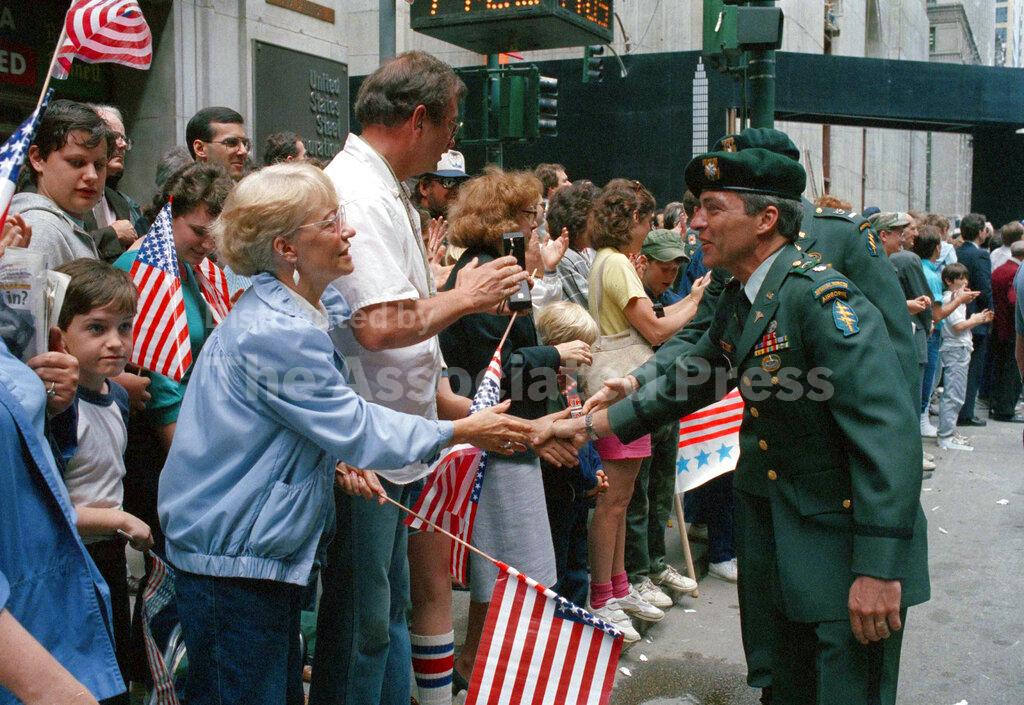
An estimated 200,000 people marched in Chicago today in what sponsors called the largest parade of Vietnam veterans ever held, and a half million spectators cheered them. As the parade wound through downtown Chicago, the crowd threw tickertape and kisses at the veterans and waved banners with such mottos as “Honor the Warrior, not the War.” The veterans, from as far away as Australia, came to town for a Flag Day weekend highlighted by the parade and the dedication Thursday of a copy of the Vietnam Memorial wall commemorating the 58,000 Americans who were killed in the war.
A judge gave Mayor Harold Washington a partial victory today in his continuing quest to put aldermen loyal to him into key positions of the City Council. The judge, Arthur L. Dunne of Cook County Circuit Court, upheld the right of the Mayor’s new working majority to amend a Council rule that had required a two-thirds vote to change committee chairmen. The rule was altered last Friday, with Mr. Washington casting a tie-breaking vote when the Council was deadlocked 25 to 25. The new rule provides that a simple majority is enough to change committee chairmanships.
A Federal district judge today instructed the jury in the espionage trial of a former agent of the Federal Bureau of Investigation, Richard W. Miller. The jury will begin its deliberations Monday. In a time full of espionage cases, that of Mr. Miller, a 49-year-old former counterintelligence agent in the bureau’s Los Angeles office, has been one of the strangest. Mr. Miller, who was dismissed by the bureau shortly before his arrest a year and a half ago, was the first bureau agent ever charged with espionage. Mr. Miller is accused of conspiring with a Russian emigre who was his lover, Svetlana Ogorodnikov, to pass classified documents to the Soviet Union in return for a promise of $65,000 in cash and gold.
Seven suspended or former Miami police officers used their police jobs to run a drug operation that used murders, threats and bribery, according to a Federal indictment unsealed today. State prosecutors said they were dropping earlier charges, including first-degree murder counts against three of the officers. Four defendants are charged in the 21-count Federal racketeering indictment with five civil rights violations, including killings. The indictment names four slaying victims, including three reputed cocaine smugglers who drowned last July 28 when they were purportedly forced into the Miami River by the police in a cocaine theft, and a man whose body was found in a dump last August. The seven officers were charged as part of investigations that have resulted in criminal or administrative charges against at least 30 members of the 1,050-member city police force.
Robert Dean Cardin, the 3-week-old first identified as “Baby Calvin,” received a new heart today, hours after his parents appealed for Congress to improve an organ donor network that allowed their child to be bypassed in favor of a more-publicized baby. “The infant’s vital signs are good and his blood pressure is stable,” said Dr. Constantine Mavroudis, who performed the 4 ½-hour operation, his first infant heart transplant. Robert, whose family wished to remain anonymous, had been dubbed Baby Calvin, but his parents, Wendell and Patricia Cardin, let the hospital release their names today, a spokesman at Kosair Children’s Hospital said. Robert and Baby Jesse, a California infant who received his heart transplant Tuesday after his parents made public pleas for a donor heart, were both born with hypoplastic left heart syndrome, a congenital defect. Robert had been on the nationwide organ-donor list since May 30, before Baby Jesse’s name was added.
A lawsuit accusing Los Angeles County of systematic discrimination against women and members of minority groups was filed today on behalf of 47,000 employees. Locals 660, 434 and 535 of the Service Employees International Union charge in the suit that the county discriminates against women and minorities by paying them far less than it pays white men in similar jobs and promoting them less often.
Organized medicine is seeking to limit the rapid growth in the supply of doctors, particularly specialists, which leaders in the profession say is making a dent in the substantial incomes most physicians receive. A report issued by the American Medical Association’s board of trustees calls for doctors, states and education officials to review the size of medical school enrollments and urges standards that would limit the admission of foreign-trained doctors into the American medical system. The report represents a major reversal by the association, which is moving with extreme caution in view of antitrust constraints. For years the association has said it believed market forces, rather than regulation or planning, should determine supply and demand for medical services. Now, however, the board says “market forces cannot be relied upon by themselves.”
Benny Goodman died, apparently of a heart attack, at his Manhattan home at the age of 77. Mr. Goodman, the King of Swing, used his clarinet to lead a generation of music fans into the Big Band era. The death of the man who brought jazz to Carnegie Hall and enthralled millions with renditions of “Sweet Georgia Brown” and “Stompin’ at the Savoy” brought expressions of grief and loss from his colleagues. Lionel Hampton, the vibraphonist, recalled that Mr. Goodman was the first major music figure to put black and white musicians together on stage in the 1930’s. “The most important thing that Benny Goodman did,” he said, “was to put Teddy Wilson and me in the quartet. It was instant integration. Black people didn’t mix with whites then. Benny introduced us as Mr. Lionel Hampton and Mr. Teddy Wilson. He opened the door for Jackie Robinson. He gave music character and style.”
Major League Baseball:
Gene Michael, twice a Yankee manager and the team’s third-base coach the past three seasons, was named manager of the Chicago Cubs today. The Cubs dismissed Jim Frey on Thursday and named John Vukovich, a coach, to manage the team for its doubleheader against the St. Louis Cardinals today.
The Atlanta Braves edged the Cincinnati Reds, 3–2. Bob Horner singled home Omar Moreno with the tie-breaking run in the fifth inning, giving Atlanta a victory before the Braves’ largest home crowd of the year, 38,280. Moreno drew a walk from John Denny (4–6) and advanced on a sacrifice by Rafael Ramirez. After Dale Murphy walked, Horner grounded a single to left for his seventh game-winning hit of the season.
Bob Tewksbury, the rookie who so impressed Manager Lou Piniella in the spring, returned from his banishment to the bullpen tonight and shored up the Yankees’ sagging pitching forces. Tewksbury, starting for the first time in 16 days, allowed only one run and four hits in six innings as the Yankees defeated Baltimore, 3–1, and supplanted the Orioles in second place in the American League East. The Orioles had displaced the Yankees with a three-game sweep at Yankee Stadium last weekend. In winning tonight, the Yankees are halfway to a sweep of this four-game series. It has been an unlikely pair of victories because the games were started by Alfonso Pulido, just up from the minor leagues, and Tewksbury, just out of the bullpen. Neither pitcher was in Piniella’s plans earlier in the week. He had planned on starting Tommy John and Bob Shirley, but John went home and then on the disabled list with a strained left Achilles’ tendon, and the manager decided Shirley was more valuable in the bullpen.
Jim Rice went 2 for 3 and doubled home a fifth-inning run tonight, leading the Boston Red Sox to a 5–3 victory over the Milwaukee Brewers. Dennis (Oil Can) Boyd, now 8–4, struggled through the first six and a third innings, allowing 10 hits while walking two and striking out five. Bob Stanley earned his 11th save of the season. Teddy Higuera (8–5) took the loss. With the score 3–3 in the fifth, Boston scored twice. Marty Barrett led off with a double but was cut down at third on a Boggs grounder. Bill Buckner reached on the first baseman Cecil Cooper’s error, advancing Boggs to third. Rice followed with his double to left-center field, scoring Boggs to give the Red Sox a 4–3 lead. Don Baylor was intentionally walked to load the bases before Dwight Evans’s sacrifice fly to right scored Buckner to make the score 5–3. Trailing by 3–1, the Brewers tied the score in the fifth. Charlie Moore started with a single and advanced to third on Robin Yount’s one-out single. Cooper’s infield out scored Moore, advancing Yount to second. Ben Oglivie lined a two-out single to left to score Yount for a 3–3 tie.
The Kansas City Royals routed the California Angels, 10–2. Steve Baiboni drove in four runs on two homers as the Royals beat California in a game halted for 38 minutes by a third-inning power failure. Bret Saberhagen (4–6) scattered seven hits in seven innings of work to get the win.
The pinch-hitter Thad Bosley’s run-scoring single in the 11th inning lifted Chicago to an 3–2 victory for a split of a doubleheader with St. Louis. In the opener, the Cardinals ended a four-game losing streak in 10 innings, winning, 1-0, behind the rookie left-hander Greg Mathews (2–1). Ryne Sandberg opened the 11th inning of the nightcap with a walk, went to third on single by Keith Moreland and scored as Bosley singled through a pulled-in infield. Lee Smith (3–4) was the winner; Todd Worrell (3–5) was the loser.
The Indians clobbered the Twins, 11–2. Andre Thornton drove in five runs with a two-run single and three-run homer and Brook Jacoby and Mel Hall each knocked in a pair as Cleveland got its fifth consecutive victory. Tom Candiotti (4–6) allowed 11 hits while striking out eight and walking none in his fourth complete game. The attendance was 61,411, the largest crowd in the majors this season.
It took San Francisco’s Chili Davis until the ninth inning to quiet a rowdy Houston Astros crowd, but his three-run homer silenced the cheering fans. “It’s my first home run in the Astrodome so it was an even bigger hit for me,” said Davis, whose ninth inning blast over the rightfield fence gave the Giants a 3–1 victory. “I’ve had a tough time in the Astrodome. They shut me out here earlier this year.” Davis’ homer came off reliever Dave Smith and spoiled another outstanding performance by starter Mike Scott, who struck out seven and gave up only four singles in 8 ⅓ innings. “It was a forkball and I just threw a bad pitch,” said Smith, who yielded only his second homer of the season. “I felt fine. I just threw a bad pitch and he hit it.”
It was an odd ending to one of the more curious games of the Mets’ brilliant season, but it ended up as it almost always does: with the Mets winning, this time by 6–5, over the Pirates last night at Shea Stadium. Darryl Strawberry singled with two out in the bottom of the ninth to send Mookie Wilson home with the winning run. This came about after the Pirates had scored two in the top of the inning to tie the score off of the reliever Jesse Orosco. It was the second survival test of the night for the Mets. They had also endured the second inning, when Dwight Gooden simply lost his control — walking four, throwing a wild pitch — and then just as suddenly regained it. His final pitching line read: three runs and five walks, but also only three hits and 13 strikeouts in eight innings of work.
The Rangers edged the A’s, 2–1. Pete Incaviglia drove in his second run of the game with a tie-breaking, eighth-inning single as the Rangers won for the 10th time in their last 11 games. Texas pitcher Jose Guzman, 6–6, scattered seven hits in 7 ⅔ innings and sent the A’s to their ninth straight loss. Greg Harris finished up for his 12th save.
The Expos bowed to the Phillies, 2–1. Steve Jeltz singled home Glenn Wilson with the bases loaded and one out in the bottom of the ninth, giving Philadelphia a victory and ending the Expos’ four-game winning streak.
The Dodgers downed the Padres, 6–2. Fernando Valenzuela pitched a six-hitter for his ninth complete game of the season, backed by Bill Madlock’s three-run homer, as the Los Angeles Dodgers beat San Diego. Valenzuela, 9–4, struck out seven batters, walked one, and retired the last 10. He leads the National League in complete games.
John Moses’ single over a drawn-in outfield scored Spike Owen from third base with the winning run in the ninth, lifting Seattle to a slugfest 11–10 victory over the White Sox. Owen led off with a double to left. Steve Yeager singled him to third. Harold Reynolds walked, loading the bases for Moses. Bill Dawley, 0–4, took the loss. Matt Young earned the victory to improve to 5–4.
Darrell Evans drove in four runs, including three with a home run, to pace Detroit as the Tigers beat the Blue Jays, 10–5. Evans, who had three hits, broke the game open with his 10th homer of the season in the Tigers’ four-run third. The rookie Eric King (2–0), who was ripped for five hits and four runs in the first inning, settled down to limit the Blue Jays to two hits over the next five and a third innings before being replaced by Chuck Cary in the seventh.
Cincinnati Reds 2, Atlanta Braves 3
New York Yankees 3, Baltimore Orioles 1
Milwaukee Brewers 3, Boston Red Sox 5
Kansas City Royals 10, California Angels 2
St. Louis Cardinals 1, Chicago Cubs 0
St. Louis Cardinals 2, Chicago Cubs 3
Minnesota Twins 2, Cleveland Indians 11
San Francisco Giants 3, Houston Astros 1
Pittsburgh Pirates 5, New York Mets 6
Texas Rangers 2, Oakland Athletics 1
Montreal Expos 1, Philadelphia Phillies 2
Los Angeles Dodgers 6, San Diego Padres 2
Chicago White Sox 10, Seattle Mariners 11
Detroit Tigers 10, Toronto Blue Jays 5
Wall Street rallied impressively yesterday, with the Dow Jones industrial average regaining much of the ground it lost earlier in the week as new signs of a lackluster economy proved a potent elixir for the troubling interest rate environment. The Dow, which fell a record 45.75 points on Monday, recouped 36.06 points yesterday, to 1,874.19, its eighth-best one-day point gain ever. For the week, the Dow lost 11.71 points. “The stage was set for the market by the light selling during the downturn of the last few days,” said Alan Ackerman, market analyst with Herzfeld & Stern. “It kept investors on the sidelines but didn’t signal the beginning of a serious correction.”
Dow Jones Industrial Average: 1874.19 (+36.06)
Born:
Ashley and Mary-Kate Olsen, twin American actresses (Full House — “Michelle”), and fashion designers, in Sherman Oaks, California.
Kat Dennings [Litwick], American actress (“2 Broke Girls”, “Thor”), in Bryn Mawr, Pennsylvania.
Jonathan Lucroy, MLB catcher and first baseman (All-Star, 2014, 2016; Milwaukee Brewers, Texas Rangers, Colorado Rockies, Oakland A’s, Los Angeles Angels, Chicago Cubs, Boston Red Sox, Washington Nationals, Atlanta Braves), in Eustis, Florida.
Clyde Gates, NFL wide receiver (Miami Dolphins, New York Jets), in Vernon, Texas.
Myron Pryor, NFL defensive tackle (New England Patriots), in Louisville, Kentucky.
Sequoia Holmes, WNBA guard (Houston Comets, Phoenix Mercury, San Antonio Silver Stars, Las Vegas Aces), in North Las Vegas, Nevada.
Died:
Benny Goodman, 77, American clarinetist and bandleader, known as the ‘King of Swing’ (“Stompin’ at the Savoy”; Moonglow”; “Sing, Sing, Sing”), of a heart attack.
Jim Ferrier, 71, Australian golfer (PGA Championship, 1947).
 History Diaries