Adolf Hitler met with his High Command regarding Operation BARBAROSSA, the invasion of the Soviet Union. Hitler, who already has absolved in advance Wehrmacht troops of all crimes they may commit during Operation BARBAROSSA, expands upon previous orders such as the Commissar Order of 6 June 1941. He reiterates that Soviet prisoners of war do not have to be treated according to the Articles of the Hague Convention and Geneva Convention. He reasons that the USSR is not covered by the treaties because it has not signed them. This means that they do not have to be fed or housed properly and so forth. In addition, as previously ordered, he emphasizes that Soviet Commissars are “not to be considered POWs” and are to be shot upon capture. It is certain that these orders are illegal and contrary both to treaties and the rules of warfare.
According to notes taken by a Luftwaffe general, at one point Hitler says:
“The main enemy is still Britain. Britain will fight on as long as the fight has any purpose; this is typical of the British, as we have seen from their individual soldier’s conduct in Flanders, and it was demonstrated again by Dunkirk, by Greece, and by Crete. But Britain’s fight only makes sense as long as they can hope that American aid will take effect and that they may find support on the continent. This explains why they have high hopes that the Russians will intervene and tie down the Germans, wearing down our war economy while the balance of power is tilted by American aid. At present this is very meager; it will not become effective until the summer of 1942, assuming they have enough shipping tonnage to bring it over here; and the shipping losses are increasing.
“The proof of [Britain’s] advances to Russia is the complete uniformity in their press treatment of Cripps’s journey.(1) Russia’s attitude is perpetually obscure; she exploited every moment of political or military preoccupation elsewhere to raise immediate political demands. We can see this happening in Russia’s intervention in the Polish campaign, and again against the Baltic states and Finland, and now in the Balkans (Bessarabia, and the treaty of friendship with Yugoslavia).
“Our attempt to “clarify the position” met with the following objections from Molotov. First question, What does our guarantee to Romania mean and would we object to a Russian military mission? The second question concerning the Dardanelles, and the third about Finland. In other words continual efforts to push in somewhere. Since these efforts coincided chronologically with various temporary weaknesses in the German position, we would have to expect them to use every chance they can in the future to act against Germany’s interests. The Russian armed forces are strong enough to prevent us from demobilizing soldiers and feeding them into the arms and consumer-goods industries so long as this latent Russian threat persists. Even if we made peace with Britain this would still be so. We want this conflict to come early, however ; indeed it is absolutely vital if we are not to forfeit the favorable conditions that prevail. The bulk of the Russian forces are standing on the frontier, so we have a good chance of defeating them right there.”
Hitler admits during his typical monologue that Soviet troops outnumber the Wehrmacht. He reasons that this problem is surmountable because of the higher quality of German troops.
There is an awkward moment when Reichsmarschall Hermann Goering, attempting to be positive (he has expressed his doubts about Operation BARBAROSSA in private), stands up and yells that the victory over the Soviet Union will rival those of Hitler’s previous victories. Hitler, however, does not take the bait. Instead, he darkly warns that Operation BARBAROSSA will be the “toughest” fight yet because Germany “shall be fighting an ideological enemy and an ideological enemy of fanatical persistence at that.”
Commander Theodore Eicke of the SS Death’s Head division informs his officers of Hitler’s “Commissar” order to kill all Communist officials on sight. Some commanders later claim, however, not to have informed their men of the order.
The Germans instruct their vessels in Soviet ports to leave.
British quarters said tonight that Germany had increased her forces in Finland to two divisions, and elsewhere had disposed 130 fully equipped divisions facing Soviet Russia. Information from authoritative Finnish sources, it was reported, said the bulk of the two German divisions, perhaps 30,000 men, had been concentrated at Rovaniemi, above the Gulf of Bothnia.
A Hungarian broadcast said tonight that “according to reports from Istanbul the Soviets are understood to have withdrawn the concentrations of troops lined up along the Turkish frontier and to have launched moves of divisions to other fields.” The broadcast was heard in New York by C.B.S. The direction in which the troops are being shifted was not stated.
Foreign Minister Vyacheslav Molotov tells German Ambassador Friedrich Werner von der Schulenburg that “only a fool would attack Russia.” Schulenburg secretly basically agrees but has an inkling of what is to come. Molotov informed Friedrich Werner von der Schulenburg that the Soviet Union was to publish, on the next day, that the rumors of a German attack on the Soviet Union were all fabricated by the British.
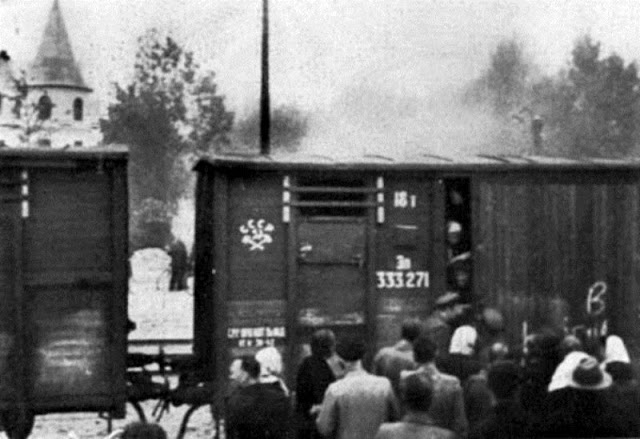
The June Deportation, which was the first major wave of Soviet mass deportations and murder of Estonians, Latvians and Lithuanians, began. Arrests in Estonia began after Soviet Union occupied Estonia in July 1940, but they are made quietly. There were about 7,000 people arrested before 14 June, mostly Estonian politicians, high level officers and others whom the Communists considered dangerous. The procedure for the deportations was approved by Ivan Serov in the Serov Instructions. People were deported without trials in whole families, which were then split. Men were generally imprisoned and most of them died in Siberia in Gulag camps. Women and children were resettled in forced settlements in Omsk and Novosibirsk Oblasts, Krasnoyarsk, Tajikistan, Altai Krais, and Kazakhstan. Thousands of people were stuffed into cattle cars, usually under unsanitary conditions, leading to casualties, especially among the elderly and children. Due to poor living conditions at the destination, the mortality rate was very high. For example, the mortality rate among the Estonian deportees was estimated at 60%.
Eight days to BARBAROSSA.
British tanks gathered on the Egyptian-Libyan border to prepare for a major offensive; Germans reinforced the front lines and strengthened the siege on Tobruk, Libya as they detected the British movement. After sundown, German artillery bombarded Tobruk. British troops move forward to jump-off points for Operation Battleaxe. This is an offensive on the Libyan border designed to relieve Tobruk. British Middle East Commander General Bernard Wavell anticipates that German General Erwin Rommel has his tanks tied down around Tobruk and that his armor will cut through the defending German infantry easily.
Due to careless wireless signals on the British side, Rommel learns eight hours before the British offensive begins that it is coming. He immediately orders reinforcements to the border. The main German force that will bear the brunt of the British offensive is the 15th Panzer Division. The German 5th Light Division also is available on the Tobruk perimeter.
Wavell orders this night the launch of Operation BATTLEAXE, which has as its aim the destruction of Rommel’s forces and to achieve a decisive victory in North Africa. If all else failed the attack might at least relieve Tobruk. The attack was to be led by the new commander of 13 Corps. Lt-General Beresford-Pierse, who had replaced the captured General Neame. To achieve this aim, the British had to capture the old frontier posts at the Halfaya Pass, Fort Capuzzo and Sollum in the first attack. This would be achieved by the Indian 4th Division with the Matilda tanks of the 4th Armoured Brigade in close support. Once they had succeeded in penetrating the enemy line, 7th Armoured would come forward, join with 4th Armoured and break through to Tobruk. This done, 7th Armoured, now reinforced by the Tobruk garrison, would push on and secure a line along the axis between Derna and Mechili. Wavell estimated that Rommel had 13,000 men and 100 tanks close to the wire with another 25,000 men and 200 tanks around Tobruk, 80 miles to the west. The true figures were that the British had 300 assorted tanks to Rommel’s 200, of which only about 100 were the gun-armed PzKw IIIs and IVs. But Rommel had prepared a defensive line and moved all his anti-tank forces forward, including 88mm guns, which could easily penetrate the thick armor of the Matildas.
In a letter to General Hastings Ismay, Winston Churchill criticized Bernard Freyberg’s tactical handling of the defense of Crete, Greece, in particular the fact that no counter-attack had been mounted in the western sector (e.g. around Maleme airfield) for 36 hours after the initial German assault.
Operation EXPORTER continues on 14 June 1941, but the Commonwealth forces run into fierce Vichy French opposition. The Australian 21st Brigade continues attacking Sidon on the coast road but still fails to completely secure the city. The French forces use Renault R35 tanks to good effect, and other Australian troops have to be called up from the southeast to outflank the defenders. The defending French pull out during the night after a hard-fought defense.
The 25th Brigade of the Australian 7th Division consolidates its hold on Jezzine, a key stop on the road to Beirut. To the east, the French force in Ktriese tries to block the British advance.
The Vichy French Navy sends two destroyers out of Beirut at 16:20 to shell the advancing Australians, but New Zealand cruiser HMNZS Leander and British destroyers send them back to port. British destroyers HMS Jervis and HMS Griffin bombard Sidon.
Fierce air battles develop offshore, where the Axis forces attack the Royal Navy ships off Tyre. Curtiss Tomahawks of RAAF No. 3 Squadron shoot down three bombers.
Croatia became the newest member of the Tripartite Pact.
Assets of German and Italian nationals in the United States were frozen.
A year ago the Germans occupied Paris. A humiliating surrender was only days away. Twelve months later, despite the acquiescence of the pro-Nazi regime in Vichy, there are signs that resistance is beginning to stir in occupied France. A coal-miners’ strike has just ended in the Pas-de-Calais region, which cost the Germans 500,000-tons of coal. 100,000 miners downed tools on 26 May, shouting “No coal for the enemy” and paralyzing two entire regions.
This show of strength, along with the student demonstration in Paris in 11 November, is the most spectacular resistance action France has yet seen. But so far the Resistance lacks both finances and organization within France. Most would-be resistors prefer to work alone or in small groups. The circles of intellectuals, like the famous group ‘Musee de l’Homme’ which suffered severe losses in February, prefer to hand out pamphlets or clandestine newspapers. Others have opted for concrete action, like sabotaging some military installations, storing weapons, helping Jewish prisoners to escape and organizing uprisings. Paul Koepfler managed to help 120 people escape to the south on Christmas Eve; soon after he was arrested by the Germans. The risks are extremely high, regardless of the type of resistance chosen — especially since informing on one’s neighbors is encouraged by the Vichy rulers. Many French citizens oppose the enemy by means of individual gestures, like placing flowers at the ‘Arc de Triomphe’ or tearing up German posters. Despite the arrests, the torture and the deportation awaiting the resistance, the number of people joining the resistance movement continues to grow.
Given Vichy French unwillingness to ratify the Paris Protocols, they essentially become a nullity aside from the Luftwaffe use of airfields in the Levant — which at this point is a fairly useless concession given the fall of Iraq to the British.
British aircraft carriers HMS Ark Royal and HMS Victorious, escorted by cruiser HMS Renown and 7 destroyers, set sail from Gibraltar for Operation Tracer and launched 47 Hurricane fighters for Malta; 43 of them would reach their destination safely. The carriers and their accompanying escorts, Force H, then return to Gibraltar.
The Luftwaffe sends eight He 111s of KGr 100 to attack the aircraft factory at Filton. The Luftwaffe loses one plane and the attack causes little damage.
The British RAF began daylight fighter sweeps across northern France. German Luftwaffe ace Oberfeldwebel Robert Menge was shot down and killed near Marquise, France by Squadron Leader James E. Rankin of No. 92 Squadron RAF. At the time of his death Menge had 18 kills to his credit.
Hans-Joachim Marseille suffered damage in the engine of his Luftwaffe fighter and was forced to crash land in friendly territory in Libya. He returned to based, took off in another fighter, and later was shot down once again, and again was able to crash land and escape unharmed.
RAF Bomber Command, Day of 14 June 1941
30 Blenheims on coastal sweeps, to Brest and on a Circus operation to St-Omer airfield. 1 aircraft lost.
RAF Bomber Command, Night of 14/15 June 1941
Cologne
29 Hampdens. The target was completely cloud-covered. 25 aircraft bombed estimated positions but Cologne reports only light damage with approximately 2 bomb loads in the city, 1 person killed and 1 injured. No aircraft lost.
Air Chief Marshal Sir Philip Joubert becomes AOCinC (commander) of RAF Coastal Command.
Italian planes based on Rhodes bomb Suez Bay.
U-751, commanded by Kapitänleutnant Gerhard Bigalk, sank British steamer St Lindsay (5370grt), which departed on 31 May from UK, in 51N, 30W. At 0346 hours on 14 June 1941 the unescorted St. Lindsay (Master Oliver John Stanley Hill), detached from convoy OG.64, was hit on port side underneath the bridge by one G7e torpedo from U-751 while steaming at 9 knots in rough sea about 580 miles east of St. John’s, Newfoundland. The U-boat fired the torpedo on the surface from a distance of only 350 meters, remaining unseen in the dark night with low visibility, after having missed the ship with a first torpedo at 0248 hours. The hit caused a very heavy detonation after which the vessel rapidly settled by the bow and sank vertically with the stern raising out of the water after 80 seconds. St. Lindsay had been reported missing after leaving the convoy and was presumed lost in approx. 51°N/30°W. The master, 35 crew members, six gunners and five passengers (naval personnel) were lost. Among those lost in the steamer were P/T/Sub Lt (A) P.G. Cliff RNVR, P/T/Sub Lt (A) B. Burletson RNVR, and P/T/Sub Lt (A) G.F. Robinson RNVR, en route to Fleet Air Arm base Goshawk for duty in 752 Squadron, T/LT (A) J.H. Crane RNVR, en route to Fleet Air Arm Base Goshawk for duty in 793 Squadron, and T/A/Lt Cdr C.J. Gordon-Canning RNVR, en route to duty in Benbow. The 5,370-ton St. Lindsay was carrying general cargo and was headed for Buenos Aires, Argentina.
Having been torpedoed off Norway by an RAF Beaufighter, Kriegsmarine heavy cruiser Lützow returns to Kiel under its own power. It will be out of commission for about a year.
Aircraft carriers HMS Furious and HMS Argus, Greek liner Nea Hellas (16,991grt), and destroyers HMS Cossack, HMS Maori, and HMS Sikh arrived in the Clyde.
CS.2 transferred his flag to light cruiser HMS Arethusa.
Indian sloop HMIS Sutlej departed Scapa Flow at 1000 for the Clyde to join the Western Approaches after working up.
Destroyer HMS Eclipse departed Plymouth at 1315 for Scapa Flow on completion of her refitting. The destroyer arrived at Greenock at 1700/15th with engine problems. The destroyer was able to continue at 0900/17th and arrived at Scapa Flow at 0630/18th.
Destroyers HMS Electra, HMS Anthony, and HMS Antelope departed the Clyde and topped off fuel at Londonderry to escort a special outbound troop convoy LC.1 of armed merchant cruisers HMS California and HMS Bulolo for Halifax, Bulolo on to Baltimore for refitting, steamer Mendoza for Montreal, and steamer Ulysses en route to the Far East. On the 17th the destroyers parted company with the convoy and steamer Ulysses was detached for independent passage. Destroyers Electra and Anthony proceeded to Scapa Flow and destroyer Antelope to Iceland. Battleship HMS Revenge joined the convoy on the 19th and escorted the convoy to Canada. Destroyer Antelope arrived at Hvalfjord at 0925/19th.En route to Scapa Flow, destroyers Electra and Anthony were detailed to search for a submarine reported by aircraft in 56-10N, 10-58W. The search continued until 0600/20th. Destroyer Electra arrived at Scapa Flow at 2200/20th. Destroyer Anthony arrived at Loch Ewe at 1730/20th to refuel. She then continued and arrived at Scapa Flow at 0100/21st.
Anti-aircraft ship HMS Alynbank departed Methil at noon to cover convoy EC.32. Departing the convoy in Pentland Firth, the ship arrived in Scapa Flow at noon on the 15th.
Submarine HMS Thrasher departed Holy Loch for Gibraltar, arriving on the 20th.
Submarine HMS Severn departed Gibraltar for patrol in the Tyrrhenian Sea.
Destroyers HMS Jervis and HMS Griffin bombarded Sidon to ease opposition for the troops ashore.
Destroyer HMS Griffin sighted the two French destroyers off Beirut at 1620. When light cruiser HMS Leander closed to engage the destroyers, the French destroyers retired into harbor.
Submarine HMS Clyde sank Italian steamer Giovanni Bottigliere (former Guglielmo, 331grt) south of Sardinia.
Convoy OG.65 departed Liverpool, escorted by destroyer HMS Westcott, sloop HMS Deptford, and corvettes HMS Marigold and HMS Periwinkle, and anti-submarine trawlers HMS Syringa and HMS Holly. Corvettes HMS Auricula, HMS Freesia, and HMS Hibiscus and anti-submarine trawler HMS Rumba joined on the 15th. Trawler Rumba was detached later on the 15th, destroyer Westcott and corvettes Auricula, Freesia, Hibiscus, Marigold, and Periwinkle were detached on the 17th.Sloop Deptford was detached on the 18th. Submarine HMS Olympus and corvettes HMS Geranium, HMS Jonquil, and HMS Spiraea joined the convoy on the 22nd, and arrived at Gibraltar on the 28th with sloop Deptford, anti-submarine trawlers Syringa and Holly, whalers Gos 2 and Gos 3, and corvettes Geranium and Jonquil and submarine Olympus.
Convoy HG.65 departed Gibraltar, escorted by sloop HMS Wellington, submarine HMS Olympus, corvettes HMS Geranium, HMS Jonquil, and HMS Spiraea, and anti-submarine trawler HMS Lady Hogarth. Destroyer HMS Fortune departed Gibraltar on the 15th and joined the convoy for passage to the UK for refitting. The trawler was detached on the 20th and the remainder of the escort, except sloop Wellington, was detached on the 22nd. Destroyers HMS Chelsea, HMS Mansfield, and HMS Verity, corvettes HMS Begonia and HMS Jasmine, and catapult ship HMS Springbank joined the convoy on the 25th. Destroyer HMS Veteran joined on the 26th. The convoy arrived at Liverpool on the 29th.
President Roosevelt issued Executive Order 8785, freezing all German and Italian assets in the United States. At President Roosevelt’s direction, the U.S. Treasury Department today froze the American assets of Germany and Italy and simultaneously imposed a strict supervision upon all financial transactions with Soviet Russia or its citizens. How much the freezing order may accomplish was brought into question, however, by those who recalled, that Secretary of the Treasury Morgenthau recently said the axis powers, acting in anticipation of such a move, already have withdrawn sizable portions of their American funds. “The barn is empty,” was Morgenthau’s comment. U.S. President Franklin D. Roosevelt issued Executive Order 8785 freezing all German and Italian assets in the United States. “In view of the unlimited national emergency declared by the President, . . . The Executive Order is designed, among other things, to prevent the use of the financial facilities of the United States in ways harmful to national defense and other American interests, to prevent the liquidation in the United States of assets looted by duress or conquest, and to curb subversive activities in the United States.”
The order applies to the nations themselves and individuals of those nations. No reason is given in the text of the order, but it clearly is directed at the Axis powers (including the Soviet Union and its satellites). Notable from its absence on the list is Japan, which is subject to other sanctions.
In addition, the US State Department tells Germany and Italy to close all consulates in the United States except for their embassies. The United States demands damages and reparations from Germany, but the Reich ignores this demand. Germany quickly responds by telling the United States to close its consulates in the Reich, and Germany and Italy both begin considering freezing United States assets in Europe.
President Roosevelt’s order freezing the assets of all continental European countries and providing for a worldwide inventory of foreign assets in the United States, started the screws turning today on the most rigorous economic clamp this government could apply against the Axis Powers.
Undersecretary of State Sumner Welles, commenting at a press conference on a German spokesman’s statement that every ship carrying contraband to England would be sunk if caught, declared today that “the people of the United States never have been impressed with what they regarded as bluster or threats.” Arming of American merchant vessels was predicted in well-informed congressional circles today after Welles, Undersecretary of State, declared the United States would maintain its insistence on freedom of the seas despite German bluster and threats. One legislator, unwilling to be quoted by name but high in administration confidence, said that in view of the circumstances of the sinking of the freighter Robin Moor “the president is going to have to arm our merchant ships and tell them to protect themselves,” At the same time, the gravity of the current world situation was emphasized by a U.S. Navy disclosure that waters off New York harbor are to be mined immediately.
The sinking of US freighter Robin Moore off the African coast by U-69 (Kptlt. Jost Metzler) on 21 May 1941 results in sanctions against the Axis powers. It now is accepted even by isolationist United States Senator Gerald Nye (R-North Dakota) that the Germans sank the freighter. Nye states:
“The evidence that the Robin Moor was sunk by a German submarine is too complete to permit my declaration of yesterday noon, to the effect that the boat might have been sunk by Britain, to stand.”
The U.S. Government asked 55 eastern shipyards at work on defense orders yesterday to approve a two-year agreement designed to avoid strikes, stabilize employment and prevent needless migration of workers. The agreement was drafted at Washington by a shipbuilding stabilization committee set up by the labor division of the Office of Production Management and composed of representatives of employers, the navy, the maritime commission, the C.I.O. and the A.F.L.
Philip Murray, C.I.O. president, cleared up today the strike of 12,000 C.I.O. loggers in the Puget Sound area by persuading the union president, O. M. Orton, to abandon his defiant attitude and send the men back to work under a settlement formula of the National Defense Mediation Board.
Jesse II. Jones, federal loan administrator, said today he intended to provide nearly $1,000,000,000 to build plants for the 500-bombers-a-month program, drawing on his new defense spending powers. President Roosevelt this week signed a law expanding the powers of the Reconstruction Finance Corp. and the federal loan agency. Specifically it also gave the R.F.C. $1,500,000,000 additional special borrowing powers for defense purposes with virtually no strings attached. The R.F.C. already had committed all of a similar $1,500,000,000.
Large coastal defense rifles at Fort MacArthur, San Pedro, California, were fired in practice today for the first time in 14 years. Owners of several nearby homes claimed severe damage from the concussion and several plate glass windows were shattered. R. D. Cherry said not a single room of his two-year-old home escaped damage and that some of the walls were split. Army officials said compensation would be made.
Leon Henderson, Federal Price Control Administrator, fixed maximum prices today on hides, calf skins and kips in an effort to bring down the cost of shoes to government and civilian consumers.
Expressions of serious concern over labor-capital disputes in the present emergency were mingled with the patriotic appeals for unity and sacrifice as thousands of New Yorkers, young and old, gathered yesterday under the Stars and Stripes in various parts of the city in solemn observance of Flag Day.
Central North Atlantic patrols commenced with battleship/destroyer task groups. The battleship USS Texas (BB-35) and accompanying destroyers would inaugurate these patrols (see 20 June).
Ground is broken for Boeing Plant II (ex-AFLC Plant 13) in Wichita, Kansas.
The first tests of the launcher, rocket antitank, T1, codenamed “The Whip”, this is later known as the bazooka.
American stage and screen actress Tallulah Bankhead (39) divorces American actor John Emery (36) in Reno, Nevada after less than 4 years of marriage.
Jimmy Dorsey and his Orchestra have a No. 1 hit on the Billboard singles chart with “Maria Elena.” It is a 1932 popular tune written originally in Spanish by Lorenzo Barcelata and released by Decca Records (3968). The flip side is “Green Eyes,” which also will hit No. 1, making it a big double-sided hit recording.
Major League Baseball:
The Chicago White Sox broke a four-game losing streak today to defeat the Boston Red Sox, 5–2, and move within four percentage points of the third-place Bostonians. Lefty Ed Smith, who won Chicago’s last previous game when he set down the Red Sox a week ago, went the route. Wildness kept Mickey Harris, starting Red Sox pitcher, in trouble and he blew up completely in the eighth with the score tied at 1–1.
Vern Olsen, sophomore southpaw, allowing only three hits for his second consecutive shutout, the Chicago Cubs outmaneuvered both the rain and the Philadelphia Phillies for a 3–0 home-coming victory today. The Cubs got only five hits off Cy Blanton, Bill Crouch, Frank Hoerst and Ike Pearson, but the quartet of Philly pitchers tossed in nine passes, four of which figured in the scoring.
Before 44,161 at Yankee Stadium, the Yankees beat the Cleveland Indians, 4–1, for their sixth successive triumph and snapped Bobby Feller’s winning streak at eight games. Tommy Henrich started the fall of the matchless Feller with his tenth home run of the campaign in the first inning, a mighty blast into the lower right-field grandstand. On top of this, Joe DiMaggio walloped Feller for a third-inning double that was good for the second Yankee run, and Charley Keller slashed a single in the fifth to knock in a couple of more and place the game beyond the reach of the Indians. All the scoring in the game came with two out.
Elden Auker hurled shutout ball until the ninth inning when Wilson Miles doubled and Bob Johnson hit a home run as St. Louis scored an easy 7–2 victory over the Athletics today. The Browns went to work early, scoring two runs in the first when Johnny Lucadello, Walt Judnich and Roy Cullenbine blasted Bump Hadley with successive singles.
Long-range hitting drove the Pirates to an 8–2 victory over the Braves today. Vince DiMaggio and Al Lopez drove in five runs with two homers. Max Butcher allowed Boston seven hits, including a homer in the first inning by Babe Dahlgren and one in the seventh by Eddie Miller. DiMaggio’s circuit clout came in the sixth after Fletcher had walked. Lopez struck his homer in the eighth, bringing home Fletcher and DiMaggio. All four homers disappeared over the left-field wall.
Brooklyn takes the second game of their series against the Cardinals, scoring 7 runs in the 6th to win 12–5. A ladies’ day crowd of 11,241 in St. Louis, including 5,885 paid, had enjoyed five innings of Harry Gumbert’s shutout pitching and was stunned into silence in that devastating sixth. The big blow of the frame, the fifth of six straight hits, was Dolph Camilli’s fourteenth homer of the year, with two mates aboard. Pete Reiser, finding his batting eye against Gumbert, contributed another long homer off Sam Nahem in the eighth, when the Dodgers scored four more runs.
The scheduled game between the New York Giants and the Reds at Cincinnati was postponed due to rain. The game will be made up as part of a doubleheader on July 31.
The scheduled game between the Detroit Tigers and the Senators at Washington was postponed due to rain. The game will be made up as part of a doubleheader tomorrow.
Chicago White Sox 5, Boston Red Sox 2
Philadelphia Phillies 0, Chicago Cubs 3
Cleveland Indians 1, New York Yankees 4
St. Louis Browns 7, Philadelphia Athletics 2
Boston Braves 2, Pittsburgh Pirates 8
Brooklyn Dodgers 12, St. Louis Cardinals 5
Swedish steamer Ningpo (6079grt) was damaged by a mine at Singapore when she picked up a floating mine in her screw. The steamer was towed to Hong Kong for repairs.
Three squadrons of Japanese bombers totaling twenty-seven planes raided Chunkking today, damaging poor riverside districts and destroying junks on the Chisling River. Casualties were light. Headquarters of the Japanese Central China Fleet said today that naval planes had raided Chungking again and had maintained “complete mastery of the air.”
Japan today is intently watching the reaction of the United States to the sinking of the Robin Moor. The matter is treated with extreme caution here, both official quarters and the press being reticent in their comments.
The resignation of Agriculture Minister Tadaatsu Ishiguro and his immediate replacement with Vice Minister Sekisai Ino again directed attention to Japan’s economic structure and the effects on it of the “China incident” and the defense program. Although statistical data have become rather meager in Japan because of the War Secrecy Act, neither the Premier, Prince Fumimaro Konoe, nor other government officials made any secret of the fact that production and distribution are not functioning as well as they should. Economic commentators accuse the government of lacking proper management and of unwillingness to use its power to correct the situation.
Japanese Foreign Minister Yosuke Matsuoka endorsed today the speech that Premier Mussolini made Tuesday before the Chamber of Fasces and Guilds, in which he said that Japan “would not remain indifferent in the face of American aggression against the Axis.”
After several days’ delay the decision of the Japanese Government on the deadlocked trade negotiations with the Netherlands Indies was dispatched to Kenkichi Yoshizawa, head of the Japanese delegation in Batavia, this afternoon, together with instructions for the course of the delegation.
The Japanese Vice-Consul in Hawaii, a Japanese intelligence officer posing as a diplomat, reports to Tokyo that a light cruiser has entered Pearl Harbor for repairs. The Japanese are keeping a very close eye on U.S. Navy fleet movements across the Pacific.
Dow Jones Industrial Average: 122.04 (-0.27)
Born:
Sam Baker, American gospel and soul singer (“I Believe in You”), in Jackson, Mississippi (d. 2019)
Mike Yarwood, British comedian and impressionist, in Bredbury, Cheshire, England, United Kingdom (d. 2023).
Yevgeny Frolov, Russian light welterweight boxer (Olympics, 1964 (silver medal), 1968), in Moscow, Russian SFSR, Soviet Union.
John Edgar Wideman, American writer (“Brothers and Keepers”), in Washington, District of Columbia.
Naval Construction:
The Royal Navy LCT (Mk 2)-class landing crafts, tank HMS LCT 133 and HMS LCT 139 are laid down by Stockton Construction (Thornaby, U.K.).
The U.S. Navy SC-497-class (110-foot wooden hull) submarine chaser PC-514 (later SC-514) is laid down by the Quincy Adams Yacht Yard Inc. (Quincy, Massachusetts, U.S.A.).
The Kriegsmarine (German Navy) Type VIIC U-boat U-303 is laid down by Flender Werke AG, Lübeck (werk 303).
The Kriegsmarine (German Navy) Type VIIC U-boat U-414 is laid down by Danziger Werft AG, Danzig (werk 115).
The U.S. Navy Gleaves-class destroyers USS Doran (DD-634) and USS Earle (DD-635) are laid down by the Boston Navy Yard (Boston, Massachusetts, U.S.A.).
The Royal Navy LCT (Mk 2)-class landing craft, tank HMS LCT 131 is launched by Stockton Construction (Thornaby, U.K.).
The Royal Canadian Navy Bangor-class (Diesel-engined) minesweeper HMCS Lachine (J 266) is launched by the Davie Shipbuilding and Repairing Co. Ltd. (Lauzon, Quebec, Canada).
The Kriegsmarine (German Navy) Type 39 torpedo boat T23 is launched by F. Schichau, Elbing, East Prussia (werk 1482).
The U.S. Navy 77-foot Elco patrol motor torpedo boat USS PT-34 is launched by the Electric Launch Company Ltd. (Elco), (Bayonne, New Jersey, U.S.A.).
The Kriegsmarine (German Navy) Type VIIC U-boat U-333 is launched by Nordseewerke, Emden (werk 205).
The U.S. Navy Gleaves-class destroyers USS Forrest (DD-461) and USS Fitch (DD-462) are launched by the Boston Navy Yard (Boston, Massachusetts, U.S.A.).
The Royal Fleet Auxiliary Dale-class fleet tanker RFA Dewdale (X 51; later A151) is commissioned. Her first commanding officer is Captain Robert I. Grimer, RFA.
The U.S. Navy stores ship USS Mizar (AF-12) [ex-Quirigua], lead ship of her class of 5, is commissioned. Her first commanding officer is Commander Edward Dewey Walbridge, USN.
The U.S. Navy Mizar-class stores ship USS Tarazed (AF-13) [ex-Chiriqui] is commissioned. Her first commanding officer is Commander James Monroe Connally, USN.
The U.S. Navy Arcturus-class cargo ship USS Betelguese (AK-28, alter AKA-11) [ex-Mormaclark] is commissioned. Her first commanding officer is Commander Harry Douglas Power, USN.
The U.S. Navy cargo ship USS Hamul (AK-30) [ex-Sea Panther; ex-Doctor Lykes], lead ship of her class of 2, is commissioned. Her first commanding officer is Commander Elwood Morse Tillson, USN.
The U.S. Navy repair ship USS Vulcan (AR-5), lead ship of her class of 4, is commissioned. Her first commanding officer is Commander Leon Sangster Fiske, USN.
The U.S. Navy Accentor-class coastal minesweeper USS Cotinga (AMc-43) is commissioned.
The Royal Australian Navy Bathurst-class minesweeper-corvette HMAS Lithgow (J 206) is commissioned. Her first commanding officer is Commander Alfred Victor Knight, RD, RANR(S).

