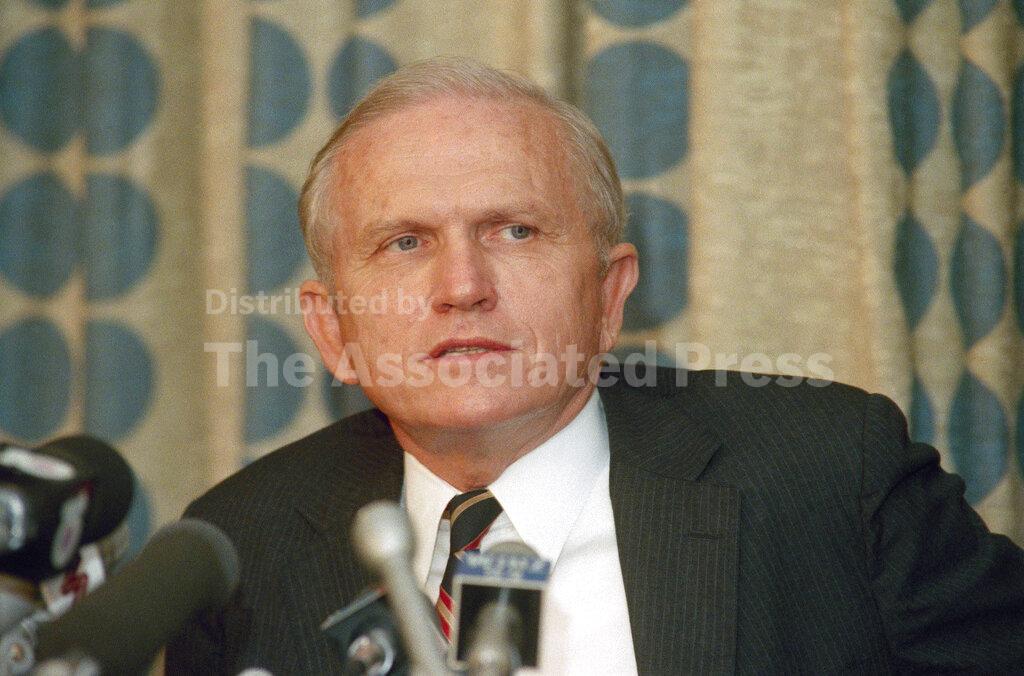
Amid sharp criticism of President Reagan’s decision to abandon the 1979 strategic arms treaty, Democrats and Republicans began efforts today aimed at forcing the White House to continue to observe the terms of the pact. In the House, Representative Norman D. Dicks, a Washington Democrat, introduced legislation that would bar any spending on strategic arms that violates the limits of the treaty. Representative Jim Wright of Texas, the majority leader, took the floor and spoke for the Democratic leadership when he said, “If there is any one thing the world clearly does not need and cannot afford, it is a new escalation of the nuclear arms race.” The Senate minority leader, Robert C. Byrd, a West Virginia Democrat, said he might support legislation to enforce the treaty’s provisions as an amendment to military spending bills when they reach the Senate floor.
Soviet Ambassador to Britain Leonid M. Zamyatin said Soviet leader Mikhail S. Gorbachev still wants a second superpower summit that “strengthens international security, creates trust and leads to curbing of the arms race.” He told a London news conference that a second summit between Gorbachev and President Reagan could reach agreements on a number of critical issues. The Soviet news media said the apparent U.S. decision to no longer be bound by the 1979 strategic arms limitation treaty could imperil chances for a summit in the United States this year.
President Reagan appealed to Congress today to continue to finance his space-based missile defense program and improvements in the nation’s nuclear forces. Mr. Reagan said budget cuts that would slow either program would be “the worst way to respond to the continuing pattern of Soviet activities.” The detailed statement reflected deep Administration concern that the five-year military buildup is in danger, especially the Strategic Defense Initiative, the missile defense program commonly known as “Star Wars.” In an eight-page message, Mr. Reagan warned that Congress was on the verge of imperiling the nation’s security, undercutting American negotiating efforts at the Geneva arms control talks and sending “precisely the wrong signal” to the Soviet leadership. “There is no free ride,” he said. Mr. Reagan was responding to developments that have raised significant doubts among Administration officials about the willingness of Congress to provide what they consider adequate military spending. There has been particular concern over a move in the Senate to sharply curtail spending on “Star Wars” research.
The President’s message was delivered as many lawmakers criticized his recent announcement that the United States planned to abandon the 1979 strategic arms limitation treaty at the end of the year. Democrats and Republicans began steps aimed at forcing the White House to observe the unratified pact. [ Page A13. ] Some Administration officials have expressed alarm that the decision to end adherence to the treaty could generate a backlash on Capitol Hill that would hurt financing for some strategic programs, including the MX missile and “Star Wars” research. “If they are going to sack arms control, it will cost them on S.D.I., ” said Representative Norman D. Dicks, Democrat of Washington, who introduced legislation that would bar any spending on strategic weaponry that violates the treaty’s provisions. The Senate’s budget proposal sets military spending for the next fiscal year at $301 billion, about $19 billion less than the President requested. The House version is about $35 billion less than what Mr. Reagan sought. The White House has been particularly concerned about a letter from 46 senators urging reductions in the missile-defense research program. The letter, written two weeks ago to Senator Barry Goldwater, the Arizona Republican who heads the Armed Services Committee, urged that Mr. Reagan’s request of $5.4 billion be cut to $3.1 billion, only a 3 percent increase from this year’s spending level. The President’s request amounted to a 77 percent increase.
About 18,000 people suffered from headaches, coughing, respiratory trouble and some spat blood after the Chernobyl nuclear disaster, and the death toll now stands at 25, Soviet doctors said today. Soviet newspapers also reported that a number of soldiers engaged in rescue work were being treated for radiation disease in Kiev, and that 177 Communist Party members, who are supposed to display particular discipline in times of stress, had failed to show up for work after evacuation of an 18-mile zone around the Chernobyl power station. The new death toll was given by Dr. Yevgeny I. Chazov, a Deputy Minister of Public Health, who said at a news conference that 23 people had died from radiation, besides two killed in the initial explosion at the Chernobyl plant on April 26. The previous total death count stood at 23.
Mikhail S. Gorbachev called on other nations today to join the Soviet Union in strengthening safeguards against nuclear disasters such as Chernobyl. In a message to Secretary General Javier Perez de Cuellar calling for an international convention on the subject, the Soviet leader also called for stronger measures to prevent acts of nuclear terrorism. “It is quite obvious that there is a practical need to start, without delay, setting up an international regime for the safe development of nuclear energy,” Mr. Gorbachev said. “Such a regime would be aimed at bringing to an absolute minimum a possibility of the peaceful atom causing harm to people.”
Vladimir Posner, the Soviet commentator now touring the United States, said today that he regarded Soviet jamming of some Western radio broadcasts as “counterproductive.” He said in an appearance at the American Enterprise Institute, a private research group, that in his “very personal evaluation” the jamming of Radio Liberty and Radio Free Europe, two American-financed stations broadcasting from Munich, East Germany, attracted undue attention to the programs. Mr. Posner is in the United States to make public appearances and to arrange a Soviet-American television program June 22 involving people in Boston and Leningrad to be aired in the two countries.
The Government of France is investigating charges that French officials knew as early as 1979 that Kurt Waldheim had given a false account of his World War II service with the German Army, a spokesman for Prime Minister Jacques Chirac said today. The investigation of the former United Nations Secretary General was ordered by Mr. Chirac’s office last week after Rabbi Marvin Hier, dean of the Simon Wiesenthal Center for Holocaust Studies in Los Angeles, gave the Prime Minister’s staff copies of what appeared to be a report on Mr. Waldheim’s wartime career prepared by the French Military Government archivist in Berlin and dated March 21, 1979. Officials here say the archivist’s report, first described in the Austrian magazine Profil in April, indicates that Mr. Waldheim was transferred on March 14, 1942, to the Staff of Gen. Alexander Lohr, an officer who was later executed for war crimes. Until recently, Mr. Waldheim had said he was excused from army service as a result of a wound at the end of 1941 and spent the rest of the war studying law in Vienna.
President Reagan today approved another yearlong extension of trade benefits to Rumania, but said he did so “with difficulty” because of its poor record on human rights. In a statement, the President said: “I am disappointed by the very limited response of the Rumanian Government to numerous expressions of strong U.S. public, Congressional and Administration concern about its performance in areas of human rights and religious issues.” Members of Congress had urged the President to deprive Rumania of so-called most-favored-nation treatment, which calls for the imposition of lower United States import tariffs granted to most countries.
A Polish official notified the United States in advance of the 1981 crackdown on the Solidarity union, according to a published report. Informed sources familiar with United States intelligence reports said the official, Colonel Wladyslaw Kuklinski, a senior Polish staff officer, had been a longtime source of information, The Washington Post reported today. After a Soviet official warned the Polish Government in November 1981 that plans for the crackdown had been disclosed to the United States, Colonel Kuklinski and his family were brought to the West by the Central Intelligence Agency, The Post reported. They now live in the United States under new identities, the newspaper said. According to The Post, the Polish Government spokesman, Jerzy Urban, said the United States could have prevented the imposition of martial law by making the plan public. But American sources said Colonel Kuklinski had been unable to provide the date — December 13, 1981 — on which martial law was to be imposed.
West German Chancellor Helmut Kohl announced that his government is creating an Environment Ministry, a move viewed as a political reaction to the Soviet nuclear power plant disaster at Chernobyl. Heading the new ministry will be the mayor of Frankfurt, Walter Wallmann, one of the more popular politicians in Kohl’s Christian Democratic Union. The party has fallen in public opinion polls since the Chernobyl accident April 26, partly because of the government’s confused reaction to radiation levels in West Germany.
A revised extradition treaty between the United States and Britain gained momentum today when the chairman of the Senate Foreign Relations Committee offered to amend it to meet objections that have kept it stalled in the committee since last fall. The chairman, Richard G. Lugar, an Indiana Republican, scheduled a committee vote for Friday morning. He initially set the vote for Wednesday, but postponed it after the committee’s Democrats, who hold eight of the 17 seats, asked for more time.
A fire destroyed a Murdoch plant in London. Bruce Matthews, an aide to publisher Rupert Murdoch, accused dismissed printers of setting the $9 million blaze. Some printers suggested the publishing company may have set the fire.
The fiercest fighting in a year engulfed West Beirut today as Shiite Muslim militiamen clashed in separate battles with Palestinians and a pro-Palestinian Sunni Muslim faction. By tonight, 53 people were reported slain and 242 wounded after a day and a night of nonstop clashes between the combatants. Thirty-two deaths were reported to have occurred in the street battles in West Beirut between the mainstream Shiite militia Amal and a Sunni faction called the February 6 Movement. Death totals for the fighting, which began 13 days ago, have not been reported. The state-run Radio Lebanon said the clashes today were a sequel to continuing fighting between Amal militiamen and Palestinian guerrillas in and around three Palestinian districts near the international airport, just south of the city proper. Amal has said it is determined to prevent the Palestinians from re-establishing a military presence in Beirut, fearing that a resurgence of Palestinian power could cut into the Shiites’ own influence. The majority of Palestinians are Sunni Muslims. The Shiites have also said they are determined to prevent a recurrence of the conditions that prevailed in Lebanon before 1982, when Israel invaded the country and drove out the Palestinian guerrillas. Amal used Soviet-built T-54 tanks supplied by Damascus in pounding positions of the February 6 Movement, while Sunni irregulars fired back with rocket propelled grenades, mortar and heavy machineguns. The city shook to the sound and thud of explosions that were going off at the rate of three a minute.
President Reagan told Republican Congressional leaders today that a Senate vote later this week on the sale of missiles to Saudi Arabia would “have a profound effect” on United States relations with Arab states. At stake in the vote, White House officials and Republican leaders emphasized, was nothing less than Mr. Reagan’s influence among the less militant Arab countries and his leadership at home. “The President’s leadership is on the line, particularly as far as Republicans are concerned” said Bob Dole, the Senate majority leader, after the Republican legislators met with Mr. Reagan. Senator Dole said: “We’re all running around the country praising Ronald Reagan for his great leadership, his 68 percent approval rating. And if we really believe what we say, then we ought to be with him on a critical issue like this.”
Iran has opened a new mobilization drive in its war with Iraq, asking volunteers to stay longer at the front and extending by two months the two-year military service for conscripts, Parliament Speaker Hashemi Rafsanjani said. Rafsanjani told the Islamic Republic newspaper that the steps are in response to Iraq’s new strategy of cross-border attacks. Rafsanjani, spokesman for the council monitoring the war effort, said the volunteers have been asked to extend their three-month tour at the front one month.
Sri Lankan President Junius R. Jayewardene told his ruling party’s parliamentary group that he will convene an “all-party conference” again to seek an end to the bitter ethnic conflict between the Sinhalese majority and the Tamils. Talks between the government and the Tamils collapsed in 1984. Observers have said the government’s last chance of avoiding all-out civil war is to induce moderate Tamils to accept a political settlement.
President Chun Doo Hwan met with the head of South Korea’s main opposition party today, but they failed to achieve any breakthrough on the central political issue here, a continuing debate over constitutional revision. The opposition leader, Lee Min Woo, president of the New Korea Democratic Party, said after the meeting that he was not satisfied with its outcome. Political leaders here had hoped it might produce an agreement that could speed constitutional change. But members of the ruling party said they believed the meeting had paved the way for more dialogue.
When Corazon C. Aquino, as a presidential candidate, first started talking about what she would accomplish in her first 100 days as President, one of her advisers recalls, “talk was easy” because she was not expected to take office. But now the reality is upon her with the 100-day mark on Wednesday, and the date has become a benchmark. Government ministers are rushing to complete projects or programs of reorganization, the armed forces have prepared a 100-day progress report and the President herself has scheduled a news conference Thursday. Her own staff has been monitoring her progress, and a group of technocrats known as the presidential management staff has drawn up a report listing her campaign promises and the action that has been taken on them. According to the 21-page report, titled “Promises Made by the President,” Mrs. Aquino has fulfilled 10 of her 100-day pledges, started work on six others and left one still pending. A tally is also included on dozens of other campaign promises.
The chairman of the Senate Foreign Relations Committee said today that the United States should show its support for the new Philippine Government by providing $100 million more in aid than the Reagan Administration has sought. “More is involved here than simply an infusion of economic resources,” the committee chairman, Richard G. Lugar, Republican of Indiana, said as the panel opened hearings on additional aid to the Philippines.
The U.S. International Trade Commission voted to impose penalty duties of 3% to 40% on Canadian and Taiwanese steel products used in oil and gas wells. The action affects $90 million a year in imports from Canada alone, according to the commission. In a 4-2 ruling, the commission found that firms in Taiwan and Canada have injured U.S. companies by “dumping” the steel goods in this country at below cost. The action came as Canada prepared to slap import duties on U.S. computer parts and publications to retaliate against U.S. tariffs on cedar products.
The police found no explosives in the homes or workplaces of the five Sikhs arrested in Montreal on Friday, Robert Beaudet, their lawyer, said. The five were arraigned on charges of conspiring to possess explosives with intent to injure. The Globe and Mail, a Toronto newspaper, reported that the accusations were in connection with a reported plot to blow up an Air-India Boeing 747 flying from New York on Saturday. The United News of India, quoting “official reports,” also reported that a jet flying to New Delhi was targeted by terrorists. The police and other Government officials are not commenting on the case, although they are expected to provide further details at a bail hearing set Wednesday morning in Montreal. In order to keep the men in jail, they will have to provide details as to why the men are dangerous.
President Reagan participates in a meeting with members of the Mexican-U.S. Interparliamentary Union.
The Salvadoran leftist guerrilla movement formally accepted an offer today to reopen peace talks with the government and said its most senior commanders would attend the meeting. In an official communique, the rebel Democratic Revolutionary Front and Farabundo Marti National Liberation Front said that they would send a four-member delegation to the talks and that they wanted the meeting to be held in San Salvador, the capital. The rebels said they would be represented by their two top military commanders, Joaquin Villalobos and Leonel Gonzalez, as well as by the two leading civilian politicians in the rebel alliance, Guillermo Manuel Ungo and Ruben Zamora.
Costa Rica granted political asylum to former Nicaraguan rebel leader Eden Pastora, who recently ended his insurgency against the Marxist-led Sandinista regime. Costa Rican President Oscar Arias Sanchez said the asylum was granted on condition that Pastora “respect the laws.”
Colombian guerrillas released a Fluor Corp. construction worker kidnaped last December, but a second worker taken hostage died in captivity, officials of the California-based engineering firm said. John Geddes, 56, reported that Edward M. Sohl, 62, a construction superintendent for San Francisco-based Bechtel, died of a heart attack on May 17. Geddes was in good health when released Monday and has already returned to the United States, a Fluor spokesman said in Irvine. The two men had been working on a pipeline Bechtel is building for Occidental Petroleum through the Colombian jungle.
South Africa’s largest labor federation said today that it would back a one-day strike on June 16 to mark the 10th anniversary of the 1976 Soweto uprising. The labor group, the Congress of South African Trade Unions, which says it has 500,000 members, issued the strike call in a joint statement with two anti-apartheid organizations, the United Democratic Front and the National Education Crisis Committee. The groups urged whites to support the one-day strike.
The Presidential commission on the space shuttle disaster will urge the space agency to review many critical components in the shuttle besides the faulty rocket joint that caused the disaster. Several of the 13 commissioners said in recent interviews that they particularly wanted to warn against what one called a “quick fix” to get the shuttle flying again before it is safe to do so. The final report on the January 28 disaster, which killed seven astronauts, is to be released Monday. The sources said it would assert that there were potentially hazardous safety problems in many aspects of shuttle operations. These will have to be addressed and key repairs made if necessary to prevent possible future losses of shuttles and their crews, the sources said. The components that have caused concern include, among others, the wheel, braking and steering systems and the main engines, several sources said. The wheel and braking systems have locked on some shuttle landings and pose a major threat to safety, according to astronauts. The main engines have long been considered one of the least reliable parts of the shuttle, largely because of valve failures, leaks from heat exchangers and premature wearing out of turbine blades. Although the main engines have been kept safe by replacing them frequently, one commissioner said, there is concern that the National Aeronautics and Space Administration might relax its vigilance. “There are probably several other items that are more important than the solid-rocket boosters” that failed on the Challenger flight, one commission member asserted. “We felt we couldn’t walk away from things that were obviously accidents waiting to happen.”
The commission will also disclose that it found no evidence to support suggestions that the White House exerted pressure on NASA to launch the Challenger, as some senators have suggested. And the commission will report that it made no major effort to determine definitively whether the astronauts on the Challenger died quickly as the shuttle broke apart or suffered tension-filled final minutes as the shuttle orbiter plunged toward the sea. The space agency’s own investigation has suggested that death came quickly, and the commission appears prepared to accept that, sources said. The commission will urge that the faulty rocket joints be made at least as strong as the rest of the rocket casing, that astronauts and contractors be given a greater role in recommending whether to launch a shuttle, that NASA consider again the possibility of installing an escape mechanism for astronauts on the shuttle, that communications within the space agency be improved so important safety problems can be brought to the attention of top management and that NASA’s overall decision-making be streamlined and centralized. The report will urge NASA to strengthen its quality assurance and reliability staffs, which have been sharply reduced in size over the last 15 years, one commissioner said. He expressed surprise that the quality assurance personnel were “almost totally noninvolved” in the arguments over what to do about erosion problems in the rocket joints and whether to launch the Challenger. “We couldn’t figure out why they were so uninvolved,” he said. “That’s got to be strengthened.” Calls for New Safety Panel The report will further recommend that NASA establish a new safety panel, to include astronauts, to review a wide range of issues, like technical problems with the brakes, the safety of various landing sites and the appropriate weather criteria to be used in decisions to launch the shuttle, the commissioner said.
Titan explosion investigators have identified a serious manufacturing and maintenance flaw that raises new concern about the safety of the space shuttle, according to senior space flight officials. They said they believed that a critical layer of insulation had peeled away from the inside of the Titan’s solid-fuel booster rockets, allowing flames to burn through the rocket casing.
The chairman of the Republican-controlled Senate Budget Committee today told President Reagan that unless he agreed to a revenue increase, not even the Senate’s 1987 military budget level would be approved. The Senate level is already $19 billion below what Mr. Reagan sought for the Pentagon, and the House of Representatives’ figure is $16 billion below that. “I wasn’t very optimistic without revenue,” the chairman, Pete V. Domenici of New Mexico, said he told the President at a meeting this morning. Mr. Reagan opposes a tax increase, which would be required to raise the $13.2 billion in new revenue included in the House and Senate budgets for 1987.
The Administration is considering selling the plants that process uranium for the nation’s nuclear power utilities, according to officials. Several said they would even consider giving away much of the business — a Federal monopoly — to stem the Government’s losses from running it. “I think the Department of Energy and the Administration would be interested in selling the whole shebang if they could,” said Thomas Gale Moore, a member of the President’s Council of Economic Advisers. As for giving the business away, Mr. Moore said, “I would consider it among the options if that’s the best you can do.”
The Senate urged the White House to release $5 million to refurbish a crumbling Capitol Hill shelter for the homeless — an act that would end a hunger strike by activist Mitch Snyder. The “sense of the Senate” resolution was adopted by voice vote during a day of lengthy negotiations between Congress and the Reagan Administration aimed at breaking a deadlock that prompted Snyder to fast. The White House says it will not release the $5 million until the full House passes a bill to transfer control of the homeless shelter to the District of Columbia, an action that could occur Thursday.
The Senate today overwhelmingly passed a bill extending programs that offer loans and grants to college students for five more years. The Higher Education Act of 1965, which arrived on the Senate floor Monday with strong bipartisan support and more than 40 sponsors, was renewed by a vote of 93 to 1. Senator Jesse Helms, Republican of North Carolina, cast the only opposing vote. The Senate-passed bill calls for programs costing up to $9.4 billion in the first year, providing increases in the maximum possible support available to needy students. But it would also make it more difficult for some middle-class students to qualify for Federal aid and require students after their second year in college to demonstrate satisfactory academic progress to continue receiving such aid.
Senator Strom Thurmond (R-South Carolina) requested a Justice Department investigation into whether the top textile official in the Commerce Department violated criminal laws when he left government this year to advise foreign governments on trade policy. Thurmond, the chairman of the Senate Judiciary Committee, said that “significant questions” have been raised by the textile industry and the press about the propriety of Walter C. Lenahan’s conduct after he left the Commerce Department in February to join International Business and Economic Research Corp.
The Supreme Court held today that the out-of-court confession of a defendant’s alleged accomplice is “presumptively unreliable” and may not be used against the defendant unless special circumstances suggest it can be trusted. The Court held, 5 to 4, that an Illinois judge had violated a woman’s constitutional rights to confront her accusers by using as evidence against her the pretrial confession of her boyfriend and co-defendant. He had elected not to testify at their joint trial, and could not be cross-examined on his statements in the confession because of the Fifth Amendment privilege against compelled self-incrimination. The case was an appeal by Millie R. Lee of East St. Louis, who was tried and convicted of murder along with her boyfriend, Edwin Thomas, for the stabbing deaths of her aunt and a friend of the aunt’s after a quarrel.
The Nuclear Regulatory Commission reported a serious mechanical failure of a water pump at the LaSalle nuclear power plant that was not relayed to the NRC until 13 hours after it occurred, agency officials said. However, the NRC and company spokesmen stressed that the public was never endangered by the malfunction, which was quickly corrected, and that no radiation was released from the plant near Marseilles, Illinois.
The highest-ranking black woman in the Agricultural Extension Service charged that the Agriculture Department has systematically denied services to blacks, as the department came under increasing fire for alleged racial discrimination. Edith Thomas, who said she expects her proposed firing to become final within a few days, told a news conference that, among other things, she had tried to conduct nutrition training sessions at traditionally black universities but was denied permission by her superiors.
A former Navy analyst and his wife are expected to plead guilty Wednesday to Federal charges in connection with an Israeli espionage operation that gathered classified material in the United States, Reagan Administration officials said today. The nature of the charges could not be determined, but one official said that the former analyst, Jonathan Jay Pollard, would probably face many years in prison under the plea bargain. The United States Attorney’s office in Washington, which is handling the diplomatically sensitive case, announced that a court hearing dealing with the case would be held Wednesday afternoon. The office declined to describe the purpose of the hearing, but officials who spoke on the condition that they not be identified said that the Pollards would probably enter their guilty pleas at that time. They said that new details of the espionage operation might also be disclosed at the hearing.
Stephen M. Bingham ended a second day under cross-examination at his murder and conspiracy trial today, repeatedly insisting that he became a fugitive for 13 years out of fear, not guilt. Questioned by the prosecutor, Terry Boren, Mr. Bingham said time after time that he remained in hiding, mostly in Paris, because he feared for his life. “I always knew I was going to come back because I could never clear my name if I didn’t come back,” he said. But at another point, Mr. Bingham, 44 years old, said he did not come back to face trial because “I was perhaps not courageous enough to risk my life in prison or jail.” Mr. Bingham, a lawyer, is charged with two counts of murder and one of conspiracy stemming from an uprising at San Quentin prison on Aug. 21, 1971. The state has accused Mr. Bingham of smuggling a gun to a prison inmate, George Jackson, and of conspiring with him and others to help them escape. In the violence, three prison guards and three inmates were killed, including Mr. Jackson.
The Knights of Columbus, a powerful Roman Catholic lay group with 1.5 million members, is planning a national campaign against abortion, the organization’s leader said in New Haven, Connecticut. “We felt, where we’ve got the organizational strength at the grass-roots level, it’s time that we get involved in force,” said Virgil C. Dechant, whose title is supreme knight. Action may include challenges to abortion through the courts or through legislation, but the organization will not take action against specific abortion clinics, as some other groups have done, he said.
The international meatpackers’ union took control of Local P-9 in Austin, Minnesota, and reopened contract negotiations with Geo. A. Hormel & Co. in an effort to end the 9 ½-month strike at the company’s flagship plant. The parent United Food and Commercial Workers Union acted one day after a federal judge ruled that it had authority to take over P-9 for refusing to obey its order to end the strike. The main dispute in the strike has been over wages and working conditions.
The United Automobile Workers and the General Motors Corporation won a major challenge Monday to their agreement for union representation at G.M.’s $3.5 billion Saturn Corporation plant being built in Tennessee. The general counsel to the National Labor Relations Board effectively dismissed a complaint by the National Right to Work Legal Defense Foundation that the agreement gave an illegal preference to U.A.W. members in filling the 6,000 jobs at the plant. The general counsel, Rosemary Collyer, authorized the board’s regional director in Detroit to dismiss the charge, saying the agreement was a result of bargaining between the company and the union on the effects that the Saturn project will have on employees at existing General Motors plants.
The American Telephone and Telegraph Company is hiring thousands of temporary telephone operators to replace striking workers. Meanwhile, negotiators for the company and its largest employee union held what were described as largely unproductive bargaining sessions today. Officials for the company said 2,000 temporary operators were hired Monday and 1,000 more today to help run switchboards normally staffed by 24,000 union operators. More are to be hired if the strike continues. “Even though we are hiring temporary people to handle this emergency, we want our regular operators back and everyone who comes back will have a job waiting,” said Herb Linnen, a company spokesman. The company was struck Sunday by 155,000 members of the Communications Workers of America after the union rejected the company’s offer of an 8 percent pay increase over the next three years.
The Peabody Coal Company has pleaded guilty to felony charges of violating federal mine safety regulations stemming from the death of a worker. Lawyers for the company entered the plea Monday in Federal District Court here, according to United States Attorney Frederick Hess. Peabody acknowledged it allowed miners to work under an unsupported roof at its Eagle Mine No. 2 near Shawneetown, the prosecutor said. One miner was killed when the roof fell. Mr. Hess said six felony counts stemmed from that accident. He said Peabody could be fined as much as $25,000 on each of the six counts. Company lawyers said that by entering the plea the company was not acknowledging liability for the death.
More than 6,000 residents of northern Alabama affected by DDT that leaked from a plant of the Olin Corportion have agreed to accept damages from a $15 million fund of the company. The settlement of the suit against the company based in Stamford, Conn., was reached Monday, according to the plaintiffs’ lawyer, Mark Rowe. He said that 6,000 to 7,000 people would be tested to determine their amounts of the settlement. A spokesman for Olin said there was no conclusive evidence that injuries were caused by discharges of the insecticide from its plant, operated from 1947 through 1970. But he said the company agreed to the settlement “to put the costs and disruption of the DDT litigation behind it.”
Heeding warnings that computer crime “will be the crime wave of the next decade,” the House of Representatives today passed a bill making the use of computers for some cases of fraud or theft a federal felony. The measure covers the use of a computer in another state or one owned by the Federal Government, a bank or a securities dealer, even in the same state. The bill also makes it a crime to break into any of those computers and cause “malicious damage,” such as destroying programs or altering passwords to make the computer unavailable to its legitimate users.
Drugs and serious crime are more closely linked than previously believed. The study found that more than a quarter of those arrested in the two cities were using more than one drug close to the time of arrest. “The researchers were amazed at the findings,” said James K. Stewart, director of the the National Institute of Justice, the department’s principal research agency, which conducted the study. “Previous estimates of drug use among defendants were much lower.”
This was why Bill Walton came to the Boston Celtics, why he left the sun and surf of Southern California to play for a team on the other, colder coast. It was to become a critical member of a team that could win a world title. Now 33 years old, he is within one game of realizing that dream, all because he came back from a weak first-half performance to make the most critical play of the series — rebounding an errant shot by his teammate, Dennis Johnson, in the final minutes and scoring between two defenders to give the Celtics an exciting 106-103 victory here at the Summit. The victory gave the Celtics a commanding three-games-to-one lead over the Houston Rockets in the National Basketball Association Finals. Game 5 will be played here Thursday. “I’m excited,” the 6-foot-11-inch Walton, who joined the team this season in a trade with the horrid Los Angeles Clippers, said amid the celebration in the victorious Celtics locker-room. “This is really fun.”
Major League Baseball:
At County Stadium, the Braves score 7 runs in the 6th to beat the Pirates, 8–5. Ted Simmons drilled a grand slam to highlight the seven-run sixth inning that carried Atlanta to victory. With one out in the sixth and Pittsburgh leading by 5–2, Rafael Ramirez singled to center off Larry McWilliams. After Dale Murphy walked, Bob Horner hit a two-run double to right. Terry Harper walked and Andres Thomas forced Harper, knocking out McWilliams and moving Horner to third. Chris Chambliss greeted Cecilio Guante (2–1) with a double to center. After Ken Oberkfell walked to load the bases, Simmons, batting for Rick Mahler (5–5) drove the first pitch over the right-field fence for his first home run of the season and ninth career grand slam.
The Orioles beat the Mariners, 4–2. Larry Sheets drove in three runs and Mike Boddicker allowed five hits over seven innings as Baltimore defeated Seattle. Sheets and Fred Lynn each hit bases-empty homers for the Orioles, who have won 17 of 22.
Rich Gedman sparked a two-run third inning with a run-scoring double, and Don Baylor hit a two-run homer in the seventh tonight, leading the Boston Red Sox to a 5–1 victory over the Cleveland Indians. The Red Sox improved their American League’s best record to 35–15 with their fourth consecutive victory, and 14th in the last 16 games. Mike Brown (4–1) allowed at least one hit in every inning, but Cleveland managed to score only on Andre Thornton’s eighth homer to start the fourth before Bob Stanley came at the start of the eighth. Brown, recalled from the minors in mid-April, struck out five and walked only one. In the third inning, Bill Buckner opened with a single. After Jim Rice flied out, Baylor was hit by a pitch for the 10th time this year. Gedman then bounced a double down the right-field line, scoring Buckner. Baylor scored as Dwight Evans grounded to short. Buckner opened the Boston seventh with his third single and, one out later, scored as Baylor hit his 12th homer far over the high screen atop the left-field wall. Boston’s Wade Boggs extended his hitting streak to 10 games with a fourth-inning single and finished the game 1 for 5 for a .390 average.
The evening began with changes. It ended with another Yankee defeat, this one coming when 41-year-old Don Sutton pitched superbly for his 298th victory and 38-year-old Bob Boone hit a three-run homer to lift the California Angels to a 4–2 triumph. The defeat, the Yankees’ fourth in five games, dropped them four and a half games behind Boston in the American League East and trimmed their lead over third-place Baltimore to just a half game. They got a home run from Mike Pagliarulo in the fifth, his third in three days and 12th of the season, and a run-scoring groundout in the eighth by the pinch-hitter Ken Griffey.
The Rangers topped the White Sox, 4–1. Gary Ward doubled in two runs to cap a four-run third inning, and the rookie Edwin Correa scattered four hits over seven innings. Correa (4–3), who fanned four, gave way to Mitch Williams at the start of the eighth.
The Reds downed the Cubs, 5–3. Nick Esasky hit a two-run homer that capped a three-run Cincinnati rally in the eighth. Eddie Milner led off the inning with a triple and scored the tying run on a single by Dave Parker, who had a two-run double in the sixth. Esasky, after fouling off a sacrifice-bunt attempt, connected for his sixth home run of the season against Jay Baller (1–3). Steve Trout limited the Reds to one hit in the first five innings. But singles by by Wade Rowdon and Kurt Stillwell and Parker’s two-run doubles chased Trout.
Greg Mathews, making his major-league debut, pitched eight shutout innings before needing relief in the ninth, and Jack Clark hit a two-run homer as the Cardinals extended their winning streak to four games, as the Astros bowed, 3–1.
The Royals bested the Brewers in Milwaukee, 4–1. Steve Balboni hit a homer and a run-scoring double, and Bret Saberhagen broke a three-game personal losing streak with a seven-hitter. Saberhagen (3–5) won his first game since May 2, striking out five and walking one.
Dan Gladden singled twice, stole two bases and scored a run, and Vida Blue allowed two runs over five innings, leading San Francisco to a 7–6 victory over the Expos in Montreal. The Giants won their third straight game but lost their rookie first baseman, Will Clark, who suffered a hyperextended left elbow in a collision in the third inning.
The ball that Kevin McReynolds hit took a sharp right turn at the last second and Mookie Wilson missed it. The ball that Carmelo Martinez hit minutes later took no detours and did not miss the left-field stands. The double by McReynolds and the home run by Martinez, both against Sid Fernandez in the sixth inning, turned out to be the decisive blows in a game of bizarre twists and turns that ended with San Diego edging the Mets, 5–4. The double drove in the first run of the Padres’ rally and the home run wiped out the lead the Mets had grabbed with a three-run flurry in the fifth inning that featured three Padres errors.
Dave Kingman raises his average to .215 with a 1st-inning grand slam as Oakland beats the visiting Tigers, 6–4. Kingman hit his 16th grand slam and Oakland held on to win, sending the Tigers to their fifth straight defeat. Kingman’s homer tied Babe Ruth and Hank Aaron for fifth place on the career grand-slam list. Kingman’s homer, his 12th, came off the Detroit starter Dave LaPoint (2–4), who didn’t last after yielding a homer to Bill Bathe in the second.
Greg Brock hit two homers and doubled to drive in four runs tonight, and Fernando Valenzuela overcame a shaky start to help Los Angeles break the Phillies’ seven-game winning streak with an 11–4 rout. The Dodgers had 15 hits in their highest-scoring game of the season. Valenzuela (8–3) gave up four runs on five hits in the first inning but shut out the Phillies on three hits the rest of the way. Valenzuela struck out 11 and walked 2. The Dodgers jumped to a 4–0 lead in the first inning against Mike Maddux, who was making his major-league debut. With two outs, Ken Landreaux singled, stole second and scored on Mike Marshall’s single. After Mike Scioscia walked, Brock hit a homer to right field. The Phillies tied it in the bottom of the first on doubles by Juan Samuel, Von Hayes and Glenn Wilson and a sacrifice fly by Mike Schmidt.
The Blue Jays edged the Twins, 6–5. George Bell snapped a tie with a run-scoring single in the seventh and Lloyd Moseby keyed a Blue Jays’ comeback with a three-run homer. With the score tied at 5–5 and two out in the seventh, Moseby walked, stole second and scored on Bell’s single off Keith Atherton (2–3). The Jays, who rallied from a 4–0 deficit, took a 5–4 lead in the fourth on a pinch-hit double by Garth Iorg. But the Twins came back to tie the game when Mark Eichhorn walked Roy Samlley with the bases loaded.
Pittsburgh Pirates 5, Atlanta Braves 8
Seattle Mariners 2, Baltimore Orioles 4
Cleveland Indians 1, Boston Red Sox 5
New York Yankees 2, California Angels 4
Texas Rangers 4, Chicago White Sox 1
Chicago Cubs 3, Cincinnati Reds 5
St. Louis Cardinals 3, Houston Astros 1
Kansas City Royals 4, Milwaukee Brewers 1
San Francisco Giants 7, Montreal Expos 6
San Diego Padres 5, New York Mets 4
Detroit Tigers 4, Oakland Athletics 6
Los Angeles Dodgers 11, Philadelphia Phillies 4
Minnesota Twins 5, Toronto Blue Jays 6
Wall Street ended its two-day losing streak yesterday, encouraged by easing pressures on interest rates. The Dow Jones industrial average, which had been in a moderate slump since Friday, gained 8.48 points, thanks to a late surge today, to close at 1,870.43. But volume slowed to 114.7 million shares from Monday’s 120.6 million.
Dow Jones Industrial Average: 1870.43 (+8.48)
Born:
Al Horford, Dominican NBA center (NBA Champions-Celtics, 2024; NBA All-Star, 2010, 2011, 2015, 2016, 2018; Atlanta Hawks, Boston Celtics, Philadelphia 76ers, Oklahoma City Thunder, Golden State Warriors), in Puerto Plata, Dominican Republic.
Rafael Nadal, Spanish tennis player (22 x Grand Slam singles titles — 14 x French Open), in Manacor, Balearic Islands, Spain.
Zach Lutz, MLB pinch hitter, third baseman, and first baseman (New York Mets), in Reading, Pennsylvania.
Tomas Verner, Czech ice skater, in Písek, Czechoslovakia.
Josh Segarra, American actor (“Arrow”, “FBI”), in Longwood, Florida.
Died:
Anna Neagle, 81, English actress (“London Melody”, “Nurse Edith Cavell”).
Patricia Wheel, 42, American actress (Christine-“Woman to Remember”).
 History Diaries